Business Acquisition Offer Letter: What to Include
Business Acquisition Offer Letter: What to Include

The usual advice about a business acquisition offer letter is to make the price attractive and keep the document short. That's incomplete. A higher offer won't protect you when the seller's earnings don't reconcile, the landlord refuses an assignment, or your lender won't finance the proposed payment mix.
The stronger offer explains what you can verify, what happens if the facts change, and how much risk you'll carry at closing. It gives the seller a credible path to payment without turning an unfinished investigation into a promise to buy.
Table of Contents
- When a Business Acquisition Offer Letter Is Used
- Clauses Every Offer Letter Should Name and Which Bind
- Offer Letter Types by Deal Structure
- Risk Terms That Survive Until Closing
- Negotiation Moves Before the Outline Is Agreed
- Annotated Sample Offer Letter in Order
- How Offer Terms Link to Later Documents
- How to Submit and Track the Offer
When a Business Acquisition Offer Letter Is Used
A business acquisition offer letter is commonly a letter of intent, or LOI. It's the first formal milestone after buyer and seller see a transaction worth putting in writing, not the asset purchase agreement, stock purchase agreement, or merger agreement that completes the legal bargain.
Before sending one, test whether you can identify the buyer, describe what's being acquired, explain the price calculation, and name a plausible financing path. If those answers are missing, you're still screening an opportunity.

Send after screening, not after complete diligence
The practical sequence is preliminary financial review, a management discussion, an initial financing assessment, and then the LOI. You need enough information to propose defensible terms, but you don't need to finish the investigation before requesting access.
For context, BizBuySell's annual figures for 2024, summarized in this annual-report post, put the median business sale price at $345,000 and median time on the market at 168 days. Neither figure tells you how long your diligence should take. Market time includes the seller's search for a buyer, not just your work after agreeing on an outline.
Use preliminary financial review to identify what remains unverified. Jumpstart Partners' financial due diligence checklist for founders is a useful resource for organizing the records and questions that should inform your access request.
Separate response time from transaction time
Your letter needs distinct deadlines for acceptance, exclusivity, and the anticipated transaction schedule. Don't combine them into a single closing date.
For a hypothetical straightforward acquisition, you might allow a week or two for a response, request a month or two of exclusivity, and state a target close in months. Those are negotiating choices, not standard periods that fit every business. A regulated operation or separated division needs a different calendar from a simple local service company.
Two timing mistakes deserve particular attention:
- Sending a price-only email. The seller can accept your headline while imagining entirely different assets, liabilities, and payment terms.
- Commissioning the definitive agreement too early. Counsel can't efficiently document a deal when the parties haven't agreed on its commercial outline.
Readiness test: Explain the acquisition to your accountant and lender without using the phrase “we'll work that out later” for price, scope, or funding.
If you can't name the financial records behind your price, stop. A proposal should begin verification, not conceal the absence of a valuation basis.
Clauses Every Offer Letter Should Name and Which Bind
Read the letter as a sequence of decisions: who is involved, what changes hands, how payment works, and what governs the negotiation. A document can be commercially detailed without obligating either party to complete the acquisition.
Stout's guidance on getting the letter of intent right distinguishes generally non-binding economics from commonly binding confidentiality, exclusivity, expenses, governing-law, jurisdiction, and dispute-resolution provisions. That distinction needs to appear in the operative language, not just the document's title.
Offer letter clauses, purpose, and binding status
The status column describes a drafting convention, not a legal conclusion about an unsigned template. Counsel must check the actual wording and applicable law.
| Clause | Job in the letter | Usually binding | Drafting checkpoint |
|---|---|---|---|
| Parties and target | Name buyer, seller, and company or division | No, as proposed deal terms | Legal names and what is excluded |
| Transaction structure | Asset, stock, merger, partnership, or carve-out | No | Perimeter of assets and liabilities |
| Purchase price | Headline number or formula | No | State it is non-binding and subject to diligence |
| Form of consideration | Cash, shares, seller note, earnout, or mix | No | Amount and timing of each piece |
| Price adjustments | Working capital, cash, debt, or leakage | No | Peg, collar, and who prepares the estimate |
| Diligence access | Data room, interviews, and timing | Access rights often yes | Scope and seller cooperation duties |
| Exclusivity or no-shop | Seller stops competing talks | Yes | End date and permitted seller activity |
| Confidentiality | Use and return of information | Yes | Survival if the deal ends |
| Closing conditions | Diligence, financing, consents, approvals | No | Name requirements beyond satisfactory review |
| Material adverse change | Proposed buyer walk right if the business deteriorates | No | Objective examples and negotiated exceptions |
| Expiration and timetable | Offer lapse plus target signing and closing | Expiration often yes; targets generally no | Calendar dates and separate acceptance mechanics |
| Expenses, law, and forum | Allocate costs and establish dispute rules | Yes | Each party bears its own costs unless stated otherwise |
The working-capital peg deserves more attention than first-time buyers usually give it. A peg is the agreed benchmark for operating working capital delivered at closing. Without a calculation method, account definitions, and treatment of unusual balances, buyer and seller can agree on the headline price while disagreeing about what must accompany it.
A collar also needs an explicit rule. Specify whether an adjustment begins only after a threshold is crossed and whether the adjustment then covers the full difference or just the excess.
Annotate the sentences, not just the headings
Use a drafting review copy with a status label beside each operative sentence:
- Non-binding. The proposed purchase price and payment mix remain subject to diligence and definitive agreements.
- Binding only as to process. The seller provides specified records and controlled access, without either party promising to close.
- Binding. The seller observes the negotiated no-shop restriction during its stated term.
- Binding. Both parties follow the confidentiality, expense-allocation, and dispute provisions identified by clause.
- Binding only as to process. The proposal lapses at its acceptance deadline; that deadline isn't a commitment to complete the sale.
These are drafting descriptions, not substitute contract language. The signed letter should identify exactly which numbered provisions bind and state that the remaining provisions create no obligation to consummate the acquisition.
The dangerous version is definite about payment and restrictive about withdrawal, but silent about non-binding status. Calling that document an “expression of interest” doesn't resolve contradictory promises inside it.
Ask counsel to rewrite any sentence that says the buyer shall purchase, limits withdrawal, requires continued negotiation, or imposes a fee for stopping. Decide deliberately whether you want that obligation. Don't discover it while trying to leave the transaction.
Offer Letter Types by Deal Structure
Start with what changes hands. An offer written for a complete cash-out won't adequately describe a partnership, a staged acquisition, or the purchase of a division that still depends on its parent.
In KPMG's 2025 mid-year survey of 303 U.S. dealmakers, private-equity respondents increasingly prioritized carve-outs and considered joint ventures; 70% of private-equity dealmakers expected more M&A activity in 2025. That was an expectation in that survey, not proof of subsequent activity. The practical lesson for small-business buyers is narrower: don't assume every proposal involves acquiring the entire standalone company.
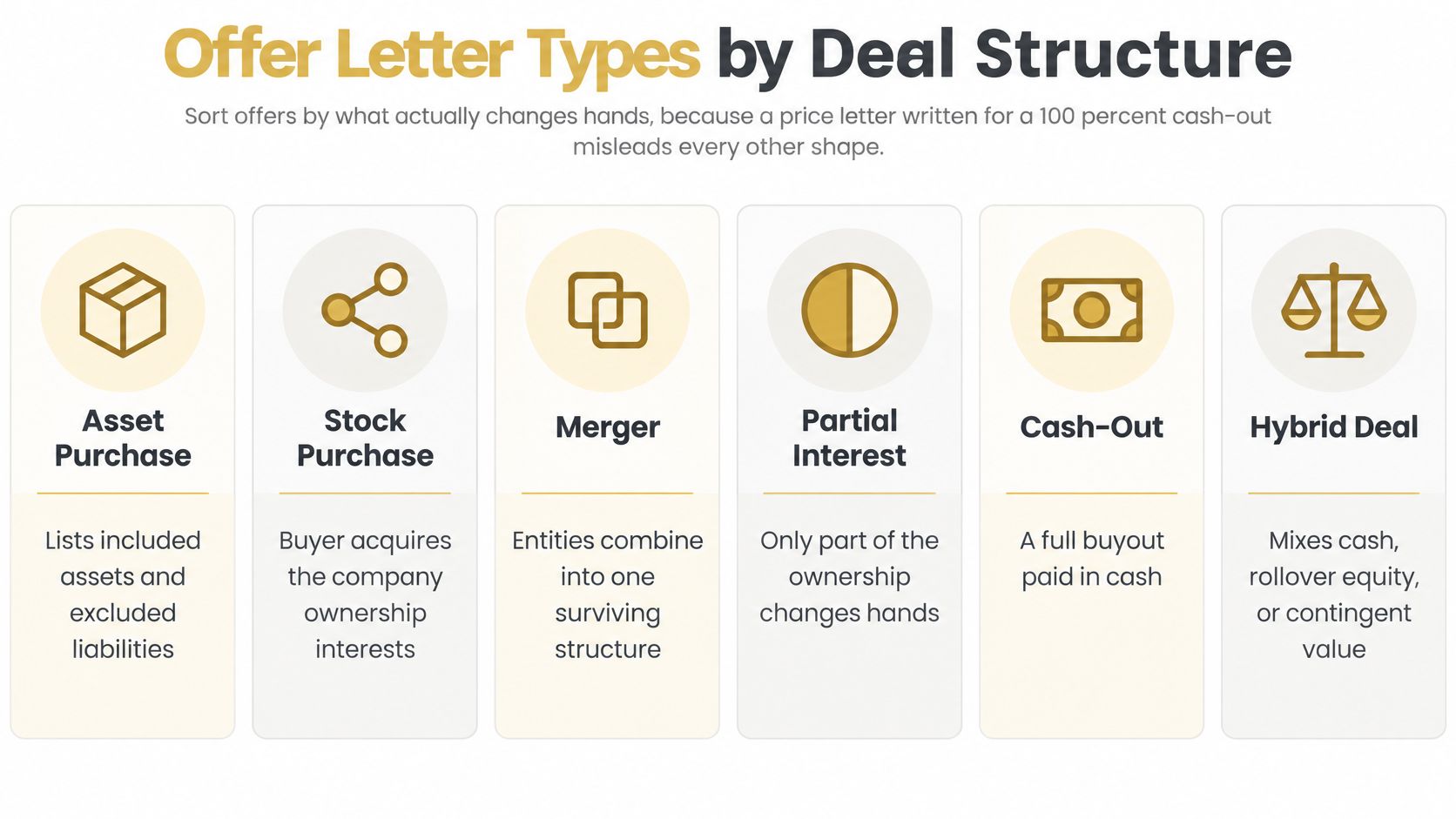
What the offer letter must add by deal shape
| Structure | What transfers | Liability result | Extra letter language |
|---|---|---|---|
| Asset purchase | Selected assets and contracts | Seller generally retains excluded liabilities, subject to legal exceptions | Included-asset list and excluded liabilities |
| Stock purchase | Company equity | Liabilities remain inside the company | Share class and owner consents |
| Merger | Combination into buyer or a new company | Surviving entity holds the combined business and associated obligations | Name the surviving entity |
| Equity partnership | Partial stake; seller remains | Existing company obligations remain; investor exposure follows structure and guarantees | Ownership split, vetoes, board seats, capital calls |
| Staged buy or option | Initial stake plus a later purchase | Allocate obligations at each acquisition stage | Formula for pricing the later slice |
| Carve-out or division | A unit, not the whole company | Allocate unit liabilities and retained shared-service obligations | Employees, intellectual property, brand, leases, transition services |
| Bolt-on | Add-on to a business the buyer already owns | Legal liability follows transaction form; buyer manages integration | What remains separate during initial integration |
Add the missing perimeter language
For an asset purchase, distinguish ownership from use. A seller may use software, equipment, or a trading name without owning transferable rights. The letter should identify critical permissions requiring confirmation, not assume everything used by the business can be delivered.
For a stock purchase, identify the equity being acquired and who can transfer it. The comparison of asset purchases versus stock purchases can help buyers frame that choice before proposing terms. Don't treat an asset transaction as a guarantee against every historical liability.
A merger needs the surviving entity identified. A partnership needs proposed decision rights, not just an ownership split. Address who appoints directors, approves borrowing, authorizes distributions, and funds a cash shortfall. For a staged acquisition, determine whether later value reflects the original business, buyer-funded improvements, or both.
A carve-out requires a dependency list: payroll, accounting, customer support, technology, premises, and branding. If the seller will provide temporary support, identify the service, pricing approach, responsible person, and exit plan.
Bolt-on describes an acquisition strategy, not a separate legal transfer mechanism. Its letter still needs an asset, equity, or merger structure underneath it. Specify which operations the buyer will integrate immediately and which must remain separate until systems and customer obligations are understood.
Risk Terms That Survive Until Closing
A price negotiated before verification can become unsuitable long before closing. The buyer needs access and an exit route during the investigation, then an appropriate allocation of identified risks in the definitive documents.
IBBA/M&A Source findings summarized by Conclave Partners put average LOI-to-close diligence at 5.5 months for businesses valued at $5 million to $50 million. That segment isn't a timetable for every small acquisition, but it illustrates why an offer must accommodate a prolonged investigation.
Risk tools between the offer letter and closing
| Mechanism | Risk it moves | Use it when | Watch-out |
|---|---|---|---|
| Seller note | Seller retains credit risk after closing | Less cash is available at closing and verified earnings support repayment | Senior lender may restrict the note or its payments |
| Escrow or holdback | Reserves purchase proceeds against named claims | A defined indemnity exposure needs security | Broad or unclear claims can stall release |
| Earnout | Makes part of the price contingent on post-close results | Parties disagree about supportable future performance | Metric, operating control, and audit rights must be explicit |
| Working-capital true-up | Adjusts for delivered operating balances, not hidden debt | A consistent benchmark reflects normal operations | Define the collar and prevent double counting |
| Termination right | Allows negotiations or commitments to end before closing | Diligence, financing, or consents may fail | Distinguish freedom not to sign from rights under a signed purchase agreement |
| Material adverse change | Allocates defined deterioration risk | Losing a key customer or another specified event could undermine the deal | Define triggers, exceptions, and consequences |
Match the mechanism to the actual uncertainty
An escrow doesn't establish whether earnings are real. A seller note doesn't automatically permit the buyer to deduct a claim from repayments. An earnout doesn't replace access to historical records.
Say a service company's owner presents disputed expense add-backs as recurring profit. First require invoices, payroll records, and a reconciliation to the accounts. If the adjustments remain unsupported, reduce the valuation or decline the transaction rather than assuming deferred payment makes the earnings dependable.
For a hypothetical negotiable issue with bounded exposure, I'd consider less cash at closing, a claim-specific escrow, and a modest seller note before a large earnout. Have the lender assess the entire structure before you promise it. If a note is intended to secure seller claims, counsel must address offset rights, priority, and any lender restrictions explicitly.
Earnouts work better when the disagreement concerns uncertain future performance. Define the metric, accounting policies, reporting access, permitted operating decisions, and dispute process. Revenue alone may encourage low-margin sales; profit may depend on costs the buyer controls.
A deferred payment is protection only when its legal terms address the risk you actually identified.
The verification request should cover customer concentration, debt and liens, employee obligations, lease assignments, insurance, and required seller disclosures, with supporting records and named response owners. A structured review of hidden liabilities in acquisitions helps connect those requests to concrete exposures.
Don't ask merely for access to “all relevant information.” Identify the contracts, schedules, records, and controlled interviews needed to test the seller's account. A credible verification process can justify a firmer offer more effectively than an unsupported increase in price.
Negotiation Moves Before the Outline Is Agreed
Make the counteroffer explainable before making it larger. A seller can challenge a bare price indefinitely; a formula-backed proposal gives both sides something specific to test.
For a hypothetical negotiation, assume a buyer proposes a headline price of $1,200,000, including $900,000 cash at closing. The buyer should tie the headline to an agreed earnings definition and negotiated multiple, then show the deferred components separately. Don't describe the entire amount as cash proceeds.
Trade structure before increasing value
If that hypothetical seller asks for $1,300,000 all cash, find out whether the objection concerns total value, immediate liquidity, or uncertainty about collecting later payments. Those are different negotiations.
The buyer might retain the original headline and propose $180,000 as a seller note over 36 months and $120,000 in escrow for 12 months. Those illustrative terms preserve the proposed closing cash while allocating some collection and claims risk to the seller. They aren't economically equivalent to an all-cash payment.
Use a simple payment schedule showing cash at closing, conditional releases, and scheduled repayments. Explain interest, security, and release conditions before debating whether the headline feels fair.
- Trade lower-cost process items first. Adjust meeting availability, reporting formats, and the working-capital measurement calendar when doing so doesn't compromise verification.
- Price expense concessions. Offering to share a defined cost can help, but an uncapped reimbursement obligation isn't a minor courtesy.
- Protect financing realism. Don't remove a financing condition merely because a seller interprets it as hesitation. Explain what approval remains outstanding.
Decide what you won't trade
Before the next call, write down the maximum closing cash the business and your funding can support. Separately identify findings that end negotiations, such as unverifiable earnings or a critical contract that cannot transfer.
Negotiating discipline: Offer a concession in exchange for a resolved issue, not simply to keep the conversation moving.
Respond to seller markups with a short issue list and a controlled redline. Keep agreed confidentiality and expense language intact unless a proposed change requires reconsideration. Don't circulate a fresh clean draft that reopens settled points.
Ask what additional evidence would support the seller's requested value. If the seller rejects deferred consideration but accepts a higher headline, immediate payment may be the main concern. If the seller accepts structure only after total value rises, price remains unresolved. Test the explanation rather than assuming either response proves motivation.
Annotated Sample Offer Letter in Order
The following hypothetical asset-purchase outline illustrates document order, not a ready-to-sign legal form. All amounts and periods are illustrative negotiating choices. Its overarching rule is that only expressly identified process provisions bind; neither party must consummate the acquisition without executed definitive agreements.
An SEC-filed acquisition LOI illustrates the distinction between preliminary transaction terms and conditions involving diligence and definitive documentation. Counsel should review your version because definite terms and withdrawal restrictions can create obligations despite a non-binding label.

Worked asset-deal outline
Parties and target. Riverdale Acquisition LLC proposes acquiring the operating assets of Maple Grove Services LLC, a hypothetical local services business.
Annotation: Match the Parties and target row to the legal owners, not merely the trading name.Structure, non-binding. The proposed asset acquisition includes agreed inventory, equipment, assignable customer contracts, and identified intellectual property; cash and pre-close debt are excluded. Assumed liabilities require a separate agreed schedule.
Annotation: Use the Transaction structure row to prevent an undefined transfer perimeter.Price and consideration, non-binding. Proposed consideration totals $1,200,000, comprising $900,000 cash at closing, a $180,000 seller note over 36 months, and $120,000 deposited into escrow for 12 months against specifically scheduled claims.
Annotation: Match Form of consideration to the seller-note and escrow tools, including interest and release terms still requiring agreement.Working capital, non-binding. The proposed peg uses an agreed trailing average, consistent account definitions, and a negotiated collar. Attach a calculation before signing definitive documents.
Annotation: Complete the Price adjustments row with an actual method, not an unexplained benchmark.Diligence access, binding only as to process. The seller provides 21 days of agreed access to financial records, leases, and controlled customer and employee discussions; contact requires seller coordination.
Annotation: Apply the Diligence access row without authorizing disruptive direct approaches.Exclusivity, binding. The seller agrees to a 45-day no-shop beginning on acceptance, with prohibited solicitation and negotiation activities expressly described.
Annotation: Complete the Exclusivity row with a calculable endpoint and agreed exceptions.Conditions, non-binding. Any acquisition remains subject to satisfactory diligence, financing, landlord consent, corporate approvals, definitive agreements, and absence of defined material adverse changes.
Annotation: Connect Closing conditions to the termination and deterioration risks requiring protection.Expiration and targets. The offer lapses 10 business days after delivery unless accepted. Target definitive signing is 20 days after acceptance, with closing targeted 30 days afterward; both targets remain non-binding.
Annotation: Separate the Expiration and timetable row's lapse mechanism from aspirations.Expenses, confidentiality, and governing law, binding. Each party bears its own transaction costs. The identified confidentiality agreement survives failed negotiations; counsel inserts the agreed governing law and forum.
Annotation: Complete the binding rows with actual documents and jurisdictions.Acknowledgment and signatures. Authorized buyer and seller representatives acknowledge the expressly binding provisions and non-binding status of the remaining proposal, signing with names, titles, and dates.
Annotation: Signature authority and the binding-status acknowledgment must align.
Stock-deal edit
Replace the asset perimeter with the identified shares or ownership interests, their holders, and required delivery documents. Remove asset-assignment assumptions, then revise debt, cash, liability, and consent treatment to fit the equity transaction. Changing the heading alone won't convert this outline into a stock offer.
How Offer Terms Link to Later Documents
Treat each agreed commercial point as an instruction for the definitive drafting team. The useful question isn't whether the later agreement repeats the LOI's wording. It's whether the operative clauses and schedules produce the result both sides intended.
Build a navigation index beside the draft. Your accountant should be able to locate the calculation rules, and your lender should be able to locate the payment and financing provisions without searching through recitals.
Open the operative section, not the summary
| If the letter addresses | Open this next | Check before approval |
|---|---|---|
| Purchase price and payment mix | Purchase-price and payment provisions | Closing payment, deferred amounts, and funding mechanics reconcile |
| Working-capital benchmark | Adjustment schedule and sample calculation | Account definitions and accounting policies match |
| Seller financing | Promissory note, security documents, and intercreditor terms | Payment restrictions and remedies are workable |
| Escrow | Escrow agreement and indemnification provisions | Claim procedure, release rules, and protected obligations align |
| Earnout | Contingent-consideration schedule | Metric, operating covenants, reporting, and dispute rights fit together |
| Required consents | Closing conditions and deliverables | Each necessary approval has an identified owner |
| Employees, branding, and shared services | Transfer and transition schedules | Responsibilities, costs, and end dates are operationally usable |
A purchase-price clause can look correct while the funds-flow schedule pays a different amount. Compare both against the treatment of debt repayment, transaction expenses, escrow funding, and any retained cash. Require a reconciliation rather than accepting “the lawyers will sort it out at closing.”
For working capital, request a sample calculation using actual accounts. An attachment marked “to be agreed” leaves a material commercial issue open, even when the main agreement appears almost finished.
Resolve document conflicts deliberately
Earnout definitions need particular discipline. If financial review measured gross profit after direct labor, don't accept a later schedule that measures an undefined profit figure. Specify how shared overhead, refunds, related-party charges, and accounting changes affect the calculation.
Required approvals should become named deliverables: landlord assignment consent, franchisor approval, or licensor permission, as applicable. For a carve-out, shared employees and systems belong in detailed transition schedules with service owners, not a recital promising cooperation.
Use guidance on negotiating business sale agreement terms to organize unresolved points before treating counsel's draft as execution-ready.
Exclusivity should end under its agreed mechanism, not become an accidental permanent restriction. Confidentiality needs a clear relationship with the definitive covenant, including what survives if negotiations fail.
Finally, ask counsel to address document priority. The definitive agreement should specify what it supersedes and whether any separate obligations survive. If its economics contradict the accepted outline, resolve that discrepancy expressly before signature rather than relying on the earlier letter to repair it.
How to Submit and Track the Offer
Submission is a version-control and deadline-management exercise. The seller should receive one approved proposal through the agreed channel, and your team should know which document is current.
Use a shared spreadsheet for milestones and a controlled folder for drafts, signed copies, and delivery records. Email alone is a poor transaction register because commercial decisions become scattered across attachments and forwarded conversations.
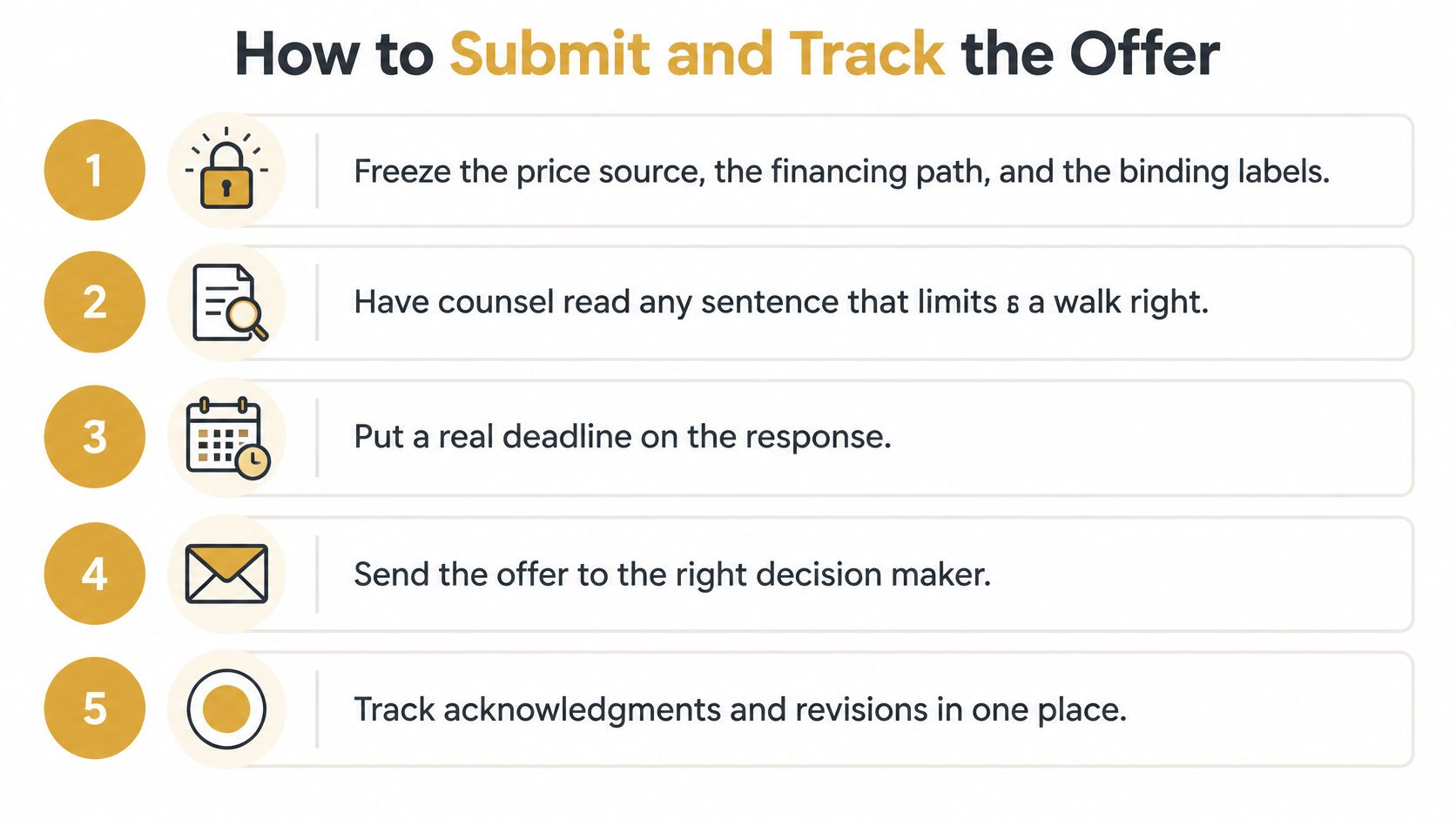
Submission and tracking procedure
Freeze the commercial basis. Save the financial information supporting the price, the financing assumptions, and the approved payment mix. Date the valuation worksheet so later changes can be traced to new facts.
Complete legal review. Have counsel review withdrawal restrictions and the list of binding provisions. Resolve comments before producing the signature copy, not after the seller has accepted it.
Make the response deadline unmistakable. Put the actual expiration date, time, and relevant time zone on the first page. Specify how acceptance must be delivered and distinguish acknowledgment of receipt from acceptance.
Use the agreed delivery channel. Send the approved letter to the seller's authorized decision-maker and counsel. Copy the broker when that's the agreed arrangement, rather than bypassing established communications.
Create the transaction register. Record delivery, acknowledgment, acceptance status, exclusivity commencement, diligence requests, responsible people, and target closing. Store the transmitted PDF and any accompanying message together.
Calendar every operative deadline. Add reminders for expiration, exclusivity expiry, information delivery, and financing milestones. Record how each period is calculated, including whether it starts on signature, receipt, or another event.
Control returned revisions. Compare the seller's version against the transmitted copy using Word's Compare function or another document-comparison tool. Maintain a short open-issues list and obtain approval for each commercial change.
Record the outcome. On acceptance, save the executed version and open the definitive-document workstream. If the offer expires, record that result; if negotiations end, have counsel confirm any required notice and the continuing confidentiality obligations.
Handle exceptions without losing control
If the seller asks for more time, document the extension before relying on it. Specify whether only the acceptance deadline changes or whether other milestones move too. Don't assume a casual email extends every obligation.
When talks stop, follow the governing confidentiality terms for returning or deleting files, including permitted archival retention. Don't erase records your legal or regulatory obligations require you to preserve.
Send this week if the price basis, acquisition perimeter, and financing path are real. Otherwise, hold the proposal and complete the missing work. A placeholder offer creates negotiating expectations without giving either party a dependable route to closing.
Dealmaker Wealth Society offers acquisition training, playbooks, templates, and live coaching for buyers working through offer terms, seller financing, and exclusivity. Visit Dealmaker Wealth Society to explore those resources and bring your active proposal for practical feedback before your lawyer finalizes the letter for submission.

From the Dealmaker Blog












A Creative Business Buying Fable