Mergers and Acquisitions Contracts Explained
Mergers and Acquisitions Contracts Explained
You've signed a letter of intent to buy a service business for $3 million. The seller is enthusiastic, your lender has the financial package, and then a 60-page purchase agreement lands in your inbox. It's full of defined terms, schedules, conditions, indemnities, and cross-references that seem designed to make a straightforward acquisition feel anything but straightforward.
That reaction is normal. Mergers and acquisitions contracts aren't paperwork that follows the deal. They are the deal's risk-allocation system. They decide who pays when revenue falls, a customer brings a claim, a key employee leaves, a tax issue surfaces, or the former owner stops cooperating after closing. The headline price matters, but the contract determines how much of that price you receive in economic value.
Table of Contents
- How M&A Contracts Really Work for Small Deals
- The Four Core Contract Categories in Any Deal
- Reading a Letter of Intent Without Getting Burned
- Anatomy of a Purchase Agreement
- Stock Purchase Versus Asset Purchase in the Contract
- Indemnification, Baskets, Caps, and Survival Periods
- Escrow, Holdback, and Earnout Mechanics
- Non-Competes and Transition Services Agreements
- Closing Conditions and Material Adverse Effect
- Matching the Contract Toolkit to the Deal Lifecycle
- Quick-Reference Checklist and Glossary of Contract Terms
How M&A Contracts Really Work for Small Deals
A first-time buyer often treats the letter of intent as the finish line for negotiation. In practice, it's the point where the negotiation becomes more precise. The LOI establishes the commercial direction, the purchase agreement converts that direction into enforceable promises, and the ancillary documents make the promises workable after ownership changes.
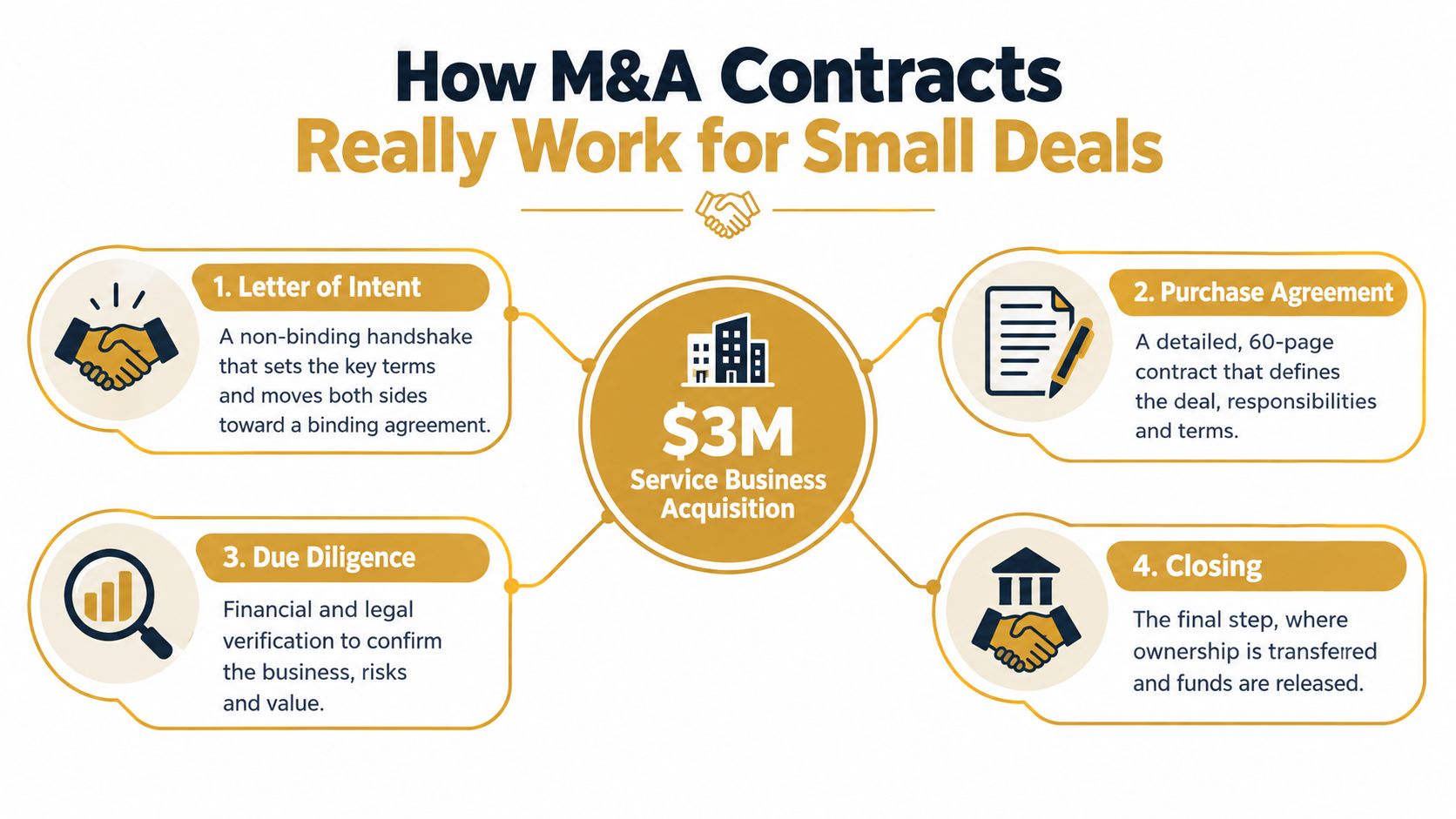
The contract stack usually develops in this order:
- Letter of intent: Sets price, structure, exclusivity, diligence expectations, and the proposed timetable. Most business terms are non-binding, but confidentiality, access, exclusivity, expenses, and governing law may be binding.
- Purchase agreement: Defines exactly what transfers, what the seller represents, what the buyer must do, which conditions must be satisfied, and what happens after a breach.
- Ancillary documents: Cover seller employment or consulting, non-compete obligations, transition services, leases, customer consents, financing, and other matters that the main agreement can't handle alone.
- Post-closing instruments: Include escrow arrangements, seller notes, earnout schedules, releases, and certificates that control the final exchange of money and continuing obligations.
Practical rule: If a protection matters after closing, don't assume the purchase agreement will supply it by implication. Put it in the document that governs the relevant conduct.
The order matters because each document affects risk in the next. A vague LOI can force a buyer to negotiate price mechanics from scratch after spending heavily on diligence. A strong purchase agreement can still fail if a transition agreement lets the seller walk away immediately or an escrow agreement gives the release agent no clear dispute process. Buyers exploring alternatives to starting from scratch, including opportunities to find qualified franchisees, should apply the same discipline. The business model may be standardized, but the contracts still allocate operational and legal risk.
The Four Core Contract Categories in Any Deal
Most small acquisitions use four connected contract categories. They aren't interchangeable, and each one becomes important at a different point.
First is the letter of intent. It records the commercial bargain before the parties incur the full cost of drafting and diligence. The document may be short, but its treatment of price, assumed debt, working capital, seller financing, exclusivity, and access can shape every later draft.
Second is the definitive purchase agreement. This is the controlling document for the transfer. It identifies the equity or assets being sold, sets representations and warranties, establishes covenants between signing and closing, and provides remedies if the parties' promises prove inaccurate.
Third are the ancillary agreements. A seller's consulting agreement, non-compete, lease assignment, intellectual-property transfer, or transition services agreement may determine whether the buyer can operate the acquired business on day one. These agreements should be reviewed beside the purchase agreement, not after it.
Fourth are the post-closing instruments. An escrow agreement controls funds held for claims. A seller note controls repayment. An earnout schedule controls contingent consideration. A release may limit future claims, while a closing certificate confirms that specified conditions were satisfied.
The documents should use consistent definitions. If “indebtedness” excludes an item in the purchase agreement but includes it in the seller note, the discrepancy can create an avoidable dispute. Cross-check every schedule, certificate, and ancillary agreement against the definitive agreement before signing.
Reading a Letter of Intent Without Getting Burned
An LOI becomes dangerous when a buyer reads only the proposed price and skips the binding provisions. The opening sentence often says the document is non-binding, but that description usually has exceptions. Confidentiality, exclusivity, access rights, expense allocation, dispute resolution, and governing law can survive as enforceable promises.

The clauses that deserve attention
Start with the purchase-price mechanics, not just the number. Ask whether the price is cash-free and debt-free, whether a working-capital target applies, whether the seller will finance part of the purchase, and whether an earnout is included. “Purchase price of $3 million” can describe very different economic outcomes depending on those mechanics.
Exclusivity also deserves precise drafting. A workable clause should identify the restricted conduct, the covered transaction, the duration, and the seller's obligation to stop discussions with other buyers. For example:
Exclusivity sample: “For the exclusivity period, the seller and its representatives won't solicit, encourage, negotiate, or provide non-public information in connection with any competing proposal involving the sale of the business or its material assets.”
The diligence provision should identify access to financial records, contracts, employees, intellectual property, litigation files, tax information, and operational data. It should also say what happens if the seller delays access. A buyer shouldn't be trapped by an open-ended diligence period that consumes time without producing usable information.
A practical LOI explanation for acquisition buyers can help you recognize common terminology, but your own LOI still needs deal-specific review.
Three red flags
- Open-ended diligence: The buyer gets access “as reasonably requested,” but no timetable or delivery standard applies.
- Vague price mechanics: The LOI states a price without defining debt, cash, transaction expenses, or working capital.
- Automatic exclusivity extensions: The seller can extend exclusivity whenever diligence or documentation takes longer, without a matching obligation to provide information or negotiate in good faith.
The binding-versus-non-binding paragraph should be read clause by clause. If the seller expects the buyer to commit resources, the buyer should know exactly which commitments are enforceable before signing.
Anatomy of a Purchase Agreement
The definitive purchase agreement should be read as a system, not as a long sequence of legal paragraphs. Its definitions control the meaning of later provisions, its schedules supply the factual detail, and its remedies determine whether a negotiated protection has practical value.
Definitions and schedules
Definitions often decide disputes before the parties reach the indemnity section. Review terms such as “Company Material Contract,” “Indebtedness,” “Transaction Expenses,” “Losses,” and “Material Adverse Effect.” Then compare those definitions with the disclosure schedules.
The disclosure schedule is where the seller identifies exceptions to representations. A representation that says there is no litigation means something very different when the schedule lists a customer claim, an employment complaint, and a threatened regulatory inquiry. Buyers should require enough detail to understand the issue, not accept a vague reference to a data room folder.
Promises before and after closing
Representations and warranties describe the business as of signing or closing. They usually address financial statements, taxes, contracts, employees, intellectual property, permits, litigation, privacy, and compliance. Covenants govern conduct between signing and closing, such as maintaining the business in the ordinary course, preserving relationships, obtaining consents, and avoiding unusual payments.
Conditions precedent answer a different question: what must be true before a party has to close? Typical conditions include accurate bring-down representations, required approvals, third-party consents, delivery of closing certificates, and absence of a specified blocking event.
Remedies complete the design
A buyer-friendly representation is weak if the remedies section makes recovery impractical. Review the basket, cap, survival period, exclusive-remedy language, fraud carve-out, specific-performance rights, and treatment of insurance. The business purchase agreement negotiation guide is useful background, but the schedules and remedy limitations are where a deal's practical protection usually lives.
Pay special attention to three schedules:
- Disclosure schedule: What exceptions has the seller disclosed?
- Working-capital schedule: What accounting principles produce the target amount?
- Excluded-liabilities schedule: Which obligations remain with the seller rather than transferring to the buyer?
A purchase agreement is only as clear as these schedules. If the contract says the buyer assumes “ordinary-course liabilities” but never defines the phrase, the parties may be negotiating the actual deal after closing.
Stock Purchase Versus Asset Purchase in the Contract
The legal structure changes the drafting burden. In a stock purchase, the buyer acquires the entity and generally inherits its contracts, assets, employees, permits, and liabilities, subject to the agreement and applicable law. In an asset purchase, the buyer selects the assets and liabilities that transfer, but each transfer may require assignment language, consent, or a separate instrument.
| Clause Area | Stock Purchase | Asset Purchase |
|---|---|---|
| Transferred property | Equity interests in the target entity | Listed assets, contracts, goodwill, and intellectual property |
| Liabilities | The entity remains responsible for its liabilities, with seller indemnity for specified risks | Assumed liabilities must be identified, while excluded liabilities remain with the seller |
| Contracts | Existing contracts generally remain with the entity, subject to change-of-control provisions | Assignments and third-party consents may be required |
| Employees | Employment usually continues through the same entity | Offers, transfers, payroll changes, and benefit treatment need express handling |
| Tax allocation | Focuses on equity ownership and entity-level tax matters | Requires allocation of consideration among transferred assets and treatment of assumed liabilities |
| Indemnity focus | Historical entity liabilities, ownership, authority, and compliance | Asset condition, assumed liabilities, excluded liabilities, and transfer mechanics |
Small-business buyers often prefer an asset structure because it can limit the liabilities they agree to assume. Sellers may resist because an asset sale can create more transfer work and may produce less favorable tax treatment. Professional-services businesses, regulated companies, and software businesses may push toward an equity transaction when licenses, customer contracts, or intellectual property are difficult to move.
If the structure changes during negotiation, don't just replace “shares” with “assets.” Rework the representations, tax covenants, employee provisions, consent conditions, excluded-liability schedule, and closing deliverables. A basic primer on allotment versus share transfer is useful for understanding why issuing new equity and transferring existing equity create different legal mechanics, although an acquisition agreement requires a broader analysis.
Indemnification, Baskets, Caps, and Survival Periods
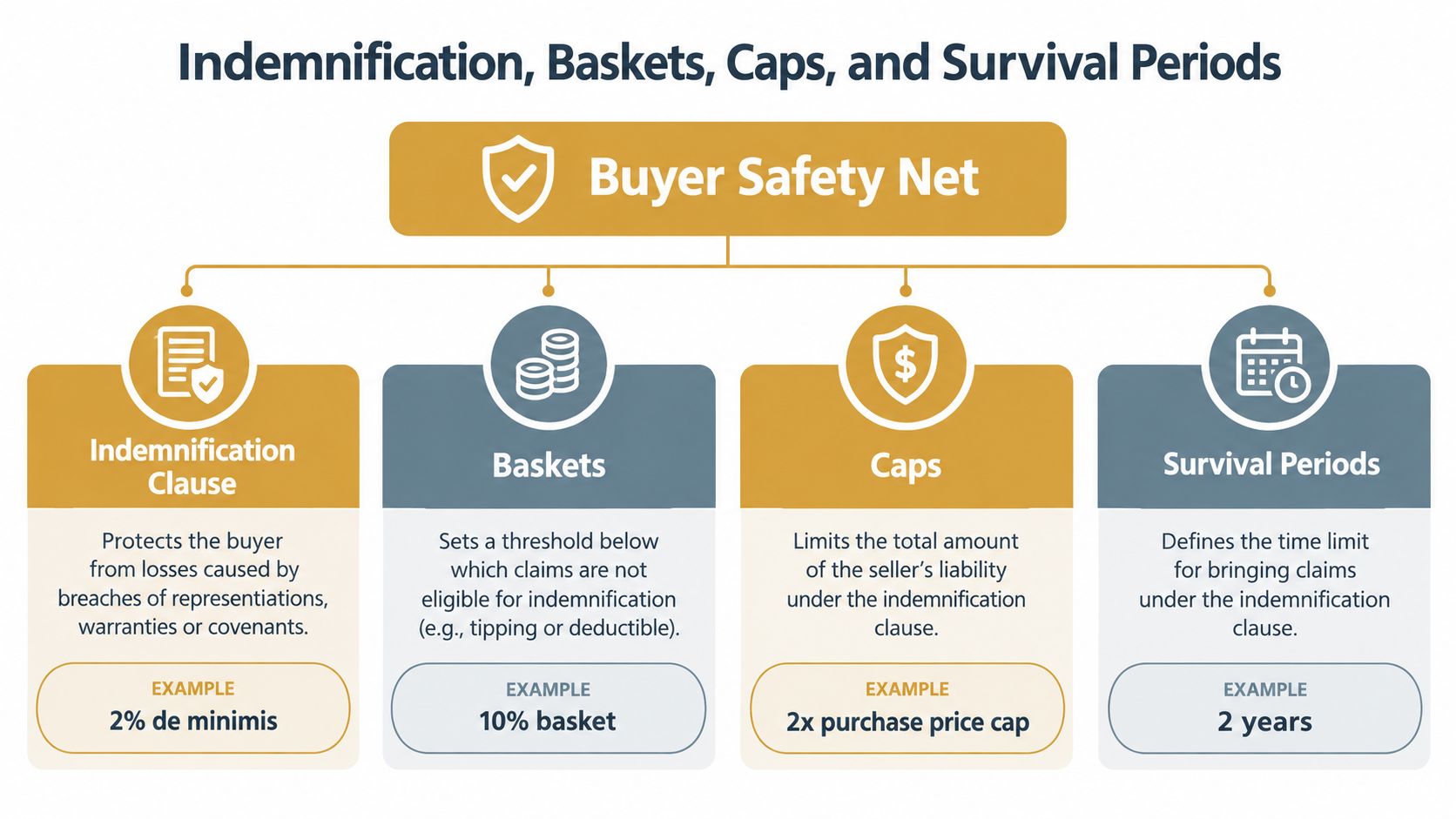
Indemnification is the buyer's post-closing recovery system. It should answer five practical questions: What conduct creates liability? How much must the buyer absorb first? What is the seller's maximum exposure? How long does the buyer have to claim? Which recovery sources are available?
Testing the safety net
A de minimis threshold excludes small individual claims. A basket sets an aggregate threshold before recovery begins. With a tipping basket, reaching the threshold can expose the seller to the full amount of covered losses, subject to the cap. With a deductible basket, the seller pays only losses above the threshold.
The cap limits total liability. General representations may have a lower cap and shorter survival period, while fundamental representations concerning authority, ownership, title, taxes, or capitalization often receive stronger treatment. Fraud is commonly carved out of negotiated limitations, but the wording matters.
A buyer should model the clause with examples before accepting it. Ask what happens if there are several small claims, one large claim, a tax assessment, and an undisclosed customer dispute. Then test whether the escrow is the only practical recovery source or whether the seller remains creditworthy after receiving the purchase price.
How insurance changes the negotiation
Representations-and-warranties insurance can shift the indemnity architecture. The 2025 ABA Private Target M&A Deal Points Study reported references to RWI in 63% of surveyed private-target deals, up from 55% in the prior study, and reported that no-survival structures rose from 30% to 41%. These figures are reported in the ABA study.
Insurance doesn't eliminate diligence or contractual risk. The policy may exclude cyber incidents, tax exposures, environmental matters, employee classification, customer concentration, or AI-generated content. Compare the policy with every representation, definition, exclusion, retention, claims deadline, and insurer-consent requirement. The purchase agreement should identify the seller's uninsured indemnities and allocate known risks explicitly.
Escrow, Holdback, and Earnout Mechanics
These tools solve different problems. Escrow secures claims. A holdback delays payment for an identified risk or event. An earnout pays for future performance. Treating them as interchangeable creates confusion over both control and timing.
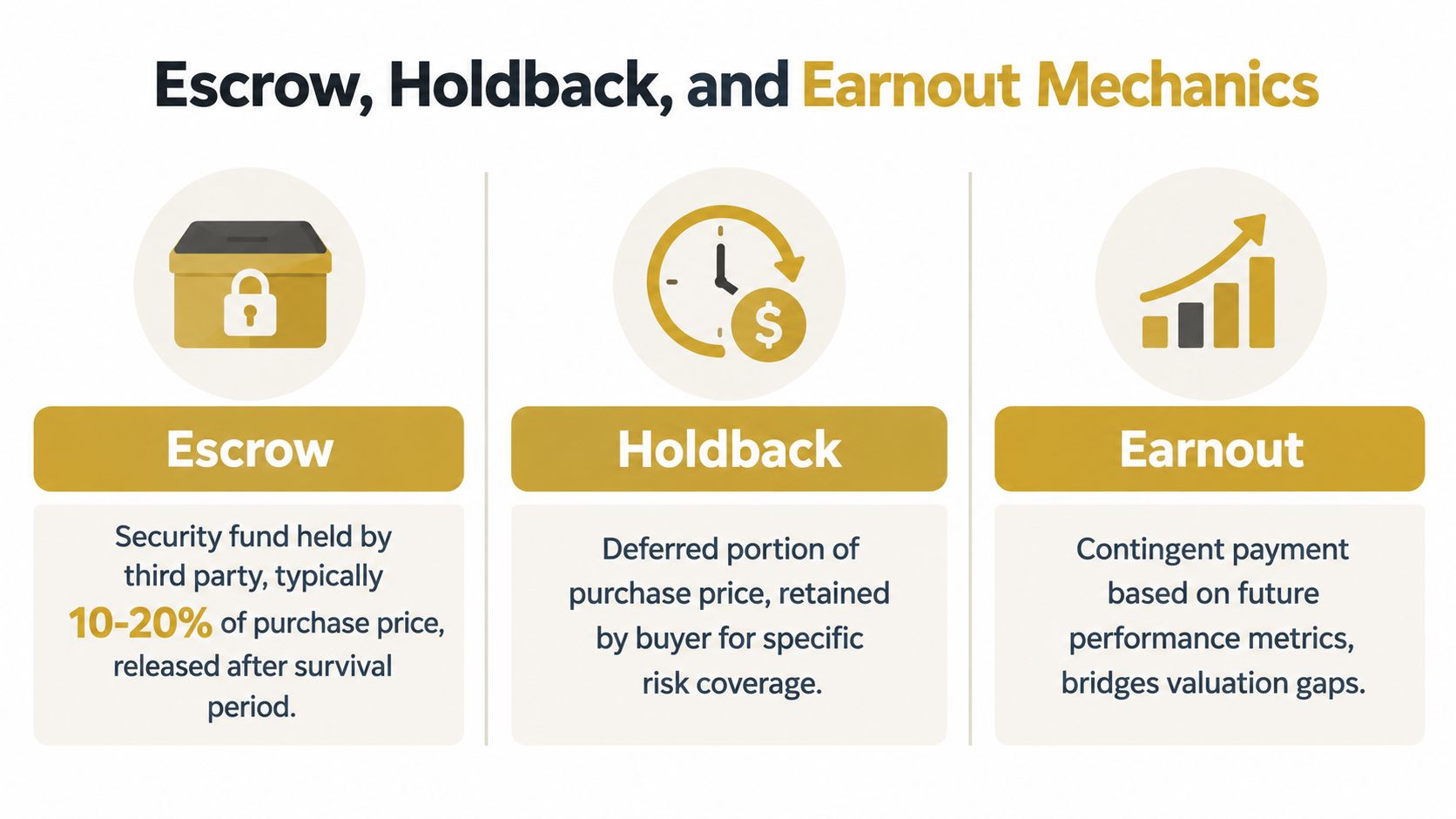
An escrow agreement should name the escrow agent, identify the covered claims, state the release date, explain how a claim is noticed, and tell the agent what to do if the buyer and seller disagree. A workable provision might read:
“The escrow agent shall release the undisputed portion of the escrowed funds upon the scheduled release date. Funds subject to a timely, specific claim shall remain in escrow until the parties deliver joint written instructions or a final, non-appealable determination resolves the claim.”
A holdback should identify a defined trigger rather than give the buyer a general right to delay payment. For example, the agreement might retain an amount until a specified license transfer, customer consent, tax filing, or remediation obligation is completed. The buyer should not be able to convert a targeted holdback into an indefinite price reduction.
Earnouts demand the most operational detail. The clause should define:
- Metric: Revenue, EBITDA, cash collections, customer retention, or another objective measure.
- Measurement period: The start date, end date, and reporting schedule.
- Accounting rules: Consistent policies, permitted adjustments, treatment of unusual expenses, and allocation of shared costs.
- Operating covenants: Budgeting, staffing, pricing, acquisitions, integration, and access to records.
- Verification: Reporting rights, audit access, notice deadlines, and an independent-expert process.
- Payment rules: Timing, set-off rights, buyout rights, and treatment of customer returns or cancellations.
The 2023 ABA Private Target M&A Deal Points Study analyzed more than 100 middle-market transactions executed in 2022 or the first quarter of 2023 and reported that 59% of transactions where closing payment relied on the target's estimated purchase-price adjustment included seller review and consultation rights, as reported in Bass, Berry & Sims' summary. That principle applies to earnouts too. Sellers need visibility into calculations, while buyers need control over legitimate operating decisions.
Earnouts appeared in fewer than one-quarter of private acquisition agreements during the earlier study period discussed by Reuters Practical Law, which supports treating them as negotiated exceptions rather than default consideration. The earnout drafting discussion also highlights reporting, adjustments, dispute procedures, and operating obligations. For more on the commercial trade-offs, see this guide to earnouts in business transactions.
Non-Competes and Transition Services Agreements
Buyers often spend more time negotiating the purchase price than the seller's post-closing cooperation. That can be a mistake. A customer introduction, pricing handoff, vendor explanation, or employee conversation may protect more value in the first weeks after closing than a heavily negotiated general representation.
Drafting the non-compete
A non-compete should define the restricted activity, territory, duration, and covered parties. It should also address the sale of a competing investment, solicitation of customers and employees, use of confidential information, and permitted passive investments. Broad language such as “any business that competes with the company” invites challenge because it may cover activities unrelated to the acquired operation.
Enforceability depends on applicable law and facts, so the agreement should be reviewed in the relevant jurisdiction. Buyers should also separate the non-compete from confidentiality and non-solicitation obligations. If one provision fails, the others may still matter.
Making transition services usable
A transition services agreement needs more than “seller will assist as requested.” Specify the services, expected availability, response times, location, compensation, expenses, confidentiality, access to systems, and termination rights. Include a process for adding or removing tasks as the buyer becomes self-sufficient.
A transition agreement should describe work the seller can actually perform, not cooperation in the abstract.
A seller may resist an indefinite commitment, unrestricted availability, or compensation tied to vague milestones. A buyer may regret accepting an arrangement with no obligation to introduce customers or transfer operational knowledge. The practical middle ground is a defined service period, a clear hourly or fixed compensation structure, and a short escalation process for missed deliverables.
Closing Conditions and Material Adverse Effect
Signing and closing are separate events when the deal requires financing, regulatory clearance, third-party consents, or a period for the buyer to complete final conditions. The purchase agreement should state exactly what must happen before either party has to complete the transaction.
Common conditions include:
- Regulatory approvals: Required government or industry clearances.
- Third-party consents: Assignments, landlord approvals, lender releases, or customer permissions.
- Accurate representations: Representations remain accurate, subject to negotiated materiality standards.
- Covenant compliance: Each party has performed the obligations due before closing.
- Closing deliveries: Certificates, payoff letters, resignation documents, assignments, and funds-flow instructions are complete.
The Material Adverse Effect, or MAE, condition addresses deterioration between signing and closing. Buyers want coverage for a serious decline in the target's business, financial condition, operations, or prospects. Sellers seek narrow language because a broad MAE can let a buyer walk away based on ordinary volatility or industry-wide conditions.
A buyer-friendly formulation might cover any event that has had, or would reasonably be expected to have, a material adverse effect on the target's business, excluding only general market conditions that don't disproportionately affect the target. A seller-friendly version may exclude broad economic, industry, financing, political, regulatory, pandemic, and force-majeure events, while limiting the buyer's remedy to circumstances affecting the target disproportionately.
Avoid phrases that leave the standard entirely subjective, such as “buyer is dissatisfied with the business.” Also avoid a condition that allows the buyer to refuse closing for any decline, however temporary or ordinary. The agreement should connect the MAE to defined business impacts and specify which exclusions apply.
Public merger filings commonly define an MAE condition under which a buyer may refuse to close if specified adverse changes occur between signing and completion, as discussed in the WilmerHale M&A report. In a smaller deal, the wording can be shorter, but the allocation decision is the same.
Matching the Contract Toolkit to the Deal Lifecycle
Contracts work best when the buyer uses them at the stage where they gain advantage.
During sourcing, the buyer needs confidentiality terms, an initial information request, and a screening framework that identifies structure, owner dependence, customer concentration, liabilities, and financing needs. The goal isn't to negotiate every clause early. It's to avoid signing an LOI before the major structural risks are visible.
During diligence, the buyer tests the seller's representations against records. Financial statements, tax returns, contracts, employee files, intellectual property, insurance, litigation, and compliance materials should flow into disclosure schedules and specific indemnities. Missing information should produce a drafting response, not merely a note in a diligence folder.
During negotiation, the buyer connects price mechanics with risk allocation. Working capital, debt, transaction expenses, escrow, baskets, caps, survival, seller notes, and earnouts should be modeled together. A concession on one term may require protection elsewhere.
During integration, the buyer relies on transition services, non-compete obligations, customer handoffs, employee arrangements, and post-closing reporting. The strongest purchase agreement won't repair a failed handover if the operating documents are vague.
The handoff between stages is where many small deals lose protection. Every open diligence issue should have a destination: disclosure, covenant, condition, indemnity, escrow, price adjustment, or a deliberate decision to accept the risk.
Quick-Reference Checklist and Glossary of Contract Terms
Before signing, confirm:
- Definitions: Debt, cash, working capital, transaction expenses, losses, and material adverse effect.
- Schedules: Disclosure exceptions, assumed liabilities, excluded liabilities, intellectual property, contracts, and working-capital methodology.
- Indemnity: De minimis threshold, basket type, cap, survival, fundamental claims, fraud, and exclusive remedy.
- Closing: Consents, payoff letters, certificates, funds flow, assignments, and resignations.
- Post-closing: Escrow release, seller note, earnout reporting, transition services, non-compete, and claims process.
Basket: Aggregate threshold before indemnity applies.
Cap: Maximum liability.
Covenant: Promise about future conduct.
De minimis: Minimum size for an individual claim.
Earnout: Contingent payment tied to future performance.
Escrow: Funds held by a third party to secure obligations.
Fundamental representation: Core promise about authority, ownership, title, or similar matters.
Holdback: Purchase price retained for a defined purpose.
Indemnity: Obligation to reimburse covered losses.
MAE: Contract standard for serious adverse deterioration.
RWI: Representations-and-warranties insurance.
Survival: Period during which a claim may be brought.
Tipping basket: Once reached, the threshold may expose the full covered loss.
Working-capital peg: Agreed target used for the post-closing adjustment.
Dealmaker Wealth Society provides acquisition training, coaching, templates, and peer support covering LOIs, diligence, deal structuring, earnouts, escrows, warranties, and post-closing execution. Visit Dealmaker Wealth Society to find practical education and support for reviewing your next acquisition contract before you commit capital.

From the Dealmaker Blog










A Creative Business Buying Fable