Mergers and Acquisitions Valuation: A Practical SMB Guide
Mergers and Acquisitions Valuation: A Practical SMB Guide
You're staring at a seller's CIM, the business looks clean, the numbers seem solid, and the asking price feels close enough to what you had in mind. That's usually the exact moment first-time buyers get into trouble. In mergers and acquisitions valuation, the hardest part isn't finding a number, it's knowing which number deserves your trust before you commit to an LOI.
A local service business can look simple on paper and still be wildly mispriced in practice. One buyer sees a profitable company and assumes the asking price is the value. Another buyer sees the same business and starts asking what happens if customer concentration shifts, working capital spikes, or the owner's “normal” earnings turn out to be anything but normal.
Good valuation doesn't give you a magical price tag. It gives you a defensible range, a way to explain that range, and a language lenders, sellers, and advisors can use for negotiation. It also keeps you from overpaying just because the headline multiple sounds familiar.
Table of Contents
- Why SMB Buyers Get Valuation Wrong Before They Start
- What Mergers and Acquisitions Valuation Delivers
- Intrinsic and Relative Methods for SMB Deals
- Precedent Transactions and LBO Pricing for SMB Buyers
- Using Earnouts to Bridge the Valuation Gap
- Behavioral Biases That Distort SMB Valuation
- Triangulating the Five Methods Into a Defensible Range
- Valuation Checklist and Common First-Time Buyer Questions
Why SMB Buyers Get Valuation Wrong Before They Start
A first-time buyer finds a $3 million service business with steady customers, clean branding, and an owner who says the price reflects “what the market is paying.” That buyer hears confidence and mistakes it for evidence. A week later, the broker says the number is based on EBITDA, the lender wants more detail, and the buyer realizes the asking price was never the same thing as a valuation.
That mistake cascades fast. If you anchor too high, your debt service may become awkward, your equity check gets bigger, and your return math gets thinner. If you anchor too low, you may lose a good business before you've even learned whether the seller's earnings are real, repeatable, and financeable.
Practical rule: the offer stage is where bad valuation becomes expensive. By the time a deal breaks, the issue is often not the business itself, it's the buyer's original framing.
The market's preferred pricing language also matters. In a large academic sample, EBITDA was the most common denominator in valuation multiples, appearing in 32.0% of cases, ahead of earnings at 24.6% and revenue at 22.4% academic sample on M&A multiple denominators. That tells you how the market thinks, but it doesn't mean the first number you see is automatically fair.
For SMB buyers, valuation is less about hunting a single “right” price and more about learning how the price was built. A seller's number may reflect growth hopes, a broker's positioning, or a recent competitive auction. Your job is to strip those layers apart before you decide whether the deal is real.
What Mergers and Acquisitions Valuation Delivers
Valuation is the bridge between what a business earns, what it owns, and what a buyer can pay. In an SMB deal, that bridge matters because the asking price, the lender's advance, and the buyer's return target rarely line up on their own. Enterprise value is the value of the operating business itself, while equity value is what belongs to shareholders after debt, cash, and other claims are counted. For a private-company deal, that difference is often where the first misunderstanding starts.

Price and value are not the same thing
A seller usually talks about price. A buyer should first ask about value. The two can be close, but they are not identical, because the same company can support very different outcomes once debt, taxes, cash on the balance sheet, and post-close risk are folded in.
A small-business buyer who wants a fuller view of the bridge from operating results to transaction value can use how to value your business for growth as a starting point. The useful question is not, “What is the asking price?” The better question is, “What range makes sense once the deal structure, debt, and cash are all adjusted to the same basis?”
Three lenses are better than one
A sound mergers and acquisitions valuation process usually compares intrinsic value, relative value, and precedent transaction value instead of relying on a single polished model triangulation framework for valuation methods triangulation framework for valuation methods. Each lens answers a different question. Intrinsic value asks what the company's future cash flows are worth today. Relative value asks how similar businesses are priced. Precedent transactions ask what buyers have paid in comparable deals.
That matters because a business can look cheap on one method and expensive on another. A clean range gives the buyer room to deal with negotiation pressure, seller optimism, and the common bias that a headline multiple should settle the conversation. It also helps when talking with lenders, because you can show how the company supports the deal from more than one angle, not just one model.
Intrinsic and Relative Methods for SMB Deals
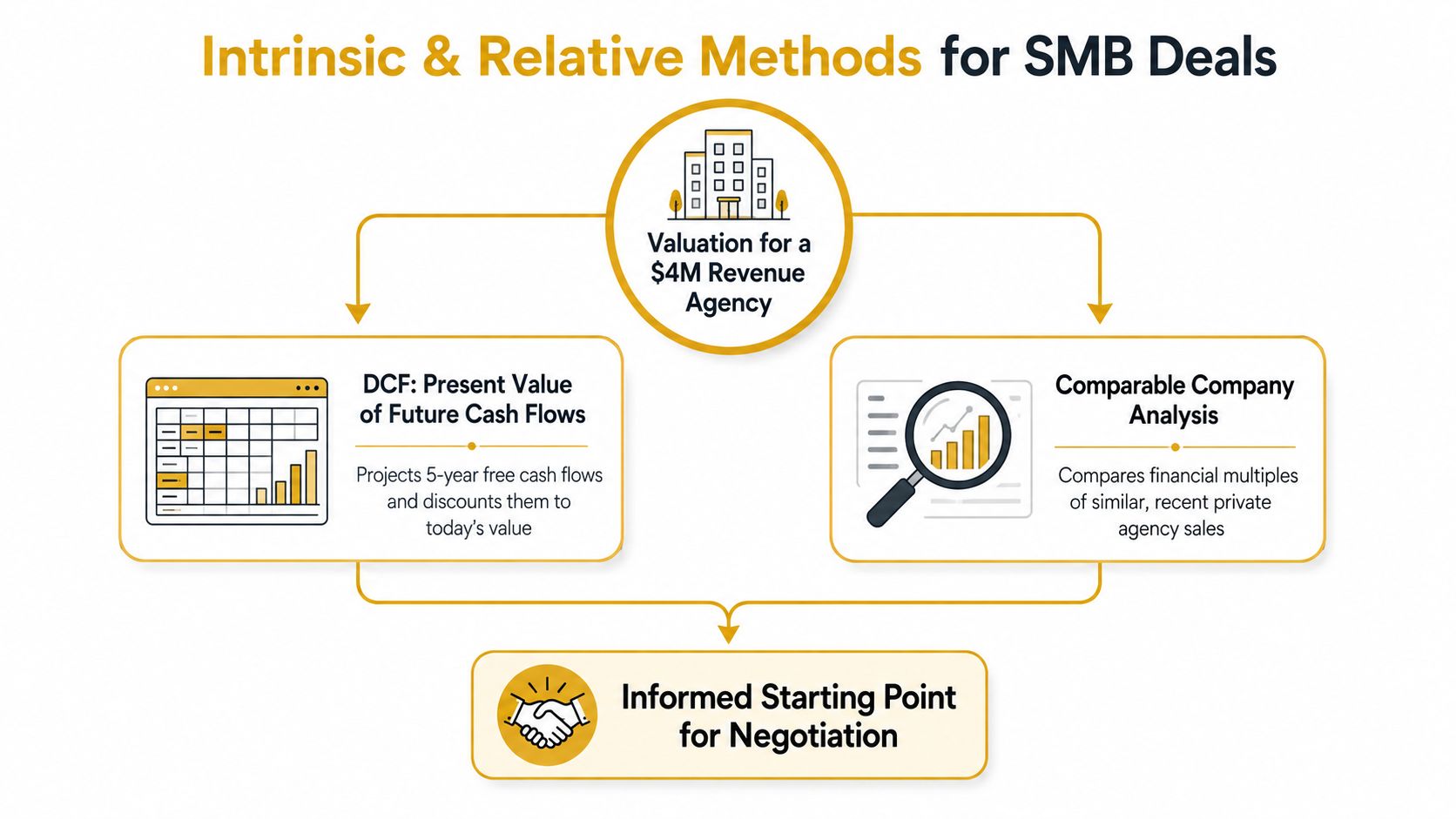
A buyer looking at a small agency can get misled fast if the first number on a teaser memo becomes the whole story. A better approach is to start inside the business, then test that view against the market. For a $4 million revenue agency, that means asking what the cash flows can support on their own, then checking how similar agencies are being priced in real deals.
DCF gives you the cash-flow story
A discounted cash flow, or DCF, model starts with projected free cash flow, discounts those cash flows back to today using a discount rate, and adds terminal value at the end of the forecast period. The logic is straightforward, even if the spreadsheet is not. If the agency can keep generating cash in future years, those cash flows have a present value today. For a practical walkthrough of the mechanics, see this guide to DCF modeling for small-business valuations.
The catch is that DCF lives or dies on the assumptions behind it. Stretch growth, margins, or exit value, and the output can move quickly. That makes DCF useful for disciplined buyers and risky for hopeful ones, especially when a seller is anchoring to a headline multiple that ignores working capital, debt, or a lumpy client base.
Comparable company analysis keeps you honest
Comparable company analysis looks at market multiples such as EV/EBITDA or P/E from similar businesses. If two agencies share the same service mix, customer type, and margin profile, those market multiples can serve as a reality check on whether your DCF is too generous or too stingy. The comparison works best when the peer set is narrow and the business model is close enough that the numbers mean something.
A buyer still has to choose the comp set with discipline. The companies should be relevant, not flattering. A buyer who screens only for premium peers can make an ordinary business look cheap on paper, even when the actual deal economics do not support that conclusion. That mistake shows up often in SMB negotiations, where sellers point to the best trade multiples they can find and buyers counter with the lowest public comp they can defend.
Useful filter: if your DCF and your comps only agree after you push both models in the same direction, the model is probably telling you what you want to hear.
For SMB targets, neither method should stand alone. DCF works best when the historicals are clean and the forecast is believable. Comparable company analysis works best when the peer set is tight and the target's business model is familiar. Used together, they give a buyer a clearer opening range, which matters when a seller is pressing for a number based on emotion, recent growth, or a single strong year.
For a fuller explanation of how the income method works in small-business settings, this guide to income approach valuation is a useful companion.
Precedent Transactions and LBO Pricing for SMB Buyers
A small-business owner hears two numbers for the same company and assumes one side is wrong. More often, both are right, just from different angles. Precedent transactions show what buyers paid, while public comps show what the market quoted for listed companies.
That gap matters in mergers and acquisitions valuation because private deals can clear at richer prices than public multiples. A strategic buyer may pay more when the target fits neatly into an existing platform, brings cross-sell potential, or lets the buyer remove duplicate costs. A financial buyer usually cannot justify that same premium unless the cash flows support it on their own.
Why deal prices and market multiples diverge
A broker may point to a “recent comparable sale” as proof that a seller's asking price is fair. The first question should be simple, who bought it and why? If the buyer was strategic, the price may reflect integration benefits rather than a clean read on the business itself.
That is why precedent deals need context, not just headlines. A sale in the same industry can still be a poor comp if the buyer had a special reason to pay up, such as scarce customer relationships, a tuck-in acquisition, or cost savings unavailable to a first-time buyer. In a small-business deal, a quoted multiple can look attractive on paper and still fail under actual financing terms.
The sponsor lens changes the ceiling
An LBO, or leveraged buyout, values the business through debt capacity and the return a financial sponsor expects over a typical hold period. The sponsor asks two plain questions, how much debt can the company carry, and how much equity value is left after that debt is paid down.
That creates a different ceiling from the one a strategic acquirer uses. A sponsor is pricing the business as a cash-flow engine that must support the debt stack, protect downside, and still leave enough upside at exit. A strategic buyer may justify a higher offer if the deal produces real operating gains after closing.
A simple way to see the difference is to compare a platform buyer and a sponsor looking at the same target. The platform buyer may see a larger price range because the target plugs into existing systems, customers, or sales channels. The sponsor sees the same company through repayment capacity and equity return, which often pulls the bid back toward a tighter range.
For a practical look at how precedent deals and sponsor returns shape pricing in small and lower middle market acquisitions, see this note on structuring deals and earnouts in acquisitions.
The seller's audience matters too. If strategics and sponsors are both at the table, the spread between their indications may be rational, not a sign that someone misread the business. One bidder is buying operating fit, the other is buying a debt-supported cash-flow stream.

Using Earnouts to Bridge the Valuation Gap
An earnout is not a valuation method. It's a deal structure that lets buyer and seller agree on part of the price now and part later if the business hits agreed targets. That matters because many SMB deals break not because the parties can't do math, but because they disagree about whether the future will look like the past.
A simple example is a buyer offering $3 million upfront plus $1 million if 2025 revenue exceeds $5 million. The seller believes customer retention will hold. The buyer worries that key accounts may drift after the owner exits. An earnout lets both sides put some money behind their view without forcing a fake certainty today.
Earnouts move risk, not just price
The seller's effective multiple usually drops when part of the price is contingent. That's not a flaw, it's the point. The buyer is paying for performance that hasn't happened yet, so the seller bears more of the execution risk after closing.
If the seller can still influence the metric, the earnout has a chance of working. If the buyer controls the metric and the seller can't affect it, the earnout can become a dispute waiting to happen.
The structure matters more than the label. Revenue earnouts are easier to measure, but they can ignore profitability. EBITDA earnouts align better with value, but they can invite arguments over accounting treatment. The cleanest earnouts are built on metrics the parties can both understand and verify.
For buyers who want a framework for structuring contingent consideration inside a larger acquisition plan, this resource on earnout structuring for acquisitions is a useful reference.
When earnouts work, they bridge a real gap. When they fail, they usually do so because the metric was vague, the operating controls were unclear, or the headline price was inflated from the start.
Behavioral Biases That Distort SMB Valuation
A lot of valuation disputes aren't really about valuation. They're about anchoring, peer selection, and confidence in forecasts that haven't earned that trust yet. The seller sees a round number and treats it like a market truth. The buyer sees a comparable sale and assumes the comparison is objective, even when the peer set was chosen to flatter the deal.
Academic work on neglected peers shows that peer selection can materially distort merger valuations, and survey evidence found 68% of respondents saw the bandwagon effect while 72% saw anchoring and ignoring intangibles as common valuation biases biases and neglected peer selection in valuation. That lines up with how SMB deals get negotiated. People don't just argue about numbers, they argue about which numbers deserve to count.
The fastest way to debias a CIM
- Check the peer set. Ask why these companies were selected and which obvious peers were left out.
- Separate actuals from projections. Management forecasts should be treated as a hypothesis, not a fact pattern.
- Strip out one-time items. Normalized earnings matter more than tidy presentation.
- Test the narrative against customer concentration. A business can look stable until one account leaves.
- Ask what changed since the last good month. Timing issues and temporary swings often hide inside the headline multiple.
The better your process, the less room there is for optimism to masquerade as evidence. That matters in SMB deals because the buyer often has less information than the seller, and the seller often has more emotional attachment than they realize. A disciplined buyer doesn't just protect against bad deals, they protect themselves from wanting the deal too much.
Triangulating the Five Methods Into a Defensible Range
A buyer who treats valuation like a single number usually ends up defending the wrong number. In a small-business acquisition, the five methods work better as a triangulation kit, like checking a property's value with a recent sale, a rental yield, and a lender's appraisal before you write the offer. Each method answers a different question, and each one can be distorted by seller optimism, buyer optimism, or a thin set of comparable deals.
For an SMB target, the weighting depends on what you can verify. Clean financials and steady cash flow give intrinsic value more weight, because projected earnings are easier to trust when the books are tidy. A visible market with real peers pushes comps higher in the mix. Sparse or noisy transaction data makes precedent transactions a check on judgment, not the anchor for it.
A simple weighting logic
Start with the method that fits the business model best, then use the other methods to test whether the first answer is too high or too low. A DCF tells you what the business could be worth if the forecast holds. Comparable companies show how the market prices similar assets. Precedent transactions show what buyers have accepted in deals that look close enough to matter.
For a typical small-company deal, those methods should produce a range, not a single polished figure. The lower end protects you from forecast error, customer churn, and the sort of earnings “normalization” that removes real risk. The upper end reflects strategic fit, recent momentum, and any synergy you can explain without hand-waving. Your opening offer should sit below the middle of that range, because negotiation needs room for the seller to move without forcing you to abandon your discipline.
Best practice: if your final number cannot survive a conversation about debt, cash, working capital, and one-time adjustments, you do not have a valuation yet. You have a wish.
Sanity-check before you move
A good range still needs a market check. That check should look beyond the seller's story and ask whether the pricing makes sense against broader M&A activity and the deal's own economics. For current market context, PwC's Global M&A Industry Trends report discusses how deal conditions, capital costs, and sector shifts shape valuation pressure in active markets. That matters because headline multiples in smaller deals often get distorted by scarcity, financing terms, and the seller's choice of peer set.
The same bias shows up inside the room. A seller may quote a premium multiple from a single headline transaction and ignore the weaker deals around it. A buyer may do the opposite and anchor on a bargain sale that had unusual distress behind it. In deals under $50M, the negotiation is often about which story gets to define the “market,” so the range should be grounded in methods that can survive pushback from both sides.
For a small-business buyer, the output should be practical. You want a low-to-high range, a clear opening offer, and a short list of assumptions that can move the number without breaking the deal. That is the triangulation toolkit at work, and it is the same discipline that helps buyers keep emotion from dressing itself up as valuation.
Valuation Checklist and Common First-Time Buyer Questions
Before an LOI, check normalized EBITDA, working capital, funded debt, cash that really belongs in the deal, and any debt-like items that change the equity check. Then compare your range against the market and ask what would make you wrong. If the answer depends on one fragile assumption, pause.
For deal review and diligence discipline, essential due diligence checklists for buyers is a practical companion. If you want help organizing the legal and operating questions around a deal, LegesGPT for business owners can also be part of the workflow.
When should you walk away on price? When the deal only works if the seller's best-case forecast comes true and your lender stays perfectly comfortable.
How do lenders view the same numbers? They care less about your enthusiasm and more about cash flow durability, debt service, and clean adjustments.
What do sellers negotiate? Price, earnout terms, working capital targets, and who absorbs the risk if the numbers slip.
What if there are no clean comps? Lean harder on DCF, transaction logic, and a careful review of what the business can produce.
The right next move is not to memorize another formula. It's to build a habit of triangulating every deal before you issue an LOI.
If you want a place to sharpen this process with real acquisition frameworks, structured training, and deal discussion, visit Dealmaker Wealth Society. It gives first-time buyers a way to think through valuation, financing, and negotiation as one connected process, which is exactly how SMB deals are won or lost.
Composed with Outrank tool

From the Dealmaker Blog









A Creative Business Buying Fable