LOI vs Term Sheet: Key Differences and When to Use Each
LOI vs Term Sheet: Key Differences and When to Use Each
A term sheet can mark every line of economics as indicative and still bind you to a period in which you can't walk away, the seller can't shop the business, and your advisers keep billing. That asymmetry sits at the centre of the LOI vs term sheet question, and most comparisons never reach it.
Both documents do the same job in different shapes. One records a process and a roadmap, the other compresses the economics onto a page or two. Neither label decides whether a court will hold you to the words inside.
Table of Contents
- LOI and Term Sheet Compared Side by Side
- Why the Document Title Does Not Set Binding Force
- How Private and Public Deals Use Each Document
- Binding Clauses to Check Before You Sign
- When to Ask for Exclusivity Under an LOI
- Which Document Fits Your Deal and Exclusivity Length
LOI and Term Sheet Compared Side by Side
In most acquisition practice, both documents leave core economics such as price, structure and closing conditions non-binding, while a narrower set of clauses, typically confidentiality, exclusivity or no-shop, expense allocation and governing law, is drafted to bind. The difference between an LOI and a term sheet is format, depth and where each turns up in the deal, not legal force.
That split explains why so many buyers win the price negotiation and lose the flexibility they thought they'd kept. The numbers are usually the part you can still walk away from. The obligations are the part you can't.
| LOI vs term sheet across the key criteria | ||
|---|---|---|
| Criterion | Letter of intent | Term sheet |
| Typical format | Letter form with a fuller roadmap | Abbreviated bullet-point summary |
| Main focus | Process, diligence access, timing, approvals and risk allocation | Headline economics such as valuation, consideration mix and financing |
| Level of detail | Developed roadmap for the definitive agreement | Compact list of principal terms |
| Core economics (price, structure, closing conditions) | Usually stated as non-binding | Usually stated as non-binding |
| Where it usually appears | Private-company acquisitions before diligence and definitive documents | Private financing and investment rounds, and sometimes preliminary public-company talks |
| How enforceability is decided | Wording, intent to be bound, certainty of terms and jurisdiction, not the title | Same test as an LOI, not the title |
Where each document does its real work
A letter of intent is usually drafted in letter form and runs longer, because it maps the route to the definitive purchase agreement: deal structure, diligence conditions, access rights, timing, required approvals and proposed allocation of risk. A term sheet compresses the same conversation into an abbreviated, bullet-point summary built around valuation, purchase price, consideration mix, financing assumptions, structure and governance.
The convention exists for a reason. Financing rounds need a compact list that investors can compare quickly, which is why term sheets dominate them. Acquisitions are messier, because the buyer needs process commitments before spending heavily on diligence, and the letter form carries those commitments more naturally.
The chart below shows where the two documents diverge, and it isn't the price line.

Say a draft arrives titled "term sheet." Its price is marked indicative, its structure is marked indicative, and clause nine hands you a 60-day no-shop period with a reimbursement obligation if the seller talks to another buyer. The title changes nothing about clause nine. You've just bought six weeks of exclusivity with the only currency that matters in a competitive auction, which is time.
Practical rule: before anyone negotiates a number, agree in writing which sections of the draft are commercial and which are binding. Both sides then read the same document the same way, and a later argument about intent has less room to grow.
That agreement costs one conversation before the first redline. Skipping it costs a lawyer's retainer once positions harden.
Why the Document Title Does Not Set Binding Force
The title on the cover settles nothing. A document called a letter of intent can be fully non-binding, partly binding, or enforceable as a contract, and the same is true of one called a term sheet. What decides it is the parties' intent, the wording of each provision, the certainty of the terms, the surrounding conduct and the governing jurisdiction. Harvard Law's Corporate Governance Forum treats the LOI and the term sheet as a difference of market convention and emphasis rather than a universal legal rule.

The Delaware warning on good faith
The enforcement risk isn't hypothetical. In the Delaware case discussed by the Forum, the parties expected nothing more than an agreement to agree, and the letter of intent still created an affirmative obligation to negotiate in good faith. The phrase "agreement to agree" was no shield. The drafting was the exposure.
That's why every provision should carry an explicit binding status, in the provision itself rather than in a preamble nobody rereads. The definitive agreement should then state which of the earlier provisions survive into it and which are superseded. A preamble declaring the whole document non-binding, sitting three pages above a clause imposing a duty to negotiate, is a contradiction that a court resolves. You don't.
Same label, different meaning across borders
Terminology travels badly. "Heads of terms" is the standard label in some markets, while LOI and term sheet are used interchangeably in others, as practitioner guidance on letters of intent sets out. Two documents with identical titles, signed in different countries, can carry different expectations about whether anything is owed at all.
The document's job isn't to record a deal. It's to secure diligence access, define the perimeter of the negotiation and preserve your flexibility until the closing documents are executed.
Read your draft against that job description and the priorities reorder. Access, perimeter and flexibility are three things a title can't give you and one badly drafted clause can remove. Mark the binding status of every provision before the draft leaves your desk, not after the seller's lawyer sends back a version that assumes the opposite.
How Private and Public Deals Use Each Document
In private-company acquisitions, an LOI or an unsigned term sheet commonly comes before diligence and definitive documentation, which gives buyer and seller a chance to align on valuation, consideration, transaction structure, exclusivity and the path to closing. WilmerHale's 2024 M&A report describes that as the ordinary sequence for private targets.
Public targets run the other way. The same report states that when the target is public there's usually no LOI, and the parties proceed directly to a definitive agreement, because announcing preliminary negotiations creates disclosure and regulatory concerns. An unsigned term sheet is sometimes prepared anyway, but preparing one doesn't make the proposed transaction binding.
What this means when the target is a small business
Almost every business a first-time acquisition entrepreneur looks at is privately held, so the LOI or term sheet is the preliminary document you'll use. Public-company mechanics only enter the picture if you're buying shares in a listed company, which changes the disclosure timeline, the board's fiduciary posture and the announcement rules.
Confirm ownership before you choose the document. Check the entity registration, the cap table and whether the shares trade on an exchange, then pick the path that matches. That one check also feeds assessing risks in the acquisition process, because a listed target brings shareholder-process and market-integrity risk that a private target doesn't.
Term sheets also dominate private financing and investment rounds, so if you're raising equity alongside the purchase, the same document does a different job with different terms. Buyers weighing that route can find investors for your round before committing to a structure they can't fund.
Binding Clauses to Check Before You Sign
The drafting benchmark for a small business acquisition is to split the document in two. One section is expressly non-binding and keeps your flexibility over price, structure, representations, financing and closing conditions. The other is a precisely identified binding section that names confidentiality, exclusivity or no-shop duration, diligence cooperation, expense allocation, governing law, dispute resolution, public-announcement controls and, where relevant, escrow or deposit treatment. The practitioner guide to preliminary legal documents in M&A sets this out as the actionable standard, and it beats a preamble that declares the whole thing non-binding.
Split the draft into two sections
The commercial half should stay loose on purpose. Price, payment mechanics, structure, representations and closing conditions all belong there, because you want room to reprice when diligence finds what diligence finds. Nothing in that section should read like a promise.
The binding half needs the opposite treatment. Every clause in it should be short, specific and numbered, with its own stated duration and its own consequence for breach. Vague language doesn't soften a binding clause, it just moves the argument to a courtroom.
The table below sets out the provisions buyers negotiate most often and what to write into each one.
| Binding provisions and what to specify | ||
|---|---|---|
| Provision | Usually binding? | What to specify |
| Confidentiality | Yes | Scope of information, duration, and who may receive it |
| Exclusivity or no-shop | Yes | Length in days, what counts as a breach, and extension rules |
| Expense allocation | Yes | Who pays advisers, and whether reimbursement applies if diligence fails |
| Governing law and disputes | Yes | Governing law, court or arbitration, and the dispute process |
| Good-faith negotiation | Sometimes | Whether any duty to negotiate exists, or an express disclaimer |
| Public announcements | Often | Who controls announcements and their timing |
| Deposit or escrow | Depends on the deal | Amount, refund conditions, and release trigger |
Walking the rows in negotiation order
Confidentiality comes first because it usually already exists in a separate NDA. Reference it rather than redrafting it, state how long the obligation runs past termination, and list who may receive information: your accountant, your lender, your lawyer, your insurer. A clause that says "advisers" without naming categories invites an argument later.
Exclusivity is where deals are won and lost. Put a number of days in the clause and tie it to milestones. Say the draft gives the seller a no-shop "during the diligence period," and the diligence period has no end date. Your exclusivity now has no end date either, and the seller's lawyer will happily let you believe otherwise.
Expense allocation looks administrative until diligence collapses. Picture a target whose largest customer contract has no assignment clause. You need a consent letter before closing, the consent never arrives, and the deal dies in week nine. Who pays the accountants, the lawyers and the quality-of-earnings firm? Write the answer in, including whether reimbursement applies if diligence fails for a reason either side could see coming.
Governing law and disputes should name the law, the court or arbitration seat, and whether disputes about the preliminary document go to the same forum as disputes about the purchase agreement. Splitting them is a mistake that surfaces only when you're already in conflict.
Good-faith negotiation deserves a deliberate decision rather than silence. Either accept a duty to negotiate, or disclaim it in plain words. Public announcements need an owner and a timetable, because employees and customers usually hear news before a deal closes and the seller's staff are the ones who'll tell them. Deposits and escrow need an amount, refund conditions and a release trigger, or the money sits in limbo.
That structure reduces accidental pre-contractual liability while giving you enough exclusivity and information access to justify the cost of underwriting the deal. It also helps to read the draft alongside the wider legal considerations in business transactions, since assignment and consent issues in the target's contracts tend to reshape the binding section late.
Mark every clause binding or non-binding, and fill in its specific terms, before the draft leaves your hands.
When to Ask for Exclusivity Under an LOI
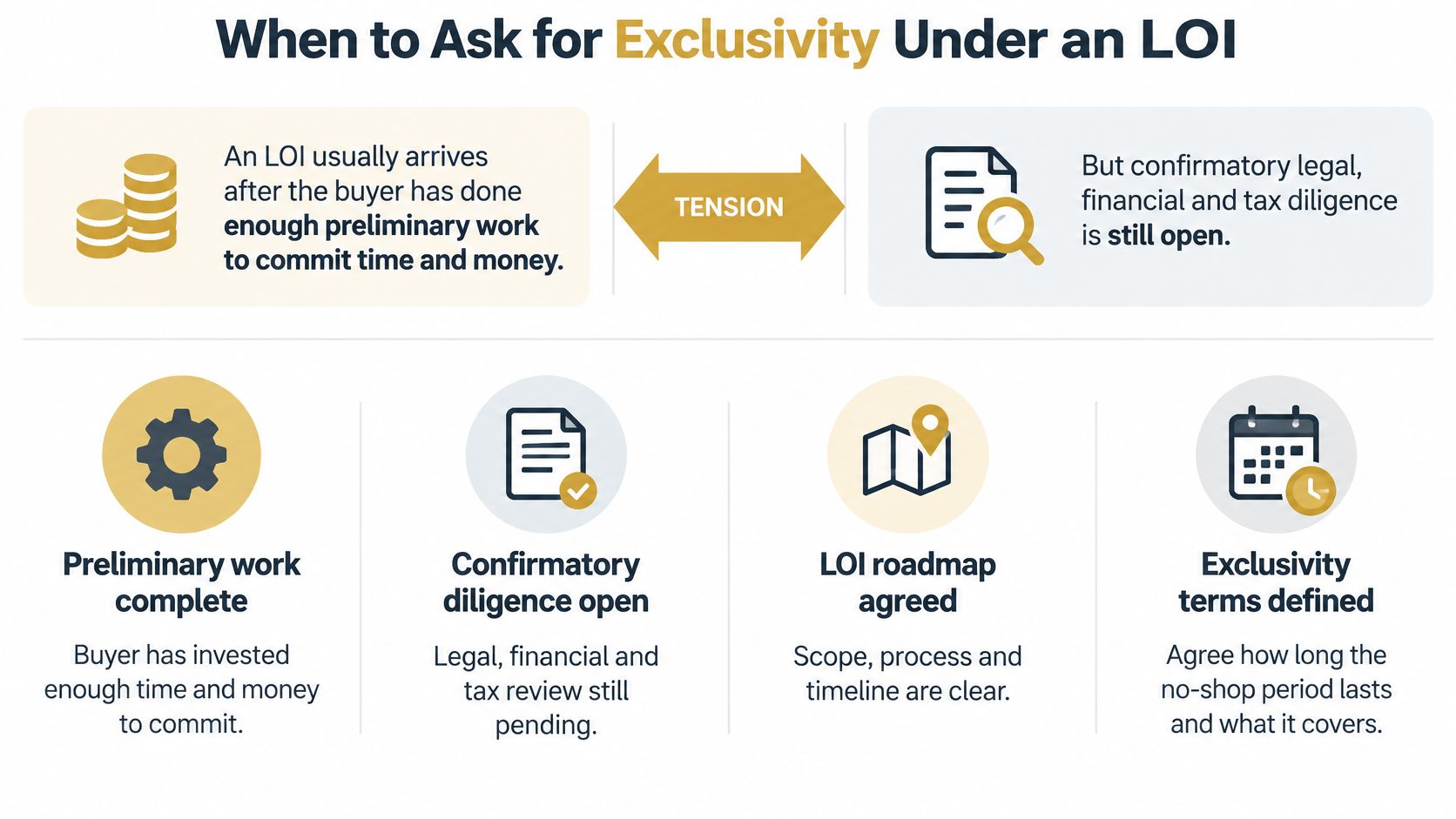
The timing question is harder than the document question. An LOI typically arrives once you've done enough preliminary work to commit time and money, while confirmatory legal, financial and tax diligence is still open. Sign too early and you've locked a price before quality-of-earnings, tax, working-capital, customer-concentration or financing risk is understood. Sign too late and a competing buyer takes the seller's attention.
Practitioners treat the LOI as the point where interest turns into commitment. Exclusivity removes the seller's best source of pricing pressure, the threat of a competing process, so expect the request itself to be tested. A no-shop ask signals that you believe the deal is real, and asking before you can prove it signals the opposite.
Three stages before a no-shop
An indication of interest costs you nothing and commits you to nothing. It signals interest, names a broad range if anything at all, and asks for information.
A term sheet pins headline economics once you've seen enough to price the business roughly. It still shouldn't buy exclusivity while your funding is unresolved.
An LOI with exclusivity is the third stage, and it should only be signed after the gates below are cleared.
The gates to clear first
Each gate converts an assumption into evidence the seller's adviser can check.
- Validated earnings: quality-of-earnings work done or commissioned, with one-off items and owner add-backs tested rather than accepted.
- Seller financing assumptions: the seller's expectations on a note, earnout or rollover written down and checked against what they've said in conversation.
- Debt capacity: a real conversation with a lender or investor about the structure you're proposing, rather than a hope that debt funding will appear.
- Key contracts: the material customer and supplier agreements reviewed, including whether each one can be assigned without a customer consent letter.
- A written list of unresolved diligence items: the open questions named, so the exclusivity request can be tied to closing them.
The diagram below condenses the same test into the conditions a seller's adviser will expect to see before granting a no-shop period.
Financing certainty comes before the no-shop
Practitioners report private credit and nonbank lenders remaining prominent in acquisition finance, with all-equity transactions a major alternative in the 2025 deal environment. Whatever your funding mix, test whether the structure survives realistic lender or investor review before you ask for a binding no-shop period. A financing contingency discovered mid-exclusivity burns the one thing you asked for.
Test before you ask: if your lender's credit team would balk at the working-capital assumption in your model, the seller's adviser will balk at it too. Fix the model first.
Then write the escape routes into the document. State which assumptions permit repricing, which permit termination, and which permit an extension of the exclusivity period. Those three sentences are the difference between a no-shop that protects you and one that traps you, and they belong in the same conversation as the terms you're negotiating on price and structure.
Which Document Fits Your Deal and Exclusivity Length
Use a term sheet to fix headline economics early. Move to an LOI with a fuller roadmap and a no-shop once your evidence gates are cleared. If the target is public, expect to go straight to a definitive agreement.

Four buyer scenarios
The first-time buyer of a profitable private business. You've found a business with steady earnings, the seller is motivated, and you've never signed one of these documents. Start with a term sheet that pins valuation, consideration mix and the working-capital assumption, then convert to an LOI with a no-shop tied to your diligence milestones once the gates are cleared. The risk isn't the document, it's the order: lock a price before quality of earnings is done and every later discovery turns into an argument about reopening economics.
Customer verification earns its place here. Our four-part process covers a customer interview, a concentration analysis, a contract review and a retention risk assessment, and Dealmaker Academy members can run it on real targets with the coaching team before committing to a price.
The bolt-on by an operator who knows the seller. You've run the target's category for years and you know the owner personally. A short term sheet with binding confidentiality and a limited exclusivity period does the work here, extended only in writing. The risk is the handshake, where extensions get granted verbally until the seller has shopped the business for months while you've stopped looking elsewhere.
The debt-funded or seller-financed buyout. Your structure needs a lender or a seller note, so the LOI states the financing conditions and exclusivity comes only after lender or seller feasibility review. The risk is a no-shop that starts before the loan is real, leaving you to fund diligence on a deal your funding can't close.
The eCommerce roll-up with several targets. You're running parallel conversations, so sequence the LOIs and check the exclusivity windows against each other. The risk is overlap: three live no-shops, one diligence team, and a deadline you can't meet on any of them.
| Document choice by situation | ||
|---|---|---|
| Situation | Document to use | Exclusivity to request |
| Private target, first contact, financing unclear | Indication of interest or unsigned term sheet | None yet |
| Private target, valuation and structure aligned, diligence not started | Term sheet or LOI with clearly non-binding economics | Short period tied to diligence milestones |
| Private target, seller-financed or leveraged structure | LOI with financing conditions stated | Only after lender or seller feasibility review |
| Public target | Definitive agreement, sometimes preceded by an unsigned term sheet | Handled inside the definitive agreement |
| Bolt-on with an existing relationship to the seller | Short term sheet with binding confidentiality | Limited period, extended only in writing |
Documents are a funnel stage, not a formality. In 2025, private-equity firms reviewed a median of 98 business plans, sent 6 term sheets, and signed 2 letters of intent for each deal they closed, a figure Mark Zides reports using the 2025 Pepperdine Private Capital Markets Report.
Here's how that sequence plays out when the documents move from draft to signature.
Closing rates are context, not a promise. In 2024, 78% of private M&A deals that reached a signed letter of intent ultimately closed, according to SRS Acquiom's 2024 M&A Deal Terms Study as reported by Synergy AI. That study draws on more than 2,100 private-target transactions valued above $475 billion that closed between 2018 and 2023, per SRS Acquiom's deal terms research, so the figure describes a market where most signed LOIs do convert. It says nothing about your seller, your financing or your diligence findings.
Three checks before the draft goes out
- Every clause carries a binding status. Confidentiality, exclusivity, expenses, governing law and announcements are marked binding. Price, structure and closing conditions are marked non-binding. No clause sits in the gap.
- Exclusivity has a length and a breach trigger. A stated end date, a definition of what counts as talking to another buyer, and a rule for extensions that requires both signatures.
- Repricing and termination assumptions are written in. Which diligence findings reopen price, which ones let either side walk, and which ones extend the timeline.
Have counsel read the binding section specifically, not the whole document generically. We keep specialty coaches for capital raising, operations, financial due diligence, M&A legals and contracts, post-acquisition growth, transition and integration, and deal origination, so the review lands with someone who drafts these clauses for a living.
The binding section of your next LOI is where exposure sits, and it's the part most buyers draft alone at midnight. Dealmaker Wealth Society walks you through it with templates, live coaching and specialty support for M&A legals and contracts, plus real-time feedback on your own live deal as it moves from term sheet to exclusivity to closing. Start at Dealmaker Wealth Society and bring the draft you're working on.

From the Dealmaker Blog









A Creative Business Buying Fable