What Is Rollover Equity in an Acquisition
What Is Rollover Equity in an Acquisition
Rollover equity is the portion of a seller's price reinvested in the buyer's post-closing company instead of paid in cash, so a $30 million price with a 15% roll means $4.5 million goes back into the business.
You may be looking at a term sheet that promises a strong purchase price but leaves part of your payment invested alongside the buyer. Before you agree, you need to know more than how much you're rolling. You need to know what you're buying with the proceeds you're giving up, who gets paid ahead of you, and who controls your next opportunity to sell.
Table of Contents
- What Rollover Equity Means at Closing
- Typical Rollover Sizes in Real Deals
- What Your Stake Is Worth After the Waterfall
- Why Buyers and Sellers Both Want a Roll
- When the Tax Deferral Actually Holds
- A Thirty Million Dollar Deal From Close to Exit
- Checks to Make Before You Roll Equity
What Rollover Equity Means at Closing
You're reviewing the closing statement, and the buyer's payment isn't entirely cash. Part of your sale proceeds will become an investment in the company's new ownership structure, rather than money you can move into your personal account.
Using the example described by Sadis's rollover equity guide, a $30 million purchase price and a 15% rollover put $4.5 million back into the buyer's structure, leaving a calculated $25.5 million cash component before taxes, fees, and other closing adjustments. That split assumes the purchase price represents proceeds available to the seller, not an enterprise value still subject to debt repayment.
What you own after closing
You may sell control of the operating business and receive your new interest in a holding company or acquisition vehicle. That distinction matters: your ownership documents must identify the entity, the security, and the rights attached to it.
The buyer's structure may own more than your original company. It might already include other businesses or provide for future acquisitions, so your investment exposure can extend beyond the operation you built.
Your closing documents should distinguish:
- Cash consideration: The proceeds payable to you at closing, subject to the agreed adjustments.
- Rollover investment: The value exchanged for ownership in the post-closing entity.
- Employment arrangements: Your compensation and obligations if you stay involved after the sale.
Your rollover is purchased with value you already own. Incentive equity is different: it's generally granted to reward future performance, rather than acquired with your sale proceeds.
You become an investor under someone else's control
Once the transaction closes, your retained investment can benefit from a later sale or recapitalization. It can also lose value, and you generally won't have the same authority you had as the owner.
Practical rule: Read the rollover documents as if you were investing fresh money in a business controlled by someone else.
That mindset changes the questions you ask. Instead of asking only whether the sale price is attractive, ask whether the new investment deserves a place in your personal portfolio.
Also pin down what the quoted rollover percentage measures. Seller proceeds, existing equity, purchase price, and post-closing ownership are different denominators, even when a term sheet uses the same shorthand for all of them.
Typical Rollover Sizes in Real Deals
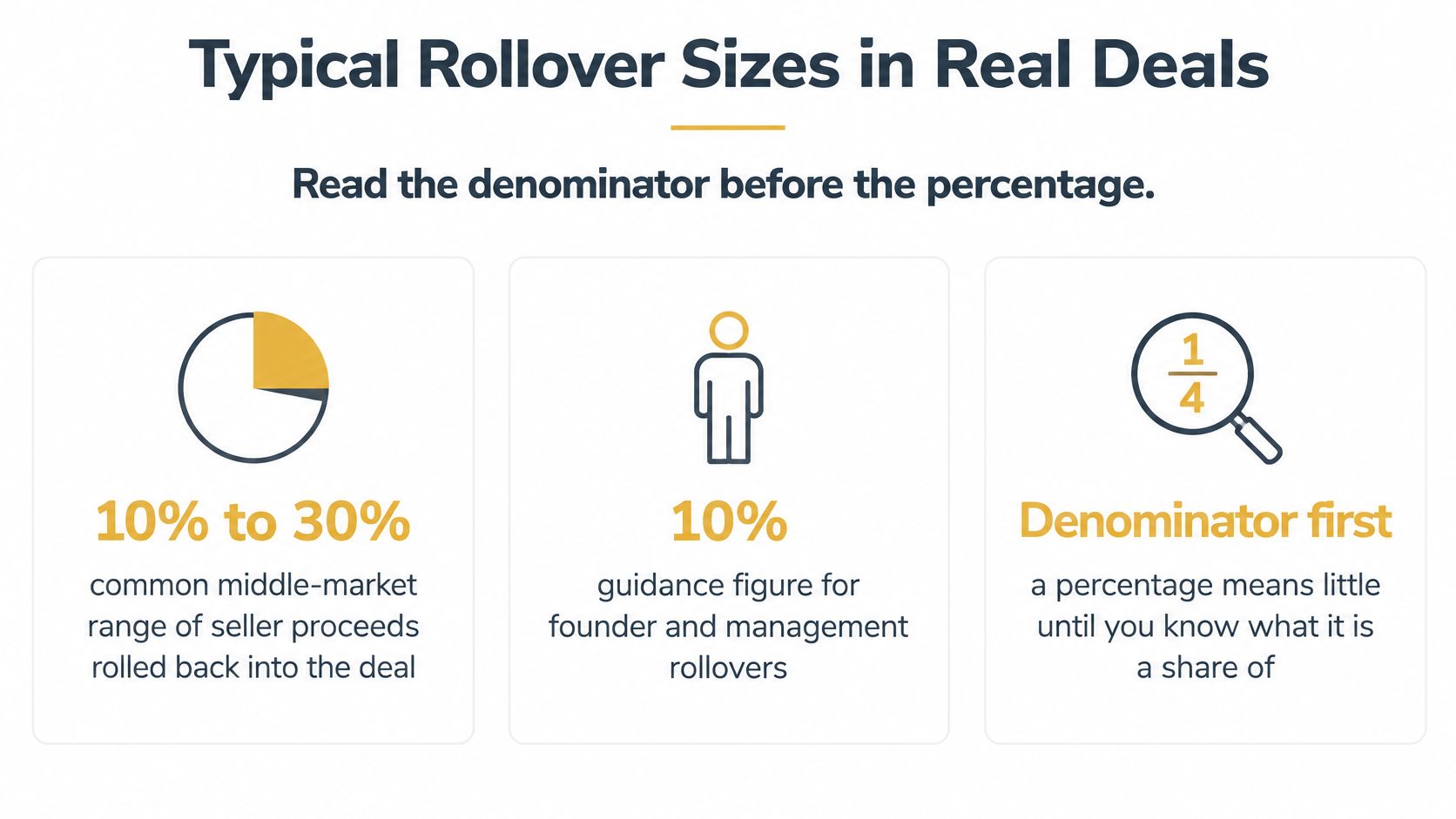
Read the denominator before the percentage. A percentage of your sale proceeds tells you how much you're investing. It doesn't, by itself, tell you how much of the buyer's company you'll own.
How rollover size is quoted in current deals
| What is being measured | Figure | Denominator | Source year |
|---|---|---|---|
| Common middle-market practice | 10% to 30% | Seller proceeds | Market practice |
| Some founder or management guidance | 10% to 40% | Rollover of founder or management equity | Market guidance |
| Middle-market private-equity deals using rollover | 63.6% of deals | Share of deals | 2024 GF Data |
| Average amount sellers rolled | 14.5% | Purchase price | 2024 GF Data |
| Private-target deals with cash plus management rollover | 21% in 2025 data; 18% in 2024; 16% in 2023 | Share of private-target transactions | SRS Acquiom 2026 study |
| Average rollover of enterprise value | 16.9% through Q3 2025, up from 14.0% in 2021 | Enterprise value | Through Q3 2025 |
| Rollover share of total capitalization | 16.4%, up from 13.3% in 2021 | Total capitalization | Through Q3 2025 |
The market-practice ranges describe rollover contributions, not guaranteed ownership in the new company. The observed deal statistics also measure different things, so don't compare them as though they describe the same transaction population.
According to GF Data figures reported by Bridgebook, rollover appeared in 63.6% of middle-market private-equity deals in 2024, with sellers rolling an average of 14.5% of the purchase price.
Separately, Davis Wright Tremaine's discussion of SRS Acquiom's 2026 M&A Deal Terms Study reports cash plus management rollover in 21% of private-target transactions in the 2025 dataset, compared with 18% in 2024 and 16% in 2023. That's a different measure from the middle-market private-equity figures, not a conflicting estimate.
The visual below highlights why the measurement basis comes first.
Turn the percentage into an investment
Calfee's rollover equity commentary reports average rollover rising from 14.0% of enterprise value in 2021 to 16.9% through Q3 2025, while its share of total capitalization increased from 13.3% to 16.4% over that period. Neither measure tells an individual seller their fully diluted ownership.
To evaluate your own offer, ask the buyer to show the calculation in writing:
- Start with the denominator: Identify the exact proceeds, equity value, or purchase-price amount used.
- Calculate the contribution: Convert the proposed rollover into dollars.
- Identify what those dollars purchase: Specify the equity class, issue price, and number of units or shares.
- Calculate fully diluted ownership: Include the management pool and other committed issuances.
Treat broad ranges as negotiating context, not instructions. The frequency of rollover doesn't make it mandatory, and a market-average contribution doesn't establish whether your particular security is fairly priced.
What Your Stake Is Worth After the Waterfall
Owning a share of common equity isn't the same as owning that share of enterprise value. Enterprise value describes the business before allocating value among lenders and equity holders. Your payout depends on what remains for your security after higher-ranking claims are satisfied.
Motion Advisory Partners' discussion of founder returns emphasizes the importance of debt, preferences, dilution, and minority rights. A seller can retain a meaningful common-equity percentage yet receive little if senior claims consume the available proceeds.
Illustrative payouts on a 15% common roll
The following is a hypothetical teaching model, not a reported transaction. Assume a seller invests $4.5 million for 15% of the common equity, with $12 million of net debt outstanding at exit and, where specified, $10 million of preferred equity paid ahead of common.
For simplicity, the model excludes transaction costs, taxes, accrued preferred returns, and participation rights.
| Exit case | Enterprise value | Left for common |
|---|---|---|
| Debt repaid, no preferred ahead | $40 million | $28 million |
| Debt and $10 million preferred paid first | $40 million | $18 million |
| Enterprise value down 25%, debt and preferred first | $30 million | $8 million |
| Same stack, new issuance halves the stake | $40 million | $18 million |
| Good-leaver repurchase benchmark | Not an exit | Stake may be bought back |
In the hypothetical debt-only case, the seller receives $4.2 million, calculated as 15% of the $28 million remaining. Add the preferred claim, and the illustrative payout falls to $2.7 million, even though the enterprise value hasn't changed.
In the hypothetical downside case, the seller receives $1.2 million from the $8 million remaining for common. If new issuance instead halves ownership to 7.5% in the higher-value case, the illustrative payout is $1.35 million from the $18 million common pool.
A larger rollover can increase your exposure without improving your position in the payment queue.
These calculations aren't a valuation opinion about the original investment. They demonstrate why you need an equity valuation that reconciles the price paid for your security with its actual economic rights.
The terms that can change your check
Ask counsel and your financial adviser to connect the model to the governing documents:
- Fully diluted capitalization: Include incentive awards, acquisition shares, and other potential issuances.
- Liquidation preferences and participation: Determine whether preferred holders receive priority payments, further participation, or both.
- Dilution protections: Check whether you can participate in future funding and what anti-dilution provisions protect.
- Governance and transfer rights: Review information rights, drag-along, tag-along, transfer limits, and approval rights over future financing.
Employment-related repurchase terms deserve separate attention. A 2024 Goodwin survey found that 82% of sponsors priced rollover equity at fair market value in good-leaver repurchase situations, while 16% exempted it from repurchase.
Those findings concern good leavers, not bad-leaver protection. Read both definitions, the valuation procedure, and payment terms before assuming you'll remain invested until the sponsor exits.
Why Buyers and Sellers Both Want a Roll
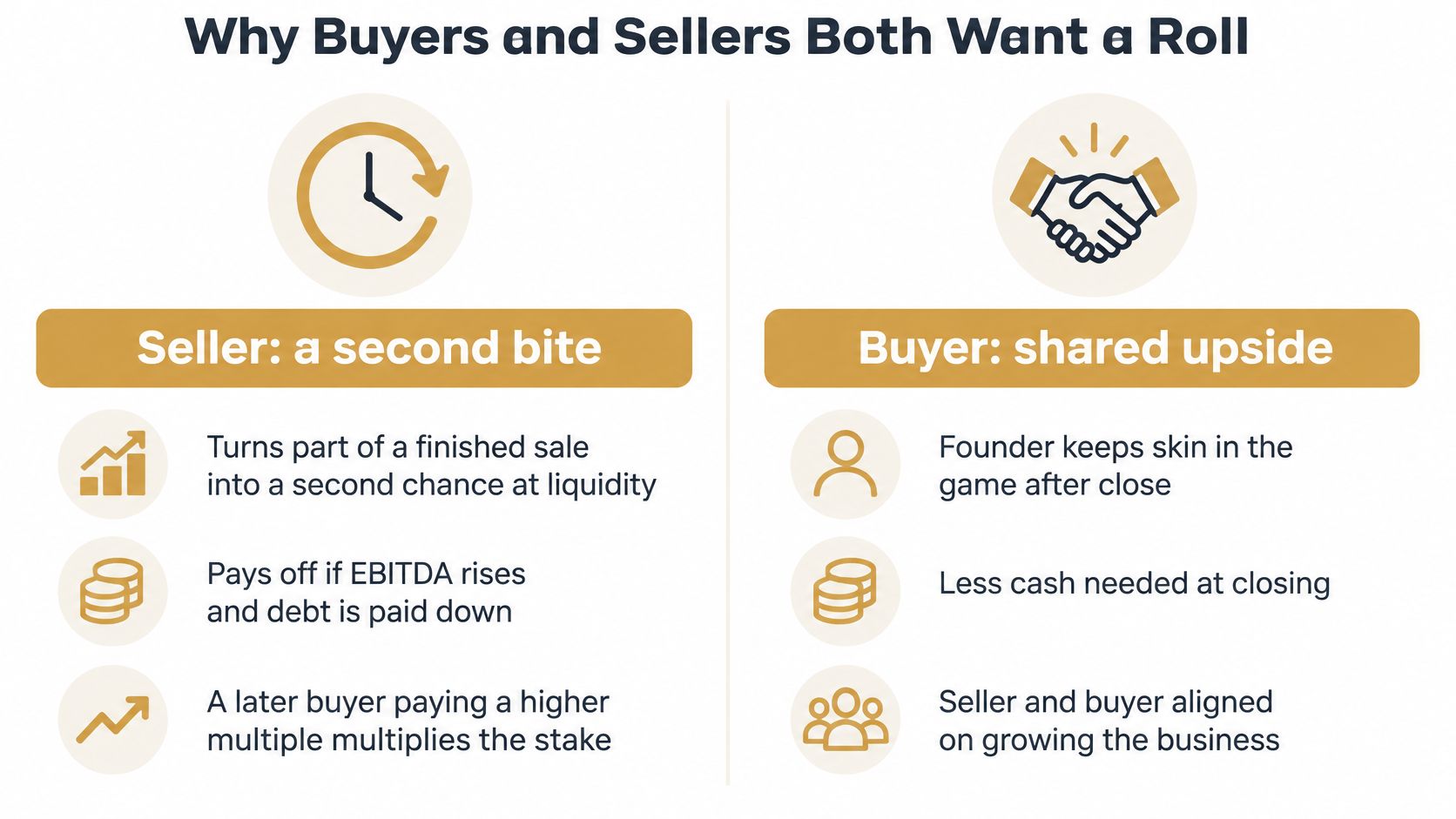
The seller and buyer can agree on a rollover while pursuing different goals. The seller wants an attractive return on retained capital. The buyer wants financing flexibility and a management team that remains committed after control changes.
Uplevered's management rollover explanation describes the potential return drivers as stronger earnings, reduced debt, and a favorable later valuation. Those are business outcomes to underwrite, not benefits the rollover automatically delivers.
The seller's case for staying invested
A seller may believe the company can grow faster with access to acquisition capital, a broader management team, or capabilities the founder couldn't fund alone. Rolling allows the seller to participate without continuing to finance the entire business personally.
But confidence in your company isn't enough. You also need confidence in the buyer's operating plan, financing choices, and treatment of minority investors.
Purchase-price context can help frame the discussion. According to GF Data figures cited by Middle Market Growth, 2024 deals involving rollover in the $1 million to $10 million segment averaged a 6.0x trailing-twelve-month EBITDA purchase-price multiple, versus 4.3x for deals without rollover.
That's an association, not proof that agreeing to roll causes a higher offer. Differences in company quality and transaction structure can influence the comparison, and a higher headline price may still come with less attractive investment terms.
The illustration below separates each party's motivation.
The buyer's financing and continuity case
For the buyer, seller equity reduces the new cash equity needed to fund the agreed consideration. That can make room in the financing plan for working capital, integration spending, or a future bolt-on, although it doesn't remove lender constraints or create free capital.
The buyer may also value the founder's continued involvement. A seller who remains invested has a financial reason to help preserve customer relationships, transfer operating knowledge, and support the agreed growth plan.
For an acquisition entrepreneur, rollover can help bridge a funding gap between the purchase price and available bank debt and investor cash. It shouldn't be used to disguise a business that can't support its financing.
Understanding why sellers don't always want cash can help buyers shape a credible offer rather than request a concession. Ask what the seller wants to achieve with the retained investment and what role they're willing to play.
The trade is straightforward: the seller gives up immediate liquidity and discretion over that capital in exchange for uncertain future proceeds. Judge the offer by the security and its after-debt economics, not the purchase multiple alone.
When the Tax Deferral Actually Holds
Cash proceeds are generally taxable under the rules applicable to the seller; only the rolled portion may qualify for deferral. Receiving equity doesn't automatically make a transaction tax-deferred, and deferral isn't the same as permanent exemption.
In the United States, Financial Edge's management rollover guide explains that a contribution to a partnership or an LLC taxed as a partnership may implicate Internal Revenue Code Section 721, while a contribution to a corporation may implicate Section 351. Each requires transaction-specific analysis rather than an assumption that the equity exchange qualifies.
Establish the structure before signing
Ask your tax adviser to describe the actual steps, not just the intended result. A cash sale followed by reinvestment can have a different outcome from a qualifying contribution or exchange.
The documents and funds flow need to support the chosen treatment. If formally separate steps operate as a predetermined cash sale, recharacterization can leave you owing tax on value you never received in cash.
Work through the following questions with M&A counsel and your tax adviser:
- What are you transferring? Identify the property or interests contributed and the entity receiving them.
- What are you receiving? Separate cash, investment equity, and employment-related awards.
- What happens immediately afterward? Review planned borrowing, distributions, and other connected steps.
- Who reports the transaction? Assign responsibility for valuations, tax reporting, and consistent treatment.
Tax discipline: Don't sign based on a promise of deferral. Ask for an explanation of the qualifying structure and the facts that could defeat it.
Employment and entity choices need their own review
Continued employment tied to equity, vesting, forfeiture, and distributions following new borrowing can affect tax characterization. Have advisers examine whether any interest could be treated as compensation rather than investment property, and whether connected steps raise disguised-sale concerns.
S-corporation transactions require particular care over sequencing, eligibility, elections, and state-law consequences. A mistake in the planned steps may not be repairable after closing.
These U.S. concepts aren't universal. The seller's tax residence, the company's legal form, and the acquisition vehicle can produce a different result in another jurisdiction.
Use a structured review of acquisition tax implications to compare after-tax cash under alternative structures before committing. Ask advisers to show both the intended treatment and the consequences if deferral fails.
Write the rollover amount, entity type, equity class, valuation, representations, covenants, and reporting duties into the documents. Your practical question is how much spendable cash remains after closing taxes, and whether you can fund any tax liability without selling the restricted investment.
A Thirty Million Dollar Deal From Close to Exit
Consider a hypothetical founder selling a profitable services company, using the purchase-price scale introduced earlier. This is an illustration of negotiated terms, not a reported transaction.
The founder's closing decision involves cash, ownership, and a separate operating role.
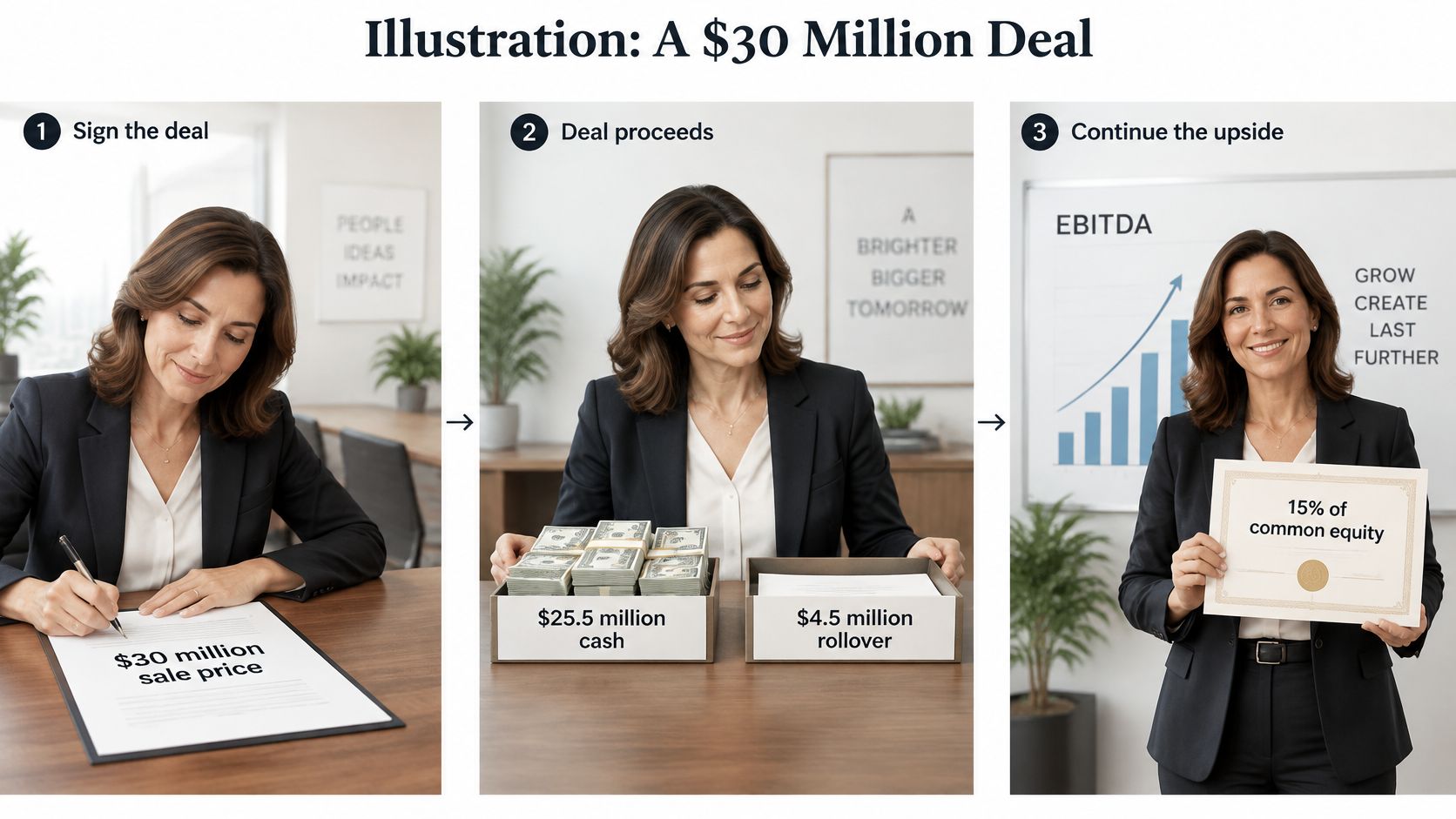
In this hypothetical deal, she receives $25.5 million in cash and contributes $4.5 million for 15% of the common equity in the buyer's holding company. Her employment agreement pays her to remain an operator, while the equity documents govern her investment.
Growth doesn't settle the payout question
At closing, the bank's debt and the sponsor's preferred investment rank ahead of her common interest. Her adviser confirms that the contribution percentage and common ownership percentage happen to match in this illustration, but that isn't a rule she can assume in another offer.
Over the hypothetical holding period, the buyer improves earnings and acquires a complementary business. It finances part of that acquisition with new shares, reducing her fully diluted ownership.
She receives financial reports under her information rights, but she can't block the acquisition. When the sponsor later arranges a sale, the drag-along provision requires her participation even though she would prefer to wait.
The accompanying video offers another format for considering the transaction.
Different endings for the same founder
In the successful operating scenario, the business sells above its original enterprise value. Nevertheless, her distribution is based on her diluted stake in the common pool after debt and preferred claims, not her original percentage multiplied by the announced sale price.
In the downside scenario, earnings fall and the remaining debt consumes most of the equity value. Her original cash proceeds remain separate from the investment, but the rollover can be worth little despite a successful initial sale.
For this illustration, assume advisers confirmed that the cash component was taxable and the contribution qualified for deferral until a later taxable event. That treatment doesn't protect the investment from losses or guarantee favorable treatment of employment-related changes.
The question she should have asked before signing is concrete:
What does my retained stake pay if business value falls, if the buyer issues new shares, or if I leave before the exit?
Checks to Make Before You Roll Equity
Take the proposed term sheet, capitalization table, and draft equity documents to counsel together. Reviewing the rollover clause in isolation won't tell you what you're agreeing to buy.
Confirm the investment and your rights
- Contribution and denominator: Reconcile the stated percentage to a dollar amount and identify the proceeds against which it's measured.
- Fully diluted ownership: Include the management pool, committed issuances, and any planned acquisition financing.
- Security and payment priority: Name the class and review liquidation preferences, preferred returns, and participation.
- Control and liquidity: Check drag-along, tag-along, transfer restrictions, information rights, and authority over debt, budgets, and exit timing.
- Departure consequences: Read good-leaver and bad-leaver definitions, repurchase pricing, and payment mechanics.
Test the decision before committing
Have your tax adviser distinguish a contribution, reinvestment, or reorganization and assess employment-related conditions. Ask for base-case, lower-value, and diluted-ownership exit models, with taxes and transaction costs included.
For acquisition entrepreneurs, business quality comes before financing creativity. At Dealmaker Wealth Society, we recommend acquiring only businesses that have weathered economic recessions, generate $1 million in gross revenue, and have a proven record of steady profits.
Your final decision should compare the proposed investment with the cash you could otherwise retain. Roll only when the after-tax upside, downside exposure, and restrictions justify giving up that liquidity, not because the buyer describes the percentage as standard.
Our acquisition education covers roll-ups, bolt-ons, buyouts, and consulting for equity, with specialty coaches in capital raising, financial due diligence, M&A contracts, and post-acquisition integration. Visit Dealmaker Wealth Society to explore training and practitioner support for pressure-testing a real term sheet, including the capital stack, retained ownership, and exit assumptions behind your rollover.

From the Dealmaker Blog







A Creative Business Buying Fable