Mergers and Acquisitions Financing: A Complete Guide
Mergers and Acquisitions Financing: A Complete Guide
The most popular advice about mergers and acquisitions financing is also the least useful: find the cheapest debt first, then build the deal around it. That approach works only when the buyer has strong financials, a clean target, ample equity, and enough time to let a lender dictate the process. Smaller acquirers usually have none of those advantages at the same time.
The practical question isn't whether capital exists. It does. The question is who can access it, how quickly, on what terms, and with how much control left after closing. A financing package that costs more but closes reliably may create more value than a low-rate facility that arrives too late, requires excessive conditions, or leaves no room for working capital and integration.
Table of Contents
- The Real State of Acquisition Capital Access
- Core Financing Options for M&A Transactions
- Comparing Financing Structures for Deal Success
- How Covenants and Leverage Shape Deal Behavior
- Creative Deal Structures That Bridge Financing Gaps
- Raising Capital for Your Acquisition Step by Step
- Building Your Optimal Capital Structure Decision Framework
The Real State of Acquisition Capital Access
M&A headlines can create a dangerous illusion. One outlook cited by PwC's M&A trends analysis places projected global deal value for 2026 at about $4 trillion, roughly 13% higher year over year, while another view in the same market context describes global M&A activity as having increased by around 40% in 2025. Those figures sound like a broad financing boom.
They don't describe the experience of every buyer. Deal activity is increasingly concentrated in fewer, larger transactions, so capital is readily available for strategic buyers, sponsor-backed platforms, and mega-deals while smaller acquirers face a much narrower pool. A headline increase in value can coexist with scarce practical funding for an entrepreneur trying to buy a profitable local operator.
The right question isn't “Is financing available?” It's “Is financing available for this buyer, this target, and this risk profile?”
That distinction changes how you approach a transaction. A lender doesn't fund an acquisition because the overall M&A market is healthy. It underwrites the target's cash flow, the buyer's experience, the quality of the financial records, the collateral, the repayment plan, and the credibility of the downside case. An equity partner evaluates those factors differently, often caring as much about the operator and growth plan as the entry valuation.
Why smaller deals get squeezed
Large transactions can attract multiple sources at once, including banks, private credit funds, insurers, institutional equity, and strategic co-investors. Smaller acquisitions may have sound economics but lack the scale, documentation, or institutional sponsorship that makes them efficient for a capital provider to underwrite.
That produces a bifurcated market. The strongest buyers compete for flexible capital, while first-time acquirers and lower-middle-market buyers often need to combine seller financing, outside equity, senior debt, and contingent consideration to make the sources-and-uses schedule balance.
A useful overview of how banking transactions and industry consolidation intersect is available in Visbanking M&A insights. Use resources like that to understand the market context, but don't confuse market visibility with personal financing access.
What actually wins a closing
For smaller acquisitions, speed, certainty, and equity efficiency often matter more than the lowest nominal rate. A seller may reject a slightly higher offer if the buyer can't demonstrate committed funding. A lender may approve a facility but reserve the right to revisit key terms after diligence. An equity partner may require more ownership than expected but eliminate a funding gap that would otherwise kill the transaction.
The strongest financing plan is therefore built backward from closing risk. Identify the amount of equity you can commit, the cash flow the business can safely support, the seller's willingness to defer consideration, and the timing pressure created by the process. Then design a capital stack that gives each participant a reason to stay engaged through signing and funding.
Core Financing Options for M&A Transactions
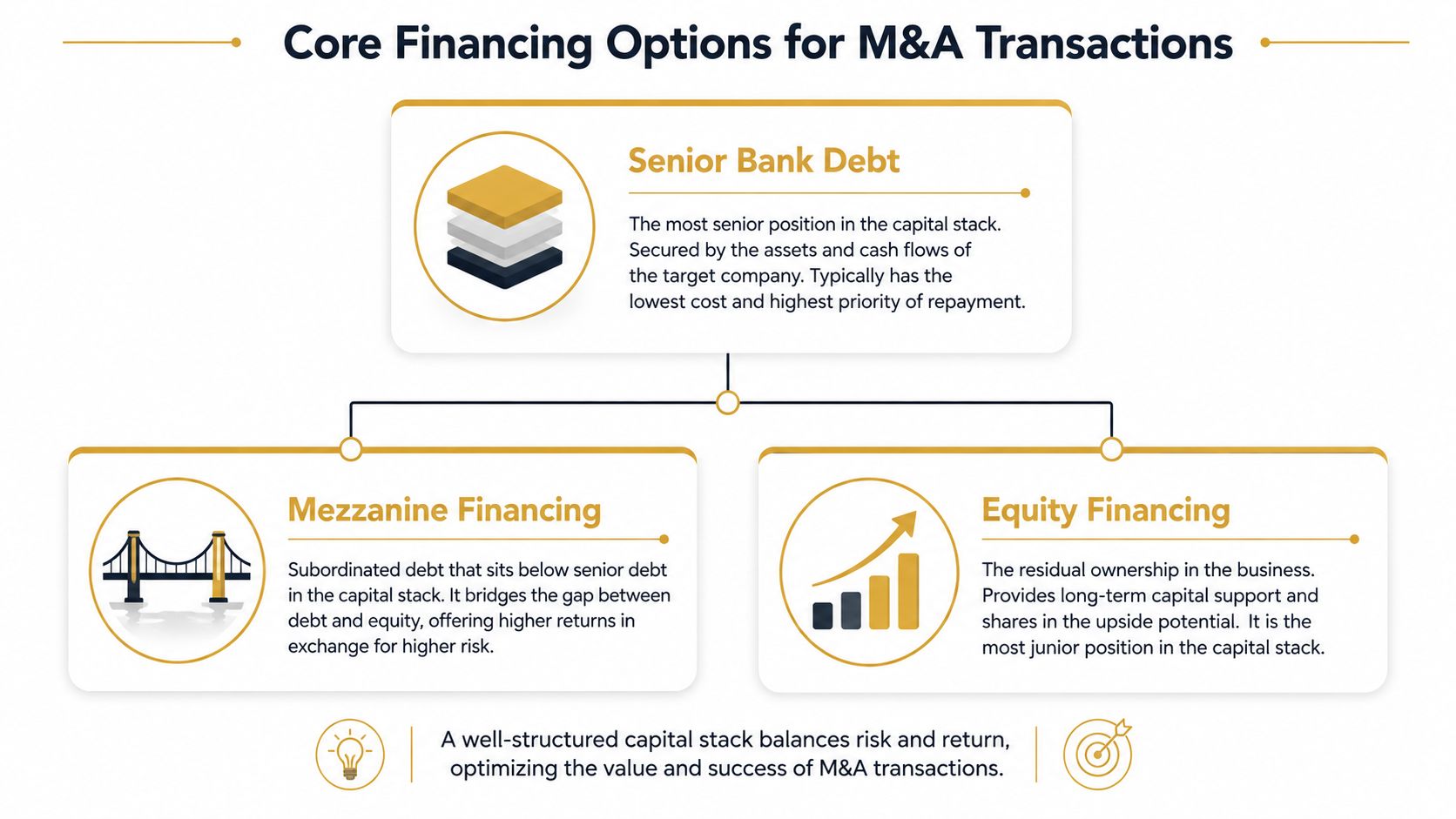
An acquisition capital stack allocates risk among lenders, sellers, investors, and the buyer. Senior debt sits closest to the operating cash flow, while equity absorbs the greatest downside and receives the residual upside. The best structure isn't the one with the most layers. It's the one that matches repayment obligations to the target's dependable cash generation.
Senior bank debt
Senior secured loans usually offer the lowest cost of borrowed capital because the lender has priority over junior creditors and equity holders. Banks typically focus on historical earnings, predictable debt service, collateral, owner contribution, and the buyer's ability to operate the company after closing.
For an SMB acquisition, senior debt makes the most sense when the target has stable cash flow, defensible customers, clean financial statements, and limited operational volatility. It can preserve ownership, but the lender may move slowly, require extensive documentation, and impose restrictive covenants. A bank facility that looks attractive on paper isn't useful if approval arrives after the seller has moved to another buyer.
Government-backed structures can also be relevant where eligibility and transaction mechanics fit. Buyers evaluating larger transactions may benefit from reviewing this guide to financing large business acquisitions with SBA loans, particularly when conventional financing alone doesn't cover the required uses.
Seller financing and vendor notes
A seller note defers part of the purchase price. The seller receives a promise to be paid over time, usually alongside a negotiated interest rate, maturity, payment schedule, and remedies if the buyer defaults.
This structure does more than reduce the cash required at closing. It can demonstrate seller confidence, preserve liquidity for working capital, and give the buyer leverage to resolve a valuation disagreement. Sellers may also remain involved during a transition, which can protect customer relationships and institutional knowledge.
The weakness is equally practical. The seller becomes a creditor, so the note requires careful subordination terms if a senior lender is involved. Buyers shouldn't accept a payment schedule that drains the business before the operating team has stabilized it.
Mezzanine debt
Mezzanine financing sits beneath senior debt and ahead of equity. It can fill a capital gap without immediate ownership dilution, but the higher risk usually means a higher return requirement, more complex documentation, and sometimes warrants or other equity-linked features.
Mezzanine works best when the target has enough cash flow to support additional debt but not enough collateral or senior borrowing capacity to fund the full purchase. It isn't a substitute for weak earnings. Adding junior debt to an unstable business can convert a manageable acquisition into a restructuring problem.
Private credit and unitranche
Private credit can offer faster execution, flexible underwriting, and a single documentation package. Mid-market unitranche facilities typically support about 4.0 to 5.5 times EBITDA, with total financing reaching roughly 6.0 to 7.0 times when mezzanine is added. Pricing commonly falls around EURIBOR or SONIA plus 550 to 750 basis points, according to Revelle Capital's acquisition financing overview.
The trade-off is significant. Lenders commonly seek equity equal to roughly 35% to 50% of enterprise value, reflecting the higher borrowing and pricing risk. Private credit can solve certainty and timing problems, but it doesn't remove underwriting discipline.
For a broader discussion of equity and debt financing for acquisitions, compare not just interest expense but also control, reporting, flexibility, and the consequences of missing a forecast.
Equity, co-investment, and earnouts
Equity absorbs losses first, so it gives the business more breathing room after closing. The cost is dilution. A capital partner may also bring operating expertise, acquisition experience, or relationships that are more valuable than the cash itself.
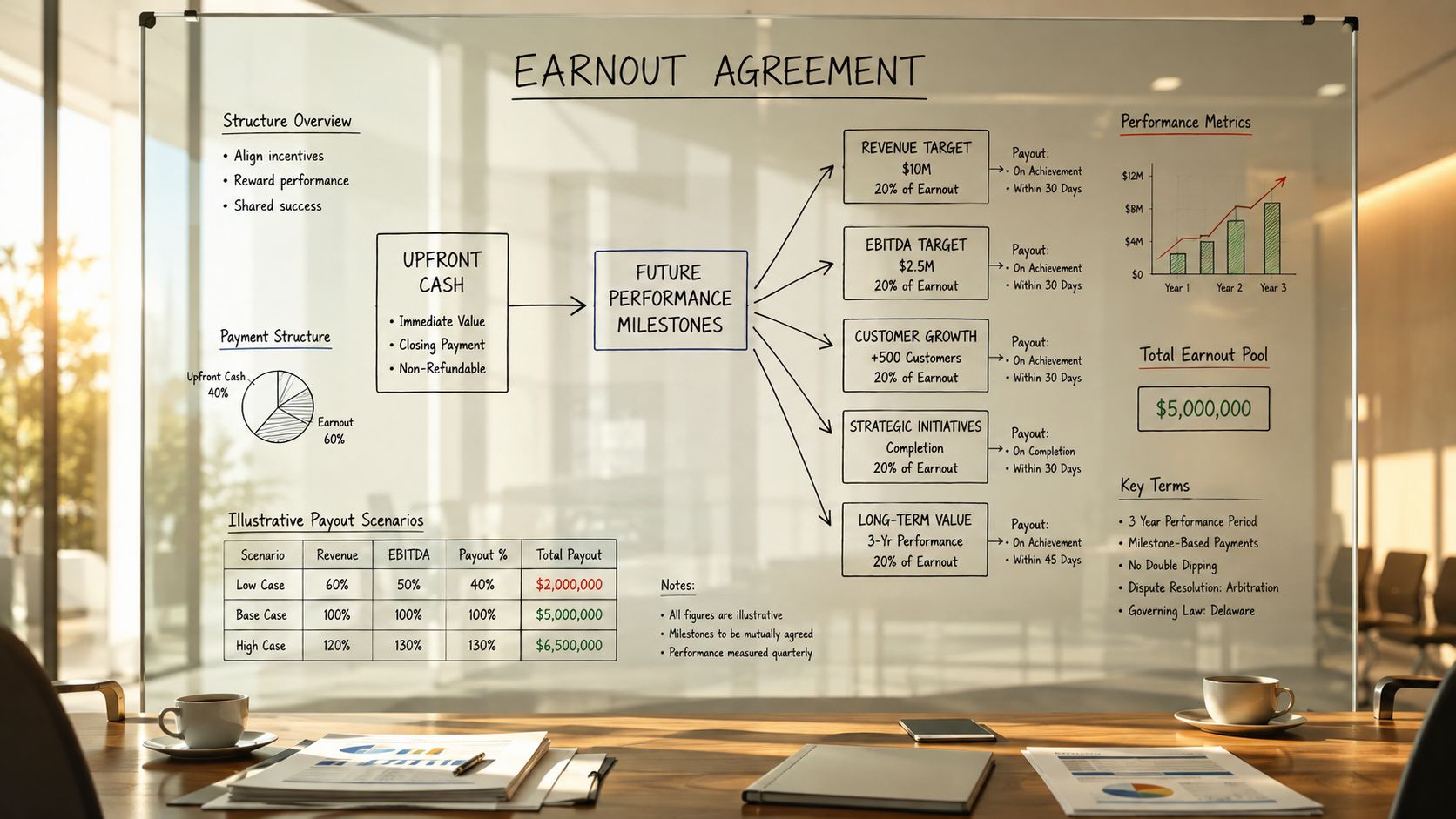
An earnout makes part of the purchase price contingent on future performance. It can bridge a gap between the seller's expectations and the buyer's confidence, but only if the agreement defines metrics, accounting rules, decision rights, and dispute procedures with precision. Poorly drafted earnouts create conflict rather than alignment.
Comparing Financing Structures for Deal Success
A financing structure should be evaluated against the actual failure points in the transaction. Cost matters, but a structure that cannot fund on time has no economic value. The buyer also needs to consider how much ownership is surrendered, whether the business can absorb required payments, and whether the documents permit acquisitions or operational changes after closing.
Private credit's role is expanding because it can offer execution certainty and adaptable underwriting. The 2026 market discussion from Clifford Chance on global M&A trends describes private credit as increasingly important, alongside insurance capital, renewed bank lending, and equity co-investment. It also notes that alternative credit can improve certainty and speed in competitive auctions.
| Structure | Execution Speed | Deal Certainty | Cost of Capital | Equity Required | Post-Close Flexibility |
|---|---|---|---|---|---|
| Senior bank debt | Moderate to slow | Strong after approval, but sensitive to diligence | Usually lower | Lower than fully equity-funded structures | Can be limited by covenants |
| Seller note | Fast when seller is cooperative | Depends on seller confidence and documentation | Negotiated | Reduces upfront equity need | Often flexible, but senior lender consent may apply |
| Mezzanine debt | Moderate | Useful for filling a defined gap | Higher | Lower than an all-equity structure, but may include equity rights | Constrained by layered debt obligations |
| Private credit unitranche | Often faster than traditional bank debt | High when the lender is committed | Higher than senior bank debt | Often substantial | Frequently negotiated, but lender protections are robust |
| Equity or co-investment | Variable | High once committed | Highest economic cost if the deal performs well | Highest capital contribution from investors | Greater cash-flow flexibility, but less ownership control |
| Hybrid structure | Depends on the slowest critical component | Can be strong if sources are coordinated | Blended | Tailored to the funding gap | Depends on intercreditor and governance terms |
Matching structure to transaction pressure
Use senior bank debt when the target's financial history is clean and the timeline allows a full underwriting process. Choose private credit when speed, certainty, and structural flexibility justify the higher cost. Seller financing is particularly powerful when the seller wants a higher headline price but understands that the buyer can't safely fund all consideration at closing.
Equity becomes more attractive when the target has growth potential that current cash flow doesn't capture, or when heavy debt would leave too little room for integration. A partnership can also improve credibility if the capital partner has completed similar acquisitions.
The cheapest capital is not always the most valuable capital. The valuable capital is the capital that closes without impairing the business afterward.
How Covenants and Leverage Shape Deal Behavior
Interest rates get attention because they're easy to compare. Covenants deserve more scrutiny because they determine what the buyer can do when the business performs differently from the base case.
Empirical work using global LBO and syndicated-loan data shows that covenants act as deal-shaping constraints, not merely downside protection. Acquisition flexibility can depend on merger baskets, asset-sale permissions, and indebtedness baskets, while maintenance tests may include debt and fixed-charge coverage ratios. The underlying research is discussed in the Journal of Financial Economics covenant analysis.
The terms that change your options
A merger covenant may restrict acquisitions unless the buyer meets a pro forma test. An indebtedness basket may limit new borrowing, even when an add-on acquisition would improve the platform. Asset-sale provisions can control whether the buyer can dispose of underperforming locations, equipment, or divisions.
Maintenance covenants create an ongoing monitoring obligation. The buyer must calculate the relevant ratios according to the agreement's definitions, not solely rely on internal accounting. EBITDA add-backs, permitted synergies, extraordinary expenses, and acquisition adjustments can materially change the calculation.
Direct-lending covenant cushions may be calibrated with roughly 25% to 35% cushion to projected EBITDA, as described in the cited academic and market context. That cushion isn't permission to overborrow. It's a negotiated buffer intended to reduce technical default risk while leaving room for integration volatility and future acquisitions.
Model the bad months before signing
Build a covenant model that includes slower collections, customer loss, margin pressure, delayed synergies, and unexpected integration costs. Then test the exact reporting definitions and cure rights.
Ask these questions before committing:
- What triggers a default? Separate payment default, covenant breach, reporting failure, and change-of-control provisions.
- How much headroom exists? Measure it against conservative operating assumptions, not management's most optimistic case.
- Can the buyer make add-on acquisitions? Review merger baskets, pro forma tests, and required lender consent.
- Who controls remedies? Understand whether a breach leads to a waiver negotiation, additional fees, cash sweeps, or acceleration.
- What happens during a sale? A financing package can affect exit timing, consent requirements, and transaction proceeds.
For a plain-English explanation of the subject, see this guide to what acquisition covenants mean. The key lesson is simple: negotiate flexibility before the lender has power over a live problem.
Creative Deal Structures That Bridge Financing Gaps
The most useful structures solve a specific mismatch. The buyer may have operating ability but limited cash. The seller may want a high price but worry about the buyer's capacity. An investor may have capital but lack an operator. Good deal design gives each party a reason to accept the risk it understands best.
Scenario one, the valuation gap
A seller believes the business deserves a higher price because a new contract is expected to expand revenue. The buyer refuses to pay for performance that hasn't arrived.
An earnout can place the disputed value after closing. The buyer pays the agreed base consideration, then pays additional amounts if clearly defined revenue, gross profit, customer retention, or delivery milestones are achieved. The agreement must specify who controls pricing, staffing, marketing, and investment decisions, because the buyer can't be held responsible for a target it isn't allowed to influence.
This guide to structuring acquisition earnouts is useful when converting a broad promise into measurable contractual mechanics.
Scenario two, the equity shortfall
A buyer can obtain senior debt, but the lender's required equity contribution exceeds the buyer's available cash. The seller wants to retire but is willing to support a transition.
A subordinated seller note can reduce the cash required at closing, provided the senior lender accepts the structure. The buyer preserves liquidity for payroll, inventory, customer retention, and integration. The seller receives a contractual claim and may gain confidence from remaining economically connected to the outcome.
The note should address payment priority, interest accrual, maturity, prepayment, information rights, and what happens if the business misses its plan. Informal promises are not a financing structure.
Scenario three, the missing operator or capital partner
A first-time buyer finds an attractive company but lacks either the equity or the sector experience to win the seller's trust. A partnership can combine the buyer's sourcing and operating plan with a capital partner's funding and transaction experience.
The partners need more than a handshake. Define ownership, decision rights, future capital calls, compensation, deadlock procedures, exit rights, and the circumstances under which one partner can buy out another. A joint venture can close a deal that neither party could complete alone, but unclear governance can make the post-close relationship more dangerous than the original financing gap.
Hybrid structures
A practical capital stack might combine senior debt, a seller note, investor equity, and an earnout. Each layer funds a different risk. Debt supports the portion covered by dependable cash flow, equity protects the company against volatility, the seller note bridges immediate liquidity, and the earnout handles uncertain future value.
The structure works only when the documents work together. Intercreditor terms, payment restrictions, guarantees, security interests, and operating covenants must be reviewed as one system rather than negotiated in isolation.
Raising Capital for Your Acquisition Step by Step
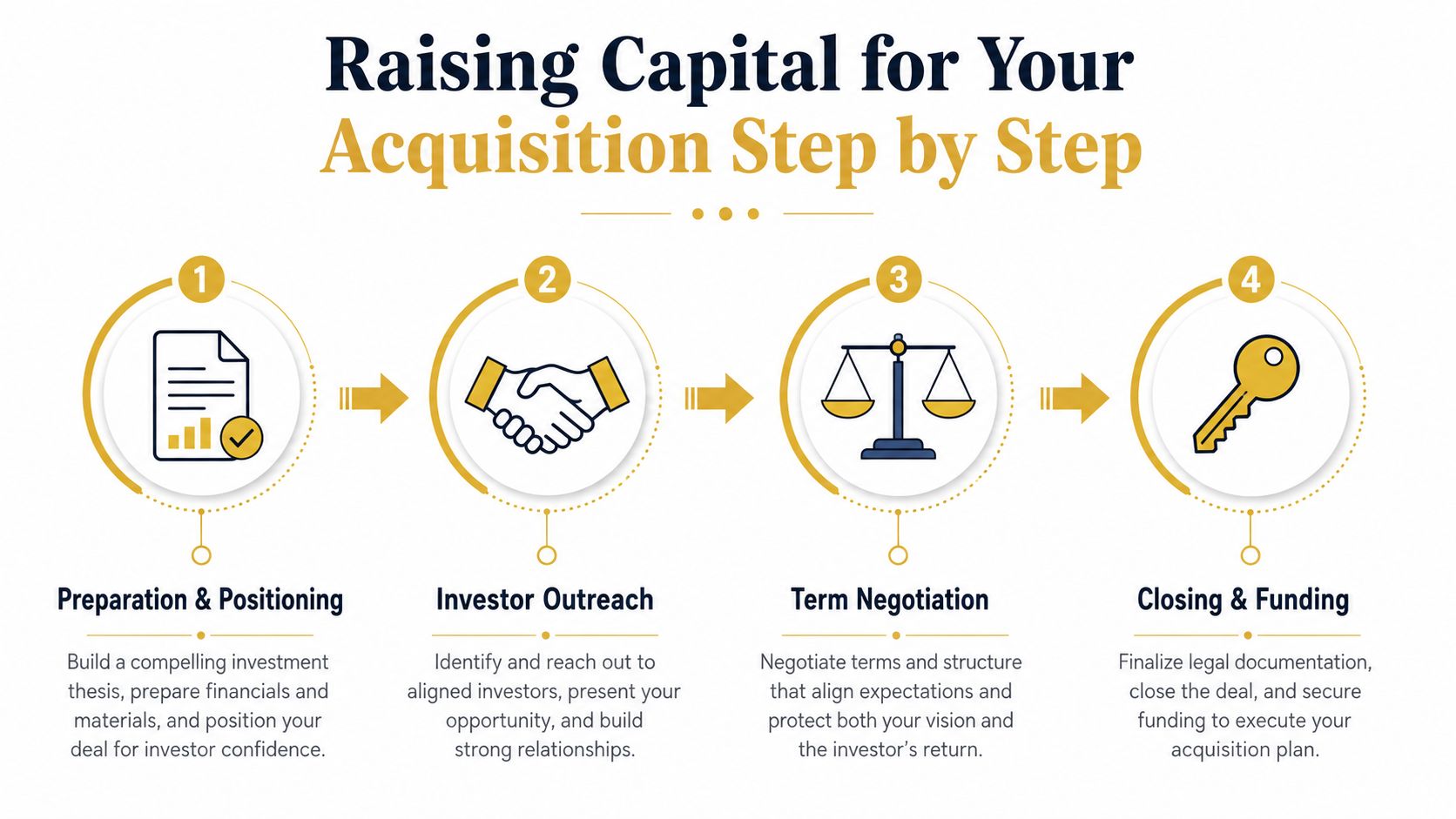
Capital raising starts before the buyer approaches a lender or investor. A credible buyer can explain the target, the purchase logic, the downside case, the operating plan, and the precise amount of capital required. A weak buyer asks for “funding” without showing how the money will be used or repaid.
Step one, prepare the transaction
Build a sources-and-uses schedule, a quality-of-earnings view, a working-capital requirement, and an integration budget. Organize tax returns, financial statements, customer concentration information, contracts, debt schedules, ownership records, and the seller's explanations for unusual items.
Your model should separate historical results from adjustments and projected improvements. Lenders may give limited credit to expected synergies, while equity investors may underwrite them only after seeing a credible implementation plan.
Step two, position the buyer
Investors back a complete proposition, not just a company. Present your operating background, why this target fits your capabilities, how the seller transition will work, and what happens if growth arrives later than expected.
Approach multiple capital sources, but don't send the same generic deck to everyone. A bank wants repayment visibility. A private credit fund wants structural protection and a clear path to repayment. An equity partner may care more about governance, upside, and the buyer's ability to execute.
For a practical reference point on acquisition lending channels, buyers can review Business Loan Warrior's acquisition funding guide, then verify eligibility and terms directly with the relevant lender.
Step three, negotiate the full package
A term sheet is only the start. Compare pricing, amortization, collateral, personal guarantees, covenants, reporting, prepayment provisions, closing conditions, and lender consent rights.
Don't negotiate the headline rate while ignoring the definition of EBITDA or the permitted acquisition basket. Those details can determine whether the business has room to grow after closing.
The video below provides another format for thinking through the capital-raising process.
Step four, coordinate diligence and funding
Keep legal, financial, lender, investor, and seller workstreams synchronized. A financing commitment can still fail if diligence reveals a contract problem, a working-capital dispute, an unresolved lien, or an operating risk that changes the lender's view.
Before signing, confirm every funding condition, required equity wire, payoff letter, security document, insurance requirement, and transition deliverable. Closing day should verify an already coordinated process, not reveal missing pieces.
Building Your Optimal Capital Structure Decision Framework
The optimal structure balances four questions:
- Cash flow stability: Can the target support scheduled debt through a weak operating period?
- Growth and risk tolerance: Are projected improvements dependable enough to justify debt financing?
- Cost of capital: What is the total economic cost after fees, warrants, dilution, seller concessions, and restrictive terms?
- Control requirements: Which decisions must the buyer retain, and what governance can be shared?
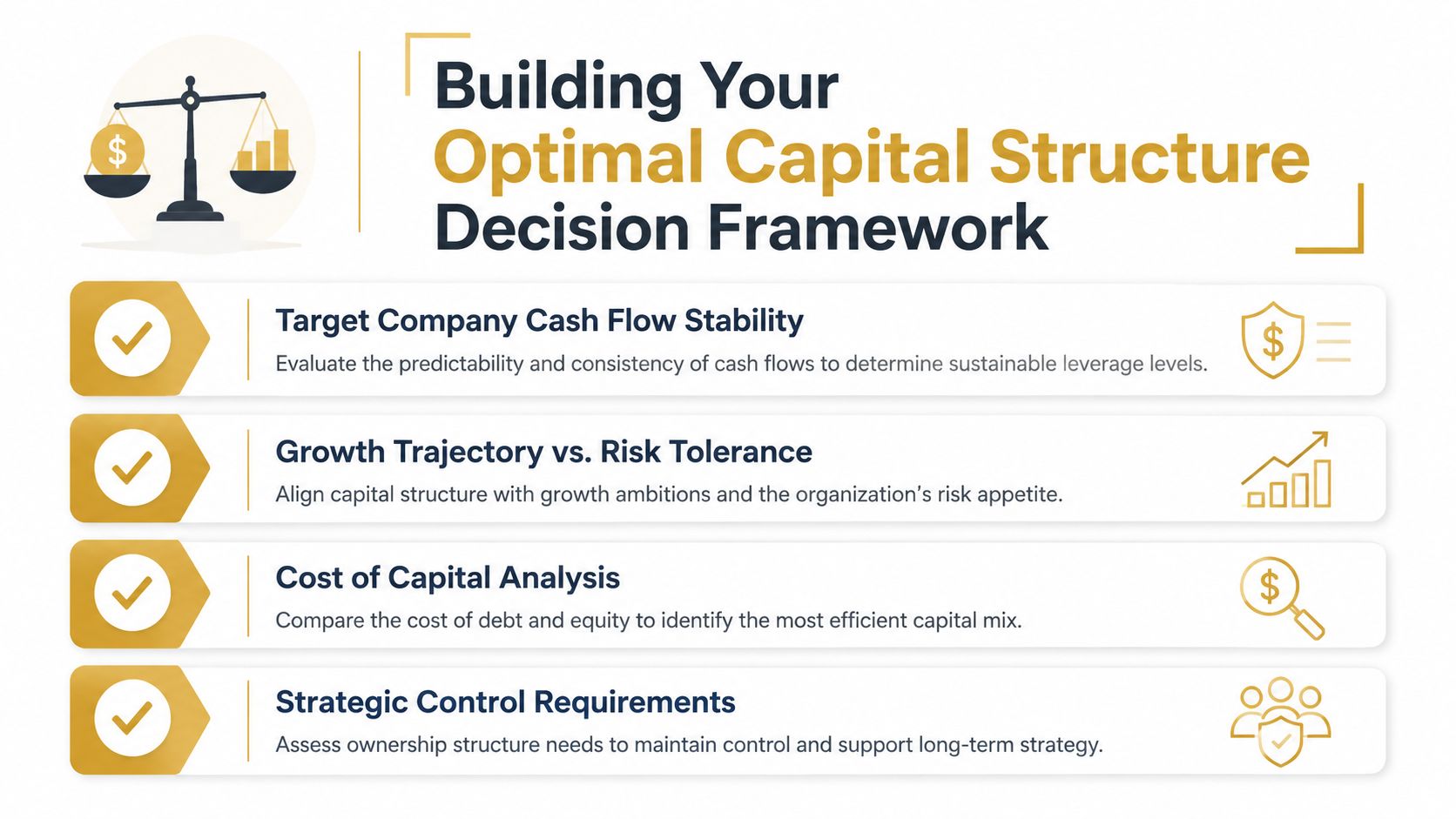
Choose the least expensive structure that still closes on time and leaves the company operationally resilient. If the target has stable cash flow, senior debt may anchor the stack. If timing is critical, private credit may justify its premium. If equity is limited, combine seller financing with a carefully governed capital partner. If future performance is uncertain, shift part of the price into an earnout instead of borrowing against hope.
Dealmaker Wealth Society provides acquisition training, capital-raising education, deal-structuring playbooks, mentorship, and a peer network for buyers working through transactions like these. Visit Dealmaker Wealth Society to develop a financing plan, evaluate creative structures, and connect your acquisition strategy to the capital required to close.

From the Dealmaker Blog









A Creative Business Buying Fable