Joint Venture vs Partnership: SMB M&A Guide
Joint Venture vs Partnership: SMB M&A Guide

You've found a promising small business, but the acquisition needs more than capital. An industry operator can bring sourcing access and integration experience, while you bring financing, deal execution, or ownership of the acquisition vehicle. A handshake may feel efficient at the start. It becomes dangerous when both parties begin approving expenses, directing employees, sharing profits, or signing obligations without agreeing what legal relationship they've created.
That's the practical problem behind joint venture vs partnership decisions. The label on a term sheet won't control every legal consequence. The parties' conduct, the agreement's wording, the entity used, and the jurisdiction can all shape liability, authority, taxation, and exit rights. For SMB buyers, structure should be decided before sourcing turns into operating activity, not after the first bolt-on closes.
Table of Contents
- The Hidden Risks of Informal Deal-Making
- Core Legal and Temporal Distinctions
- Liability Exposure and Governance Mechanics
- Matching Structures to M&A Use Cases
- Preventing Accidental Partnership Status
- Modern Deal Trends and Capital Flexibility
- The Acquisition Entrepreneur Decision Framework
The Hidden Risks of Informal Deal-Making
A buyer identifies a family-owned service company with a strong customer base but weak sales execution. An industry specialist knows how to improve the operation and offers to help find a nearby bolt-on. The buyer agrees to fund diligence and the purchase. The specialist will contribute relationships, negotiate with the seller, and lead integration. They split the expected upside in a short email that calls the arrangement a “partnership.”
The first target doesn't close. A second opportunity appears. The specialist opens a shared bank account for diligence costs, tells the seller that both parties will own the platform, and signs a vendor agreement for integration support. The buyer pays the invoice, and both parties begin describing the project to lenders as their acquisition business.
Nothing about that sequence requires bad faith. It can still create a dispute over authority, profit entitlement, confidential information, and responsibility for obligations. The parties may have intended a one-off joint venture, but their conduct can look like an ongoing business operated for shared profit.
The label isn't the protection
A joint venture is generally designed around a defined commercial objective, such as one acquisition, a particular bolt-on, or a market-entry initiative. A partnership usually supports a continuing enterprise in which the parties share operations, profits, and risk. The distinction affects how quickly the relationship can end and how much authority each participant may exercise.
Loose term sheets often address economics while ignoring the mechanics that make those economics enforceable. They may say who receives what percentage of profits but omit who can bind the venture, which expenses require consent, whether a party can pursue another target independently, and what happens if the buyer and operator disagree.
Practical rule: If the parties can't explain what ends the relationship, who controls each decision, and which entity signs each obligation, they haven't finished structuring the deal.
Where the exposure starts
Risk tends to appear at transaction boundaries:
- Sourcing: A prospective partner may claim ownership of an opportunity after introducing the seller, even if no acquisition vehicle exists.
- Signing: A party may make representations or commitments that the other party never approved.
- Closing: Capital contributions, seller financing, guarantees, and indemnities can create obligations outside the intended project scope.
- Integration: Shared employees, customer communications, and operating bank accounts can make a temporary collaboration look continuous.
- Exit: Without a termination trigger, one party may argue that the relationship continues beyond the original acquisition.
The right question isn't just which structure sounds more impressive. It's whether the documents and behavior keep the collaboration inside the intended boundaries.
Core Legal and Temporal Distinctions
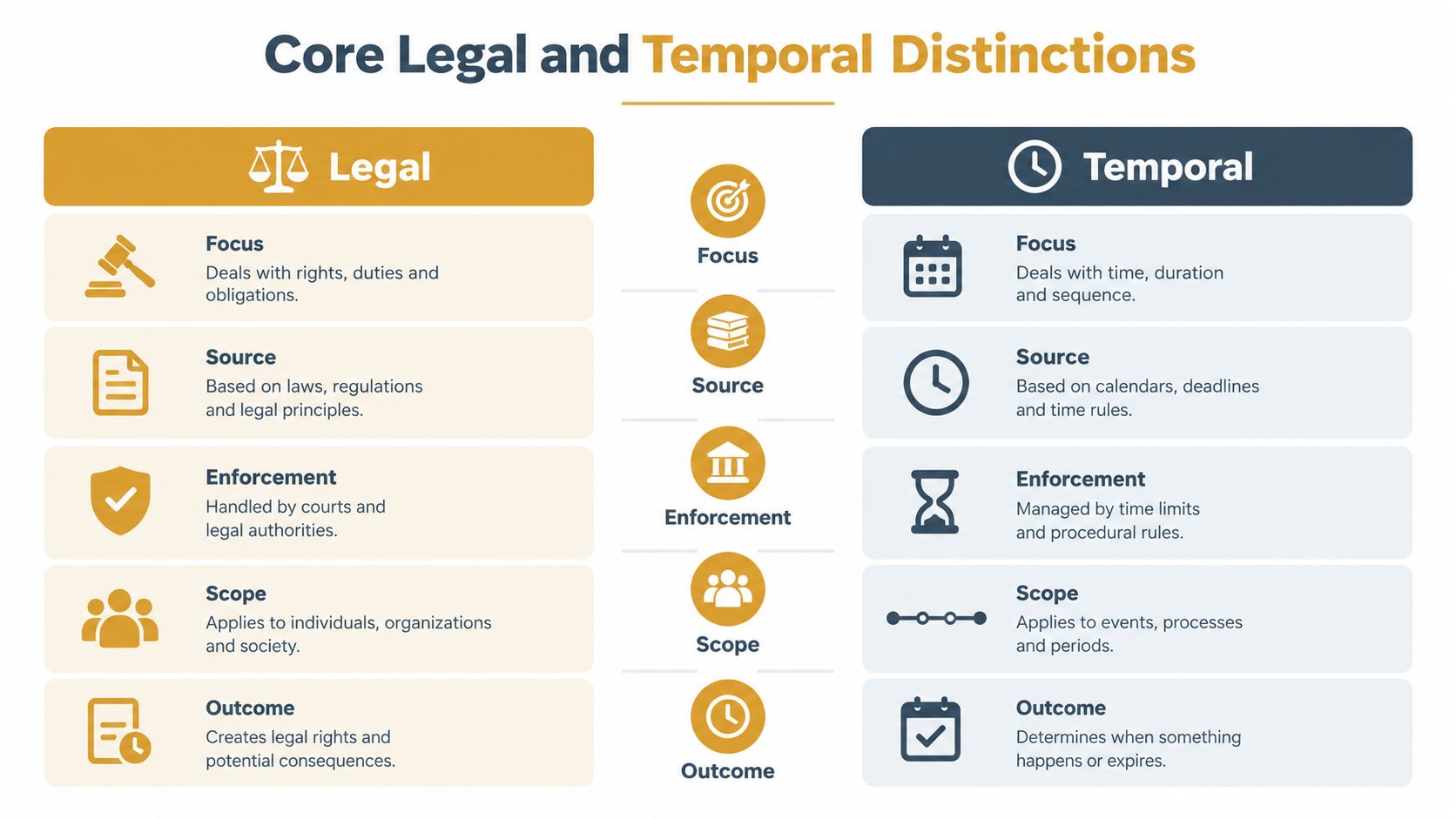
The basic distinction is straightforward, but its legal effect is not. A joint venture is typically temporary and project-specific, while a partnership is usually an ongoing business relationship. A buyer pursuing one acquisition may want a defined vehicle that ends after closing and a transition period. Two operators building a permanent platform may instead need continuing ownership, management authority, and shared economics.
Courts may look beyond the name
In U.S. legal practice, courts in most states often apply partnership law to joint ventures. That means calling an arrangement a JV doesn't automatically prevent partnership principles from influencing disputes over authority, duties, or liability. Texas and Maryland are among the few jurisdictions that have expressly abolished the legal distinction by statute, which shows why a buyer must analyze local law rather than rely on a generic internet definition. Fordham Law Review commentary on joint ventures and partnership treatment provides useful context for this jurisdiction-sensitive problem.
The agreement should therefore describe the project, contributions, ownership economics, authority limits, fiduciary expectations, records, tax responsibilities, and dissolution process. It should also state whether the parties intend to form a separate entity, whether either party can act as an agent, and which obligations remain with the individual parties.
Historical context reinforces how foundational partnership concepts are in commercial law. Special rules regulating partnerships date back to about 2300 BC under the Code of Hammurabi. Modern partnerships remain significant: the IRS reported more than 4.5 million partnership returns for tax year 2023, representing over 30.2 million partners. Limited liability companies made up 72.7% of all partnerships, while limited partnerships accounted for 9.7%, according to the source discussing IRS partnership figures and joint venture treatment.
Time horizon changes the operating design
A JV should identify the event that completes the project. That might be acquisition closing, completion of integration milestones, sale of a specific asset, or achievement of a defined market-entry objective. A partnership agreement must instead anticipate recurring decisions, additional investments, new business lines, partner withdrawals, and long-term succession.
Tax administration deserves attention from the beginning. The parties should confirm which entity files, how income and losses are allocated, who maintains records, and what happens if a filing is late or incomplete. Buyers unfamiliar with partnership compliance can review the practical implications of a partnership late filing penalty before finalizing their operating documents.
For broader acquisition planning, compare the structure against the transaction's diligence requirements using this guide to comparing business acquisition models. The legal label should follow the commercial plan, not substitute for one.
Liability Exposure and Governance Mechanics
Liability is where the joint venture vs partnership debate becomes a financial decision rather than a terminology exercise. A general partnership can expose every general partner to joint and several liability for obligations incurred by another partner acting with authority. One partner's operational mistake, unauthorized commitment, or poorly managed vendor relationship can therefore transmit risk to the others.
A JV generally preserves each party's separate liability structure. The parties can define the venture's purpose, limit authority, allocate losses, and keep unrelated business obligations outside the project. That protection isn't automatic. It depends on the entity, contract, conduct, insurance, and applicable law.
Compare the exposure before signing
| Feature | Joint Venture | General Partnership |
|---|---|---|
| Commercial scope | Usually tied to a defined acquisition, asset, or project | Usually supports an ongoing business |
| Separate identity | Parties generally retain their separate businesses and can use a project vehicle | Partners operate through the partnership relationship |
| Authority | Can be restricted to named decisions and approved budgets | Each partner may have broad authority to act for the partnership |
| Liability | Can be allocated around the venture's defined activity and contributions | One authorized partner's obligations can expose all general partners |
| Deadlock | Agreement can specify escalation, buy-sell, or termination triggers | Requires detailed continuing governance provisions |
| Exit | Can be linked to project completion, sale, or another defined event | Often requires dissolution, withdrawal, or negotiated buyout |
| Best fit | Isolated transactions with bounded exposure | Continuing operations with shared risk and shared profit motive |
Engineer control instead of hoping for cooperation
A well-designed JV agreement should identify reserved matters. These commonly include acquisition price changes, debt, guarantees, hiring or firing key personnel, related-party transactions, material contracts, litigation settlements, and distributions. The agreement should distinguish ordinary-course decisions from decisions requiring unanimous approval or a specified voting threshold.
Deadlock provisions matter just as much. A useful sequence may require management discussion, escalation to principals, mediation, and then a defined buyout, sale process, casting right, or termination mechanism. The parties should also decide what happens to a target opportunity if they can't agree. Otherwise, the first disagreement can freeze the acquisition while the seller moves on.
Partnerships need stronger guardrails
A partnership can work well when the parties intend to operate together over time. It works poorly when the parties choose it for convenience but expect one person to control daily operations while the other assumes limited exposure. Broad agency authority and continuing shared economics can create precisely the risk the passive partner thought they had avoided.
Drafting should cover capital calls, partner loans, distributions, noncompete obligations where enforceable, intellectual property, confidentiality, insurance, books and records, dispute resolution, and transfer restrictions. It should also define whether a partner may pursue competing acquisitions, use shared personnel, or pledge partnership assets.
Control is not the same as ownership. A minority capital partner can still face serious exposure if the operating agreement leaves authority undefined.
The practical test is simple. If a party needs exposure limited to one acquisition, that party should insist on a narrow purpose, separate accounting, controlled signing authority, and a clear end point. If the parties want a permanent operating company, they should accept that continuing governance and shared risk require much more than a short profit-split clause.
Matching Structures to M&A Use Cases
Structure should follow the deal's operating reality. Start by asking whether the parties are combining resources for one defined transaction or creating a business that will repeatedly acquire, operate, and reinvest. The answer affects financing, control, tax administration, and the cost of unwinding the relationship.
Use a JV for a contained objective
A joint venture usually fits an isolated bolt-on acquisition. The buyer may contribute capital and transaction execution, while an industry operator contributes sourcing, customer knowledge, and post-close leadership. The agreement can define the target, the approved budget, the integration responsibilities, and the point at which the parties either distribute the asset, continue under a new arrangement, or sell.
A single-asset real estate hold is another natural use. One party may source the property and manage it, while another supplies equity. They can ring-fence the property, specify refinancing and sale decisions, and keep each participant's unrelated assets outside the project.
Market entry also favors a JV when one party wants temporary access to local relationships, licenses, technology, or distribution. The parties can test the opportunity without immediately combining their entire businesses. If the market doesn't justify continued investment, the exit mechanics can be activated without dissolving each party's broader enterprise.
The benefits of joint ventures for business growth are most relevant when the collaboration needs shared resources but not permanent shared ownership.
Use a partnership for a continuing platform
A partnership is more appropriate when the parties intend to build a long-term equity partnership. A roll-up platform may need recurring capital calls, standardized acquisition criteria, shared employees, common branding, and reinvestment of profits. Treating every acquisition as a separate temporary JV can create administrative friction and inconsistent economics when the parties want one continuing enterprise.
The partnership model can also suit two operators who will jointly manage the acquired business indefinitely. Both parties may have meaningful authority, contribute ongoing labor, and share profits from the entire operation rather than from a single asset. In that case, the agreement needs a durable governance system, not just an end date.
Match the structure to each transaction stage
Use this sequence before selecting the entity:
- Define the asset or platform. One target or bolt-on points toward a JV. A pipeline of acquisitions points toward a continuing structure.
- Separate contributions. Identify cash, seller relationships, financing guarantees, labor, intellectual property, and operating assets. Contributions shouldn't be described as “support” without valuation or performance expectations.
- Set control by decision type. Daily management, acquisition approval, borrowing, distributions, and sale decisions may require different voting rules.
- Model the exit. Specify who can trigger a sale, how a buyout is priced, and whether a party can continue independently after termination.
- Confirm tax and filing treatment. The chosen vehicle may produce different reporting, allocation, and compliance obligations by jurisdiction.
A structure that looks efficient at signing can become expensive if every new acquisition requires renegotiation. Conversely, a permanent partnership can burden a one-off transaction with unnecessary shared authority and continuing obligations.
Preventing Accidental Partnership Status
Many buyers assume a signed document controls the relationship. It helps, but conduct can tell a different story. UK guidance notes that partnerships can be created by conduct, while a joint venture is usually governed by contract and may avoid default partnership rules if structured correctly. Cross-border transactions deserve particular caution because the same commercial behavior can produce different liability, filing, and taxation outcomes by jurisdiction.
Keep the project visibly separate
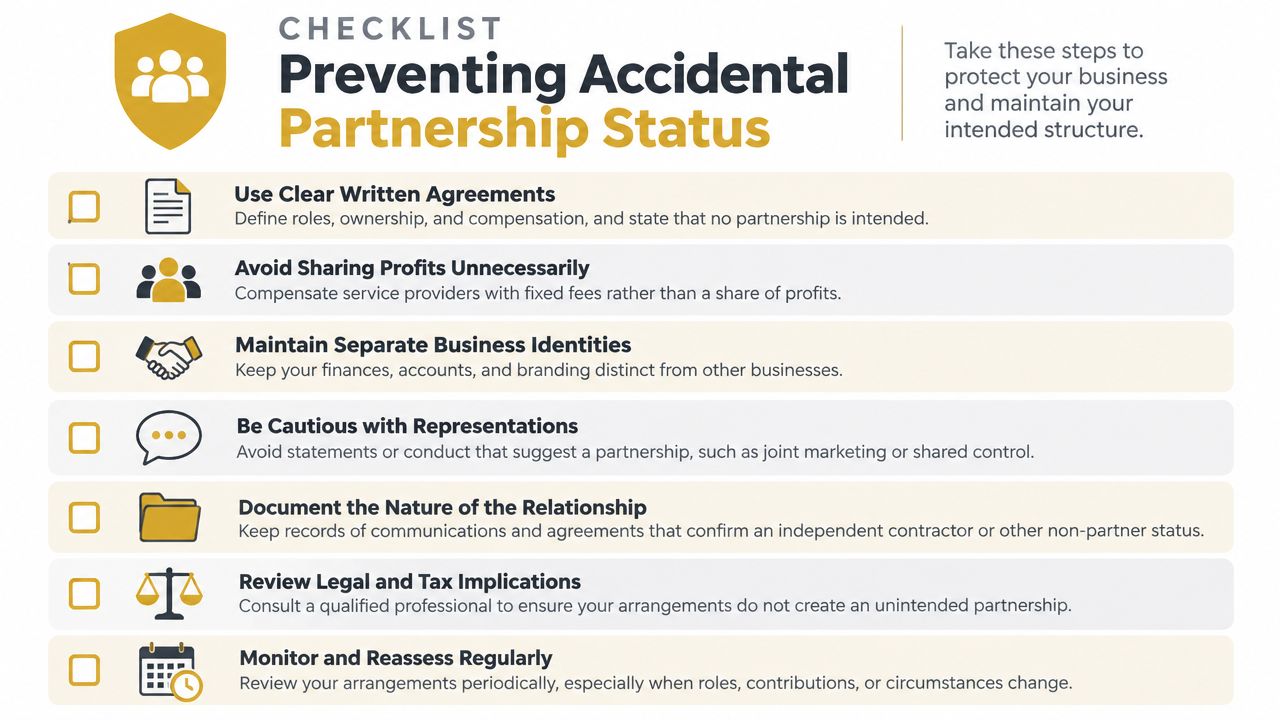
A buyer who wants a JV should make the project look and operate like a defined project. Use a dedicated entity or contract, a separate bank account, project-specific accounting, and written approval limits. Send seller, lender, employee, and vendor communications through the correct entity. Don't casually describe the parties as “partners” if the intended relationship has narrower scope.
The documents should identify:
- Purpose: The exact acquisition, asset, territory, or initiative covered.
- Duration: The event or date that ends the arrangement.
- Contributions: Cash, labor, guarantees, assets, and intellectual property.
- Authority: Who can sign, spend, borrow, hire, settle, or make representations.
- Economics: How revenue, expenses, losses, and distributions are calculated.
- Independence: Which activities remain outside the venture.
- Exit: Sale, buyout, dissolution, transfer, and post-termination obligations.
Watch the drift after closing
Accidental partnership risk often grows during integration. The parties start by sharing diligence costs, then share employees. The operator begins signing contracts for the acquired company, the capital partner approves operational spending, and both parties treat cash generated by the target as a common pool. Each step may seem practical. Together, they can undermine the boundaries written into the JV agreement.
Use a stage-based control checklist:
- During sourcing, record who introduced the opportunity and whether any fee or equity right exists before confidential information is exchanged.
- At signing, require written approval for the purchase agreement, financing, guarantees, and seller communications.
- At closing, document capital contributions, ownership issuance, board or manager appointments, and signing authority.
- During integration, track shared services, employee reporting lines, vendor contracts, and intercompany charges.
- At exit, follow the agreed valuation, transfer, sale, and winding-up process instead of continuing informally.
A project doesn't stay a project merely because the original email called it one.
Before inviting someone into a recurring acquisition program, use a structured process for analyzing potential business partnerships. Legal counsel and tax advisers should review the actual documents and conduct, especially when multiple entities or countries are involved.
Modern Deal Trends and Capital Flexibility
The shorthand that JVs are short-term and partnerships are long-term helps at first, but it can mislead acquisition entrepreneurs. A joint venture may support a complex growth initiative while allowing each party to retain strategic independence. A partnership may create unwanted exposure when the parties need to change funding sources, add bolt-on acquisitions, or separate one business line from the wider platform.
A market data platform tracks 239,609 or more joint venture and strategic alliance transactions dating back to 1966, including 78,629 formal joint ventures and 160,968 strategic alliances, as reported by LSEG's joint venture transaction data. The figures show that collaborative structures serve many deal types, from defined commercial initiatives to broader strategic programs.
Flexibility matters in capital-intensive deals
Technology-related initiatives often require capabilities that neither party wants to own permanently. A buyer might need data infrastructure, engineering talent, distribution, or sector expertise for a defined expansion. A JV can set funding rounds, development milestones, intellectual property rights, and commercialization decisions without forcing a permanent combination.
The same logic applies to acquisition funding. If capital needs may change during sourcing, a bolt-on, or post-close integration, the agreement should state how additional funds are requested and whether contributions are mandatory. It should also specify the result when one party declines, including dilution, revised ownership, or a preferred return. Guarantees need similar treatment, with clear fees, approval rights, liability limits, and release conditions.
A global survey of competition authorities found average JV notification volumes rose from fewer than 20 notifications per authority in 2017 to close to 40 in 2019. The practical lesson is not that every SMB should form a JV. Collaborative structures can require serious regulatory, financing, and governance analysis, particularly when repeated acquisitions make an informal arrangement look like an ongoing enterprise.
Preserve independence without creating ambiguity
A modern JV agreement should define independence in operational terms. Each party needs clear rules for using customers, employees, technology, and suppliers, including the permitted period and conditions. Shared capability should have assigned responsibilities, approval rights, and a process for changing the arrangement when the market or acquisition plan shifts.
Informal conduct can still create partnership risk. Shared contracts, pooled cash, recurring profit allocations, or authority to bind the other party may matter more than the label on the agreement. Structure and conduct must therefore match throughout the deal cycle.
Watch the embedded video for a visual discussion of the structure and decision points:
The deciding factor is often control velocity. If the parties need to scale a defined initiative and later separate cleanly, a JV may offer the better architecture. If they intend to operate one enterprise with enduring shared authority, a partnership may fit better. Neither label resolves financing, execution, or trust problems without precise documents and disciplined conduct.
The Acquisition Entrepreneur Decision Framework
Use the transaction stages as the decision test. Don't ask only, “Which structure is cheaper to form?” Ask what the parties need to control, what they may become responsible for, and how they will separate when the economics change.

Sourcing
Define opportunity ownership before anyone contacts sellers. Is the relationship limited to one target, or can either party bring future acquisitions into the shared economics? Who pays for diligence? Who owns rejected opportunities? Record these answers before introductions begin.
Signing
At signing, test authority. Who can approve the letter of intent, purchase agreement, seller note, lender package, guarantees, and representations? A JV should require specific approvals for material commitments. A partnership needs an authority matrix that prevents one partner from creating obligations the other didn't anticipate.
Closing
Confirm the legal and economic architecture at closing. Document capital contributions, ownership percentages, management appointments, bank controls, insurance, indemnities, and tax responsibilities. Make sure every contract is signed by the correct entity, not by an individual acting informally for “the partnership” or “the group.”
Post-close control
Separate ownership from operating responsibility. The person running the acquired business may need authority over ordinary-course decisions, but major spending, acquisitions, debt, hiring of key executives, and distributions should follow the agreed approval process. Review the structure if the integration expands beyond the original target.
Exit
A JV should have an identifiable completion event and a process for leftover assets, liabilities, intellectual property, employees, and customer contracts. A partnership needs withdrawal, buyout, dissolution, and transfer rules that work even when the parties disagree. If no one can explain how a departing party gets paid, the exit has not been designed.
Ask counsel and capital partners these final questions:
- What facts could cause a court to treat this relationship as a partnership?
- Which obligations can one party create without the other's consent?
- What happens if one party won't fund the next capital call?
- Who owns the relationship with the seller and the target's customers?
- Can either party pursue another acquisition independently?
- What event ends the arrangement, and who can trigger it?
- Which rules change if the transaction crosses a state or national border?
Dealmaker Wealth Society offers acquisition education, live coaching, peer support, deal templates, and guidance on creative structures such as equity partnerships and joint ventures. Those resources can help buyers organize the commercial questions before taking the documents to legal and tax advisers.
The correct structure is the one that matches the intended duration, authority, exposure, funding model, and exit. Treat the decision as part of deal underwriting, and you'll reduce the chance that an informal collaboration becomes a permanent liability.
If you're evaluating a bolt-on, platform roll-up, or equity partner, visit Dealmaker Wealth Society for acquisition training, deal-structuring playbooks, mentorship, and peer support. Use the community and practical resources to clarify ownership economics, decision rights, capital responsibilities, and exit mechanics before you sign.

From the Dealmaker Blog














A Creative Business Buying Fable