
Steps in an Acquisition: The Buyer’s Roadmap
Steps in an Acquisition: The Buyer’s Roadmap

The popular advice makes acquisition sound like a hunt: define your target, find a business, make an offer, and celebrate when the seller signs the letter of intent. That sequence is incomplete. An LOI doesn't mean you've won. It means you've earned a short, expensive opportunity to discover whether the business you agreed to buy exists as presented.
The practical steps in an acquisition run from strategy and capital planning through diligence, closing, and integration. Each phase has a different decision standard. You aren't trying to prove that a deal can be done. You're trying to determine whether the risk, price, financing, and operating plan still make sense after the story meets the evidence.
Table of Contents
- Why Most Deals Break After the Letter of Intent
- Building Your Deal Team and Capital Strategy Early
- Navigating Confirmatory Diligence as a Decision Gate
- Closing the Transaction and Executing the First 100 Days
- The Hidden Cost of Skipping Pre-Close Integration Planning
- Your End-to-End Acquisition Execution Checklist
Why Most Deals Break After the Letter of Intent
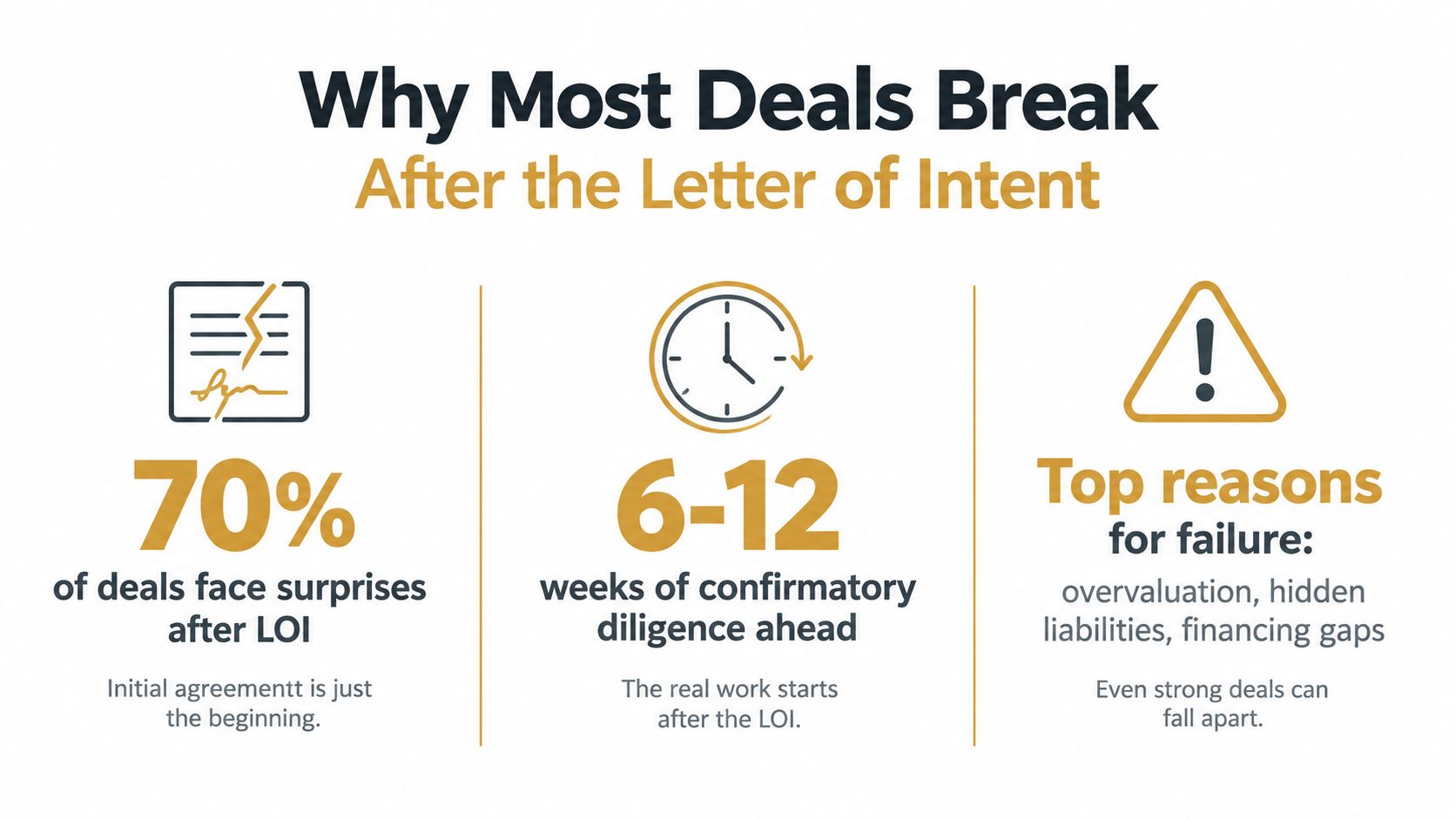
The letter of intent is where acquisition risk becomes expensive. Once exclusivity begins, the buyer has limited time to test earnings, contracts, employees, tax exposure, systems, and working capital. The seller expects progress, lenders need reliable information, and advisors bill against a fixed clock. Treating the LOI as a finish line encourages buyers to defend an emotional decision instead of testing whether the investment still works.
A 2025 CFA Institute analysis of M&A due diligence reports deal failure rates of 70% to 90% when diligence or integration is weak. The same source cites Bain's finding that almost 60% of executives attributed failed deals to poor due diligence that missed critical issues. Those figures do not mean every signed LOI is doomed. They show why the post-LOI period demands more discipline than the search and offer phase.
Exclusivity changes the buyer's job
Before the LOI, speed and relationship-building matter. After it, verification becomes the job. Set up a clean information request, a diligence tracker, owners for every workstream, and a written list of findings that could change price, financing, or structure.
The danger extends beyond fraud. A seller may calculate adjusted EBITDA generously, rely on informal customer arrangements, carry outdated inventory, or depend on an employee who plans to leave. A liability can be legitimate and still conflict with your financing, insurance, operating model, or risk tolerance.
An explanation of what an LOI means for buyers puts the document in the right context. It records commercial intent. It does not replace a purchase agreement, lender approval, diligence, or an integration plan.
Practical rule: Treat the LOI as permission to investigate, not proof that the investment works.
The post-LOI phase is a repricing mechanism
New information creates three honest choices: proceed on the original terms, revise the economics or protections, or walk away. Continuing solely because time and fees have already been spent is the costliest choice.
A 2025 review of failed transactions summarized by Valutico reports that Axial examined 75 unsuccessful transactions. It found 46.6% of collapsed LOIs failed because diligence uncovered problems or missed facts. Within that group, 25.3% involved non-QoE diligence findings and 21.3% involved EBITDA discrepancies. Financing issues accounted for 10.7% of failures in the cited analysis.
The acquisition process reaches its most consequential stage after the seller accepts the offer. That is when the buyer compares the seller's narrative with bank statements, contracts, tax filings, customer behavior, employee records, and operating reality. Hidden capital needs, weak controls, or an integration burden can change the price and the decision even when the initial offer looked attractive.
Building Your Deal Team and Capital Strategy Early
A credible buyer prepares before requesting a CIM. That preparation signals seriousness to sellers, gives advisors time to understand your buy box, and prevents financing constraints from distorting the search. It also exposes whether you can afford the transaction beyond the headline purchase price.
A small acquisition usually needs specialized judgment, not a large committee. The core team should include a transaction attorney, a QoE accountant, a lender or debt broker, and, where appropriate, an M&A advisor, tax specialist, insurance advisor, and industry operator. A family lawyer may be excellent at estate planning or general contracts, but acquisition documents contain representations, indemnities, working capital mechanics, restrictive covenants, and closing conditions that require transaction experience.

Build the team around decisions
Each advisor should have a defined question to answer.
- Transaction attorney: Can the structure protect you from known and unknown liabilities, and can the seller deliver the assets, consents, and restrictions required at closing?
- QoE accountant: Which earnings are recurring, which adjustments are defensible, and what working capital level does the business need to operate normally?
- Debt broker or lender: Does the cash flow support the proposed debt, and what information will underwriting require before issuing a commitment?
- Tax advisor: Should you pursue an asset purchase, equity purchase, or another structure, and what tax exposures transfer under the proposed deal?
- Operating lead: Can the current team, systems, and customer base support the growth plan without assumptions that the business hasn't demonstrated?
Don't hire advisors only because they offer the lowest hourly rate. Cheap review that misses a change-of-control clause can cost more than a properly scoped engagement. Ask each professional to explain deliverables, timing, relevant transaction experience, and the findings that would cause them to recommend a pause.
Budget the capital stack, not just the price
The purchase price is one use of funds. Buyers also need to plan for legal and accounting fees, lender diligence, insurance, escrow, taxes, equipment or system upgrades, and cash required to keep the business stable after closing.
For SBA-financed acquisitions, guidance on buying a small business indicates that buyers typically need a 10% equity injection. The same guidance says a $3 million acquisition can require approximately $350,000 to $400,000 in effective all-in capital after professional fees and transaction costs. These are planning benchmarks, not substitutes for a lender's underwriting or a transaction-specific budget.
Create a sources-and-uses schedule before you pursue targets. Identify which funds come from personal equity, outside investors, seller financing, senior debt, or working capital reserves. Then stress-test the plan against a slower close, a required price adjustment, and a post-close cash need.
Undercapitalization doesn't always kill a deal at signing. It often kills the buyer's ability to operate confidently after closing.
A business acquisition funding strategies guide can help buyers compare funding routes, but the practical standard remains the same: know your borrowing capacity, equity availability, and liquidity floor before you fall in love with a target.
Navigating Confirmatory Diligence as a Decision Gate
Confirmatory diligence should answer one question: What must be true for this acquisition to create value at the agreed price and structure? A data room full of files isn't a diligence process. A diligence process assigns owners, tests assumptions, ranks consequences, and turns findings into decisions.
The period is demanding. Recent process guidance places confirmatory diligence at 6 to 12 weeks, while a prepared lower-middle-market sale often runs 6 to 9 months overall. Analysis of deal timing and post-LOI collapse also notes that regulated, public, cross-border, and carve-out transactions can take 9 to 24 months. The longer the process, the more important it becomes to maintain a living risk register rather than rely on memory.
Sequence the work by value and dependency
Start with the facts that can invalidate the investment thesis. Confirm revenue quality, customer concentration, gross margin logic, debt, taxes, litigation, ownership, and the seller's authority to transfer the business. Don't spend heavily on low-impact operational refinements while the core earnings number remains unverified.
A sensible sequence looks like this:
- Financial validation: Reconcile revenue and expenses to source records, normalize owner compensation and unusual items, test EBITDA adjustments, analyze working capital, and compare reported results with cash generation.
- Legal and tax review: Examine entity ownership, material contracts, leases, permits, litigation, employment obligations, intellectual property, tax filings, and change-of-control provisions.
- Commercial review: Test customer retention, pricing, pipeline quality, supplier dependence, competitive position, and the durability of the stated growth plan.
- Operational and technology review: Map people, processes, equipment, software, cybersecurity, data access, inventory, and dependencies that could interrupt service after close.
- Integration validation: Confirm that payroll, accounting, banking, reporting, systems, and decision rights can transfer without disrupting the business.
A practical operational due diligence checklist keeps the review grounded in how the company really works, not just how its folders are organized.
Sort findings into action categories
Not every issue deserves the same response.
| Finding type | Typical response |
|---|---|
| Fatal risk | Stop or suspend the deal until the issue is resolved. Examples include untransferable core rights, unsupported earnings, undisclosed liabilities, or a dependency that makes the business materially different from the buy box. |
| Economic risk | Retrade price, change financing, add a seller note, or adjust working capital terms. EBITDA discrepancies often belong here when the underlying business remains viable. |
| Protection risk | Use escrow, specific indemnities, warranties, insurance, or closing conditions when the exposure is measurable and enforceable. |
| Execution risk | Build a funded remediation plan with an owner, deadline, and post-close milestone. |
The buyer's job is not to eliminate every imperfection. It is to avoid paying for earnings that won't recur, inheriting risks that can't be protected, or accepting an integration burden that the capital plan can't support.
Use a daily findings log with four fields: fact, impact, response, and decision owner. If a seller can't provide a document, record the absence itself. Missing evidence isn't automatically proof of wrongdoing, but it should reduce confidence and may justify a structural protection or a pause.
Before each advisor call, ask what changed in the valuation, financing, closing conditions, or integration plan. That discipline prevents a long list of observations from becoming a short list of ignored warnings.
Closing the Transaction and Executing the First 100 Days
Closing is a controlled handoff, not a ceremonial wire transfer. In the final days, confirm that the purchase agreement matches the approved economics, funds are available, required consents are complete, insurance is bound, licenses can transfer, and the seller has delivered every closing item.
The working capital adjustment deserves particular attention. Define the target, calculation method, permitted accounting policies, and dispute process before the closing statement arrives. A vague mechanism can turn a negotiated price into a post-close argument.
The closing file should answer practical questions
At signing and funding, verify:
- Authority: Board, owner, lender, and investor approvals are documented.
- Assets and contracts: Purchased assets, intellectual property, leases, customer agreements, supplier terms, and permits are assigned or consented to.
- People: Employment terms, payroll access, benefits, retention arrangements, and key-person transition responsibilities are clear.
- Cash and debt: Sources and uses reconcile, debt documents are executed, and bank controls are transferred.
- Records: Accounting files, passwords, customer data, vendor information, compliance records, and operating procedures are delivered securely.
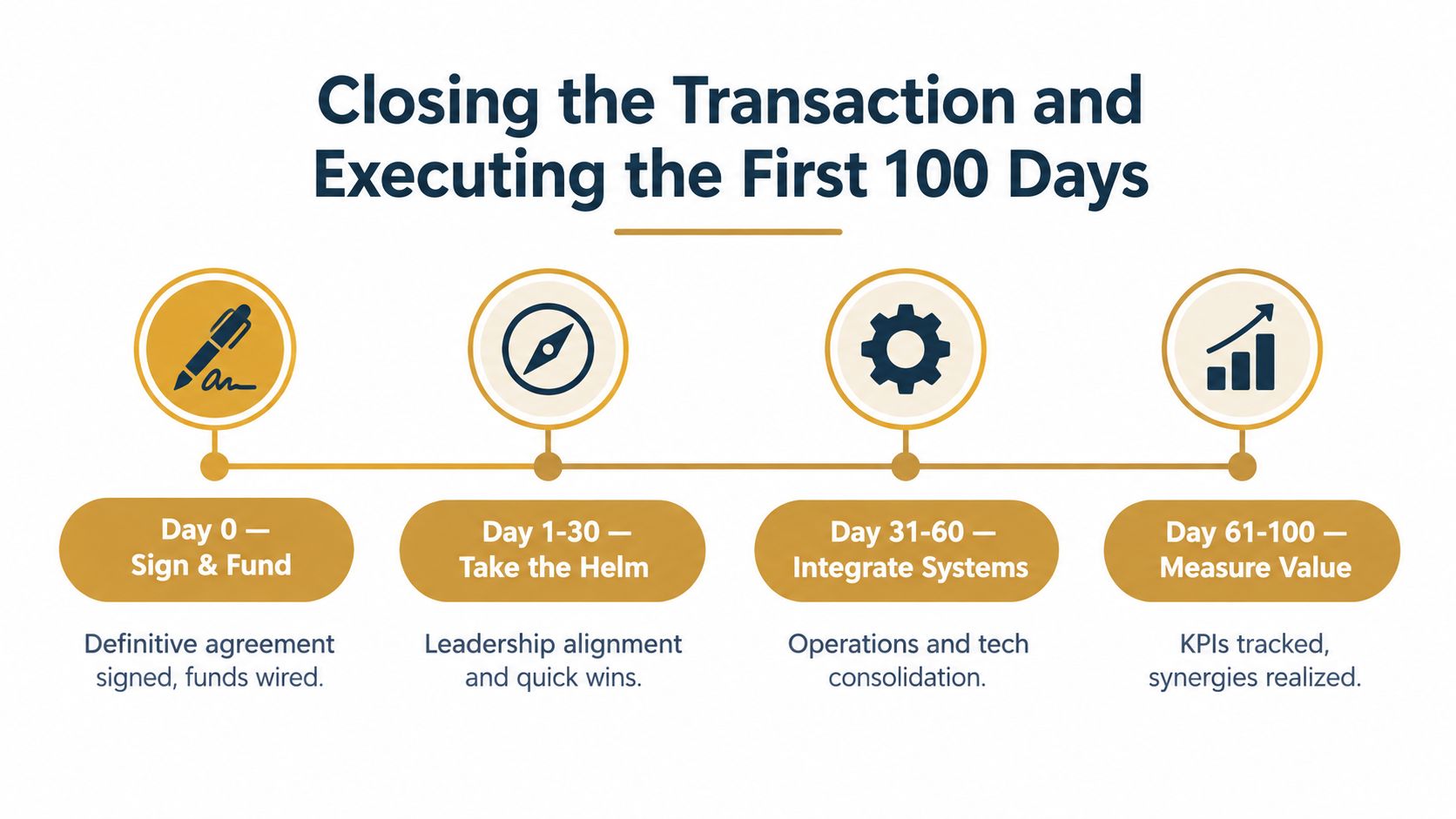
Use the first 100 days to stabilize before optimizing
On day one, employees need clarity more than a grand transformation announcement. Tell them who makes decisions, what won't change immediately, how questions will be handled, and which customer commitments remain in force. Meet key customers and suppliers early, especially where relationships depend on the former owner.
During the first month, establish reliable cash reporting, payroll continuity, customer service coverage, and a short list of operational priorities. Don't replace systems or reorganize departments just to demonstrate control. Preserve what works while identifying the constraints that prevent the business from performing.
From day 31 through day 60, consolidate the information needed for management decisions. Align accounting categories, reporting cadence, approval limits, sales stages, inventory controls, and service metrics. Document system dependencies before migrating anything.
By day 100, compare actual performance with the acquisition thesis. Review revenue, gross margin, cash conversion, customer retention, staffing, backlog, and integration milestones. The dashboard doesn't need to be complex. It needs to be consistent enough to show whether the business is moving toward the plan or consuming capital without progress.
Day-one principle: Protect continuity first. Pursue efficiency after you understand the operation you bought.
The Hidden Cost of Skipping Pre-Close Integration Planning
Integration starts before the funds settle. At closing, employees need answers, payroll must run, systems must connect, customers need reassurance, and managers need clear authority. If those workstreams were not prepared before close, the buyer spends the first weeks improvising while inherited dependencies continue consuming time and cash.
The Canadian acquisition process study divides acquisitions into pre-acquisition, acquisition, and integration phases. It found that buyers often skipped preparation: 59% secured financing before approaching the seller, 55% prepared a strategic growth plan, 41% appointed an internal or external team, and only 19% sought external help. These activities support one another. Financing affects structure, the team owns diligence and execution, the strategy defines priorities, and integration planning exposes costs before they become surprises.
Design the integration before signing
Build a 100-day integration map before signing. Assign an owner, deadline, dependency, and expected result to each workstream:
- IT and access: Inventory systems, user permissions, data ownership, cybersecurity, backups, and migration boundaries.
- Finance: Set the chart of accounts, bank controls, close calendar, reporting package, cash forecast, and working capital monitoring.
- People: Define reporting lines, retention risks, payroll, benefits, incentives, employment documentation, and the communication cadence.
- Customers and suppliers: Confirm contract transfer, service continuity, account ownership, pricing authority, and renewal priorities.
- Synergies: Identify the source, responsible operator, timing assumption, implementation cost, and measurement method.
Treat each synergy as an investment case. A lower vendor cost that requires software, training, and operational disruption may create little or no net value. Revenue cross-sell belongs in the plan only when the buyer can identify the product, customer, owner, process, and evidence behind the opportunity.
Protect the acquired culture selectively
Integration means separating value-creating practices from habits that create risk. Interview frontline employees, managers, customers, and suppliers before changing workflows. These conversations can reveal informal controls and relationship knowledge absent from the data room.
Communication must support execution. Explain why a change is happening, how it affects daily work, and where employees can raise concerns. Vague messages feed rumors, while abrupt changes create resistance. Give managers a clear transition plan they can repeat consistently.
A KPMG integration survey cited by independent commentary found that 83% of deals failing to boost shareholder returns, reinforcing the cost of weak post-close execution. The practical lesson is direct: a fair price cannot compensate for an unmanaged handoff. Budget for integration staff, system changes, training, retention measures, and temporary productivity losses before finalizing the deal.
Your End-to-End Acquisition Execution Checklist
Use this checklist as a live transaction control document. Every item should have an owner, a due date, and a definition of complete.
Before the LOI
- Define the buy box: Set target size, sector, geography, customer profile, management requirements, valuation logic, and unacceptable risks.
- Confirm capital: Document equity, debt capacity, seller-financing assumptions, transaction costs, and post-close liquidity.
- Engage specialists: Select transaction counsel, QoE accounting support, financing contacts, tax advice, and operating resources.
- Screen consistently: Use a CRM or spreadsheet to record source, fit, financial evidence, next action, and reason for rejection.
- Build the thesis: State the growth drivers, risks, integration concept, and conditions that would invalidate the offer.
- Draft the LOI carefully: Define price, structure, exclusivity, diligence access, financing conditions, working capital treatment, and closing expectations.
During confirmatory diligence
- Reconcile earnings: Test revenue, expenses, adjustments, cash flow, working capital, debt, and tax obligations.
- Verify transferability: Review ownership, contracts, leases, licenses, intellectual property, employment matters, and change-of-control terms.
- Test commercial durability: Speak with customers and suppliers where permitted, inspect retention patterns, and challenge the pipeline.
- Map operations: Document people, processes, systems, equipment, security, inventory, and critical dependencies.
- Maintain the risk register: Classify each finding as fatal, economic, protection, or execution risk.
- Update the model: Reflect retrades, escrow, indemnities, financing changes, remediation costs, and integration capital.
At closing
- Reconcile sources and uses: Confirm every funding source, fee, adjustment, and reserve.
- Complete the handoff: Secure records, access, approvals, consents, licenses, bank controls, payroll information, and customer data.
- Confirm communications: Prepare employee, customer, supplier, and lender messages before funds move.
- Protect continuity: Assign day-one decision rights and escalation paths.
After closing
- Stabilize cash and service: Track payroll, collections, customer commitments, inventory, and urgent operational risks.
- Install reporting: Create a repeatable management dashboard and close calendar. For finance teams formalizing this routine, automate your close with Loopfour offers a practical reference for organizing month-end close activities.
- Execute integration workstreams: Complete systems, finance, people, customer, and supplier actions according to the pre-close plan.
- Measure the thesis: Compare actual results with the assumptions that justified the purchase.
- Review decisions: Record what worked, what failed, and what the next acquisition should screen differently.
The strongest steps in an acquisition aren't the most glamorous. They are the repeatable controls that keep enthusiasm from outrunning evidence, and they give you permission to walk away before a weak deal becomes an expensive operating problem.
Dealmaker Wealth Society provides acquisition training, mentorship, deal feedback, funding education, and practical playbooks for buyers working through sourcing, diligence, structuring, and post-close growth. If you want a structured way to prepare your first deal team, pressure-test a target, and plan integration before closing, visit Dealmaker Wealth Society and review the available programs and community support.

From the Dealmaker Blog












A Creative Business Buying Fable
