
Business Acquisition Loan: A Complete Guide for Buyers
Business Acquisition Loan: A Complete Guide for Buyers
How much can you borrow to buy a business, and what if that question is already pointing you in the wrong direction? Buyers often start with the asking price, then work backward toward a loan amount. Lenders usually do the opposite. They start with the cash the business can reliably produce after the acquisition, then determine how much debt that cash flow can carry.
That difference explains why an attractive business can fail financing, why a seller note can rescue an otherwise difficult transaction, and why recent SBA policy changes matter beyond the headline equity requirement. A workable business acquisition loan is less about maximizing proceeds than fitting every payment, salary, capital expenditure, and ownership condition inside a durable post-close structure.
Table of Contents
- What Buyers Actually Need to Fund a Business
- Core Types of Business Acquisition Loans
- How Underwriting Really Works
- The Acquisition Loan Application Checklist
- Typical Terms, Rates, and Leverage Bands
- Why Recent SBA Rules Change the Game
- Creative Capital Alternatives When Debt Falls Short
- Next Steps for Aspiring Acquisition Entrepreneurs
What Buyers Actually Need to Fund a Business
A buyer sees a purchase price. A lender sees a repayment obligation.
Suppose an established company is offered at a price that appears reasonable against its earnings. The buyer may assume the deal works if the lender finances most of the price and the buyer contributes the balance. During underwriting, however, the lender adds the proposed loan payments, the buyer's replacement salary, maintenance capital expenditures, and any other fixed obligations. The resulting cash flow may support far less debt than the headline valuation suggests.

The practical question is therefore not, “What percentage of the price will the lender fund?” It's, “What level of annual debt service can the business support without starving operations?” That question determines whether the buyer needs more equity, a seller note, a lower price, or a different financing vehicle.
The capital stack must fit the cash flow
Most acquisitions use a layered capital stack, not one perfectly sized loan. The layers may include:
- Buyer equity, which absorbs the first loss and demonstrates commitment.
- Senior debt, usually the least expensive and most heavily protected financing.
- Seller financing, which can bridge a valuation or equity gap when the seller accepts deferred payment.
- Subordinated or mezzanine debt, which adds capacity but carries greater cost and fixed-charge pressure.
- Working capital, which protects the business from entering the transition with no liquidity.
Each layer changes the risk carried by the others. More senior debt lowers the buyer's immediate equity requirement, but it also creates larger mandatory payments. A seller note may preserve cash at closing, yet its repayment terms still affect coverage. Mezzanine capital can close a funding gap, but it only works when the company's cash conversion can tolerate its cost.
Practical rule: Structure the deal from post-close cash flow outward, not from the seller's asking price inward.
Asset value still matters. It can support collateral and influence recovery analysis, particularly in asset-heavy companies. But many small-company acquisitions depend heavily on goodwill, customer relationships, recurring operations, and the buyer's ability to run the company. Those factors make repayment capacity more important than collateral alone.
A buyer who screens deals this way avoids a common failure: negotiating a price before knowing whether the business can service the proposed capital stack. The strongest early model includes the acquisition debt, the owner's operating role, realistic reinvestment, transition costs, and a liquidity reserve. If the model only works when every forecast assumption lands perfectly, the structure is already too aggressive.
Core Types of Business Acquisition Loans
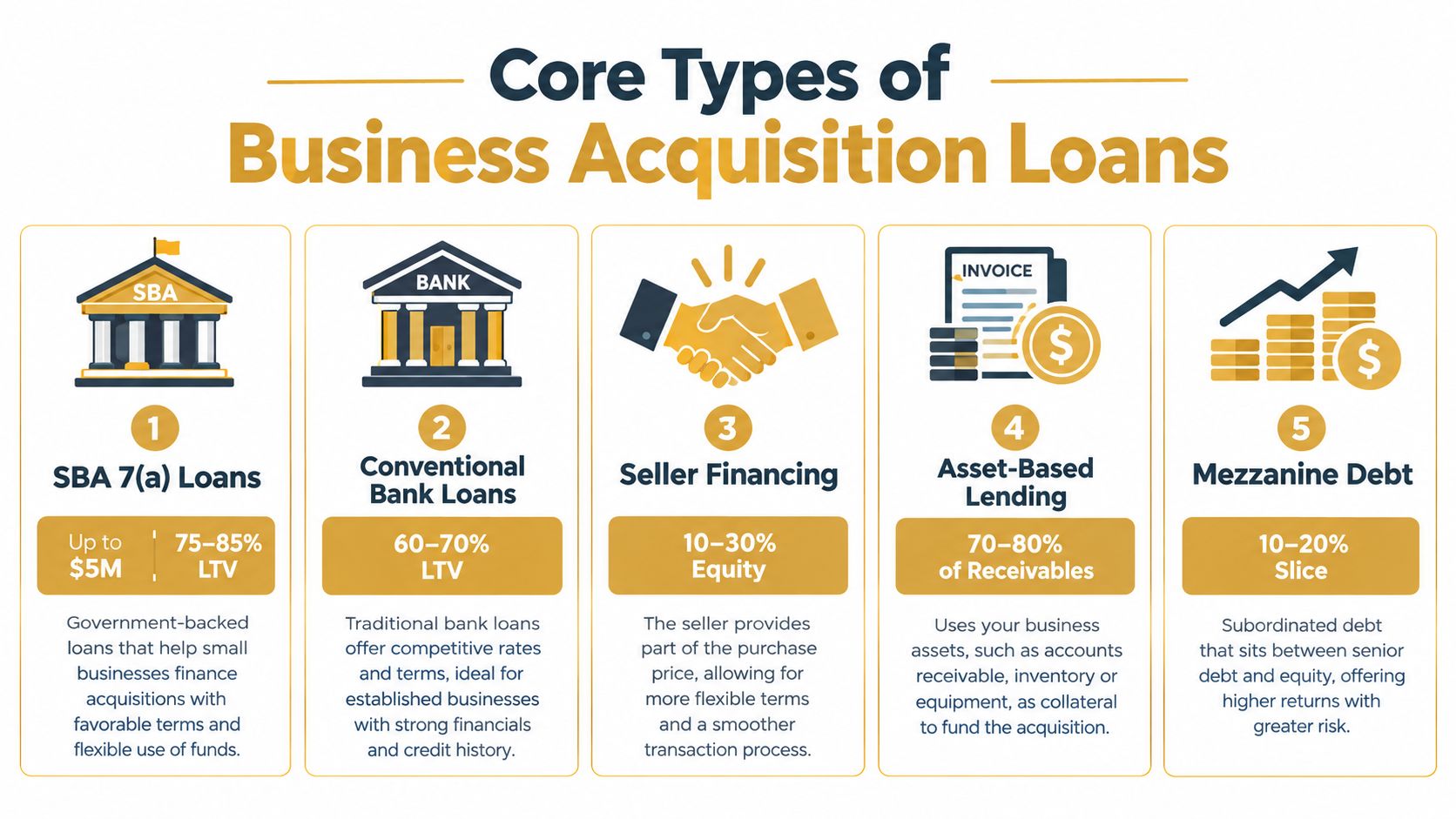
The five main financing vehicles serve different roles, and the right choice depends on the buyer, the target's cash flow, and the amount of risk each capital provider will accept.
SBA 7(a) loans are often considered when the buyer needs financing for an established small business and the transaction includes goodwill, working capital, or other eligible uses. The program can be flexible, but eligibility, ownership, valuation, and repayment capacity still control the outcome. SBA financing isn't a substitute for a credible operating plan.
Conventional bank acquisition loans generally suit buyers with strong financial profiles, relevant experience, and a target with consistent earnings and useful collateral. Banks may offer a lower-cost senior structure, but they can be less tolerant of uncertain projections, concentrated customers, weak records, or a thin equity contribution.
Seller financing places the seller in the role of creditor. It can align the seller with a successful transition and help bridge a gap between the buyer's available equity and the lender's proceeds. The trade-off is negotiation complexity, including payment priority, security, subordination, default rights, and what happens if the seller remains involved.
Asset-based lending relies more directly on eligible receivables, inventory, or equipment than on overall goodwill. It can help a company with valuable working assets but uneven earnings. Availability may fluctuate with the collateral base, so buyers shouldn't treat it as a permanent replacement for cash-flow debt.
Mezzanine debt sits below senior debt in the capital stack. It can provide useful supplemental funding when senior lenders won't finance the full requirement, but its pricing and repayment burden are higher. It belongs in a structure that has genuine cash-flow headroom, not in a deal that already depends on optimistic forecasts.
| Financing Type | Typical Borrower | Best For | Key Advantage |
|---|---|---|---|
| SBA 7(a) loan | Qualified small-business buyer | Good operating businesses needing flexible acquisition funding | Can accommodate more than hard assets |
| Conventional bank loan | Experienced buyer with strong target financials | Lower-risk acquisitions with dependable repayment capacity | Often supports efficient senior financing |
| Seller financing | Buyer and seller willing to share transaction risk | Valuation gaps and transition-sensitive deals | Flexible negotiation and deferred payment |
| Asset-based lending | Asset-rich business with eligible collateral | Receivables, inventory, or equipment support | Financing follows collateral availability |
| Mezzanine debt | Buyer with strong cash conversion and a funding gap | Supplemental capital beneath senior debt | Adds capacity without requiring all funding as equity |
Before comparing lenders, buyers should understand the difference between equity and debt in acquisitions, including how control, repayment priority, dilution, and downside risk change across the stack. The comparison of equity and debt financing for acquisitions provides a useful framework for that decision.
How Underwriting Really Works
Lenders underwrite the business after the acquisition, not the business as it existed under the seller. That distinction changes the model immediately. If the seller worked full time without drawing a market salary, the buyer's replacement compensation may reduce the cash available for debt service. The same is true of deferred maintenance, essential equipment replacement, and transition expenses.

The central metric is the debt-service coverage ratio, or DSCR. It compares cash flow available for debt service with annual principal-and-interest payments. In small-business buyouts, a common benchmark is 1.25x or higher, meaning the target should generate at least $1.25 of available cash flow for every $1.00 of annual debt service, as described in business acquisition financing guidance on DSCR.
A purchase price can look reasonable and still fail this test. Increasing debt raises scheduled payments, which lowers DSCR unless cash flow rises at the same time. That makes DSCR the binding constraint on borrowing in many transactions.
Underwrite the buyer and the business together
The buyer's background matters because lenders need confidence that the company can operate after closing. Relevant management experience, industry familiarity, a practical transition plan, and clear responsibilities among owners can strengthen the credit story. A polished résumé won't repair weak cash conversion, but an unexplained operating gap can undermine an otherwise healthy target.
The model should separate recurring earnings from adjustments that may disappear after closing. Review customer concentration, supplier dependence, owner-specific relationships, unusual expenses, working-capital swings, and the cost of replacing informal systems. A disciplined financial forecasting process for potential acquisitions helps expose these issues before they become lender objections.
Underwriting insight: The lender isn't asking whether the company was profitable. The lender is asking whether the company will remain able to pay after the buyer changes the ownership economics.
Credit history also enters the analysis. Buyers should resolve inconsistencies, document explanations, and keep supporting records organized. The same preparation mindset used for mortgage readiness with paid collections applies here, although acquisition lenders assess the target business and transaction structure as well as the individual borrower.
A useful model tests lower cash flow, slower customer collections, higher operating costs, and a delayed transition. If those conditions force a payment default, the financing package needs less debt, more equity, a seller note, or a lower purchase price.
The Acquisition Loan Application Checklist
A clean application doesn't guarantee approval, but a disorganized one creates avoidable friction. Assemble the file before approaching lenders so each party can evaluate the same facts.
Start with the buyer
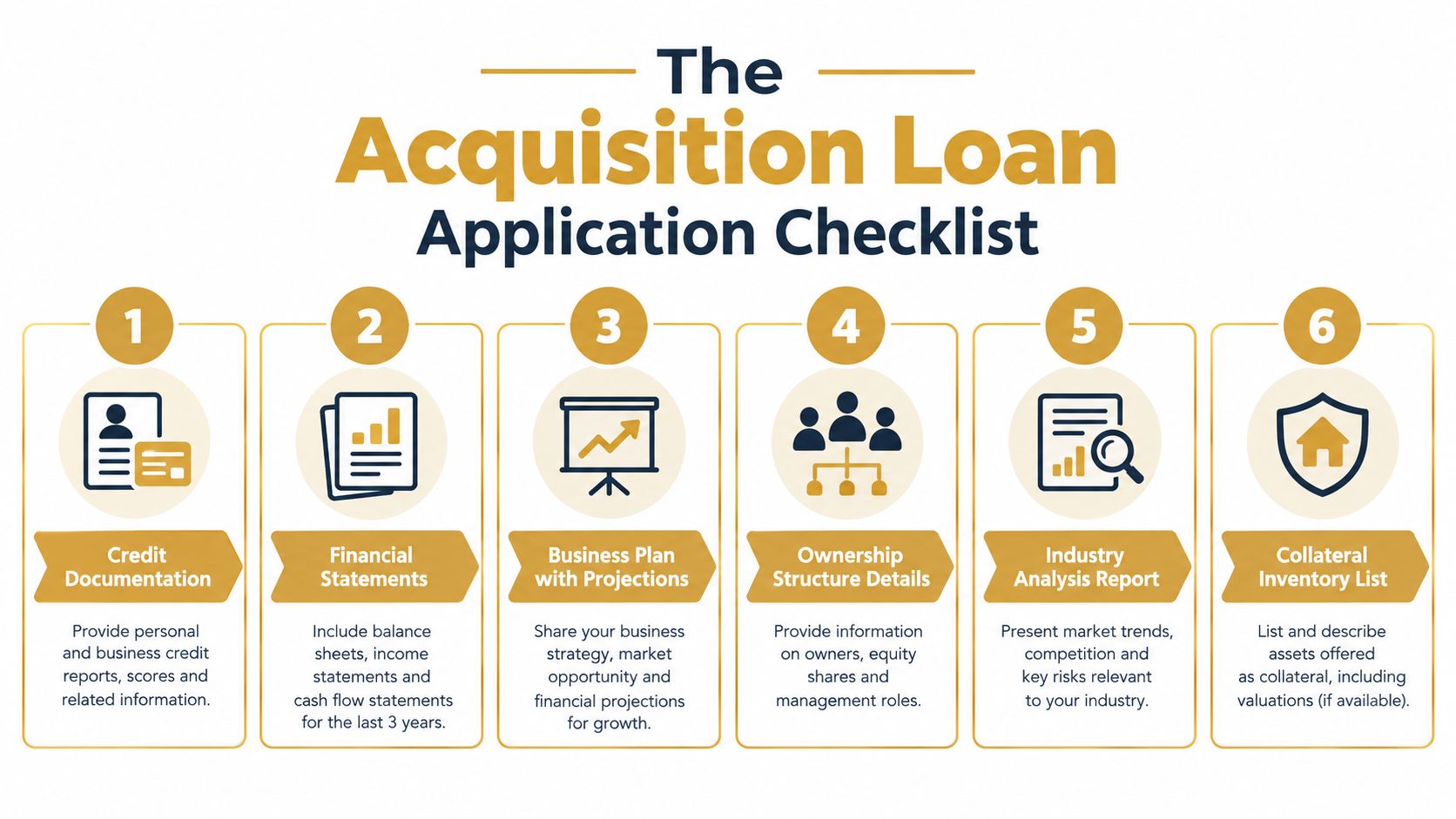
Credit documentation: Gather personal credit information, explanations for adverse items, personal financial statements, evidence of liquidity, and records showing the source of equity. Lenders need to know not only whether the buyer has capital, but whether the contribution is documented and available.
Experience profile: Prepare a concise résumé and operating plan that connect the buyer's experience to the target. If the buyer lacks direct industry experience, identify the manager, partner, advisor, or seller transition arrangement that addresses the gap.
Ownership structure details: Define who will own the company, who will guarantee the debt, who will manage operations, and how decisions will be made. Ambiguous partnership arrangements create underwriting questions and can affect eligibility.
Then document the target
Financial statements: Request historical income statements, balance sheets, cash-flow information, tax filings, debt schedules, and bank statements. Reconcile the figures rather than copying them into a spreadsheet. Differences between tax returns, internal statements, and bank activity need explanations.
Business plan with projections: Show the post-close budget, owner compensation, working capital needs, planned capital expenditures, debt service, and downside case. A forecast should explain operational decisions, not merely display attractive growth.
Industry research and collateral inventory: Document market conditions, competitors, customer concentration, supplier relationships, equipment, inventory, receivables, leases, licenses, and other assets. This gives the lender a clearer view of both repayment capacity and recovery value.
Keep the file indexed. Use consistent period labels, name each attachment clearly, and maintain a single source of truth for purchase price, equity, seller financing, fees, and working capital. When the lender changes an assumption, update the model and the narrative together.
Preparation principle: Every unexplained variance becomes a question. Answer it before the underwriter has to ask.
Typical Terms, Rates, and Leverage Bands
Pricing and capital structure should be read together. A lower rate may make senior debt attractive, but a structure with more senior proceeds can still create excessive repayment pressure. Conversely, expensive supplemental capital may preserve enough equity for the buyer to close, but only if the business produces cash consistently after all senior obligations are paid.
In middle-market transactions, industry data commonly places senior or unitranche debt around 3.5x to 4.5x EBITDA, with total debt reaching roughly 4.5x to 6.0x or more when subordinated debt is included, according to market guidance on acquisition loan structures. These are structural reference bands, not automatic borrowing entitlements. A company with volatile cash flow may support less, while a durable business with strong conversion may attract more lender interest.
Match the instrument to the job
Unitranche pricing is often quoted around SOFR plus 500 to 700 basis points, while SBA-style tranches may be priced at Prime plus 2.75% with 10-year amortization on up to $5 million, according to the same acquisition loan market reference. Buyers should confirm current terms directly with the lender because pricing, fees, covenants, and eligibility can change.
The point of comparing rates isn't to choose the lowest headline number. A buyer should compare:
- Amortization: Longer repayment spreads principal over more periods, but the buyer must understand total cost and prepayment conditions.
- Interest structure: Floating-rate debt can change the payment burden, while fixed-rate protection may carry a different price.
- Covenants: Reporting requirements and financial tests can restrict distributions, additional borrowing, or acquisitions.
- Priority: Senior lenders are paid first, which affects how seller notes and mezzanine capital are documented.
- Cash sweep and prepayment terms: These can determine how quickly excess cash reduces debt or whether the buyer can refinance.
Every additional turn of debt increases annual debt service and covenant pressure. A capital stack that looks efficient at closing may become restrictive when the owner needs to hire, replace equipment, or absorb a temporary revenue decline.
Why Recent SBA Rules Change the Game
Many buyers still treat SBA acquisition financing as a static product. That assumption is outdated. Recent policy changes affect not only the amount of equity a buyer must bring, but also who can qualify, how ownership is documented, and when the lender should be involved.
Recent SBA data cited in an SBA business acquisition lending report shows roughly $7.71 billion in FY2025 change-of-ownership approvals across 6,627 loans, with about $7.04 billion approved through August 31, 2026. Those figures indicate that acquisition financing remains a substantial part of the SBA market, even as underwriting becomes more conservative.
Equity and ownership now deserve early attention
Newer SBA policy updates include a 10% equity injection standard for riskier transactions, tighter ownership requirements, and the ability to combine 7(a) and 504 financing up to $10 million, as described in the cited SBA lending report. These rules can change the feasibility of a first-time buyer transaction or a partnership deal before the buyer submits a final offer.
A buyer should therefore answer several questions early:
- Who owns the borrower at closing?
- Which parties must provide guarantees or equity?
- Is the equity available and properly documented?
- Does the proposed structure satisfy the applicable SBA ownership requirements?
- Can the transaction use more than one SBA program without creating conflicting repayment or collateral expectations?
The strongest response isn't only raising more money. It may involve reducing the purchase price, increasing buyer equity, adding a subordinated seller note, changing the ownership arrangement, or separating eligible uses of funds. The structure must satisfy both the policy rules and the DSCR test.
Deal-structuring lesson: SBA eligibility gets you into the conversation. Repayment capacity and a coherent ownership plan get the transaction through underwriting.
This is why buyers should engage an experienced SBA lender before finalizing the letter of intent. Policy interpretation, valuation, source-of-equity documentation, and transition planning can affect timing as much as the loan application itself.
Creative Capital Alternatives When Debt Falls Short
A financing gap doesn't automatically mean the acquisition is impossible. It means the buyer needs to decide which risk belongs with the seller, an equity partner, or the operating company, rather than forcing every requirement into senior debt.
Seller carry is often the cleanest first alternative. The seller accepts a deferred payment and may remain motivated to support the transition. The buyer preserves cash at closing, but the note still needs clear terms, and the senior lender may require subordination or payment restrictions.
Equity partnerships replace some repayment risk with shared ownership. An operating buyer may contribute leadership while a capital partner contributes cash, industry expertise, or lender credibility. The cost is dilution and governance complexity. Agree on decision rights, distributions, future capital calls, deadlock procedures, and exit expectations before closing.
Rollover equity allows the seller to retain an ownership interest instead of receiving the entire purchase price in cash. It can align both parties through the transition, though the buyer must define control and the mechanics for a later buyout.
Revenue-based financing can fit a company with predictable revenue but limited collateral or insufficient conventional debt capacity. Payments tied to revenue may preserve flexibility during softer periods, but they can also consume operating cash when the company needs it most.
A blended structure works only when each source has a distinct purpose. Don't add expensive capital merely to preserve an inflated price. First identify the precise shortfall, then choose the least damaging instrument.
Buyers assessing non-dilutive options can also review Fundl's funding tips for 2026, while a broader overview of alternative financing methods for business purchases can help compare structures beyond a standard bank loan.
Next Steps for Aspiring Acquisition Entrepreneurs
Treat acquisition financing as a testable process, not a final conversation that begins after you find a target. Start by defining the buyer's equity, operating role, liquidity needs, and acceptable ownership structure. Then screen potential businesses against post-close cash flow before investing heavily in diligence or negotiating terms.
Build a lender-ready model with a base case and a downside case. Include the proposed business acquisition loan, seller financing, owner compensation, maintenance capital expenditures, working capital, and every other recurring obligation. If the structure only works under an aggressive forecast, change the structure before asking a lender to approve it.
Choose advisors for transaction experience, not just product access. An SBA lender, acquisition attorney, accountant, and diligence professional should understand how the purchase agreement, valuation, ownership, guarantees, and capital stack interact.
Dealmaker Wealth Society offers education, mentorship, templates, and peer support focused on sourcing, due diligence, financing structures, capital raising, and post-acquisition execution. Those resources can help a first-time buyer turn a broad acquisition ambition into a documented financing plan and a more disciplined lender conversation.
The next practical move is simple. Select one target profile, build the cash-flow model, and identify the financing gap before making an offer.
If you want structured guidance on evaluating targets, preparing for underwriting, and designing acquisition capital stacks, visit Dealmaker Wealth Society to explore its training, mentorship, and deal-support resources. Use the financing framework above to arrive with a defined buyer contribution, realistic DSCR assumptions, and a structure you can defend.

From the Dealmaker Blog











A Creative Business Buying Fable
