Acquisition Bridge Loan: How Short-Term Financing Closes
Acquisition Bridge Loan: How Short-Term Financing Closes

You've found the right company, negotiated a price, and secured a seller who wants to close quickly. Your permanent lender, however, is still reviewing tax returns, quality-of-earnings work, collateral, and legal documents. The seller wants certainty of funds now, while your long-term financing may not be ready until later. That timing mismatch is where an acquisition bridge loan can help, but only when the refinance plan is more than a hopeful sentence in a lender conversation.
A bridge loan can give a buyer the capital and closing certainty needed to complete an acquisition while permanent debt, a sale-leaseback, a recapitalization, or another takeout source is arranged. The central question isn't just whether you can borrow the money. It's whether you can repay the bridge on a realistic, documented timeline if the deal takes longer or performs below plan.
Table of Contents
- Why Acquisition Buyers Need Short-Term Financing
- What an Acquisition Bridge Loan Actually Does
- Pricing, Fees, and the True Cost of Bridge Capital
- Who Lends Acquisition Bridge Money in 2026
- Two Real-World Acquisition Bridge Scenarios
- Hidden Risks and Common Failure Modes
- Is a Bridge Loan Right for Your Deal
- The Bridge Mindset for Smarter Deal Structuring
Why Acquisition Buyers Need Short-Term Financing
A first-time buyer may sign a letter of intent, complete diligence, and discover that the seller expects a closing inside a narrow window. The buyer's bank may support the acquisition, but conventional underwriting still needs time to verify financial statements, assess debt service, document collateral, and approve the final structure. An SBA loan can be attractive for a small-business acquisition, yet it may not move at the same pace as a seller who already has another interested buyer.
The problem usually isn't that the buyer needs a permanent mortgage immediately. The problem is that the transaction has a deadline before the permanent capital is ready. Earnest money may become nonrefundable, the seller may demand evidence of funds, and diligence may uncover financing conditions that require another approval cycle. An equity-only buyer can sometimes solve the timing issue, but tying up all available cash may leave too little liquidity for payroll, working capital, integration, or unexpected closing adjustments.
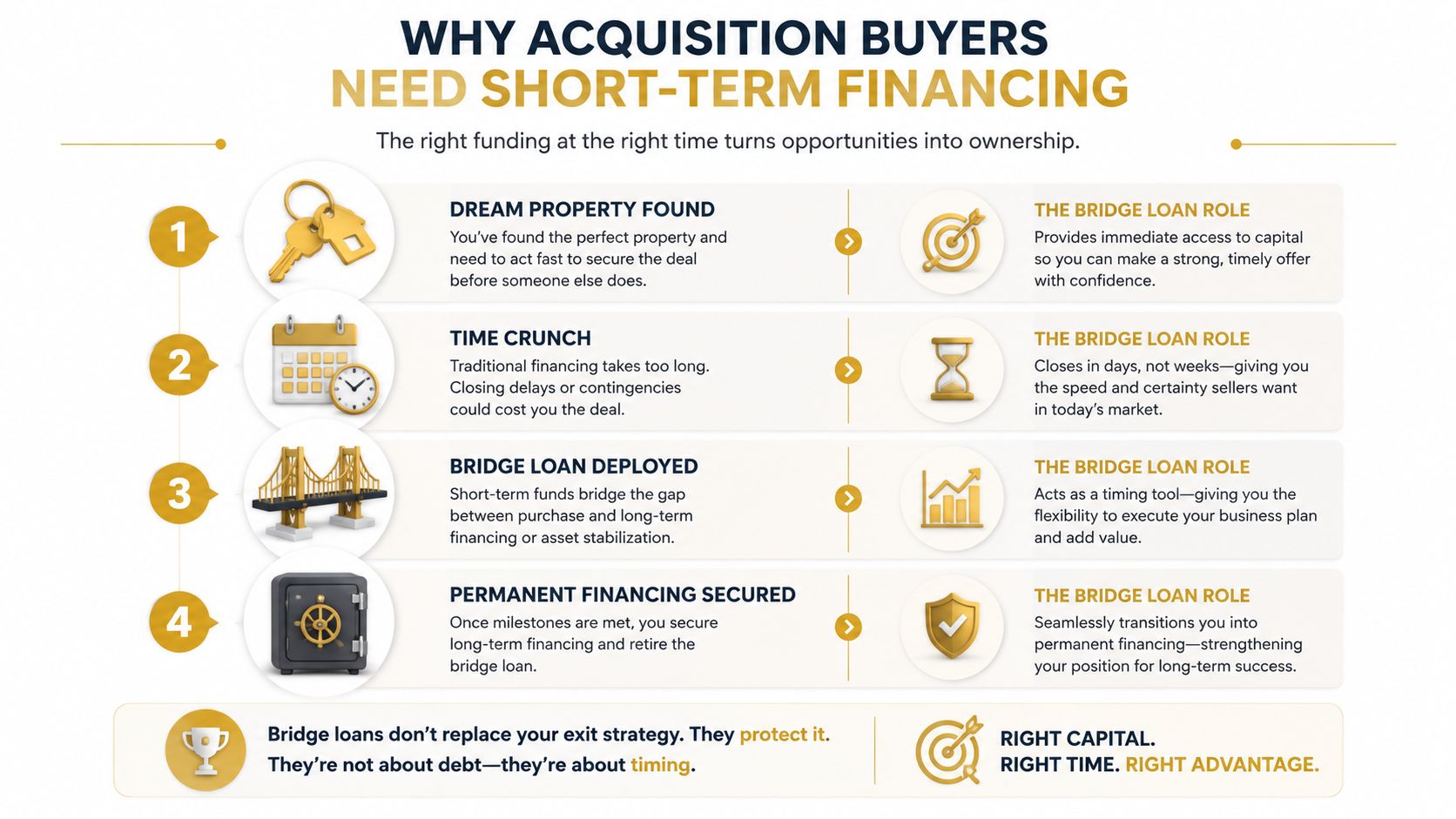
The timing gap has several moving parts
Think of the process as two financing tracks running in parallel:
- The bridge track provides committed capital for the acquisition closing.
- The permanent track prepares the lower-cost or longer-duration financing that will repay the bridge.
- The operating track protects enough cash for the acquired company to function after ownership changes.
That third track matters. A buyer who uses every available dollar to close may technically complete the acquisition but immediately face a liquidity problem. A bridge structure should therefore be sized around the full funding need, not just the purchase-price shortfall.
Buyers comparing seller notes, bank debt, equity partners, and interim capital can use this guide to acquisition financing options from RNC Group for additional perspective. For a broader primer on how sources combine inside a transaction, review this overview of acquisition financing options.
Practical rule: Use bridge debt to buy time, not to avoid deciding how the deal will ultimately be financed.
A bridge gives the seller confidence that the buyer can close while the permanent lender finishes its work. It doesn't remove underwriting risk, improve weak company performance, or guarantee that refinancing will remain available. The buyer still needs a credible takeout path before signing the bridge documents.
What an Acquisition Bridge Loan Actually Does
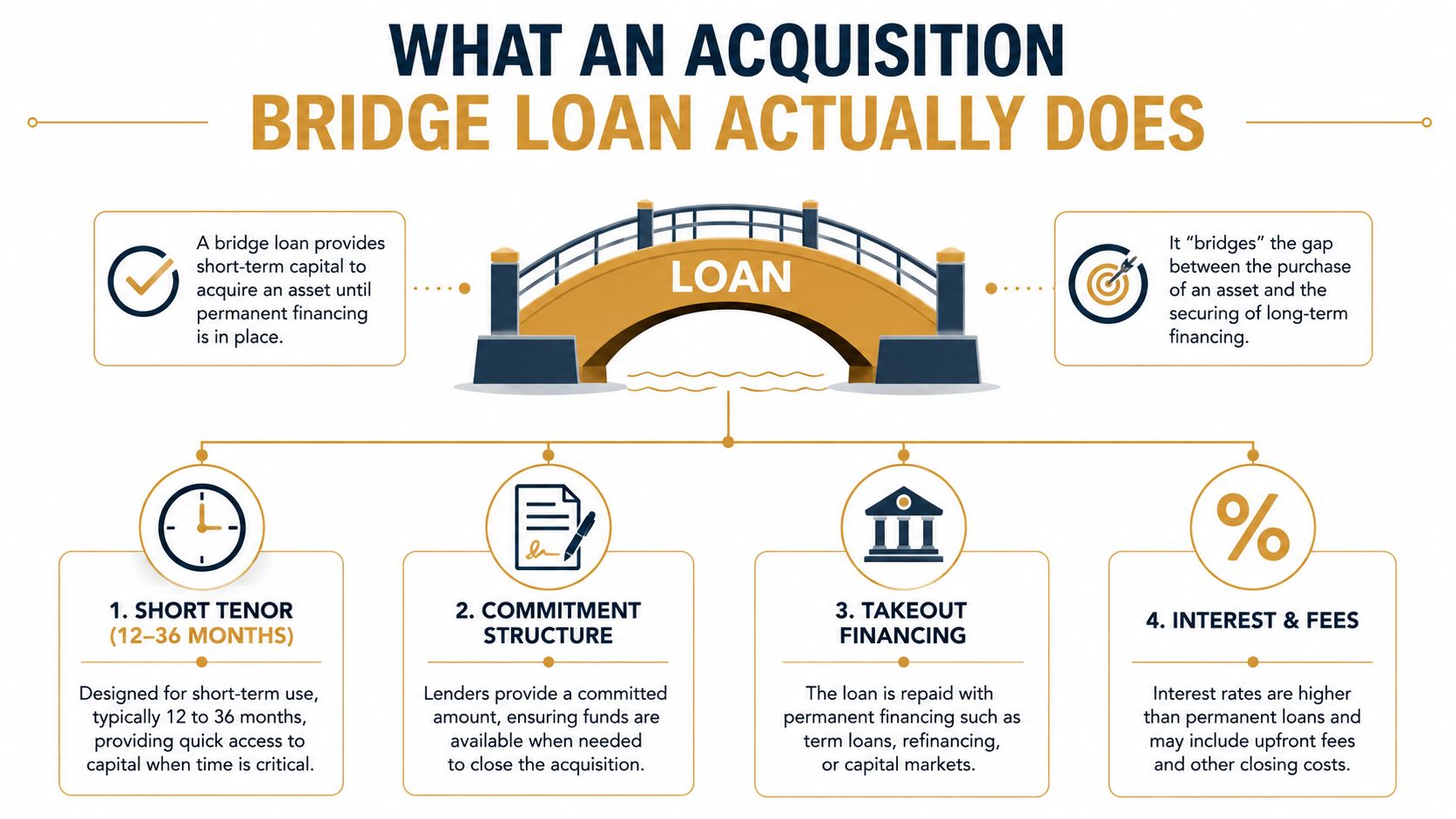
An acquisition bridge loan is temporary capital that carries a buyer from an immediate closing obligation to a later repayment event. The analogy is straightforward. You're crossing a financial gap, and the bridge gets you to the other side. The danger begins when the buyer treats the bridge as the destination rather than as a route to permanent financing.
The mechanism has four layers
First, the loan has a limited life. Acquisition bridges are designed for a short holding period, not indefinite ownership of acquisition debt. The legal documents establish maturity, repayment conditions, interest treatment, reporting duties, and possible extension rights. Some structures use interest-only payments so the acquired business retains cash during the transition, with principal repaid when the takeout closes.
Second, the lender commits capital before the final exit is complete. In some transactions, the lender commits to fund at closing even though the permanent bond, term loan, or other refinancing hasn't yet settled. That commitment can strengthen the buyer's offer because the seller sees an executable financing package rather than an informal promise.
Third, the bridge occupies a temporary place in the capital stack. Buyer equity usually absorbs the first layer of risk. Bridge debt sits above that equity and may be secured by the acquired company's assets, real estate, shares, cash flows, or additional collateral. The eventual takeout loan replaces the bridge, while the buyer's equity remains invested in the business.
Fourth, underwriting focuses heavily on the exit. A lender wants to know what event will repay principal, when it should occur, what could delay it, and what protection exists if the first plan fails. That may be a refinance into bank debt, a sale-leaseback, a strategic sale, a recapitalization, or another documented source.
An acquisition line of credit is different because it generally provides revolving access rather than a single transaction-specific bridge. Mezzanine debt usually remains part of the longer-term capital structure and may include subordinated risk, while seller financing represents credit extended by the seller under negotiated terms. Buyers evaluating collateral-based structures can also review this guide to leveraging assets for acquisition financing.
This video offers a visual explanation of bridge financing mechanics:
The right mental model is temporary certainty. The bridge helps the buyer close while the long-term structure catches up, but the exit must be underwritten before the bridge is funded.
Pricing, Fees, and the True Cost of Bridge Capital
A bridge can look affordable on a term sheet and expensive in practice. The gap usually comes from the exit. If refinancing closes quickly, short-term pricing may remain manageable. If the takeout slips, interest, extension charges, and added diligence can keep accumulating while the acquired company carries the debt.
Bridge capital is priced for speed, flexibility, and execution certainty, rather than a long holding period. A lender may charge more than a permanent lender because it is funding quickly, completing accelerated diligence, and carrying refinancing risk until the takeout closes.
Interest is only one part of the bill. M&A lenders may charge a commitment fee for reserving capital, a funding fee when the loan is drawn, and an early-refinance rebate. That rebate can range from 25% to 100% of the original fee, according to White & Case's bridge-loan overview. The arrangement rewards a prompt exit while compensating the lender for keeping funds available.
Duration can change the economics. A longer hold may trigger milestone fees, extension charges, and more interest. One example describes fees of 0.50% after 90 days, 0.75% after 180 days, and 1.00% after 270 days, as explained by Lexology's discussion of bridge-loan duration fees.
Read the term sheet as a timeline
| Cost Component | 6-Month Bridge | 18-Month Bridge |
|---|---|---|
| Interest | Accrues for a shorter hold | Accrues for a substantially longer hold |
| Commitment fee | Payable for reserved availability | May remain outstanding for a longer period |
| Funding fee | Applies if drawn, subject to negotiated rebate | More time may pass before an early-refinance rebate applies |
| Duration fee | May be avoided if takeout closes promptly | Step-ups may apply as maturity milestones pass |
| Exit or extension fee | Potentially limited by an early payoff | More likely if refinancing is delayed |
| Liquidity impact | Lower carrying burden | Greater pressure on cash flow and reserves |
Build the model around two outcomes: refinancing on schedule and refinancing after a delay. Include interest, commitment economics, funding fees, exit charges, extension fees, legal costs, lender diligence, and the cash reserve required to keep operating. This acquisition financing comparison guide can help compare the bridge with seller notes, bank debt, and equity.
The refinance plan should be visible before closing. A bridge without a documented repayment source is a temporary loan with an open-ended problem.
Your bridge budget should answer one question: What does the deal cost if the refinance closes on time, and what does it cost if the process runs late?
Who Lends Acquisition Bridge Money in 2026
The lender market depends heavily on transaction size, sponsor quality, collateral, industry, and the credibility of the takeout. Large banks may support major acquisitions when the buyer has a strong balance sheet, a well-developed financing package, and a clear path to permanent debt or capital-markets execution. These lenders often prioritize larger, institutionally sponsored transactions over smaller owner-operated acquisitions.
Private credit funds and direct lenders fill more of the middle market. They can offer flexible collateral packages, customized covenants, and faster decisions, but that flexibility usually carries a higher price. The Latham & Watkins private-credit market review describes private credit as a major acquisition-financing force in 2025 while also emphasizing that access is uneven and concentrated in larger, better-sponsored transactions.
For smaller buyers, the practical choices may include boutique acquisition-finance firms, family offices, asset-based lenders, and interim lenders connected to an eventual SBA structure. Each lender sees a different repayment source. A bank may underwrite recurring cash flow and collateral conservatively. A private lender may place greater weight on closing speed, sponsor experience, and the lender's ability to control collateral if the exit fails.
| Lender Type | Typical Deal Size | Speed to Close | Indicative Pricing | Best Fit |
|---|---|---|---|---|
| Large commercial bank | Larger, institutional transactions | Deliberate underwriting | Generally lower than private credit when risk is lower | Strong borrower with a committed takeout |
| Middle-market bank | Established acquisition businesses | Moderate | Bank-oriented pricing with negotiated fees | Buyer with quality financials and collateral |
| Private credit fund | Middle-market and sponsor-backed deals | Often more flexible | Higher spread and layered fees | Tight timelines or complex structures |
| Boutique acquisition lender | Smaller and specialized transactions | Case-dependent | Depends on collateral and exit quality | Experienced intermediaries or distinctive assets |
| Family office | Bespoke opportunities | Relationship-driven | Individually negotiated | Strong sponsor, unusual collateral, or tailored terms |
| Interim SBA-related lender | Smaller operating-company acquisitions | Depends on documentation | Structured around the eventual SBA takeout | Buyer with a credible permanent SBA path |
The table's categories are directional, not promises. A lender that says it can move quickly still needs complete financial statements, purchase documents, collateral information, and a defensible exit model. For a sub-$50M buyer, lender selection is often a trade-off between bank economics and private-credit certainty, with equity requirements rising when the lender sees more uncertainty.
Two Real-World Acquisition Bridge Scenarios
Consider a regional HVAC services acquisition priced at US$18 million. The buyer uses a 12-month bridge from a private credit fund, but the bridge isn't the entire financing strategy. Before closing, the buyer and lender agree that an SBA 7(a) package will provide the takeout, and the buyer builds a timetable around the documentation, operating performance, and approvals needed for that refinance.
The buyer also protects cash for the transition. Management retention, working capital, customer continuity, and integration work receive attention alongside the purchase price. Because the refinance path is documented and the operating assumptions are monitored, the bridge functions as intended. It carries the buyer through the closing period and is repaid on schedule without turning a temporary facility into a permanent emergency.
The same structure can fail under weaker assumptions
Now consider a US$40 million rollup involving three dental practices. The buyer receives a verbal indication that a future lender will refinance the bridge, but no binding term sheet defines covenants, collateral, or conditions. After closing, rates move, the practices underperform expectations, and the lender's requirements become more restrictive.
The buyer now faces several problems at once. The bridge is still outstanding, the projected cash flow no longer supports the original refinance case, and covenant pressure limits operating flexibility. To obtain an extension, the buyer injects fresh equity and accepts a more expensive structure. The acquisition may survive, but the buyer's ownership economics and liquidity position deteriorate.
These examples are illustrative deal patterns, not reported case studies. They show why a signed takeout plan is different from an optimistic conversation. Buyers assessing collateral-driven alternatives may also find a focused explanation of hard money bridge loan underwriting useful, especially when the lender is relying more heavily on assets than on long-term operating performance.
The clean transaction controlled its exit. The troubled transaction assumed its exit.
Before signing, ask what the permanent lender has approved, which conditions remain open, and whether the bridge lender has reviewed the same downside case. A bridge works better when every party is underwriting the same repayment story.
Hidden Risks and Common Failure Modes
A bridge can close on schedule and still fail later. The weak point is usually the exit: a permanent lender may change its view after the acquired business misses projections, customer concentration rises, collateral values weaken, or credit conditions become less receptive. If the buyer has only one refinancing option, the bridge maturity can arrive before that option is ready to close.
That risk is easier to see through a simple scenario. A buyer expects a refinance after integration, but an operating shortfall reduces cash flow. The permanent lender then asks for more equity, tighter covenants, or additional collateral. The bridge remains outstanding while the buyer has fewer ways to respond.
Maintenance covenants can create pressure well before maturity. Falling below a required financial threshold may trigger expanded reporting, restrictions on distributions, additional collateral requirements, or a prepayment demand. An equity cure may buy time, but it can force the buyer or partners to contribute capital when liquidity is already strained.
Regulatory and transaction friction can also push the exit date. Cross-border acquisitions may face CFIUS review, state licensing transfers may take longer than expected, and antitrust questions may delay closing or limit the buyer's ability to combine operations. These issues do not automatically prevent bridge financing, but they belong in the maturity date, contingency plan, and cash reserve.

Delay changes the economics
Interest reserves, exit fees, commitment charges, and duration step-ups can make a delayed takeout materially more expensive. As noted earlier, milestone-based charges may rise while the bridge remains outstanding. An extension is not a routine administrative step. It may require renewed underwriting, additional equity, a higher margin, or revised covenants.
Before signing, run the deal through several failure paths. Ask what happens if the permanent lender takes longer than expected, revenue or EBITDA declines before takeout, or permanent debt becomes less affordable after rates change. Test the effect of a covenant breach that reduces operating flexibility, and include approval or license-transfer delays in the timetable.
The bridge is a contract, not just temporary debt. Its terms can become more restrictive precisely when the acquisition needs room to adjust, so a credible refinancing path and a backup plan matter as much as the initial closing.
Is a Bridge Loan Right for Your Deal
A buyer can perform a useful self-audit before contacting lenders. The purpose isn't to predict every issue. It's to identify whether the proposed acquisition has the characteristics that make temporary debt defensible.
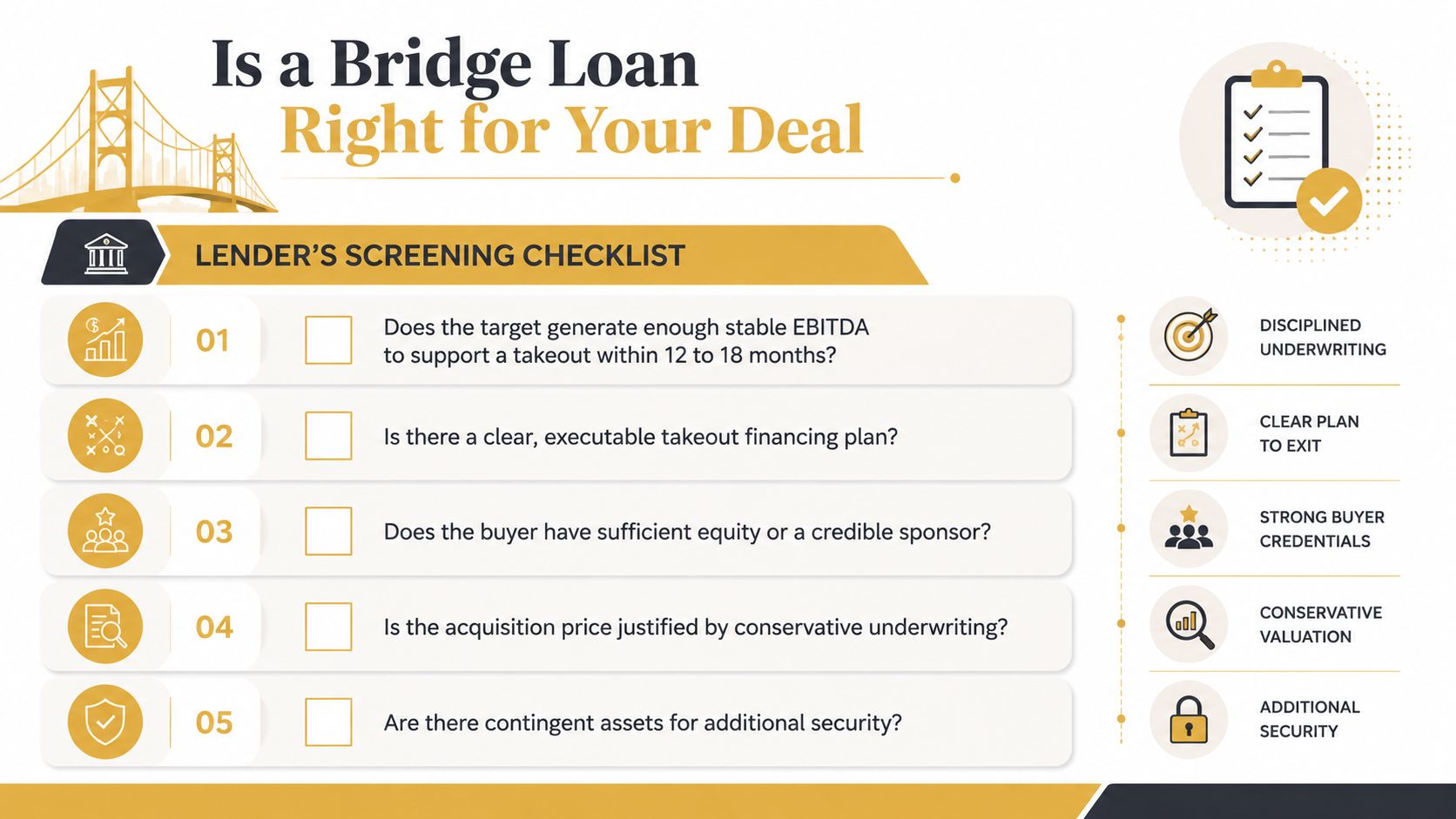
Five questions to answer before applying
Can the business support a takeout? Start with stable, supportable cash flow rather than the seller's most optimistic forecast. The lender needs to understand how the acquired company can service the bridge while you prepare permanent financing.
Is the exit executable? Name the refinancing product, lender category, collateral source, or sale event that will repay the bridge. A documented path is stronger than a verbal indication.
Do you have enough equity and liquidity? Equity isn't only the amount needed to close. You may need cash for working capital, integration, delays, lender fees, and a period of interest payments.
Does the purchase price survive conservative underwriting? Test lower performance, slower integration, and a delayed refinance. If the transaction only works under the base case, the bridge may amplify the problem.
What happens if the first exit fails? Identify additional collateral, an alternative lender, a saleable asset, a partner capital source, or another credible repayment route. Contingent assets can strengthen a lender's view, but they don't replace a primary plan.
Situations that deserve caution
A bridge deserves extra scrutiny when revenue is declining, customers are highly concentrated, litigation is pending, licenses haven't transferred, or the seller's financial records contain unresolved inconsistencies. These conditions can delay diligence and make the eventual takeout harder.
Sellers also influence feasibility. A seller who allows a meaningful financing contingency gives the buyer more room to arrange permanent debt. A seller demanding immediate certainty may justify bridge financing, but that urgency should be priced into the offer and the capital plan.
If you can't explain the repayment sequence on one page, you probably aren't ready to borrow bridge capital.
The Bridge Mindset for Smarter Deal Structuring
A bridge loan isn't a solution to an underwritten acquisition. It's a timing instrument whose value depends on the exit behind it. Buyers who use bridge financing well treat the repayment event as the starting point of the structure, then work backward to closing requirements, liquidity reserves, covenants, and lender approvals.
Three habits separate disciplined users from distressed borrowers:
- Underwrite to the refinancing floor. Build the model around conservative performance and a less favorable takeout, not the most attractive base case.
- Negotiate delay economics early. Review extension rights, duration step-ups, prepayment rebates, exit fees, reporting obligations, and covenant cures before signing.
- Keep the takeout process active. Maintain contact with the permanent lender while the bridge funds the acquisition. A warm process is more useful than starting from zero near maturity.
The buyer should also identify what remains under personal control. You can control the quality of diligence, the completeness of lender materials, the cash reserve, and the timing of the permanent-financing process. You can't control interest-rate markets, regulatory review, seller decisions, or every operating result. The structure should account for that difference.
A sound acquisition bridge loan buys certainty at a known cost while the buyer completes a clearly defined transition. A weak one buys hope at an escalating cost. Before you accept the lender's commitment, compare every bridge dollar with the certainty of the exit, not with the possibility that refinancing will somehow become easier later.
Dealmaker Wealth Society provides structured acquisition training, deal-structuring guidance, capital-raising education, and peer support for buyers evaluating financing paths such as bridge debt, seller notes, and equity partnerships. Visit Dealmaker Wealth Society to build a clearer acquisition financing plan and pressure-test your exit before you approach lenders.

From the Dealmaker Blog















A Creative Business Buying Fable