Binding vs Non Binding Agreements in M&A Deals
Binding vs Non Binding Agreements in M&A Deals

Binding means a court can enforce the agreement. Non-binding generally means neither side must complete the deal, although specific carve-outs can still create enforceable duties. A 2024 sequencing study found that binding agreements were followed by another binding agreement 63.2% of the time, while non-binding interim agreements were followed by another non-binding interim agreement 64.9% of the time.
You're sitting across the table with a two-page term sheet in front of you. “Non-Binding” is printed in bold, and you're trying to decide whether signing commits you to close. The answer depends less on the stamp at the top than on the promises buried inside the document, the parties' conduct, and whether the wording shows an objective intention to create legal obligations.
That distinction matters in acquisitions, capital raises, and strategic transactions. A non-binding LOI can preserve flexibility around price and structure while still locking one side into confidentiality, exclusivity, or a duty to negotiate. A document called “binding heads of terms” may still fail to force a closing if essential terms remain unsettled or the document clearly says a later definitive agreement is required.
The practical approach is simple. Treat bindingness as a clause-by-clause negotiation, not a document-wide label.
Table of Contents
- Why the Label Does Not Decide the Outcome
- LOIs, MOUs and Term Sheets Explained
- Side by Side Comparison of Binding and Non Binding Terms
- How the First Document Shapes the Next Step
- Sample Clauses That Change Everything
- When to Push for Binding and When to Stay Flexible
- Negotiation Playbook and Pre-Signing Checklist
Why the Label Does Not Decide the Outcome
The buyer signs a non-binding LOI, starts diligence, instructs advisers, and tells key employees that a transaction is moving forward. The seller stops talking to other buyers because the document includes an exclusivity covenant. Then the buyer walks away, arguing that the LOI was only an expression of interest.
That argument may be too simplistic. Legal analysis commonly focuses on what the parties objectively said and did, rather than relying on the document title alone. One legal review explains that there is “no general rule” because enforceability depends on the wording, conduct, surrounding facts, and whether the parties intended moral, partial, or full legal commitment. The legal review of letters of intent describes how an LOI can occupy several positions between a purely preliminary understanding and a fully binding agreement.
Operative language matters more than the cover page
Look at the verbs. “The parties intend to explore a possible transaction” signals aspiration. “The seller shall not solicit competing offers during the exclusivity period” creates a much clearer promise. “The parties will negotiate in good faith” may create exposure if the surrounding language shows an obligation rather than a statement of hope.
A confidentiality covenant can operate as a standalone contract inside a non-binding LOI. The same applies to exclusivity, governing law, dispute resolution, expense reimbursement, and carefully drafted good-faith obligations. Contract guidance confirms that non-binding documents can contain binding carve-outs, with those provisions enforced separately from the broader transaction terms. Adobe's explanation of binding and non-binding agreements makes the core distinction clear: the main document may not compel the transaction, while selected obligations still can.
Consider two short examples:
- Non-binding LOI enforced in part: The document says price and structure remain subject to a definitive purchase agreement, but it requires the seller to negotiate exclusively, protect confidential information, and reimburse specified expenses. The buyer may not be able to force the acquisition, but the seller may still face a claim for violating those covenants.
- Binding heads of terms that fail to force closing: The document uses “binding” in its title, but leaves material conditions unresolved and says the parties “will enter into a mutually acceptable definitive agreement.” A court may treat the document as a commitment to continue discussions, not as a complete sale contract.
Practical rule: Never approve an LOI by reading the title, signature block, or first paragraph alone. Mark every sentence that contains “shall,” “must,” “will,” “agrees,” or “undertakes.”
Bindingness is therefore a spectrum. The purchase price may be non-binding. Confidentiality may be binding. Exclusivity may be binding only until a defined date. A dispute clause may apply to the LOI even though the acquisition itself never closes. Your job is to identify the legal posture of each obligation before anyone signs.
LOIs, MOUs and Term Sheets Explained
Bindingness is not a label. It is a spectrum of enforceable obligations spread across a document. LOIs, MOUs, and term sheets overlap, but they serve different commercial purposes. Their titles provide context, while the wording and the parties' conduct determine the result.
The letter of intent
An LOI usually appears after initial discussions and before full diligence. It organizes the proposed transaction around price, structure, financing assumptions, diligence, closing conditions, exclusivity, and timing. The economics are often expressly non-binding, while confidentiality, no-shop obligations, information access, expenses, governing law, and dispute resolution may bind the parties.
Use an LOI to establish a workable deal path without pretending that diligence, financing, approvals, or definitive documents are finished. Read every operative clause closely. A heading such as “Non-Binding Terms” does not neutralize a paragraph requiring a party to act, refrain from acting, or pay.
For a plain-English introduction to how buyers use this document, see what an LOI is and how buyers use it.
The memorandum of understanding
An MOU often follows agreement on a broader framework or gives several stakeholders a shared record of the proposed arrangement. In cross-border or multi-party deals, it may set out responsibilities, governance, implementation steps, and the intended relationship between separate instruments.
An MOU may remain commercial or political rather than enforceable as a whole. Its carve-outs still require clause-by-clause review. Confidentiality, exclusivity, non-solicitation, expense allocation, governing law, and dispute procedures can carry obligations even if the broader arrangement remains subject to further agreement.
The term sheet
A term sheet is a compressed commercial summary. Early in a process, it may state headline economics and structure. Later, it may organize terms intended for a purchase agreement, investment agreement, or another definitive instrument.
Read it twice. First, determine whether it is merely an agenda for negotiation. Then identify terms that fix a position, impose a process obligation, or incorporate another document. Do not leave “agree,” “shall,” or “will” unexplained. Define whether each provision creates a duty, records an intention, or awaits definitive documentation.
Redline aggressively: non-solicit language, expense reimbursement, break fees, exclusivity periods, access obligations, and any statement that the parties “agree” to keep negotiating.
A short LOI can expose a party to more risk than a detailed term sheet when its operative clauses are careless. The document's place in the timeline affects negotiating pressure, but it does not decide enforceability. Mark the binding provisions, state their duration and triggers, and remove obligations nobody is prepared to perform.
Side by Side Comparison of Binding and Non Binding Terms
The binding vs non binding question becomes easier when you separate four issues: enforceability, timing, conditionality, and remedies. Don't ask only, “Is this document binding?” Ask, “What happens if this specific promise is breached?”
Binding vs Non Binding Terms Across Key Deal Axes
| Axis | Binding Terms | Non-Binding Terms |
|---|---|---|
| Enforceability in court | A court may enforce the promise or award a remedy for breach. | The parties generally can't compel performance of the proposed transaction itself. |
| Timing during the deal lifecycle | Usually reflects a defined commitment, such as exclusivity or an agreed process. | Usually preserves room for diligence, financing, approvals, and renegotiation. |
| Conditionality and triggers | Conditions, dates, and events determine when the duty starts or ends. | Language usually describes intentions, assumptions, or future agreement. |
| Remedies for breach | The document may support damages, injunctive relief, or another contractual remedy. | The main transaction usually has no remedy, although binding carve-outs may have separate consequences. |
A binding term can be useful even when nobody expects the transaction to close immediately. A buyer may want enforceable exclusivity while leaving valuation subject to diligence. A seller may accept confidentiality and a limited no-shop obligation while preserving the right to reject a final agreement.
The cost of cheap-looking flexibility
Suppose a seller signs a non-binding LOI with a tightly drafted exclusivity clause. The economics remain open, but the seller can't approach other bidders during the stated period. The term sheet looks flexible because price isn't binding, yet the seller has surrendered market access.
The reverse can be worse for a buyer. A binding exclusivity covenant that survives termination may protect the buyer's diligence investment, but it can also create specific performance or injunction risk if the buyer breaches the process terms. The remedy language matters as much as the obligation itself.
For smaller or less complex transactions, negotiate the scope, duration, and exit triggers of exclusivity first. For a larger transaction, fight hardest over the economic terms, conditions, remedies, and the exact point at which the parties move from indicative language to enforceable commitments. A clause that is narrow and time-limited is usually more defensible than a broad promise with no outside date.
How the First Document Shapes the Next Step
The first document establishes a negotiation rhythm. A binding opening tends to make the next document another binding instrument. A non-binding opening tends to preserve a non-binding path while the parties test diligence, financing, and structure.
A sequencing study reported that binding agreements were followed by another binding agreement 63.2% of the time, while non-binding interim agreements were followed by another non-binding interim agreement 64.9% of the time. The sequencing study of binding and non-binding interim agreements shows that parties tend to remain at the same commitment level rather than switching immediately.
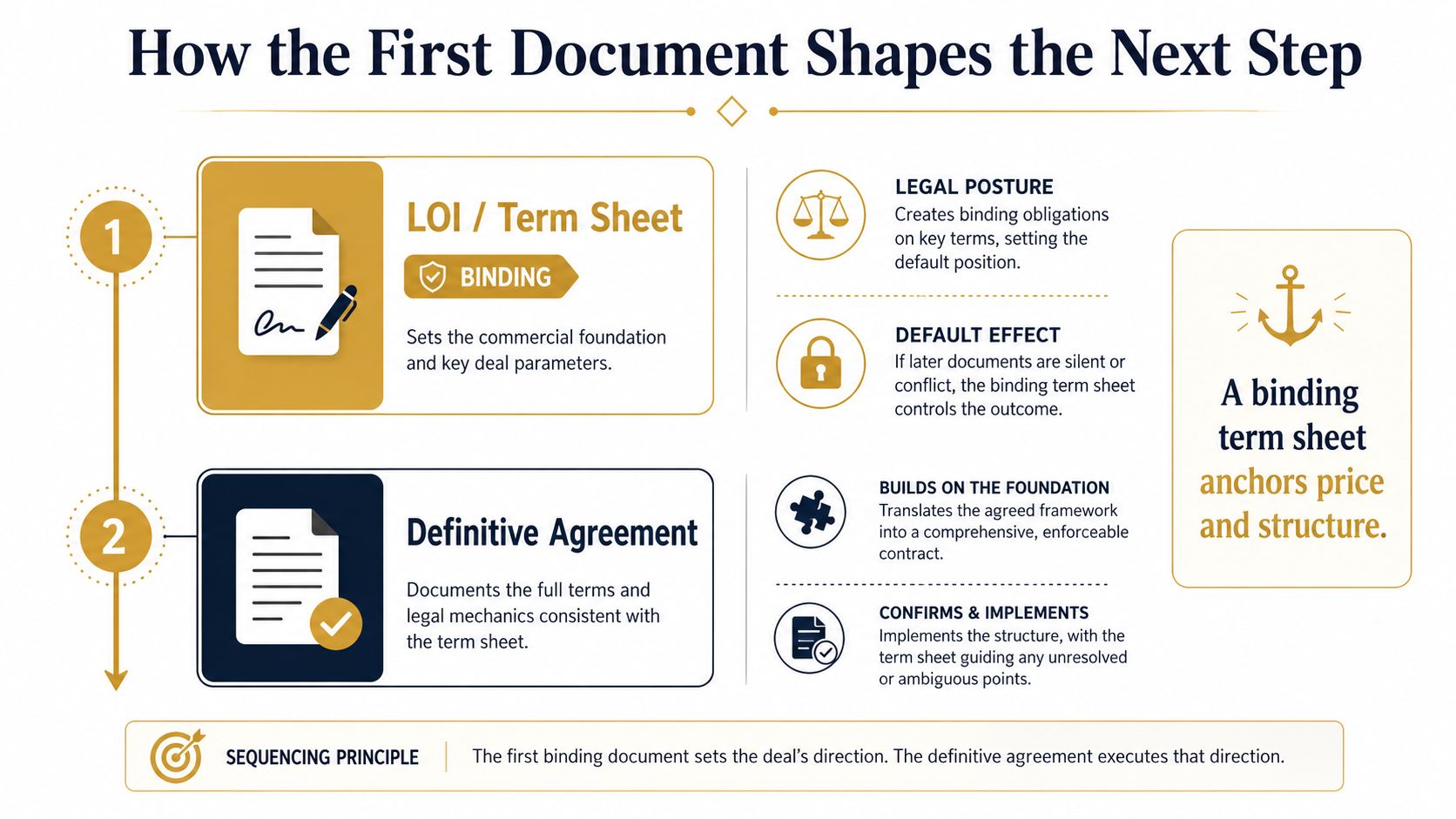
A binding term sheet anchors price and structure. That can reduce later drift, but it also limits the buyer's ability to reopen valuation after diligence. A non-binding term sheet preserves optionality, yet the seller may experience repeated renegotiation, competing buyer fatigue, or a late walkaway.
The mismatch creates the problem. Sellers sometimes treat a signed non-binding LOI as a soft commitment, while buyers treat it as a flexible worksheet. The seller then stops marketing the business, shares sensitive information, and allocates management time. The buyer continues acting as though nothing has been promised.
Write the intended sequence directly into the document. State which provisions are binding, which aren't, what event triggers the next stage, whether exclusivity ends automatically, and whether a later definitive agreement is required before the acquisition becomes enforceable. Don't leave the transition to assumptions.
Sample Clauses That Change Everything
A single poorly drafted sentence can shift an LOI from exploratory to enforceable. Drafting should make intended commitments unmistakable while keeping unresolved commercial terms outside the enforceable core. Treat bindingness as a spectrum, then mark each provision accordingly.
Start with a clear non-binding framework
Open by stating that the parties are discussing a possible transaction and that neither party must complete it unless and until a definitive agreement is signed. Pair that statement with a separate list of provisions that are binding.
Use the word “except” carefully. It distinguishes the general non-binding framework from promises the parties intend to enforce.
| Clause | Standard Wording | What Makes It Bite |
|---|---|---|
| Confidentiality | “The parties intend to keep discussions confidential.” | A mandatory covenant, defined confidential information, permitted disclosures, and a survival period. |
| Exclusivity | “The seller will work exclusively with the buyer.” | A defined start date, outside date, prohibited conduct, and an express remedy. |
| Good-faith negotiation | “The parties will negotiate in good faith.” | Mandatory language with no limit on liability or no clear boundary around the negotiation duty. |
| Expenses | “Each party expects to bear its own expenses.” | A reimbursement promise tied to specified costs or a defined termination event. |
| Break fee | “The parties acknowledge a possible fee.” | A fixed obligation, trigger, payment deadline, and enforcement mechanism. |
Draft the carve-outs as standalone promises
For confidentiality, write: “This confidentiality covenant is binding. Each party shall protect confidential information received from the other party and may disclose it only to permitted representatives or as required by law. This covenant survives termination of discussions.”
For exclusivity, specify the restricted conduct and the endpoint: “The seller shall not solicit, encourage, or enter discussions concerning a competing transaction until the outside date, unless the buyer materially breaches its stated diligence obligations.” Add a clear termination trigger. Without one, the seller may remain locked up beyond the period either side intended.
Good-faith language requires restraint. If the parties want only a process obligation, say: “Each party will use commercially reasonable efforts to schedule meetings and exchange information, but neither party is obligated to agree to any price, structure, or definitive agreement.” This wording supports cooperation without creating an open-ended promise to reach a deal.
Drafting discipline: “Good faith” should never replace an agreed commercial term.
Review merger language with the same care. A clause saying that the LOI supersedes prior discussions can erase protections or obligations one side believed would continue. Governing law and dispute resolution provisions also determine where and how a party must pursue an alleged breach.
Before signing, compare every binding provision against the business deal. Check dates, triggers, remedies, survival periods, and cross-references. A review workflow can reduce manual contract review work by surfacing inconsistent binding language, missing dates, and conflicting integration clauses before execution.
When to Push for Binding and When to Stay Flexible
Bindingness is a negotiating tool. The right answer depends on who controls the process, how much information is available, and what each side needs to protect.
A buyer should usually push for binding confidentiality, access rights, and a focused exclusivity covenant. Keep price and structure conditional until diligence confirms earnings, liabilities, working capital, customer concentration, and financing. The buyer wants protection for its effort without paying for certainty it hasn't earned.
A seller should usually resist binding price and structure commitments at the LOI stage. Accepting binding confidentiality and a narrowly defined process restriction can be sensible, especially when the buyer is giving access to capital or management resources. But the seller shouldn't let a buyer reserve the business indefinitely while continuing to negotiate every material point.
Match the document to the leverage
For a smaller transaction below $10 million, a lighter opening with mostly non-binding economics can avoid disproportionate legal expense and preserve flexibility while the parties test fit. For a transaction above $50 million, binding terms around exclusivity, process, and key economics can justify the effort because auction drift and execution risk carry more commercial weight. These deal-size recommendations are strategic guidance, not universal legal rules.
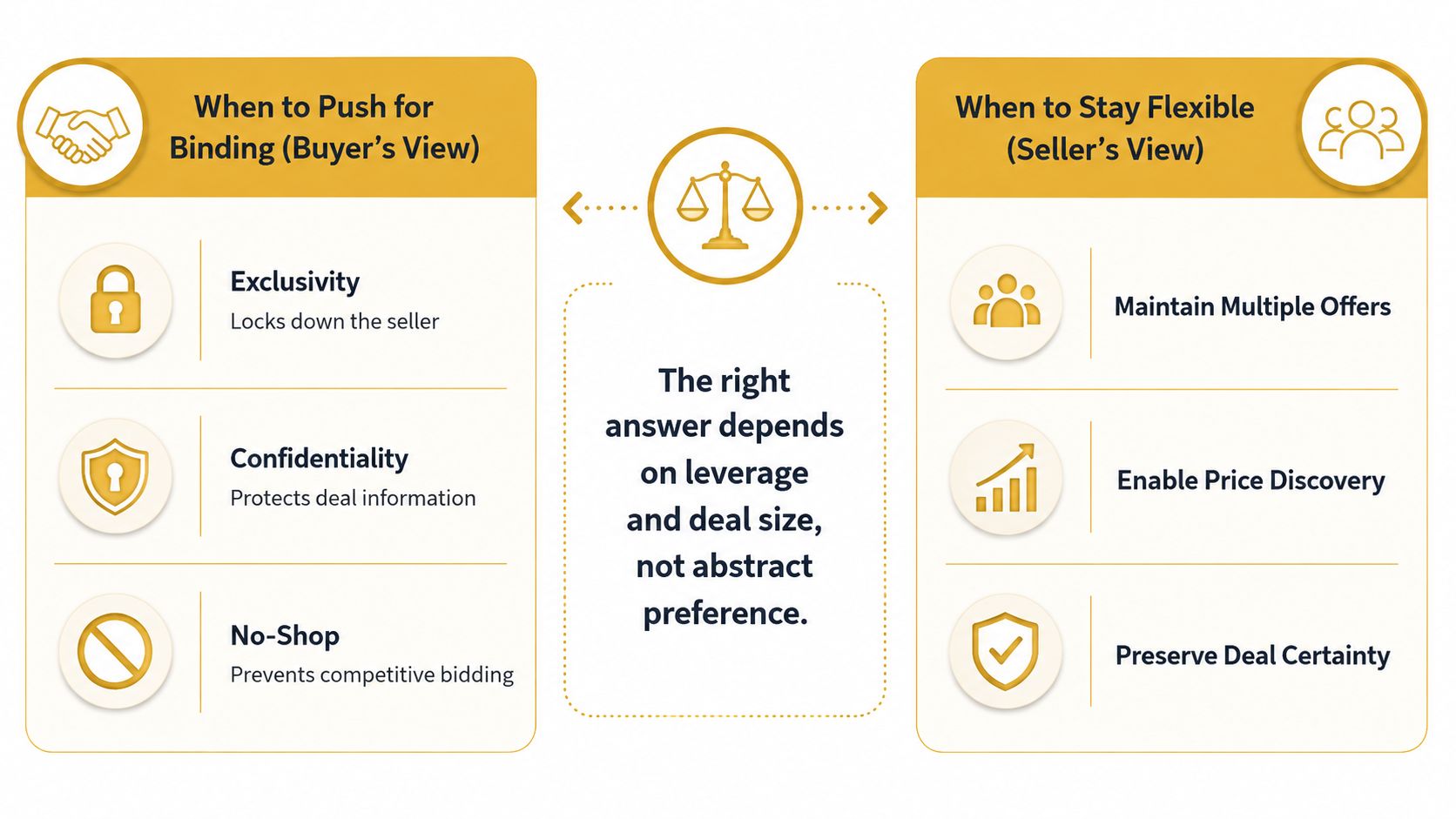
Use a different stance in each scenario.
- Competitive auction: If you're the buyer with a credible offer, push for binding exclusivity before investing heavily in diligence. If you're the seller, keep multiple offers alive and resist binding economics until bidders have demonstrated execution ability.
- Bilateral negotiation: Keep the commercial framework flexible, but make confidentiality, access, decision deadlines, and exclusivity precise. Both sides benefit from knowing the process without pretending the outcome is guaranteed.
- Distressed sale: Preserve optionality. A buyer needs diligence and financing flexibility, while a seller may need to evaluate alternatives quickly. Binding process terms should be narrow and tied to immediate actions.
For more practical guidance on deal terms, see this resource on negotiating terms in business purchases. The point isn't to eliminate commitment. It's to place commitment where it creates influence and keep uncertainty where the facts still need testing.
Negotiation Playbook and Pre-Signing Checklist
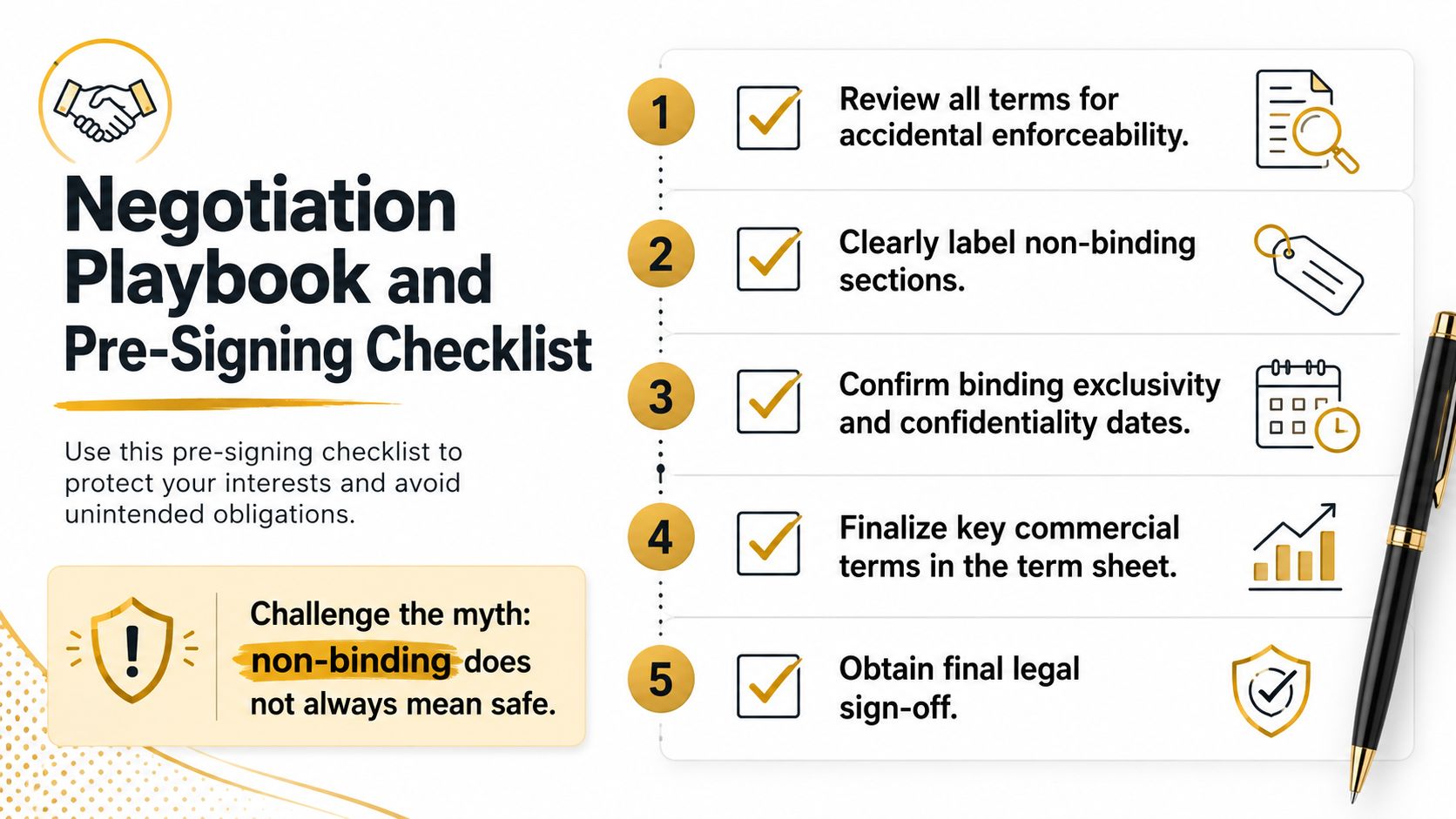
“Non-binding” is not a safety certificate. A buyer can violate confidentiality even when the acquisition itself isn't enforceable. A seller can breach exclusivity while insisting that no sale obligation exists. A good-faith paragraph can create an argument over whether the parties promised a process, not merely expressed an intention.
Run the document as though every operative sentence will be highlighted by an opposing lawyer.
Buyer pre-sign checklist
- Protect the diligence investment: Define access, information delivery, management availability, and the consequences if the seller blocks reasonable diligence.
- Limit exclusivity: Specify the prohibited conduct, start date, outside date, and automatic termination events.
- Keep economics conditional: State that price, structure, financing, approvals, and closing remain subject to diligence and a definitive agreement unless you intentionally want them fixed.
- Control reliance risk: Review forecasts, representations, and statements that could be read as promises rather than assumptions.
- Set the walk-away trigger: Decide in advance which diligence finding, financing failure, or approval issue ends the process.
Seller pre-sign checklist
- Protect optionality: Make clear that no obligation to sell or buy arises until the definitive agreement is executed.
- Narrow the no-shop: Reject vague restrictions, open-ended dates, and language covering every possible strategic conversation.
- Define permitted disclosures: Preserve the ability to speak with advisers, lenders, owners, regulators, and other parties where necessary.
- Audit reimbursement: Identify who pays which costs, when payment is due, and whether reimbursement survives termination.
- Confirm authority: Verify that the signatory has authority and that any required owner, board, or partner approval is addressed.
Either side should check these before signing
- Read the entire-agreement clause: Confirm what earlier confidentiality agreements, access arrangements, or side letters remain effective.
- Mark every binding carve-out: Put confidentiality, exclusivity, expenses, fees, governing law, and dispute resolution on a separate review list.
- Test each mandatory verb: Replace accidental “shall” or “must” language where the parties intend only an expression of intent.
- Check remedies: Know whether the other side can seek damages, an injunction, specific performance, or another remedy.
- Obtain final legal sign-off: Have counsel review the complete document, not only the page labeled non-binding.
If you're buying a business, use this guide to preparing successful business negotiations to pressure-test your process before you exchange a signed LOI. Then ask one final question: which promise am I willing to defend in court, and which promise am I not ready to make?
Dealmaker Wealth Society offers acquisition training, negotiation playbooks, due diligence guidance, capital-raising education, and feedback on active deal structures through courses, coaching, and a private peer community. Visit Dealmaker Wealth Society to strengthen your next LOI before you sign away advantage.

From the Dealmaker Blog










A Creative Business Buying Fable