Capital Raising Process for SMB Buyouts
Capital Raising Process for SMB Buyouts
The most popular advice about the capital raising process is also some of the least useful: perfect the pitch deck, then wait for investors to decide. Acquisition entrepreneurs rarely lose a deal because the font on page seven was wrong. They lose because the capital stack doesn't fit the cash flow, the investor list lacks a clear thesis, the seller's terms were negotiated too late, or diligence exposes a process that nobody controls.
Buying an SMB requires a different approach from funding a high-growth startup. The buyer must assemble financing around an existing business, its debt capacity, the seller's expectations, lender rules, and the investor's required return. Bank debt may cover only part of the purchase, while equity can be expensive in control and dilution. Seller financing, earn-outs, vendor rollovers, and deferred consideration often fill the gap.
The practical question isn't, “How do I make this opportunity sound exciting?” It's, “Which combination of capital sources makes this transaction financeable, governable, and resilient after closing?”
Table of Contents
- Why Most Capital Raises Fail Before They Start
- Funding Options for SMB Acquisitions
- Building Pitch Materials That Actually Get Read
- Investor Outreach as a Conversion Funnel
- Negotiating Terms and Structuring the Capital Stack
- Closing the Deal Without Last-Minute Surprises
- Your Capital Raising Action Plan
Why Most Capital Raises Fail Before They Start
A polished deck can't compensate for a poorly designed fundraising process. Investors decide quickly whether an acquisition fits their mandate, and a buyer who sends the same materials to every contact usually creates work without creating momentum.
One seed-stage benchmark found that a successful raise averaged 58 investor contacts, 40 investor meetings, and about 12.5 weeks to close. The same dataset reported average pitch-deck review time of only 3 minutes 44 seconds. Those figures come from a startup fundraising dataset, not an SMB acquisition sample, but the operational lesson transfers directly: investors skim first, qualify fit quickly, and spend deeper time only when the opportunity earns it. (DocSend fundraising research)
The raise is a conversion pipeline
Treat fundraising as a sequence of conversions:
- Target fit: Does the investor finance acquisitions, the relevant sector, and the required structure?
- Initial response: Does the message give the recipient a reason to engage?
- Meeting quality: Can the buyer explain the business, risks, financing need, and downside protection clearly?
- Term-sheet interest: Does the opportunity survive financial and commercial scrutiny?
- Commitment and close: Can all parties complete diligence, documentation, and funding conditions?
A weak conversion at the top creates a false diagnosis at the bottom. If the investor list is poorly matched, the buyer may conclude that the valuation is wrong when the problem is that the outreach reached people who don't invest in that type of deal.
Practical rule: Don't ask whether the pitch is persuasive until you've confirmed that the recipient is a plausible source of capital.
The most common early mistakes are predictable. Buyers contact too few investors, fail to separate senior lenders from equity partners, and approach generalists before testing people with a specific acquisition thesis. They also send a long narrative before answering the questions that matter most: what is being bought, how much capital is required, how the purchase will be financed, and what protects the investor if the plan underperforms.
Process discipline beats presentation polish
Build the process before launching outreach. Define the funding requirement, the proposed sources, the minimum acceptable terms, the decision-makers, and the documents required for diligence. Track every contact in a simple CRM or spreadsheet with fields for investor type, sector fit, check capacity, introduction source, response, next step, and date.
A credible opportunity can still stall when the buyer treats fundraising as a sequence of inspirational conversations. Capital partners need a controlled process, consistent information, and a clear path from first contact to commitment. Charisma may open a door, but matching, sequencing, and follow-through move money.
Funding Options for SMB Acquisitions
Acquisition entrepreneurs rarely fund an SMB with one instrument. The workable capital stack assigns each source a specific risk. Senior debt limits dilution but requires scheduled repayment. Equity removes that payment burden at the cost of ownership and often brings governance rights. Seller financing can fill a valuation or financing gap, provided its subordination and repayment terms work for the senior lender and remain acceptable to the seller.
Traditional bank loans fit targets with dependable cash generation, clean records, acceptable collateral, and a buyer who can demonstrate repayment capacity. SBA-backed lending can broaden access for qualifying acquisitions, but approval still depends on underwriting, documentation, borrower qualifications, and the target's ability to support the proposed obligations. A lender may like the business and still reject the structure if debt service leaves too little room for weaker trading periods.
Seller financing becomes especially useful when the seller trusts the buyer but the bank will not fund the full purchase price. A seller note defers part of the consideration and keeps the seller economically connected to a successful transition. The buyer must negotiate interest, amortization, subordination, security, and default rights before treating the note as committed capital.
An earn-out solves a different problem. It ties part of the purchase price to future performance, which can protect the buyer from paying today for uncertain results. It can also create disputes unless the metric, accounting method, reporting process, and operating control are precise. Earn-outs work best when the buyer and seller can verify performance without arguing over decisions the buyer controls.
Rollover equity lets the seller retain ownership instead of receiving all consideration at closing. That lowers the buyer's upfront equity requirement and can preserve continuity after closing. It also creates a continuing partnership, so governance, information rights, transfer restrictions, exit rights, future dilution, and decision authority require agreement before signing.
The financing mix should reflect the target's cash flow and the uncertainty around the transition. A useful comparison of equity and debt financing for acquisitions shows why repayment obligations and ownership dilution should be assessed together.
A Canadian government-backed SME study found that equity requests were approved at 76%, compared with 86% for debt requests, while authorized amounts averaged 42% of what businesses requested. (Canadian SME financing study)
| Funding Type | Approval Profile | Best For | Key Considerations |
|---|---|---|---|
| Bank debt | Highest approval likelihood for cash-flowing targets | Businesses with repayment capacity | Covenants, collateral, amortization, and personal guarantees may matter |
| SBA-backed debt | Varies by lender and borrower | Qualifying acquisitions where conventional financing is constrained | Eligibility, underwriting, guarantees, and documentation require careful review |
| Seller financing | Not standardized | Purchase-price gaps and seller transition support | Subordination, payment terms, default rights, and lender consent |
| Equity partnership | Lower approval likelihood than debt in the cited study | Deals with limited debt capacity or substantial growth opportunity | Dilution, governance, preferred returns, and exit rights |
| Joint venture | Not standardized | Buyers contributing operating expertise alongside capital partners | Control, decision rights, contributions, and deadlock provisions |
| Hybrid structure | Not standardized | Transactions where no single source funds the full purchase | Intercreditor rules, priority, cash-flow pressure, and aligned incentives |
Traditional banks have pulled back in some acquisition markets while interest rates remain high. Buyers therefore combine bank debt, seller paper, earn-outs, vendor rollovers, and deferred consideration instead of relying on one loan package. Coverage of acquisition financing and exit readiness reported $8.29 billion in SBA 7(a) acquisition loans approved through September 2025, up 34.58% year over year, indicating continued demand even as transaction structures become more complex. (Acquisition financing and exit-readiness coverage)
The practical question is which source should bear which risk. Let lenders fund predictable cash flow, let sellers absorb some uncertainty through deferred consideration or an earn-out, and bring in equity when the remaining risk requires patient capital. The strongest structure is usually the one that preserves cash after closing while keeping incentives aligned through the transition.
Building Pitch Materials That Actually Get Read
Acquisition materials must answer an investor's underwriting questions, not imitate a startup fundraising deck. The reader wants to understand the target's historical performance, the purchase rationale, the financing structure, the buyer's operating plan, and the risks that could impair repayment or returns.
Start with a short teaser. It should identify the sector, business model, broad financial profile, transaction rationale, proposed capital requirement, and buyer credentials without disclosing sensitive information prematurely. The teaser's job is to create a qualified next conversation, not explain every detail.
The CIM then carries the substantive case. A useful CIM typically covers:
- Business model: Explain how the company wins customers, delivers its product or service, and collects revenue.
- Historical financials: Reconcile statements, tax returns, bank records, add-backs, working capital, and unusual items.
- Commercial profile: Describe customers, concentration, contracts, renewal behavior, suppliers, competition, and market position.
- Transaction terms: Show purchase consideration, assumed or refinanced debt, seller financing, earn-out mechanics, rollover equity, and sources and uses.
- Operating plan: Explain what changes after closing, who will manage the business, and which assumptions drive growth.
- Risk register: Address customer concentration, owner dependence, litigation, regulatory exposure, technology, staffing, and working-capital needs.
Put the decision-critical information first
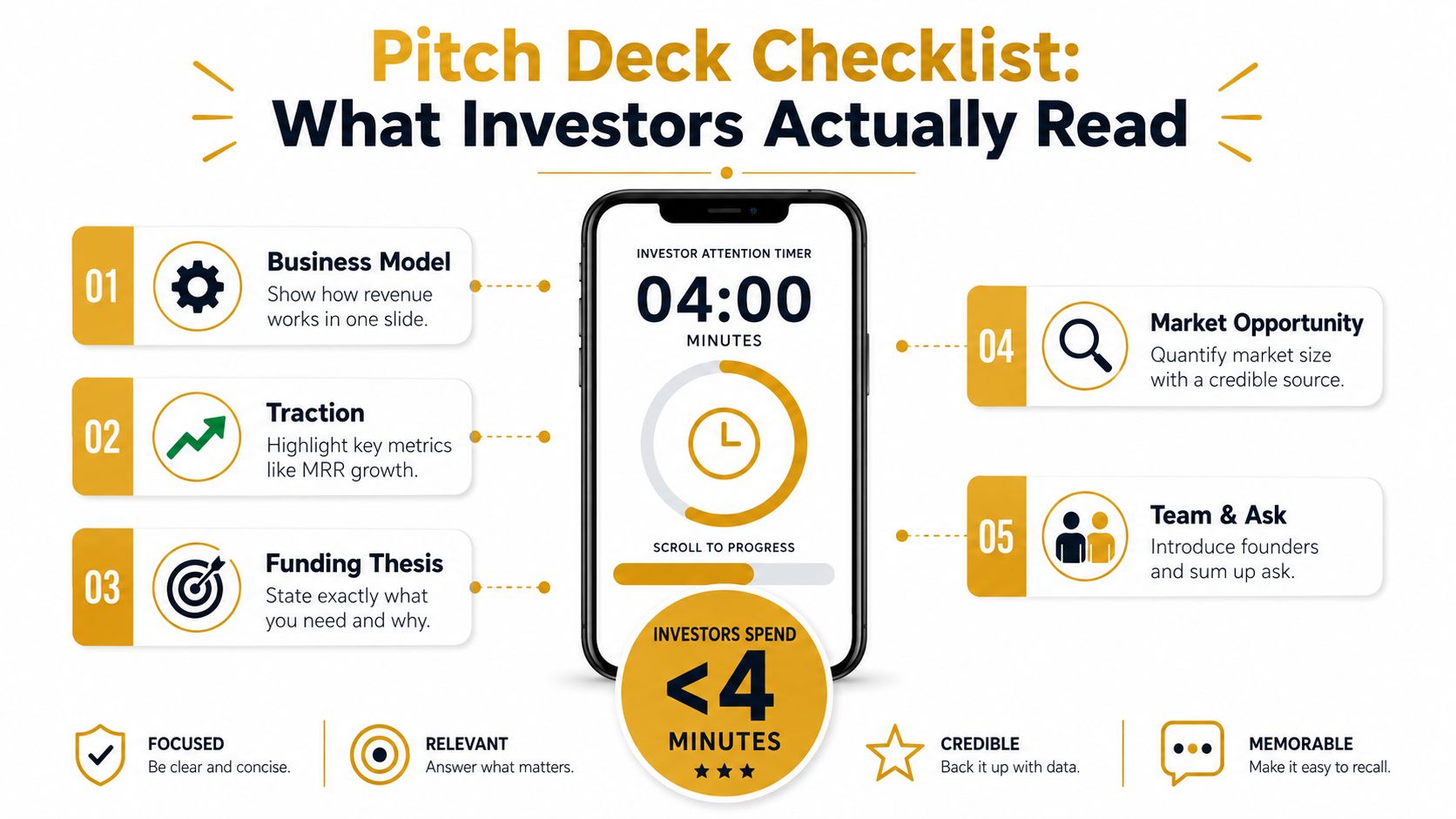
Because the cited fundraising benchmark found that investors spent only 3 minutes 44 seconds reviewing each deck, the opening pages need to establish the funding thesis immediately. (DocSend fundraising research) Lead with the acquisition, the buyer, the economics, and the proposed capital stack. Don't bury the requested amount or use of funds behind a long market narrative.
A clean model should let an investor change purchase price, debt amount, interest assumptions, seller-note terms, earn-out outcomes, operating performance, and exit assumptions. The model isn't a forecasting contest. It's a way to expose which assumptions make the deal work and which assumptions create fragility.
Make diligence boring
Create a data room with consistent file names, clear folders, and one source of truth. Include financial statements, tax filings, customer and supplier information, employee records, leases, licenses, contracts, insurance, legal matters, debt documents, and ownership records as applicable to the transaction.
Scattered documents create avoidable diligence delays. A buyer who sends five versions of a financial schedule or cannot reconcile the CIM to the model signals execution risk before the investor has finished underwriting the business. The strongest materials don't eliminate questions. They make the questions easier to answer.
Investor Outreach as a Conversion Funnel
投資人開發的核心,不是把同一份訊息寄給更多人,而是讓不同資金來源看見與自身決策相關的交易理由。名單要有足夠廣度,才能承受拒絕,也要細分到每次接觸都具備背景。可分開建立資深貸款機構、SBA 貸款機構、獨立贊助者、家族辦公室、搜尋基金投資人、策略夥伴、可能提供賣方融資的賣家,以及營運夥伴名單。
為每位聯絡人標記:
- Mandate: 收購資本、成長股權、資產抵押貸款、現金流貸款,或賣方參與。
- Sector fit: 相關營運經驗,以及對目標企業收入模式的熟悉程度。
- Transaction fit: 交易規模、地理位置、所有權要求與控制權偏好是否相符。
- Relationship strength: 既有關係、共同人脈、過往互動,或陌生開發。
- Decision path: 個人投資人、投資委員會、貸款信用團隊,或合夥人批准。
對 SMB 收購而言,外聯名單應按照資本缺口和資金來源分層,而不是追求固定聯絡人數。股權投資人通常需要理解上行空間、控制權與退出安排。貸款機構則更關注償債能力、抵押品、擔保、契約限制與還款優先順序,因此訊息應更短、更接近信用審查,而不只是描述願景。早期可先接觸能提供反饋的人,再聯繫優先級較高的資金夥伴。這種順序能在正式推介前修正結構,也能避免把賣方票據、earn-out 或 rollover equity 的安排講得含糊。
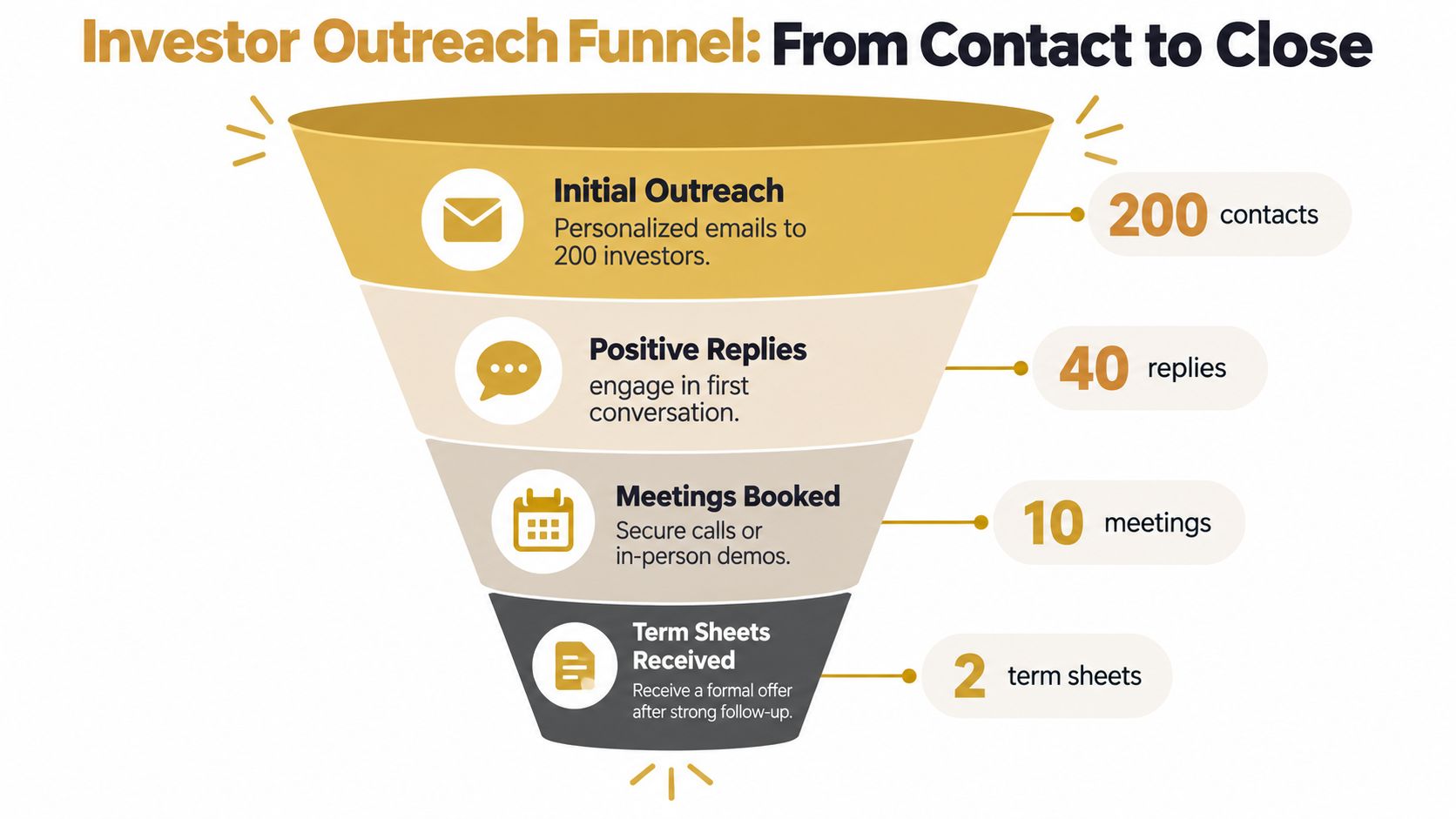
一封實用的首次訊息可以很簡潔:
Subject: Acquisition opportunity in [sector]
I'm pursuing the acquisition of a [business type] with [relevant characteristic]. I'm assembling a capital stack that may include [instrument]. Your experience with [specific mandate or sector] appears relevant. Would you be open to reviewing a short overview?
暖介紹有助於提供背景,但不能取代交易契合度。陌生開發同樣可行,前提是訊息說明買方為何聯繫對方,以及交易如何符合其投資方向。買方可參考這套 warm playbook led engagement 方法,先建立脈絡與相關性,再提出要求。
後續跟進應加入新資訊,例如更清楚的融資結構、對可能疑慮的回覆,或明確的下一步。若對方在幾次合理且有內容的跟進後仍未回應,就移至培育名單,把時間留給活躍對象。若要更直接理解貸款人對話,可參考 playing ball with financiers。
每週更新管道紀錄:誰看過 teaser、誰索取 CIM、誰參加會議、誰提出盡職調查問題,以及誰有權發出條款。將流程按階段追蹤,才能分辨是外聯不足、資料不清,還是交易本身尚未符合融資條件。
Negotiating Terms and Structuring the Capital Stack
A capital stack is a risk-allocation plan, not merely a list of funding sources. Senior debt has repayment priority and usually the strongest protections. Common equity absorbs the most uncertainty in return for greater upside. Seller notes, earn-outs, and rollover equity occupy the middle because acquisitions often need a structure that shares risk rather than placing it entirely on the buyer.
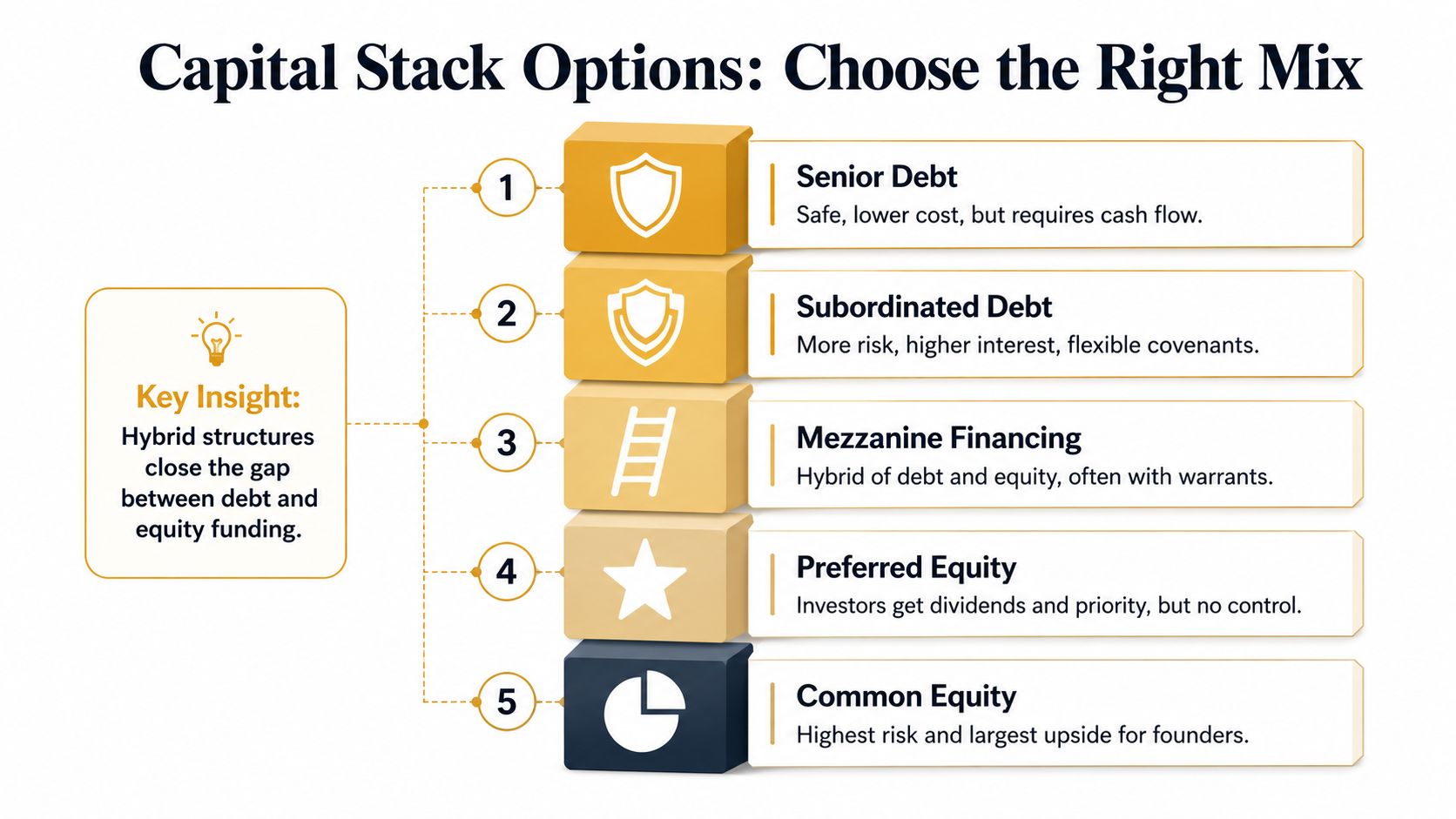
A practical stack may combine senior acquisition debt against predictable cash flow, a seller note for part of the purchase price, an earn-out tied to uncertain performance, and equity for the remaining gap and working capital. Model every layer together. A seller note that appears affordable alone can become restrictive when paired with fast senior amortization and weak first-year cash flow.
Negotiate the stack, not isolated terms
Senior lenders focus on priority, payment restrictions, security, reporting, and default remedies. If seller paper is subordinated, the lender may require a payment standstill or approval rights over amendments. The seller can accept delayed payment, but the trade-off should be explicit. For example, a buyer may offer a longer seller-note tenor in exchange for a standstill during a defined lender enforcement period. That preserves lender priority while giving the seller a clearer repayment path. Every concession should buy a specific improvement elsewhere in the structure.
Earn-outs need precise drafting. Define the performance metric, measurement period, accounting treatment, operating control, dispute process, and treatment of extraordinary events. If the buyer controls pricing, staffing, marketing, or revenue recognition after closing, the agreement must explain how those decisions affect the earn-out. Buyers can review guidance on structuring acquisition earn-outs before putting figures into a term sheet.
Vendor rollovers and seller equity preserve alignment, but they add governance obligations. Set board rights, reserved matters, transfer restrictions, distributions, future financing rules, drag-along and tag-along rights, and exit mechanics before either party depends on the other for value realization.
The Canadian SME financing data cited earlier supports giving blended structures serious consideration, since debt and equity requests can face different approval outcomes. That does not make debt automatically superior. It means a buyer should test whether seller financing, an earn-out, or rollover equity can reduce the amount of pure equity required and assign uncertainty to the party best positioned to bear it.
Protect control economics
Do not judge an equity offer by ownership percentage alone. Compare liquidation preferences, preferred returns, voting rights, protective provisions, management fees, redemption rights, and the investor's influence over a future sale. A smaller headline stake can still carry significant economic or governance consequences.
The right stack leaves the operating company room to perform. If post-close cash flow is committed to debt service, seller payments, and preferred distributions, the buyer may own the business without having enough flexibility to operate it. Model downside cases, preserve working capital, and structure for resilience rather than merely reaching closing.
Closing the Deal Without Last-Minute Surprises
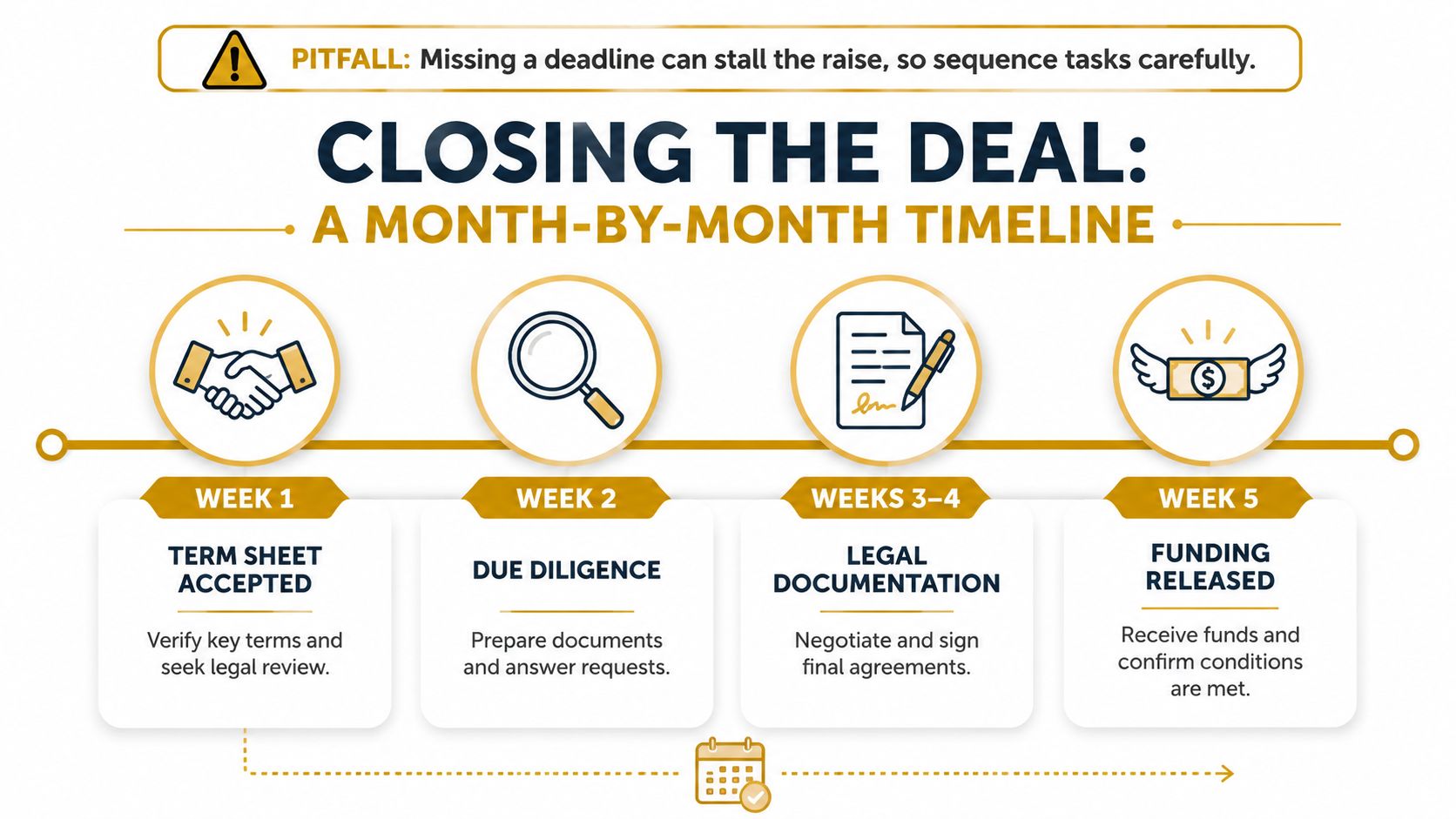
A signed term sheet does not fund an acquisition. It authorizes the most detailed work in the process. Raises often slow after initial interest because no one owns the documents, lender conditions remain unclear, or the seller delivers information in fragments.
Lower-middle-market guidance describes a disciplined raise as a 10- to 12-step process that may take roughly four to eight months, covering readiness work, quality of earnings, CIM preparation, sponsor targeting, meetings, term sheets, diligence, and closing. (Lower-middle-market capital raising guidance) The range is not a promise for every transaction. It is a warning against underwriting a purchase around one favorable conversation.
Assign owners to every condition
Create a closing tracker when the term sheet is accepted. List the responsible person, required document, counterparty, due date, status, and dependency. The buyer, seller, senior lender, equity partner, accountant, and lawyers should use the same list.
Prioritize items that could invalidate the transaction:
- Quality of earnings: Reconcile reported earnings with sustainable cash flow and document each adjustment.
- Legal review: Confirm ownership, contracts, litigation, intellectual property, employment matters, and change-of-control provisions.
- Lender diligence: Satisfy collateral, insurance, environmental, appraisal, guarantor, and reporting requirements where applicable.
- Third-party consents: Identify landlords, franchisors, customers, licensors, and suppliers whose approval may be required.
- Sources and uses: Reconcile the purchase price, fees, working capital, debt refinancing, seller consideration, and equity contributions.
- Final agreements: Align the purchase agreement, loan documents, seller note, earn-out, rollover equity, and investor agreements.
Keep the data room orderly before serious diligence begins. Use permissions, version control, and an audit trail. A missing document can be resolved. An unexplained contradiction among the model, tax returns, bank statements, and purchase agreement damages confidence and creates more questions.
Manage sequencing, not just activity
The financing pieces must fit together. Do not ask a lender to approve a structure before the equity partner has committed to fund it. Do not finalize seller economics before understanding senior lender restrictions. Check customer contracts early, rather than discovering during legal drafting that one prohibits assignment.
Hold regular closing calls with a written action log. Escalate unresolved questions while they can still be addressed, especially those affecting purchase price, working capital, debt capacity, or control. Process discipline rarely makes a deal exciting, but it keeps preventable surprises from turning investor interest into a failed closing.
Your Capital Raising Action Plan
A practical capital raising process starts before outreach. Confirm the target's financial quality, define the acquisition thesis, calculate the funding gap, and decide which risks belong with lenders, the seller, equity partners, or the buyer.
Use this sequence:
- Prepare the deal: Build the model, cap table, sources-and-uses schedule, teaser, CIM, and organized data room.
- Design the stack: Test senior debt, SBA financing, seller paper, earn-outs, rollover equity, and common equity together.
- Build the list: Segment capital partners by mandate, sector, structure, check capacity, and relationship strength.
- Run outreach: Personalize the message, track each stage, and schedule follow-ups with a defined purpose.
- Negotiate risk allocation: Review priority, control, dilution, repayment, earn-out measurement, and downside protections.
- Close deliberately: Assign every diligence and documentation item to a person with a deadline.
Expect the process to take as long as the transaction requires. Lower-middle-market guidance places a disciplined raise at roughly four to eight months, depending on readiness, diligence, financing complexity, and closing coordination. (Lower-middle-market capital raising guidance) The buyer's objective isn't to promise speed. It's to remove the preventable delays that make a reasonable timeline longer.
Get help when the structure involves multiple capital layers, unfamiliar lender rules, meaningful seller rollover, or complicated governance. An experienced M&A lawyer, transaction accountant, lender, and capital advisor can identify conflicts before they become closing conditions. Education and peer support can also help buyers pressure-test materials and financing choices. Dealmaker Wealth Society offers acquisition training, capital-raising education, live coaching, templates, and a private peer community focused on deal execution.
Dealmaker Wealth Society helps acquisition entrepreneurs build funding strategies, evaluate creative deal structures, and prepare for lender and investor conversations through structured training, coaching, and peer support. Visit Dealmaker Wealth Society to explore the acquisition and capital-raising resources available for your next SMB buyout.

From the Dealmaker Blog











A Creative Business Buying Fable