Mergers and Acquisitions Strategy Guide for SMB Growth
Mergers and Acquisitions Strategy Guide for SMB Growth
You've spotted a nearby competitor with loyal customers, capable employees, and a service your company could sell immediately. The owner is open to a conversation, but you're unsure how to judge the opportunity, finance it without damaging cash flow, or keep the team from leaving after the sale.
That's where a disciplined mergers and acquisitions strategy matters. An acquisition isn't just a larger purchase order. It's a decision about capabilities, people, cash flow, risk, and the operating model you'll build after closing. For an SMB, the margin for error is narrower because a few customers, managers, or suppliers may carry disproportionate importance.
Table of Contents
- Introduction to Mergers and Acquisitions Strategy for SMBs
- Understanding Strategic Rationale for SMB Acquisitions
- Deal Sourcing and Target Screening Best Practices
- Valuation Frameworks and Synergy Analysis
- Creative Deal Structuring and Financing Options
- Execution Playbook and Post-Acquisition Scaling
- Real-World SMB M&A Case Studies
- Conclusion and Next Steps in Your M&A Journey
Introduction to Mergers and Acquisitions Strategy for SMBs
Acquisitions can help a small business reach a new region, add a profitable product line, gain specialized talent, or remove a competitor from a crowded market. They can also create problems faster than organic growth if the buyer pays for synergies that never materialize or changes the target's culture without understanding why it works.
The first discipline is to separate strategic intent from excitement. Before contacting an owner, write down what you're trying to obtain:
- Market access: A target may provide customers, distribution, or a geographic foothold.
- Capability: The business may have software, licenses, processes, or technical talent that would take too long to build internally.
- Efficiency: Combined purchasing, administration, or production may reduce duplicated work.
- Continuity: Buying a stable operator can strengthen your company's leadership bench and customer coverage.
SMB transactions differ from large corporate deals. The owner may still approve pricing, manage key accounts, and train employees. A single operations manager can be more important than a polished organizational chart, while uneven monthly cash flow can affect debt repayment immediately.
Practical rule: Don't ask only whether you can buy the target. Ask whether your business can absorb it without weakening the cash engine that funds the acquisition.
A useful roadmap runs from strategic rationale and sourcing to screening, valuation, financing, diligence, closing, and integration. Buyers who want a broader overview of transaction preparation can also review these top merger and acquisition strategies before they begin outreach.
Understanding Strategic Rationale for SMB Acquisitions
A target should solve a clearly defined business problem. “Growth” is too broad to guide a search. “Add recurring commercial customers in a neighboring region while preserving our installation capacity” is specific enough to shape screening and negotiation.
The wider market reinforces the need for readiness rather than passive timing. Global M&A value rebounded to about $3.4 trillion in 2024, an 8% increase year over year, according to the 2024 Global M&A Report. That recovery doesn't mean every SMB target is attractive. It means prepared buyers may face competition for strategically useful assets, especially when larger transactions draw capital and attention.
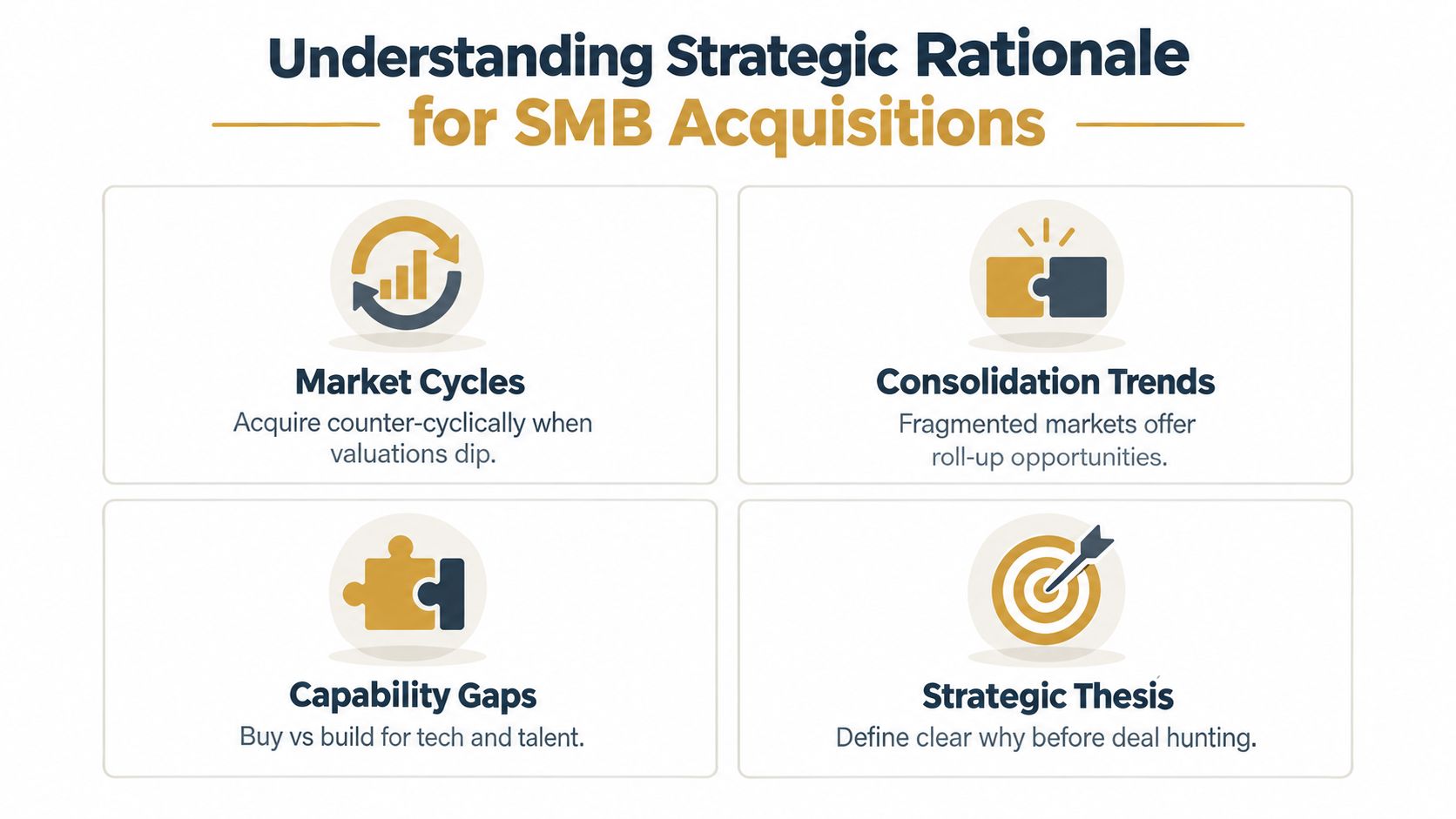
Four reasons to acquire
Geographic expansion works when the target already has local relationships, delivery infrastructure, or reputation that your company can't reproduce quickly.
Capability acquisition makes sense when the target owns a process or team that fills a genuine gap. Buying a specialized contractor, for example, may be more practical than recruiting and training an entirely new division.
Consolidation can create operating efficiency in fragmented markets, but only if the buyer can standardize what should be standardized without destroying the local strengths customers value.
Platform development involves buying a business that can support later bolt-ons. The platform needs reliable reporting, management depth, and enough operational discipline to absorb another company.
Write a one-page thesis covering the customer problem, target profile, value-creation plan, financing constraints, and reasons the deal could fail. Then ask whether the same objective could be achieved through hiring, partnership, licensing, or internal investment. An acquisition earns its place when it offers a defensible advantage, not merely a faster way to spend money.
Deal Sourcing and Target Screening Best Practices
Good deal flow rarely comes from waiting for a perfect listing. Build several sourcing channels, then record every conversation in a simple CRM such as HubSpot, Airtable, or a dedicated acquisition pipeline. Track owner contact details, industry, location, strategic fit, financial quality, relationship status, and the next action.
Start with a target profile. Define the customer type, service area, operational model, leadership requirements, and unacceptable risks. This prevents attractive but irrelevant businesses from consuming your time.
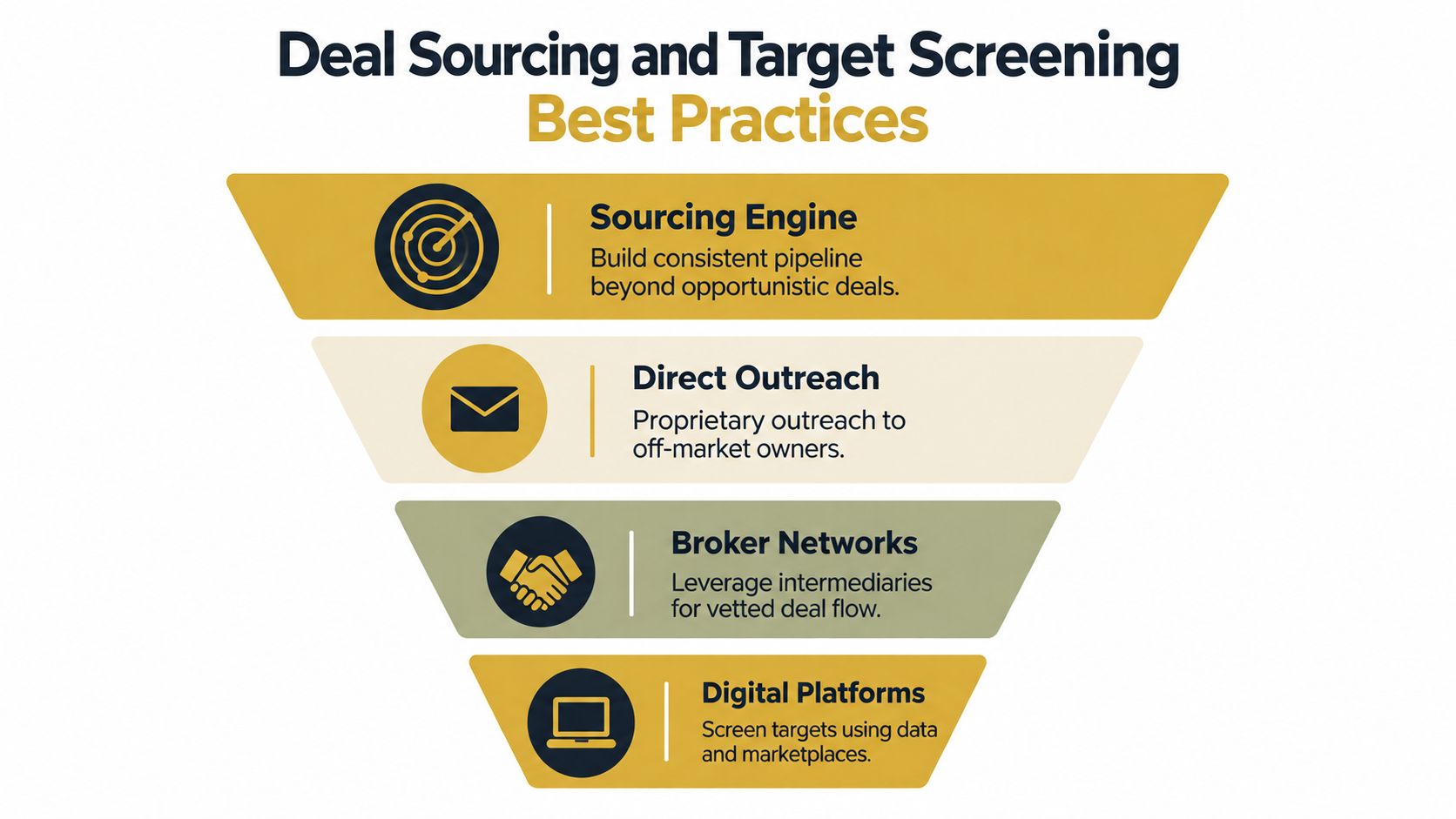
Build the pipeline deliberately
- Direct outreach: Contact owners of businesses that match your thesis, including companies that aren't publicly marketed. A respectful letter, phone call, or referral can open a conversation before a formal sale process begins.
- Intermediary relationships: Business brokers, accountants, attorneys, and commercial lenders can introduce owners who value discretion. Explain your criteria clearly so they don't send unsuitable opportunities.
- Digital screening: Marketplaces and professional networks can widen the search, but treat listing information as an opening hypothesis, not verified fact.
- Relationship follow-up: Owners may not be ready immediately. Keep useful notes and offer a credible reason to reconnect rather than sending repetitive messages.
If outbound calling isn't a strength inside your company, a specialist team that can hire cold callers may help create a more consistent first-contact process. The caller should qualify interest and context, not make unsupported promises about price or closing speed.
For a more structured evaluation process, use this deal evaluation framework alongside your CRM.
Cross-border targets deserve a separate risk category. In 2024, cross-border deal value was about $1.1 trillion, roughly 33% of total M&A activity, according to the XBMA annual review for 2024. Domestic sourcing is often the sensible starting point for an SMB, while international opportunities require deeper work on regulation, currency, tax, employment, and integration.
Valuation Frameworks and Synergy Analysis
A seller's historical earnings provide a starting point, not a complete answer. An SMB buyer also needs to test why the acquisition fits the strategy and whether the expected gains justify the price. Separate four drivers so the model shows where value comes from:
- Incremental cash flow from synergies. List specific savings or revenue opportunities, such as combined purchasing, duplicate software removal, or selling the target's product to existing customers.
- Growth-rate changes. Estimate how distribution, sales coverage, or capacity could change the combined company's growth. Keep these assumptions separate from cost savings.
- Capital-cost changes. Greater scale, diversification, or clearer reporting may affect financing terms and perceived risk. Model that effect separately instead of hiding it in a higher valuation multiple.
- Timing and duration. A benefit arriving after implementation work is worth less than one available immediately. Some gains may also decline if customers, employees, or suppliers respond poorly.

Convert the thesis into operating assumptions
Suppose a target buys materials from several vendors. Replace “procurement savings” with a line-by-line schedule covering each category, supplier, current price, expected combined volume, implementation requirements, and timing. Apply the same discipline to payroll overlap, software, facilities, sales conversion, and customer retention.
Publicly communicated run-rate EBIT synergies average only 1% to 5% of combined sales, according to this synergy assessment study. The figure is a reference point, not a forecast for your transaction. Bottom-up evidence should support each assumption before it influences the purchase price.
Build a base case, downside case, and upside case. In the downside case, delay benefits, raise retention costs, reduce cross-selling, and test whether the business can still service its obligations. Buyers comparing approaches can also review these business valuation methods so the model matches the selected valuation logic. For an SMB, this approach also exposes the people and implementation work behind each synergy, rather than treating human-capital integration as an afterthought.
Creative Deal Structuring and Financing Options
The best structure shares risk according to who controls the relevant outcome. If the seller claims that a customer relationship will remain strong, an earn-out may connect part of the consideration to agreed performance. If the buyer controls pricing and staffing after closing, the earn-out must define those decisions carefully or the arrangement will create conflict.
| Financing Type | Description | Typical Use Case | Pros | Cons |
|---|---|---|---|---|
| Seller note | The seller receives payment over time under agreed terms. | Bridging a funding gap or supporting a transition. | Preserves buyer cash and keeps the seller economically connected. | Creates repayment obligations and may require security or subordination terms. |
| Earn-out | Deferred consideration depends on defined results. | Managing uncertainty about customers, revenue, or leadership continuity. | Aligns payment with outcomes and can narrow valuation gaps. | Metrics, accounting rules, and post-close control can become contentious. |
| Vendor take-back | The seller finances part of the purchase directly. | Transactions where conventional lending doesn't cover the full price. | Can simplify the capital stack and demonstrate seller confidence. | Seller may demand protections, and the buyer carries additional obligations. |
| Equity partner | An investor contributes capital in exchange for ownership. | Buyers with a strong operating plan but limited personal capital. | Reduces immediate debt pressure and adds potential expertise. | Dilutes ownership and requires clear governance rights. |
| Mezzanine financing | A subordinated layer sits between senior debt and equity. | Deals needing additional capital beyond primary lending. | Can fill a financing gap without immediate full equity funding. | Usually carries complex terms and can increase financial pressure. |
Match terms to cash-flow resilience
A seller note may suit a stable business with predictable collections. An earn-out can help when the buyer and seller disagree about future performance, but the agreement should specify the measurement period, reporting method, customer treatment, and dispute process. Equity may be more appropriate when preserving liquidity matters more than retaining complete ownership.
Creative financing doesn't eliminate risk. It makes risk visible and allocates it through contracts. Buyers considering international capital, multi-party transactions, or specialized funding can also speak with a corporate finance advisory Dubai provider, provided the advice fits the transaction's jurisdiction and legal structure.
Execution Playbook and Post-Acquisition Scaling
Closing documents don't integrate employees, transfer customer trust, or prove synergy assumptions. The buyer needs an operating plan before signing, with named owners for every critical action and a dashboard that distinguishes financial results from activity.
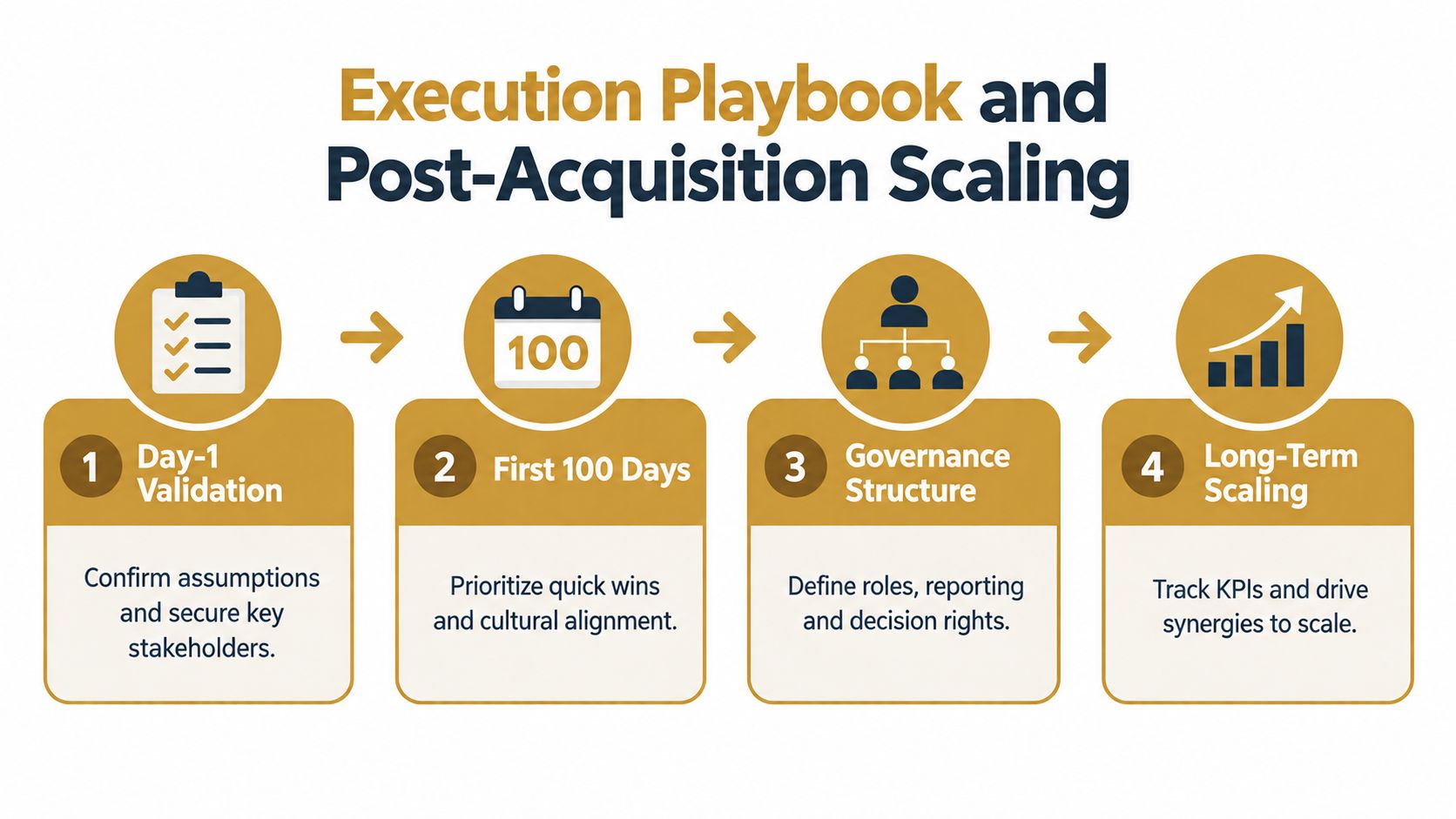
Day one and the first operating phase
On Day 1, confirm payroll, banking access, insurance, customer communication, supplier continuity, system permissions, and the retention plan for essential employees. Don't announce broad changes before managers understand who owns decisions.
During the first operating phase, focus on stability before aggressive redesign. Meet key customers, document core workflows, review cash conversion, and resolve issues that could interrupt delivery. A short list of visible quick wins can build confidence, but only if the team understands why each change matters.
Governance that survives busy weeks
Appoint an integration leader with authority, not merely a coordinator who collects updates. Create workstreams for people, customers, finance, operations, technology, and legal matters. Each workstream should have an owner, a baseline, an expected benefit, a deadline, and a funding requirement.
Deals with explicit synergy tracking from day one show a 92% success rate, and 78% of successful acquirers spend at least 6% of deal value on integration, according to PMI Stack's synthesis of integration statistics. These figures support a practical conclusion, integration belongs in the budget and the measurement system, not in an informal post-close wish list.
For a detailed operating checklist, use these integration planning best practices. Add bolt-ons only after the platform can report performance consistently and leadership knows which processes must remain local.
Real-World SMB M&A Case Studies
Consider a niche eCommerce buyer that acquires a smaller brand serving the same customer type. The buyer doesn't assume that the target's sales will automatically transfer. Instead, it maps the product catalog, supplier terms, email permissions, fulfillment workflow, and customer service practices.
The buyer keeps the acquired brand's merchandising voice while combining selected back-office functions. The seller remains available through a defined transition arrangement, and deferred consideration depends on agreed customer and revenue outcomes. Before closing, the buyer identifies the people who understand supplier relationships and product quality, then makes retention and decision rights explicit.
The lesson is simple: brand overlap is not the same as operational compatibility. A buyer should model the work required to combine inventory, systems, customer data, and marketing rather than treating “cross-sell” as a free benefit.
A regional services operator offers a different example. It buys a neighboring provider whose owner wants partial liquidity but still wants a role in customer relationships. The structure includes seller equity and performance-linked consideration, while the acquiring company centralizes finance and scheduling without immediately replacing local service leaders.
The buyer's main human-capital task is not to impose identical titles. It is to identify which managers hold customer trust, which employees can supervise expansion, and which roles depend on the former owner's personal involvement. The integration plan creates regular operating reviews and a path for leaders to earn broader responsibility.
These examples reflect why SMB buyers shouldn't copy a large private-equity playbook without adaptation. Bain reported that small and mid-sized deal volumes barely moved in 2025 while billion-dollar deals surged, reinforcing the need for SMB-specific sourcing, financing, and integration choices in the 2026 M&A midyear outlook. A smaller acquisition may win when it transfers a scarce capability quickly, protects cash flow, and can be integrated by the existing leadership team.
Conclusion and Next Steps in Your M&A Journey
A reliable SMB acquisition process follows six linked decisions: define the strategic rationale, build a target funnel, screen risks, value the business from the bottom up, structure financing around cash flow, and execute integration with clear ownership. The human-capital plan belongs inside that process, because retention, leadership continuity, and incentives can determine whether the thesis survives closing.
Start by writing your acquisition criteria, listing potential targets, and creating a simple screening scorecard. Then validate the financial model with downside assumptions, speak with financing partners, and decide which terms could share risk with the seller. Don't submit an offer until you can explain what changes on Day 1 and who will lead them.
Dealmaker Wealth Society offers training, templates, mentorship, and peer support for entrepreneurs working through sourcing, valuation, creative financing, and post-acquisition integration. Visit Dealmaker Wealth Society to explore its acquisition education and deal-support resources, then choose the program or community format that fits your next step.

From the Dealmaker Blog












A Creative Business Buying Fable