M&A Due Diligence Course: What to Learn First
M&A Due Diligence Course: What to Learn First

You've signed a letter of intent, and the seller has opened the data room. It holds financial statements, customer lists, contracts, employee files, and more, but you're still unsure which findings should change the price, the agreement, or your decision to proceed.
That's where an M&A due diligence course should help. It shouldn't just teach you to collect documents. It should teach you to test the deal's assumptions, decide what to do with evidence, and plan how the business will keep operating after closing.
The guidance below is for first-time acquisition entrepreneurs, operators planning bolt-ons or roll-ups, corporate professionals moving into independent M&A, capital partners, and eCommerce owners exploring acquisitions. You'll find a map of the core learning, ways to compare training options, a sample curriculum, and practical tests for whether a finding changes the economics or creates a continuity risk.
Table of Contents
- Why Buyers Need an M&A Due Diligence Course
- What the Course Must Teach Before You Sign
- Price and Contract Lessons Most Courses Skip
- How to Choose the Right Training Path
- A Sample Curriculum for First-Time Buyers
- Findings That Should Change the Deal
- Your Next Step on a Live Acquisition
Why Buyers Need an M&A Due Diligence Course
A first-time buyer can open a data room and immediately feel behind. The financial records may look familiar, but the meaning of a customer contract, a seasonal inventory build, or a gap in employee records may be harder to judge. A checklist can tell you to look. It may not tell you whether what you find means renegotiate, add protection, or walk away.
That distinction matters because a transaction doesn't create value just because it closes. PwC's 2023 M&A Integration Survey reported that 14% of respondents achieved significant integration success across key measures. The survey also found that 44% couldn't fully integrate customer and go-to-market activities. Those findings point to a practical lesson: an issue list is useful only when the buyer connects it to a plan for preserving or creating value.
From documents to decisions
A buyer might discover that one customer accounts for a large share of revenue. The next questions are whether that customer can terminate its contract after a change of control, whether the relationship depends on the seller personally, and whether the asking price assumes that revenue will continue. The finding could lead to a price adjustment, a seller transition commitment, or a decision not to proceed.
The course should help you ask these questions without pretending that every red flag means the same thing. A customer concentration issue, for example, may be manageable if relationships are transferable and customers are committed. It may be deal-breaking if key accounts can leave immediately and the valuation depends on their revenue.
Who benefits from structured training
A first-time entrepreneur needs a way to direct accountants, lawyers, and other specialists without mistaking their reports for a complete operating plan. A business owner pursuing a bolt-on needs to understand whether the target's systems and people can work with the existing company. A capital partner needs to see how diligence findings affect cash requirements and risk allocation.
By the end of a useful course, you should be able to create a prioritized issue list, connect material findings to valuation or contract terms, and outline the work that must happen after closing. The aim isn't to become a substitute for legal, tax, or accounting professionals. It's to know which questions to ask them, and how to turn their answers into a decision.
What the Course Must Teach Before You Sign
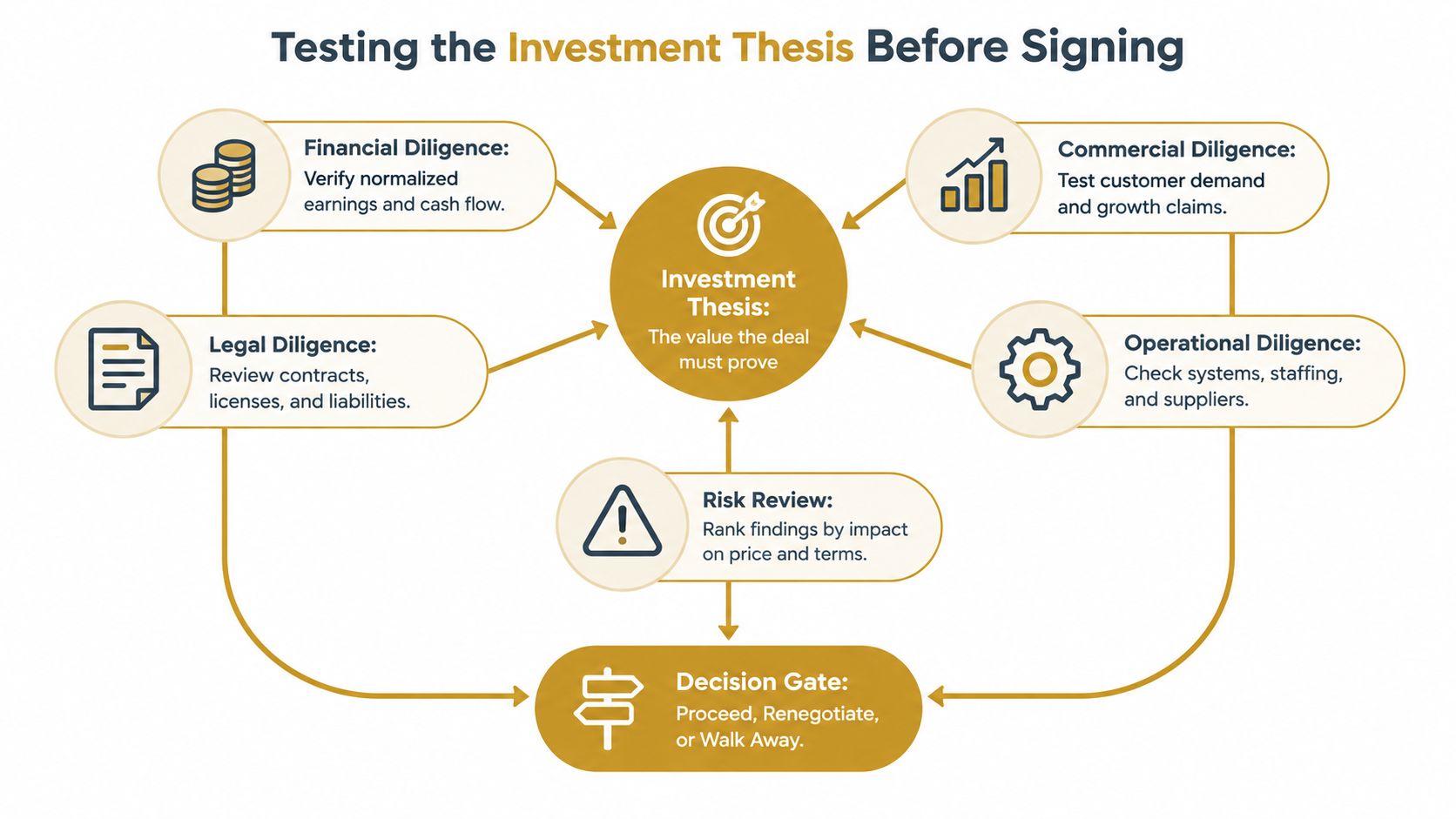
A useful course tests the investment thesis before you're legally committed. If your thesis is that the target has dependable earnings, loyal customers, and a simple path to growth, diligence must test each part. A tour of folders may show you where the evidence sits, but you need training in how to judge it and what to do when it contradicts your assumptions.
Test the thesis across workstreams
Start with the financials. A quality-of-earnings review should help you distinguish recurring earnings from unusual items, owner-specific expenses, and adjustments that lack good support. Then test whether the commercial story holds up: who buys, how concentrated revenue is, and whether the seller's growth claims match customer and sales evidence.
Legal and operational questions matter just as much. Review contracts, licenses, liabilities, employees, technology, compliance, tax records, and operating processes. Each workstream should feed the same decisions: Does the evidence support the valuation? Should the agreement include a specific protection? What must the buyer arrange to keep the company functioning?
A guide to assessing operational due diligence factors can help you think through how systems, staffing, and suppliers affect the business's ability to operate after a transaction.
Convert risks into ownership and action
PwC's 2023 survey found that 60% of companies planned their long-term operating model before due diligence in 2022, compared with 25% in 2019, while integration challenges remained, including in customer and go-to-market activities. The lesson isn't that early planning guarantees success. It's that planning an operating model and integrating the business are different tasks.
For a small-business buyer without an integration department, this difference is especially important. If a diligence finding requires customer outreach, software migration, new controls, or supplier discussions, identify who will own it, when it must happen, and what evidence will show it's complete. Include dependencies, such as whether a key contract must be amended before a system change.
Survey results about major transactions primarily reflect larger organizations, so a small acquisition won't necessarily have the same resources or structure. But the practical discipline still applies. By signing, the student should be able to produce a thesis test, a prioritized issue list with owners, and a first-100-day outline tied to the evidence, not a risk list with no next steps.
Price and Contract Lessons Most Courses Skip
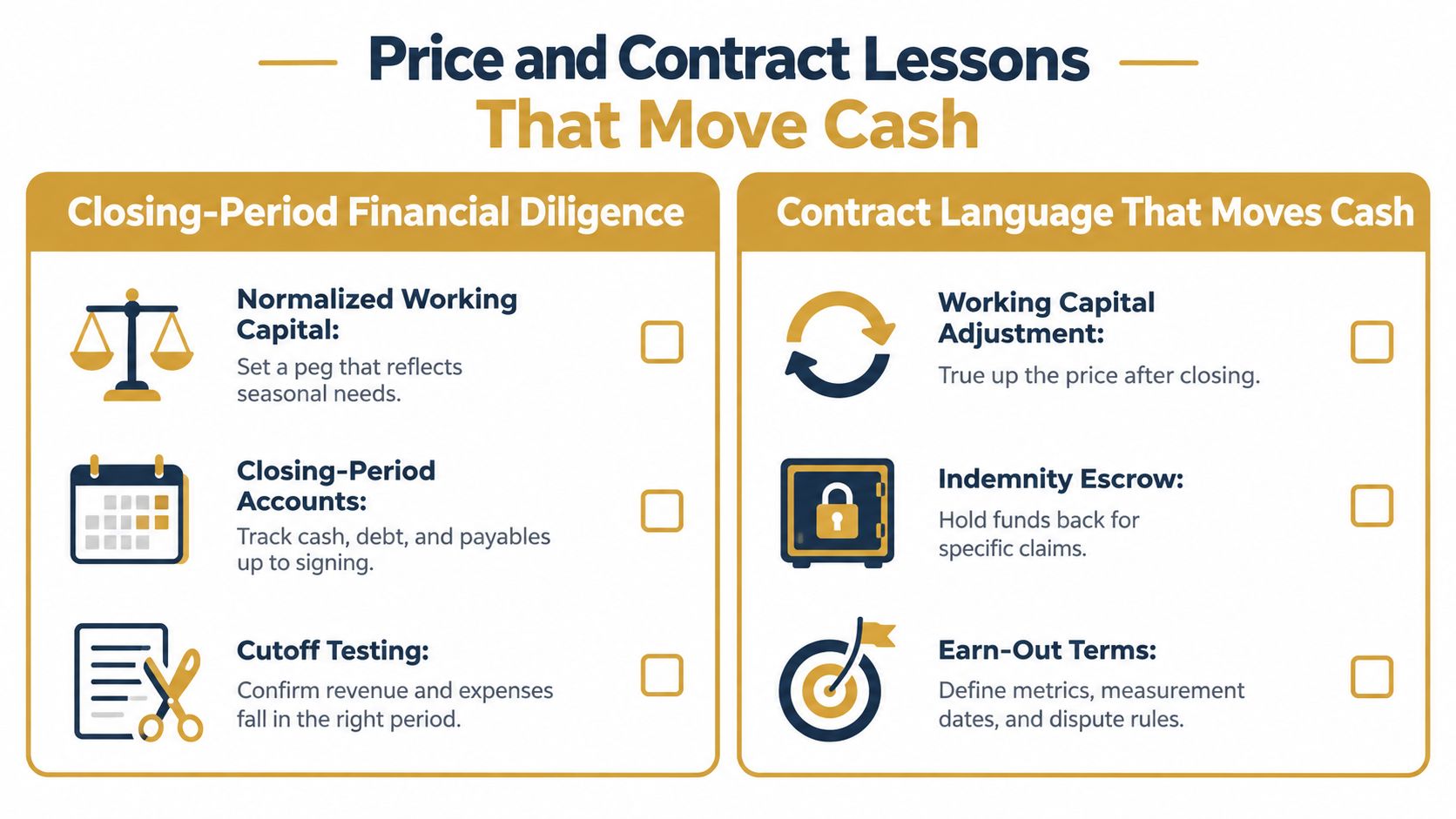
A profitable business can still leave its new owner short of cash. Quality-of-earnings analysis helps assess earnings, while working-capital diligence establishes how much operating cash the company needs at closing. The purchase agreement must define the calculation in terms that match the business's actual operating cycle.
Build a monthly working-capital bridge over a period long enough to capture several full seasonal cycles. Separate operating items from non-operating ones, then examine seasonality, receivable aging, inventory turns, and supplier terms. For example, a company that stocks up before its busy period or collects slowly during a quiet season may need more cash than a simple average suggests.
The peg sets the working-capital level the seller is expected to deliver at closing. If it is too low, the buyer may take over a business without enough cash to support normal operations. If it is too high, the seller is more likely to fall short at closing, triggering a price reduction at true-up and shifting value toward the buyer. A course should teach buyers to test the peg against the seasonal bridge, then connect the result to closing adjustments, minimum-cash requirements, earnouts, or seller notes. This guide to determining a fair business purchase price explains how price assumptions and deal terms relate.
Make cyber evidence a purchase decision
A breach, weak access controls, obsolete software, or unreliable backups can change the deal. Shoosmiths reports that more than 30% of its 2025 transactions involved a material cyber or data-protection component, underscoring the prominence of these issues in transaction reviews (Shoosmiths' M&A review and outlook).
A contained past incident differs from unsupported administrator access, failed backup recovery, or customer data stored across jurisdictions. The buyer should establish what evidence exists, what remains unknown, who can estimate remediation costs, and whether the seller can address the issue before closing.
Then translate the finding into a decision: adjust the price, require remediation or an escrow, negotiate an indemnity or warranty, make resolution a condition to closing, or set a post-close covenant. If the work could compete with payroll, inventory, or customer-retention spending, treat the weakness as a cash-flow and continuity risk. A course earns its place when it helps a buyer turn such evidence into contract terms and first-100-day priorities, not merely a longer checklist.
How to Choose the Right Training Path
Choose training by its outputs, not by the size of its document checklist. Look for instructors with transaction experience, practice using real or redacted documents, request templates, issue logs, and feedback on a live deal. The material should connect diligence to financing and post-close execution, and offer access to peers who understand the acquisition process.
| Path | Best for | What you should get | Main limitation |
|---|---|---|---|
| Self-study checklists | Buyers who need an initial map of diligence topics | A starting document list and questions to investigate | Usually won't show how to resolve a finding or negotiate its impact |
| Professional advisors | Buyers who need legal, tax, accounting, or specialist analysis | Expert opinions and work on transaction-specific issues | Advisors don't automatically teach you how to coordinate the whole process |
| Practitioner training | Buyers who want a repeatable method and deal practice | Exercises, templates, structured learning, and opportunities for feedback | Quality varies, and training doesn't replace professional sign-off |
Match the option to the work ahead
A checklist is a sensible starting point if you're learning vocabulary or preparing to speak with an advisor. It's less useful if you already have an LOI and don't know how to respond to a questionable working-capital peg. Professional advisors remain essential for legal, tax, and accounting opinions. A course should teach you how to direct those specialists and understand how their findings affect the transaction, not replace their work.
Dealmaker Wealth Society is an education and community platform for acquiring, building, and scaling small businesses. Its offerings include online courses on acquisition basics, diligence, sourcing, and negotiation; the 10-Day Business Buying Launch curriculum; live coaching with Carl Allen, Chris Moore, and Ross Turner; playbooks for roll-ups, bolt-ons, and debt-financed buyouts; capital-raising training; and a private peer network that includes partner matching. The platform describes its instructors' acquisition and capital-raising experience as part of its practitioner-led approach.
Before enrolling anywhere, ask what you'll produce. Can the training help you set a defensible working-capital peg, draft a response to a material finding, and assign owners for the first hundred days? Ask whether instructors review work from a live deal or offer feedback on a practice case. If you'll only watch lessons and download generic forms, you may understand the vocabulary without learning how to make the decision.
A Sample Curriculum for First-Time Buyers
A useful course starts with the buyer's reason for acquiring a business, then turns that thesis into evidence requests, deal decisions, and an operating plan. Each module should produce something the buyer can use, not just a completed video.
Move from screening to evidence
Start by writing down why the target fits your acquisition goals and what evidence could weaken that case. Use those questions to create a document request that fits the business, rather than copying a generic list.
Next, examine earnings and cash needs. Build a normalized-earnings bridge that shows which adjustments you accept and why. Then model working capital by month, including seasonal demands, collection patterns, and the cash required to keep operations running.
Coordinate legal and tax reviews with qualified advisors. Examine customer contracts, supplier agreements, and other commercial records for transferability, consent requirements, and termination risk. For each material finding, record its likely consequence, a possible response, and an issue log with a named owner. That gives each open question a person responsible for resolving or escalating it.
Bring integration into diligence
After reviewing the records, assess people, technology, cybersecurity, and data. A small business may have no security team, but it can still provide a practical record of system access, supported software, backups, known incidents, and customer-data handling. Exercises using spreadsheets, seasonal scenarios, and redacted records help students practice applying evidence to decisions.
Integration planning belongs in diligence because findings can change what the buyer must do immediately after closing. For example, a course module can take a student from identifying an unsupported system or a key employee's role, to assigning a transition owner, setting an interim process, and adding the work to a first-100-day plan. Its outputs might include an access register, a list of contract consents to obtain, and a prioritized handoff schedule. The buyer can then see whether a gap calls for a price or contract response, a pre-close condition, or a post-close task.
Finish with valuation adjustments, deal structure, and the first hundred days. Students should practice reviewing sample conditions or escrow language with counsel, then prepare an integration checklist showing priorities, owners, and dependencies. A course earns its place when students must turn findings into working-capital, cyber, contract, and first-100-day decisions. The length of its checklist matters less than whether those work products are grounded in evidence.
Findings That Should Change the Deal
A seasonal service company can show acceptable normalized earnings and still need more cash than the buyer expects. Suppose the seller's working-capital peg reflects quieter months but not the inventory build before the busy season or slow collections during winter. The buyer should test the proposed peg against monthly records, customer payment timing, supplier terms, and inventory needs, then estimate the cash required to keep the business running through its early operating cycle.
If the evidence supports a different peg, raise it before closing and connect the number to the purchase agreement's true-up mechanics. Where the buyer can't comfortably fund a seasonal shortfall, a seller note or minimum-cash term may help address the gap. The agreement should make clear how the calculation works, what records each side can use, and how a disagreement is resolved. Guidance on interpreting due diligence findings in an acquisition can help buyers think through how evidence should affect the transaction.

Separate a past incident from a present weakness
Now consider an eCommerce brand without a formal security team. The seller may document a past incident, show that it was contained, and provide evidence that the cause was addressed. That finding still deserves review, but it's different from discovering current unsupported administrator access and weak backup recovery, where the buyer may lack confidence that the business can control access or restore operations.
The buyer can ask for evidence, have a qualified specialist scope the remediation, and assess the cost against available post-close cash. If the work can be completed before closing, a condition precedent may be suitable. An escrow or specific contractual protection may address defined residual exposure. A price change may reflect the necessary investment. If remediation would crowd out inventory or customer retention, walking away may be more prudent.
The same warning sign doesn't always call for the same clause. A course earns its value when the buyer can separate a finding that changes economics from one that needs protection, and from one that makes the target the wrong business.
Your Next Step on a Live Acquisition
Choose one real target or practice case and prepare a one-page diligence brief. Write down the investment thesis, the three value drivers that need proof, the working-capital questions you still need answered, and the cyber or data evidence that's missing. For every material issue, note the contract response it could trigger and who would own the work during the first hundred days.
Keep the brief practical. If you're unsure what a customer contract says about a change of control, name the advisor who needs to review it. If the cash forecast depends on a busy season, list the records you need to test that assumption. If the target's backup process is unclear, identify what proof would give you confidence and what you'd do if the seller can't provide it.
Use the brief to interview a course provider, an advisor, or a mentor. Ask them to improve the decisions, not merely add documents to the request list. If training can't help you explain how a finding changes price, terms, funding, or the post-close plan, it isn't suited to the deal in front of you.
Keep qualified legal, tax, and accounting professionals responsible for their specialist opinions and sign-off. Your standard as the buyer is to understand, before signing, what must be true for the price to hold and what you'll do in the first hundred days if it does.
Dealmaker Wealth Society offers acquisition and due diligence training, coaching, templates, and a peer community for people buying and growing small businesses. Bring a live deal question or your one-page diligence brief to Dealmaker Wealth Society to explore structured learning and deal support.

From the Dealmaker Blog













A Creative Business Buying Fable