Business Acquisition Strategy: A Practical Guide for 2026
Business Acquisition Strategy: A Practical Guide for 2026

Most acquisitions are not grand platform purchases. Add-on acquisitions accounted for 72.9% of private-equity buyouts in 2025, according to CBH Bank's Private Equity Report. The buying that gets done is small, incremental, and attached to something that already operates.
That number reframes the whole exercise. A business acquisition strategy isn't a single heroic takeover or a list of steps to tick off. It's a chain of linked decisions, and any one of them can wipe out a purchase price you negotiated well. The seller's readiness to let go, the way the debt is structured, and the first hundred days of ownership each carry enough force to turn a sharp deal into a bad one.
The practitioners who compound returns treat those links as connected. A diligence finding changes the price. A lender's ceiling changes which targets are worth calling. An owner who won't hand over relationships changes the offer structure. Strategy is what happens when those constraints talk to each other.
Table of Contents
- The Six Parts of a Business Acquisition Strategy
- Choosing the Acquisition Model and Buyer Criteria
- Sourcing Deals, Including From Retiring Owners
- Valuing the Business on Standalone Earnings
- Financing the Deal Without Overloading the Business
- Due Diligence That Tests the Thesis, Not Just the Books
- Integrating the Business in the First 100 Days
- Confirm Your Thesis Before You Make an Offer
The Six Parts of a Business Acquisition Strategy
Deal supply moves with the cost of money. Global transaction value fell 15% year over year in 2023 to about $3.2 trillion, the lowest annual level in a decade, then recovered 13% in 2024 to roughly $3.5 trillion as volume rose 9%, according to Bain's global M&A report. Bain also found that deals valued below $1 billion represented 95% of all 2024 M&A activity.
Read those two facts together and the implication for a first-time buyer is clear. You are fishing in the part of the market where nearly all the transactions happen, and the water level rises and falls with financing conditions you don't control. What you control is the repeatability of your process.
| Component | Core question | Output to hold before moving on |
|---|---|---|
| Objectives and buyer criteria | What kind of business do I want to own, and why? | Written acquisition thesis and screening scorecard |
| Deal sourcing | Where will viable targets come from? | Ranked target list with owner-motivation notes |
| Valuation and underwriting | What is the business worth on its own, and what is synergy? | Model separating standalone cash flow, contracted synergies and speculative upside |
| Financing | How much debt can the business carry in a downside case? | Capital stack with downside coverage tests |
| Due diligence | Does the evidence support the thesis? | Findings log linked to price, terms or walk-away decisions |
| Integration | What happens in the first 100 days, and who owns it? | Named owners, dated synergy targets and a cost-to-achieve budget |
The sequence matters because each row constrains the next. A buyer who underwrites a $900,000 purchase and then discovers the bank will lend against only 60% of it hasn't found a financing problem. They've found a target-selection problem, because the businesses they were screening were never financeable at that price.
The reverse also holds. A diligence finding that customer concentration sits at 40% of revenue isn't a footnote for the file. It's a repricing event, a retention-clause trigger, or a reason to walk. Strategy lives in those adjustments, not in the tidy completion of six stages.
Where to start: write the acquisition thesis and call a lender in the same week. The thesis tells you what to look for. The lender's ceiling tells you what you can actually buy, and finding that out before you tour ten businesses saves months.
Choosing the Acquisition Model and Buyer Criteria
The first decision isn't which business to buy. It's which kind of buyer you intend to be, because each model demands different capital, different skills, and a different appetite for integration work.
| Model | Typical target | Main risk | Best suited to |
|---|---|---|---|
| First business purchase | One established, owner-operated business | Owner dependence and undocumented know-how | First-time buyers with time to run the company |
| Bolt-on acquisition | Small business that plugs into an existing company | Overpaying for synergies that never arrive | Operators who already run a platform |
| Roll-up or platform | Several related businesses combined under one management team | Integration load across multiple companies | Buyers with a management team and integration capacity |
| Leveraged buy-out | Profitable business financed mainly with debt secured on its cash flow | Debt service in a downside year | Buyers with stable cash flow and a lender relationship |

Models overlap in practice. A financed buy-out of a single business is often the first step toward a roll-up, and a bolt-on is a roll-up executed one acquisition at a time. What you can't do is drift between them, because the screening criteria for each are different. If you're weighing share purchase against asset purchase, or a straight buyout against a partnership structure, exploring alternative acquisition structures before you make offers prevents a late-stage restructure.
Bolt-ons and roll-ups both drag the target's technology vendors into your operation. If you're inheriting an outsourced IT arrangement, compare managed service providers for SMBs before you sign, so you know what the contract covers and what it excludes.
Turning criteria into a scorecard
Dealmaker Wealth Society's guidance is to acquire only businesses that have weathered economic recessions, generate $1 million in gross revenue and show a proven track record of steady profits. Take that as a starting filter and convert it into thresholds you score every target against.
- Revenue floor: at or above the level your financing model needs, with three years of history.
- Profit consistency: earnings stable or rising through the last downturn, not rescued by one exceptional contract.
- Owner dependence: sales, supplier relationships and pricing decisions not locked inside one person's head.
- Customer concentration: no single account large enough to sink the business if it leaves.
- Trading history: enough years in operation to show the model survives bad years, not just good ones.
Say you have $200,000 of cash and no operating team. A platform strategy is the wrong fit, because platforms consume management attention you don't have. A single owner-light business with a manager already running daily operations is the better target, even if it grows more slowly.
Write the scorecard before you open the first listing. A criteria list assembled after you've fallen for a business is a rationalisation exercise, not a screening tool.
Sourcing Deals, Including From Retiring Owners
Deals arrive through four channels: direct outreach to owners, broker listings, referrals from accountants and lenders, and your own network of operators and investors. Brokers deliver volume and competition. Direct outreach delivers less competition and better information, which is why serious buyers spend more time on it.
The seller side is where the market is shifting fastest. A 2025 U.S. Bank survey found that more than half of U.S. small-business owners are over 55, only 54% have a succession plan, and 37% expect to sell within 12 months, while 36% of Gen Z and Millennial owners plan to acquire from a retiring owner, per the U.S. Bank small business survey.
That gap between owners who want out and owners who are ready is your opening. An owner with no plan is not optimizing for the highest headline number. They're optimizing for what happens to their staff, their customers, and their name on the sign.
Why the top bid loses
A seller who has run a business for thirty years is being asked to hand over the thing that organizes their life. The buyer who answers that fear beats the buyer who answers it with money alone.
If you want to read the seller's real priorities before you make an offer, understanding seller motivations in acquisitions is the work that separates a signed deal from a rejected higher bid.
A succession-fit conversation covers four things: what the owner wants to happen to staff, customers, family members and the company's identity; how much post-close involvement is realistic; what happens if their knowledge is undocumented; and what timeline they can live with. Offer structures that reduce perceived transition risk then do the persuasive work. Seller financing signals you're confident in the cash flow. An earn-out shares the risk of what the owner claims. A retained minority stake keeps their identity intact. A paid advisory period gives customers a familiar face.
Consider a buyer competing against a higher all-cash offer. They win by promising a six-month handover with the owner on payroll, a written commitment to retain all staff for twelve months, and seller financing on 20% of the price. The seller's net proceeds are lower, and their risk is lower too. That's the trade.
Three questions for the first call:
- What do you want to happen to your people? The answer tells you what to write into the offer.
- What would you do with your time after closing? Reveals whether a handover is real or imaginary.
- What isn't written down anywhere? Surfaces the knowledge transfer risk before you price it.
Valuing the Business on Standalone Earnings
Your price must rest on what the business earns without you in it. Synergies you intend to create belong in a separate layer, and only after someone has verified them.
- Normalise the earnings. Add back owner compensation above a market-rate salary for the work performed, personal expenses run through the business, and genuine one-off costs. Document every adjustment with the underlying receipt or payroll record. An adjustment you can't evidence is an adjustment a lender will strip out anyway.
- Pick the right earnings measure. For owner-operated businesses in the region of $1 million of revenue, seller's discretionary earnings is the usual base. Once a management team runs the company and pays itself market wages, EBITDA is the cleaner measure.
- Apply a multiple from real comparable sales, matched on sector, size and customer type, not from a rule of thumb you heard at a conference. State the range, then justify where in the range you're landing.
- Build the model in three layers: standalone value, contracted synergies with dates and costs attached, and speculative upside, which the offer values at zero.
For a worked example, take a business with $1 million of revenue and $250,000 of normalised owner earnings. At three times earnings, standalone value is $750,000. Add a verified $50,000 annual synergy that costs $20,000 to achieve, and it sits in its own layer rather than being multiplied into the headline price. The offer has to stand up on the standalone layer alone, with synergies sharing the upside only after diligence confirms them. If you're still calibrating the range, understanding valuation multiples in deals covers how the band shifts with size and risk.
Financing the Deal Without Overloading the Business
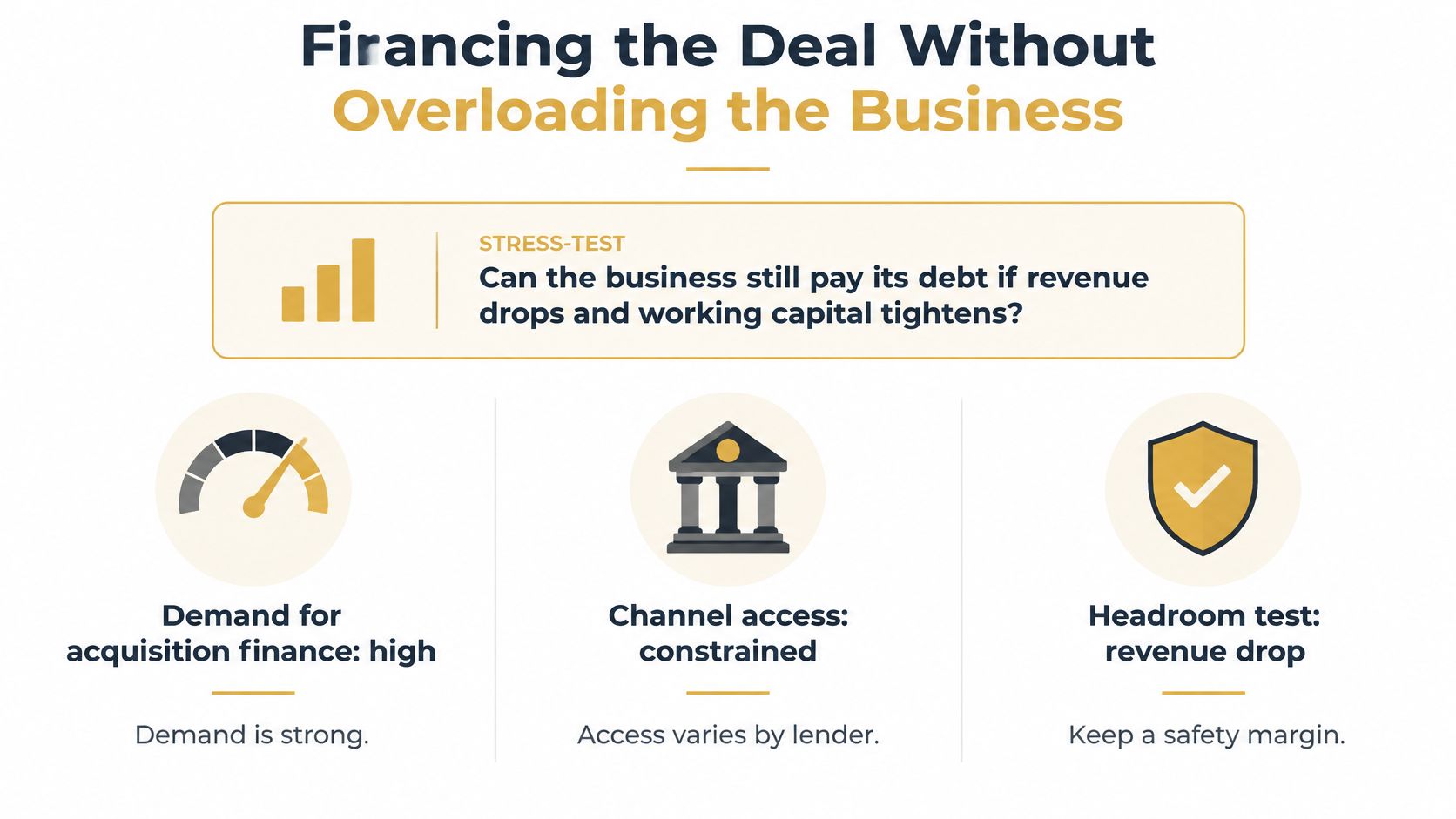
Run one test before you look at a term sheet: can this business still service its debt if revenue drops and working capital tightens in the same quarter? Everything else in the capital stack is secondary to that question.
Demand for acquisition finance is strong, but access runs through specialized channels. U.S. SBA 7(a) lending totaled $37.3 billion across 78,078 loans in fiscal 2025, while acquisition-related lending was approximately $8.29 billion across about 7,003 deals, according to Dealmaker Wealth Society's funding guide. The same source notes that 52% of private-equity executives and 54% of corporate executives reported looking to nontraditional lenders in 2025.
| Source | Role in the capital stack | Main constraint | Post-close risk |
|---|---|---|---|
| SBA 7(a) loan | Senior debt for acquisitions | Eligibility rules and lender underwriting | Heavy debt service in a revenue downturn |
| Conventional bank term loan | Senior debt, often with collateral | Collateral and cash-flow covenants | Covenant breach if margins compress |
| Seller note | Subordinated debt from the owner | Seller agreement on terms and subordination | Repayment pressure if the seller's terms are short |
| Earn-out | Deferred payment tied to future results | Agreed performance measures | Disputes over how results are measured |
| Outside equity partner | Equity capital for part of the price | Control rights and return expectations | Loss of control over strategic decisions |
| Nontraditional lender | Flexible debt or bridge capital | Higher cost and shorter terms | Refinancing risk when the loan matures |
The downside tests that matter
Model the deal at the revenue level you'd hate to see, then check six things. Debt-service coverage must clear the covenant with room left over. Working capital needs a facility, not just a balance, because receivables stretch when customers get nervous. Seller-note subordination determines whether the seller gets paid before or after the bank in a bad year, and sellers sometimes demand terms that outrank senior debt.
Investor control rights can hand a minority partner veto power over hiring, borrowing or selling. Personal guarantees convert a business failure into a personal one. Delayed draws and fees eat the cushion you were counting on, and origination points come out of cash on day one.
Here's how it plays out. A target generates $600,000 of annual cash flow. At current rates the bank will lend an amount that services comfortably today, but run the same debt against a 20% revenue decline and coverage falls below the level any prudent lender accepts. Two options remain. Max out the bank loan and hope the decline doesn't come, or reduce senior debt and close the gap with a seller note that carries lighter amortisation. The second option costs more in headline interest and much less in survival probability.
Prefer lower leverage, a staged purchase, or a capital partner over a structure that leaves no cash cushion in the downside case. A deal you own 60% of and keep is worth more than a deal you own 100% of and lose.
Creative financing widens access and adds governance complexity in the same move. Decide your rules before you're negotiating a deadline.
Due Diligence That Tests the Thesis, Not Just the Books
Diligence is not a confirmation exercise. It's the stage where each claim in your thesis gets tested against evidence that didn't come from the seller's own records, and McKinsey research found that pre-merger diligence failed to provide an adequate roadmap for capturing synergies in 42% of transactions, as reported in McKinsey's work on merger integration. A buyer can pick the right target and still destroy value if the thesis never becomes a measurable plan.
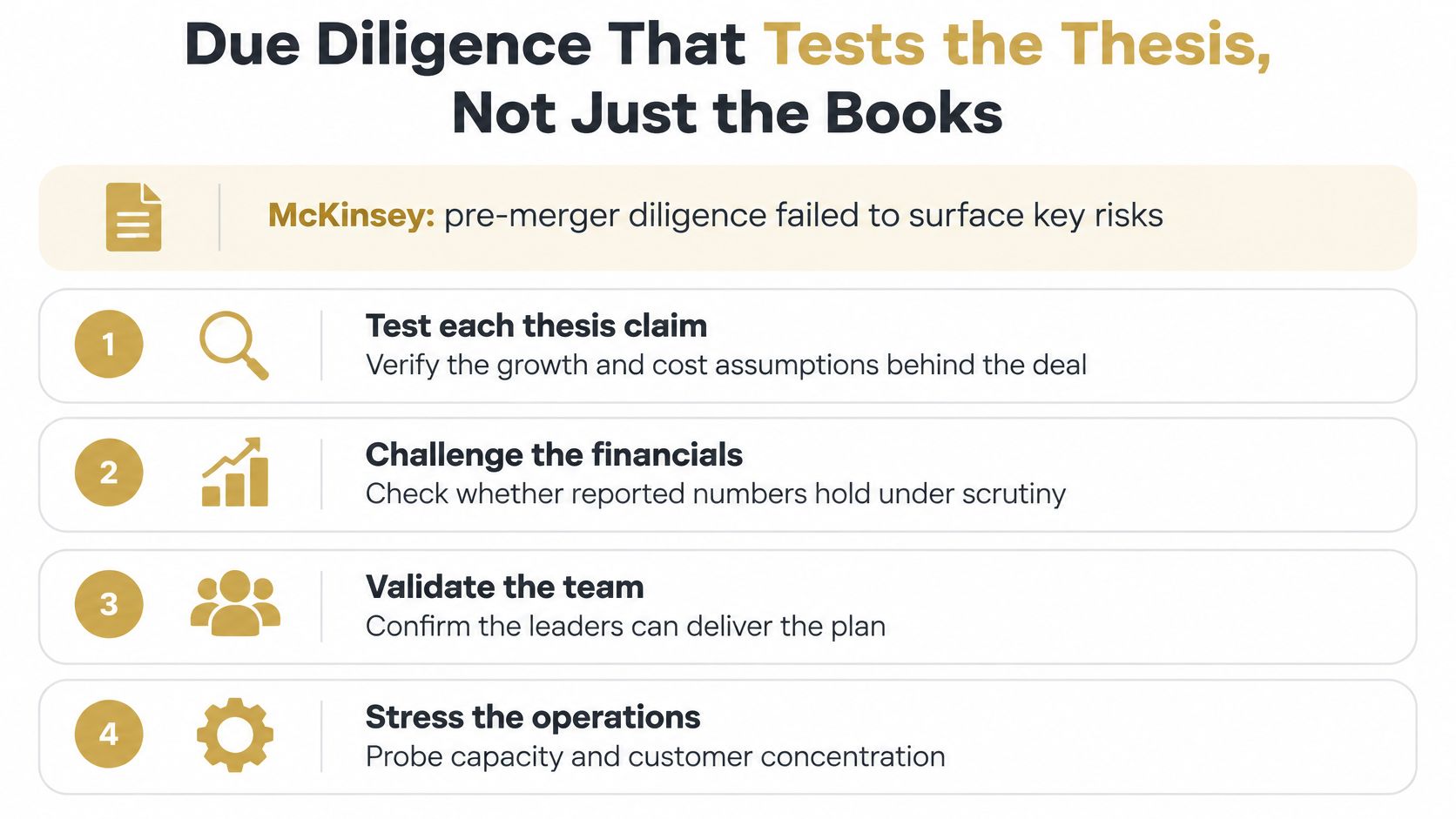
The sequence below works because it forces every assumption into a form someone can be held to.
- List every value driver in the thesis. Pricing power, cross-sell, overhead reduction, talent retention, channel expansion. Write them down as separate line items instead of a paragraph of optimism.
- Give each driver five attributes: an owner, a baseline metric, a cost to achieve, a timing assumption and a reporting KPI. A driver without a baseline can't be measured. A driver without an owner doesn't happen.
- Verify the baseline from outside. Supplement management's numbers with market benchmarks, customer interviews and third-party data, particularly where internal records leave gaps. Owners describe the business as they experience it, which is not the same as how customers experience it.
- Split the model into standalone cash flow, contracted synergies and speculative upside. Size debt capacity against the first two categories only.
- Run a downside case across revenue attrition, margin compression, working capital, customer concentration and delayed synergy realisation. Integration duration, personnel and one-time systems costs get modelled before signing, not discovered after.
The four-part customer verification process
Dealmaker Wealth Society's four-part customer verification process takes a revenue base apart before any money moves. It starts with a customer interview process that tests why clients buy and whether they'd stay after a change of owner. Then a concentration analysis of revenue by client. Then a contract review covering terms, change-of-control clauses and renewal dates. Finally a retention risk assessment that scores each key account.
Employee promises need the same treatment. Verbal assurances about benefits and leave become your liability at closing, so run the target's plans against Benely's benefits compliance checklist while you still have room to negotiate.
Say the concentration analysis finds that one client supplies 40% of revenue on a contract that renews in eight months. That finding does one of three things: it lowers the price to reflect the risk, it adds a retention condition to the deal terms, or it ends the conversation. A finding that changes nothing wasn't an analysis.
The test for every finding is the same question: does this change the price, the terms, or the walk-away decision? If the answer is none of the three, it belongs in a file, not in the negotiation.
Integrating the Business in the First 100 Days
Integration decides whether the purchase price was a price or a mistake. Among dealmakers who outperformed peers 18 months after close, 79% continued to outperform three years later, only 17% of deals underperforming at 18 months recovered, and more than 70% of ultimately successful deals avoided the first-year performance dip altogether, per McKinsey's research on how the best acquirers handle integration.
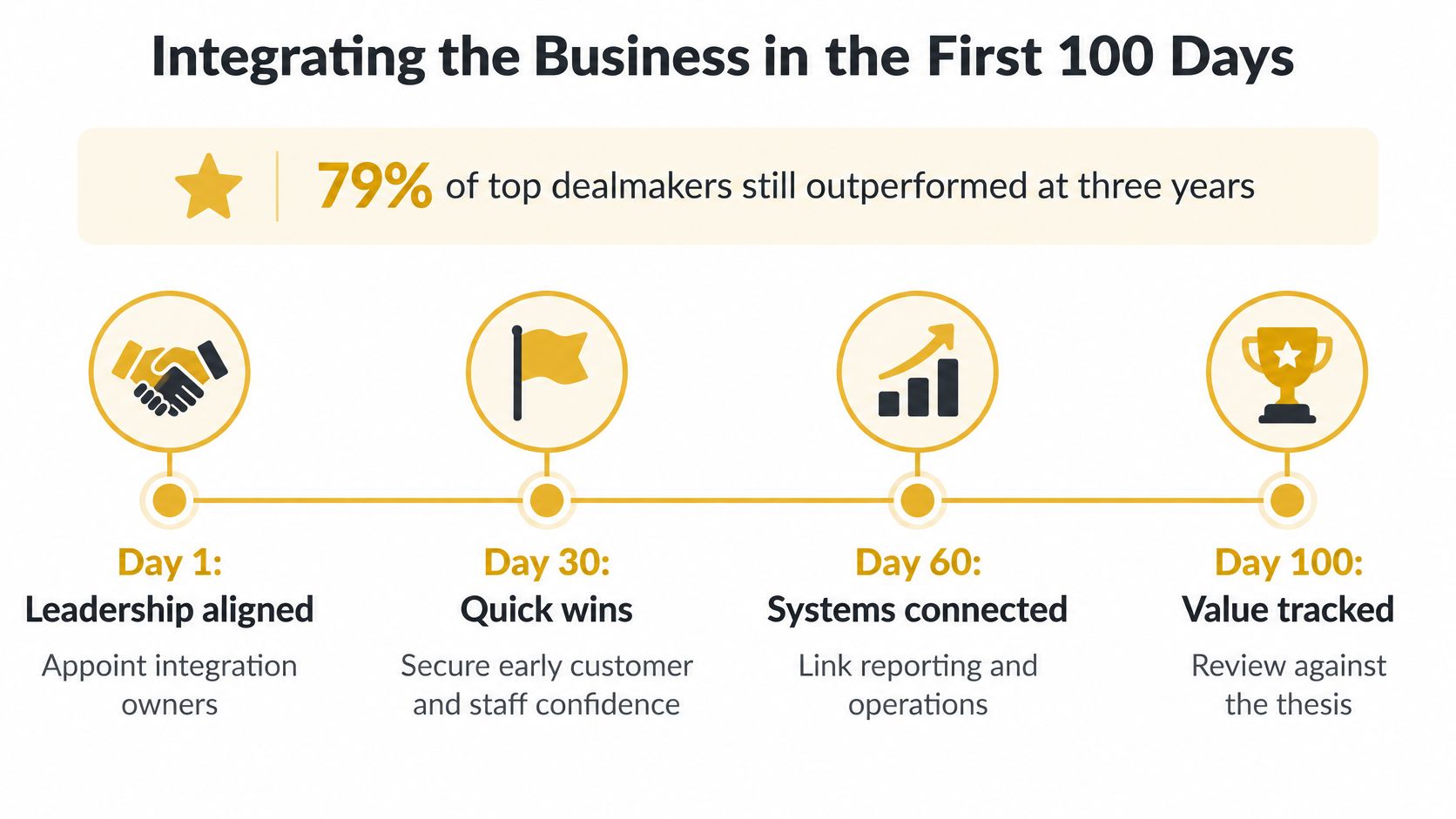
Revenue is where neglect shows up fastest, and large mergers that skip integrated commercial planning commonly see sales growth lag for years after closing. Treat the first 100 days as the last link in the deal chain, not the first step of a new one. A seller who exits before customers transfer their loyalty, a financing structure that leaves no cash for transition costs, and an integration that starts late can each undo a price that was correct on the day it was agreed.
| Window | Priority | Accountable owner | Measure |
|---|---|---|---|
| Days 0 to 30 | Preserve revenue-critical operations and set a clean baseline for cash, pipeline, payroll and customer retention | Buyer | Baseline documented and reconciled |
| Days 31 to 100 | Stabilise customers and staff, confirm who does what, open the cost-to-achieve budget | Buyer and workstream owners | Retention at or above pre-close level |
| Months 4 to 6 | Integrate at least two functions and protect customer continuity; keep a separate cost-to-achieve budget | Workstream owners | Functions integrated; customer churn at or below baseline |
| Months 7 to 12 | Complete remaining functions, including IT | Workstream owners and IT lead | Synergies realised against the dated dollar target |
| Year 2 onward | Scale revenue through marketing and sales | Buyer and sales lead | Revenue growth from the post-close baseline |
PwC's research makes the gap between disciplined and undisciplined integration concrete: 83% of successful dealmakers achieved their expected synergies, compared with less than half of unsuccessful dealmakers, and 54% of successful dealmakers fully integrated IT versus 27% of the others, according to PwC's post-merger integration study.
Why speed pays and delay costs
Faster, governed integration pulls cash benefits forward. Slower decisions postpone them and add risk while you wait. That is the causal link most buyers miss: delaying a systems decision is a scheduled cost, and every week of drift spends goodwill the seller's name used to hold in place.
The seller's transition sits inside this chain. Agree before closing how long the seller stays, which customers they introduce you to personally, and in what order. The cost-to-achieve budget in the table exists for the same reason: integration spending competes with debt service for the same cash, so it needs its own line rather than a claim on whatever is left over.
Small acquisitions need less brute force than large mergers, but they need the same discipline. Buying a business is only half the job. The work after closing is to scale it from $1 million to $2 million and beyond through better marketing and sales, which requires clean reporting, a functioning sales pipeline and people who stayed.
If the integration plan depends on manual reporting while your team is buried in the transition, hire Latin American virtual assistants to carry the recurring analysis rather than pulling operators off the floor.
Every priority needs three things attached: a named owner, a dollar target, and a date. Anything without all three is a wish with a deadline.
Confirm Your Thesis Before You Make an Offer
Before an offer leaves your desk, run four checks. Each one depends on evidence you should already hold, not conviction you can summon in the moment.
- Model fit. The acquisition model matches your operating capacity, and the scorecard is written down, dated, and applied to this target.
- Debt capacity. Standalone cash flow services the debt in the downside case, with no reliance on synergies you haven't verified.
- Diligence impact. Every finding is tied to a price change, a term change or a walk-away decision. Findings that changed nothing are findings you didn't act on.
- Integration readiness. A named owner and a dated 100-day plan exist for the first six months, including who talks to the largest customers in week one.
If a check fails, revise the thesis. Negotiating harder against a broken model just moves the loss to a later quarter.
For a first purchase, Dealmaker Wealth Society runs a 10-Day Business Buying Launch and keeps specialist coaches for capital raising, operations, financial due diligence, M&A legals and contracts, post-acquisition growth, transition and integration, and deal origination. Compare that against other training, paid advisers, and your own deal experience before committing either money or months.
The action for this week is unglamorous and decisive. Write the thesis and the scorecard, then test both against a lender's ceiling.
Dealmaker Wealth Society teaches the full chain these decisions sit in, from sourcing and creative deal structuring through diligence, financing and post-close growth, with live coaching from practitioners who execute deals and a peer community that reviews real transactions. If you want to stop reading about acquisition strategy and start screening your first target, the 10-Day Business Buying Launch is the entry point, with specialist coaches on hand for capital raising, diligence and integration when a live deal needs them. Visit Dealmaker Wealth Society to see how the training and community fit the business you intend to buy.

From the Dealmaker Blog









A Creative Business Buying Fable