8 Post Merger Integration Examples: Lessons for Buyers
8 Post Merger Integration Examples: Lessons for Buyers
Integration advice usually starts with an org chart. Fold the acquired team into your structure, pick one accounting system, get everyone on the same payroll by the end of the quarter. That sounds disciplined. It's also how buyers destroy the thing they just paid for.
The strongest post merger integration examples share a different instinct: decide what to protect before deciding what to combine. Disney left Pixar's creative engine alone and merged distribution. P&G kept Gillette's brands and merged procurement. DaimlerChrysler merged nearly everything and lost the executives who made Chrysler work.
Every case below covers four things: the integration decision, the pitfall, the metric worth tracking, and the first move you can copy in the first 90 days. Scale matters less than the choices made when the plan met reality. The final entry is Haspeslagh and Jemison's four-approach framework, which is the tool I'd hand any first-time buyer before signing a letter of intent. It answers the question the other seven cases raise: how much should you integrate?
Table of Contents
- 1. Disney and Pixar Integration (2006)
- 2. Cisco Serial Acquisition Integration Model
- 3. Adobe and Macromedia Product Integration (2005)
- 4. ExxonMobil Merger Integration (1999)
- 5. Procter & Gamble and Gillette Integration (2005)
- 6. Sprint and T-Mobile Network and Customer Integration (2020)
- 7. DaimlerChrysler Merger (1998-2007) as a Cautionary Example
- 8. Haspeslagh and Jemison Integration Approaches Framework
- How the Eight Post Merger Integration Examples Compare
- Turning These Post Merger Integration Examples Into Your Own 100-Day Plan
1. Disney and Pixar Integration (2006)
Disney's purchase of Pixar shows why integration should follow the source of a business's value. The companies combined parts of the commercial platform while protecting Pixar's creative operation. BCG's analysis of the deal describes this approach as reverse integration.

What got integrated and what got protected
Disney combined marketing, distribution, consumer products and licensing to use its broader commercial platform. It protected Pixar's creative development, leadership continuity and internal culture. The trade-off was clear: coordinate the functions that could extend Pixar's reach, while avoiding changes that might disrupt the work producing the value.
BCG reports that Disney generated annual total shareholder returns of 22% in the period after the acquisition, alongside a run of successful animated releases.
Practical rule: Name the capability you are buying and the decisions that protect it before setting the integration plan.
The version a small buyer can run
For a 12-person design studio whose value depends on one creative director and two senior designers, copy the principle at a smaller scale:
- Set boundaries before closing: List what stays unchanged, such as the studio's name, review process and client-facing leads. Record those decisions so they remain clear during integration.
- Give the acquired leader real authority: Define decision rights over hiring and creative sign-off. A title without those rights does little to protect the operation.
- Move back-office functions selectively: Transfer payroll, benefits, accounting and insurance to your systems while leaving client delivery alone for at least two quarters.
Track retention of the three key people and revenue from work the acquired team originated. If either falls for two consecutive quarters, review whether integration has disrupted the value you intended to preserve.
2. Cisco Serial Acquisition Integration Model
Cisco is the reference case for repeatable acquisition because it stopped treating integration as a project. The company assigns integration owners during due diligence, works from a standing checklist covering finance, systems, customers, people and communications, and moves acquired technology and teams onto its platforms on a defined timeline. Repetition is the advantage: the second deal is faster than the first because the template already exists.
The talent side is where most buyers under-invest. The WTW 2025 M&A Barometer, based on more than 80 HR leaders across North America, Europe, the Middle East and Asia-Pacific, found 78% ranked identifying non-executive key talent with unique skills as their highest people-related due-diligence priority. Retention of non-executive talent was also the leading integration-success metric at 50%, against 29% for leadership retention.
Read that gap carefully. Keeping the CEO is not the same as keeping the technician who knows why the main client's integration only works on the legacy version.
Build the checklist before you need it
- Five workstreams, five owners: finance, systems, customers, people, communications. Name them before closing, not after.
- One page per workstream: what changes on Day 1, what changes in month three, what never changes.
- A lessons file: after every deal, write down what broke and what the fix cost, so the next integration starts ahead.
A checklist you wrote under pressure at 11pm the night before closing is not a checklist. It's a to-do list with better formatting.
Worked example
Say you're rolling up three IT services firms. The first integration takes four months of your time. If you document the vendor consolidation, the ticketing migration and the client communication script, the second should take six weeks. Track average days to full integration per deal and specialist retention at 12 months; both should improve as the portfolio grows.
3. Adobe and Macromedia Product Integration (2005)
The Adobe and Macromedia transaction was never a cost play. It was about owning the entire workflow of the people who design and build digital products: page layout, imaging, prototyping, code. Adobe folded Macromedia's Flash and Dreamweaver into its Creative Suite bundles, which turned two separate customer relationships into one buying decision, and it kept Macromedia's product names alive through the transition rather than rebranding overnight.
That last choice is the one small buyers skip. Renaming the acquired product within 30 days feels decisive. To the customer, it reads as a signal that the thing they bought is being discontinued.

Product consolidation is also slower than the deal model assumes. A 2025 M&A success survey reported that 75% of integrations took at least seven months and 27% took more than 12 months, per the GPMIP M&A survey. Any plan that assumes the combined price list is live by the end of the first quarter is fiction.
Map customer overlap before you touch a price list
Pull both customer lists into one sheet and tag every account as overlap or single-product. The decision rules are simple:
- Same buyer, complementary products: bundle, because you're saving them a vendor and a purchase order.
- Same buyer, competing products: keep both alive for at least two quarters and let usage decide, or you'll force a migration the customer didn't ask for.
- Different buyers entirely: leave the products separate. Shared branding adds nothing to a customer who never crosses over.
Track attach rate, meaning the percentage of overlapping accounts buying both lines after the bundle, and renewal rate inside the overlap segment specifically. A bundle that lifts average order value while raising churn in your best accounts is a loss dressed up as a win.
4. ExxonMobil Merger Integration (1999)
Exxon and Mobil merged on a cost thesis, and the integration ran like a capital project: consolidate overlapping refineries, collapse duplicate offices, put combined purchasing power against suppliers, and hold the whole program to a number. That discipline is worth copying even if you'll never touch a refinery, because cost synergies are the only part of the deal thesis you fully control.
What Exxon-style programs get right is ownership. What they often get wrong is the assumption that the people running the consolidated assets will stay through three rounds of cuts.
The architecture of a real synergy program
A large equipment-manufacturer merger run by EY's synergy practice shows the machinery in detail. The company built a dedicated synergy-realization team and a KPI-tracking program from the outset, covering sales, manufacturing, supply chain, product, regional and customer-segment initiatives. It captured synergies within six months, against the 12 to 18 months commonly associated with integrations, and identified realizable value up to 20% above the initial estimate.
Notice what produced the speed: governance and measurement, not a bigger announcement.
- Owner: one named person per initiative, not a committee.
- Baseline: the current number, captured before any change.
- Target and timing: a figure and a date, both written down.
- Dependency: what has to happen first, such as a system migration or a contract renewal.
- Classification: cost reduction, revenue uplift, or working-capital improvement, because each one gets tracked differently.
A synergy without an owner, a baseline and a date is a wish with a spreadsheet attached to it.
Say you buy a competitor with two warehouses serving overlapping territories. Consolidating one site is the visible saving. The account managers who hold the top 20 customers are the invisible risk, and they're the ones who leave if the first thing you do is announce a headcount review.
5. Procter & Gamble and Gillette Integration (2005)
P&G's handling of Gillette is the mirror image of a pure cost merger. The company combined manufacturing, distribution and purchasing to take out real cost, and kept Gillette's brand names intact, including Duracell, rather than folding them into P&G-branded lines. Sales teams were aligned early so retail buyers saw continuity rather than two reps and two sets of terms.
That combination is rarer than it sounds. Most acquirers pick one lane: cut hard and lose revenue, or preserve everything and never earn a return.
The base rate explains why the discipline matters. In 2023, expected synergies were achieved or exceeded in 40% of cases, according to Eight Advisory's post-merger integration survey of 92 European companies and private-equity funds covering more than 700 M&A deals.

The brands were the asset, and P&G treated them that way. Procurement and logistics were the lever.
Sequence procurement before brand integration
- Weeks 1 to 8: top 20 suppliers by spend, side by side. Where both businesses buy the same category, consolidate and take the volume price.
- Weeks 6 to 12: logistics and distribution. Shared carriers, shared warehousing, one delivery schedule per region.
- Quarter two onward: sales coverage. Only merge territories once you can name which rep owns which account on a single sheet.
Say you're rolling up two distributors selling into the same 50 retail accounts. Merging the sales forces in month one gives the buyer an excuse to re-tender. Holding the structure for two quarters while you consolidate freight and supplier terms captures the cost without touching the relationship.
Track supplier savings run-rate monthly, revenue per retained account, and volume by brand if you follow the multi-brand route. If brand-level volume slips while procurement savings hold, you cut into the commercial engine to hit a cost number.
6. Sprint and T-Mobile Network and Customer Integration (2020)
Sprint and T-Mobile had to combine two wireless networks while moving customer accounts and retiring duplicate cell sites without disrupting service. The integration shows why a migration plan needs to protect the customer experience as well as deliver technical and cost savings.
IT integration synergies typically arrive in phases over one to three years, rather than at a single cutover. Bain's research on IT integration in mergers supports planning around that longer timeline. For a small buyer, the practical lesson is to set milestones, define what must keep working, and avoid promising a single cutover weekend.
The technical work spans systems, data, and the connections between them. Technology integration challenges in mergers explains why those layers need explicit owners and plans.
Phase the cutover and keep a rollback
- Inventory systems and touchpoints: list applications, owners, data flows, interfaces, and any critical spreadsheets.
- Cut over in phases: move one function at a time, with a rollback date and a named decision maker for each.
- Set dual-running exit dates: parallel systems protect continuity during migration, but without an end date they can become permanent duplicate costs.
- Explain the timeline plainly: tell staff and customers what changes and when, before the first outage or service interruption.
Track customer churn during migration, days of dual running per system, and invoice-to-cash cycle time. Review them against the cutover milestones; a spike in churn or a longer-than-planned parallel run is a signal to pause and address the cause before moving the next function.
7. DaimlerChrysler Merger (1998-2007) as a Cautionary Example
Daimler-Benz and Chrysler announced their merger in May 1998 in a deal valued at approximately $36 billion, described at the time as the first major transatlantic merger and the largest of its kind. On paper, the integration was well organized. Management set a stated mission and vision, ran synergy-tracking processes, held recurring coordination meetings, and stood up 12 issue-resolution teams covering purchasing, research and supply operations.
It still failed. The IMD case study of the DaimlerChrysler integration is blunt about why: differences in leadership style, hierarchy, decision-making and corporate culture eroded trust and communication, many Chrysler executives resigned or were replaced during the early integration period, and the anticipated operating and commercial synergies never materialized. DaimlerChrysler separated its Chrysler business in 2007, and the broader union ended in 2009.
The lesson isn't that the strategy was wrong. It's that governance ambiguity and cultural friction can dismantle a formally structured integration program.
The wider hit rate supports the caution. PwC's M&A Integration Survey found that in 2023, only 14% of respondents reported significant success across strategic, financial and operational integration outcomes.
The org chart was fine, the decision rights weren't
Twelve issue-resolution teams can't compensate for nobody knowing who decides. Before closing, write down:
- One accountable leader for the combined business, with the authority to settle disputes rather than escalate them.
- Whose process wins in each function, stated explicitly. "We'll figure it out" becomes a two-year argument.
- A cultural read done in diligence, not a workshop in month nine. Cultural integration techniques for acquisitions covers how to run that assessment before you commit.
Say you buy a family-run manufacturer and keep the founder as "president" without defining what that role controls. Every hiring decision, every pricing exception, every customer dispute becomes a negotiation. Track voluntary departures among your top 50 people in the first 12 months, and how long it takes to get a decision made across the two legacy teams. Both numbers tell you whether the governance is working long before the P&L does.
8. Haspeslagh and Jemison Integration Approaches Framework
Every case above is answering the same question at different volumes: how much of the target should stay intact? Philippe Haspeslagh and David Jemison built the durable answer in their 1991 book Managing Acquisitions, classifying integration along two axes, the need for strategic interdependence between the two businesses and the need for organizational autonomy in the acquired company.
Four approaches come out of that grid.
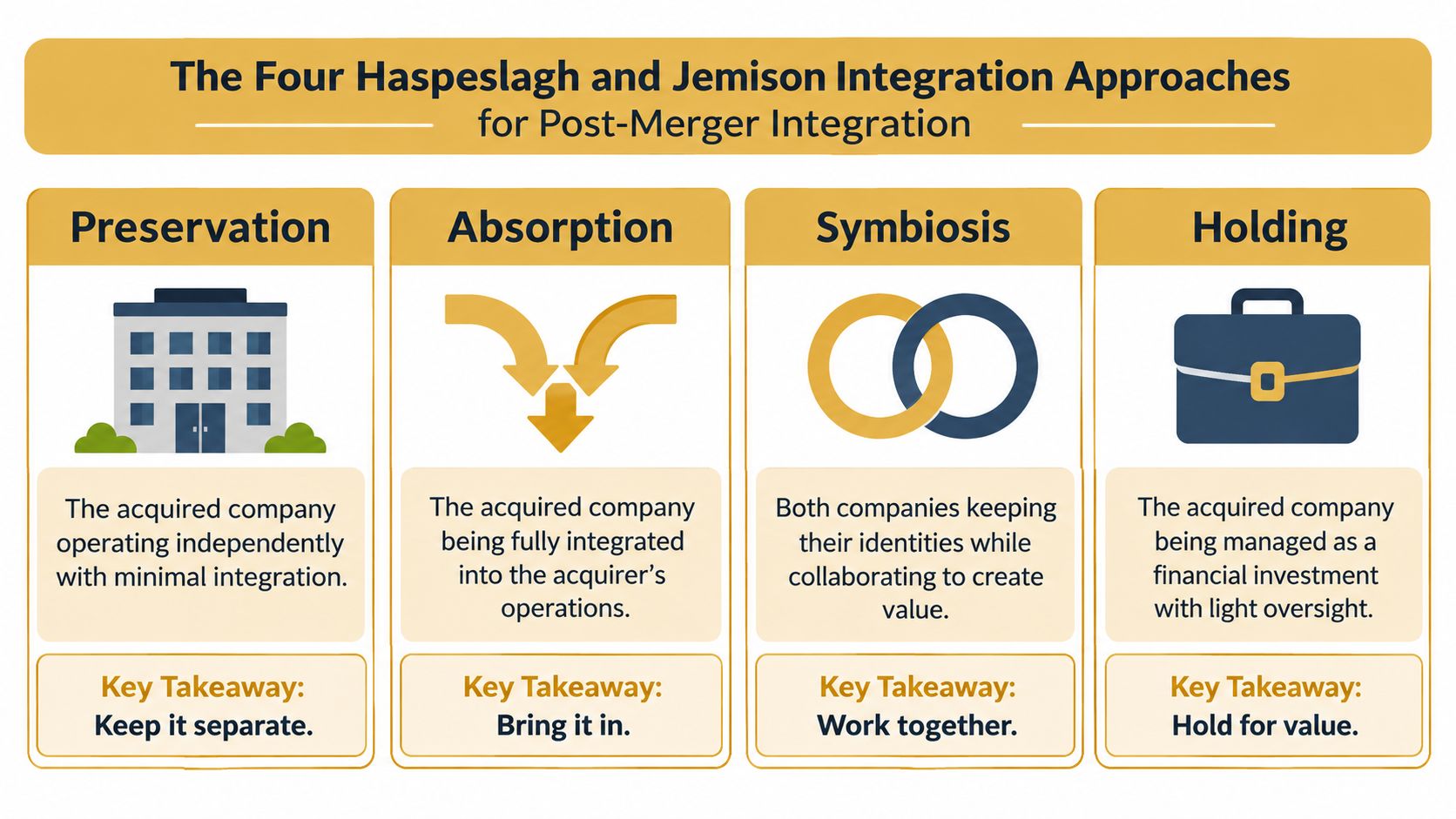
- Absorption: high interdependence, low autonomy need. Full consolidation onto one set of systems, one brand, one process. Right for roll-ups of undifferentiated service businesses.
- Preservation: low interdependence, high autonomy need. The target keeps operating as it did; you integrate reporting and capital allocation only.
- Symbiosis: high on both. Value comes from combining capabilities in both directions, which is the hardest to run and needs strong management on both sides.
- Holding: low interdependence, low autonomy need. Financial ownership with minimal operational involvement.
Choosing in diligence, not after closing
The failure mode is defaulting to absorption because it feels decisive. A profitable niche brand absorbed into a generic back office loses the reason customers paid a premium.
- Name the source of value: capability, customer relationship, or cost base. Only one usually drives the thesis.
- Score interdependence realistically: how much does the target gain from your platform, distribution or purchasing?
- Document the choice in the deal memo and use integration planning best practices to translate it into a workstream plan.
- Revisit at 6 and 12 months. A preservation call in year one often becomes selective integration once trust and reporting are stable.
Say you're buying three HVAC service companies in adjacent territories. Absorption is probably right: same systems, same pricing logic, one dispatch board. Buy a specialty brand with a distinct customer promise and preservation, or at most symbiosis, is the honest answer. Track realized synergies against the register and customer retention by acquired company. If retention holds and savings lag, you chose the right approach and need better execution. If retention drops while savings arrive on schedule, you chose the wrong one.
How the Eight Post Merger Integration Examples Compare
These cases are most useful as operating choices, not as templates to copy wholesale. For an SMB buyer, the practical questions are what to integrate, what to protect, what to measure, and what to do first.
| Example | Integration Approach | Deal Scale | Replicable Lesson |
|---|---|---|---|
| Disney–Pixar Integration (2006) | Preserved Pixar's creative culture and autonomy while sharing leadership | About $7.4 billion | Protect the source of value and integrate only where the businesses benefit |
| Cisco Serial Acquisition Integration Model | Began integration planning during due diligence and used a repeatable process | Serial acquisition program | Start planning before closing and apply lessons from each acquisition |
| Adobe–Macromedia Product Integration (2005) | Combined complementary products through bundles and gradual platform integration | Multi-billion-dollar deal | Integrate products where they strengthen the customer offer |
| ExxonMobil Merger Integration (1999) | Consolidated overlapping operations to capture cost synergies | Multi-billion-dollar deal | Set specific synergy targets and track delivery |
| Procter & Gamble–Gillette Integration (2005) | Preserved brands while combining supply chain and back-office operations | Multi-billion-dollar deal | Protect customer-facing value while consolidating back-office work |
| Sprint–T-Mobile Network and Customer Integration (2020) | Phased customer and network migration with milestone tracking | Multi-billion-dollar deal | Sequence migrations, monitor milestones, and communicate with customers |
| DaimlerChrysler Merger (1998–2007): A Cautionary Example | A merger of equals hindered by cultural and leadership misalignment | About $36 billion | Set clear leadership responsibilities and address cultural differences early |
| Haspeslagh and Jemison Integration Approaches (Framework) | Choose preservation, absorption, symbiosis, or holding based on strategic needs | Conceptual framework | Match the approach to strategic interdependence and the target's need for autonomy |
For a small buyer, the first 90 days should turn the chosen approach into visible operating decisions. If the thesis depends on a distinct brand or specialist capability, protect it while setting shared reporting and customer-retention measures. If value depends on removing duplicated work, assign owners to the affected processes and track savings against the plan. The right integration is the one that captures the deal's intended value without damaging what made the target worth buying.
Turning These Post Merger Integration Examples Into Your Own 100-Day Plan
The pattern across all eight cases is a sequence, not a philosophy. Decide the approach before you close, put one name against the program, watch a small number of metrics, and revisit the choice when the evidence changes.
Before closing. Pick preservation, absorption, symbiosis or holding, and write it down with the reasoning. Score the target on strategic interdependence and autonomy need. Flag the three to five people who own the customer relationships and the operating know-how, because those people decide whether the value survives the wire transfer.
Name one accountable owner. Not a steering committee. One person with the authority to settle the argument over whose process wins, and a direct line to you when the answer costs money.
Track two or three metrics, not twenty. Customer retention in the acquired book. Realized synergies against the register. Voluntary departures among the people you identified as mission-critical. Add cash conversion if working capital is tight. Everything else is commentary until those move.
Review at 6 and 12 months. Integration choices age. A business that needed protection in month three may be ready for shared services by month twelve, and a business you absorbed in month one may need its independence back.
Integration isn't a project with an end date. It's an operating transition with a decision you own.
Coaching earns its keep here. Dealmaker Wealth Society provides post-acquisition transition and integration coaching through specialist coaches, alongside capital raising, financial due diligence, and M&A legal and contracts support. The screening discipline matters just as much: the recommended acquisition criteria focus on businesses that have weathered recessions, generate at least $1 million in gross revenue, and show a proven track record of steady profits. A business with those characteristics gives you something to integrate. A business without them gives you a turnaround with extra paperwork.
Start with the framework, not the checklist. The checklist is downstream of the decision about how much to combine, and that decision is the one that determines whether your first acquisition looks like Pixar or DaimlerChrysler.
If you want to run this playbook on a real deal, Dealmaker Wealth Society teaches the full sequence, from sourcing and customer verification through post-close integration, with specialty coaches covering post-acquisition transition, integration, financial due diligence, and M&A legal. The community pairs structured training with live mentorship from practitioners who've closed hundreds of acquisitions, so you're not learning integration theory on your own balance sheet. Visit Dealmaker Wealth Society to see the programs and the 10-Day Business Buying Launch curriculum.

From the Dealmaker Blog









A Creative Business Buying Fable