Asset Purchase vs Stock Purchase: Tax and Liability Guide
Asset Purchase vs Stock Purchase: Tax and Liability Guide
The popular advice to buy assets rather than stock because assets are safer leaves out the hardest part of the decision. A buyer can exclude a liability in the purchase agreement and still face successor exposure under local law. A buyer can also secure attractive tax deductions but lose more value waiting for a critical customer contract or operating permit to transfer.
A useful asset purchase vs stock purchase comparison measures what the buyer can retain after taxes, transfer costs, historical claims, and recoveries from the seller. The discussion below focuses on U.S. acquisitions. Entity classification, state law, contract language, and the target's operating footprint can change the answer.
Table of Contents
- Asset vs Stock Purchase Side by Side
- Liability Exposure Category by Category
- Tax Basis, Step-Up and the 338(h)(10) Election
- How to Allocate Purchase Price in an Asset Deal
- Financing, Consents and Deal Friction
- Due Diligence Scope for Each Structure
- Which Structure Fits Your Deal and What to Do Next
Asset vs Stock Purchase Side by Side
In an asset purchase, the buyer selects assets and expressly assumes identified liabilities, subject to legal exceptions. In a stock purchase, the buyer acquires the target's shares, leaving its operating assets, contracts, employees, and history inside the existing entity.
The Congressional Research Service's acquisition overview describes this foundational distinction between acquiring specified assets and acquiring ownership of the company itself.
Asset vs stock purchase at a glance
| Criterion | Asset purchase | Stock purchase |
|---|---|---|
| What the buyer acquires | Selected assets and expressly assumed liabilities | The whole legal entity with its contracts, permits, employees, and history |
| Buyer tax basis | Purchase-price-based basis allocated across assets using fair market values | Target retains historical inside basis; buyer holds basis in the shares |
| Depreciation and amortization | Potentially larger deductions from a step-up, with timing determined by asset class | Generally no underlying asset step-up without an applicable tax election |
| Tax attributes, including losses and credits | Generally stay with the seller's entity | May remain available, subject to ownership-change restrictions |
| Seller tax | Asset-sale gain; corporate and shareholder taxation can arise for a C corporation | Shareholders generally recognize capital gain on their shares |
| Contract and permit transfer | Individual items may need consent, assignment, or reissue | Generally remain with the entity, subject to change-of-control requirements |
Interpret the economic differences carefully
Buying the entity isn't the same as receiving unrestricted continuity. A landlord, regulator, or customer may have approval rights even when the legal counterparty doesn't change. Conversely, buying selected assets doesn't mean every historical obligation stays behind.
The tax rows also need interpretation. A purchase-price-based asset basis isn't an immediate deduction equal to the price. The buyer recovers different asset costs under different tax rules, so the allocation and deduction schedule matter.
Seller taxation requires particular care. Corporate-level tax followed by shareholder tax is a potential C corporation outcome, not a universal description of asset sales. Pass-through entities require a different analysis.
Finally, separate transaction structure from payment consideration. Paying cash for shares still produces a stock purchase. Statistics about acquisitions paid for with stock don't establish how many buyers acquired assets rather than shares.
Practical rule: The structure determines which problems you inherit, not just which taxes you pay.
Liability Exposure Category by Category
Liability category by purchase structure
| Liability | Asset purchase | Stock purchase |
|---|---|---|
| Federal income tax | Generally stays with the seller | Remains with the acquired entity |
| State income tax | Generally stays with the seller in many states | Remains with the acquired entity |
| State sales, use, and gross-receipts tax | Can follow assets through successor liability | Remains with the acquired entity |
| Payroll withholding tax | Can follow assets under state successor rules | Remains with the acquired entity |
| Employee claims | May attach if assumed or under successor rules | Remain with the acquired entity |
| Environmental obligations | Asset ownership and applicable law determine exposure | Remain with the acquired entity |
| Known and unknown litigation | Generally excluded unless assumed, subject to successor doctrines | Remains with the acquired entity |
| Contract obligations | Obligations under transferred contracts may be assumed | Contracts remain with the entity, subject to their terms |
An asset agreement establishes the parties' allocation of responsibility. It doesn't necessarily restrict what a taxing authority or another claimant can recover under applicable law.
Deloitte's successor-tax-liability guidance explains that nearly all U.S. states can impose successor liability for certain non-income taxes, including sales, use, gross-receipts, withholding, and transaction-related transfer taxes. That makes an operating-state map more useful than a general assurance that the buyer isn't acquiring liabilities.
Separate legal exposure from recoverable protection
For an asset buyer, counsel should identify the exceptions that could override contractual exclusions. For a stock buyer, the diligence team should assess obligations already inside the target, including claims that haven't yet appeared in its accounts.
Use a process for identifying hidden liabilities in acquisitions to reconcile tax records, legal correspondence, payroll reports, and management disclosures. A clean balance sheet isn't evidence that every contingent claim has been identified.
Then match protections to the exposure:
- Tax-clearance certificates: Establish what the jurisdiction's certificate covers, what it excludes, and whether it must be obtained before closing.
- Specific indemnities: Address identified exposures directly rather than relying solely on broad representations.
- Escrow and survival terms: Align available funds and claim deadlines with the period during which the relevant exposure could emerge.
- Insurance: Review exclusions, retention, and coverage before treating a policy as a substitute for seller security.
Ask what happens after the seller distributes the proceeds. An indemnity against an entity with no remaining assets may offer little practical recovery.
The working question isn't which structure sounds safer. It's which liabilities can reach the buyer in each jurisdiction, and who will fund them if they do?
Tax Basis, Step-Up and the 338(h)(10) Election
A stock buyer's investment generally creates basis in the acquired shares, not a fresh deduction schedule for the target's assets. An asset buyer instead allocates acquisition consideration to the purchased assets, potentially increasing the basis available for future deductions.
The relevant benefit is the present value of incremental tax savings, not the nominal amount of the step-up. Deductions received later are worth less today, and a deduction has limited immediate value if the buyer can't use it.
The bridge between legal form and tax treatment
Under Section 338(h)(10), eligible parties can jointly elect to treat a stock acquisition as a deemed asset sale for federal tax purposes, as explained by The Tax Adviser's discussion of the election. The buyer may receive stepped-up asset basis while the seller bears asset-sale tax consequences.
For an eligible S corporation transaction, deemed asset-sale gain passes through to shareholders. Adjusted shareholder basis can mean the deemed liquidation adds little additional tax, leaving a single principal layer of taxation. Eligibility and the seller's actual tax position still require transaction-specific advice.
Model the seller's price for agreeing
Consider a hypothetical business priced at $10 million with $6 million of inside asset basis. Ignoring other adjustments, the potential step-up is $4 million. That difference is deductible basis to analyze, not cash savings to add directly to valuation.
Build the comparison in this order:
- Schedule deductions: Allocate the incremental basis to the relevant asset classes.
- Estimate usable savings: Apply the buyer's expected tax position and discount the resulting savings.
- Calculate seller cost: Compare the seller's after-tax proceeds with and without the election.
- Solve for the gross-up: Determine the additional price needed to leave the seller economically indifferent, including tax on that additional payment.
The buyer's break-even gross-up cannot exceed the benefit retained after incremental costs and risks. Our guide to reviewing tax implications in business acquisitions provides a framework for organizing those questions with an advisor.
Legal form and tax form can differ. The election is a negotiated deal term, not an automatic feature of buying stock.
How to Allocate Purchase Price in an Asset Deal
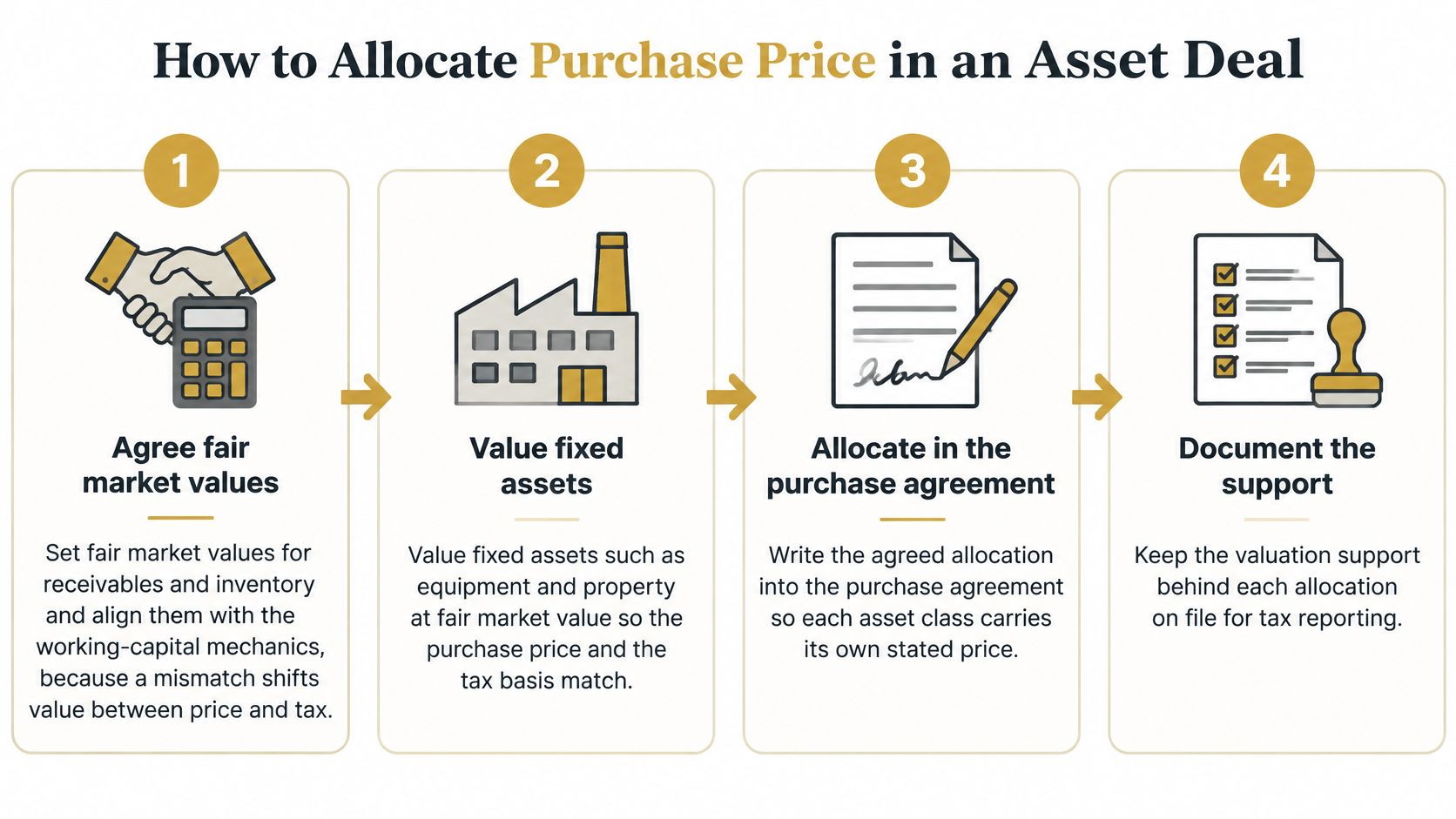
Treat the allocation as a valuation schedule, not a tax appendix completed after closing. The following workflow connects asset values with the purchase agreement and supporting records.
Build and support the allocation
Reconcile receivables and inventory. Agree values consistent with collectibility, obsolescence, and working-capital adjustments. The common mistake is counting the same economic adjustment in both the price allocation and closing working capital.
Value fixed assets. Support equipment and property values with appropriate records, appraisals, and condition assessments. Don't substitute book value for an acquisition-date valuation without testing it.
Identify intangible assets. Assess customer relationships, intellectual property, and contractual rights separately where appropriate. A common slip is assigning value to rights that the buyer cannot obtain.
Check the residual. Acquired goodwill and other qualifying Section 197 intangibles are generally amortized over 15 years, according to the IRS instructions for Form 8594. Don't use goodwill as an unexplained plug that conceals unsupported values elsewhere.
Model after-tax recovery. Estimate deductions by asset class and when the buyer expects to use them. Comparing basis amounts without comparing timing can misstate their economic value.
Coordinate reporting. Both parties generally report the transaction allocation using the applicable acquisition-allocation form. Reconcile their schedules before filing rather than assuming separate advisors will arrive at matching numbers.
Document contractual protection. Include the allocation, adjustment process, reporting cooperation, and treatment of unassumed liabilities in the agreement. Don't leave responsibility for a later allocation dispute unstated.
The accompanying video provides another way to consider the transaction mechanics.
Before the letter of intent, prepare a preliminary allocation schedule both sides can acknowledge. Make clear which values remain subject to diligence and final valuation.
Financing, Consents and Deal Friction
A tax advantage can disappear economically if the buyer can't operate the acquired business as planned. A critical lease, customer contract, license, or platform account deserves its own transfer analysis, not a generic assumption that everything will move at closing.
Execution conditions matter even in an active acquisition market. Completed middle-market private-equity acquisitions rose 3.8% year over year to 5,371 in 2025, according to Capstone Partners' Middle Market Private Equity Index. That activity isn't evidence that any particular buyer should accept transfer uncertainty.
Build a friction-adjusted value line
Start with the same operating-business valuation for both structures. Then calculate the structure-specific adjustments:
Net structure adjustment = step-up present value − expected failed-transfer loss − consent-delay cost − stranded working capital − historical-liability loss + expected indemnity recovery − incremental financing and execution costs.
Include any seller gross-up as an additional cost. Estimate historical-liability losses before recovery, then add expected recovery separately so the model doesn't count indemnification twice.
For consents, maintain a register showing the governing clause, approval party, required document, responsible person, and closing dependency. In an asset deal, test assignment and reissue requirements. In a stock deal, review change-of-control language rather than assuming entity continuity resolves approval rights.
For financing, ask the lender to confirm its collateral and closing requirements against the proposed structure. An asset acquisition may require new security documentation and lien filings; a stock transaction requires careful treatment of existing debt, guarantees, liens, and lender approval rights.
Price uncertainty rather than hiding it
Say a service business depends on a customer whose agreement restricts assignment. The asset buyer should estimate the consequence of losing that revenue, not merely budget the legal fee for obtaining consent.
Likewise, distinguish temporary working-capital funding from permanent loss. Count the financing cost of recoverable cash separately from amounts unlikely to return.
Finally, use a realistic recovery estimate. If the seller plans to distribute the proceeds, an unsecured indemnity shouldn't receive the same model value as funded escrow. The strongest contractual promise isn't necessarily the most collectible protection.
Due Diligence Scope for Each Structure
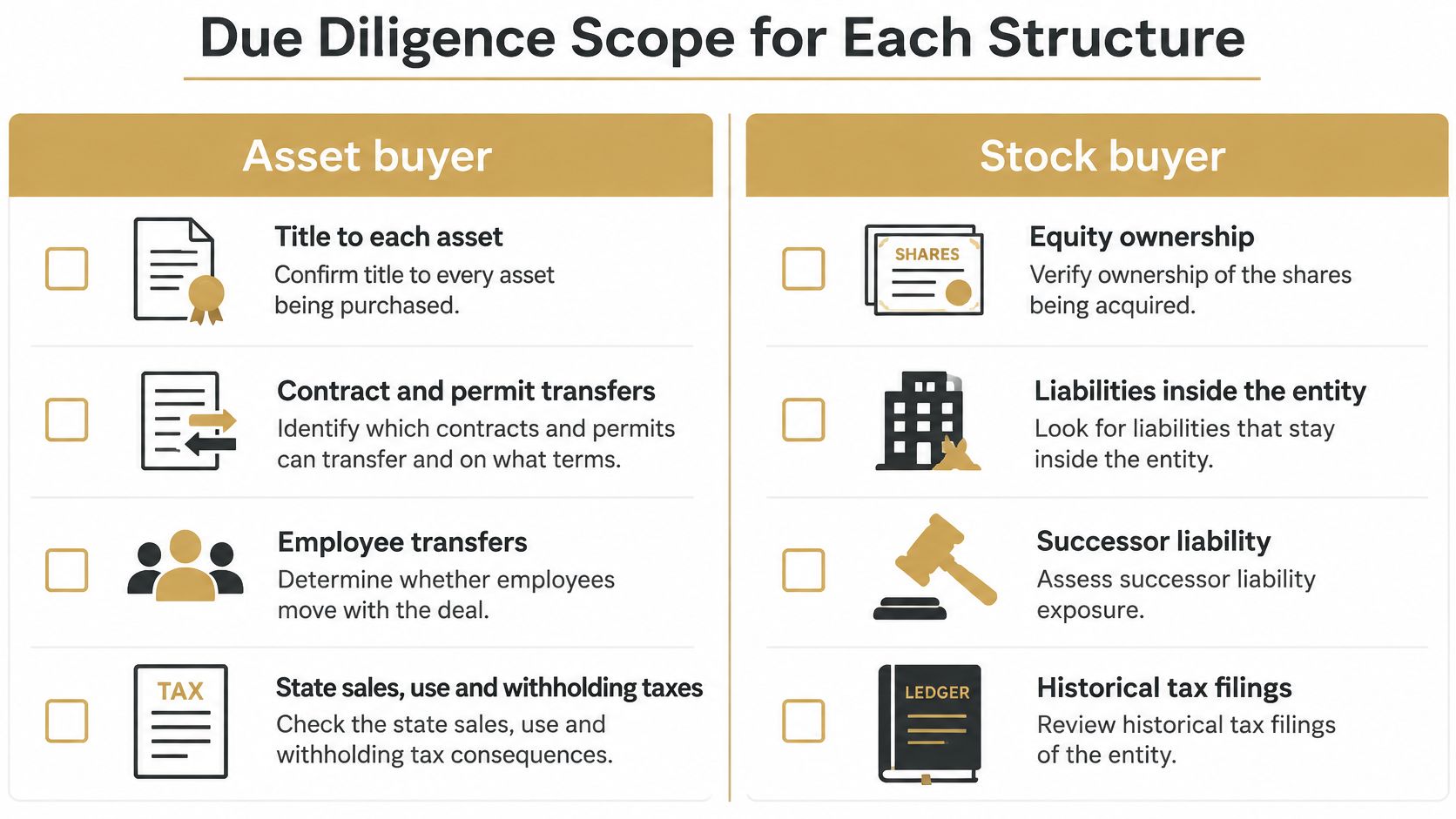
Diligence should test whether the proposed structure delivers the assets, continuity, and protections assumed in the valuation. Use the checklist as a request list, then attach evidence and a resolution to each material issue.
Asset buyer requests
- Title: Obtain asset registers, ownership documents, and lien searches. Can the seller deliver clear title? Missing ownership evidence or unreleased security interests should change closing conditions.
- Transferability: Request contracts, permits, licenses, and assignment provisions. Can the buyer legally operate at closing? A critical approval with no credible completion path may require a delayed closing or different structure.
- Employees: Review employment agreements, accrued obligations, and the proposed transition roster. Who will accept employment, and on what terms? Unresolved retention of essential personnel warrants a specific transition plan.
- Successor taxes: Obtain state registrations, returns, audit notices, and available clearance documentation. Do reported liabilities reconcile to operations? Unfiled returns require investigation, not merely a seller assurance.
Stock buyer requests
The IRS discussion of stock basis helps distinguish the shareholder's investment from the company's underlying assets. Operational diligence must separately investigate the history remaining inside that company.
- Ownership and financing: Request the capitalization table, share records, debt agreements, guarantees, and lien reports. Does the seller own what it's selling? Disputed ownership or undisclosed guarantees require resolution.
- Taxes and reserves: Review returns for open periods, tax correspondence, and contingent-liability schedules. Are reserves supported? Missing filings or unexplained gaps should affect price and protection.
- Claims and compliance: Obtain litigation files, employment complaints, environmental reports, and regulatory correspondence. What remains unresolved? Unsupported management dismissals of documented claims are red flags.
- Control provisions: Review customer, landlord, lender, and licensing documents. Does ownership change require approval? An unaddressed termination right can undermine continuity.
Verify customers under either structure
Our Dealmaker Academy customer verification process combines customer interviews, concentration analysis, contract review, and retention-risk assessment. Show revenue share by customer, inspect assignment and termination rights, and test whether relationships depend on the departing owner.
Use these critical due diligence steps for buyers to turn findings into a concise diligence plan. Assign an owner, deadline, required evidence, and decision consequence to every material item before signing.
Which Structure Fits Your Deal and What to Do Next
Deal situations and the structure they usually favor
| Situation | Usually favors | Why | Watch for |
|---|---|---|---|
| Carve-out of one division or product line | Asset purchase | Only selected assets move | Shared contracts, systems, and employees need separation |
| Target with a long, clean history and many permits | Stock purchase | Preserves the existing operating entity | Undiscovered historical liabilities and approval requirements |
| Target with significant net operating losses | Stock purchase | Tax attributes may remain available | Ownership-change limits can restrict their use |
| Goodwill-heavy business with valuable incremental deductions | Asset purchase | Creates basis available for amortization | Seller gross-up and timing of usable deductions |
| Target with multi-state sales-tax exposure | Asset purchase, if effective clearance is obtainable | Can limit exposure when statutory protections are satisfied | Certificate scope, exclusions, and escrow |
| S corporation seller | Either, potentially with a deemed-asset-sale election | May combine legal continuity with asset-sale tax treatment | Eligibility, joint election, and seller economics |
These are starting points, not verdicts. A target can occupy several rows at once, and the most important row is the one with the largest economic consequence, not the one that sounds most familiar.
A goodwill-heavy acquisition may initially favor an asset purchase. If essential contracts cannot transfer reliably, however, the buyer should compare the value of incremental deductions with the risk of acquiring a business that can't retain its revenue. The tax benefit belongs in the model only alongside the operating assumptions needed to realize it.
Resolve conflicting signals with evidence
A clean operating history is useful only when supported by records. Likewise, a large reported tax-loss balance isn't worth its face amount to a buyer. Ask the tax advisor to estimate usable benefits, and ask counsel to identify the approvals and obligations that survive the chosen structure.
For an owner-dependent company, scrutinize what will continue after the seller leaves. AmbitionCFO's discussion of transferable earnings and deal terms is a useful companion to that assessment. The practical question is whether the earnings support the price under the actual transition arrangements, not merely whether historical accounts show a profit.
Choose an asset purchase when liability isolation and incremental tax benefits outweigh transfer friction. Choose a stock purchase when continuity and usable tax attributes justify the historical exposure that diligence and enforceable protections can address.
Don't make jurisdiction a footnote. A business operating across state lines may need separate tax-clearance, employment, permit, and successor-liability analyses. Good-standing confirmation also serves a different purpose from tax clearance; obtaining one doesn't establish the protection offered by the other.
Put the decision into transaction documents
Use the same assumptions across the tax model, lender package, diligence register, and purchase agreement. If the tax advisor assumes transferred customer contracts while counsel identifies unresolved assignment restrictions, the teams aren't evaluating the same acquisition.
Proceed in this order:
Request a written comparison from your tax advisor. Model both structures using the same underlying price assumptions and a consistent asset-valuation schedule. Show deduction timing, usable attributes, seller proceeds, election alternatives, and any gross-up separately.
Request state-specific confirmations. Seek available tax-clearance certificates and good-standing confirmations wherever the target operates. Record what each document proves, what remains outside its scope, and whether further investigation is necessary.
Draft protection against the liability matrix. Match specific indemnities, escrow, survival terms, and insurance to identified exposures. Confirm who will owe the payment and what assets or coverage will remain available.
Resolve consent requirements. Identify assignments, reissues, and change-of-control approvals. Make critical approvals closing conditions rather than optimistic post-closing tasks.
Agree a preliminary allocation before the letter of intent. Document the proposed allocation approach and identify assumptions still subject to diligence. Preserve a process for revising values without changing the parties' negotiated economics.
Before committing to a structure, bring the tax comparison, consent register, and liability matrix into one decision meeting. Approve the structure only when the team can explain why its expected retained value exceeds the alternative.
Dealmaker Wealth Society offers acquisition training and specialty coaching in capital raising, operations, financial due diligence, M&A legals and contracts, deal origination, and post-acquisition growth, transition, and integration. Visit Dealmaker Wealth Society to explore education and deal feedback that can help you organize an asset-versus-stock comparison alongside your legal and tax advisors.

From the Dealmaker Blog










A Creative Business Buying Fable