Pro Forma Agreement: Definition, Clauses, and Deal Use
Pro Forma Agreement: Definition, Clauses, and Deal Use
You're a first-time buyer negotiating to acquire a regional staffing firm for $8 million. The seller's broker emails you a 40-page purchase agreement you've never reviewed, and you ask for a “sample” so you can compare it with something familiar before opening the data room.
That sample is likely a pro forma agreement. It's a ready-made, fill-in-the-blank contract built around a typical transaction, used as a drafting starting point rather than a binding offer. The phrase can also refer to financial statements that show what a company's results might look like after a transaction. Confusing those two meanings can lead to bad assumptions about both the legal document and the numbers supporting the deal.
Table of Contents
- What a Pro Forma Agreement Is and Why Buyers Use One
- The Two Meanings of Pro Forma in Transactions
- When a Pro Forma Agreement Becomes Legally Binding
- Typical Clauses in a Pro Forma Agreement
- How Pro Forma Agreements Structure Deals from LOI to Close
- Using Pro Forma Financials in Due Diligence and Financing
- Common Misconceptions That Get First-Time Buyers in Trouble
- Putting Pro Forma to Work in Your Next Acquisition
What a Pro Forma Agreement Is and Why Buyers Use One
In legal practice, pro forma commonly means “for the sake of form.” A pro forma agreement follows a recognizable industry structure, giving the buyer and seller a document they can negotiate from instead of forcing counsel to create every provision from a blank page. The document usually contains standard clauses, defined terms, schedules, and bracketed options, but deal-specific information remains incomplete or clearly illustrative.
A pro forma contract generally isn't binding merely because someone circulated it. As this legal guide to pro forma contracts explains, the term has a formal meaning in legal usage, while the contract itself typically becomes binding only after the parties agree on the terms and formally execute it.
Buyers request these documents for practical reasons:
- Speed: Counsel can begin with a known structure, then focus time on the transaction's unusual features.
- Benchmarking: You can compare the seller's draft against a conventional purchase agreement and identify provisions that materially depart from market practice.
- Early risk identification: Unusual indemnity baskets, broad earn-out discretion, restrictive covenants, or seller-friendly closing conditions become visible before negotiations advance.
- Cost control: A useful starting document can reduce the outside counsel time required for basic drafting, although it doesn't replace legal review.
The word “sample” can mislead first-time buyers. A pro forma agreement isn't a prediction that the deal will close, and it isn't necessarily the seller's commitment to offer the stated terms. It's closer to an architectural plan. The plan shows where the walls, doors, and utility systems belong, but the parties still need to decide what materials, dimensions, and specifications the finished building will contain.
Practical rule: Treat every blank, bracket, comment, and “to be agreed” note as an unresolved deal point, not as harmless drafting clutter.
The same transaction will eventually require a second kind of pro forma work. Lenders and investors may need pro forma financial statements showing the target's hypothetical results after acquisition, refinancing, purchase-price allocation, and new financing. The legal form describes the obligations. The financial model tests whether the economics can support them.
The Two Meanings of Pro Forma in Transactions
The contractual and financial meanings of pro forma are related, but they answer different questions.
A pro forma agreement asks, “What legal structure will govern the transaction?” It may be a stock purchase agreement, asset purchase agreement, financing document, SAFE, or another transaction form. The document gives the parties a written baseline for negotiation. Its provisions may address the assets being transferred, purchase price mechanics, representations, covenants, indemnification, closing conditions, and termination.
A pro forma financial statement asks, “What would the company's financial position or results look like if the transaction had already happened?” In an acquisition or financing, the model can incorporate purchase-price allocation, fair-value step-ups, additional depreciation and amortization, new interest expense, and debt required to close. The resulting figures help lenders and investors evaluate the combined business rather than relying only on the target's historical standalone statements. The SEC's financial reporting manual describes the use of pro forma financial information in significant acquisitions to present the expected financial position of the combined entity.
The timing differs. The contract form usually appears during the letter of intent and redlining process. The financial version becomes central during valuation, quality-of-earnings analysis, lender underwriting, and financing negotiations. In a well-run deal, both workstreams develop together.
| Attribute | Pro Forma Agreement, Contract | Pro Forma Financial Statement |
|---|---|---|
| Core purpose | Provides a legal drafting framework | Models hypothetical post-transaction results |
| Main users | Buyer, seller, attorneys, and other deal advisers | Buyer, lender, investor, accountant, and financial adviser |
| Typical inputs | Parties, assets or shares, price, representations, covenants, and closing conditions | Historical results, transaction adjustments, financing, purchase-price allocation, and accounting effects |
| Main question | What are the parties agreeing to do? | Can the combined economics support the proposed deal? |
| Binding effect | Usually nonbinding until customized and executed | Analytical information, not a contract |
| Workflow location | LOI, draft purchase agreement, and negotiation | Due diligence, valuation, financing, and reporting |
The two documents meet when a buyer negotiates a purchase price that depends on financing capacity. The agreement may require a lender commitment or specify debt terms, while the financial model shows whether the acquired company can support that debt. A contract can be perfectly drafted and still describe an uneconomic transaction. A model can look attractive while the legal protections remain inadequate.
When a Pro Forma Agreement Becomes Legally Binding
A template becomes enforceable through the ordinary principles of contract formation, not through the label “pro forma.” The relevant analysis generally looks for offer, acceptance, consideration, capacity, lawful purpose, and mutual assent, along with sufficient certainty and proper execution where required. Australian legal guidance on pro forma contracts emphasizes that a pro forma contract is normally only a starting document and that enforceability depends on the usual elements of a valid contract.
Start with the offer. A bare template often leaves the purchase price, payment structure, closing date, acquired assets, or other essential terms blank or marked illustrative. That makes it difficult to identify a definite offer. A document with completed terms can create more risk, especially if the parties' communications suggest that they intended immediate commitment.
Acceptance presents the next problem. A buyer's email saying “this looks good” may not establish acceptance of a definitive agreement, but the surrounding communications matter. If the parties exchange signed copies, agree on the final language, and act as though the transaction is binding, a dispute can arise even when one side later points to the document's “pro forma” label.
Consideration is the bargained-for exchange. In an acquisition, it may include cash, shares, assumed liabilities, a seller note, an earn-out, or another agreed form of value. Capacity concerns whether the parties have authority to contract, while lawful purpose asks whether the transaction itself is permitted. Mutual assent focuses on whether both sides agreed to the same essential terms.
A practical distinction helps:
- An unsigned template is a drafting tool.
- An LOI that refers to the template may establish agreed commercial points, but it remains nonbinding if the LOI expressly says so.
- A signed definitive purchase agreement can create binding obligations when it contains sufficiently certain terms and the parties intend to be bound.
The risk often appears during early calls. A buyer may say, “We've agreed to the purchase price and structure,” while the seller believes the discussion was only a basis for drafting. The parties should identify which provisions are binding, which are nonbinding, and whether exclusivity, confidentiality, expenses, access, or governing law operate separately from the broader transaction.
A pro forma label doesn't protect careless drafting. Clear intent, complete terms, execution, and delivery matter more than the document's filename.
Typical Clauses in a Pro Forma Agreement
A transaction-stage pro forma usually carries the skeleton of the final agreement. The drafter should make the document useful without making it appear complete. That means clearly identifying placeholders, bracketing alternatives, and labeling unresolved provisions as illustrative or subject to negotiation.
The preamble identifies the parties and the proposed transaction. The recitals explain the background, such as the seller's ownership of the shares or assets and the buyer's intention to acquire them. Recitals can help provide context, but they shouldn't create obligations that the operative provisions don't address.
The agreement then defines what's being purchased. In a stock deal, the subject may be the issued equity of the target. In an asset deal, the document should distinguish acquired assets, excluded assets, assumed liabilities, and retained liabilities. A blank description here isn't cosmetic. It can change the entire allocation of risk.
Purchase price provisions address cash at closing, deferred payments, seller financing, rollover equity, escrow, working capital adjustments, and earn-outs. The pro forma should use brackets for alternatives and avoid presenting an illustrative amount as the agreed price.
Other core provisions include:
- Conditions precedent: Financing, regulatory clearance, third-party consents, accuracy of representations, and required closing deliveries.
- Representations and warranties: Statements about authority, financial information, taxes, contracts, employees, litigation, intellectual property, and compliance.
- Covenants: Promises governing conduct before closing, including operating the business in the ordinary course and restricting unusual distributions or new commitments.
- Indemnification: Procedures, survival periods, baskets, caps, exclusions, and recovery limits.
- Termination rights: Circumstances allowing either party to walk away, including failure to satisfy conditions or expiration of an outside date.
For a plain-language explanation of a frequently misunderstood category of operating promises, see this guide to covenants in acquisition agreements.
| Clause | Purpose in Pro Forma | Placeholder Content | Fate in Final Deal |
|---|---|---|---|
| Parties and recitals | Identifies participants and transaction context | Legal names, entity details, ownership facts | Usually retained and finalized |
| Transaction scope | Defines shares, assets, assumed liabilities, and exclusions | Asset schedules, equity numbers, liability lists | Retained, heavily customized |
| Purchase price | Sets the economic exchange | Price, escrow, earn-out, financing, adjustments | Retained with negotiated mechanics |
| Conditions precedent | Establishes what must happen before closing | Approvals, consents, lender requirements | Retained and tailored to closing risk |
| Representations and warranties | Allocates information and disclosure risk | Bracketed topics, thresholds, knowledge standards | Negotiated extensively |
| Covenants | Controls conduct before and after closing | Operating restrictions and affirmative duties | Some retained, others narrowed or removed |
| Indemnification | Establishes post-closing recovery rules | Caps, baskets, survival, procedures | Retained in bespoke form |
| Termination | Explains when the deal can end | Outside date, breach standards, fees | Finalized around actual process |
Some provisions survive almost unchanged because they are standard and fit the transaction. Others disappear after counsel reviews the facts. A pro forma should make that editing process easier, not conceal unresolved choices behind polished formatting.
How Pro Forma Agreements Structure Deals from LOI to Close
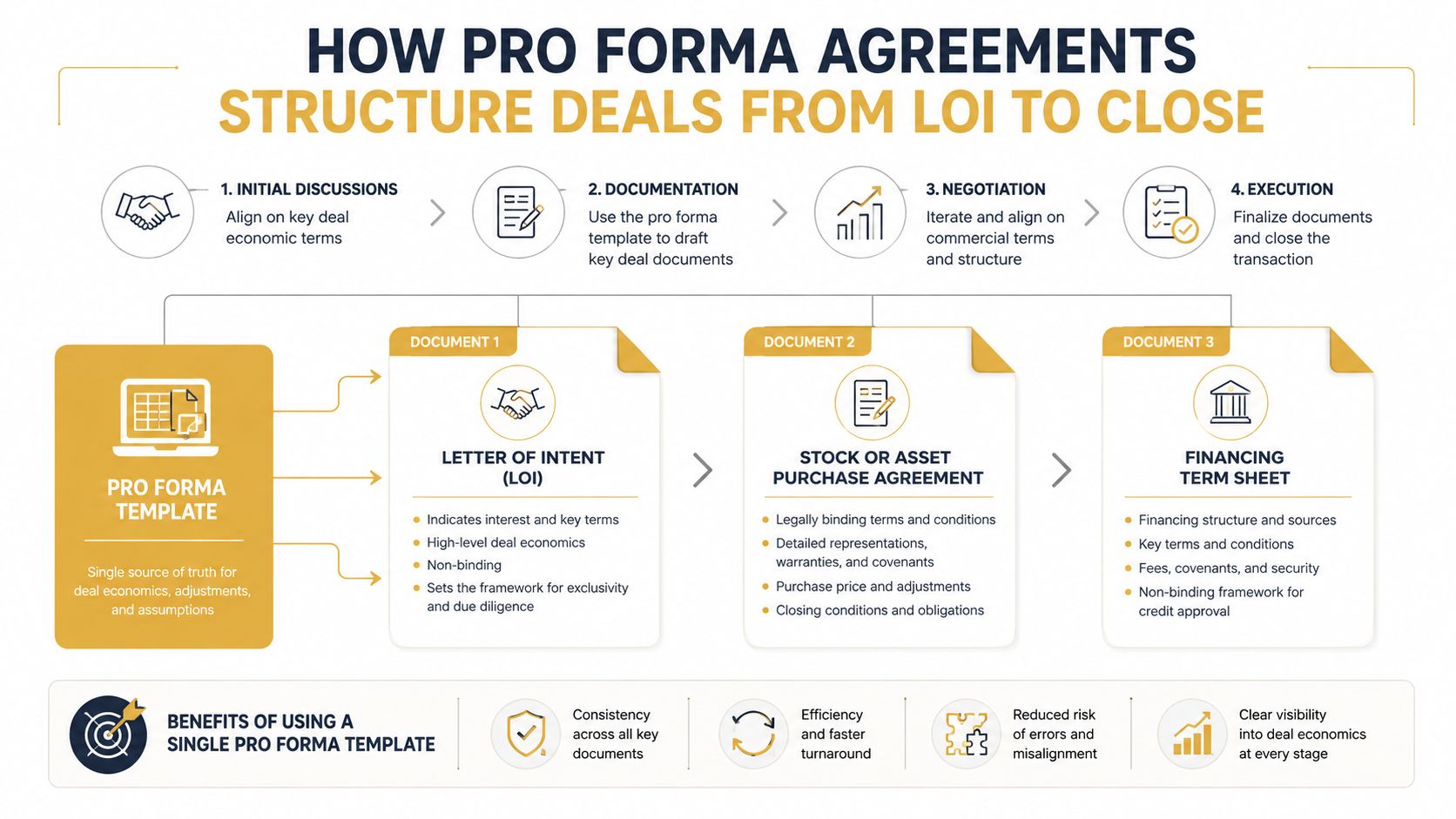
A buyer often handles three connected documents during the transaction. The letter of intent records the proposed commercial framework. The purchase agreement turns that framework into enforceable legal obligations. The financing term sheet describes the lender's conditions, pricing, collateral, and repayment expectations.
The LOI usually comes first. It may identify the proposed purchase price, structure, exclusivity, diligence access, timing, and confidentiality. Only some provisions are intended to bind the parties. A useful explanation of the document's role appears in this guide to letters of intent in acquisitions.
Once the parties authorize drafting, counsel imports the agreed commercial terms into the pro forma purchase agreement. The template supplies the organization, while the LOI and diligence findings supply the facts. Redlines then expose the actual negotiation: the seller may seek a narrower indemnity, the buyer may request stronger access rights, and both sides may revise the working capital mechanism.
The financing term sheet adds a second layer. Lender requirements may become closing conditions, representations, covenants, collateral provisions, or payment mechanics in the acquisition documents. The purchase agreement must also coordinate with the debt documents so that the buyer can satisfy both sets of obligations at closing.
The LSTA model credit agreement provides a real-world example of standardization in leveraged finance. Model forms help borrowers, lenders, and counsel use a shared vocabulary across transactions, including cross-border financings where consistency reduces drafting friction. A model document still requires transaction-specific negotiation. Standardization improves the starting point, but it doesn't decide the borrower's debt-to-equity ratio, collateral package, or permitted exceptions.
The best workflow keeps a change log connecting the LOI, purchase agreement, financing term sheet, and financial model. When a price, debt amount, closing condition, or earn-out definition changes, the legal and financial teams should update the related documents together.
Using Pro Forma Financials in Due Diligence and Financing
A buyer reviewing a small business may see profitable historical statements, then add acquisition debt, new interest, and purchase-accounting effects. The resulting pro forma financial model shows how the proposed transaction could change the combined business. It is a forward-looking analysis, not a rewritten history.
Start with the target's standalone historical income statement. Add or remove items expected to change after closing, such as acquisition debt service, interest on seller rollover notes, depreciation and amortization from purchase-price allocation, and one-time transaction costs. A purchase-price allocation can create fair-value step-ups, which may produce additional depreciation or amortization. New financing may also create interest expense absent from the target's standalone statements.
Every adjustment should have a clear source and explanation. A lender needs to know whether an item is recurring or temporary, cash or noncash, buyer-specific, or dependent on an assumption that still requires confirmation. The model should separate EBITDA from cash available for debt service. EBITDA may exclude depreciation, amortization, interest, taxes, and other items, while debt service still requires actual cash.
| Line Item | Standalone ($000) | Adjustment ($000) | Pro Forma ($000) |
|---|---|---|---|
| Revenue | TBD | TBD | TBD |
| Operating expenses | TBD | TBD | TBD |
| EBITDA | TBD | TBD | TBD |
| Depreciation and amortization | TBD | TBD | TBD |
| Interest expense | TBD | TBD | TBD |
| One-time transaction costs | TBD | TBD | TBD |
| Net income | TBD | TBD | TBD |
The table uses TBD instead of invented amounts because the correct adjustments depend on the target's statements, negotiated purchase price, financing structure, and accounting analysis. The SEC's guidance on pro forma financial information explains how acquisition-related information can present the expected financial position of a combined entity and the effects of a transaction.
These figures affect more than a lender's approval decision. They support the buyer's quality-of-earnings review, help set earn-out thresholds, and show whether reported earnings can support the proposed capital structure. A lender may examine debt-to-equity and debt service coverage. The buyer should also test downside scenarios, including weaker revenue, higher expenses, or delays in expected operating improvements.
Use a documented financial due diligence process to connect each adjustment to source records, an accounting conclusion, or a negotiated deal term. The legal pro forma provides the proposed structure and obligations. The financial pro forma tests what that structure may require from the combined business, giving the buyer and financing parties a common basis for reviewing the deal.
Common Misconceptions That Get First-Time Buyers in Trouble
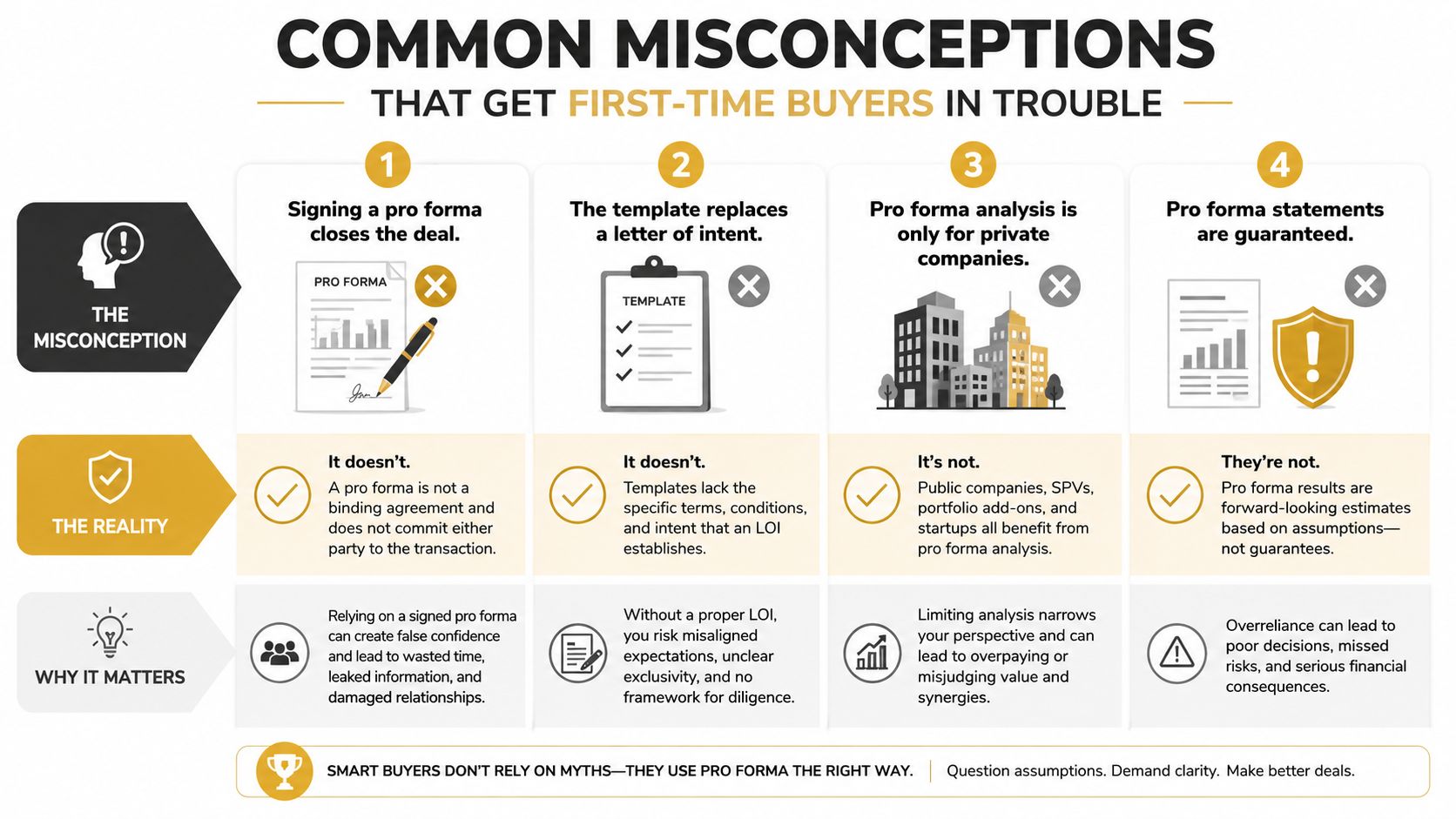
First-time buyers often treat the polished appearance of a pro forma as evidence that the transaction has already crossed a legal threshold. It hasn't. The document's value comes from organizing negotiation and analysis, not from replacing the documents and approvals that create the actual deal.
Misconception one, signing a pro forma closes the deal. A signature can matter, but the question is what the parties signed, whether the terms are complete, and whether they intended the document to bind them. A buyer who wires earnest money based only on a marked-up template may discover that the parties never agreed on the purchase price adjustment, closing conditions, or refund rights.
Misconception two, the template replaces the LOI. The documents serve different functions. An LOI records the proposed headline terms and identifies which provisions are binding. The pro forma purchase agreement provides a detailed drafting framework. If the parties assume the template memorializes exclusivity without an express provision, they may have no reliable basis for that assumption.
Misconception three, pro forma analysis is only relevant to public companies. Private-company buyers and lenders use the same basic logic when they ask what the target will look like after acquisition. Purchase-price allocation, new financing, and post-closing expenses can affect the buyer's forecast regardless of whether the target files public reports. Public-company rules may require formal pro forma information in particular circumstances, but private deals still need disciplined modeling.
Misconception four, pro forma is only an accounting exercise. The financial model can change the legal negotiation. If new debt makes the proposed payment structure difficult to support, the buyer may seek a lower price, more seller financing, a different earn-out, or stronger operating covenants. Conversely, a legal provision such as a working capital adjustment can materially change the financial model.
The safest mental model is simple. The contractual pro forma is a working draft, and the financial pro forma is a decision lens. Neither is a substitute for final legal documentation, verified diligence, or professional accounting advice.
Putting Pro Forma to Work in Your Next Acquisition
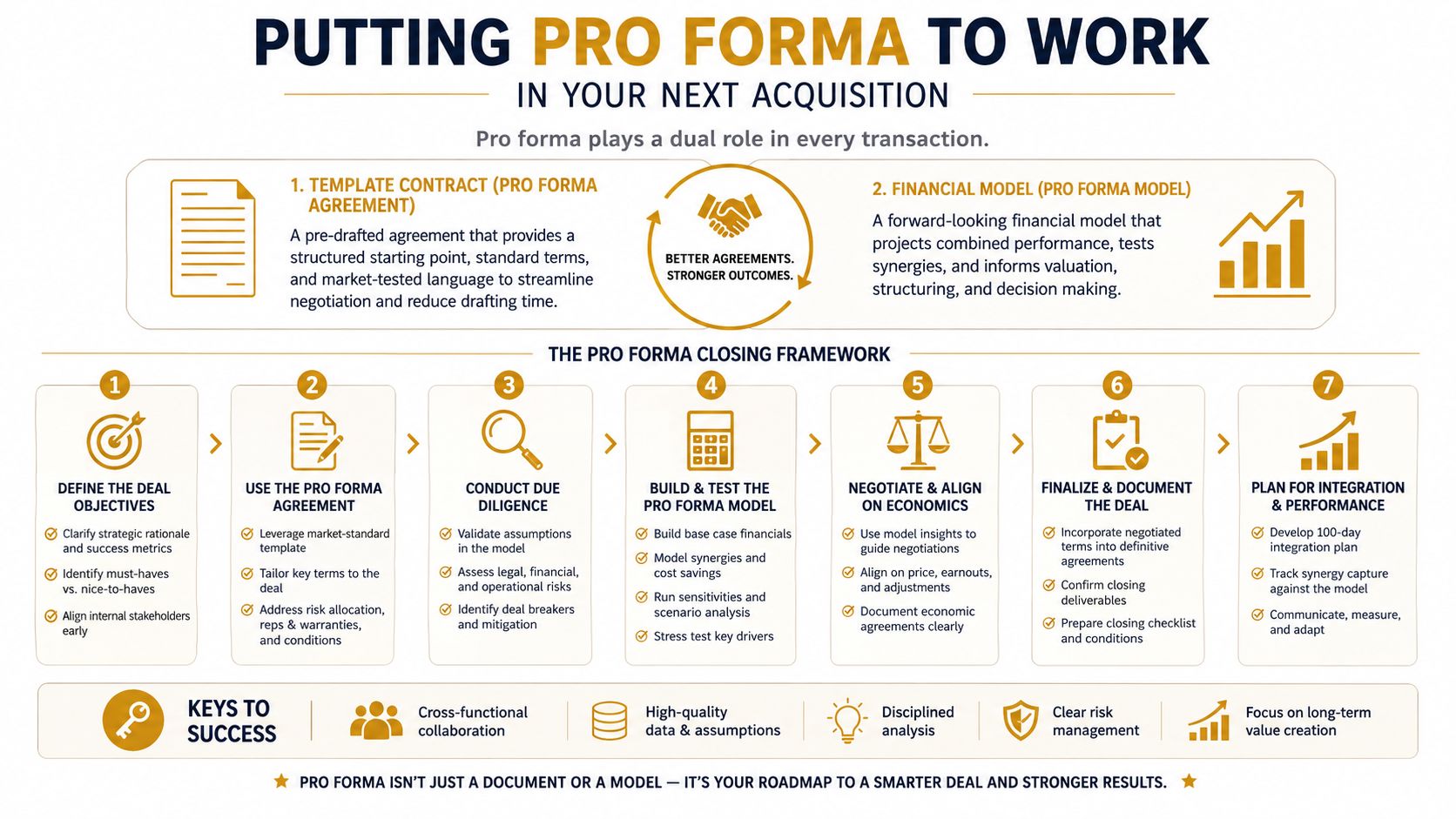
Use the pro forma agreement as a controlled workspace, not as a shortcut around judgment. Before circulating it, confirm that the LOI accurately reflects the commercial terms the buyer and seller discussed. Mark unresolved provisions, alternatives, and illustrative figures clearly, and label the document as nonbinding unless counsel has intentionally drafted a binding instrument.
A practical closing framework includes these checks:
- Confirm the baseline: Reconcile the purchase price, transaction structure, payment terms, exclusivity, and timing with the LOI.
- Mark open terms: Use brackets, comments, and “to be agreed” labels for unresolved provisions.
- Separate binding provisions: Identify confidentiality, access, expenses, governing law, exclusivity, and other terms that may operate before closing.
- Map the purchase mechanics: Connect cash, seller notes, rollover equity, escrow, earn-outs, and working capital adjustments to the financial model.
- Model the post-close business: Include financing, interest, purchase-price allocation, step-ups, depreciation, amortization, and one-time costs where applicable.
- Track evidence: Retain the legal drafts, redlines, schedules, assumptions, lender requests, and financial model in the diligence file.
- Obtain final review: Have qualified transaction counsel and accounting advisers confirm that the executed documents and financial presentation match the intended deal.
The strongest buyers keep the legal and financial versions synchronized. A change in price can affect financing. A change in financing can affect conditions precedent. A change in purchase-price allocation can affect projected earnings and debt capacity. Reviewing those connections early gives the buyer more time to renegotiate before the deal reaches the closing table.
The following video can provide another practical perspective on applying a structured acquisition process:
Dealmaker Wealth Society helps aspiring buyers turn acquisition concepts into practical deal skills through structured training, mentorship, templates, and peer support. Visit Dealmaker Wealth Society to learn how to evaluate opportunities, structure financing, manage diligence, and move from a pro forma draft toward a well-supported closing.

From the Dealmaker Blog














A Creative Business Buying Fable