
Stock for Stock Merger: Tax, Mechanics, and Impact
Stock for Stock Merger: Tax, Mechanics, and Impact

You've probably been in this spot already. Two founders like the logic of combining businesses, the numbers look workable, and somebody says, “Why not make it an all-stock deal and keep cash for growth?” That sounds clean until you map what the shares buy, who takes the valuation risk between signing and closing, and how much control changes hands when the exchange ratio lands.
Table of Contents
- What a Stock for Stock Merger Actually Means
- The Mechanics Behind the Exchange Ratio
- Fixed Versus Floating Exchange Ratios and Collar Mechanics
- How Ownership and Control Actually Shift Post-Close
- Tax Treatment Under Section 368 and What Deferral Really Means
- Accounting Treatment and the Legacy of Pooling Versus Purchase
- The Hidden Cost of Paying With Stock
- Choosing Stock Versus Cash in Practice
What a Stock for Stock Merger Actually Means
A stock for stock merger is a share exchange, not a cash sale. The target's shareholders give up their existing shares and receive acquirer shares under a pre-agreed formula, so the buyer pays with equity instead of money. That structure matters because the consideration floats with the buyer's stock price up to closing, which means the value delivered can move before the deal is done. Investopedia's plain-English description of stock-for-stock mergers captures the basic mechanics well.
A founder comparing an all-stock combination with a cash offer usually isn't choosing between “payment” and “no payment.” choice is between immediate liquidity and continued ownership in the combined business. Buyers like stock because it lowers immediate cash funding needs and can speed execution versus raising debt or cash for a pure buyout. Sellers like it when they want upside in the combined company, especially if they believe the acquirer's equity still has room to run.
Practical rule: if the seller wants out completely, cash is cleaner. If the seller wants a continuing stake and can tolerate share-price risk, stock becomes more attractive.
The phrase “no cash changes hands” also hides a real economic trade. Stock consideration still has a price, just not a cash one. The buyer gives up future upside through dilution, and the seller accepts the buyer's valuation risk after closing. That's why a stock for stock merger often feels simple in the term sheet and complicated in real life.
These deals show up often in major markets, not as a niche structure. An academic study covering 34 years found an average of 1,023 mergers per year, with activity peaking at 2,570 mergers in 1998 and still reaching 516 mergers in 2009. In the same research stream, U.S.-listed firms were acquired at roughly a 5% annual rate, and the average public-company acquisition premium was about 36% over the target's prior stock price, measured against the trading price seven days before announcement (University of Iowa research PDF). Those figures show why this structure stays relevant when cash is expensive, markets are volatile, or buyers want to preserve flexibility.
The Mechanics Behind the Exchange Ratio
The whole deal turns on one number, the exchange ratio. It tells you how many acquirer shares the target holder receives for each target share. If the ratio is wrong, the valuation is wrong, the ownership split is wrong, and the post-close governance story is wrong.
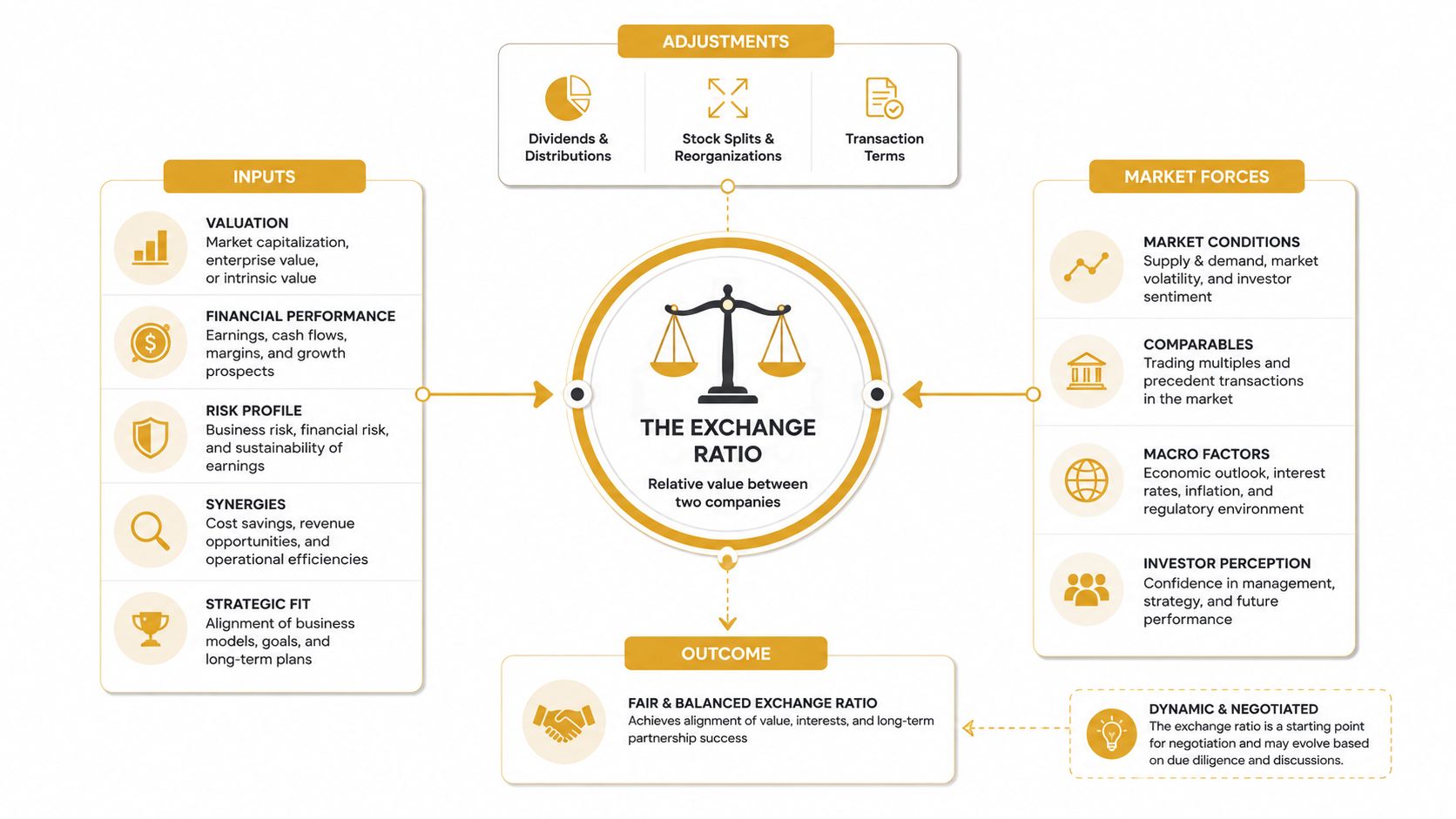
Bankers usually start by comparing the two companies' value on a relative basis, then testing the result with market multiples and DCF. Boards care about fairness opinions, but in practice they care just as much about how the ratio affects dilution and post-close ownership. The ratio is the bridge between valuation theory and the cap table the combined company will live with. An overview of how advisers use market multiples and DCF to set the ratio appears in Ascot International's discussion of stock-for-stock mergers.
A simple way to read the term sheet is to ask, “What does one target share become?” That question gets you to the economic core fast. If the acquirer stock rises before closing, target holders get more value. If it falls, they get less, even if the exchange ratio never changes. That's why a stock for stock merger is really a moving-value contract wrapped in legal merger language.
The negotiation often looks symmetrical on paper but isn't symmetrical in effect. A larger acquirer can issue a small slice of its equity and still control the combined company. A smaller buyer may have to issue a meaningful block of shares, which changes ownership more sharply. Either way, the exchange ratio determines the conversion math, while the market decides the final dollar value.
The cleanest way to think about it is this. The exchange ratio sets the starting point, but the acquirer's stock price sets the realized outcome. That's the part many deal summaries skip, and it's the part that causes the most disappointment when the market moves.
Fixed Versus Floating Exchange Ratios and Collar Mechanics
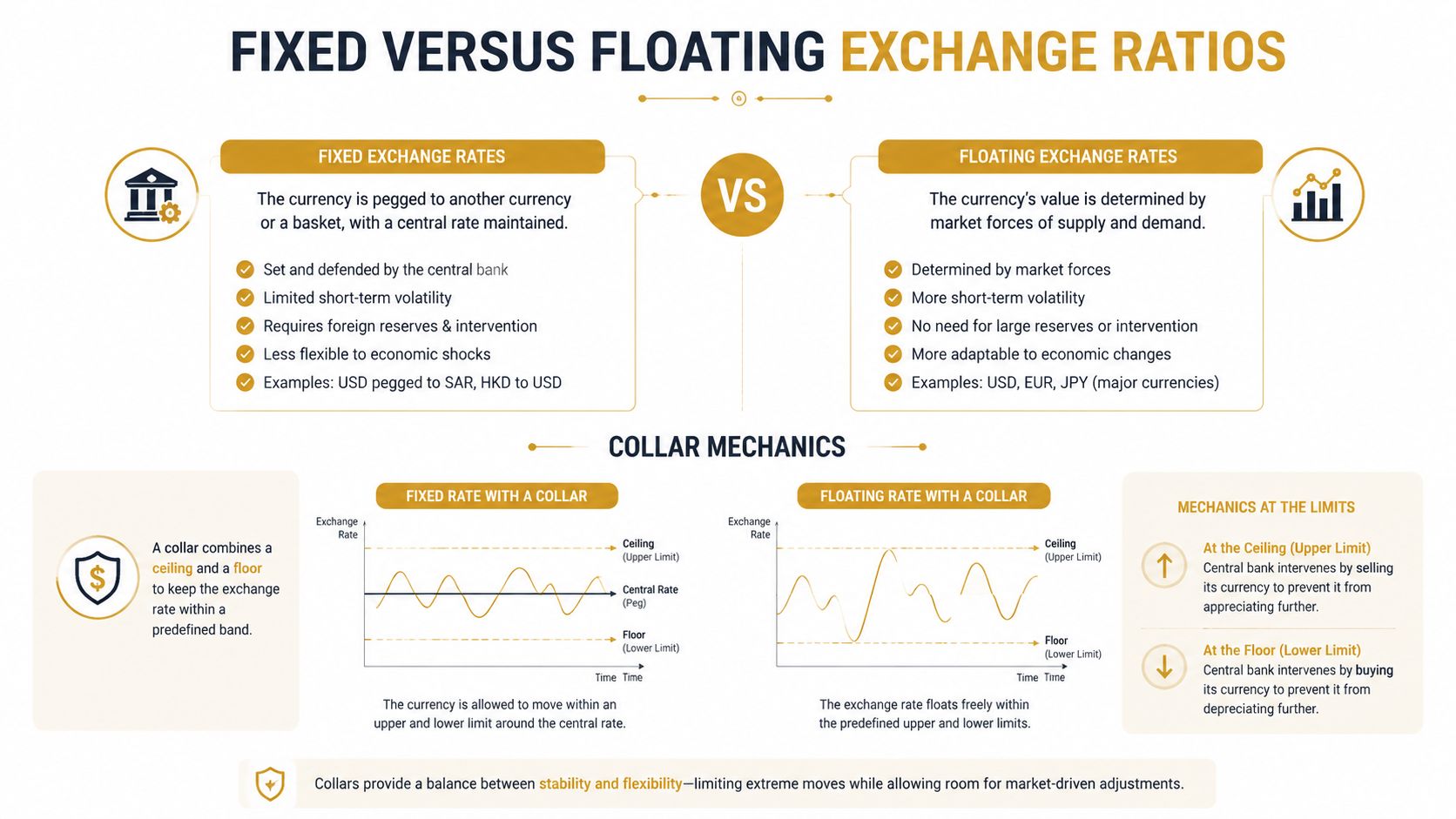
A fixed exchange ratio says the target gets a fixed number of acquirer shares per target share. If the buyer's stock climbs, the target benefits. If it falls, the target absorbs the hit. That structure is common when the seller wants continued upside and the buyer believes its equity is properly valued or likely to appreciate.
A floating exchange ratio works differently. The agreement is written so the target receives enough shares to equal a set deal value, which pushes more of the price risk back onto the acquirer. In practice, floating structures are more protective for the seller and more expensive in a falling market for the buyer. They're also harder to draft cleanly because the share count changes as the acquirer's stock moves.
Where collars come in
A collar narrows the range of outcomes. If the buyer's stock moves too far, the agreement adjusts the exchange ratio or lets one side walk away, depending on the drafting. That's the practical answer to a signing-to-closing gap that might otherwise turn a fair deal into a lopsided one.
Collars matter most when both boards know the market is unstable and neither side wants to carry all the volatility alone.
Many deals get negotiated. The headline ratio may look fixed, but the collar determines who really bears the risk if the stock drifts. A seller usually wants a tighter downside floor. A buyer usually wants flexibility if its own stock drops hard enough to make the transaction uneconomic.
The deal community often focuses on whether a transaction is “all stock” or “all cash.” That framing misses the real question. How the agreement allocates share-price risk between signing and closing. A fixed ratio, a floating ratio, and a collar all answer that question differently.
The M&A community's discussion of how stock value can change between signing and closing is a useful reminder of why these mechanics matter in volatile markets, especially in merger-of-equals style deals (MNA Community analysis). The party that thinks it has locked in value can discover that the market, not the lawyers, had the final word.
How Ownership and Control Actually Shift Post-Close
Ownership shifts are easy to misunderstand because the exchange ratio doesn't tell you the whole story. It tells you how many shares each side gets, but it doesn't automatically tell you who controls the combined company. Control depends on the final cap table, voting agreements, board composition, and how much dilution the acquirer is willing to absorb.
| Worked Example of Ownership Shift in a Stock-for-Stock Merger | Acquirer | Target | Combined |
|---|---|---|---|
| Existing shares | 100 | 50 | 150 |
| New shares issued in deal | 0 | 25 | 25 |
| Total shares after close | 100 | 25 | 125 |
| Ownership percentage | 80% | 20% | 100% |
In this worked example, the target receives newly issued acquirer shares equal to one-half of its existing share count. On paper, the target is part of the merged business. In reality, the acquirer still controls 80% of the combined equity, so the “merger” functions more like an acquisition with equity consideration than a genuine merger of equals. That's the kind of structure many sellers underestimate when they focus only on the exchange ratio.
A merger of equals is not automatic just because both names appear in the press release. One side can still end up dominant if the board seats, officer appointments, and shareholder voting power follow the economics of the deal. For a practical cross-check on the mechanics of transferring ownership, see this ownership transfer resource.
What actually decides control
Board seats matter more than marketing language. Voting agreements matter more than slogans about partnership. If the acquirer retains a majority of the voting power, it usually controls strategy, integration pace, and the first wave of management decisions.
Practical rule: if the ownership math gives one side a clear majority, call it what it is. Don't let “merger of equals” hide an acquisition structure.
The other subtle issue is dilution. Every new share issued to the target dilutes the acquirer's existing holders. That dilution is the cost of using stock, and it can be tolerable or painful depending on how much value the combined business is expected to create after closing. The legal form is a merger, but the economic reality is a redistribution of upside.
Tax Treatment Under Section 368 and What Deferral Really Means
For sellers, the tax question is often the first serious reason to consider stock. Where the transaction qualifies as a reorganization under IRC Section 368, seller-level gain may be deferred until the received shares are later sold. That does not erase tax, it postpones it, which can be valuable when the seller wants liquidity later rather than immediately.
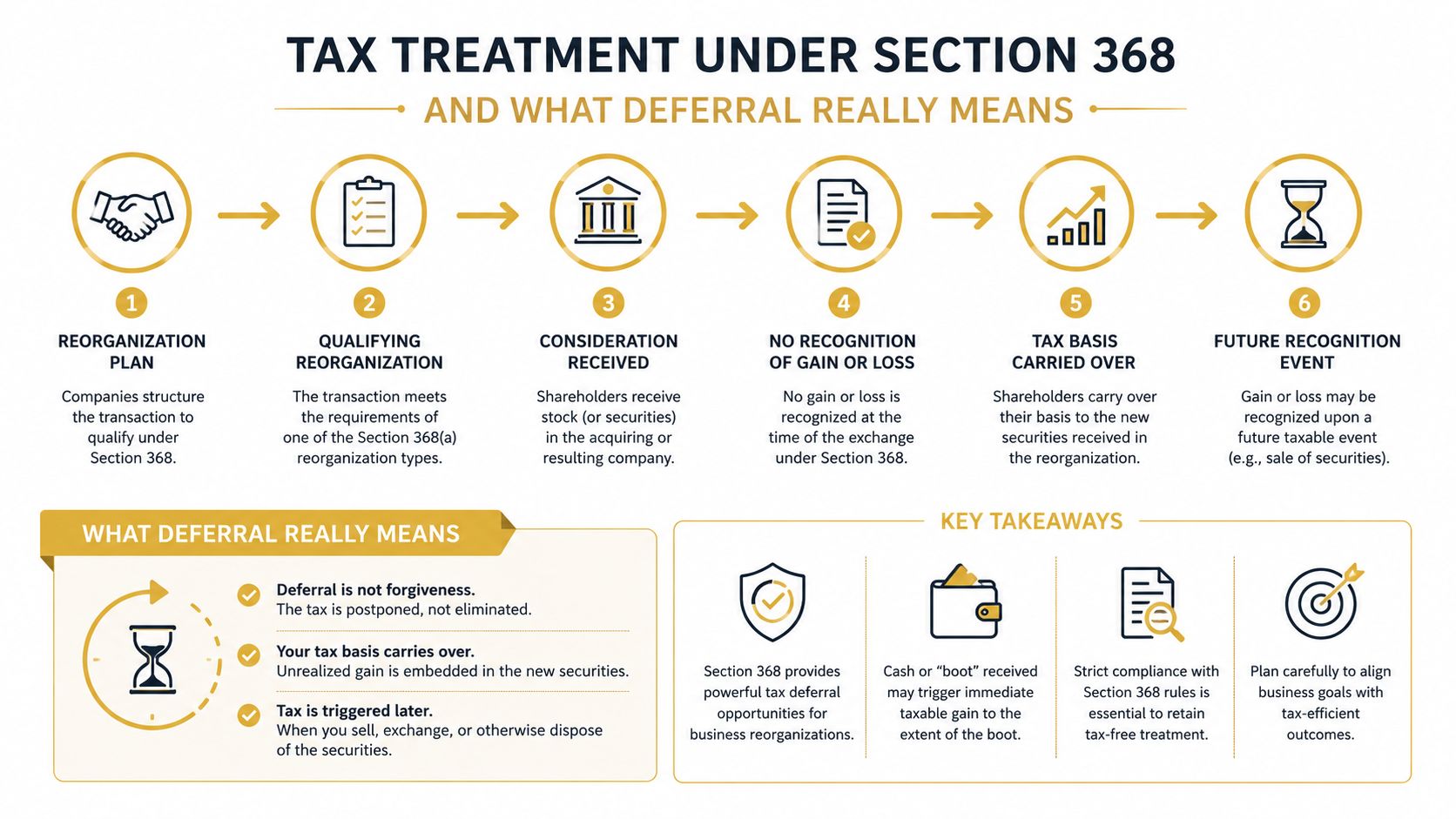
The simplest way to think about deferral is this. Instead of cashing out now and paying tax now, the shareholder receives stock and carries the tax basis into the new shares. The tax bill shows up later when those shares are sold, assuming the deal satisfies the relevant reorganization rules. A helpful practical reference for basis tracking is Allied Tax Advisors' guide to cost basis for stocks and crypto, which is especially useful when a share exchange creates a new tax lot to track.
When deferral can break down
The tax result is not automatic. Reorganization treatment depends on meeting the structural requirements, including continuity of interest and continuity of business enterprise. If the deal includes too much non-stock consideration or fails the reorganization tests, the tax treatment can change in ways that matter at closing.
That's why sellers should not treat “tax-deferred” as a marketing label. It's a contingent result that depends on the actual paperwork, the deal structure, and the final mix of consideration. A stock for stock merger can be useful for preserving liquidity, but only if the tax qualification holds.
For a broader planning lens, the tax implications of business acquisitions are also discussed in this M&A tax review resource. The point isn't to hand over tax advice, it's to recognize that the stock deal's tax value lives or dies on transaction design.
Accounting Treatment and the Legacy of Pooling Versus Purchase
Stock-for-stock deals used to carry a different accounting feel when pooling-of-interests was still part of the conversation. That history still matters because many people assume an all-stock deal should somehow look cleaner on the books than a cash deal. Under current U.S. GAAP, that instinct is mostly outdated.
Today, acquisition accounting treats most combinations as purchases for accounting purposes, even if the buyer paid entirely with stock. That means the acquirer records the acquired assets and liabilities at fair value and often recognizes goodwill if the purchase price exceeds net identifiable assets. The stock label doesn't prevent accounting remeasurement, and it doesn't shield earnings from post-close noise.
Why the old distinction still lingers
The old pooling idea created the illusion of a merger in which no one really bought anyone. That is not how current reporting works. Investors still care about the form of consideration, but they care even more about what the deal does to reported earnings, balance sheet obligations, and goodwill testing over time.
For a practical refresher on the balance sheet side of that story, this guide on how to read a balance sheet is a useful companion. It helps connect the merger agreement to the accounting statements that follow.
A stock for stock merger can still look gentler than a debt-funded buyout because it doesn't drain cash at close. But that doesn't mean the economics are gentler. The acquirer may still take on earnings dilution, intangible asset recognition, and future impairment exposure if the business underperforms.
The accounting label doesn't decide whether the deal works. Post-close operating results do.
That's the key point many founders miss. All-stock financing changes the source of consideration, not the reality of what gets recorded after closing. The reported impact can be as meaningful as the legal structure.
The Hidden Cost of Paying With Stock
The main sales pitch for stock consideration is convenience. The buyer keeps cash, the seller gets upside, and everyone feels like the deal is efficient. The problem is that stock has a long-run cost, and the market has historically punished stock-financed acquirers.
A Wharton study of stock-financed merger bids found that successful stock-financed acquirers had a mean abnormal return of -7.0% over the first 250 trading days after announcement, and the annualized abnormal return for the successful stock acquirer portfolio was -6.3%, -7.0%, and -6.0% over one-, two-, and three-year holding periods under the Fama-French three-factor model (Wharton study PDF). The same paper reported that in an exogenous failed sample, the mean ratio of target to acquirer size was 0.512, while the mean acquirer three-year abnormal return was -44.2%. Those numbers are a blunt reminder that equity financing can be expensive even when no cash leaves the company at closing.
Where the cost hides
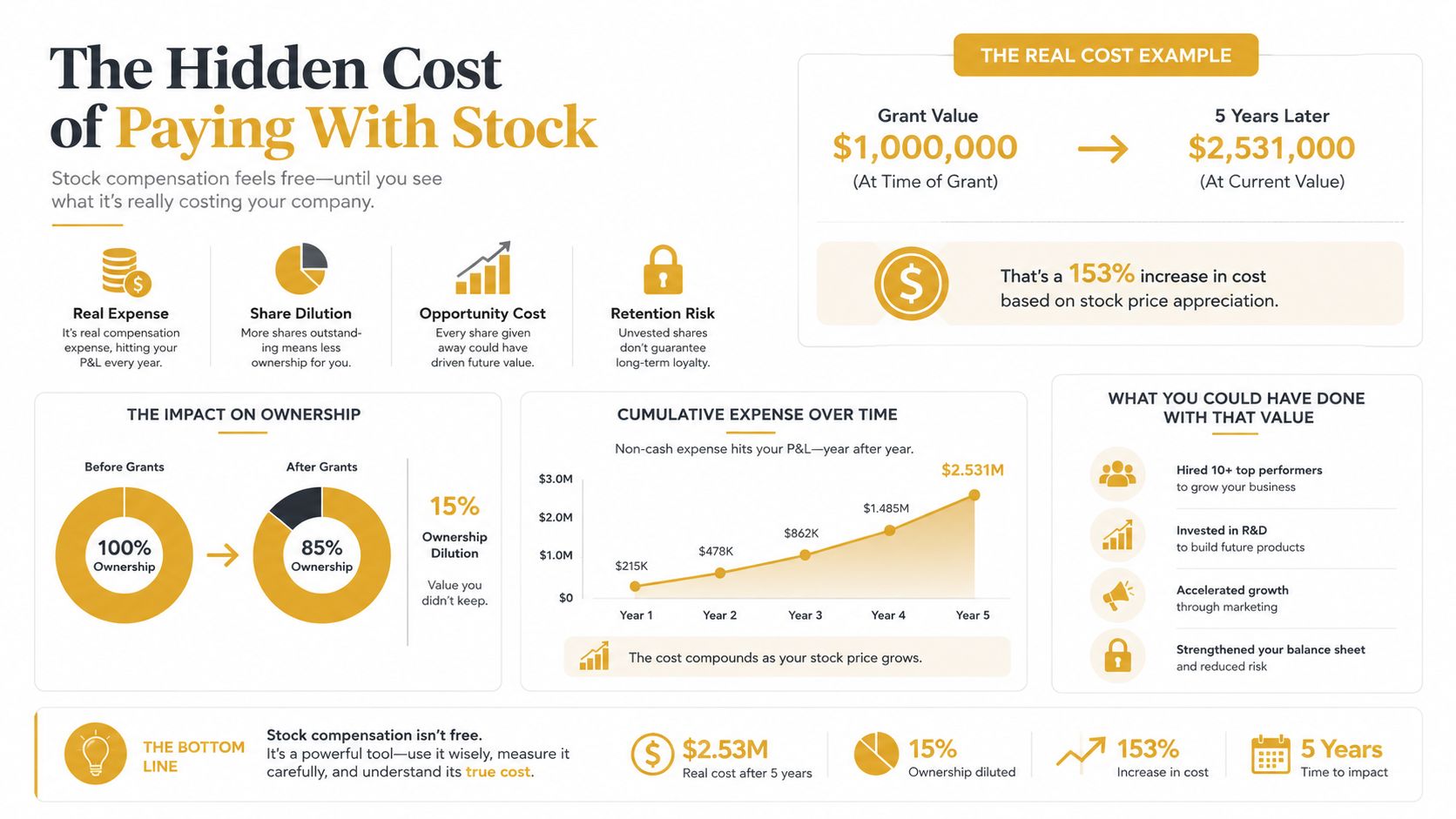
The cost shows up in dilution, but also in valuation risk transfer. The buyer gives the target holders a claim on future upside, which means existing shareholders own a smaller piece of the combined company. If the acquirer overpays with its own stock, that dilution can become a permanent drag.
The target also takes on buyer stock volatility. If the acquirer weakens between signing and closing, the target may receive less value than it expected when the deal was announced. That's why a stock for stock merger is not a free way to buy growth, it's a way to pay with an asset whose price can move against you.
The hidden cost is often easiest to see when a buyer is enthusiastic about its own currency. Management may like the optics of an all-stock deal because it preserves cash and signals confidence. Investors, though, have to ask whether the buyer is preserving value or converting today's equity strength into tomorrow's dilution.
Choosing Stock Versus Cash in Practice
The clean decision framework has three questions. First, how expensive is capital for the buyer right now. Second, how much post-close alignment does the seller want. Third, how volatile is the buyer's stock between signing and closing. If capital is expensive and the seller wants a continuing stake, stock gets stronger. If the seller wants certainty, cash usually wins.
A useful way to pressure-test the answer is to compare the deal to an asset purchase or stock purchase alternative. This stock-versus-asset purchase guide helps frame the broader structural choice, not just the payment method. For a valuation-oriented lens on how private-equity-style ownership can affect deal pricing, PEO Metrics' discussion of deal valuation and PEO analysis is worth reading alongside the financing model.
Stock tends to work best when the buyer believes its own equity is a strong currency, when the seller wants upside participation, and when both sides can tolerate price movement before close. Cash is safer when certainty matters more than participation. A mixed structure often makes sense when the parties want some liquidity now and some alignment later.
If you're structuring a real transaction, Dealmaker Wealth Society offers training, templates, and deal support for buyers working through acquisition strategy, capital raising, and post-close execution. If you want a practical framework for judging when stock consideration helps and when it shifts too much risk, visit Dealmaker Wealth Society and use the acquisition resources to pressure-test your next offer.

From the Dealmaker Blog















A Creative Business Buying Fable
