
What Is Deal Sourcing and How It Powers M&A Success
What Is Deal Sourcing and How It Powers M&A Success

Deal sourcing is the upstream origination activity where acquisition targets are identified, qualified, and routed into an M&A pipeline. In one global study, researchers found 8,298 targets across 2013–2022, while deal flow was the resulting stream of opportunities produced by that sourcing work. S&P Global's deal-sourcing study provides the larger market context, but the practical lesson applies to a first-time small-business buyer too.
You may already know the industry you want, have read acquisition books, and even have financing conversations underway. Yet your inbox is empty, broker calls are irregular, and every promising listing seems to disappear before you can evaluate it. That isn't a valuation problem. It's an origination problem.
Table of Contents
- Why Every First-Time Buyer Starts With the Same Missing Step
- What Deal Sourcing Means in the M&A Funnel
- The Five Channels That Generate Acquisition Opportunities
- Comparing Sourcing Channels for Small Business Buyers
- Key Metrics That Separate Real Sourcing From Random Outreach
- How Sourcing Fits Into the Broader Acquisition Pipeline
- Turning Deal Sourcing Into a Repeatable Weekly System
Why Every First-Time Buyer Starts With the Same Missing Step

A first-time buyer may spend weeks studying deal structures, comparing lending options, defining a target profile, and preparing diligence questions. Then the search begins, and nothing happens. Broker calls arrive sporadically, listings disappear quickly, and the inbox stays quiet.
The missing piece is a weekly origination routine. A buyer needs a repeatable way to identify businesses, start owner conversations, test whether a sale is possible, and route suitable opportunities into review. That work comes before valuation, diligence, financing, and negotiation.
Preparation only matters when targets enter the funnel
Deal sourcing connects acquisition preparation with acquisition action. Without a steady source of prospects, even a buyer with financing and a clear thesis can remain at zero qualified targets.
The funnel is selective. Research summarized in the Deal Sourcing & Spend Benchmark Report found that, for every 100 opportunities considered, investors investigated fewer than 24, signed agreements on fewer than 14, and closed only 6. The lesson for a first-time SMB buyer is practical: sourcing must produce enough suitable opportunities to withstand each later filter.
Treat sourcing as an operating system rather than a hunt. Set weekly activity by channel, record responses, calculate conversion rates, and apply qualification rules consistently. A broker referral, an owner introduction, an industry association contact, and a marketplace listing may all enter the same pipeline, but they rarely convert at the same rate. Tracking the mix shows where time produces real conversations.
A useful target profile should answer:
- Industry and business model: Which sectors match your experience and operating strengths?
- Geography: Where can you realistically visit, manage, or build relationships?
- Financial fit: What profitability and cash-flow traits can support the acquisition?
- Seller situation: Are you seeking a retiring owner, a growth-minded founder, or a business needing transition?
- Deal structure: Would you consider seller financing, a partnership, an earnout, or only a straightforward purchase?
Keep the profile focused enough to guide screening, but open enough to leave plausible targets in the pipeline. A framework for identifying suitable acquisition targets can help turn broad preferences into practical criteria.
Practical rule: If you cannot describe how a target will enter your pipeline this week, you do not yet have a sourcing strategy.
What Deal Sourcing Means in the M&A Funnel
Deal sourcing is the front-end work of finding businesses, contacting owners or representatives, and deciding whether an opportunity deserves further attention. It covers target research, first outreach, follow-up, and early qualification, so unsuitable prospects do not consume the same time as credible ones.
M&A professionals often call this front end origination. Sourcing is the operating discipline around origination. It brings together direct owner outreach, intermediary referrals, inbound opportunities, market research, relationship management, and initial screening.
Sourcing is what you do. Deal flow is what arrives as a result. That distinction matters for a first-time buyer. A marketplace listing, broker introduction, or owner reply is deal flow. The target criteria, channel plan, outreach schedule, follow-up process, and qualification rules that produce those opportunities are sourcing.
Consider a buyer who records twenty owner conversations each week. They separate conversations by channel, track replies and follow-ups, and mark which owners meet their target profile. After several weeks, the buyer can see whether direct email, adviser referrals, industry contacts, or marketplace research creates the strongest conversations. A buyer who checks listings occasionally has visibility into deal flow, but no operating system for improving it.
A pipeline with fewer well-matched opportunities can be more useful than one filled with weak leads. The difference comes from consistent qualification and feedback, not from raw activity.
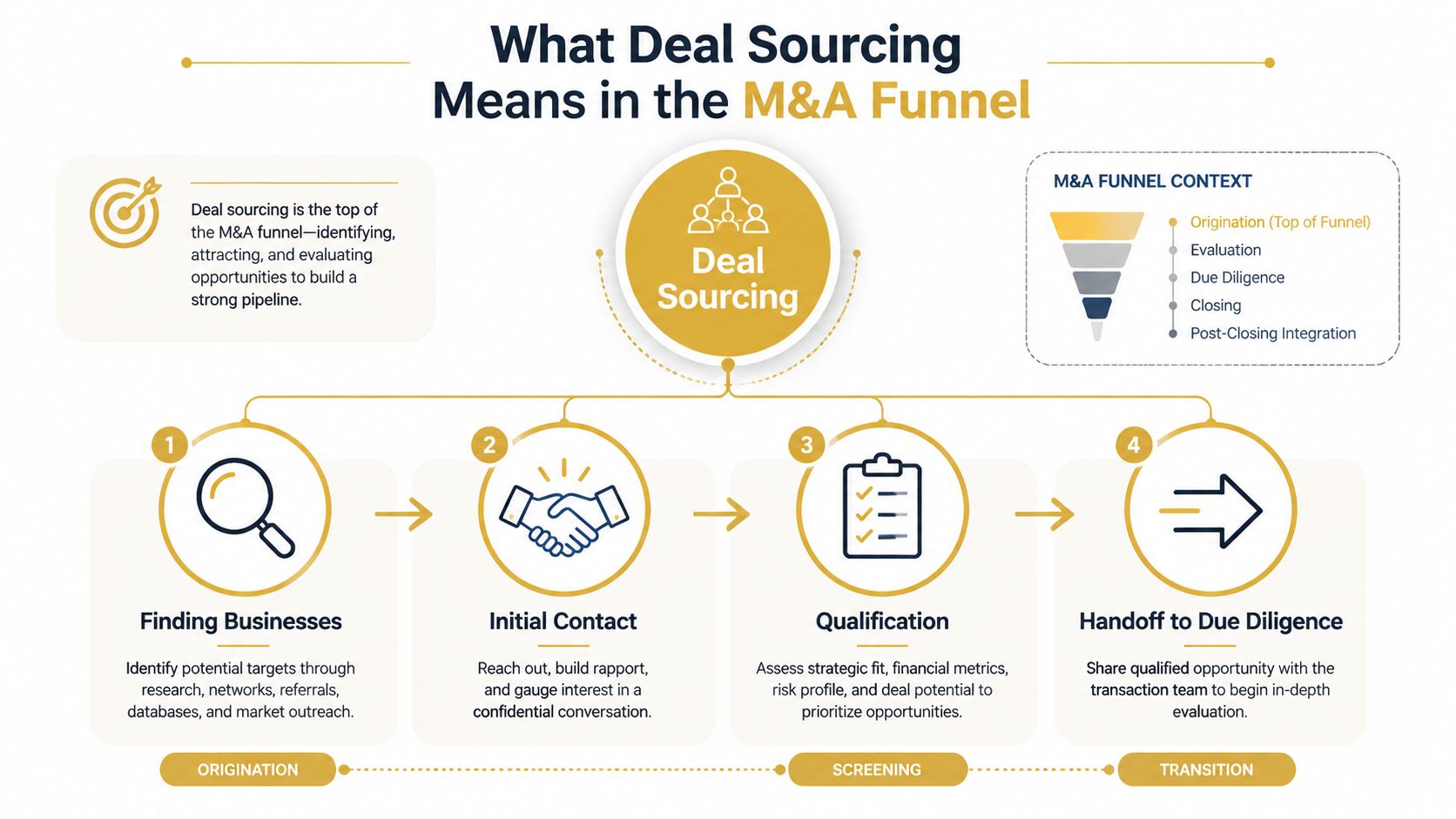
A functioning system has four parts:
- Inputs: Target criteria, data sources, broker relationships, owner lists, referrals, content, and outreach.
- Activities: Research, first contact, follow-up, relationship building, and initial screening.
- Outputs: Qualified conversations, information requests, active prospects, and opportunities handed to evaluation.
- Feedback: Rejection reasons, seller objections, channel performance, and changes to the target thesis.
Earlier research found that about 36% of closed deals were proactively self-generated, compared with 33% from investment banks, 8.6% from brokers, and 8.6% from executive networks. These figures support a practical lesson: proprietary access can matter more than receiving broad intermediary deal flow.
For the mechanics of identifying and contacting business owners, a B2B prospecting services guide provides useful context. Acquisition outreach usually requires more patience because owners may not be actively selling.
The Five Channels That Generate Acquisition Opportunities
Small-business buyers usually build deal flow through five channel families. Each one solves a different access problem, so the right question isn't which channel is universally best. It's which mix fits your time, credibility, target sector, and ability to follow up.
Brokers and M&A advisers
Brokers and advisers represent sellers and can provide structured information, established processes, and owners who have already considered a transaction. This channel suits buyers who value speed and seller readiness, but competition can be intense and access depends on your credibility, responsiveness, and fit with the mandate.
The trade-off is that intermediated opportunities may be easier to evaluate but less proprietary. A buyer who relies only on brokers also has little control over which sectors or sellers enter the pipeline.
Online marketplaces
Marketplaces such as BizBuySell and Acquire.com make discovery accessible. They help a new buyer learn how businesses are presented, compare business models, and identify owners or advisers worth contacting.
The weakness is noise. Listings may lack depth, contain optimistic descriptions, or attract many competing buyers. Treat marketplace listings as research inputs and conversation starters, not automatic acquisition candidates.
Direct owner outreach
Direct outreach includes personalized email, letters, phone calls, and relationship-building with owners who haven't formally listed their businesses. It can uncover proprietary opportunities and lets the buyer choose a precise industry or geographic focus.
The cost is operational. Cold email direct outreach often produces only 1–3% reply rates, according to CTA Acquisitions' acquisition guide. That doesn't make it ineffective. It means the buyer must research carefully, personalize the message, and maintain a substantial follow-up habit.
Professional and investor networks
Accountants, attorneys, lenders, operators, trade associations, investors, former colleagues, and portfolio-company leaders can introduce owners before a formal sale process begins. These referrals often carry more trust than cold contact.
The channel grows slowly because relationships need maintenance before they produce an opportunity. However, the same guide reports that network referrals can close at 10–20% conversion, making them lower-volume but potentially higher-quality than broad cold outreach. Use that figure as directional evidence, not a promise for every buyer or sector.
Inbound content and search
A buyer who publishes a clear acquisition thesis can attract owners, advisers, and referral partners through articles, interviews, newsletters, and professional profiles. Inbound takes time to build, but it can establish credibility before the first conversation.
Channel concentration creates risk. Intralinks' deal-sourcing guidance recommends maintaining a channel inventory and reviewing whether referrals, intermediaries, or inbound opportunities dominate the pipeline. Its example of 70% network referrals, 20% intermediaries, and 10% inbound is a monitoring illustration, not a universal target.
For a first-time buyer, two or three active channels are usually easier to manage than five neglected ones. A buyer might combine direct outreach with broker relationships and a referral network, then add inbound content once the core process is working. Practical support around sourcing services for acquisitions can also help clarify which activities belong in the operating system.
Comparing Sourcing Channels for Small Business Buyers
A side-by-side view helps you choose channels based on control, seller readiness, cost, and workload. The table below uses qualitative comparisons because actual results vary by industry, geography, message quality, and buyer credibility.
| Channel | Typical Deal Volume | Avg. Deal Size | LOI Conversion | Weekly Hours | Upfront Cost | Seller Readiness |
|---|---|---|---|---|---|---|
| Brokers and M&A advisers | Low to medium, controlled by available mandates | Varies by mandate and buyer fit | Selective, after screening | Moderate | Often higher, depending on adviser terms | Usually high |
| Online marketplaces | Broad and visible inventory | Wide range | Low to selective | Low to moderate | Low to moderate | Mixed |
| Direct owner outreach | High potential reach | Defined by target list | Low at first contact, improves with qualification | Moderate to high | Low to moderate | Often low or uncertain |
| Professional and investor networks | Low to medium | Strongly shaped by network | Higher trust, but relationship-dependent | Moderate | Low financial cost | Medium to high |
| Inbound content and search | Slow initial volume, compounding over time | Varies by audience and positioning | Gradual and relationship-led | Moderate | Time and content investment | Mixed |
A broker may give you a seller who has prepared financial information and a transaction timeline. Direct outreach may give you access to an owner who has never considered selling, which creates more education and trust-building work. Marketplaces reduce discovery friction, but you must perform more of the qualification yourself.
Choose a manageable starter mix
A buyer with less than $1 million to deploy should avoid building an institutional-looking sourcing machine before learning how to qualify opportunities. Start with one controllable channel and one relationship-based channel, such as direct owner outreach plus referrals from accountants, lenders, and operators.
Add a broker channel when you can respond quickly and explain your target profile clearly. Keep the CRM simple, record the source of every opportunity, and review whether each channel produces conversations that match your thesis.
The goal isn't to maximize activity. It's to create enough variety that one silent channel doesn't leave your entire pipeline empty.
Key Metrics That Separate Real Sourcing From Random Outreach
A first-time buyer can send messages all week and still have no usable pipeline. Real sourcing measures movement between stages, so each week's activity can be reviewed and improved.
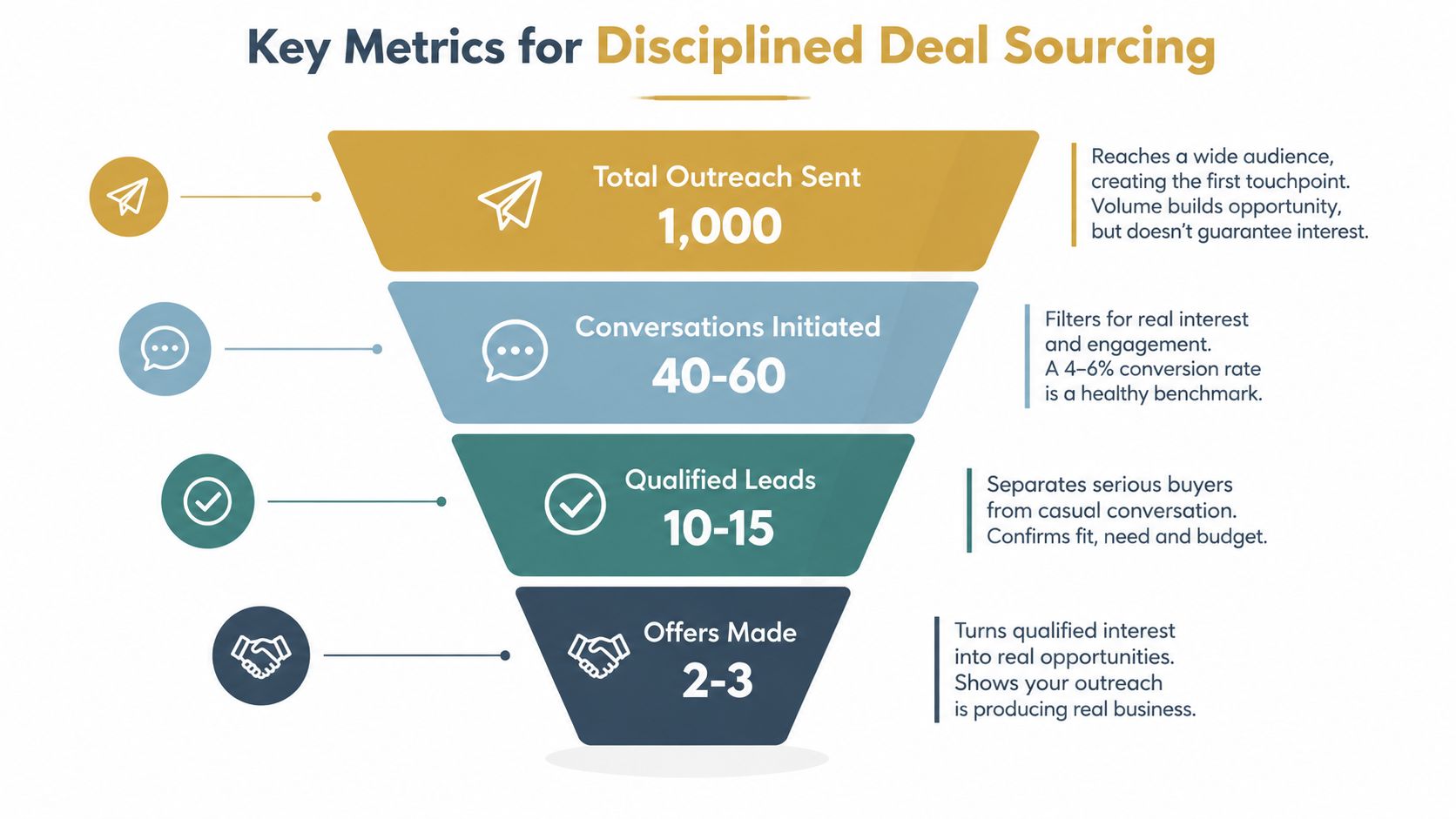
Start with a funnel: contacts approached, responses received, conversations held, information requested, qualified opportunities, offers made, and completed transactions. Conversion rates will vary by market. The sequence still shows where prospects stop progressing and which channel deserves attention.
Track channel performance, not just total activity
A CRM should answer four practical questions:
- Which channel creates qualified conversations? Separate brokers, marketplaces, direct outreach, referrals, and inbound so volume does not hide quality.
- Where do prospects stall? Many conversations but few information requests may point to weak qualification or unclear messaging.
- Why are targets rejected? Record price expectations, geography, financial quality, seller timing, and strategic mismatch.
- Which relationships need follow-up? For an owner who is not ready, follow up every 30 days with a brief, value-adding note rather than a status-check email.
The S&P Global study examined 8,298 targets across 2013–2022. Its findings report an average of about 820 deals per year and a yearly swing of 112 deals, illustrating that sourcing conditions change over time. The study found that acquirers took a controlling stake in 62% of deals and a significant stake (above 25%) in 72% of deals. Ownership structure therefore belongs in early qualification, not only in final negotiations.
Add structural signals to the dashboard
Conversion metrics do not explain every outcome. Track the age and tenure of owners you contact, how long they have operated the company, whether a successor appears to exist, and whether the business fits your operating capabilities.
Monitor channel concentration as well. If nearly every active opportunity comes from one intermediary or marketplace, availability and quality from that source can shape the entire pipeline. A simple CRM beats inbox memory because it preserves each conversation and makes the next action visible.
How Sourcing Fits Into the Broader Acquisition Pipeline
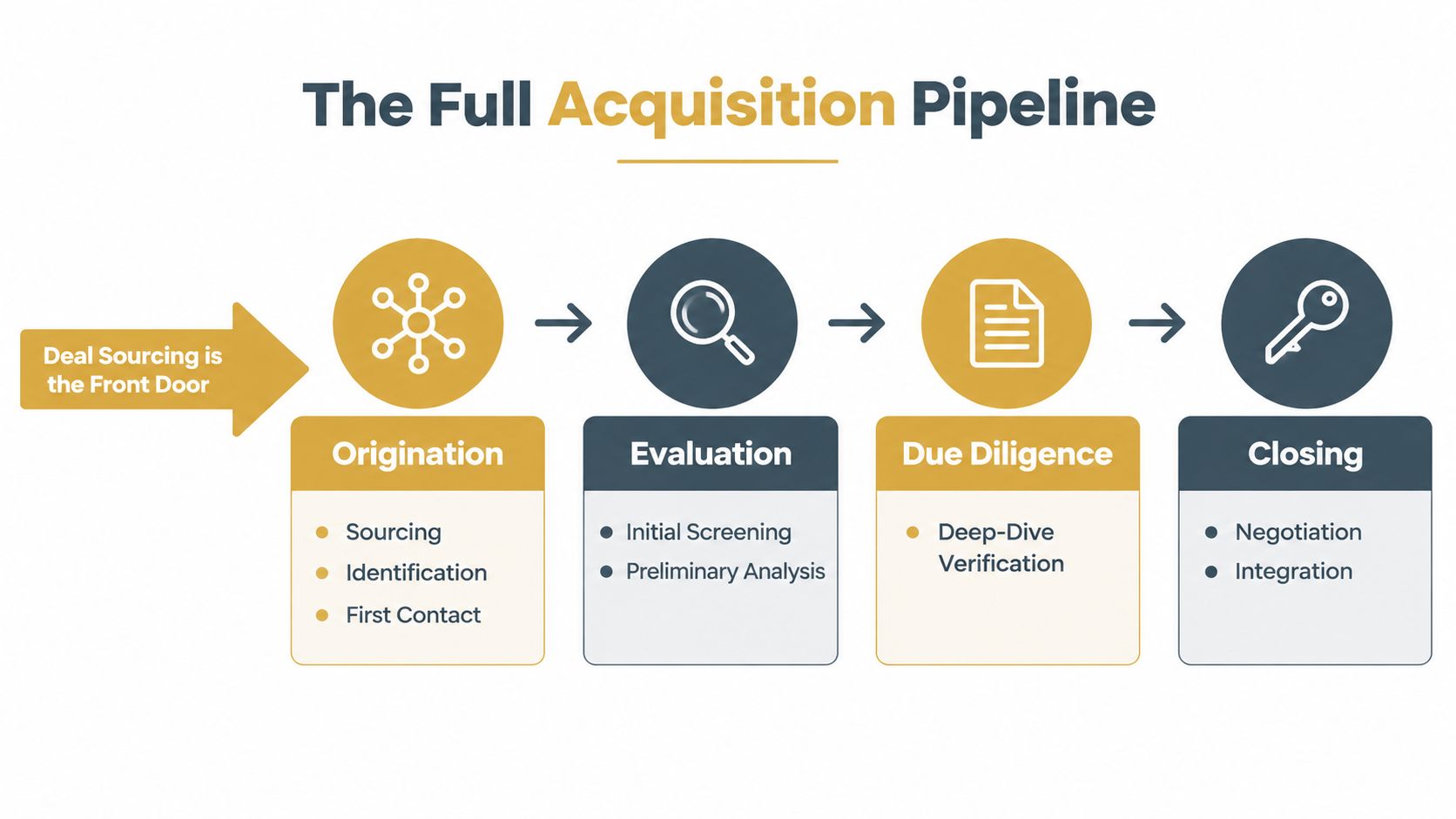
Sourcing is the front door of an acquisition process. It brings a possible target into the pipeline, where each stage answers a more specific question: does the business fit, can the claims be verified, and can both parties complete a workable transaction?
Origination and screening
Origination covers identifying a company, making first contact, and learning whether a sale might be possible. Screening then applies written rules, such as minimum revenue, target geography, financial profile, owner situation, operational fit, and acceptable deal structure.
A broker-sourced company from a retiring owner may arrive with a timeline and information package. A cold outbound opportunity may offer less data but more direct access. Neither channel is automatically better. Compare them through the same screen.
Set clear gates before reviewing opportunities in depth. Examples include a minimum revenue threshold, owner willingness to discuss seller financing, clean customer concentration, acceptable geography, and a transition plan that matches the buyer's operating ability. A gate should produce a decision, not a vague impression.
Evaluation and structuring
Evaluation examines financial records, management, customers, suppliers, and the business model. If the target passes, the buyer builds a preliminary deal model and considers an LOI, exclusivity, financing, and transaction structure.
The first conversation affects the quality of this work. If it leaves owner goals, earnings quality, operational dependence, or timing unclear, those questions return during investigation, when answering them takes more time.
For outreach that needs to remain clear and professional, a sales template from Mail Merge for Gmail can help organize initial messages and follow-ups. Acquisition outreach still needs personal context, especially when the owner has not advertised a sale.
Due diligence and closing
Due diligence tests the opportunity's claims. Legal, financial, operational, commercial, and tax reviews may reveal liabilities, customer concentration, weak records, or transition risks. If the findings support the thesis, the parties negotiate definitive documents, arrange financing, and plan the handoff.
Declining a mismatched target early costs hours. Declining it after diligence can cost months.
The decision rules at origination shape every later stage. A qualified target does not guarantee a successful close, but it gives the buyer a clearer basis for testing fit, timing, seller motivation, information quality, and transaction structure. Sourcing therefore works best as a measurable operating system: track channel mix, conversion rates, and qualification outcomes rather than treating deal flow as a random hunt.
Turning Deal Sourcing Into a Repeatable Weekly System
A first-time buyer doesn't need a complicated platform to begin. They need a calendar, a target profile, a CRM, and the discipline to complete the same core actions every week.
Use four operating blocks
- Monday market scan: Review relevant marketplace listings, broker updates, industry news, and referral messages. Save only targets that meet your initial criteria.
- Tuesday outreach: Send personalized messages to selected owners, advisers, and referral partners. Explain your target profile and the type of transition you can support.
- Wednesday and Thursday follow-up: Respond to replies, hold introductory calls, request available information, and log every interaction immediately.
- Friday pipeline review: Disqualify poor fits, assign next steps, identify stalled conversations, and compare channel performance.
Your qualification rules should be written before the pipeline fills. Include industry, geography, revenue or profitability requirements, owner motivation, operational complexity, and acceptable transaction structures. If a target fails an essential rule, mark the reason and move on.
CRM hygiene matters more than advanced software. Record the source channel, contact date, owner context, current stage, next action, and reason for rejection. A simple spreadsheet can work at the beginning, while a dedicated system becomes useful as relationships and follow-ups multiply.
The deal origination machine concept captures the right mindset: sourcing should function as a repeatable operating process, not an occasional burst of searching. Consistency matters more than chasing an impressive activity count. Each week should leave you with cleaner data, better relationships, and a clearer understanding of which channels deserve more attention.
Dealmaker Wealth Society provides acquisition education, structured training, mentorship, deal-sourcing guidance, and peer support for people buying and growing small businesses. If you want help turning your target profile into a practical sourcing and acquisition process, visit Dealmaker Wealth Society and explore the available programs and community resources.

From the Dealmaker Blog













A Creative Business Buying Fable
