What Is Enterprise Value vs Equity Value for Buyers
What Is Enterprise Value vs Equity Value for Buyers

Equity value is the shareholders' claim, while enterprise value is the operating business for all capital providers: in the simplified bridge, enterprise value equals equity value plus net debt, so $200 million of equity plus $50 million of net debt equals $250 million of enterprise value.
The popular advice to learn the formula and apply an EBITDA multiple stops too early. For a small-business buyer, the harder question is what happens between the offer and the closing statement. Debt-like liabilities, unavailable cash, working-capital adjustments, and deferred payments can change the economics even when everyone agrees on the operating business's value.
If you're asking what is enterprise value vs equity value, learn both definitions. Then build the bridge that tells you who gets paid, which obligations remain, and how much cash the buyer needs.
Table of Contents
- Enterprise Value and Equity Value in One Bridge
- How the Two Values Differ on Every Criterion
- How Debt and Cash Move the Price
- Why Headline Enterprise Value Is Not Seller Cash
- Walking From Enterprise Value to Equity Value at Close
- When Buyers Use Each Value in an Acquisition
- Lock Five Definitions and Walk One Teaser
Enterprise Value and Equity Value in One Bridge
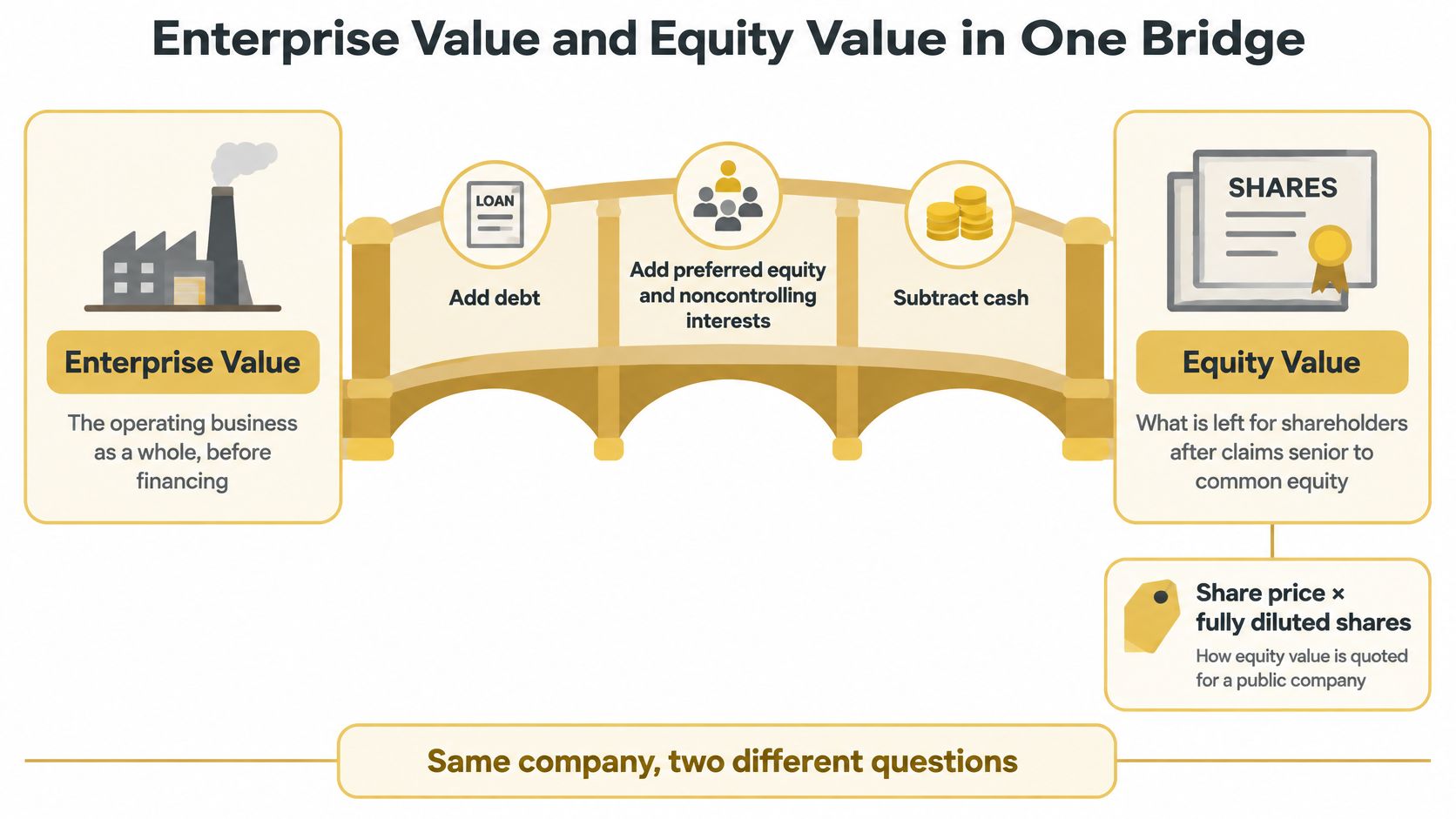
Equity value is the value attributable to shareholders after accounting for claims senior to common equity. For a public company, the familiar starting point is share price multiplied by fully diluted shares outstanding. For a privately held business, there's no quoted share price, so the equity purchase price is negotiated.
Enterprise value, or EV, measures the operating business available to all capital providers. It separates the value of the operations from the way the owners financed them.
The standard relationship is:
Enterprise value = Equity value + Total debt + Preferred equity + Noncontrolling interests − Cash and cash equivalents
The shortcut is enterprise value = equity value + net debt, provided there aren't additional preferred or minority claims to include.
Put the arithmetic in acquisition terms
Using the example explained by Corporate Finance Institute, 10 million diluted shares at $20 produce $200 million of equity value; adding $80 million of debt and subtracting $30 million of cash produces $250 million of enterprise value.
That calculation doesn't describe separate businesses. It describes different claims on the same business. A buyer needs both values because purchasing the shareholders' ownership doesn't make the company's borrowings disappear.
The visual bridge shows how those claims connect.
Build from documents, not a broker's label
Start with the latest balance sheet, then reconcile it to supporting schedules. Take borrowings from the debt schedule and loan documents, not just the balance-sheet total. Reconcile cash to bank statements and identify restrictions before assuming it's available.
For a public-company calculation, reconcile the diluted share count to outstanding shares and relevant equity awards. For a small-business acquisition, inspect the capitalization table, shareholder loans, and preferred rights instead of treating every ownership interest as ordinary common equity.
- Check the valuation date. A current offer shouldn't rely on an old debt balance without adjustment.
- Identify every claimant. Preferred shareholders and minority owners may require separate treatment.
- Keep operations separate from financing. A debt-heavy target isn't automatically a cheaper operating business.
The practical benefit is comparability. Enterprise value gives buyers a cleaner basis for comparing operations, while equity value identifies the ownership claim they're negotiating to acquire.
How the Two Values Differ on Every Criterion
Use this comparison as a lookup when reviewing an offer, investment memo, or acquisition model. The labels matter because a seller, broker, and lender may use the word price to mean different things.
Enterprise value versus equity value
| Criterion | Equity value | Enterprise value |
|---|---|---|
| Who is paid | Common shareholders | All capital providers |
| What it measures | Residual claim after senior claims | Operating business, more capital-structure neutral |
| Matched performance multiple | Price to earnings | EV/EBITDA or EV/EBIT |
| If leverage rises and operations stay the same | Falls, holding EV and cash constant | Stays about the same |
| Effect of surplus cash | Increases it, holding EV constant | Decreases it, holding equity value constant |
| Typical use in a deal | Seller consideration before further adjustments | Headline offer and peer comparison |
The claimant determines the question
Equity value answers what belongs to the common shareholders. Enterprise value includes the claims of the broader capital structure, allowing buyers to discuss the operations without treating the seller's financing choices as operating performance.
That distinction also prevents a funding mistake. The target's equity value isn't necessarily the cash the buyer must contribute. Acquisition lenders, outside investors, seller financing, and rollover ownership can all affect the buyer's funding requirement.
Match the multiple to the right value
Price to earnings pairs equity value with earnings attributable to equity holders. EV/EBITDA and EV/EBIT pair enterprise value with operating measures calculated before interest.
Interest is the key distinction. If you divide an equity purchase price by EBITDA, you subtract borrowing obligations from the numerator while leaving financing costs out of the denominator. The resulting ratio can make a highly indebted company look cheaper for reasons unrelated to its operations.
Practical rule: Compare the operating business with an operating-business multiple. Evaluate the shareholders' claim with an equity-based measure.
Cash requires the same care with assumptions. Holding operating value constant, additional distributable cash increases what shareholders own. Holding equity value constant, subtracting more cash produces a lower implied enterprise value. Those aren't contradictory results. You've held a different starting value fixed.
The table doesn't decide whether a customer deposit is debt-like, whether inventory is acceptable, or whether cash can leave the company. Those are purchase-agreement questions.
When reading a teaser that quotes a multiple of profit before interest, treat the headline as a proposed enterprise value unless the document explicitly defines something else. Ask for the price basis before negotiating the multiple.
How Debt and Cash Move the Price
Reverse the bridge when you start with an offer for the operating business:
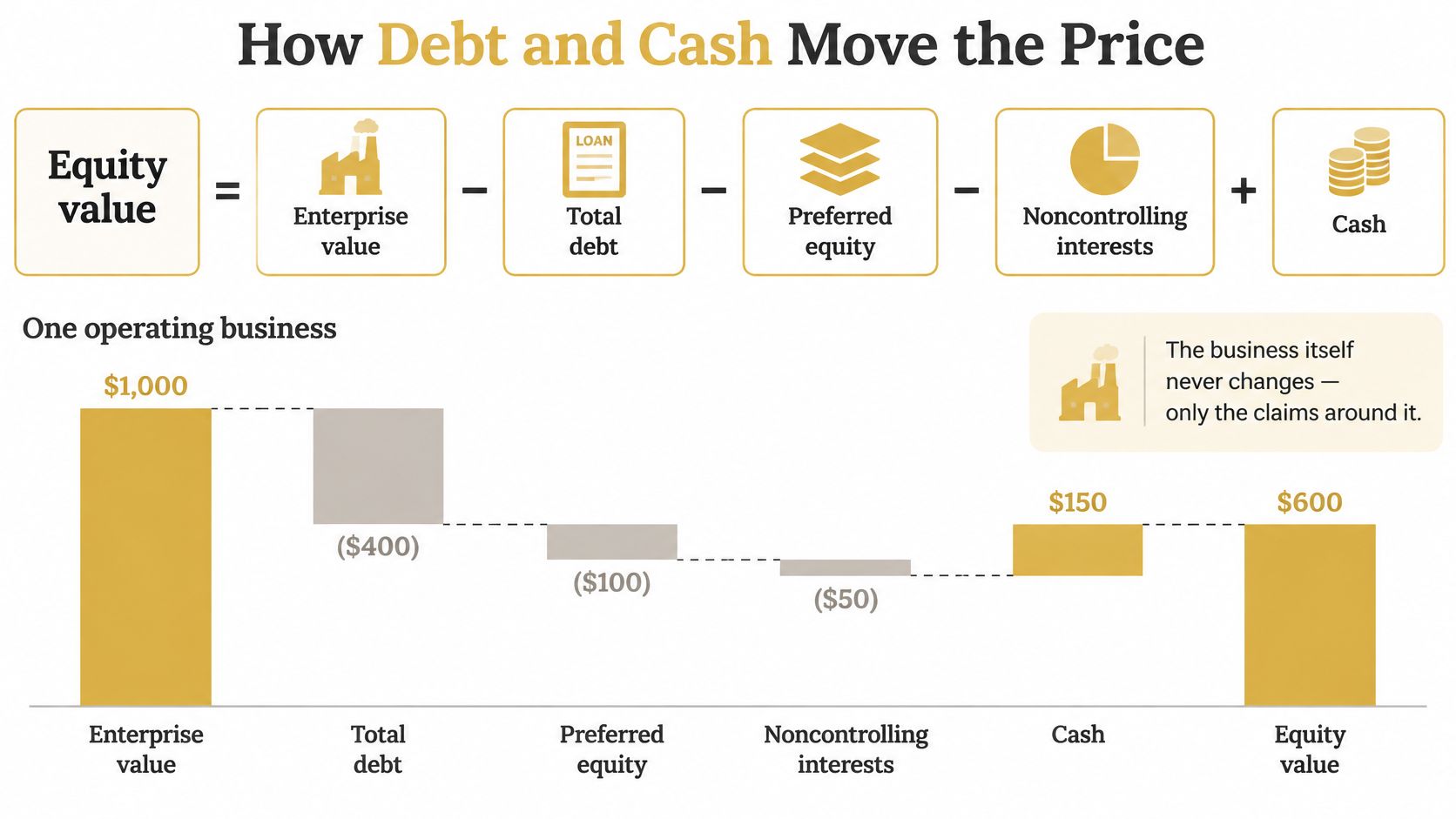
Equity value = Enterprise value − Total debt − Preferred equity − Noncontrolling interests + Cash
The direction matters. Debt reduces the value attributable to common shareholders at a fixed enterprise value. Available cash increases it.
In the example from the IB Interview Questions valuation guide, $100 million of enterprise value, less $15 million of debt, plus $20 million of surplus cash, implies approximately $105 million of equity value before other adjustments.
The shareholders' claim can therefore exceed the value assigned to the operating business. That doesn't mean the buyer has valued the operations more generously. The seller also owns surplus cash.
The reverse formula makes those additions and deductions visible.
Change the balance sheet, not the business
Consider the same operating business with heavier borrowings and less available cash. Without changing its operating valuation, you'd calculate a smaller residual claim for its shareholders.
That's why a lower equity asking price doesn't establish a bargain. The buyer may be purchasing shares in a company that carries substantially more debt. Inspecting only the shareholder payment leaves the repayment or assumption of those borrowings out of the comparison.
Use a simple model discipline:
- Hold operating value fixed. Don't revise enterprise value merely because the seller has different borrowings.
- Change financing inputs separately. Update debt and available cash from supporting schedules.
- Review other claims explicitly. Don't bury preferred equity or noncontrolling interests inside an unexplained adjustment.
This also explains the multiple trap. If you compare a cash-rich target's equity value with a target's equity value that reflects debt using EBITDA as the denominator, you're comparing financing arrangements as well as operations. Use the correctly matched valuation before deciding which business is cheaper.
Cash on the balance sheet isn't automatically an addition
Preferred claims and noncontrolling interests can reduce what common shareholders receive. Likewise, a bank balance isn't proof that the buyer will acquire freely distributable cash.
Restricted funds, unavailable balances, and money needed to keep the business operating require separate consideration. The phrase cash-free, debt-free needs an agreed definition, not an assumption that every cash account and liability vanishes.
Our explanation of a cash-free, debt-free deal is useful when translating that headline language into offer terms. Put the cash and debt treatment beside the proposed enterprise value so the seller can see how you intend to calculate the ownership price.
Why Headline Enterprise Value Is Not Seller Cash
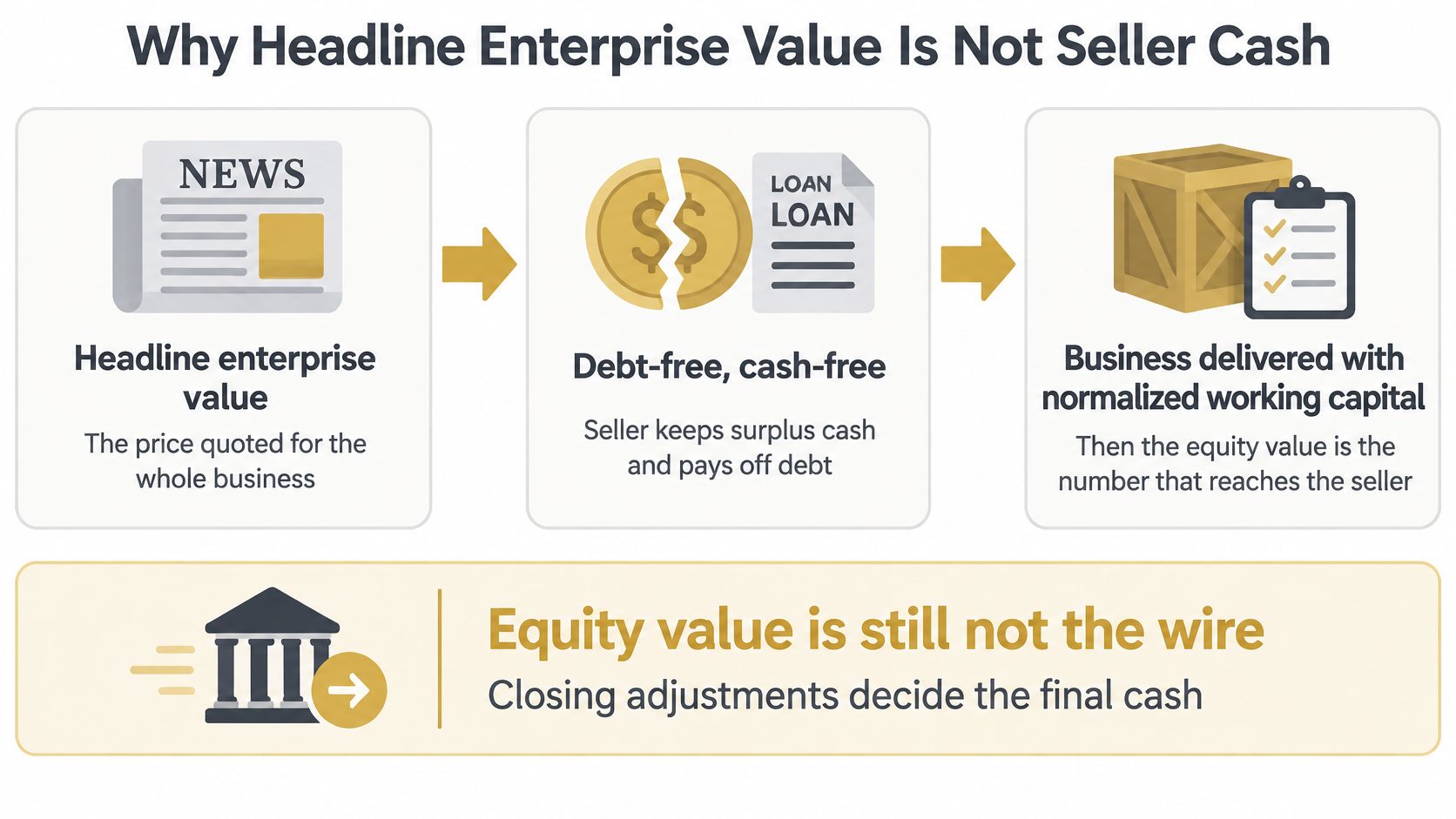
Equity value still isn't the seller's wire. It describes ownership consideration, but some consideration may arrive later, remain conditional, or be paid to someone other than the seller.
The SABV equity-bridge guide identifies the practical gap: buyers need a sources-and-uses waterfall covering debt, cash treatment, working capital, transaction expenses, and seller financing, not merely a headline valuation formula.
A cash-free, debt-free structure generally contemplates the seller retaining surplus cash and settling debt. It doesn't mean the seller can empty the operating accounts, strip working capital, and deliver a business unable to meet its ordinary obligations.
Follow the money through the closing statement
From headline enterprise value to cash at close
| Bridge item | Usual treatment | Effect on cash at close |
|---|---|---|
| Headline enterprise value | Starting price from the EBITDA multiple | Sets the top line, not the wire |
| Financial debt repaid or refinanced | Deducted from enterprise value | Lowers seller cash |
| Distributable surplus cash | Added back when acquired, or retained separately by seller | Raises seller proceeds without double counting |
| Restricted or operating cash | Often excluded from surplus cash | Little or no distributable cash to the seller |
| Working-capital peg | Deficit or excess true-up | Down if short, up if excess |
| Debt-like items such as unpaid taxes, deposits, deferred revenue | Negotiated as debt-like or left in the business | Often lowers proceeds if treated as debt |
| Seller note or earn-out | Deferred or contingent purchase consideration | Delays or replaces cash at close |
Follow each item to its destination. If the seller retains cash before closing, don't also add it to the buyer's payment. If the buyer refinances a loan, show the lender payoff separately from the payment to shareholders.
The distinction between headline price and distributable proceeds is visible in the transaction flow.
Negotiate classification before arithmetic
Inventory, customer deposits, deferred revenue, unpaid taxes, shareholder loans, and leases deserve explicit treatment. An obligation may be included in working capital, treated as debt-like, assumed by the buyer, or settled outside the purchase price. Don't deduct it twice.
For example, customer deposits can bring cash into the company while leaving the buyer responsible for delivering the work. The deposit balance needs to be assessed alongside the remaining fulfillment obligation, not treated as free money.
Use the same discipline for cash. Our guide to surplus cash addresses the distinction that matters: money the owner can distribute isn't the same as money the company needs to operate.
A higher equity value can be economically worse for a buyer if the acquired company has insufficient working capital or retains liabilities the buyer hasn't priced.
Finally, separate cash consideration from a seller note or earn-out. A seller may accept a larger stated purchase price in exchange for deferred or conditional payment, but the closing statement should never present that entire amount as cash received.
Walking From Enterprise Value to Equity Value at Close
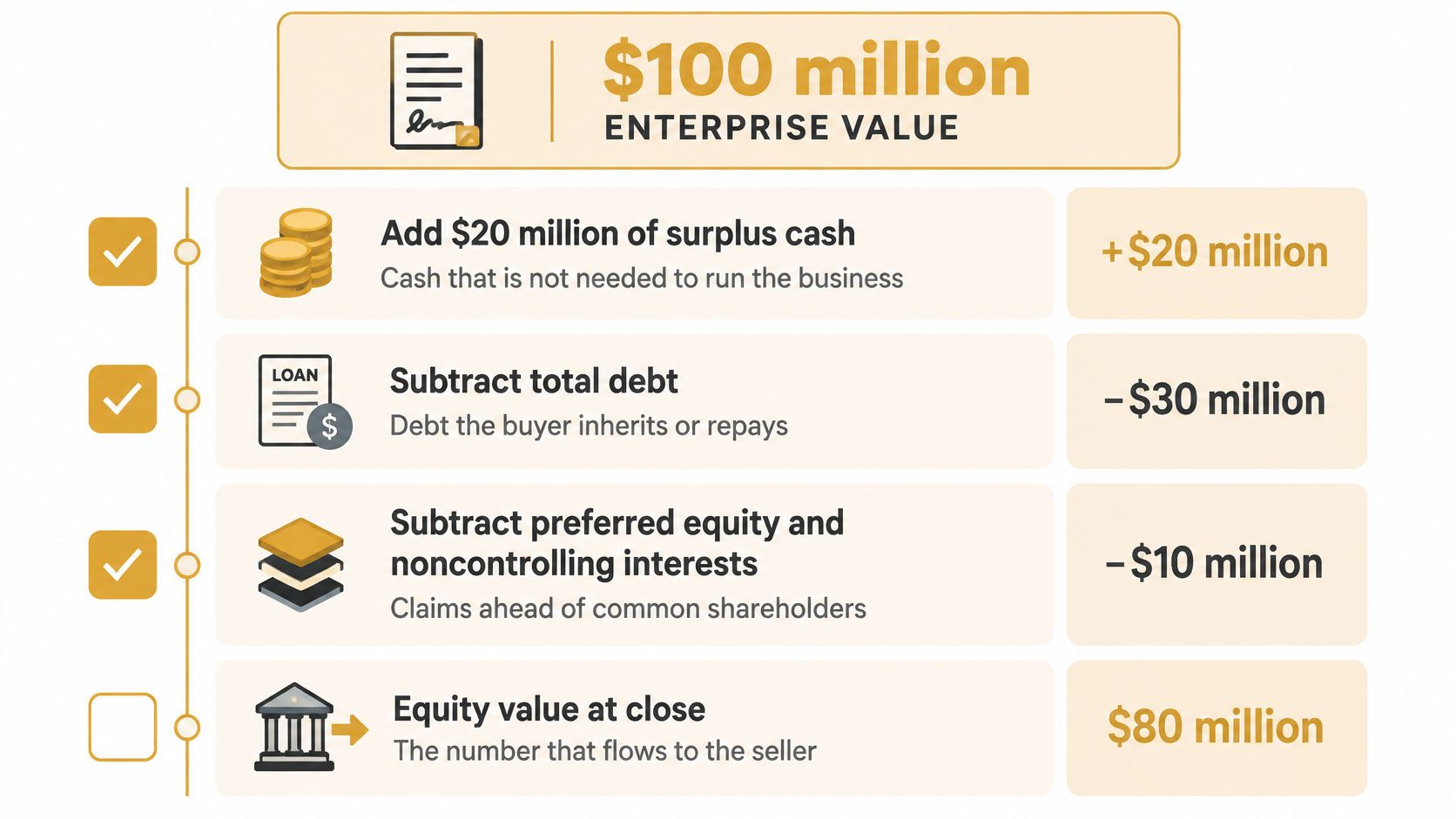
Build the closing bridge as a funds-flow calculation, with a named document supporting every adjustment. DealMatrix's worked example starts with $100 million of enterprise value, adds $20 million of surplus cash, subtracts $15 million of debt, a $15 million working-capital deficit, and a $2.5 million preferred-stock claim, producing $87.5 million of equity value before transaction-specific items, as shown in its enterprise-to-equity-value bridge.
Use the visual as a checklist of claim categories, then reconcile every adjustment in the closing schedule.
Support each adjustment
Start with the agreed enterprise value in the signed offer or purchase agreement. Add only the qualifying surplus cash the buyer acquires, then deduct the financial debt being repaid or assumed.
Next, compare delivered working capital with the contractual target. Deduct a shortfall or add an agreed excess. Apply preferred and minority claims according to their actual rights rather than assuming all proceeds belong to common shareholders.
- Cash support: Bank reconciliations and evidence of availability.
- Debt support: Lender payoff letters, shareholder-loan balances, accrued interest, and applicable repayment penalties.
- Working-capital support: A closing balance sheet calculated under the agreed accounting policies.
- Ownership support: The capitalization table and documents establishing preferred or minority entitlements.
A working-capital peg should reflect the business's normal operating requirements. Review representative monthly balances and seasonality rather than selecting a conveniently depleted or inflated month.
Make the true-up executable
Write down which accounts enter working capital, how they're measured, and which are excluded because they're already classified as cash or debt. Address inventory valuation and receivable collectability so the buyer doesn't receive nominal working capital that can't support operations.
Our guide to completion accounts helps connect those definitions to the closing adjustment process. Agree who prepares the accounts, who reviews them, and how disagreements are resolved.
The video provides another way to follow the valuation discussion.
The resulting equity value remains before transaction expenses and non-cash seller consideration. Keep those deductions in the funds-flow statement so neither party mistakes the calculated ownership value for the final bank transfer.
When Buyers Use Each Value in an Acquisition
Choose the value that answers the decision in front of you. A useful acquisition model keeps operating value, shareholder consideration, and funding sources on separate lines.
Comparing targets and quoting an offer
When comparing acquisition targets, normalize the operating metric before comparing multiples. Check owner compensation, proposed adjustments, and what assets support the earnings. A clean enterprise-value comparison won't rescue an inflated EBITDA figure.
For a roll-up, use the same valuation basis across every bolt-on. Otherwise, you can mistake a target with substantial debt for a bargain beside a cash-rich company. Lead with enterprise value.
When quoting an offer, state the operating price and its assumptions together. Identify the cash-free, debt-free basis, the expected working-capital delivery, and the adjustments needed to reach shareholder consideration.
A bare price leaves too much room for disagreement. The seller may hear a cash payment while the buyer means a value before debt repayment and closing adjustments. Lead with enterprise value, accompanied by the bridge terms.
Discussing proceeds and arranging funding
When the seller asks what they can take home, discuss the shareholder consideration and then separate immediate cash from deferred payments. Identify transaction expenses paid from proceeds and any seller rollover. Lead with equity value, then calculate net cash proceeds.
When arranging acquisition finance, build a full sources-and-uses statement. Uses include the purchase consideration, relevant debt repayments, fees, and required funding for the acquired business. Sources can include acquisition debt, investor capital, buyer cash, and agreed seller financing.
Don't label the buyer's cash contribution as the target's equity value. They answer different questions. Lead with enterprise value for the operating purchase, then solve the funding requirement.
Funding distinction: Buying the seller's equity and contributing buyer equity aren't the same transaction line.
At Dealmaker Wealth Society, we focus on roll-ups and bolt-ons, debt-financed buy-outs, consulting for equity, and big exits. Across those strategies, the acquisition structure changes how the purchase is funded, not the need to distinguish operating value from seller consideration.
We recommend acquiring only businesses that have weathered economic recessions, generate $1 million in gross revenue, and have a proven track record of steady profits. Screening for a suitable business comes before engineering an attractive financing structure.
The misuse rule is straightforward: don't put equity value into an EBITDA multiple, and don't tell a seller that enterprise value is what they'll receive.
Lock Five Definitions and Walk One Teaser
Before sending an offer, write the purchase-price definitions into your model assumptions and draft terms. Don't leave them in an email thread where the buyer, seller, and advisers can interpret them differently.
Agree on the definitions
- Surplus cash versus operating cash: Specify which balances can be distributed, which transfer with the business, and how restricted funds are treated.
- Debt and debt-like items: Address term loans, revolvers, shareholder loans, accrued interest, prepayment penalties, unpaid taxes, and customer deposits. Record the negotiated treatment rather than assuming every item belongs in the same category.
- Working capital: Define the included accounts, target, measurement date, accounting policies, and true-up timing.
- Preferred and minority claims: Identify who has a claim, what triggers payment, and where the payment appears in the bridge.
- Cash versus deferred consideration: Separate closing cash from a seller note, earn-out, or ownership rollover.
If a definition remains blank, the quoted multiple isn't yet an executable price. Keep an adjustment register with the item, proposed treatment, supporting document, responsible reviewer, and unresolved question.
Walk a live teaser before negotiating
Use a spreadsheet with separate tabs for operating valuation, purchase-price adjustments, and funding. Then work through the teaser in this order:
- Establish enterprise value. If the teaser quotes EBITDA and a multiple, calculate the implied operating price and confirm what assets it includes.
- Bridge the balance sheet. Add qualifying surplus cash acquired and subtract debt and agreed debt-like liabilities.
- Apply delivery adjustments. Measure working capital against the peg, then deduct preferred and minority claims.
- Estimate closing cash. Separate transaction expenses, seller financing, conditional payments, and rollover from immediate seller proceeds.
- Negotiate the economics. Discuss the multiple alongside the cash payment, obligations assumed, and operating resources delivered.
For newcomers, our 10-Day Business Buying Launch teaches the art of creative deal structuring and is designed as a first step. Bring the same discipline to your first practice model: every payment needs a recipient, every adjustment needs a definition, and every funding requirement needs a source.
Dealmaker Wealth Society offers acquisition training, mentorship, and deal feedback to help buyers evaluate and structure small-business purchases. Visit Dealmaker Wealth Society to explore the 10-Day Business Buying Launch and start turning a headline valuation into a defined offer, closing bridge, and funding plan.

From the Dealmaker Blog









A Creative Business Buying Fable