Due Diligence Checklist for Acquisition of a Private Company
Due Diligence Checklist for Acquisition of a Private Company

You've signed the letter of intent. The seller has promised the business is clean, profitable, and ready to transfer. Your lender is asking for support, your attorney is requesting documents, and the seller's broker is pressing for a fast close. That's the moment many buyers open a generic due diligence checklist and start collecting files.
That approach is too passive. A due diligence checklist for acquisition of a private company should function as a staffed, budgeted investigation. You're testing whether the earnings are real, whether the seller owns what you're buying, whether customers and employees will stay, and whether hidden liabilities belong in the price, the indemnity package, or your walk-away decision.
Private deals require this discipline because there's no EDGAR-style public filing system to fill gaps. Buyers usually need to verify ownership, contracts, financial records, tax filings, employment arrangements, intellectual property, and regulatory correspondence directly, as outlined in Thomson Reuters' private-deal due diligence guidance. Treat the process as a series of decisions, not a document download.
Table of Contents
- The Window Between Signed LOI and Signed Purchase Agreement
- Setting Up the Ten Parallel Diligence Workstreams
- Verifying Claims With Third Party Evidence When Records Are Thin
- Financial Diligence From Quality of Earnings to Working Capital
- Legal Tax HR and Technology Workstreams That Actually Move the Deal
- Red Flags That Kill Deals and How to Investigate Them
- Budgeting Diligence and Avoiding the Re Closing Mistake
The Window Between Signed LOI and Signed Purchase Agreement
The seller signs the LOI, grants exclusivity, and expects a fast close. You have a negotiated price, not a completed acquisition. The period that follows is a controlled investigation of every assumption behind your offer.
Set the boundaries immediately. Exclusivity should stop the seller from soliciting or negotiating another transaction during the agreed period. Your access rights should cover management interviews, customer and supplier information, facility visits, accounting records, systems, and outside advisers. Treat the information memorandum as a sales document, not evidence.
If the LOI is unfamiliar, review what an LOI means in a business acquisition before accepting the seller's timetable. The document should provide enough access and time to test the economics. A short deadline is a negotiating problem, not a diligence strategy.
Run diligence as a daily operating rhythm
For a clean private-company transaction valued between $10 million and $100 million, the period from signed LOI to signed purchase agreement often runs 60 to 75 days. Smaller or more complicated transactions can follow a different schedule. In every case, waiting until the final week to review findings gives the seller negotiating power when you need it least.
Create a shared data-room index and assign an owner to every request. Hold brief daily standups for urgent blockers and weekly calls with each workstream lead. Keep one issues log with five fields:
- Finding: What the documents or interviews show.
- Evidence: The exact file, filing, statement, contract, or third-party record supporting it.
- Commercial impact: The effect on earnings, cash, continuity, compliance, or integration.
- Deal response: A price reduction, escrow, specific indemnity, retention condition, covenant, or decision to walk.
- Owner and deadline: The person responsible for resolving the issue before signing.
The investigation and purchase agreement should develop together. A customer contract with a change-of-control restriction may become a closing condition. An unrecorded tax exposure may require a specific indemnity and escrow. A weak EBITDA adjustment may reduce the headline price. Draft representations and warranties early. Precise drafting forces vague concerns into specific seller promises.
Run source-backed checks when the seller's records are thin. Search UCC filings for liens, review court records for litigation and judgments, and obtain business credit data to identify obligations or payment problems that may not appear in the data room. Assign each result to the issues log and require an explanation before treating the matter as resolved.
The purchase agreement should reflect the evidence, not the seller's preferred narrative.
Practical rule: Every material finding must map to a financial adjustment, contractual protection, closing condition, or decision to walk.
Before signing the SPA, hold a formal red-team meeting. Ask which beliefs still rest only on the seller's statements, which open items could change the price, and what must be true on the closing date. If the team cannot answer from the issues log, diligence is unfinished.
Setting Up the Ten Parallel Diligence Workstreams
A private-company acquisition can lose value through one overlooked lien, weak earnings adjustment, or unassignable customer contract. Run diligence as a budgeted, workstream-by-workstream process, not as a document pile. A serious review typically covers about ten parallel workstreams, consistent with the CTA Acquisitions' acquisition due diligence framework. Assign a lead, define the evidence required, set a target date, and budget the specialist time before the review begins.
Ten Diligence Workstreams at a Glance
| Workstream | Lead | Key Documents | Target Week |
|---|---|---|---|
| Financial and quality of earnings | QoE provider or transaction accountant | Tax returns, P&Ls, trial balances, bank statements, AR aging | Early review |
| Tax | Tax adviser | Income tax returns, sales tax filings, notices, nexus analysis | Early review |
| Corporate legal | M&A counsel | Charter, bylaws, operating agreement, cap table, minutes | Early review |
| Commercial contracts | Commercial counsel | Customer, supplier, partner, lease, and vendor agreements | Early to mid-review |
| HR and benefits | Employment counsel or HR adviser | Employee census, offer letters, payroll, benefits, restrictive covenants | Mid-review |
| IT and cybersecurity | Technology diligence specialist | System map, SaaS contracts, security policies, incident records | Mid-review |
| Commercial and customers | Commercial adviser or buyer | Customer list, revenue by account, churn, references, pipeline | Mid-review |
| Operations and supply chain | Operating specialist | Supplier records, inventory, procedures, capacity and maintenance records | Mid-review |
| Environmental and facilities | Environmental adviser | Leases, permits, assessments, site records | Mid to late review |
| Insurance and EHS | Insurance and safety specialist | Policies, claims history, safety records, regulatory correspondence | Mid to late review |
Set the budget by workstream, then release deeper review only when the evidence justifies it. Financial and ownership checks start immediately because they can invalidate the offer. Contract, tax, customer, HR, technology, and operations reviews follow. Environmental, insurance, and safety work should start early enough to resolve specialist findings before the purchase agreement is final.
For an SBA-financed acquisition closing on or after October 2026, include the new quality-of-earnings requirement in the financial workstream from the outset. Confirm what report and provider the lender will accept, and reserve time for follow-up questions. A late QoE review can delay financing and force rushed price or structure decisions.
A solo buyer can use a practical RACI: you remain accountable, counsel owns legal execution, the QoE provider owns earnings verification, and each specialist is responsible for evidence in their domain. One experienced transaction adviser may coordinate several lanes in a smaller acquisition. Coordination does not replace independent verification. Require source-backed checks where seller records are thin, including UCC filings, court records, and business credit data.
Build One Master Issues Register
Every lead reports into the same register, using shared materiality categories. A contract reviewer should not label a termination right “minor” while the commercial lead assumes the customer will leave. The buyer needs one conclusion about whether that contract changes value.
Require each lead to record what was reviewed, what remains missing, which assumptions failed, and the recommended remedy. Link each issue to its owner, deadline, estimated cost, and decision impact. The register then connects diligence to the purchase agreement and prevents the team from spending the final week debating an identified problem that nobody was assigned to resolve.
Verifying Claims With Third Party Evidence When Records Are Thin
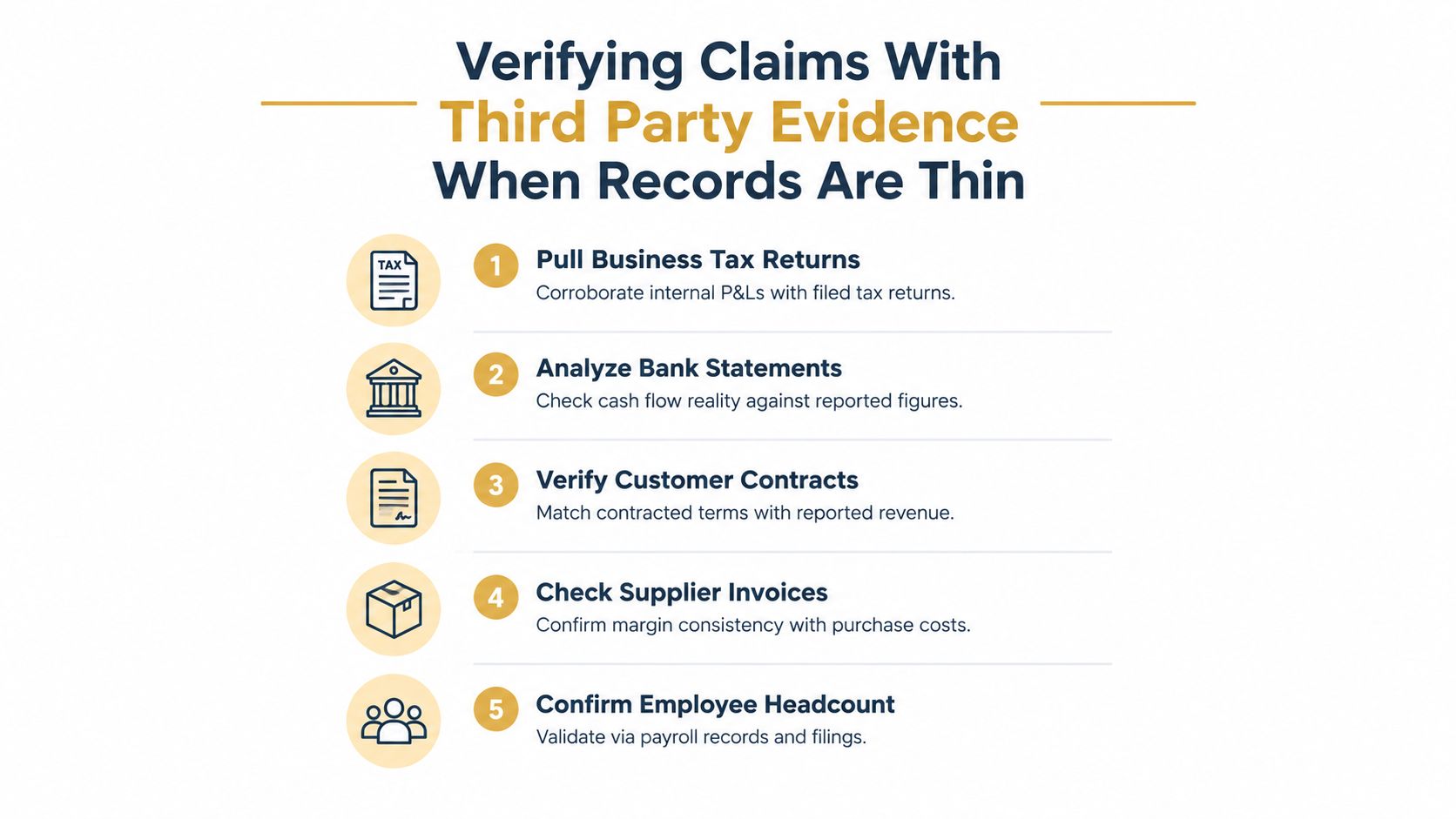
Private sellers often maintain competent businesses without maintaining buyer-ready records. You may receive internal P&Ls without clean reconciliations, informal customer arrangements, founder-controlled intellectual property, or verbal supplier commitments. That's when a static checklist fails. You need a triangulation process that compares management's story with independent evidence.
Match reported performance to cash and tax evidence
Request business tax returns, not just internal financial statements. Compare reported revenue, wages, deductions, and taxable income with the P&Ls supplied in the data room. Then match bank deposits to reported sales and investigate timing differences, transfers, owner withdrawals, and unexplained cash activity.
Payroll provides another useful cross-check. Reconcile the employee census and payroll register to IRS Form 941 filings. If management reports a stable workforce but payroll filings show unexplained gaps, contractor-heavy periods, or compensation that doesn't match the general ledger, stop treating the discrepancy as an administrative detail.
Search outside the seller's data room
Run UCC searches against the company and relevant owners where appropriate. Review secretary of state filings, business credit reports from providers such as Dun & Bradstreet and Experian Business, court records, judgments, tax liens, and regulatory correspondence. These searches can reveal secured lenders, equipment financing, litigation, collection problems, or obligations that never appeared in the seller's folder structure.
Customer reference calls should test contract reality, not merely satisfaction. Ask whether the relationship is governed by a signed agreement, whether pricing is changing, who owns the relationship, and what would happen if the founder disappeared. Confirm key supplier terms directly when margins or continuity depend on them.
Turn contradictions into deal questions
A bank deposit pattern that exceeds reported revenue may indicate timing, pass-through funds, or incomplete books. A customer who describes a month-to-month relationship when the seller presents recurring revenue requires a different valuation assumption. A UCC filing that the seller forgot to disclose demands payoff documentation and a closing release.
Your objective isn't to “catch” the seller. It's to establish which claims survive independent testing before you issue a final price, escrow, or indemnity package. Thomson Reuters' guidance on diligence in public and private deals specifically highlights the need for source-backed investigation when private-company records are incomplete or informal.
Financial Diligence From Quality of Earnings to Working Capital
Financial diligence starts with a simple question: what earnings will remain after the seller leaves? Reported EBITDA is a starting point, not a conclusion. A QoE provider should reconcile adjusted EBITDA to tax returns, bank statements, and underlying accounting records before you let the number drive valuation.
Rebuild normalized earnings
Test every adjustment rather than accepting the seller's schedule. Normalize owner compensation to the cost of the role you'll need after closing. Remove genuine one-time expenses only when the evidence shows they won't recur. Strip out related-party transactions that won't continue, but add back the replacement cost if the company currently receives a real service from a related party.
Revenue deserves its own durability test. Sample customer contracts against reported revenue, check whether recurring arrangements are enforceable, review churn and retention patterns, and investigate deferred revenue that creates future service obligations. Annual billing can make cash look strong while shifting delivery work into the period after closing.
If adjusted EBITDA depends on the owner's personal relationships, unusual billing practices, or expenses that your operating plan must replace, it isn't normalized earnings. It's a forecast dressed as history.
Look for liabilities outside the headline balance sheet. Accrued bonuses, warranty reserves, pending litigation costs, personal expenses, change-of-control payments, and obligations tied to prior arrangements can all reduce the cash value you're buying. The practical test is whether the buyer will fund, perform, settle, or inherit the obligation after closing.
Set the working-capital mechanism before the final price
Build a trailing-twelve-month net working-capital benchmark using consistent accounting definitions. Agree which accounts belong in the peg, how seasonality is handled, and how the closing statement will calculate the true-up. Review AR aging, inventory quality, payables, deferred revenue, customer deposits, and accrued expenses together. A seller who extracts cash, delays payables, or accelerates collections before closing can hand you a business that technically meets the price formula but lacks normal operating liquidity.
Buyers managing inventory, receivables, and supplier timing can also use this practical resource on how to manage working capital as a tradie for operational context.
Request the QoE bridge, revenue cut-off testing, customer concentration analysis, debt-like items schedule, working-capital calculation, bank reconciliation, tax-return tie-out, and management representation schedule. Then ask the QoE provider what evidence would make them reject an adjustment, which customer claims they sampled, and what remains unresolved. For a broader operating review, use this operational due diligence factors checklist alongside the financial work.
Legal Tax HR and Technology Workstreams That Actually Move the Deal
Document collection is not legal diligence. The deal moves when a specific clause changes what you can own, operate, retain, or enforce after closing. Review the documents with the purchase agreement in mind, and label each finding by its remedy.
Trace ownership before negotiating value
Corporate counsel should reconstruct the cap table from formation documents, stock or membership records, shareholder agreements, options, warrants, and convertible instruments. Missing approvals or unauthorized issuances can prevent the seller from delivering clean title. Don't accept a promise that the cap table is “basically right.” Require evidence and a closing certificate.
Contract review should prioritize revenue, dependency, and restriction. Pull the largest customer and supplier agreements first, then examine assignment restrictions, change-of-control provisions, exclusivity, minimum commitments, termination rights, renewal mechanics, pricing protections, and service-level obligations. A customer contract that can terminate on acquisition may justify a closing condition or price reduction. A supplier agreement with a nonassignable exclusivity clause may constrain your integration plan.
Tax and people risks become cash risks
Tax advisers should reconcile federal and state income tax returns, sales tax filings, nexus, net operating losses, 1099 history, and IRS or state notices. Ask who filed, where the company had employees or customers, and whether prior notices were resolved. A tax exposure may require a specific indemnity, escrow, purchase-price adjustment, or a different transaction structure.
HR review should map the people who carry customer trust, technical knowledge, and operating authority. Examine the employee census, offer letters, restrictive covenants, wage compliance, payroll, 401(k) documents and audits, benefits, severance, and change-of-control payments. Then identify which relationships are documented and which exist only because the founder answers every call.
Technology diligence should verify source-code ownership, contractor assignments, open-source compliance, SaaS and cloud spend, cybersecurity controls, customer-data handling, incident history, and vendor assignment rights. A business can have attractive earnings and still require a costly technology rebuild. That cost belongs in the valuation model before signing.
| Workstream | Critical Document or Clause | Value-Shift Mechanism | Typical Adjustment |
|---|---|---|---|
| Corporate | Cap table and approval records | Determines whether the seller can transfer clean title | Closing condition, cure obligation, or walk-away |
| Contracts | Change-of-control and assignment rights | May allow termination or renegotiation | Price reduction, consent condition, or escrow |
| Tax | Sales tax filings and notices | Quantifies inherited tax exposure | Specific indemnity or escrow |
| HR | Key-person agreements and payroll records | Tests retention and labor-liability assumptions | Retention funding, price adjustment, or indemnity |
| Technology | IP assignments and open-source terms | Confirms ownership and limits use rights | Specific indemnity, remediation, or price reduction |
| Cybersecurity | Incident records and data-handling policies | Exposes breach and compliance risk | Escrow, insurance requirement, or walk-away |
The point is not to produce a larger document list. It's to connect a clause to a consequence. That's how counsel earns its fee.
Red Flags That Kill Deals and How to Investigate Them
Some findings are fixable. Others tell you the seller's story cannot support the proposed price. The difference comes from testing, not instinct.
Start with revenue recognition. Bill-and-hold arrangements, channel stuffing, premature annual billing, and abrupt period-end deposits can inflate the apparent run rate. Review contract terms, delivery records, invoices, credit notes, subsequent collections, and bank statements. Ask management to explain every unusual cutoff item, and require a price adjustment or walk-away if the earnings cannot be normalized.
Customer concentration becomes dangerous when the relationship is short-term, informal, or tied to the founder. Don't rely on a customer list. Inspect signed agreements, renewal history, account-level revenue, churn, and customer references. Where the relationship is fragile, use a retention condition, escrow, earnout, or lower price.
Unexplained margin compression demands a bridge from historical margin to current margin. Compare supplier invoices, pricing, labor costs, inventory records, and customer-level profitability. Related-party transactions require fund-flow tracing and arm's-length support, especially when those transactions disappear after closing.
Use external searches to test the uncomfortable claims
UCC searches, judgment and tax-lien searches, court records, bank statements, tax returns, payroll filings, and business credit reports each expose a different blind spot. Request complete bank and legal correspondence when liabilities appear unrecorded. Ask management whether every loan, guarantee, threatened claim, and tax notice is included in the disclosure schedules.
Founder dependency needs a retention and transfer plan, not a comforting transition promise. Identify which customers, suppliers, employees, and technical decisions route through the owner. If those relationships don't transfer through documented contracts and direct introductions, price the risk as a likely loss of earnings.
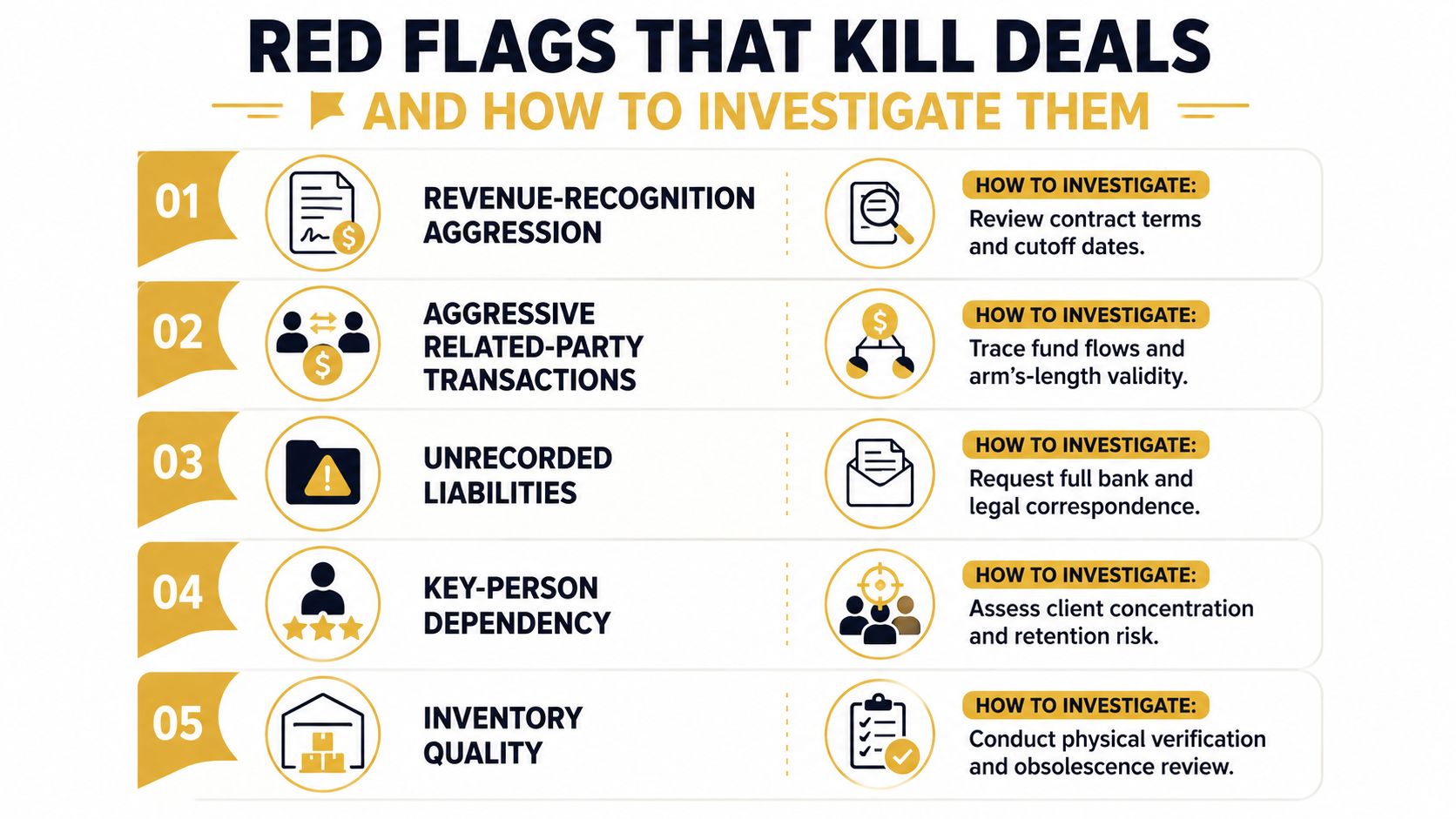
Use this red-flags checklist for business sales as a one-page investigation worksheet. For each issue, record the claim, evidence requested, independent source, management answer, financial exposure, proposed remedy, and decision owner.
Walk-away rule: If management's explanation changes after third-party evidence appears, treat the credibility problem as a deal issue, not a paperwork issue.
Diligence deserves a real budget because findings can destroy a transaction. Industry analysis cited by CTA Acquisitions on why deals fall apart reported that diligence findings accounted for about 46.6% of failed deals, while non-QoE issues alone represented 25.3%. That's why buyers should fund legal, tax, customer, operational, and technology verification rather than treating QoE as the only serious review.
Budgeting Diligence and Avoiding the Re Closing Mistake
Treat diligence as a budgeted transaction process, not a document request. Buyers commonly use four to six third-party diligence providers, and buyer-side diligence spend often falls between 0.8% and 2.1% of enterprise value, according to CTA Acquisitions' diligence cost analysis. Total fees can reach $50,000 to $300,000, so include them in the initial deal model. Do not wait for a red flag before requesting approval.
| Workstream | Typical Share of Diligence Budget | Notes |
|---|---|---|
| Quality of earnings | Core allocation | Validate earnings independently and reconcile cash flow |
| Legal and contracts | Core allocation | Check ownership, material agreements, litigation, and closing mechanics |
| Tax | Targeted allocation | Review filings, nexus, notices, and transaction structure |
| Technology and cybersecurity | Risk-based allocation | Expand review where IP, data, software, or systems drive value |
| Commercial and operational | Risk-based allocation | Test customer retention, suppliers, capacity, and integration |
| Insurance, environmental, and EHS | Targeted allocation | Expand review where facilities, safety, permits, or claims matter |
Reserve part of the budget for outside verification when company records are thin. Search UCC filings and court records, obtain business credit data, and compare those results with management's disclosures. A clean seller-prepared folder does not prove clean ownership, payment history, or litigation exposure.
SBA financing creates a timing issue. Guidance indicates that certain SBA 7(a) acquisitions and business expansions of $3 million or more are scheduled to require an independent QoE report beginning October 1, 2026, as described by EisnerAmper's SBA quality-of-earnings update. If the financing may fall within that rule, coordinate the lender, QoE provider, and seller before final negotiations. A lender-grade report cannot be ordered at closing.
Recheck material findings after each LOI revision, contract change, financing change, or working-capital adjustment. Schedule a 72-hour pre-close recheck covering UCC searches, lien filings, payroll registers, bank activity, legal correspondence, and customer concentration. Closing is a second diligence gate.
Dealmaker Wealth Society provides acquisition training, checklists, deal-structuring guidance, and community support for buyers handling sourcing, diligence, financing, negotiation, and integration. Visit Dealmaker Wealth Society for its available programs.

From the Dealmaker Blog













A Creative Business Buying Fable