
What Is a Business Acquisition and How Does It Work
What Is a Business Acquisition and How Does It Work
A business acquisition is the transfer of ownership or control of one company to another, usually through an asset purchase or a stock purchase, and that legal choice determines which liabilities move to the buyer. It's also a high-risk process after closing, not just at signing. Research and industry analyses commonly place acquisition failure rates in the 70% to 90% range, and one 40,000-deal analysis found that 70% to 75% of acquisitions fail to achieve their intended objectives.
If you're reading this, you're probably in one of two places. You're either thinking about buying a business for the first time, or you've heard people talk about acquisitions as if they're a fast path to growth and want to know what that means in real life.
The confusion usually starts because “buying a business” sounds simple. It sounds like buying a car, a website, or maybe a rental property. But a business acquisition is different. You're not just buying equipment or revenue. You're stepping into customer relationships, employee dynamics, contracts, tax issues, and operational habits that were built by someone else.
That's why a patient buyer learns the concept in layers. First, what an acquisition is. Then how the deal is structured. Then how the process unfolds. And finally, why so many buyers get to the closing table successfully but still fail to create value afterward.
Table of Contents
- What a Business Acquisition Is
- A Brief History of Acquisitions as a Growth Strategy
- Asset Purchase vs Stock Purchase vs Management Buyout
- The Five Stages of an Acquisition From Sourcing to Integration
- A Real-World Example of a Small Business Acquisition
- Why Most Acquisitions Fail to Create Value
- Integration Habits That Separate Winners From the 70 Percent
- Financing Realities and Your Next Steps as a Buyer
What a Business Acquisition Is
A retiring owner offers to sell you a local service company. The phones are still ringing. The staff knows the work. Customers renew every year. On the surface, it looks like you are buying income.
You are buying a working system. That system includes people, contracts, habits, software, vendor relationships, and hidden weak spots that may not show up in last year's profit.
A business acquisition is a deal in which one party buys enough of another company's assets or ownership interests to control the business. In an acquisition, there is a clear buyer and a clear seller. It is different from a true merger, where the legal framing is two companies combining rather than one taking control, as explained in this overview of mergers and acquisitions.
The legal form and the practical reality
Beginners often get stuck on the word “buying.” It sounds like a single event. Sign papers, send money, take over.
In practice, an acquisition works more like buying a house together with its wiring, plumbing, tenants, lease terms, and maintenance backlog. The purchase price matters, but so does what comes attached.
That is why experienced buyers separate two questions.
- What am I getting?
- What am I taking on?
Those are not the same question.
A buyer might purchase selected business assets, such as equipment, inventory, a phone number, a customer list, and a brand. A buyer might instead purchase the company's stock or equity and step into the whole legal entity. A management buyout adds another variation, where the people already running the business become the buyers or stay closely involved in the ownership change.
The difference sounds technical until money is at risk.
If you buy assets, you can often choose what comes with the deal and leave more unwanted liabilities behind, subject to contract terms and law. If you buy stock or equity, you usually take control of the whole company, including obligations that may be harder to separate from the entity. Two deals can produce the same storefront, same employees, and same revenue on day one, while creating very different legal and tax consequences for the buyer.
Why first-time buyers misunderstand acquisitions
A first-time buyer often focuses on the handoff. Will the seller agree on price? Will the bank lend? Will the paperwork close?
Those questions matter, but they are only the front end of the job.
The harder part often starts after closing. If the staff leaves, customer service slips, reporting changes, or the buyer forces new systems too fast, a good-looking deal can lose value in months. That is why a business acquisition should be understood as both a purchase and a transfer of operating responsibility.
Acquisition versus merger
People often use the words loosely, but the buyer's role is different in an acquisition.
In an acquisition, one side is responsible for diligence, financing, structure, transition planning, and the results that follow. Control sits with the buyer, even if the old brand stays on the building for a while. A merger carries a different legal story and, in some cases, a different balance of control.
For a first-time buyer, the practical lesson is simple. Do not treat an acquisition like winning a prize. Treat it like taking over an aircraft mid-flight. The business is already moving, customers still expect service tomorrow morning, and your job is to keep it stable while improving it.
A Brief History of Acquisitions as a Growth Strategy
Business acquisitions aren't a modern trick. They've been part of capitalism for a long time, especially when owners wanted scale faster than organic growth could provide.
Historically, the United States saw major merger waves in the early 20th century, when companies such as U.S. Steel and Standard Oil expanded by acquiring competitors and consolidating industries, according to this background on mergers and acquisitions.
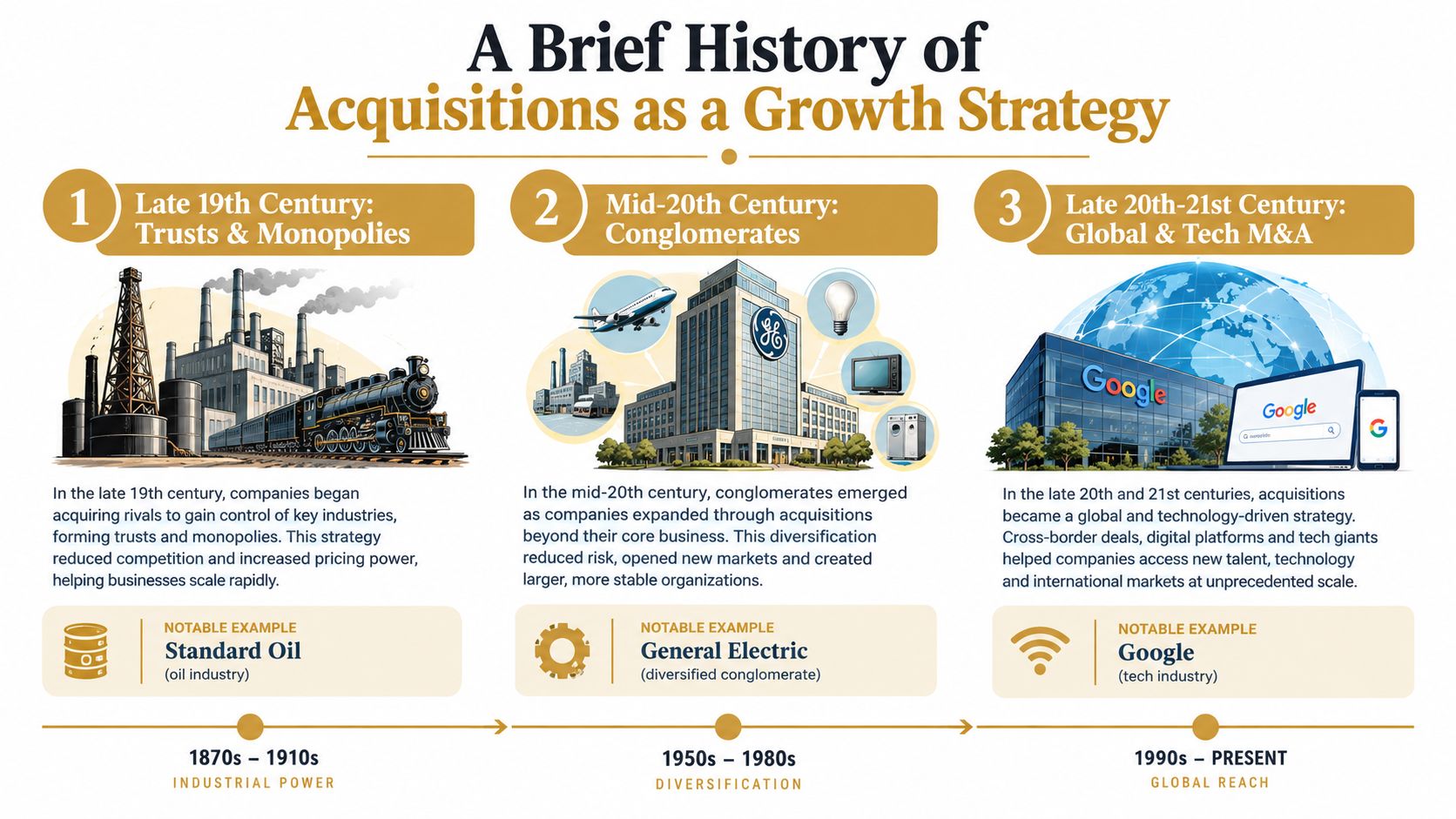
That long history matters because it shows the basic motive hasn't changed. When building from scratch feels too slow, buyers purchase what already exists.
Why buyers keep using acquisitions
A company can grow in two broad ways. It can build. Or it can buy.
Building means hiring salespeople, opening locations, developing products, winning customers one by one, and waiting. Buying means acquiring customers, staff, systems, and market presence that someone else has already assembled.
That logic scales down neatly to small business deals:
- A bakery owner buys a second location instead of starting one from zero.
- An HVAC operator acquires a local competitor to add technicians and maintenance contracts.
- A software reseller buys a regional rival to gain customer accounts and trained account managers.
A helpful companion read on growth options is this unleashing insights guide to scaling, which shows how acquisition-led growth fits alongside other expansion paths.
A short visual overview helps place that history in context.
The pattern that repeats
Across different eras, the surface details change, but the pattern keeps returning.
Buyers turn to acquisitions when they want speed, market access, or consolidation that would take too long to build organically.
That's true whether the buyer is a giant public company or a local operator buying a business across town. The scale changes. The logic doesn't.
Asset Purchase vs Stock Purchase vs Management Buyout
Once a buyer understands the basic idea, the next question is usually the one beginner guides rush past.
Are you buying the business itself, or are you buying the company that owns the business?
That's the heart of deal structure. And structure changes your risk.
A useful plain-English explanation from the lower middle market notes that business acquisitions are often done through an asset purchase agreement or a stock purchase agreement, and that the structure affects liability transfer, tax treatment, and post-close risk allocation in meaningful ways, especially in a more selective deal market, as discussed in this guide on business acquisition meaning and structure.
Asset purchases
In an asset purchase, the buyer selects the assets it wants. That may include equipment, inventory, phone numbers, customer lists, brand goodwill, websites, and certain contracts.
This is often attractive to buyers because it can reduce exposure to old liabilities. You may be able to leave behind obligations you don't want, subject to law, contract terms, and what you specifically agree to assume.
The tradeoff is practical friction. Contracts may need to be reassigned. Licenses may need to be updated. Vendors and customers may need fresh paperwork.
Stock purchases
In a stock purchase, the buyer acquires the shares or equity interests of the existing company. The legal entity stays in place. Ownership changes.
That can make continuity easier. The bank account, contracts, employer records, and permits may remain with the same company.
But there's a cost to that simplicity. The buyer usually inherits the entity with its history attached, including known liabilities and the risk of unknown ones.
A stock deal often feels smoother on day one and riskier on day one hundred.
Management buyouts
A management buyout is a special case. Here, the people already running the company buy the owner out, often using debt, outside capital, or both.
These deals can work well when the management team already knows the business. The buyers understand the staff, customers, and operating rhythm. But they still have to solve the same structure questions about liabilities, taxes, and financing.
Comparing the structures
| Structure | What Transfers | Liability Exposure | Tax Treatment (Buyer) | Best Fit |
|---|---|---|---|---|
| Asset Purchase | Selected assets and chosen obligations | Often more limited because the buyer may avoid taking all entity-level liabilities | Often preferred by buyers when they want a fresh basis in acquired assets | Buyers who want selectivity and downside protection |
| Stock Purchase | The entire legal entity through shares or equity interests | Broader, because the entity and its history usually continue | Often less favorable to buyers than an asset deal | Deals where continuity matters and contracts are hard to reassign |
| Management Buyout | Control shifts to existing managers, through stock, assets, or a hybrid approach | Depends on structure chosen | Depends on whether the deal is done as stock or assets | Insider teams buying out an owner |
The buyer-side decision
Most first-time buyers frame this the wrong way. They ask which structure is “best.”
The better question is simpler. Which problems do you want to solve before closing, and which ones are you willing to carry after closing?
That's what structure really does. It allocates headaches.
The Five Stages of an Acquisition From Sourcing to Integration
An acquisition feels overwhelming when you look at it as one giant event. It gets easier when you see it as a sequence.
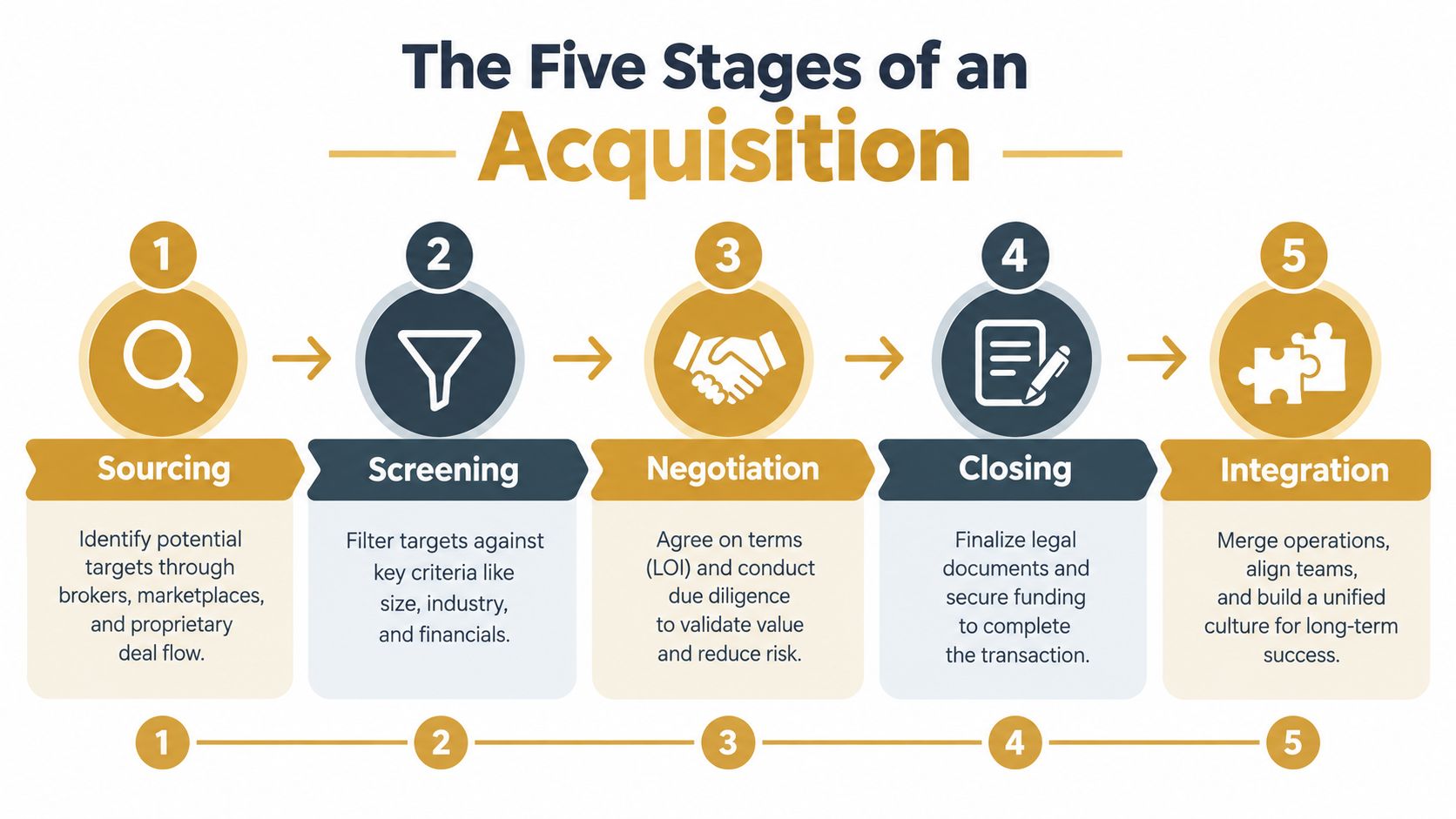
Most small business deals move through five practical stages. The easiest analogy is apartment hunting. You search, screen, inspect, negotiate, sign, and then move in. Buying a business follows the same rhythm, except the paperwork is heavier and the consequences are bigger.
Sourcing and screening
First, you need opportunities to review. Buyers find them through brokers, marketplaces, accountants, attorneys, industry contacts, and direct outreach to owners.
Then comes screening. Discipline starts. You compare each opportunity against your criteria:
- Industry fit: Do you understand how this business makes money?
- Size: Is it large enough to justify the work and small enough to manage?
- Stability: Are customers recurring or one-off?
- Owner dependence: Will the business still function if the seller leaves?
This stage is like scrolling listings and deciding which apartments are worth touring. Most should be ruled out quickly.
Due diligence and negotiation
Once a target passes the first filter, diligence begins. This is the business equivalent of a home inspection, except you're checking many systems at once.
You'll review items such as:
- Financial records, including revenue quality, margins, and cash flow behavior
- Legal documents, including contracts, leases, permits, and pending disputes
- Operations, such as staffing, systems, vendors, and fulfillment
- Commercial strength, including customer concentration and sales pipeline
- Culture, especially whether key employees are likely to stay
After that, the parties negotiate terms. Price matters, but so do working capital, holdbacks, seller transition support, non-competes, financing terms, and what happens if diligence uncovers a problem.
The purchase agreement doesn't just record a sale. It records who bears which risk.
Closing and integration
Closing is where signatures happen and money moves. Attorneys finalize documents. Lenders fund. The ownership transfer becomes official.
Many first-time buyers treat this as the finish line. It isn't. It's moving day.
The work starts in integration:
- telling employees what's changing and what isn't
- reassuring customers
- aligning systems and processes
- clarifying authority
- preserving the parts of the business that made it worth buying
The part beginners underestimate
Integration is where strategy turns into operations. A buyer can survive a clunky negotiation. A buyer usually can't survive a chaotic handoff to employees and customers.
That's why experienced acquirers build the integration plan before the ink dries.
A Real-World Example of a Small Business Acquisition
A representative small-business deal makes this easier to grasp than abstract definitions.
Say a buyer finds a regional HVAC services company whose owner wants to retire. The company has loyal residential customers, maintenance agreements, a dispatcher, several technicians, service vans, and a recognizable local name. The buyer likes it because demand is practical and repeatable. Heating and cooling systems still need service whether the economy is hot or cold.
How the deal comes together
The opportunity comes through a business broker. The buyer signs a confidentiality agreement, reviews summary financials, and speaks with the seller.
Early on, the buyer notices two things. First, customers seem sticky. Second, the business depends heavily on a handful of field employees and on the seller's relationships with certain commercial accounts.
That shapes the diligence plan. The buyer brings in:
- An attorney to review the letter of intent and purchase documents
- A CPA to review earnings quality and tax issues
- A lender to assess financing options
- The broker to keep both sides moving and help resolve friction points
Why the buyer chooses an asset deal
The buyer decides an asset purchase makes more sense than buying the company entity.
Why? Because the buyer wants the customer relationships, vehicles, tools, brand assets, and phone number, but doesn't want to automatically step into every unknown liability that may sit inside the company. That means more transfer work, especially around contracts and permits, but the buyer prefers that extra effort to broader inherited risk.
During diligence, the buyer discovers a few messy areas. Some customer records are inconsistent. A vehicle title issue needs cleanup. One technician is more central to the business than the seller first suggested.
None of that kills the deal. But all of it affects terms.
A good diligence finding isn't always a deal breaker. Often it's a deal shaper.
The first stretch after closing
After closing, the buyer's priorities are straightforward:
- meet key employees quickly
- call top customers
- keep the dispatch schedule stable
- preserve service quality during the handoff
- get the seller to make introductions while credibility is still high
The acquisition becomes real. Before closing, the buyer was evaluating a business. After closing, the buyer is operating one.
Why Most Acquisitions Fail to Create Value
A buyer signs the documents on Friday, celebrates over dinner, and walks into the business on Monday expecting progress to follow. The customers are still there. The employees are still on payroll. The bank account changed hands. Yet six months later, revenue is soft, two key people have quit, and the buyer is spending more time putting out fires than growing the company.
That is what acquisition failure usually looks like.
Fortune's report on M&A failure rates says multiple studies and industry analyses place the failure rate for mergers and acquisitions in the 70% to 90% range, and a 40,000-deal review across four decades estimated that 70% to 75% of acquisitions fail to achieve their intended objectives, according to Fortune's report on M&A failure rates.
For a first-time buyer, that number can sound confusing. It does not usually mean the legal closing failed. It means the business did not produce the result the buyer paid for.
Closing the deal is only the handoff
A business acquisition works like buying a rental property with tenants already inside. Getting title matters, but title alone does not produce a good return. You still have to keep the tenants, fix the broken processes, collect cash, and make the property run better under new ownership.
Acquisitions work the same way. The signature transfers control. The value shows up later, or it does not.
That is why beginner guides often miss the problem. They spend pages on valuation, negotiation, and purchase agreements, then treat post-close execution like cleanup work. In practice, integration is where many buyers either keep the value they bought or watch it leak away.
What value failure actually means
Value failure shows up in ordinary, expensive ways:
- customers pause orders because they trusted the seller, not the company
- a manager with undocumented know-how leaves in the first 30 days
- billing, inventory, or CRM systems conflict and create errors
- the buyer cuts too quickly and damages service quality
- expected cross-selling or cost savings never become real
Those problems are less dramatic than a broken deal, but they hurt more because they happen after the money is already spent.
A useful distinction helps here.
| Type of problem | What it means in plain language | Typical result |
|---|---|---|
| Deal failure | The transaction does not close | No ownership transfer |
| Value failure | The transaction closes, but the expected upside never arrives | Weak returns, missed synergies, avoidable churn |
For a deeper look at prevention tactics, this guide on strategies for minimizing acquisition failures is a useful follow-on.
Why integration causes more damage than the purchase price
New buyers often assume the main risk is overpaying.
Overpaying matters. But many disappointing deals would still have disappointed at a lower price because the breakdown happened after closing.
Here is the pattern. The buyer focused hard on getting the transaction done, then treated day one as the finish line instead of the starting line. No one mapped who owns the top customer relationships. No one documented how jobs are scheduled, how exceptions are handled, or which employee prevents daily chaos. The seller leaves. Small cracks appear. Then performance slips.
Asset deals and stock deals create different versions of this risk, which is one reason structure matters more than many beginner articles suggest.
In an asset purchase, the buyer can leave behind some liabilities, but must transfer contracts, permits, systems, and relationships one by one. That creates more friction during the handoff. If customers need to re-sign, vendors need new paperwork, or employees feel uncertain about the new setup, value can drop even if the legal structure reduced risk.
In a stock purchase, the contracts and entity often stay in place, which can make continuity easier. But the buyer may inherit more hidden issues inside the company. That can include tax exposure, compliance problems, or weak internal controls that only become obvious after closing.
So the tradeoff is not “safe structure” versus “risky structure.” It is one type of integration strain versus another.
That is the part many first-time buyers miss. The deal table decides what you bought. Integration decides what it becomes.
Integration Habits That Separate Winners From the 70 Percent
Closing day feels like the win. For many buyers, it is the handoff from planning to execution.
A small service business can look stable in diligence, then wobble within weeks because the buyer changed too much, too fast, or failed to protect the people and routines that kept customers happy. That is why strong acquirers treat integration like moving a running machine to a new workshop. You do not just carry it over. You label the parts, keep the power on, and make sure the person who knows the strange noise in the motor is still standing nearby.
The habits that matter early
Integration usually fails in ordinary places. A customer does not know who their new contact is. A dispatcher leaves. Payroll changes create confusion. The buyer assumes the old way was sloppy, replaces it on day one, and learns too late that the “sloppy” system depended on one trusted employee who knew how exceptions were handled.
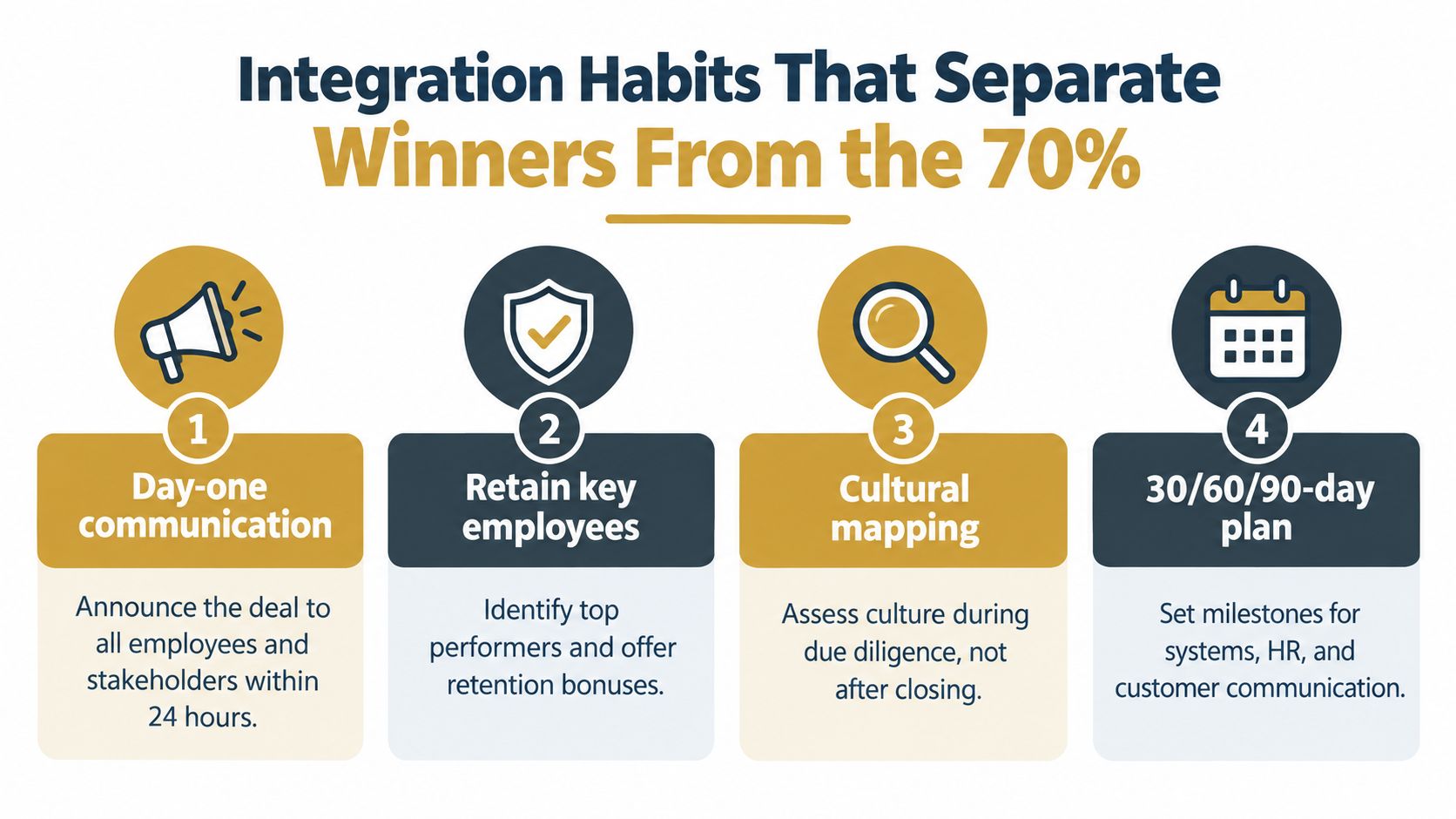
Good integration habits are simpler than first-time buyers expect:
- Communicate on day one: Employees, customers, and vendors should hear what is changing, what is staying the same, and who to call with questions.
- Protect key people: Identify the employees who hold customer trust, technical know-how, or day-to-day control of workflow. Give them clarity, incentives, and a reason to stay through the transition.
- Map culture during diligence: A business with informal decision-making will react differently than one built on process and reporting. If your operating style clashes with the seller's culture, plan the transition in stages.
- Use a 30-60-90 day plan: Put names and deadlines on the first set of decisions so important work does not drift after closing.
A practical resource for assessing people-side fit before and after closing is this MyCulture.ai M&A culture check.
Why alignment beats ambition
Researchers studying 101 SME acquisitions found that strategic fit improved performance when post-acquisition efforts were aligned, and that trying to maximize conflicting goals at the same time could hurt results, as explained in this research on pre- and post-acquisition value creation mechanisms.
In plain language, buyers get into trouble when they try to preserve every old habit while also rebuilding the company immediately.
A better rule is to choose a few changes that matter most, sequence them, and protect the cash flow while those changes are underway. For example, if you buy a HVAC company, you might keep dispatch and customer communication unchanged for 60 days, while tightening pricing controls and financial reporting first. That preserves the customer experience while giving you better visibility into margins.
Buyers who want a practical operating checklist can review these integration planning best practices. Dealmaker Wealth Society also offers structured training on sourcing, diligence, structuring, and post-close execution. Integration planning, grounded in these habits, is what separates buyers who create value from those who join the 70 percent.
Financing Realities and Your Next Steps as a Buyer
Many first-time buyers think the hard part is agreeing on price.
Often, the hard part is financing the purchase and structuring risk so the deal can close.
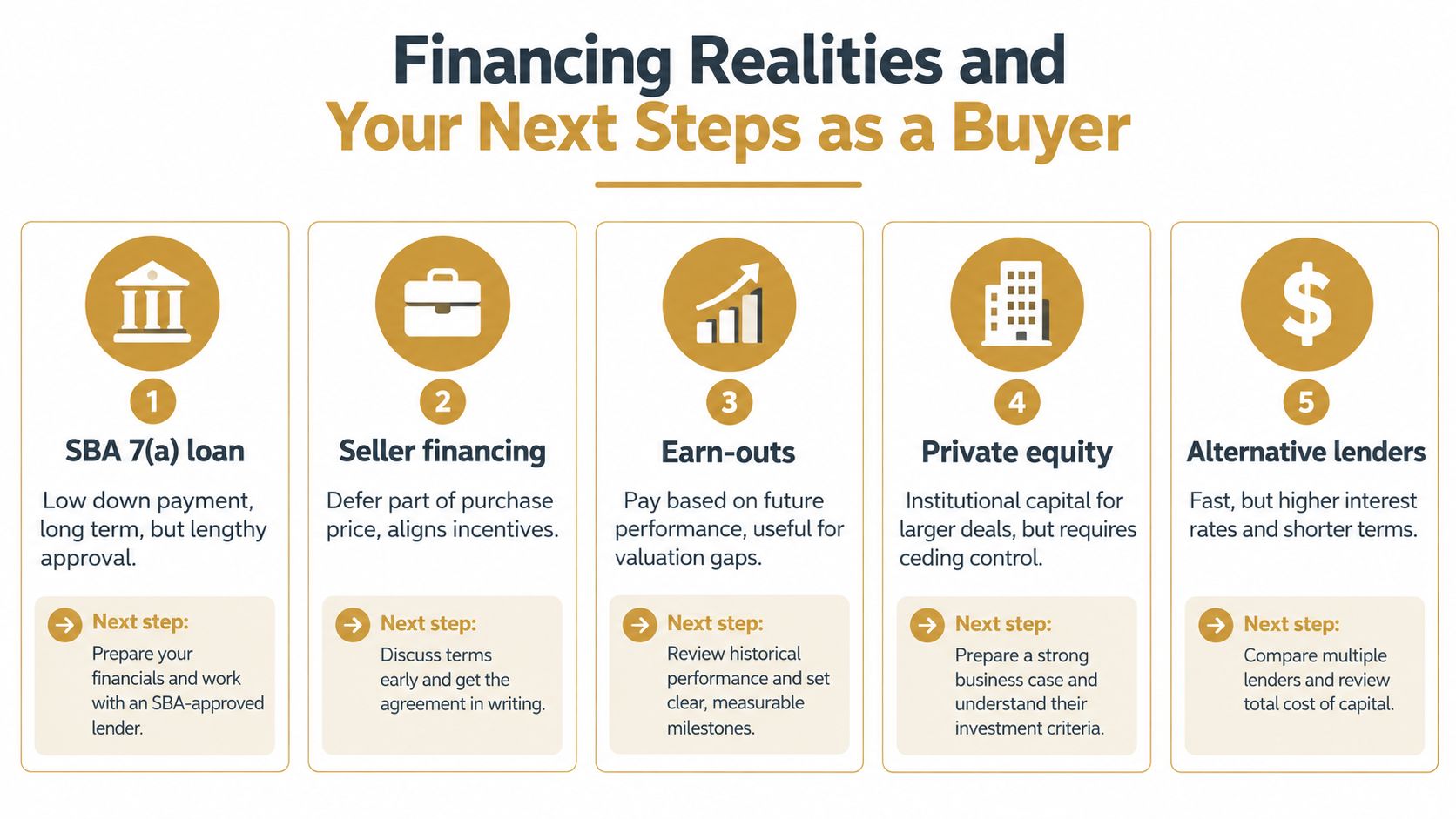
Recent market data shows the U.S. SBA 7(a) acquisition segment reached about $8.29B across roughly 7,003 deals in FY2025, while broader SBA 7(a) lending also rose year over year; the same source notes that 2025 U.S. small-business transactions were roughly flat overall with sale prices up 2%, and BizBuySell reported 2,599 closed deals in Q3 2025, up 8% year over year, all of which suggests buyers still have access to acquisition financing but need disciplined funding strategy and structure, as outlined in these small-business M&A statistics and financing trends.
What buyers usually piece together
Small business acquisitions are commonly funded through some mix of:
- SBA-backed loans, which can support acquisition financing when the deal fits lender requirements
- Seller financing, where the seller accepts part of the price over time
- Rollover equity, where the seller keeps some ownership
- Earn-outs, where part of the payment depends on future performance
Each one shifts risk differently. Seller financing can align incentives. Earn-outs can bridge valuation gaps. Rollover equity can keep a seller engaged, but it also creates a continuing relationship that must be governed carefully.
For a practical look at funding paths, this guide on business acquisition funding strategies is a strong next read.
Your next move shouldn't be “find any business for sale.” It should be to sharpen your criteria, learn how deal structure changes risk, and line up the advisors and financing paths you're likely to need before a live deal appears.
Dealmaker Wealth Society helps aspiring buyers learn how to acquire, structure, finance, and integrate small business deals through training, mentorship, and peer support. If this article clarified what a business acquisition is but also made you realize how much happens after the letter of intent, visit Dealmaker Wealth Society to explore practical education built around real deal execution.

From the Dealmaker Blog










A Creative Business Buying Fable
