How to Do Seller Financing for Small Business Deals
How to Do Seller Financing for Small Business Deals

You're probably looking at a deal where the math almost works.
The bank will lend, but not enough. Your equity covers part of the gap, but not all of it. The seller wants their number, the lender wants more protection, and everyone around the table starts using the phrase “creative structure” as if that solves anything by itself.
It doesn't. Seller financing closes small business deals when it's used as a disciplined layer in the capital stack, not as a vague promise to figure it out later. If you want to know how to do seller financing well, you need to understand three things early: where the note fits, how SBA rules can limit flexibility, and how to protect both sides if the buyer struggles after closing.
Table of Contents
- Why Seller Financing Makes Small Business Deals Close
- How Seller Notes Are Typically Structured
- Structuring Your Seller Financing Deal From Price to Paperwork
- Navigating SBA Rules and the Buyer Seller Expectation Gap
- Protecting Both Sides With Guarantees Escrow and Covenants
- Your Seller Financing Checklist and Next Steps to Close
Why Seller Financing Makes Small Business Deals Close
A typical small business acquisition has three moving parts: buyer cash, senior debt, and whatever gap remains between those two and the agreed price. Seller financing often fills that gap.
That's why seller financing has been a longstanding feature of small business acquisitions. In SBA-backed deals, a seller note can count toward the buyer's required 10% equity injection only if it is on full standby for the life of the SBA loan, and it can cover no more than 5% of total project cost as part of that injection, as summarized in this SBA acquisition financing overview. The same source notes that seller financing is commonly required in 30% to 50% of acquisition deals when buyer equity is thin or debt service coverage is tight.

It solves a financing problem, not just a negotiation problem
Buyers sometimes think of a seller note as a concession. Sellers sometimes think of it as a sign the buyer is undercapitalized. Both views are incomplete.
A seller note often does four jobs at once:
- Bridges the valuation gap: The bank underwrites to cash flow and collateral, not to the seller's emotional attachment.
- Supports lender structure: The lender may need more cushion in the stack before approving the deal.
- Expands the buyer pool: A broader group of buyers can pursue the business when the seller will carry part of the price.
- Keeps the seller engaged: If part of the price is paid over time, the seller has a reason to help the transition stick.
Practical rule: If the deal only works when the seller carries a modest piece on sensible terms, that's normal. If the deal only works when the seller becomes the primary lender, the business or the price usually needs another look.
Why it sends a useful signal
A seller note also tells the lender something important. The seller is saying, in effect, “I'm willing to bet part of my proceeds on this business continuing to perform.” That doesn't replace diligence, but it does matter.
Recent market data shows that seller financing remains widespread, but usually as a partial layer rather than full financing. One industry summary cited by Iconic reports that in Q1 2026, seller financing typically covered 10% to 16% of deal value across most Main Street and lower-middle-market segments, dropping to about 5% for businesses valued between $5 million and $50 million. The same summary says roughly 86% of closed small business transactions in 2024 included some form of seller carry, with median seller notes of 15% of consideration in deals under $5 million and 10% in deals from $5 million to $25 million, according to Iconic's seller financing guide.
That's the frame. Seller financing usually isn't the whole structure. It's the piece that gets the structure over the line.
If you're approaching a seller who insists on “all cash,” it helps to understand why sellers don't always want cash. In practice, many sellers care just as much about certainty, taxes, transition, and headline price as they do about getting every dollar at closing.
How Seller Notes Are Typically Structured
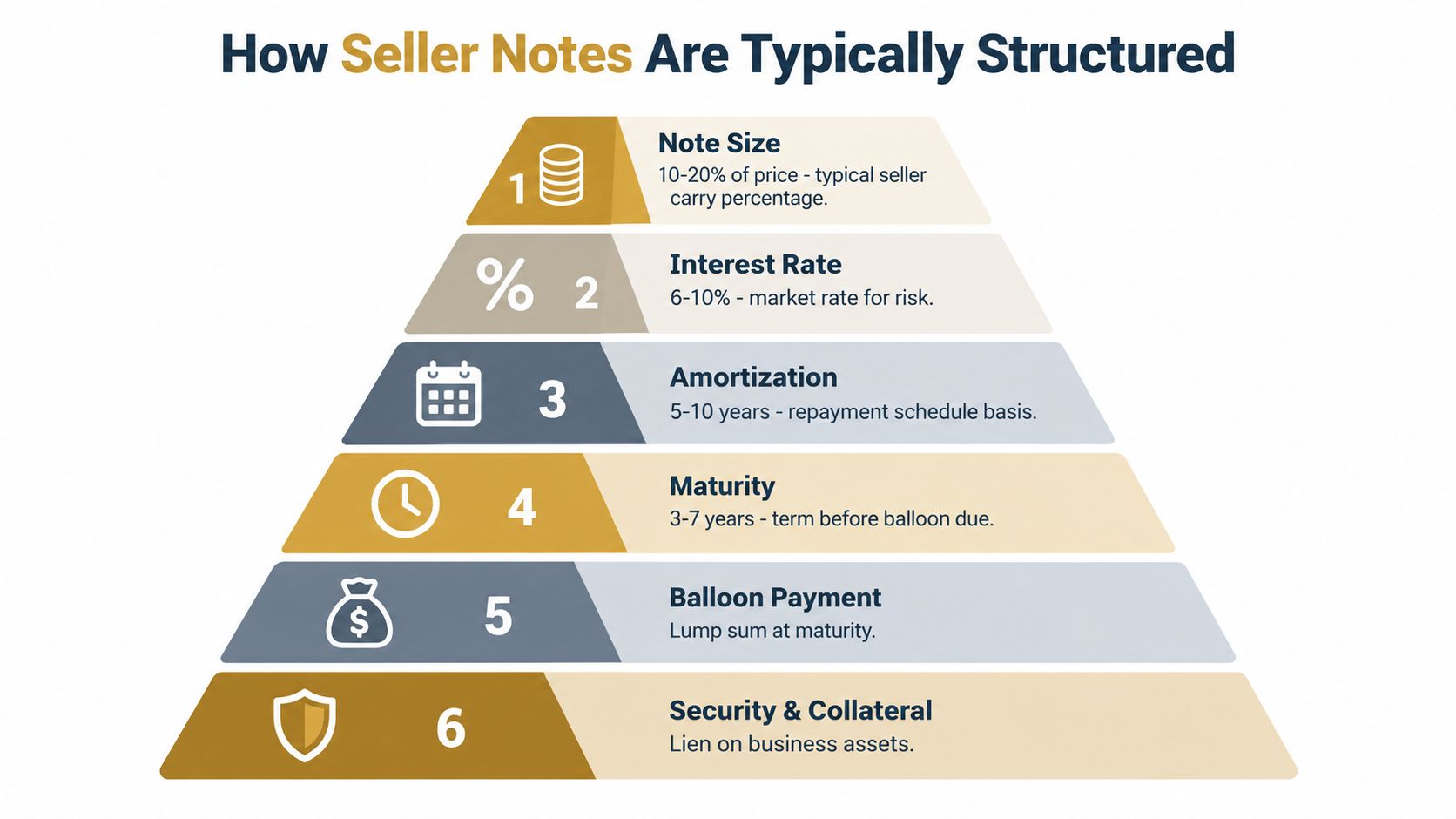
Most seller notes are structured as a minority tranche, not the main funding source. That's the first thing to keep straight when learning how to do seller financing.
Independent market summaries describe a common range of about 10% to 30% of consideration in small-business acquisitions, with terms often running 3 to 7 years and interest around 5% to 8%, according to Morgan & Westfield's seller financing guide. That same source also notes that sellers usually expect a meaningful buyer down payment to reduce default risk.
The six terms that actually drive the deal
People spend too much time debating interest rate and not enough time on the full package. A seller note usually turns on six levers.
- Note size: How much of the purchase price the seller will carry.
- Interest rate: The price of the seller's risk.
- Amortization: The schedule used to calculate payments.
- Maturity: When the balance comes due.
- Balloon payment: Whether part of the principal is pushed to the end.
- Security: What backs the note if the buyer defaults.
A note can look “friendly” because the rate is low while being dangerous because the maturity is too short. It can look “seller protective” because there's a personal guarantee while still being weak because the seller has no meaningful collateral package.
Here's a useful explainer if you want a clean legal refresher on note basics before negotiating custom terms: the guide to promissory notes for startups from Coto & Waddington walks through how promissory notes are documented and enforced.
What works and what usually doesn't
The market norm matters because it sets expectations. A seller note is often easiest to place when it feels like a bridge instrument and not a disguised price reduction.
What tends to work:
- Moderate seller carry: Enough to close the gap, not so much that the seller feels they're financing the whole transfer.
- Payment terms tied to cash flow: The business should comfortably service senior debt, the seller note, and working capital needs.
- Real security: A UCC lien, personal guarantee, or both, depending on the deal and lender consent.
- A believable takeout path: If there's a balloon, the buyer needs a credible refinance or payoff plan.
What usually creates problems:
- Oversized notes: The seller starts to feel like they're taking buyer risk without buyer upside.
- Short maturities with heavy amortization: Payments look fine on paper until the first slow quarter.
- Unsecured paper behind bank debt: It gives the seller little practical ability when something goes wrong.
- Ignoring working capital: Buyers sometimes use every available dollar to close, then starve the business immediately after.
This walkthrough gives a simple visual primer before you draft terms:
A good seller note feels boring once documented. If it feels clever, it usually has hidden stress somewhere in the repayment plan.
Structuring Your Seller Financing Deal From Price to Paperwork
The sequence matters more than most first-time buyers think. Bad seller-financed deals often fail because the parties negotiate note terms before they've aligned on price, cash at close, and post-close working capital.
Start with the economics, not the note form
Agree on purchase price first. Then decide how much buyer equity goes in at closing. Only after that should you define the seller carry.
That order matters because each issue changes the others. If price moves up, the note may need to grow or the buyer may need more cash. If working capital delivered at closing is light, the note may need softer payments because the buyer will need liquidity immediately after takeover.
A practical sequence looks like this:
- Price first: Set the enterprise value and what's included.
- Cash second: Define buyer injection and any senior debt proceeds.
- Seller note third: Plug the gap instead of negotiating a random percentage.
- Adjustments fourth: Address working capital, inventory, AR, and seller support.
- Documents last: Don't let paperwork disguise unresolved business issues.
Put the term choices side by side
The cleanest way to negotiate is to show trade-offs instead of arguing over one variable at a time.
| Term Lever | Buyer Friendly Option | Seller Friendly Option | When to Use It |
|---|---|---|---|
| Note size | Smaller note | Larger note | Use a larger note only when lender proceeds and buyer cash leave a manageable gap |
| Interest rate | Lower fixed rate | Higher fixed rate | Use a higher rate when seller risk is real but cash flow still supports payments |
| Amortization | Longer amortization | Shorter amortization | Use longer amortization when free cash flow is uneven or integration will take time |
| Maturity | Longer maturity | Earlier maturity | Use earlier maturity only if refinance visibility is strong |
| Balloon | Small or no balloon | Larger balloon | Use a balloon when current cash flow is solid but near-term liquidity must be preserved |
| Security | Limited recourse | Strong collateral and guarantees | Use stronger security when the seller is subordinated or buyer experience is thin |
Paper the note like someone will have to enforce it
Too many deals treat legal drafting as a cleanup step. It isn't. If the note matters, the documents need to be specific enough to survive stress.
At minimum, the seller-financing package usually includes:
- Promissory note: Principal, interest, payment schedule, maturity, default rate if any, and cure rights.
- Security agreement: What assets secure the note.
- UCC filing package: So the seller's lien is perfected where allowed.
- Personal guarantee: If the seller requires recourse beyond business assets.
- Subordination agreement: If the senior lender requires the seller to stand behind bank debt.
- Purchase agreement cross-default language: So a major breach under one document can trigger remedies under another where appropriate.
One practical option for buyers who want outside feedback on live deal structure is a community like Dealmaker Wealth Society, which provides real-time input on active acquisitions, documentation flow, and financing trade-offs. That kind of review is useful when the issue isn't legal theory but whether the structure matches how small business deals get closed.
Don't concede on maturity just to win on price. A note that matures before the business can realistically refinance isn't cheaper. It's just delayed conflict.
Where to hold firm
Some terms are worth fighting over.
Hold firm on enough post-close working capital. Hold firm on realistic payment coverage. Hold firm on clean definitions around default, cure periods, and collateral.
Be more flexible on things that can be traded. Sellers may accept a lower rate in exchange for stronger collateral. They may accept a smaller note if part of the upside shifts into an earnout. They may accept longer amortization if the balloon still gives them a defined exit point.
Navigating SBA Rules and the Buyer Seller Expectation Gap
Many otherwise workable deals get stuck.
Generic content on how to do seller financing often treats the seller note as flexible bridge capital. In SBA-backed acquisitions, it often isn't. The SBA treatment is tighter, and that changes what a seller is really being asked to accept.
The SBA standby issue is not a minor detail
Recent 2025 coverage explains that seller notes can cover only 50% of the required buyer equity injection, and the note typically must be on full standby for the entire SBA term, often 10 years, with no principal or interest payments, according to this review of the new SBA landscape.
That's a much different proposition from “carry a note for a few years and collect interest.” A seller may hear “seller financing” and imagine regular payments. The SBA may require “seller financing” that behaves more like parked equity support.

The expectation gap is real
That same 2025 coverage says only 22.8% of sellers plan to offer seller financing while 62.3% of buyers are considering it. It also says buyers are often looking for 30% to 40% seller financing, while sellers are more comfortable with 10% to 20%, based on the same SBA market commentary.
That gap explains a lot of stalled conversations. Buyers think they're asking for a common accommodation. Sellers think they're being asked to finance the buyer's ambition.
If you work around SBA loans regularly, it helps to understand the lender mindset, not just the borrower's wish list. Content like become an indispensable loan advisor is useful because it frames how lenders look at structure, default exposure, and documentation discipline. It also helps to review practical SBA context like the ins and outs of SBA financing before you ask a seller for terms that a bank may never allow.
Sellers don't reject seller financing only because they dislike risk. They often reject it because the buyer hasn't explained the structure in a way that matches SBA reality.
How to adapt when the seller will carry only a small note
When the seller says yes, but only to a modest note, you still have options.
- Adjust price instead of forcing a bank-dependent deal: If bank proceeds and buyer cash are fixed, price may need to move.
- Use an earnout for disputed value: If the seller believes future performance justifies more value, tie that portion to actual results.
- Add a stronger guarantor package: Better guarantees can help a seller accept a smaller current return.
- Change timing elsewhere: Transition consulting, inventory timing, or working capital targets can reduce immediate cash pressure.
- Walk away from false solutions: If the structure depends on the seller accepting SBA standby terms they don't really understand, the friction will show up later anyway.
The right move in SBA deals is usually to explain the standby issue early, not after the LOI. That saves time and avoids false momentum.
Protecting Both Sides With Guarantees Escrow and Covenants
A seller note doesn't become safe because the buyer is sincere. It becomes safer when the documents give both sides a workable system after closing.
That matters because the downside is real. Industry reporting cited in 2026 says the 2023 IBBA Annual Member Survey put seller-note default rates at 11% to 14% on small business seller carry, with recovery of only 35 to 55 cents on the dollar when the note was subordinated and unsecured by personal guarantee, according to CT Acquisitions' analysis of seller financing risk and reward.

A protection system works better than one strong clause
Sellers often focus on one remedy. Buyers often focus on one concession. Neither approach is enough.
A stronger seller-financing package usually combines several controls:
- Personal guarantee: Gives the seller recourse beyond the acquired entity.
- Collateral package: Secures the note with business assets where lender rules allow it.
- Subordination language: Clarifies exactly where the seller stands relative to bank debt.
- Escrow holdback: Preserves a source of funds for indemnity claims or post-close true-ups.
- Reporting covenants: Requires regular financial delivery so problems surface early.
- Default mechanics: Defines cure periods, notice standards, and available remedies.
A lot of sellers underestimate subordination risk. If the bank is senior and the seller is unsecured, the seller may have legal rights but little practical recovery. That's why many sellers benefit from reviewing tactics like 5 ways to guarantee seller financing payments before they agree to carry paper.
Underwrite the buyer's repayment, not just the business story
The biggest mistake in seller financing is pretending the note is protected because the business “should” support it.
Independent market research on private-company sales suggests only about 20% to 30% of listed small businesses close within 12 months, while professional preparation and qualified advisers can improve success rates to roughly 40% to 50%, according to DueDilio's review of business sale failure rates. That's a reminder that weak preparation kills deals before close, and weak underwriting hurts them after close.
The seller should stress-test:
- Normalized cash flow: Not broker add-backs piled on top of optimism.
- Debt service coverage: Based on the senior loan, seller note, and realistic operating needs.
- Working capital sufficiency: So the buyer doesn't miss payments because cash got trapped in the business.
- Integration burden: Customer concentration, owner dependence, and key employee retention all matter.
If repayment works only in the base case, the seller note is already too aggressive.
What both sides gain from discipline
Protection isn't anti-buyer. It helps buyers too.
Clear covenants reduce the chance of surprise defaults. Defined reporting keeps hard conversations factual. Escrow and indemnity mechanics stop small disputes from turning into note-payment warfare. And realistic cure periods give an operator time to fix a short-term issue without pretending it never happened.
Your Seller Financing Checklist and Next Steps to Close
Most seller-financed deals don't fail because nobody knew what a promissory note was. They fail because the parties skipped sequencing, overestimated cash flow, or treated the seller note as a patch for a weak structure.
Use a tight closing checklist.
What needs to be settled before documents go final
- Price alignment: Make sure the headline price, working capital target, and any inventory treatment fit together.
- Capital stack clarity: Confirm buyer cash, senior debt, and seller carry all match the same closing model.
- Repayment realism: Test note payments against normalized cash flow, not best-case projections.
- Security package: Decide whether the note is secured, guaranteed, subordinated, or some combination.
- Default process: Spell out notice, cure periods, and remedies while everyone is still cooperative.
- Transition support: Document training, handoff, and any seller consulting obligations so post-close performance has a fair chance.
Questions worth asking before you sign
Ask the lender whether the seller note terms are fully acceptable before you treat them as final. Ask the seller whether they understand any standby or subordination limits in plain language. Ask yourself whether the note still works if the first year is choppy.
Those questions sound basic. They save deals.
If you want the shortest version of how to do seller financing, it's this: agree on a realistic price, use the seller note as a modest bridge, document real protections, and don't build repayment around hope. A small, well-secured note with room for the business to breathe will usually outperform an aggressive note that looks better only on the day of closing.
Oversized seller notes, thin working capital, and mismatched maturities don't create creativity. They create delayed defaults.
If you're working through a live acquisition and need help pressure-testing the capital stack, note terms, or SBA constraints, Dealmaker Wealth Society offers training, deal-structuring support, and peer feedback built around small business acquisitions. It's a practical place to refine seller financing terms before they become expensive mistakes at closing.

From the Dealmaker Blog











A Creative Business Buying Fable