Structuring the Deal: A Buyer’s Acquisition Guide
Structuring the Deal: A Buyer’s Acquisition Guide
Most small-business acquisitions aren't all-cash deals. Buyers typically bring 10% to 30% equity, while the rest is layered from debt, seller financing, and sometimes earnouts, and one common small-business model borrows about two-thirds of the purchase price while equity covers a minority share.
That runs against the most popular advice buyers hear early. Too many first-time acquirers are told to focus on one number, the purchase price, as if the winner is whoever pays the most and wires the fastest. In actual lower-mid-market and small-business acquisitions, that mindset gets deals killed.
A workable deal is usually built, not bought.
Price matters, of course. But structuring the deal often matters more because structure determines who carries risk, who gets paid when, how much cash the buyer preserves for operations, and whether the business still has room to breathe after closing. I've seen plenty of buyers negotiate hard on valuation and then destroy the economics with a brittle capital stack, weak seller-note language, or an earnout that turns into an argument the minute the ink dries.
The job is to turn one business, one seller, and one imperfect fact pattern into a capital stack both sides can live with. That means knowing when to lean on senior debt, when to ask the seller to carry paper, when to leave part of the price contingent, and when to stop being clever and just simplify the deal.
Table of Contents
- The Foundation of Smart Deal Architecture
- Traditional Debt Versus Creative Financing
- Mastering the Three Pillars of Deal Structure
- Negotiation Tactics for Favorable Terms
- Real-World Deal Examples and Pitfalls
- Your Acquisition Structuring Checklist
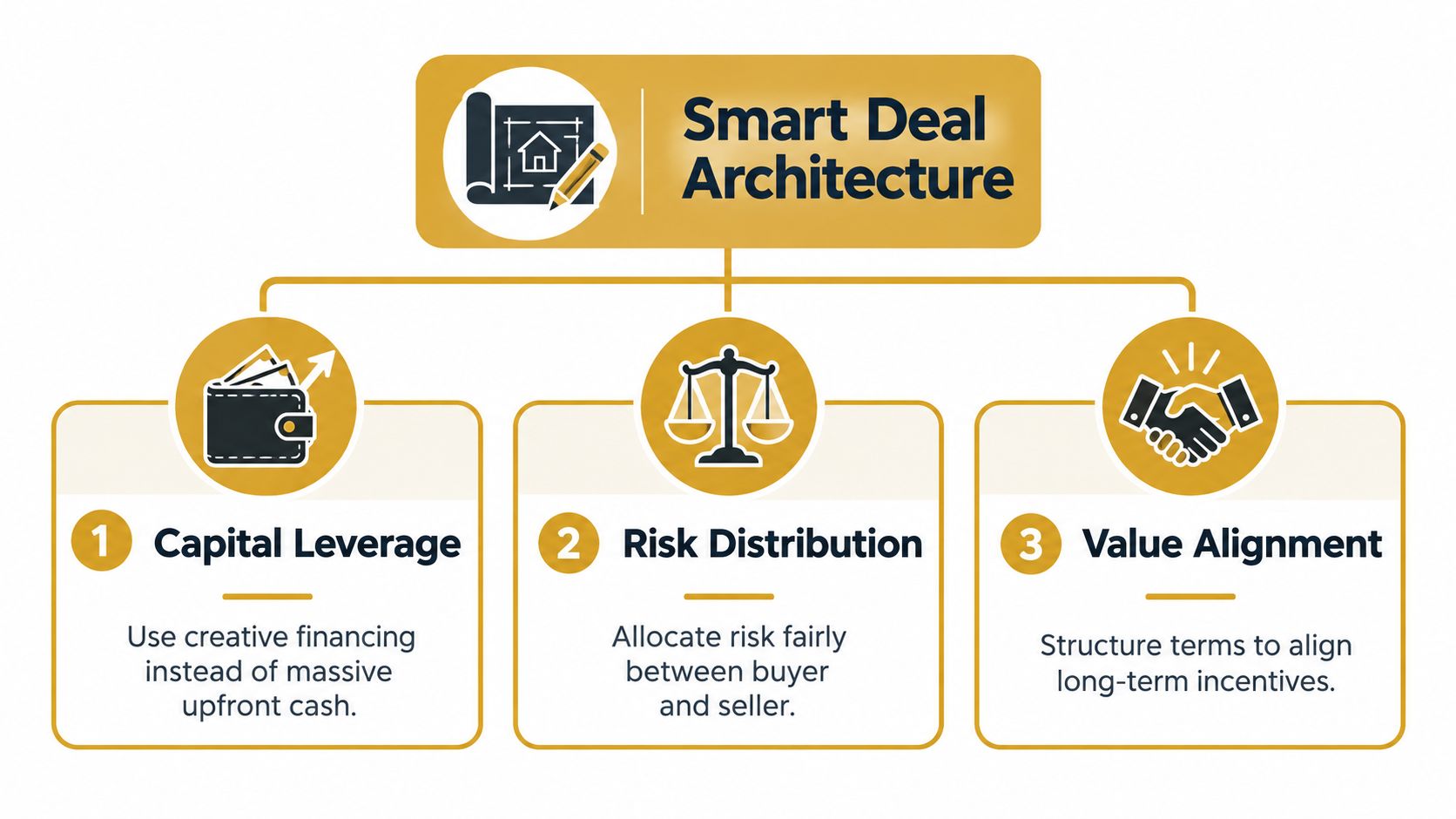
The Foundation of Smart Deal Architecture
The all-cash myth survives because it's easy to explain. It's also wrong for most small-business acquisitions.
A long-standing small-business financing pattern is a mix of bank debt and investor equity rather than full cash payment at closing, and one business-buying guide says buyers often borrow about two-thirds of the purchase price, with roughly 20% to 25% seller financing, 30% to 50% bank loans, and 30% to 35% equity investments. A separate empirical buyout study cited in the same reference found equity averaged only 25% of the purchase price, with debt funding the balance, which is why structure, not just valuation, carries so much weight in business acquisitions according to the Library of Congress small-business financing guide.
What a capital stack is really doing
A good structure does three things at once:
- Preserves operating cash: You want enough liquidity left after closing to handle payroll, inventory, customer concentration surprises, and integration mistakes.
- Distributes risk: If the seller says the business will perform, the structure should test that claim instead of forcing the buyer to underwrite everything in cash.
- Aligns incentives: A seller note, rollover equity, or contingent payout can keep the seller economically connected to a smooth handoff.
If you're buying in a niche where lenders care about industry-specific cash flow and transition risk, it helps to review a sector example like how to finance a practice purchase. The mechanics are similar even when the business type changes. Lenders still want repayment clarity, buyers still need reserves, and sellers still care about certainty of close.
The four layers most buyers should think through
Start with buyer equity. That's your credibility layer. It tells lenders and sellers you have real skin in the game.
Then size senior debt. In smaller acquisitions, debt is often the cheapest capital in the stack, but it also comes with the hardest rules. The lender will care about debt service, collateral, and whether the business can support the note without heroic assumptions.
After that, add seller financing if the gap remains. This isn't just a patch. It's a negotiation tool that tests seller confidence and reduces the buyer's cash burden at closing.
The last layer is contingent value, such as an earnout, but only if there is a real disagreement about future performance and a clean way to measure it.
Practical rule: Build the structure in order of certainty. Equity first, senior debt second, seller carry third, contingent value last.
Where buyers go wrong early
Many buyers treat structure like an afterthought once they agree on price. That's backwards. If the deal only works with flawless revenue retention and zero transition friction, the structure is too tight.
The better question isn't "Can I close this?" It's "Can this business comfortably support the obligations I'm placing on it after closing?" That's the question seasoned buyers ask before they sign a letter of intent.
Traditional Debt Versus Creative Financing
Bank debt is rarely the bottleneck in a small acquisition. The bottleneck is the gap between what the lender will support, what the seller believes the business is worth, and what the cash flow can safely carry after closing.
For acquisitions under $5 million, one market guide says SBA 7(a) lending remains a common path, with up to 90% government guarantee support and a typical need for about 10% buyer equity plus 5% to 10% seller financing. The same guide says $5 million to $25 million transactions often shift to senior debt at 2x to 4x EBITDA, mezzanine debt at 1x to 2x EBITDA, buyer equity of 25% to 40%, seller financing of 10% to 25%, and optional earnouts of 10% to 30%, while another financing reference in that same guide notes a minimum 10% equity injection for an existing business acquisition and many well-structured small-business deals landing in the 15% to 30% buyer-equity range according to this business acquisition financing guide.
Those ranges are useful, but they do not close deals by themselves.
In practice, lenders price the part they can see clearly. Everything else has to be absorbed somewhere else in the stack. If the company has customer concentration, lumpy margins, weak month-end reporting, or a founder whose relationships drive sales, the bank usually shrinks its hold instead of stretching to solve the problem.
That is why smaller acquisitions are built with layers, not with a single loan product. The winning structure is often less about maximizing cheap debt and more about putting each risk with the party best positioned to bear it.
| Structure | What it does well | Where it creates pressure |
|---|---|---|
| Senior debt | Lowest-cost capital in many deals | Covenants, fixed amortization, and limited tolerance for a slow first year |
| Seller financing | Keeps the seller tied to the outcome and reduces cash due at close | Collection risk, subordination issues, and future friction if the note is loosely drafted |
| Earnout | Separates current value from disputed future value | Post-close disputes if targets, add-backs, or control rights are unclear |
| Mezzanine or junior capital | Fills a gap when senior lenders stop short | Higher pricing, tighter intercreditor negotiation, and more moving parts |
The mistake I see most often is treating creative financing as a last resort. It is usually the main structuring tool in lower middle market and Main Street deals. Seller notes, standby payments, forgivable consulting arrangements, rollover equity, holdbacks, and performance-based payouts show up because these businesses are not perfectly financeable on day one.
A buyer who wants to sharpen the mechanics should spend time understanding buyout modeling, because debt only works when the company can absorb ordinary misses, not just hit the spreadsheet case.
Recent material on structuring deals with earnouts in acquisitions is useful for one reason. It treats contingent value as a drafting problem. That is the right frame. If two sides disagree about growth, customer retention, or margin expansion, the answer is not to argue harder about price. The answer is to separate what is known today from what must be proven after closing.
Good deal structure does not hide risk. It assigns it.
The buyers who close repeatedly know when to keep the bank piece plain and when to get creative everywhere else. In small-business acquisitions, that is usually where the work gets done.
Mastering the Three Pillars of Deal Structure
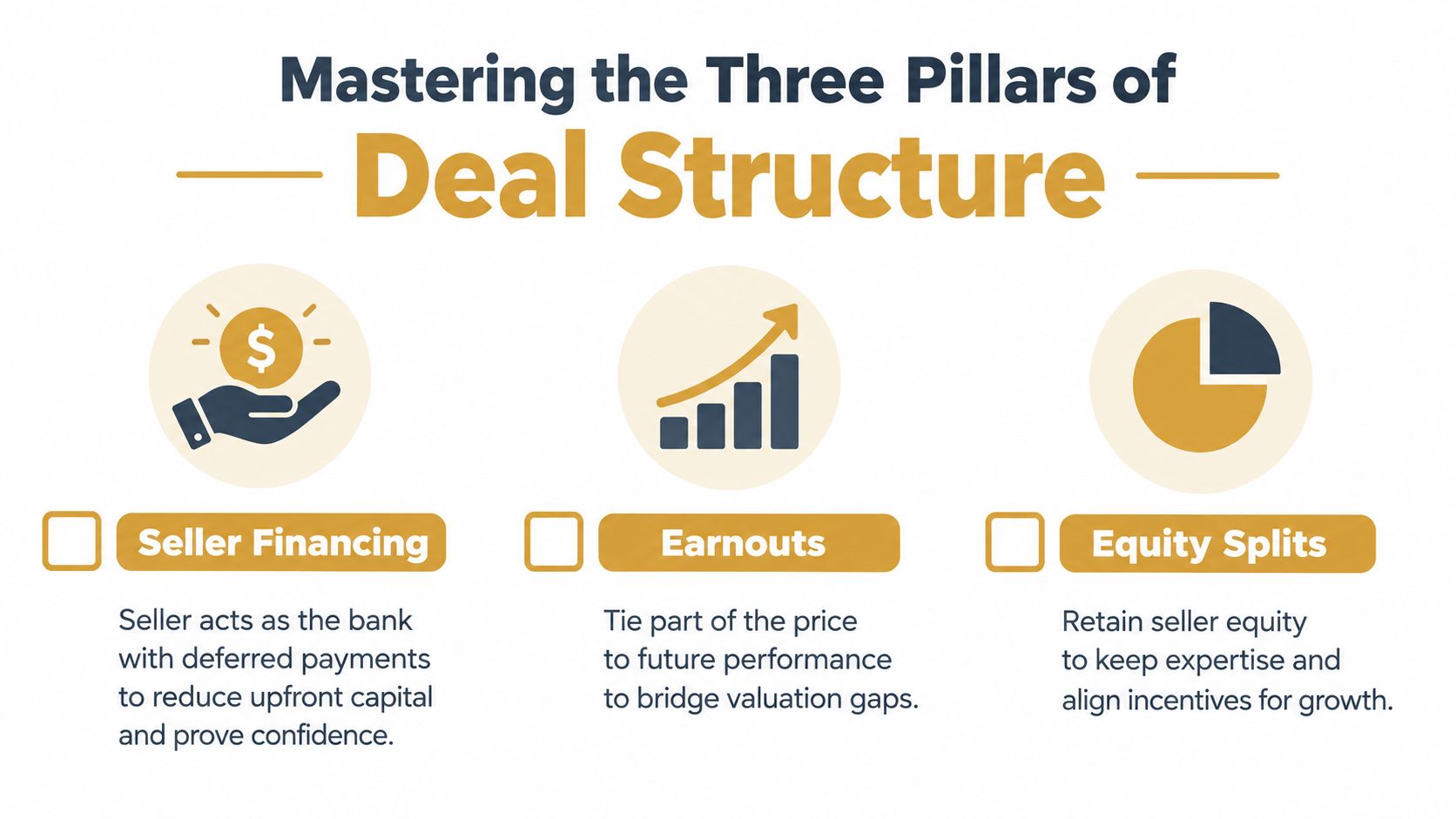
The most important parts of structuring the deal in small acquisitions aren't exotic. They're seller financing, earnouts, and equity splits. Get these three right and the rest of the documentation becomes much easier to control.
A useful companion to this discussion is this breakdown of comparing acquisition financing structures, especially if you're pressure-testing different stack combinations before issuing an LOI.
Seller financing works best as shared risk
Seller financing is most useful when you treat it as a confidence instrument, not just a missing-money instrument.
A practical benchmark from market data summarized from broker and private-capital reports says seller carry appears in most sub-$5M transactions and commonly represents about 15% to 30% of total consideration, with terms often stretching 3 to 5 years for smaller deals and 5 to 7 years in larger lower-middle-market transactions according to this guide on seller financing in acquisitions.
That benchmark tells you two things. First, asking for a note isn't unusual. Second, the note needs to be built deliberately.
The best ordering is simple:
- Set the buyer equity floor: Decide what cash you can contribute without starving the business after closing.
- Size senior debt next: Let the lender define the upper edge of bankable debt.
- Use the seller note to bridge the remaining gap: Calibrate it to subordinate risk and maintain alignment.
What doesn't work is using a huge seller note to justify an unrealistic valuation. If amortization is too aggressive or subordination language is fuzzy, today's bridge becomes tomorrow's fight over defaults, offsets, or working-capital claims.
Write seller-note documents as if the relationship will become strained. Clear subordination, payment triggers, and offset mechanics protect both sides.
Earnouts are useful, but they're unreliable if overused
Earnouts help when the parties disagree about future performance, but they shouldn't carry the deal on their back.
Independent reporting summarizing deal-term studies says earnouts appear in roughly 18% to 22% of private-target deals, with a median duration of about 24 months and a median size near 31% of closing payments when used. The same synthesis reports that only about 59% of earnouts pay anything, around 41% pay zero, and roughly 28% become formally disputed according to these founder earnout benchmarks by deal size.
Those numbers explain why experienced buyers keep earnouts secondary.
A workable earnout usually has three traits:
- Narrow metrics: Gross profit, recurring revenue, or unit shipments are easier to audit than broad profit definitions loaded with accounting discretion.
- Defined control rights: If the seller can earn the payout, the buyer can't change the rules through post-close operating decisions.
- Short enough duration to stay relevant: If the measurement period drags, memory fades and arguments multiply.
If you need an earnout to make the entire valuation feel rational, the base price is probably wrong.
Equity splits are tighter than many buyers expect
The old fantasy was buying a business with minimal cash down. That still happens sometimes, but the environment has changed.
One 2025 market report said SBA-backed acquisition lending reached $8.29 billion across about 7,003 deals, up 34.6% year over year, while another market summary in that same report said buyers were contributing an average of 94% of the purchase price as the down payment in year-to-date 2025 and that loan amounts had fallen from 66% of price in 2024 to 41% year-to-date, as described in this SBA acquisition market pulse.
Whether every deal you see will look that equity-heavy is another question. But the practical lesson is clear. Buyers should underwrite from a more conservative equity assumption and treat low-cash-close structures as situational, not standard.
Negotiation Tactics for Favorable Terms
Negotiation on structure isn't about sounding clever. It's about making the seller comfortable with the parts of the price that won't be paid at closing.

The first mistake buyers make is leading with the instrument instead of the problem. They say, "I want seller financing," or "I need an earnout." The seller hears discounting and delay. A better approach is to frame the issue in business terms: customer retention risk, transition dependency, uneven monthly cash flow, or uncertainty around a recent surge.
Start with certainty, then trade for flexibility
Open with the cleanest amount you're willing to pay at close. Then separate the rest into buckets based on why it shouldn't be paid immediately.
Use a sequence like this:
- Base price at close: the amount supported by current, durable performance.
- Deferred but fixed consideration: a seller note fits when the business can support repayment.
- Contingent consideration: reserved for performance claims that still need to be proven post-close.
That framing matters. It tells the seller you're not trying to be evasive. You're matching payment timing to business certainty.
A practical resource for sharpening those conversations is this guide to effective deal-making for buyers. It focuses on how buyer-side diligence findings should change offer terms, not just headline price.
Push hard on definitions, not just economics
Most bad disputes aren't born from greed. They're born from sloppy drafting.
If there's seller financing, define subordination, cure rights, permitted offsets, payment triggers, and what happens if an indemnity claim overlaps with note payments. If there's an earnout, define the metric, the accounting method, the reporting cadence, who controls the business during the period, and which actions are prohibited because they would distort the outcome.
This is also where buyers need discipline. Don't ask the seller to stay responsible for outcomes they can no longer influence.
Here's a useful walkthrough on the subject:
"I'll pay you for performance you can still influence" is a stronger negotiating position than "trust me and wait."
Keep the transition tied to economics
When founder continuity matters, link the transition plan directly to the structure. If the seller needs to stay for customer handoffs, key hires, or vendor relationships, spell out that role with precision.
Don't rely on verbal understandings. Put the following in writing:
- Specific responsibilities: Which customers, employees, or vendor relationships remain with the seller during transition.
- Time boundaries: The handoff period should have an endpoint, not a vague promise to be "available."
- Decision authority: Everyone should know who can approve pricing changes, staffing changes, and capital spending after close.
The cleanest negotiations happen when both sides can see why each dollar is being paid when it's being paid.
Real-World Deal Examples and Pitfalls
Small-business deal structures usually break in predictable places. Not in theory. In the mechanics.
Example one: The seller note that did its job
A buyer acquires a service business where the seller insists the company deserves credit for a strong recent run. The lender supports part of the purchase, but not the full valuation. The buyer agrees to the price in principle, then bridges the gap with a subordinated seller note instead of stretching senior debt.
That structure works because each layer has a clear role. The bank funds the proven base. The buyer contributes real equity. The seller carries part of the value they believe in. If performance holds, everyone gets what they expected. If the handoff is messy, the buyer hasn't overpaid all at once.
The hidden win in that kind of structure isn't only lower cash at close. It's psychological. Sellers who carry paper tend to stay engaged in a more practical way because they still have economic exposure.
Example two: The earnout that looked elegant and failed
Another buyer purchases a company with optimistic growth claims tied to a few large customer accounts. Instead of tightening the base price, the parties load too much of the value into an earnout with vague profit-based definitions and broad post-close discretion for the buyer.
The trouble starts fast. The buyer changes staffing, reallocates overhead, and shifts sales priorities across the platform. The seller says those decisions depressed the earnout result. The buyer says they were ordinary business judgments. Both sides think they're right.
That situation lines up with a broader market warning. A recent source says non-traditional financing appeared in nearly 60% of SMB transactions in Q1 2025, seller financing often made up 10% to 15% of deal value, and 30% to 50% seller-financed tranches were common when buyers faced tighter bank approvals, while also noting that these tools can create control, accounting, and integration risk if governance is weak, as discussed in this piece on valuation, exit readiness, and non-traditional financing.
The lesson isn't "avoid earnouts." It's "don't write an earnout around a metric the buyer can accidentally or intentionally reshape."
Bad structures usually fail where control and compensation overlap.
Example three: The overengineered first deal
A first-time buyer reads about mezzanine debt, rollover equity, contingent consideration, and consulting agreements, then tries to use all of them in one small acquisition. On paper, the stack looks intricate. In practice, it overwhelms the seller, confuses the lender, and drags the legal process into a maze of side agreements.
This happens often enough that it deserves a blunt warning: complexity is only valuable when it solves a real problem.
A cleaner deal often wins:
- One clear senior facility
- One seller note with defined subordination
- One limited contingency if needed
- One documented transition arrangement
If a structure takes fifteen minutes to explain and still sounds slippery, it's probably too complicated for the deal size.
The pitfalls buyers can actually prevent
Most avoidable mistakes show up before documents are signed:
- Loose metric drafting: If a number can be interpreted two ways, someone will interpret it their way.
- No post-close operating rules: Earnouts fail when control rights aren't discussed up front.
- Using seller financing to defend a weak valuation: Deferred payment doesn't cure overpayment.
- Underestimating working capital pressure: A deal can close and still be structurally unsound if the business is left thin on cash.
Strong buyers don't chase cleverness. They remove ambiguity.
Your Acquisition Structuring Checklist
Before you sign an LOI or move into final documents, run the deal through a short filter.
The buyer's closing checklist
- Check your true equity capacity: Don't just ask what you can wire. Ask what you can wire and still leave in the business without creating immediate pressure.
- Match each layer to a specific risk: Senior debt should fund durable cash flow. Seller financing should bridge confidence gaps. Earnouts should cover claims about future performance that can be measured cleanly.
- Stress-test the downside case: If revenue softens or transition takes longer than expected, the business still needs room to service the structure.
- Draft seller-note mechanics carefully: Subordination, amortization, offsets, default remedies, and payment triggers need to be explicit.
- Keep earnout metrics narrow and auditable: If you can't explain the formula in plain English, it's too messy.
- Tie transition duties to economics: If the seller's involvement matters, define the role, the timeline, and the boundaries.
- Prefer clarity over novelty: The best structure isn't the most creative one. It's the one that survives ordinary post-close friction.
The right structure lets the buyer sleep after closing. That's a better test than whether the deal looked impressive in the model.
A good acquisition structure doesn't eliminate risk. It puts each risk where it belongs, prices it transparently, and keeps the company functional after the celebration dinner.
Dealmaker Wealth Society gives acquisition entrepreneurs practical training on deal structure, capital stacks, negotiation, and execution so they can move from theory into real transactions. If you're serious about structuring the deal the way experienced buyers do it, visit Dealmaker Wealth Society and review its training, mentorship, and community resources.

From the Dealmaker Blog














A Creative Business Buying Fable