M&A Negotiation Strategy: The Playbook for Smaller Deals
M&A Negotiation Strategy: The Playbook for Smaller Deals
Most M&A negotiation advice starts with the wrong question: “What's the highest price I can get?” Price matters, but it rarely determines the final quality of a smaller acquisition or sale on its own. The terms around cash, financing, working capital, control, performance risk, and post-close obligations often decide how much value each party realizes.
A strong M&A negotiation strategy treats the deal as a system of connected decisions. The headline valuation is only one variable. Timing, concession sequencing, diligence discipline, and contract mechanics determine whether the transaction closes cleanly and whether the buyer and seller can operate effectively after closing.
Table of Contents
- The Real Negotiation Is Not About Price
- How to Define Your BATNA Before Any Auction
- Buyer Versus Seller Mindsets in M&A Talks
- Creative Deal Structures That Bridge Valuation Gaps
- The Timing Dynamics Behind Successful Negotiations
- A Practical Negotiation Script and Closing Checklist
The Real Negotiation Is Not About Price
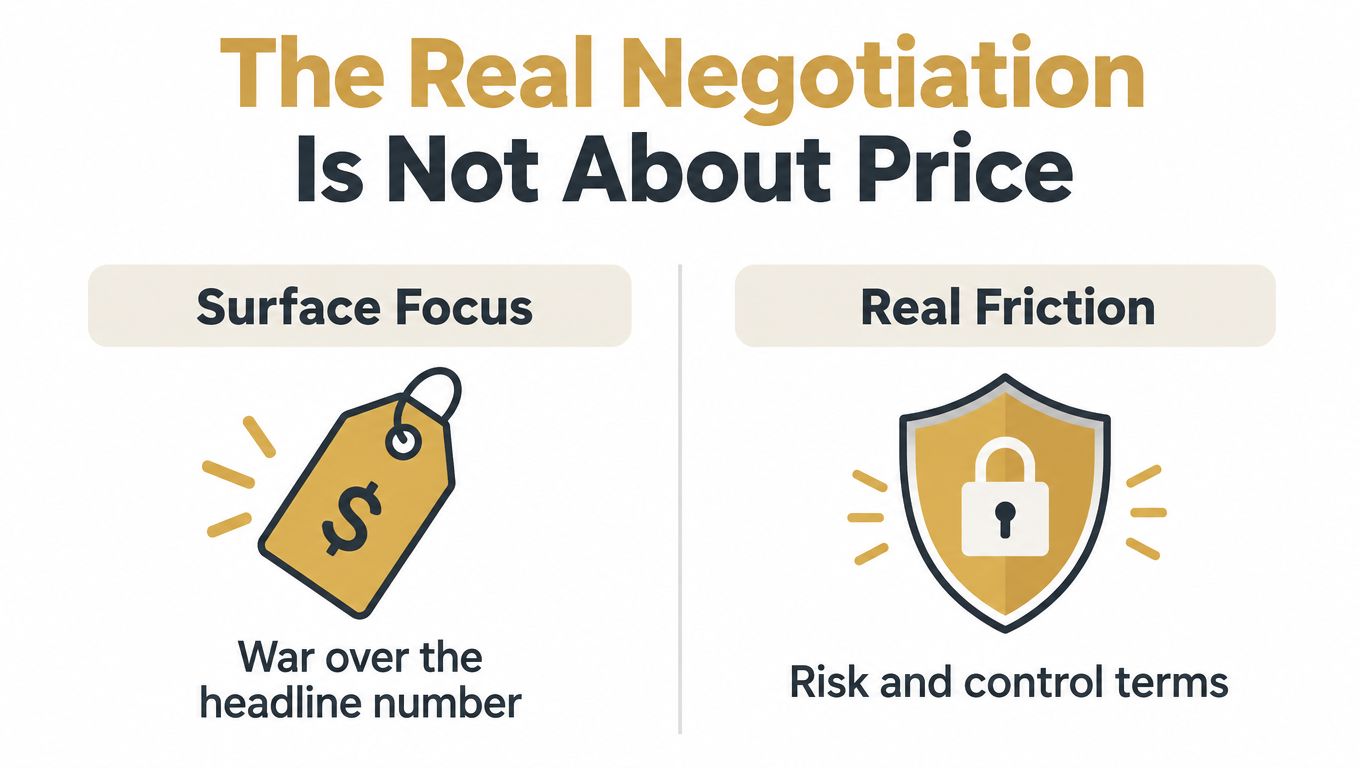
Buyers and sellers often spend too much time arguing over the headline number because it feels objective. A valuation gives the conversation a visible center, while structure can seem technical. In practice, the most difficult disagreement is often not what the business is worth, but who carries the risk if the future doesn't match the forecast.
For smaller deals, that risk may be divided across cash at close, rollover equity, seller notes, earnouts, and working capital adjustments. A seller may accept a lower amount at closing if the payment is more certain, or reject a higher nominal offer if too much consideration depends on post-close performance. A buyer may stretch on valuation when the seller finances part of the purchase or shares downside through contingent consideration.
Recent M&A data supports this reframing. KPMG found that agreeing on valuation was cited by 44% of M&A professionals as a top obstacle, while due diligence and regulatory issues were each cited by 41%, according to the small-business M&A market overview. Those figures don't make valuation unimportant. They show that a deal can remain stuck even after both sides broadly understand the price range.
Structure changes realized value
Suppose the seller wants a valuation that the buyer can't justify from current earnings. The lazy response is to argue over the multiple. The more productive response is to ask which assumptions create the gap.
If the seller believes growth is highly probable, an earnout can place part of the price behind that outcome. If the seller wants to participate in future upside, rollover equity may bridge the difference without forcing the buyer to fund the entire expectation at closing. If the buyer is worried about cash conversion, a precise working capital peg can protect against receiving a business that requires an immediate cash injection.
That approach creates more negotiating variables without pretending that risk has disappeared. The buyer gains protection, while the seller gets a path to additional proceeds or continued participation.
Practical rule: Never make a price concession without receiving a concession on structure, risk, certainty, timing, or control.
Deadline pressure destroys discipline
The most expensive concession is often the one made because a buyer fears losing the deal. Wharton summarizes evidence that 70% to 90% of deals underperform expectations, and identifies recurring errors such as failing to establish a walk-away point, choosing an all-cash structure too early, and allowing seller-imposed deadlines to override diligence discipline in its analysis of why M&A deals fail.
The practical implication is straightforward. Your negotiation begins before the first offer. It begins when you define your alternatives, identify the assumptions behind your valuation, and decide which terms you can trade. Without that preparation, the other side's urgency becomes your pricing mechanism.
A disciplined negotiator doesn't ask only whether the business is worth the requested amount. They ask whether the proposed structure converts that value into realized proceeds, whether the buyer can fund and operate the business safely, and whether both parties can live with the obligations after closing.
How to Define Your BATNA Before Any Auction
Your BATNA, or Best Alternative to a Negotiated Agreement, is not a slogan you mention at the table. It's the practical plan you will follow if this transaction fails. For a buyer, it may be another acquisition target, an organic growth plan, or retaining capital. For a seller, it may be continuing to operate, pursuing another buyer, or executing a planned transition.

Write the alternative down before competitive pressure enters the process. If you can't explain what you'll do next, you don't have a BATNA. You have an intention, and intentions tend to weaken when the seller introduces a deadline or another bidder appears.
Build a ceiling, not a wish
Start with a downside case. For a buyer, model the business without unproven synergies, aggressive growth assumptions, or immediate operational improvements. Separate recurring earnings from owner-specific benefits, normalize unusual expenses carefully, and identify the cash the business must retain after closing.
Then establish a maximum price that remains defensible under that downside case. The ceiling should reflect more than an enterprise value calculation. Include financing costs, working capital needs, integration expense, taxes, professional fees, and the value of your own time where relevant. If those items change, update the ceiling deliberately rather than drifting upward during negotiations.
Use a short worksheet with four columns:
- Value assumption: What must be true for the price to work?
- Evidence: Which financial, operational, or diligence evidence supports it?
- Downside result: What happens if the assumption fails?
- Negotiating response: Should you reduce price, add protection, or walk away?
This worksheet turns abstract optimism into a set of testable conditions.
Trade risk before you trade price
Don't default to an all-cash offer just because it appears clean. Cash gives the seller certainty, but it transfers more performance risk to the buyer. A seller note, rollover equity, escrow, or carefully designed contingent payment can distribute that risk more fairly.
The trade-off must be explicit. A seller note may preserve cash but create repayment obligations. Rollover equity can align interests but leaves the seller exposed to future control and execution decisions. An earnout can bridge a forecast disagreement but may create a dispute if the buyer controls the budget, staffing, reporting, or integration plan.
For additional preparation, review these buyer leverage tactics for negotiations and adapt them to the facts of the target, rather than copying a script mechanically.
Don't let the seller's timetable replace your diligence timetable. A fast process can be useful when information is complete and decision-makers are available. It becomes dangerous when the buyer is asked to waive verification, accept vague adjustments, or increase the offer merely to preserve momentum.
Use this decision rule: if a new fact increases risk, respond first with a structural remedy. If the seller refuses reasonable protection and the price already exceeds your ceiling, exit. The ability to say no is the core benefit of a BATNA.
Before the next negotiation call, write down your maximum price, preferred structure, unacceptable terms, open questions, and alternative path. Keep the document in front of you. Emotional discipline beats auction fever because it prevents a temporary fear of loss from becoming a permanent economic problem.
Buyer Versus Seller Mindsets in M&A Talks
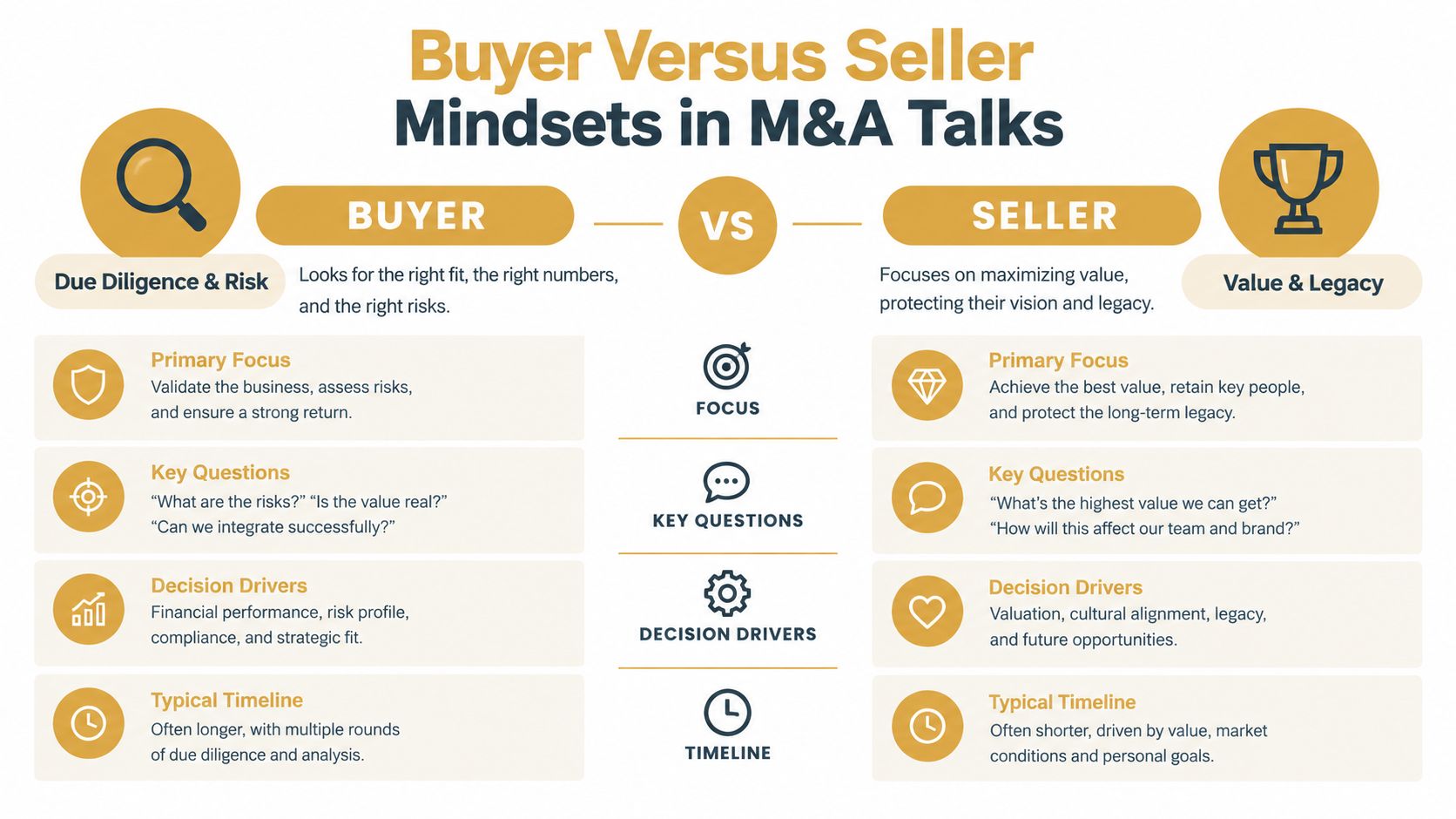
The buyer and seller may discuss the same term while solving completely different problems. A buyer sees an earnout as downside protection. A seller may see it as a discount disguised as complexity. A buyer views a working capital peg as a guardrail. A seller may view it as a mechanism that reduces the amount delivered at closing.
Understanding that difference changes how you frame the offer. You aren't trying to prove that the other side is unreasonable. You're identifying which form of certainty they value most and exchanging it for protection you need.
Two perspectives at the table
| Negotiation issue | Buyer typically prioritizes | Seller typically prioritizes |
|---|---|---|
| Valuation | A price supported by durable earnings and downside analysis | Recognition of growth, goodwill, and future potential |
| Consideration | Protection against overpaying before results are proven | Certainty and a high proportion of proceeds at closing |
| Diligence | Verification of financial, legal, operational, and customer risks | A process that doesn't undermine momentum or confidentiality |
| Control | Authority over budgets, staffing, systems, and integration | Continuity for employees, brand, customers, or legacy |
| Closing | Conditions that prevent an unsafe transaction | A clear path to signing and funding |
| Post-close | Flexibility to operate and capture synergies | Fair treatment where future payments depend on performance |
Neither side should treat these priorities as defects. They are the reason each party is willing to make different concessions.
A buyer can often offer continuity, a defined transition role, or a narrow approval right at low economic cost. A seller may place substantial value on keeping the brand intact or protecting key employees. Conversely, a seller can improve buyer confidence by accepting a precise adjustment mechanism or financing part of the purchase, while preserving a better headline valuation.
Read concessions as information
Concession patterns reveal pressure points. If a seller refuses to move on price but quickly accepts a longer transition period, certainty of legacy may matter more than the last increment of cash. If a buyer won't increase the offer but readily improves the payment schedule, liquidity may be the constraint. If either side repeatedly asks for vague language, the problem may be uncertainty about future control rather than the stated term.
Sequence concessions conditionally. Say, “If you can provide a normalized working capital level and a satisfactory customer concentration review, we can discuss more cash at closing.” That sentence links movement to evidence. It prevents the other party from treating each concession as a free gift.
The strongest negotiators make the other side feel understood without surrendering their own decision criteria.
Keep a concession log. Record the term offered, the value it has to you, the value it may have to the other side, and what you received in return. This simple record prevents fatigue from turning a series of small accommodations into a material transfer of value.
Creative Deal Structures That Bridge Valuation Gaps
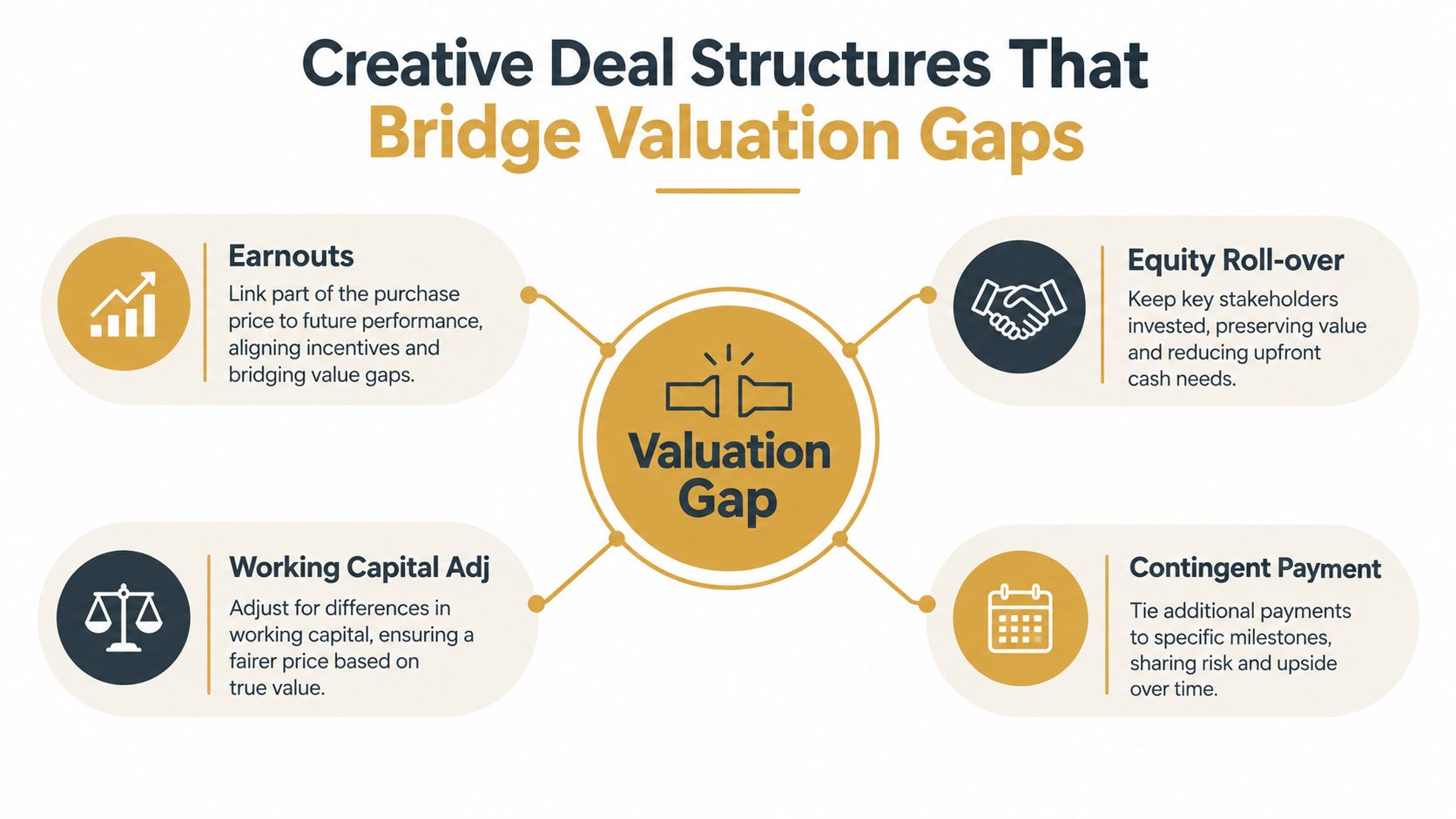
A valuation gap becomes manageable when both parties stop treating price as a single fixed number. The right structure can separate what is known at closing from what depends on future performance, while giving each party a fair method to share upside and downside.
The first question isn't, “Which structure is cleverest?” It's, “What uncertainty is this structure designed to solve?” If the uncertainty concerns future revenue, use a performance mechanism. If it concerns cash retention, address working capital. If it concerns the seller's belief in future growth, consider rollover equity. A term that doesn't solve a defined uncertainty only adds paperwork.
Match the mechanism to the risk
Earnouts work when the seller's forecast depends on a measurable result that the buyer can operate toward in good faith. They fail when the seller is judged on a metric the buyer can materially alter through integration, staffing, pricing, budget allocation, or accounting treatment. Define the metric, measurement period, permitted operating decisions, reporting access, dispute process, and treatment of a sale or termination before anyone agrees that the clause is “standard.”
Earnouts are not automatically win-win arrangements. In private M&A, they appeared in roughly 22% of deals in 2024, with the median earnout equal to 31% of closing payments, while only 50% to 60% paid out in full, according to the earnout structuring analysis. Those figures make drafting discipline more important than optimistic language about alignment.
Rollover equity can bridge a seller's higher valuation expectation when the seller is willing to retain exposure to future upside. The documents must address dilution, governance, distributions, future financing, information rights, and exit mechanics. Otherwise, the seller may receive an interest that looks valuable on paper but offers little practical influence or liquidity.
Seller financing can support a buyer's cash position and give the seller continuing economic exposure. The seller should focus on repayment priority, security, covenants, and what happens if the buyer refinances or sells. The buyer should assess whether the payment burden remains manageable if performance weakens.
Working capital adjustments protect the buyer from receiving an underfunded operation, but vague definitions create closing disputes. Specify included and excluded items, the accounting principles, the target level, the preparation process, and the review mechanism. A buyer shouldn't use the adjustment as a backdoor price reduction, and a seller shouldn't treat ordinary operating needs as distributable cash.
For a practical explanation of the trade-offs, see this guide to understanding earnouts in business transactions.
Draft for control, not just calculation
A performance payment is only as fair as the parties' ability to measure and influence the result. If the buyer controls every input but the seller bears all the performance risk, the seller has a legitimate objection. If the seller retains operational influence but the buyer bears all downside, the buyer needs boundaries.
Use objective formulas where possible. Define revenue recognition, customer cancellations, acquisitions, shared costs, extraordinary items, and changes in accounting policy. Give the seller access to reports and a timely objection process. Provide a neutral expert or defined arbitration route for technical disputes, while reserving legal remedies for genuine breaches.
The best structure doesn't eliminate disagreement. It makes disagreement narrower, more predictable, and less destructive to the relationship.
The Timing Dynamics Behind Successful Negotiations
Timing is a strategic variable, not administrative housekeeping. A buyer who rushes can miss a liability or overpay under pressure. A buyer who drags without purpose can lose seller confidence, weaken competitive position, and allow unresolved issues to accumulate.
A 2023 study of 983 worldwide unsolicited M&A deals from 1999 to 2019 found that the relationship between negotiation length and closing success follows an inverted U-shape. Completion likelihood rises as negotiations progress, then falls when discussions extend too far, according to the empirical study of negotiation timing and closing success.
That result doesn't provide a universal ideal timetable. It gives negotiators a better operating principle: move quickly when the next step reduces uncertainty, and slow down when the next step would commit capital before uncertainty has been tested.
Use milestones instead of artificial speed
Set a timetable around decision gates:
- Initial fit: Confirm strategic rationale, authority, financing capacity, and broad transaction shape.
- Evidence review: Test financial, legal, commercial, and operational assumptions.
- Structure agreement: Resolve consideration, working capital, risk allocation, and key conditions.
- Documentation: Convert agreed principles into precise definitive agreements.
- Closing readiness: Confirm funds, consents, deliverables, transition responsibilities, and communication.
Each milestone should produce a decision or a clearly defined request. “We need more time” is weak. “We need the customer contract review and a working capital schedule before we finalize the adjustment” is actionable.
The same study found that prior ownership during the negotiation period can help deal completion and may substitute for a termination fee. That finding reinforces a practical point for sellers and buyers alike: control over an asset or an established relationship can affect bargaining power, but it doesn't excuse indefinite negotiations.
Experience changes the economics of pace
A separate transaction-level study of 151 private-target acquisitions conducted between 2005 and 2010 found that negotiations averaged 170 days, with an average deal value of EUR 222 million, and that greater buyer-side lawyer expertise significantly improved the probability of favorable negotiation outcomes, according to the research on takeover negotiations and adviser expertise.
The lesson isn't that every smaller deal should take that long. It is that experienced advisers recognize which issues deserve early attention and which can wait. They also spot language that appears neutral but shifts risk in subtle ways.
Bring counsel into structural discussions before the commercial terms harden. An experienced M&A lawyer can identify whether an earnout is operable, whether a working capital definition is internally consistent, and whether a regulatory condition leaves the buyer exposed. Good counsel doesn't merely slow the process with review. They help the parties spend time on the issues most likely to affect closing and post-close stability.
A Practical Negotiation Script and Closing Checklist
A negotiation script shouldn't make you sound rehearsed. It should keep the conversation tied to evidence, alternatives, and conditional movement when emotion starts driving the room.
Open the first substantive call with a clear frame:
“We see a strong fit, but our offer has to reflect both the verified earnings and the risks that remain unresolved. We'd like to discuss the full structure, not only the headline valuation.”
That statement signals seriousness without anchoring the entire process to a single number. Ask the seller what matters most after closing, including certainty, timing, cash, legacy, employees, and continued involvement. Listen for the priority that can be addressed without weakening your core economics.
At the term sheet stage, use conditional language:
“If diligence confirms the recurring earnings and the business is delivered with the agreed working capital, we can support this valuation. If the forecasted growth is part of the seller's expectation, we can discuss contingent consideration with defined metrics and reporting rights.”
This approach keeps the price connected to facts. It also gives the seller a route to their desired outcome without requiring the buyer to pay for unproven performance upfront.
Sequence concessions deliberately
Make your first movement inexpensive to you and meaningful to the other side. That might be a transition schedule, announcement timing, or a limited change to the seller's post-close role. Preserve high-value protections, such as control of operations, clear indemnity coverage, accurate financial representations, and a workable working capital adjustment.
When a diligence issue appears, don't issue a vague threat. State the impact and offer alternatives:
“The customer concentration changes the downside case. We can address it through a price adjustment, a seller note with appropriate protection, or a contingent payment tied to retained revenue. We can't leave the risk entirely with the buyer.”
For synergy disputes, quantify the assumptions internally and communicate the range transparently. McKinsey reports that about 10% of large announced deals are canceled each year, and that 17% of mixed-consideration deals in its sample did not close. Its analysis identifies mismatched expectations around synergies and value creation, along with regulatory and political issues, among common termination drivers in its review of deals that fail to cross the finish line.
Closing checklist
Before signing, confirm the following with your legal, financial, and operating advisers:
- Purchase price adjustment: Are the working capital target, included items, accounting principles, and dispute process precise?
- Consideration mix: Does the balance of cash, notes, equity, and contingent payment match the risks each party can control?
- Representations and warranties: Are the statements specific enough to verify, with appropriate survival periods and disclosure treatment?
- Escrow and indemnity: Does the protection cover identified risks without creating an unworkable post-close burden?
- Earnout triggers: Are metrics, definitions, reporting rights, operating covenants, acceleration events, and dispute procedures explicit?
- Regulatory conditions: Does the offer address approval risk, termination rights, remedies, and any required contingency?
- Key-hire retention: Are roles, incentives, decision rights, and communication responsibilities agreed before employees hear conflicting messages?
- Transition obligations: Are customer introductions, vendor handoffs, training, systems access, and owner availability documented?
- Funds and authority: Are financing, approvals, consents, signatures, and closing deliverables ready?
Use this best-practices guide for closing a business deal as a final process reference, then have transaction counsel adapt the documents to the deal's jurisdiction and facts.
The objective isn't to win every exchange. It's to create a structure that survives diligence, preserves the buyer's ability to operate, gives the seller credible economic certainty, and leaves neither party relying on an assumption that was never written down.
Dealmaker Wealth Society provides acquisition training, negotiation and deal-structuring education, mentorship, templates, and peer support for people buying and scaling small businesses. Visit Dealmaker Wealth Society to find practical guidance for preparing your BATNA, evaluating structures, and moving from an initial offer to a defensible closing.










A Creative Business Buying Fable