
Buying a Business with a Loan: A 2026 Playbook
Buying a Business with a Loan: A 2026 Playbook

In fiscal year 2025, U.S. SBA 7(a) acquisition lending reached about $8.29 billion across roughly 7,003 deals, with average acquisition loan size rising to about $1.18 million and volume increasing 34.6% year over year (CTA Acquisitions' 2026 small-business M&A statistics). Buying a business with a loan isn't a clever exception to normal finance. It's a large, established lending channel.
The approval, however, is only the first test. A buyer can close with an attractive term sheet and still damage the business through thin working capital, optimistic seller adjustments, weak documentation, or debt service that leaves no room for operational mistakes. The 2026 playbook is therefore less about asking whether you can borrow and more about proving the company can carry the debt after ownership changes.
Table of Contents
- The Modern Capital Stack for SMB Acquisitions
- Navigating Lender Underwriting and Equity Requirements
- Preparing for 2026 Compliance and Post-Close Realities
- Why Acquisition Debt Outperforms Standard Business Loans
- The Deal Execution and Structuring Checklist
- Scaling Your Deal Flow with Expert Support
The Modern Capital Stack for SMB Acquisitions
SBA 7(a) approvals reached $37.3 billion across 78,078 loans in fiscal year 2025, while acquisition lending represented about $8.29 billion across roughly 7,003 transactions (CTA Acquisitions' 2026 market summary). That volume matters to buyers. A business acquisition is a familiar credit use, but approval alone does not make the capital stack safe after closing.
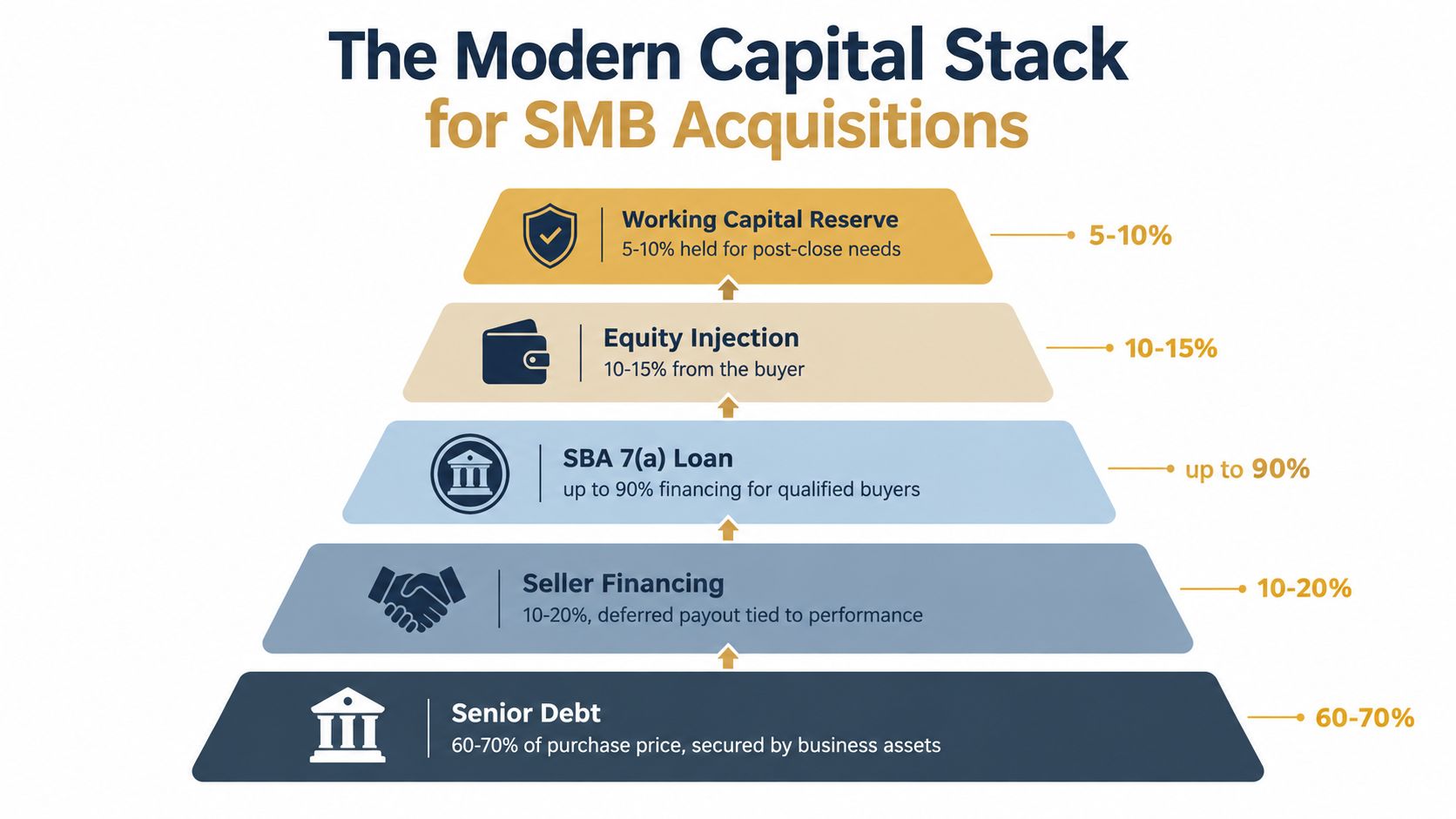
A practical structure combines several funding sources, each carrying a different risk. Small-business buyouts commonly use a senior acquisition loan for 60% to 90% of the purchase price, seller financing for 10% to 25%, and buyer equity of roughly 10% to 25% (small-business buyout financing overview). These ranges are starting points, not a pricing formula. The final mix must leave the lender protected, the seller properly subordinated, and the company with enough cash to operate.
How the layers work
Senior debt usually provides the largest share of purchase funding. The lender receives scheduled repayment and security over available business assets. The buyer gains control without paying the entire purchase price from personal savings, but the business must support principal and interest through ordinary operating swings.
Seller financing can cover part of the gap between lender proceeds and buyer cash. A seller note also keeps the seller financially exposed to the transition. That protection works only when its payment terms are subordinate to the senior lender and permitted by the loan documents.
Buyer equity shows commitment and absorbs the first loss if performance falls short. SBA-backed financing can cover up to 80% to 90% of project cost, while the buyer generally still contributes about 10% equity. The program also caps SBA-backed financing at $5 million, as noted in the same financing overview.
Working capital needs separate analysis. Payroll, inventory, receivables timing, repairs, taxes, and the owner's learning curve consume cash after closing. Putting every available dollar into the purchase can leave a profitable company unable to absorb a slow collection cycle or an unexpected repair.
Size the target from cash flow, not the asking price
Begin with seller-adjusted cash flow, then remove adjustments that will not survive the ownership transition. Owner perks, personal expenses, and one-time costs may qualify as add-backs. The lender will still test whether the buyer can eliminate them without weakening operations.
The acquisition model should show cash flow after a replacement owner salary, recurring capital expenditures, taxes, working-capital needs, and proposed debt service. That model should also reflect realistic post-close performance, including compliance costs and operating errors that a basic approval model may overlook. Set the asking price only after the cash-flow analysis establishes defensible borrowing capacity. Buyers comparing funding sources can use this equity and debt financing comparison for acquisitions to assess control, dilution, repayment pressure, and transaction speed.
Navigating Lender Underwriting and Equity Requirements
A lender underwrites repayment capacity, source-of-funds clarity, ownership risk, and the evidence supporting your forecast. Enthusiasm for the target carries little weight unless the credit file shows that the business can support the proposed debt after closing.
SBA 7(a) acquisition financing can be more financeable because the SBA guarantees a portion of the lender's exposure, typically 75% to 85%, when the transaction and borrower meet program and lender requirements (Crestmont Capital's SBA acquisition financing guide). The guarantee does not replace underwriting. The lender still tests the buyer, the company, the purchase price, and the quality of the cash flow.
Build the credit file before you negotiate hard
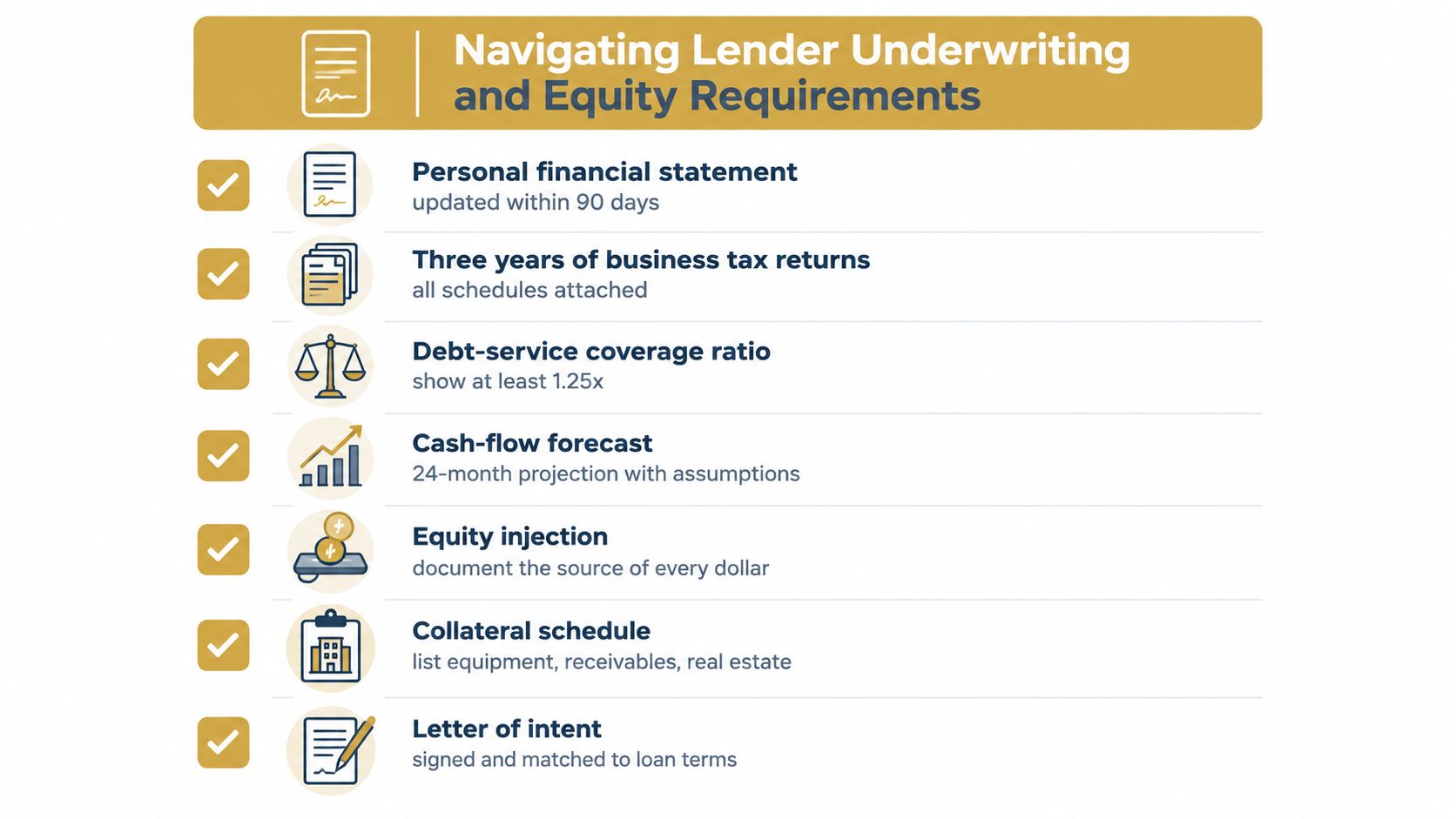
The lender package must tell one consistent story. Historical financial statements, tax returns, bank statements, debt schedules, the letter of intent, and the post-close budget should reconcile. If reported earnings differ from tax returns or bank deposits, resolve the discrepancy before underwriting exposes it.
The equity trail needs the same discipline. Show personal savings moving into a business checking account, identify the statement date, and trace the funds to escrow. Attach gift letters, partner contribution records, or source-of-funds affidavits where applicable. A clean trail is stronger than a general statement that the buyer has enough cash.
Borrowed funds, gifts, partner contributions, and personal savings can carry different documentation requirements and may change the lender's risk assessment. Assemble the evidence before the term sheet rather than reconstructing it during closing. This business acquisition funding guide can help buyers organize the financing work before approaching lenders.
Model debt service with the buyer in the business
The central test is post-close repayment capacity. The forecast should include a reasonable buyer compensation expense instead of assuming the new owner will work indefinitely without pay.
Model recurring operating cash flow, required debt payments, taxes, working-capital needs, recurring capital expenditures, and the assumptions behind revenue and margin. Run a base case, downside case, and transition case. The transition case should account for customer handoffs, employee uncertainty, delayed collections, supplier changes, and relationships that may not transfer from the seller.
Use the longer amortization terms described in the capital stack section as a payment-planning input, not as a substitute for a defensible purchase price or durable cash flow. A longer schedule can reduce required payments, but it cannot repair inflated add-backs or weak operating assumptions.
Before signing, ask how seller-note payments, standby requirements, collateral, prepayment terms, and reporting obligations will operate after closing. Buyers can use this guide to three questions to ask a lender before committing to a deal.
Preparing for 2026 Compliance and Post-Close Realities
Closing documents transfer ownership. They do not make the acquired company operationally stable or keep debt service covered.
The first year often exposes weaknesses that historical statements conceal. Customers may need reassurance, employees may question new decisions, vendors may tighten terms, and an expense described as “nonrecurring” may recur under new ownership. Scheduled payments continue through each problem, so post-close compliance and cash controls belong in the financing plan before signing.

Treat quality of earnings as a financing control
Recent reporting says a new SBA rule effective October 1, 2026 will require quality-of-earnings reports for acquisition loans of $3 million or more, adding diligence and paperwork to larger transactions (Forbes reporting on SBA changes). Buyers should reserve time and budget for that work rather than treating it as a final closing formality.
A quality-of-earnings review tests whether reported earnings represent repeatable operations. It examines customer concentration, revenue recognition, owner adjustments, working-capital requirements, unusual margins, related-party transactions, and capital expenditures. The review cannot replace judgment, but it can identify the difference between seller-presented EBITDA and cash flow a lender will accept.
Build a QoE readiness file 30 days before lender submission. Include a trailing 12-month revenue-recognition memo, a customer-concentration table with customers above 10% flagged, and an add-back evidence binder with bank-statement tie-outs. Apply conservative treatment to any adjustment that requires an extended explanation.
Make post-close compliance observable
According to the same Forbes reporting on SBA changes, many brokers say clients struggle to understand acquisition financing. The practical response is to create an evidence trail that a lender can review after closing, not merely to obtain approval.
Set ownership for covenant calculations, monthly financial close, tax filings, insurance renewals, licenses, and required lender certificates. Preserve source documents for add-backs, related-party payments, payroll, and capital expenditures. Reconcile operating accounts to the reporting package and investigate variances before they become covenant issues.
The buyer should also define escalation triggers. Examples include a missed reporting deadline, an unexplained margin decline, a customer concentration change, a material employee departure, or a vendor changing payment terms. Report material developments early, with the cause, cash effect, and corrective action documented.
Use regulatory considerations for company buyouts to check transaction-specific obligations before signing. Post-close compliance is part of preserving lender confidence and keeping the acquisition financeable.
Why Acquisition Debt Outperforms Standard Business Loans
Acquisition debt starts with an operating record. A startup loan relies more heavily on a business plan, the founder's experience, and assumptions about future demand. Acquisition underwriting can still miss risks, but lenders can examine revenue, margins, customer behavior, staffing, working-capital needs, and historical cash conversion before approving the structure.
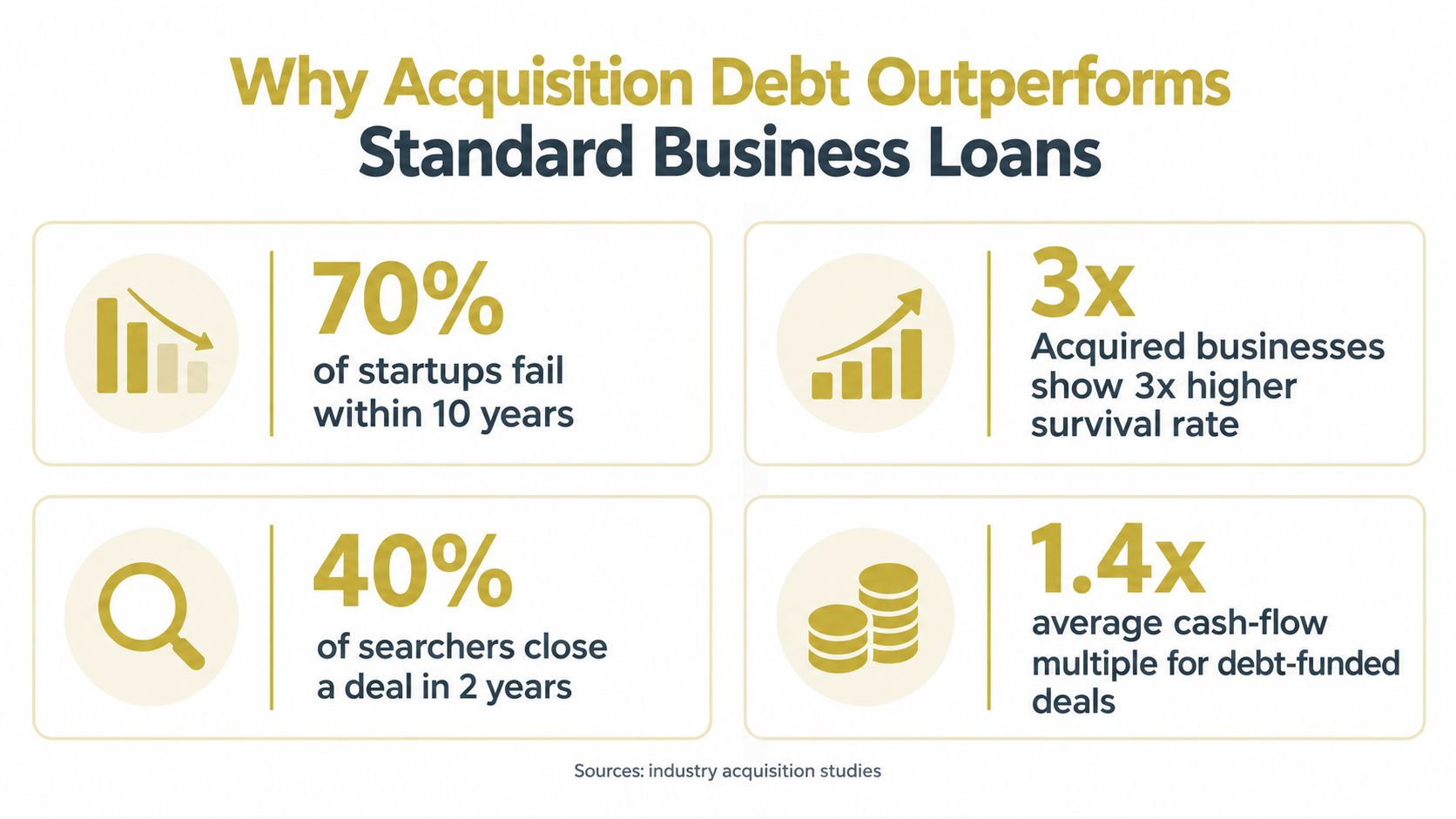
The loss data supports a disciplined acquisition thesis. Yale's review cites an annual default rate of 1.22% for business acquisition loans versus 1.64% for non-business acquisition loans (Yale review of the SBA 7(a) program%20Loan%20Program.pdf)). Other analyses of SBA loan-level data estimate 2025 acquisition-loan defaults at 1.93% versus 2.71% for non-acquisition 7(a) loans. Older cohorts reported acquisition-loan default rates of 1.68% in 2018, 1.24% in 2019, and 0.70% in 2020. Those results describe portfolio performance, not a guarantee for an individual transaction.
What the numbers mean for negotiation
The favorable trend should support disciplined structuring, not aggressive borrowing. A buyer still needs clean records, conservative adjustments, a verified equity source, and a transition plan that protects cash flow after closing.
Underwriting also turns on post-close execution. Who takes over the seller's daily responsibilities? Which customers need personal introductions? Which expenses will recur under new ownership? How much cash can the company distribute to debt service while still funding payroll, inventory, repairs, and working capital?
A credible model should show repayment capacity under slower integration, weaker margins, or delayed customer retention. That is especially important as lenders apply closer quality-of-earnings scrutiny and expect the buyer to support adjustments with evidence rather than optimistic assumptions.
Practical rule: In negotiation, cite the lower acquisition-loan default trend to justify seller-note subordination, not a higher price. Show DSCR above 1.25x in the downside case.
A standard business loan may fund expansion, equipment, or working capital, but it does not automatically address a transfer of control. Acquisition debt is structured around that change. Strong proposals connect historical cash flow to the new owner's operating plan and show how repayment remains intact if the transition takes longer than expected.
For a practical explanation of SBA 7(a) acquisition financing, review the SBA 7(a) acquisition financing explanation. The value lies in understanding lender priorities: documented cash flow, defensible adjustments, adequate equity, and a transition plan that remains financeable after closing.
The Deal Execution and Structuring Checklist
A financeable acquisition is built in sequence. Before paying for extensive diligence, confirm that normalized cash flow can support the proposed price, the buyer's compensation, and the company's post-close obligations.
Start with a repayment model
Normalize the seller's earnings first. Remove genuine one-time expenses, but retain costs that will return under new ownership. Then deduct buyer compensation, maintenance capital spending, taxes, working capital needs, and scheduled debt service. A model that works only under the seller's best assumptions needs a lower price, more equity, or different seller-note terms.
Use a worked example to test the sizing logic. Suppose the business produces $1.2 million of SDE. Subtract a $120,000 owner salary, $40,000 of capital spending, and $60,000 of taxes, leaving $980,000 available before debt service. At a 1.25x DSCR, the model supports about $784,000 of annual debt service. With 10-year amortization at 9%, that implies roughly $5.8 million of senior debt before applying the program limit, lender constraints, and required equity. The result is a ceiling for discussion, not an approval.
SBA 7(a) financing is capped at $5 million under program limits, and qualifying transactions may receive financing covering 80% to 90% of project cost, subject to lender and program requirements. The company's demonstrated repayment capacity still controls the practical debt amount.
Test the seller's story before the lender does
Review tax returns, bank statements, customer concentration, payroll, lease terms, supplier arrangements, outstanding debt, legal claims, and recurring capital requirements. Match reported revenue to deposits. Investigate every material gap between accounting profit and cash available for debt service.
Stress the model for slower customer retention, weaker margins, delayed transition support, and unexpected working-capital needs. The downside case should preserve DSCR above 1.25x, rather than relying on a rapid return to the seller's reported performance. Quality-of-earnings work also needs evidence for each adjustment, especially as 2026 SBA quality-of-earnings rules receive closer attention.
Set financing conditions, diligence access, seller transition support, and working-capital treatment in the letter of intent. A lower price can still produce a weak deal if the buyer cannot inspect records or secure enough liquidity at closing.
Package the close and the first year together
Prepare historical financials, the debt schedule, personal financial information, equity-source records, a post-close budget, an integration plan, and proposed seller-note terms before submitting the final loan package. Ask the lender to identify approval conditions that could delay closing while there is still time to resolve them. SBA 7(a) financing remains subject to lender underwriting, program compliance, and the transaction's documented cash flow.
After closing, compare actual results with the budget every month. Track revenue retention, gross margin, collections, payroll, capital spending, and debt service separately. Escalate variances when they appear, before they consume the reserve. The loan is a long-term obligation, so the operating cadence supporting repayment begins on the first day of ownership.
Scaling Your Deal Flow with Expert Support
A first acquisition rarely fails because the buyer couldn't read a loan application. It fails when the buyer can't connect sourcing, valuation, diligence, financing, and operations into one repeatable process.
A practical support system should help you screen opportunities before emotional attachment develops, compare seller adjustments against bankable cash flow, and prepare lender materials while the deal is still being negotiated. It should also give you a place to pressure-test the transition plan with people who understand that a signed purchase agreement doesn't solve customer retention, staff continuity, or cash control.
Build a repeatable acquisition operating system
Use templates for target screening, financial normalization, diligence requests, lender packaging, and post-close reporting. Keep a written record of each assumption. When the lender challenges an add-back or the seller disputes a working-capital adjustment, you should be able to show how the number entered the model and what evidence supports it.
Mentorship is most useful when it addresses a live decision. A peer may spot that the seller note is too aggressive, that the buyer's salary was omitted, or that a proposed reserve won't cover the company's collection cycle. Those observations can prevent a structurally weak deal from reaching expensive legal and diligence stages.
Dealmaker Wealth Society offers online acquisition training, live coaching, peer support, deal-structuring feedback, capital-raising education, and playbooks for due diligence, debt-funded buyouts, roll-ups, and post-acquisition growth. That type of structured environment is one option for buyers who want a disciplined process rather than isolated advice gathered from unrelated lenders, brokers, and online forums.
The objective isn't to collect more acquisition content. It's to turn each opportunity into a clear decision: proceed, renegotiate, restructure, or walk away. Buying a business with a loan becomes sustainable when the buyer treats financing, compliance, and integration as one operating discipline.
If you're evaluating a target, use a documented cash-flow model, verified equity source, lender-ready diligence file, and 12- to 18-month transition budget before you submit terms. Visit Dealmaker Wealth Society to access structured training, mentorship, peer feedback, and practical acquisition playbooks for building and executing that process.












A Creative Business Buying Fable
