Seller Financing Terms: The M&A Playbook
Seller Financing Terms: The M&A Playbook
You've found a business you can operate, the seller has accepted your offer, and the bank is willing to finance most of the purchase. Then the term sheet arrives. The monthly payment looks manageable, but a large balance remains due at maturity. The deal appears affordable until you ask the question that matters most: can the business generate enough cash to service the note and remove the balloon without depending on a perfect refinance?
Seller financing terms determine whether an acquisition gives you operating room or traps you inside a future liquidity crisis. Interest rate matters, but it's only one part of the equation. Amortization, maturity, subordination, collateral, covenants, and default remedies decide how much cash leaves the business each month and how much risk waits at the end.
Table of Contents
- The Reality of Seller Financing in Modern Acquisitions
- Mapping the Capital Stack and Seller Note Placement
- Core Mechanics of the Promissory Note
- Cash Flow Safety Versus Bridge to Refinance
- Security Covenants and Default Protections
- Negotiation Tactics for Term Sheet Alignment
- Evaluating Seller Notes Against Private Credit
The Reality of Seller Financing in Modern Acquisitions
A first-time buyer often starts with the wrong assumption. They believe the purchase must be funded entirely by a bank loan, personal savings, or outside equity. In practice, many small-business acquisitions close with a combination of buyer equity, senior debt, and a seller note that fills the gap.
Consider a buyer reviewing a term sheet for a stable service business. The bank will not fund the entire purchase price, and the buyer doesn't want to drain every liquid asset at closing. The seller, meanwhile, wants a credible buyer and a price that reflects years of work. A seller-financed note gives both parties a way forward. The buyer preserves working capital, while the seller receives a stream of principal and interest instead of relying solely on a bank's approval.
A large industry summary reported that 48% of business sales in 2023 involved seller financing, with seller notes typically representing 13% of financing for businesses valued under $500,000 and 8% to 10% for deals between $500,000 and $5 million. The same summary described standard note terms of 7% to 10% interest over five to seven years, while another practitioner dataset reported an average seller-financed amount equal to 22% of transaction value, a median of 25%, an average term of 5.3 years, and average interest of 5.68%. These figures are reported in this industry overview of seller financing in business sales.
Why sellers carry paper
Sellers don't usually finance a portion of the transaction because they want to give the buyer a favor. They do it because the note can solve a commercial problem.
- Valuation gap: A seller may believe the business deserves a higher price than a lender will support. Carrying part of the price can help bridge that disagreement.
- Buyer commitment: A buyer who contributes meaningful equity and accepts a seller note has financial exposure after closing. That can reassure the seller that the buyer is committed to operating the business responsibly.
- Transaction flexibility: The seller can make the business accessible to buyers who have a sound operating plan but can't obtain enough institutional debt.
- Confidence signal: A seller willing to leave capital invested is showing some confidence in the business's future cash generation, although it isn't a guarantee that the business will perform.
Seller financing also matters to the seller's longer-term transition. Owners thinking about succession should consider the financing structure alongside governance, tax planning, and continuity, and a resource on how to plan your business legacy in Texas can help frame that broader conversation.
The practical lesson is simple. A seller note isn't automatically a concession, and it isn't automatically a bargain. It's a negotiated risk-sharing instrument. Buyers should review seller financing options in business acquisitions as part of the full capital plan, then judge the note by the cash it consumes and the risk it leaves at maturity.
Mapping the Capital Stack and Seller Note Placement
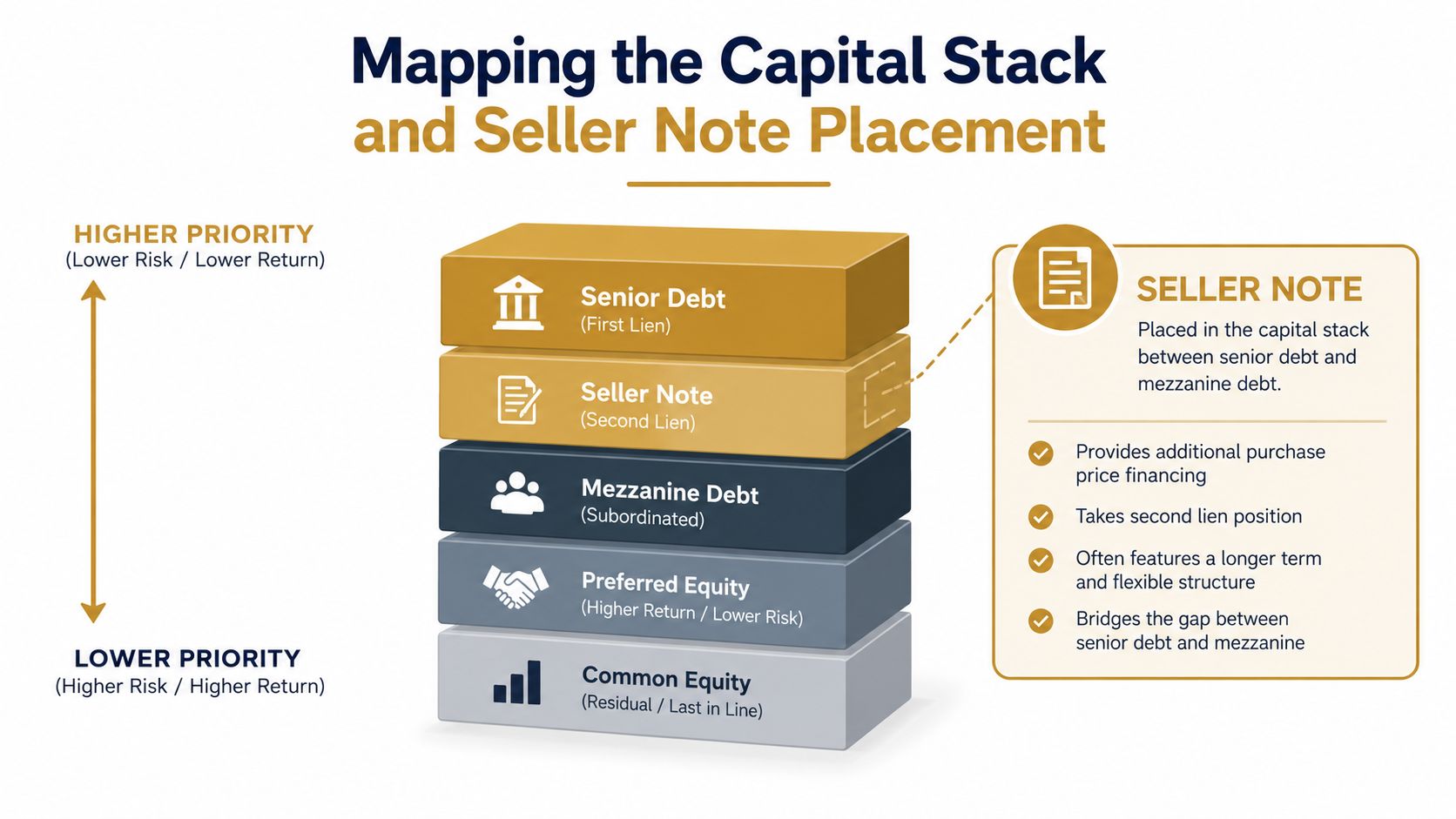
Before discussing interest, map the money from first priority to last. A seller note can reduce the buyer's cash requirement, but it also adds borrowed capacity and usually sits behind senior debt. That position affects payment priority, collateral rights, and the seller's willingness to accept a particular structure.
A common capital stack uses senior lender funding of about 60% to 80% of the purchase price, buyer equity of 10% to 25%, and a seller note for the remaining gap, according to guidance on seller financing risks, rewards, and deal structures. The same source describes seller notes commonly representing 10% to 30% of deal value, with minimum down payments frequently around 10% to 20% in lower-middle-market transactions.
The hierarchy matters
Senior debt gets paid first. The senior lender typically holds the primary lien over the business's assets and wants the seller note subordinated through an intercreditor or subordination agreement. That arrangement protects the lender if the acquisition underperforms, but it limits what the seller can do after a default.
Buyer equity absorbs the first loss. It reduces lender exposure and demonstrates that the buyer has capital at risk. Seller financing fills the space between the buyer's available equity and the amount the senior lender will advance. The note may be secured by business assets or stock, but the seller generally receives payment after the senior lender.
That structure creates two different effects:
- Lower cash needed at closing. The buyer doesn't have to fund the full gap with personal capital.
- Higher future obligations. The business must support the seller note in addition to senior debt, payroll, taxes, working capital, and operating reinvestment.
A seller note can therefore make a deal closable while making the post-close budget tighter. The correct question isn't whether the note completes the capital stack. It's whether the combined debt service leaves enough room for weak months, customer losses, equipment needs, and delayed receivables.
Subordination isn't a technical footnote
A subordinated seller should understand that the senior lender may control remedies, payment restrictions, and access to collateral. The seller may be prohibited from accelerating the note or enforcing its lien while the senior loan remains in default. The buyer should understand this too, because a dispute between the senior lender and seller can affect operational freedom.
Build a financing model that shows senior debt and seller debt together. The acquisition financing options framework is useful for organizing that analysis, but the term sheet still needs deal-specific review by financing and legal professionals.
Capital stack rule: The seller note is not free capacity. Every dollar it adds must be tested against the business's actual cash conversion, not just its reported earnings.
Core Mechanics of the Promissory Note
A promissory note turns a financing promise into a payment obligation. Buyers should read it as a cash-flow document first and a legal document second. The headline rate can look attractive while the amortization schedule creates an unaffordable maturity balance.
Seller-financed acquisition notes are commonly structured at about 5% to 8% annual interest, with three- to seven-year repayment terms and usually full amortization, according to this explanation of seller-financed acquisition structures. The same source distinguishes full amortization from balloon-heavy structures, a distinction that should drive the negotiation.
Interest is only the visible price
The interest rate determines the cost of borrowed capital, but it doesn't tell you the monthly payment by itself. The payment also depends on the principal balance, the amortization period, the payment frequency, and whether interest accrues during any deferral period.
A note at 7% over five years can require heavier monthly principal repayment than a note at the same rate amortized over seven years, even though the shorter note may reduce total interest paid. Those five-year and seven-year examples fall within the seller-financing ranges reported in the source above. The shorter schedule improves the seller's recovery timeline but may leave the buyer with less cash for growth.
| Term Length | Interest Rate | Amortization Type | Monthly Payment |
|---|---|---|---|
| Five years | 7% | Fully amortized | Higher payment because principal is repaid faster |
| Seven years | 7% | Fully amortized | Lower payment, with more interest paid over time |
| Five years | 7% | Interest-only with balloon | Lowest scheduled payment, followed by a large maturity balance |
| Seven years | 7% | Partial amortization with balloon | Moderate scheduled payment, with a balance still due at maturity |
The table compares payment behavior rather than a specific loan amount. A buyer should plug the actual principal into an amortization schedule and review the monthly payment alongside payroll, taxes, capital expenditures, and working-capital needs.
Amortization changes the risk location
A fully amortized note forces principal reduction throughout the term. That increases the monthly burden, but it steadily reduces the balance and lowers the amount that must be refinanced or paid at maturity.
An interest-only note preserves cash during the early operating period. That can help a buyer complete a transition, fund a turnaround, or absorb seasonality. The trade-off is severe. Principal doesn't fall meaningfully during the interest-only period, so the buyer may reach maturity with nearly the same obligation that existed at closing.
Partial amortization sits between the two. It lowers the scheduled payment compared with full amortization, but it creates a balloon. That balloon isn't a problem merely because it's large. It's a problem when the buyer hasn't identified a reliable source of repayment.
Read the payment schedule as an operating constraint
Ask three questions before accepting a schedule:
- What happens in a weak month? Model a period in which collections slow or gross margin narrows.
- What gets postponed to make the payment? If debt service depends on delaying hiring, maintenance, taxes, or vendor payments, the note is already too aggressive.
- What balance remains at maturity? A refinance plan should identify the lender profile, required performance evidence, and likely collateral, not assume a future bank will approve the loan.
A lower monthly payment isn't necessarily a safer term. It may just move the danger from the operating budget to the maturity date.
Cash Flow Safety Versus Bridge to Refinance
Two buyers can accept the same interest rate and term while taking completely different risks. One buyer structures the note around cash-flow safety. The other expects to refinance before maturity. Those are different deal architectures, and they shouldn't be documented as if they were interchangeable.
A cash-flow-safe note prioritizes predictable principal reduction and a payment the business can carry without heroic growth. A bridge-to-refinance note prioritizes near-term liquidity, often by using partial amortization, interest-only payments, or a balloon. The second structure can work, but only when the refinance assumptions are conservative and documented.
Cash-flow-safe structure
The buyer starts with debt-service capacity, not the seller's preferred maturity date. The note is amortized in a way that steadily reduces principal, and the payment leaves room for normal operating volatility. The buyer may accept a higher rate or provide stronger collateral in exchange for a longer repayment profile.
This structure works best when the buyer wants to own and operate the business without depending on a specific exit event. It also reduces the risk that a credit market disruption will arrive just as the seller's note matures.
The main drawback is immediate. More principal repayment means more cash leaves the business each month. A buyer who underestimates working-capital needs can create an operational problem even while reducing long-term refinancing risk.
Bridge to refinance
The bridge structure lowers scheduled payments and preserves cash during the transition. The buyer might expect improved financial reporting, operational improvements, or a stronger lending profile to support refinancing later. That expectation must be tested before closing.
A balloon-heavy note pushes more default and refinancing risk into the final payment date. If the business misses its targets, the buyer may be unable to refinance. If the credit market tightens, a lender may reject the application even when the business remains sound. The buyer then faces an extension negotiation, a forced sale, or a default under the note.

Protect the bridge before relying on it
If refinancing is part of the plan, negotiate protections before closing rather than asking for relief after the business struggles.
- Extension option: Define a process for extending maturity if the buyer is current and making reasonable refinancing efforts.
- Cash sweep: Use excess cash to reduce the seller note when performance exceeds the base plan, while preserving an agreed operating reserve.
- Performance reporting: Establish regular financial reporting so the seller sees problems early rather than discovering them at maturity.
- Balloon flexibility: Tie any maturity extension to objective conditions, such as lender underwriting in progress or a documented refinance application.
- Collateral clarity: Confirm how UCC liens interact with senior lender liens and whether the seller can enforce its security interest independently.
A UCC lien gives the seller a claim against specified business assets, but it doesn't make weak cash flow disappear. The buyer should treat collateral as a remedy that may be exercised after failure, not as evidence that the payment schedule is safe.
Refinance rule: If the deal only works after a future lender approves a new loan, the buyer should negotiate the seller note as a conditional bridge, not pretend it's permanent financing.
Security Covenants and Default Protections
The promissory note defines the obligation. The security agreement defines what the seller can reach if the buyer fails to perform. Covenants define what the buyer must do while the note is outstanding. Together, these provisions determine whether a temporary cash-flow problem becomes a negotiated workout or an immediate control fight.
A seller may request a lien over business assets, a pledge of stock, and a personal guarantee. Those protections can be reasonable, particularly when the seller is subordinated to senior debt. They also need boundaries. A broad security package can give the seller influence over essential operating assets, while an unlimited personal guarantee can expose the buyer's personal balance sheet to business volatility.
Separate monitoring from control
Financial covenants can require timely statements, tax compliance, insurance, maintenance of collateral, or restrictions on additional debt. Operating covenants may limit asset sales, owner distributions, acquisitions, or changes in the business. The purpose should be clear: protect repayment capacity without preventing the buyer from running the company.
A covenant breach doesn't always mean the business has failed. A late report, technical breach, or temporary payment issue can occur while customers, employees, and vendors remain intact. The documents should distinguish between a curable breach and a serious default.
Useful protections include:
- Cure period: Give the buyer a defined opportunity to correct a missed payment or technical breach.
- Notice requirement: Require written notice that identifies the breach and the action needed to cure it.
- Standstill agreement: Prevent immediate enforcement while the buyer and senior lender work through a documented remedy.
- Cross-default limits: Avoid making every minor breach under another agreement an automatic seller-note default.
- Workout process: Establish reporting, payment adjustments, or an extension discussion before foreclosure or asset enforcement.
The seller's subordination agreement also matters. If the senior lender controls collateral enforcement, the seller may not be able to act independently. The buyer should understand which creditor controls the remedy, how payments can be blocked, and whether the seller can accelerate the note.
For a plain-language introduction to the promises lenders monitor, review this guide to business covenants.
The legal documents should match the operating reality. A buyer planning a turnaround needs room to invest. A seller seeking a clean exit needs reliable reporting and clear remedies. Neither party benefits from vague default language that turns a solvable problem into litigation.
Negotiation Tactics for Term Sheet Alignment
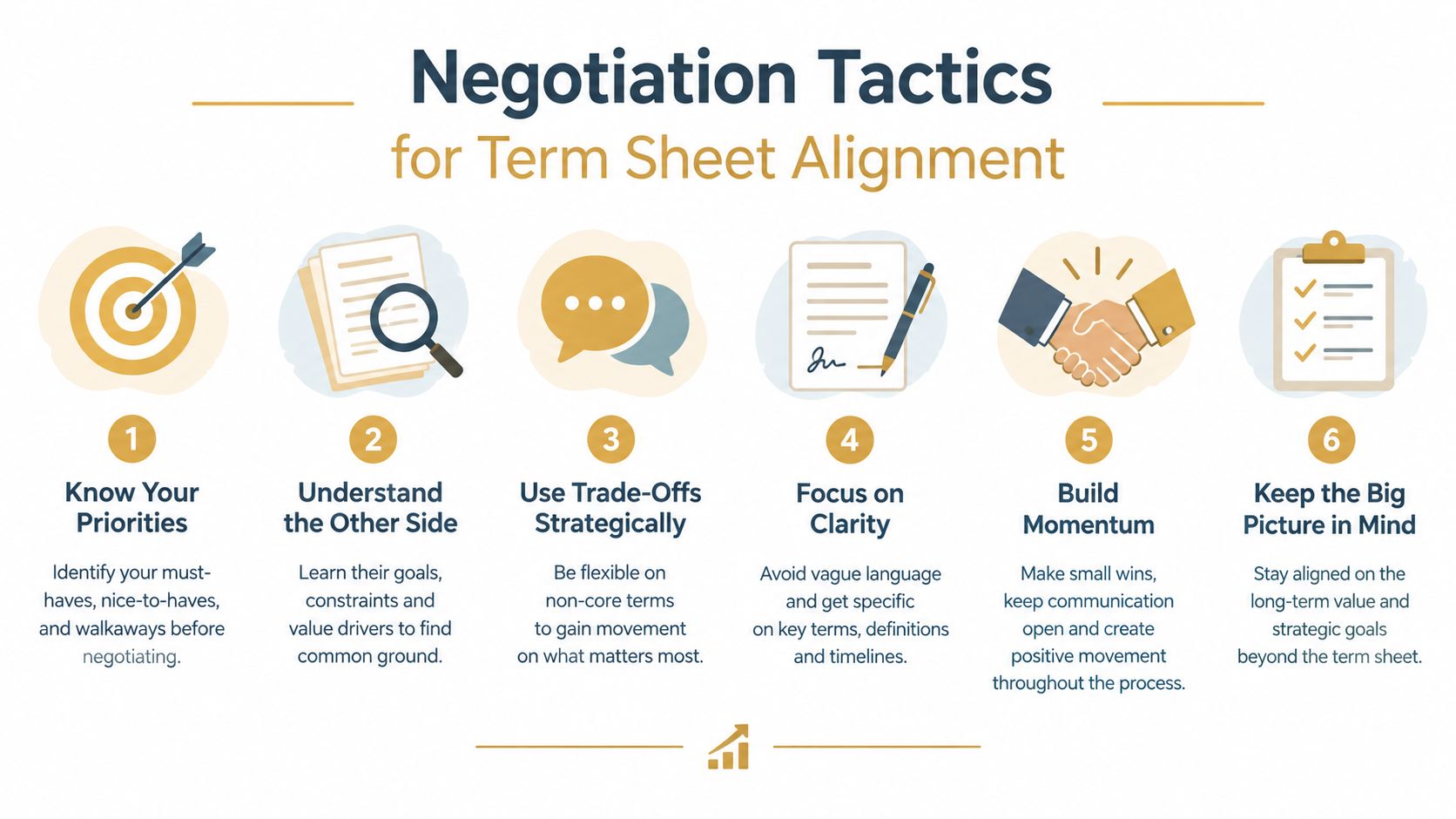
The strongest negotiation doesn't ask, “How do I get the lowest rate?” It asks, “Which combination of rate, payment, maturity, collateral, and control gives both parties a reason to support the deal?”
Sellers often care about more than the nominal interest rate. They may want a higher return for carrying risk, a clear path to repayment, protection against mismanagement, or confidence that the buyer will preserve the business. Buyers need cash-flow headroom, operational freedom, and protection against a maturity cliff. Those needs can be traded across the term sheet.
Trade price for structure carefully
A seller may accept a longer amortization period if the buyer offers a stronger rate, more equity at closing, better reporting, or a reasonable guarantee. That trade can improve monthly cash flow without asking the seller to absorb every risk.
The buyer should compare the total cost of each package, not isolate one term. A lower rate with a short balloon may be more dangerous than a higher rate with full amortization and no maturity cliff. A smaller down payment may preserve cash, but it can increase the note balance, monthly obligation, or seller's demand for collateral.
Present two or three complete alternatives rather than a list of disconnected requests:
- Stability option: More principal paid during the term, predictable payments, and limited maturity risk.
- Transition option: Lower early payments, a defined interest-only period, and a scheduled review before any balloon.
- Performance option: A fixed note for the base purchase price, with additional consideration tied to clearly defined post-close results.
Use earn-outs only where measurement is clean
An earn-out can bridge a valuation disagreement, but it isn't a substitute for a poorly designed seller note. Define the metric, reporting method, decision rights, accounting treatment, and dispute process before closing. Revenue, gross profit, customer retention, and cash collections can produce very different outcomes, especially when the buyer changes pricing, staffing, or marketing.
The seller may prefer fixed debt because it offers contractual certainty. The buyer may prefer contingent consideration because it limits payment for performance that never arrives. A blended structure can align those interests, but only if the buyer retains enough control to operate the business and the seller accepts that performance may change under new ownership.
Negotiate the prepayment right
A buyer planning to refinance should avoid a punitive prepayment penalty. A seller may reasonably want compensation for losing expected interest, but the clause should not make refinancing uneconomic. Offer a stronger reporting package, a rate premium, or a minimum interest commitment in exchange for the right to repay early.
Negotiation principle: Trade certainty for flexibility. Sellers value predictable repayment, while buyers value room to operate. Put a price on each instead of treating either preference as non-negotiable.
Evaluating Seller Notes Against Private Credit
Seller financing isn't automatically the cheapest capital. Its value comes from flexibility, access, alignment, and the seller's willingness to structure around the business. A buyer should compare the full economic and control package against other private credit options.
Recent market commentary cited seller-financing pricing around 6% to 10%, compared with 11% to 16% for mezzanine debt and 12% to 18% for preferred equity, as reported in this comparison of seller financing and private capital layers. Those ranges are directional market commentary, not a quote for any specific acquisition.
Mezzanine debt may offer more institutional process and a larger funding solution, but it can bring heavier covenants, fees, warrants, or stricter reporting. Preferred equity doesn't require scheduled principal repayment in the same way, yet it can be expensive through preference rights, participation, dilution, and investor control.
A seller note may sit below those alternatives on the headline cost of capital, but the seller can impose unique constraints. The former owner may retain a lien, require a personal guarantee, restrict distributions, or remain involved in decisions. That involvement can help during transition, or it can create friction if the buyer and seller disagree about strategy.
A 2026 market source also described situations in which down payments are compressing and 6% to 8% is becoming common in some transactions, while cautioning that the pattern isn't fully tested across sectors or geographies. A lower down payment isn't automatically favorable. If it comes with a higher rate, shorter amortization, tighter covenants, or a larger balloon, the buyer may be shifting cost from closing to future cash flow.
The comparison should cover:
- Total interest and fees.
- Monthly debt service.
- Principal remaining at maturity.
- Collateral and guarantee requirements.
- Restrictions on distributions and additional borrowing.
- Ability to refinance or prepay.
- Control rights after a default.
- Dilution or participation rights for equity capital.
The right seller financing terms are the ones the business can carry through an ordinary bad period, not merely the terms that allow the buyer to close. Build the model from cash flow backward, negotiate the maturity risk directly, and have counsel confirm that the note, security documents, and senior lender agreements work together.
Dealmaker Wealth Society offers acquisition training, mentorship, peer support, and practical playbooks for sourcing deals, completing due diligence, raising capital, and negotiating structures such as seller notes. Visit Dealmaker Wealth Society to get guidance on evaluating seller financing terms and building a capital stack that fits the business's real cash flow.

From the Dealmaker Blog













A Creative Business Buying Fable