Buying a Turnkey Business with Confidence
Buying a Turnkey Business with Confidence

The most popular advice about buying a turnkey business is also the most dangerous: buy an established company and you can skip the risk of starting from scratch. You can skip the startup phase, but you can't skip the risk. A business can have years of revenue and still depend on the seller for its customers, decisions, and day-to-day know-how.
Treat a turnkey acquisition as a system you're buying, not a history you're buying. The test is whether its earnings, relationships, contracts, and operating routines can survive the seller's departure, and whether you can finance the purchase without draining the cash the business needs to run.
Table of Contents
- What Makes a Turnkey Business Worth Buying
- Source Businesses Before You Fall in Love With One
- Evaluate Earnings and Value the Business
- Run Due Diligence Through Gated Evidence Reviews
- Align Financing With the Real Risk
- Close the Deal Without Giving Away Control
- Make the First 100 Days Prove the Thesis
What Makes a Turnkey Business Worth Buying
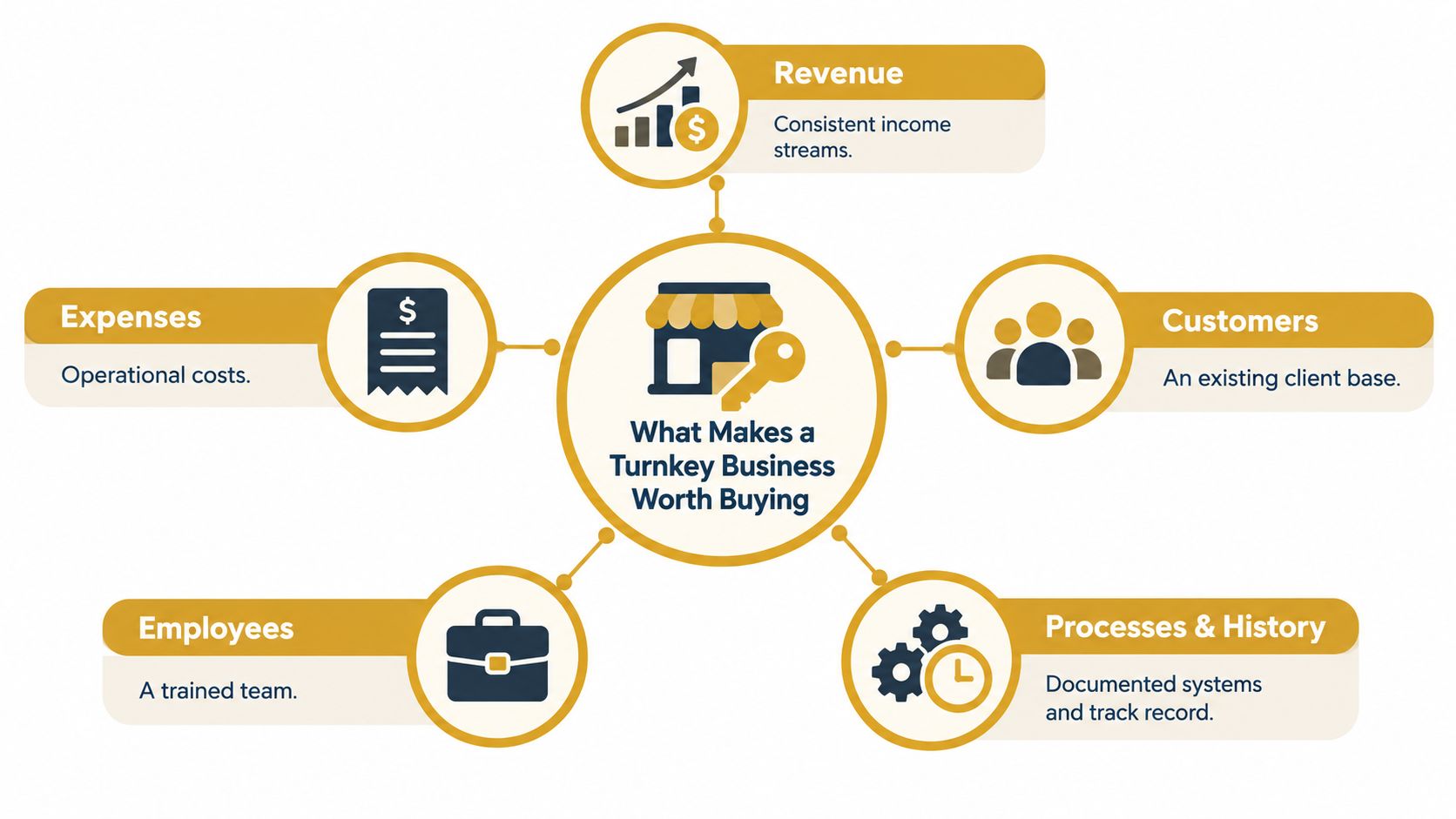
A turnkey business is an operating company with revenue, expenses, customers, employees, processes, and an operating history that can transfer to a new owner. That history gives you evidence to examine, but it doesn't make the company safe. U.S. Bureau of Labor Statistics data show that just 34.7% of private-sector business establishments born in March 2013 were still operating in March 2023. Survival also varied by industry: the 10-year rate was 50.5% in agriculture, forestry, fishing, and hunting, compared with 29.1% for information businesses and 24.5% for mining, quarrying, and oil and gas extraction (BLS establishment-survival data).
Those figures explain why buyers consider acquiring an existing operation, but they don't prove that any particular company is a sound purchase. A track record is something to investigate, not a promise of future performance. The important distinction is between a business that has operated and one that can keep operating after ownership changes.
Follow the money and the knowledge
Revenue is what customers pay. Profit is what remains after expenses under the accounting method used. Cash generation is what the business produces after the timing of collections, payments, debt, and working-capital needs. Those measures aren't interchangeable, and none alone tells you whether the earnings will transfer to you.
Owner-dependent earnings are particularly easy to overvalue. A seller may personally hold key customer relationships, approve routine decisions, or perform work that the business hasn't staffed or documented. If those responsibilities disappear at closing, the buyer may need to replace them, retain the seller temporarily, or accept that some revenue could be at risk.
The test is not whether the seller can run the company. It's whether the company can run without the seller.
The strongest candidate isn't automatically the one with the highest advertised EBITDA. It's the one whose cash flow you can verify and whose customers, contracts, employees, and routines can move to a new owner. Evaluate transferable earnings, not just historical earnings.
Source Businesses Before You Fall in Love With One
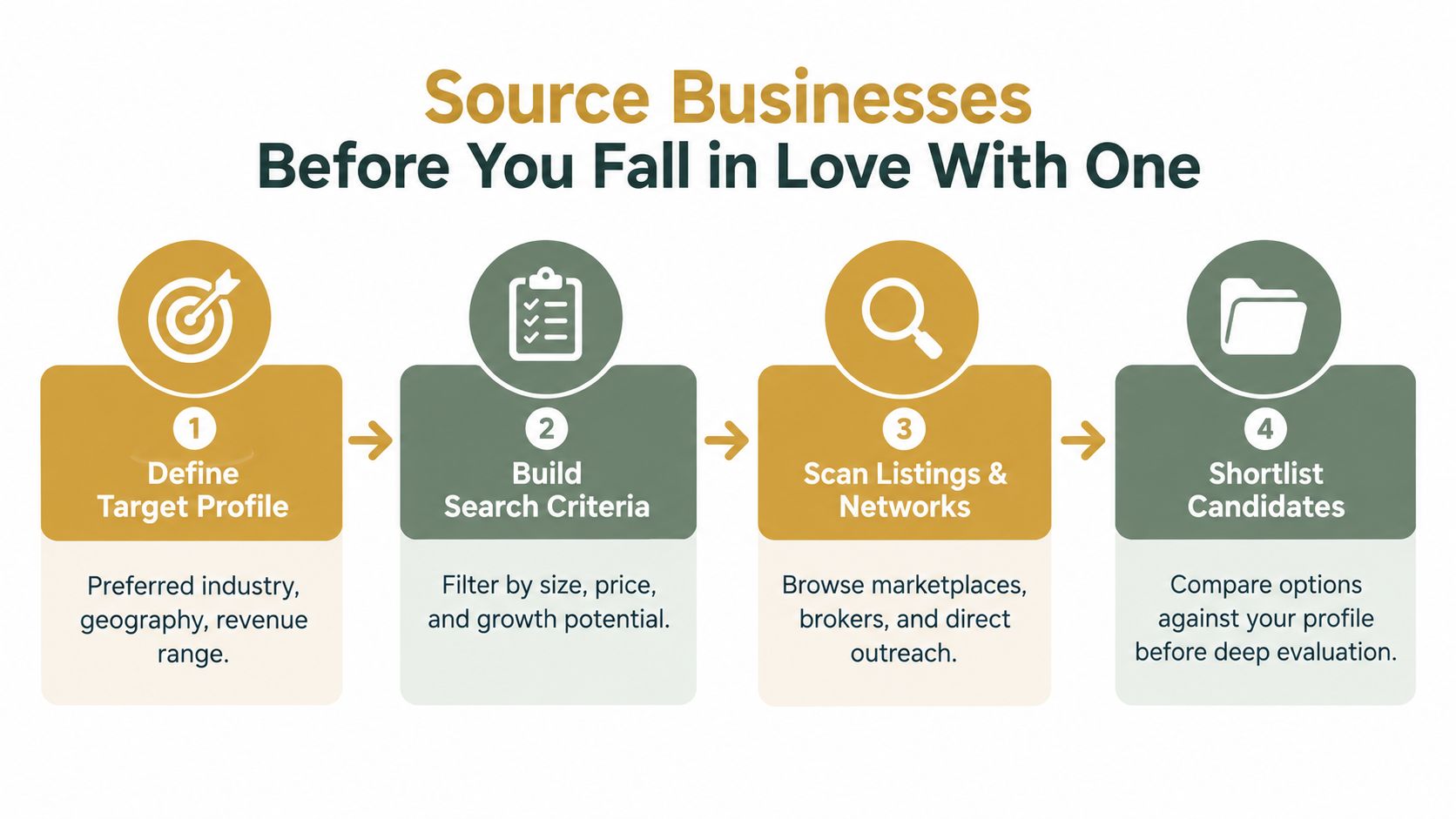
Don't start with listings. Start with a target profile. Write down the industry and geography you understand, the operating model you can manage, the owner involvement you can accept, the capital you can access, and the risks you won't take. Include preferred revenue characteristics, such as repeat purchasing or contracted work, but don't treat any seller's label for those earnings as proof.
Build a repeatable search
Use more than one channel: business brokers, online marketplaces, professional advisers, acquisition communities, and direct conversations with owners. Keep a simple pipeline so each opportunity gets the same initial review. A listing that looks compelling shouldn't get a pass on questions you'd ask of a less polished seller.
For every candidate, ask about the source and consistency of earnings, customer concentration, seasonality, staffing, leases, transferable contracts, and why the owner wants to sell. Request a confidential information package, financial statements, and the seller's written answers before paying for extensive diligence. Then arrange a walkthrough, in person or online, to see how work flows and who makes decisions.
A buyer seeking recurring revenue and documented processes might compare several service businesses, then reject the superficially cheaper one whose earnings rely heavily on a single customer. That isn't a missed bargain if the customer can leave after the sale. It's a sound screening decision made before the buyer incurs major professional fees.
If you're building a repeatable pipeline rather than browsing at random, this guide to building and fueling a deal origination machine can help organize outreach and follow-up. For buyers considering a salon or gym, a resource on loyalty programs for salons and gyms can also prompt useful questions about repeat visits, customer retention, and how those relationships are managed.
Use a shortlist to compare candidates against your original profile. If a seller can't provide basic records or answer straightforward operating questions, don't explain away the gap. Move on, or pause until the evidence is available.
Evaluate Earnings and Value the Business
An asking price is a seller's position, not evidence of value. Start by normalizing at least three years of financial statements and bank records. Check whether reported revenue appears in bank deposits and can be reconciled to tax filings, customer invoices, and payment-processor records. Identify owner compensation and personal expenses, but don't assume every adjustment is legitimate. If an expense would return under your ownership, it isn't a real saving.

Separate recurring sales from one-time work, and check whether gross margins hold up across periods and customer types. Then estimate the cash the business needs to operate: inventory, payroll, supplier payments, and the time between delivering work and collecting money. A purchase price that leaves no cushion for ordinary working-capital needs can turn a profitable company into a cash problem.
For a practical example of reading income and expense categories, buyers can review this guide to vending business profit statements. Use it as a learning aid, not as a substitute for reconciling the target company's own records.
Price the transfer risk, not just the profit
Check customer concentration, retention, supplier dependence, lease obligations, debt, and how much income depends on the seller. Each can change what earnings are worth to you. A strong profit figure means less if a major customer can leave, a lease can't transfer, or the seller is the only person who can deliver the service.
| Business profile | What may appeal | What to test before setting a price |
|---|---|---|
| High profit, owner-dependent | Attractive headline earnings | Replacement cost, customer relationships, and how revenue changes if the seller exits |
| Lower profit, documented and delegated | Clearer continuity and handover | Whether records support the earnings and whether the team can maintain service |
Value the business only after you understand those risks and the cash required to operate it. Compare the asking price with independently verified earnings, the deal's financing demands, and the return you require for taking on its risks. The seller's narrative can suggest what to investigate; it can't replace the evidence.
This video provides additional context for thinking about business financial analysis. Watch it alongside your own review of the company's records.
Run Due Diligence Through Gated Evidence Reviews
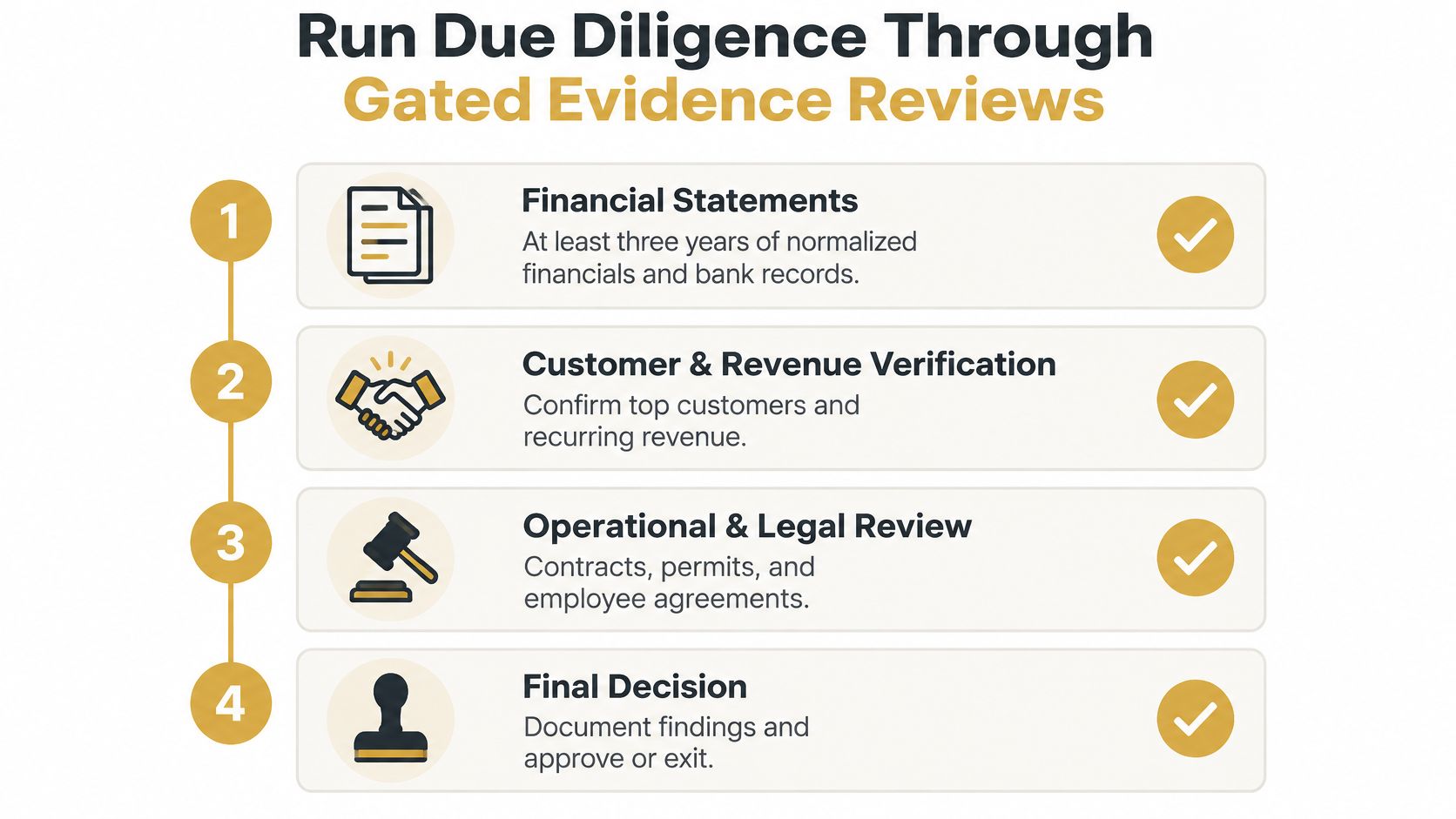
Diligence should advance only when each review produces evidence and a recorded decision. Don't let a persuasive seller narrative, a deadline, or momentum carry the deal past an unanswered question.
Move from financial proof to operating proof
Gate one is financial verification. Normalize at least three years of statements and bank records, then reconcile revenue to tax filings, payment processors, invoices, and deposits. If the records don't agree, stop and resolve the differences before treating earnings as dependable.
Gate two is commercial and cash-flow review. Examine customer concentration, recurring-revenue retention, gross-margin stability, working-capital requirements, debt, and supplier dependence. Ask whether customer contracts renew, whether important terms change on a sale, and what the business needs to pay its bills while waiting for customers to pay.
Gate three covers legal, operational, and human dependencies. Review litigation, licenses, leases, intellectual property, employee obligations, and contract-assignment requirements. Then conduct a transferability audit: identify undocumented routines, customer and supplier relationships held by the owner, decisions no one else is authorized to make, and the seller's specific transition responsibilities.
A readiness check for AI agents and business systems may help organize questions when the operation relies on automated tools or technology. It doesn't replace review of the company's contracts, access rights, records, or actual workflows.
Make every unresolved issue actionable
Keep a red-flag register. For each issue, record the evidence source, financial impact, likelihood, person responsible for resolving it, and required remedy. An item should not disappear from the register because the seller says it's unlikely to matter. Close it with evidence, turn it into a contractual protection, accept it knowingly, or walk away.
Research covering more than 900 M&A transactions found better outcomes and lower premiums for medium-length diligence, averaging 139 days, than for very short or very long reviews. Small-business diligence commonly runs about 30–90 days, and a practical target for a straightforward acquisition is 45–60 days, with more time needed when records or contracts are incomplete (guidance on the due-diligence timeframe). Don't confuse speed with discipline. Compressed diligence can leave liabilities undiscovered; an unnecessarily prolonged process can exhaust both parties and imperil the deal.
At the final gate, convert findings into price adjustments, escrow or holdbacks, seller representations, transition duties, and explicit closing conditions. If a critical assumption can't be independently verified or adequately protected, don't close.
Align Financing With the Real Risk
Work out whether a deal is financeable before you commit heavily to final valuation and negotiations. A company can look affordable against its stated earnings while leaving too little cash for working capital, required improvements, or a difficult transition. Start with your available equity and borrowing capacity, then stress-test the purchase under weaker revenue and higher operating needs.
| Structure | Potential advantage | Risk to test |
|---|---|---|
| Buyer equity | No scheduled lender payments | Uses cash that may be needed after closing |
| Business debt | Can preserve some buyer capital | Debt service can strain cash flow when earnings fall |
| Seller note | Keeps some payment dependent on the seller's willingness to finance | Terms, subordination, and seller acceptance need agreement |
| Earn-out | Ties part of payment to agreed future results | Disputes can arise if metrics or operating control are unclear |
| Equity partner | Adds capital and may bring useful capabilities | Shares ownership, control, and future returns |
Consider a business whose underwritten earnings support conventional debt, but whose cash flow becomes inadequate after revenue falls or working-capital needs rise. If the seller also refuses to finance any part of the purchase, the deal may not work at the proposed price. The right response isn't to stretch your assumptions. Rework the price, find a partner, negotiate a different structure, or pass.
A seller note can align the seller with a stable handover, but only if its payment terms fit the business's cash needs. Subordination affects repayment priority. An earn-out needs clear metrics, a measurement period, access to records, and agreed rules for how the buyer operates the company. Personal guarantees can shift substantial risk to the buyer, while rollover equity can keep the seller invested in future performance. None of these tools proves the earnings or substitutes for diligence.
Preserve enough liquidity to run the business. A purchase structure that spends every available dollar is not a safe structure.
Use a financing review that weighs feasibility, liquidity, control, collateral, and downside protection, not just monthly payments. This acquisition financing options framework can help buyers compare structures. Whatever you choose, keep a realistic cash reserve and verify that the business can meet its obligations if the seller's forecast misses.
Close the Deal Without Giving Away Control
The purchase agreement should turn important findings into enforceable terms. Work with qualified legal and financial advisers to confirm what you're buying, what the seller must disclose, and what must happen before funds change hands. Don't leave a material risk in an email, a conversation, or a vague promise.
Match each risk to a remedy
Use schedules and disclosure documents to record the assets, liabilities, contracts, employees, and other matters that form part of the deal. Representations require the seller to stand behind specified statements; indemnity provisions set out responsibility for certain losses. Escrow or a holdback can reserve funds for agreed claims or unresolved matters. Closing conditions protect your right not to complete if essential requirements remain unmet.
Connect the remedy to the issue:
- Working-capital discrepancy: define the target and purchase-price adjustment method in the agreement.
- Unresolved liability: consider a suitable holdback or escrow, with clear release conditions.
- Contract transfer: require the necessary assignment or consent before closing if continuity depends on it.
- Seller knowledge: specify transition services, access to records, customer introductions, and cooperation as written obligations.
For example, a seller may verbally promise to introduce key customers. Replace that assurance with a written transition schedule naming the introductions, the seller's required participation, the records or context to be provided, and a clear completion deadline. Define what happens if the seller doesn't cooperate. A relationship isn't transferred merely because the seller says it will be.
Decide what you'll accept before signing
Before signing, sort each material risk into one of four categories:
- Resolved: independently verified and closed.
- Mitigated: addressed through a price change, contract term, or practical operating measure.
- Accepted: understood, affordable, and recorded as part of the buyer's decision.
- Refused: too uncertain or damaging to take on, so it triggers a pause or exit.
Retain access to records needed to verify closing adjustments and post-close obligations. Define who owns the transfer of accounts, credentials, inventory, and business materials, and make required seller cooperation a condition where necessary. If a critical contract, license, customer relationship, or piece of access can't transfer as expected, preserve the right to renegotiate or walk away. Closing documents should control risk, not merely record agreement on price.
Make the First 100 Days Prove the Thesis
Closing starts the operating-risk program. Before signing, turn your acquisition thesis into a practical integration plan: what must stay stable, what must transfer from the seller, and who is accountable for each responsibility. If the business is adjacent to your customers, technology, or sales channels, you may be able to use existing capabilities. If it's unfamiliar, secure qualified operating support before taking ownership. Acquisition reviews have reported weaker outcomes when buyers purchase businesses they don't know how to run; broader M&A failure estimates cover larger, more complex deals and aren't a precise forecast for a small-business purchase (post-merger integration analysis).
Start with control, continuity, and visibility
Prioritize cash controls and access to financial records. Confirm employee responsibilities, speak with key customers, stabilize supplier relationships, transfer technology access, and document routines the seller previously handled informally. Set decision rights so staff know what they can approve and what requires your review. Maintain liquidity for working-capital volatility rather than spending every available dollar on the purchase.
Track weekly indicators that can show whether the business is behaving as expected: revenue retention, gross margin, cash conversion, accounts-receivable aging, employee departures, service quality, and actual versus underwritten EBITDA. Use these measures to investigate changes promptly, not to defend an optimistic forecast. A guide to performance metrics for acquisition success can help shape the monitoring plan.
For the first thirty days, confirm access and cash controls, meet employees and important customers, document the seller's essential routines, and review performance against the assumptions used to finance the deal. Then use the remaining transition period to resolve gaps, assign permanent responsibility for seller-dependent work, and adjust your operating plan when actual results diverge from expectations. Make customer introductions and knowledge transfer scheduled tasks, not informal hopes.
Before you commit, apply a go-or-no-go test: Does the price remain defensible under a realistic downside case? Can the financing preserve operating liquidity? Is the evidence independently verified? Can customers, contracts, staff, and routines transfer? Do you have the capability or support to run the company? If any essential answer is no, renegotiate, secure a workable remedy, or walk away. A turnkey business is worth buying only when the operation can keep working after the seller leaves.
Dealmaker Wealth Society offers acquisition training, mentorship, deal feedback, and practical playbooks covering sourcing, diligence, financing, negotiation, and post-close growth. If you're preparing to buy a turnkey business, visit Dealmaker Wealth Society to explore its training and peer support.

From the Dealmaker Blog










A Creative Business Buying Fable