How to Raise Capital for a Business Acquisition in 2026
How to Raise Capital for a Business Acquisition in 2026

You've found a business that looks buyable, the seller wants to move, and the numbers seem workable. Then a lender asks how much cash the company needs after closing, an equity partner challenges the valuation, and the seller's transition plan changes the financing picture. That's when it becomes clear: raising capital isn't a separate task from buying a business. It's part of designing a deal that can close and keep operating.
In the United States, 37% of small employer firms applied for a loan, line of credit, or merchant cash advance during the preceding twelve months, according to the Federal Reserve's Small Business Credit Survey. The number isn't a promise of approval. It's a reminder that financing is a practical part of running a business, and that the right source depends on the company, the use of funds, and its ability to repay.
For an acquisition, the job is to build a funding plan that fits the business you're buying, explains how each dollar will be used, and protects the company's ability to perform after closing. Here's how to raise capital for a business acquisition without treating the financing as an afterthought.
Table of Contents
- Before You Ask for a Dollar, Get Your Capital House in Order
- Matching the Right Capital Structure to the Deal You Are Buying
- Building a Lender and Investor Funnel That Converts
- Packaging the Deal So Capital Providers Say Yes Faster
- Reading the Term Sheet Without Getting Burned
- Closing the Raise Without Losing Momentum at the Finish Line
- Managing Capital After the Deal Closes
Before You Ask for a Dollar, Get Your Capital House in Order
A seller's asking price is only one part of your funding requirement. Before approaching lenders or investors, account for the full cash demand of the transaction: purchase consideration, transaction fees, working capital, seller transition costs, and the integration work needed after close. If those uses are missing from your plan, you may secure enough money to buy the business but not enough to operate it.
Build a file a capital provider can trust
Start by reconciling the company's tax returns to its financial statements and bank activity. Identify normalized EBITDA adjustments and keep supporting documents for each one. A lender may discount an owner add-back that isn't documented; an investor may question earnings that don't appear consistently in the records.
Then examine customer concentration and accounts-receivable aging. If a few customers account for a large share of sales, or invoices routinely collect late, those facts affect how much debt the business can safely carry. Prepare your own personal financial statement as well. If a lender considers a personal guarantee, you need to know what assets and liabilities you're bringing to the discussion.
A working checklist should include:
- Financial records: Tax returns, profit-and-loss statements, balance sheets, bank statements, and a cash-flow forecast.
- Earnings support: A schedule of adjustments to reported EBITDA, with evidence for each adjustment.
- Operating detail: Customer concentration, accounts-receivable aging, key contracts, and payroll information.
- Buyer readiness: A personal financial statement, acquisition rationale, management plan, and clear explanation of repayment sources.
Name every dollar and test the downside
Create a sources-and-uses schedule that ties each cost to a proposed source of funds. Senior debt may suit predictable repayment capacity, while seller financing can reduce cash due at closing. Equity may fit the portion of the plan that depends on execution or future growth. Don't assign a funding source just because it sounds attractive; show why it suits that specific use.
Build a cash-flow model that tests a weaker trading period, slower collections, and higher-than-expected debt service. A deal that only works when every assumption holds isn't lender-ready. It's a fragile thesis.
Practical rule: Prepare as though the first financing option may not cover the whole request. A viable smaller tranche and a protected liquidity reserve are better than an all-or-nothing plan.
Treat preparation as part of the acquisition work, not something you start after a lender asks for documents. Buyers who want a framework for researching and approaching potential equity partners can also consult this guide to how to find startup investors, then adapt the outreach to an acquisition rather than a startup.
Matching the Right Capital Structure to the Deal You Are Buying
The right financing structure isn't the one with the lowest headline rate. It's the one the acquired business can carry, the seller can accept, and the buyer can manage without creating avoidable personal exposure. Before comparing offers, decide what matters most: cost, control, downside protection, guarantee risk, or speed to close.
Senior debt can be economical when the company has reliable cash flow and assets that support repayment. But a low rate doesn't make a loan safe if the repayment schedule leaves too little operating cash. Lines of credit can help manage working-capital volatility, but shouldn't be used to disguise a business that can't meet its ordinary obligations.
Seller financing reduces the amount of cash required at closing and can align the seller's incentives during a transition. The trade-off is an ongoing relationship with the seller, plus the risk that the business performs differently than expected. An earn-out can connect part of the purchase price to future results, but the parties need clear definitions of performance, timing, and decision rights.
Equity can ease repayment pressure because it doesn't require scheduled principal payments. In exchange, the buyer gives up ownership and may share control. Preferred equity may define payout priorities, while a joint venture can bring capital and operating support together. Either way, governance terms matter as much as the initial valuation.
| Instrument | Typical deal fit | Cost range | Control impact | Personal exposure |
|---|---|---|---|---|
| Senior debt | Stable cash flow and suitable collateral | Rate, fees, and covenants determine the cost | Usually limited to lender protections | May include a personal guarantee or collateral |
| Seller note or earn-out | Seller willing to defer or condition part of the price | Negotiated repayment or performance terms | May require ongoing coordination with seller | Depends on recourse and guarantee terms |
| Equity or joint venture | Greater uncertainty, growth needs, or limited debt capacity | Ownership dilution and negotiated investor returns | Shared rights may affect major decisions | No scheduled debt repayment, but ownership is shared |
| Revenue-based financing | Revenue-producing business with repayment capacity that varies with sales | Tied to the agreement's repayment formula and fees | Usually less governance than equity | Review recourse and payment obligations carefully |
| Preferred equity | Investor wants defined payout priority and downside terms | Depends on preferences and negotiated economics | Can grant protective or approval rights | Usually no personal guarantee, but may restrict distributions |
| SAFE-style structure | A structure that converts investment under specified terms | Future dilution depends on conversion terms | Control may change at conversion | Not a substitute for reviewing legal and conversion risks |
“Cost range” is deliberately not a rate quote. The actual economics depend on the deal, documentation, and negotiated terms. SBA 7(a), subordinated debt, and mezzanine financing may also be relevant, but eligibility and terms should be confirmed with qualified providers before building them into the plan.
When you compare options, model the business under each structure. Ask how repayment behaves if collections slow, whether the investor can block decisions you'll need to make, and what happens to your personal assets if the company underperforms. For a deeper look at how to structure acquisition finance, use a resource that considers the financing stack as part of the transaction design. You can also compare equity and debt financing options for acquisitions against the specific cash flows and control needs of your target.
Building a Lender and Investor Funnel That Converts
A seller may be ready to close, but the deal still depends on capital providers whose criteria fit the transaction. Sending one pitch to every bank, investor, and finance company wastes time. Screen first, then move qualified prospects through the same review process.
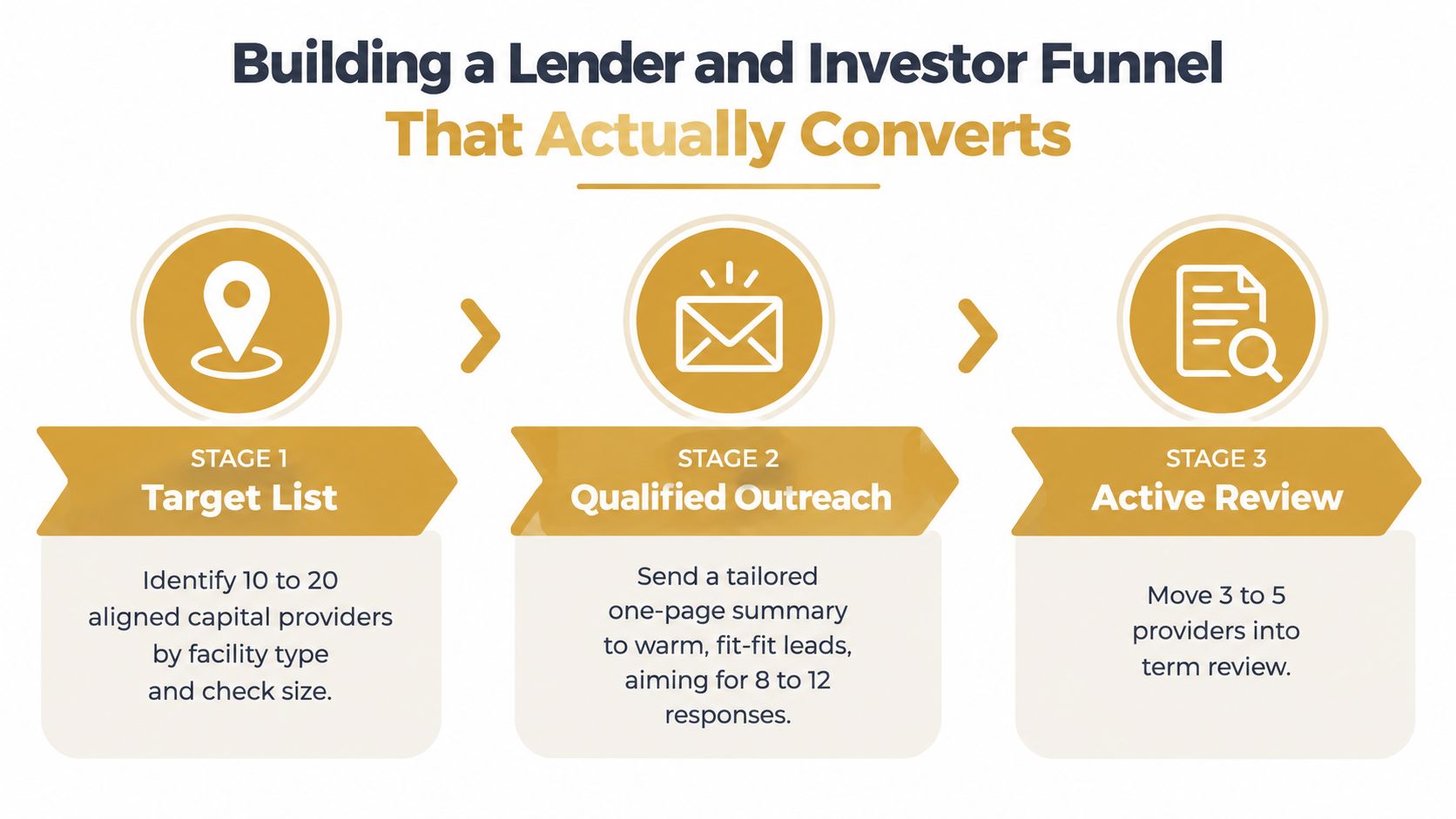
Screen for fit before outreach
Check each provider's transaction size, industry and geographic focus, collateral requirements, risk tolerance, and return expectations. Ask whether they finance acquisitions, understand the target's business model, and what evidence they need before reviewing a request. A lender that does not finance your type of purchase is not a viable lead, even if the institution is familiar.
Give small banks and credit unions early consideration, particularly for smaller or relationship-driven requests. In the Federal Reserve's 2023 survey, 75% of small-bank applicants received at least some of the financing requested, compared with 66% at large banks. Credit unions and finance companies reported 76% partial or full approval (Federal Reserve survey results). These figures do not predict an individual lender's decision. They do make relationship lenders worth testing against the deal's needs.
Run parallel tracks, not a free-for-all
Send qualified prospects a concise deal summary. Once interest is serious, use confidentiality agreements where appropriate and share materials through a consistent data room. Request indicative terms, then compare certainty, timing, total cost, collateral, guarantees, covenants, dilution, and control. Each term can change the acquisition thesis: repayment requirements may limit cash available for operations, while investor rights may constrain decisions after closing.
Keep lender and investor conversations aligned. Use the same earnings adjustments and operating assumptions with both. Avoid repeated hard credit inquiries unless you understand the process and the lender confirms they are appropriate.
Practical rule: Track each provider's fit, status, questions, and next action in a financing matrix. Treat preliminary terms as indications, not committed funding.
The Federal Reserve found that only 41% of financing applicants received all the financing they requested, while 36% received part and 24% received none (Federal Reserve report on employer firms). Plan for a shortfall early. Set the minimum financing needed to close and identify spending or growth plans that can wait without weakening the business. For an equity route, review guidance on securing private investment for business purchases, and clarify control rights and personal exposure before relying on investor capital.
Packaging the Deal So Capital Providers Say Yes Faster
A clean financial profile can still get overlooked if the deal is hard to understand. Package the financing request so a provider can quickly see what you're buying, what the money will fund, how the business will repay it, and what could go wrong.

Prepare three complementary documents
Your one-page executive summary should state the business type, purchase rationale, proposed transaction structure, funding requirement, and repayment or return thesis. It's an introduction, not a substitute for evidence.
The investment memorandum or loan narrative gives the deal context. Explain the business's customers, operating model, management plan, historical performance, and key risks. For a lender, prioritize the source of repayment, collateral, and the effect of debt service on cash flow. For an equity partner, emphasize how the buyer will run and improve the company, how decisions will be made, and how the investor may realize a return.
The data room supports the claims in those documents. Organize financial statements by period and provide source records for adjustments to earnings, customer concentration, receivables, major contracts, and ownership. Keep filenames and versions clear, and share access only with appropriate parties.
Show the risks before they ask
Include a sources-and-uses table and explain how each proposed source connects to each use. If customer concentration is material, disclose it with enough context for a provider to assess the risk. Present management backgrounds and the post-close operating plan, but don't oversell experience or remove inconvenient facts.
A lender or investor is likely to ask how the business performs under a downside case. Show what happens if revenue declines, collections slow, or expenses rise. Then explain what management can change and what cash reserve remains. A model that acknowledges pressure is more credible than a forecast that depends on perfect execution.
Before outreach, reconcile the numbers across the summary, model, and supporting files. One inconsistent earnings figure can trigger follow-up questions across the entire package, delaying review. Good packaging doesn't guarantee approval, but it gives capital providers a clear basis to assess the deal and makes your answers easier to verify.
Reading the Term Sheet Without Getting Burned
A term sheet can look attractive and still leave you with a costly or restrictive financing arrangement. Compare the whole agreement, not just the interest rate, valuation, or headline amount. Fees, repayment timing, guarantees, covenants, and control rights can change what the capital costs and what you're allowed to do after closing.

Read the obligations, not just the headline
For debt, model interest together with arrangement fees, legal costs, amortization, and any prepayment penalty. Read financial and reporting covenants closely. A minimum debt-service coverage ratio, debt level test, or cash-flow sweep can limit flexibility when trading weakens or the business needs to reinvest.
Then identify exactly who guarantees the debt, what collateral supports it, and when the lender can pursue recourse. Ask whether a guarantee can be capped, released after agreed conditions, or reduced after the business meets defined performance tests. Confirm what happens if a covenant is breached and whether you have a meaningful chance to cure it.
For equity, look past the valuation. Review dilution, liquidation preferences, participation rights, anti-dilution protection, board or approval rights, information rights, and drag-along provisions. These terms define how value and authority are shared if the business needs more capital or is sold.
Use a term-sheet review list
Before agreeing to terms, ask:
- What amount is available at closing?
- What fees and ongoing charges reduce the proceeds?
- How do repayment and amortization affect operating cash?
- Which covenants apply, and how are they tested?
- What personal guarantees and collateral are required?
- Are there prepayment, cash-sweep, or other repayment triggers?
- What are the investor's liquidation and participation rights?
- Which decisions require investor or lender approval?
- How are earn-outs, seller notes, and future funding treated?
- What diligence or closing conditions could change the terms?
The Federal Reserve reported that 59% of small businesses using debt secured it with a personal guarantee, and 38% pledged personal assets such as a home or retirement savings (Federal Reserve discussion of small-business credit). For buyers trying to limit owner-level risk, that's a reason to negotiate guarantee scope and release conditions before signing, not after a problem arises.
A practical due-diligence reference can help you organize the review of the target's records and obligations. Consider using the HireAccountants due diligence checklist alongside advice from your attorney, accountant, and financing providers. For a plain-language introduction to lender restrictions, see this explanation of what covenants mean in a deal.
Closing the Raise Without Losing Momentum at the Finish Line
A lender has issued preliminary terms, but the seller expects to close soon. The acquisition is not funded yet. Diligence, credit approvals, legal documents, and closing conditions can still change the amount or timing of capital, which can reshape the purchase price and operating plan.
Keep the workstreams moving together
Use a shared closing checklist with a named owner and next action for every open item. Track lender diligence, equity review, third-party reports, legal documents, and the seller's transition obligations. For an appraisal, environmental review, background check, or quality-of-earnings analysis, confirm who orders it, who pays, and what could delay completion.
Give each capital provider the same underlying figures. If a lender changes its debt-service requirements or reduces the amount it will fund, revise the cash-flow model and sources-and-uses schedule promptly. An outdated model can undermine a purchase-price discussion and leave the buyer committed to a deal the business cannot support.
A funding gap calls for a clear choice. Ask whether the seller can carry more of the price, whether part of the acquisition plan can be staged, or whether the revised economics make the transaction unworkable. Keep the liquidity reserve intact when possible. Using every available dollar to plug a gap may leave the business short of cash soon after closing.
Don't close on assumptions
Before signing, confirm that the final documents reflect the agreed economics and that closing conditions are met. Check the guarantees, collateral, payment mechanics, seller-note terms, and any conditions that could delay disbursement. Confirm the business will have enough cash for its first operating period under new ownership.
If financing terms change late, recalculate debt service and the funds available for operations. Then decide whether to renegotiate with the seller or walk away. A lower loan amount can require a lower purchase price or more seller financing; accepting the original price without replacing the missing capital puts pressure on the acquisition from day one.
A rushed closing can leave a buyer with a financed deal that the operating company cannot afford. Keep the acquisition thesis tied to the actual funding package, not the preliminary terms. If the final structure depends on personal guarantees or collateral, confirm the scope and release conditions before signing, and do not use operating cash to hide a financing shortfall.
Managing Capital After the Deal Closes
The financing structure keeps shaping the acquisition after the wire clears. A loan with restrictive covenants requires active monitoring. Seller financing affects the relationship with the former owner. Equity brings ongoing reporting and decision rights. Treat those obligations as part of the operating plan, not as paperwork to revisit only when a problem appears.
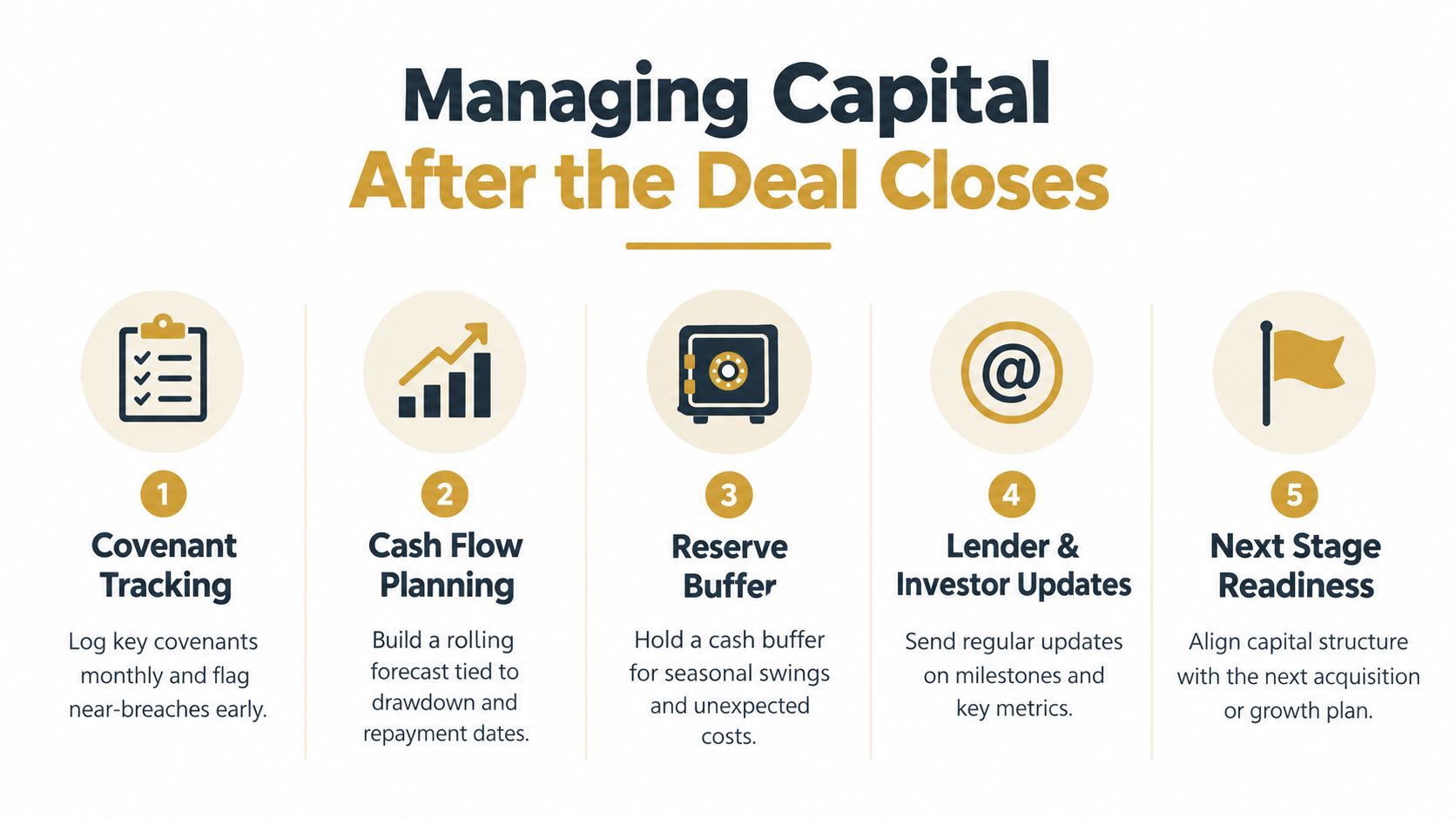
Maintain a rolling cash forecast that tracks expected collections, payroll, debt payments, and major expenses. Compare actual performance with the assumptions you gave lenders and investors, and flag a potential covenant issue early enough to discuss options. Keep a liquidity reserve for ordinary operating surprises rather than treating all available cash as acquisition capital.
Send regular, accurate updates to capital partners. Report material changes in trading, progress against the operating plan, and emerging risks. If the business stabilizes and its cash-flow profile improves, refinancing or a recapitalization may become worth assessing, but weigh fees, new guarantees, and added restrictions against the benefit.
Document the first acquisition thoroughly. Consistent financial reporting, covenant records, integration decisions, and evidence of operating performance can help explain the next opportunity to lenders or investors. Use retained cash flow carefully, including for seller-financing payments, debt reduction, and future growth. If you want to pursue another acquisition, make sure the next financing plan fits the company's actual capacity rather than assuming the first deal automatically proves the next one will work.
Dealmaker Wealth Society offers acquisition training, capital-raising education, deal-structuring playbooks, and a peer community for buyers working through financing and post-close growth. If you're preparing to finance a business purchase, visit Dealmaker Wealth Society to explore its courses, coaching, and deal support.

From the Dealmaker Blog









A Creative Business Buying Fable