How Does Creative Financing Work in Small-Business M&A?
How Does Creative Financing Work in Small-Business M&A?

You've found a business you'd like to own. The seller is willing to negotiate, the operating results look promising, and you can see yourself running it. Then the lender's proposed financing comes back below what you need, and using all your savings would leave little room for a difficult transition.
So, how does creative financing work when the business makes sense but the cash doesn't quite fit? You redesign who contributes capital, when the seller receives payment, and who bears the consequences if performance disappoints. The useful question isn't whether you can close. It's whether the business can support the obligations you create.
Table of Contents
- How Creative Financing Solves a Small-Business Funding Gap
- Building the Creative Financing Capital Stack
- Comparing the Main Creative Financing Mechanisms
- Choosing a Structure for the Deal
- Seeing Creative Financing in Practice
- Testing Who Loses Money First
- Building a Deal-Ready Financing Plan
How Creative Financing Solves a Small-Business Funding Gap
Consider a hypothetical buyer acquiring an established service business. The lender will provide part of the funding, and the buyer can contribute savings, but the combined amount won't cover the agreed price while preserving operating reserves.
The seller might accept a portion of the price later. An investment partner might contribute cash in exchange for ownership. The parties might also make the most uncertain part of the valuation payable only if the business achieves agreed results.
These arrangements solve different problems. Creative financing means deliberately combining capital sources and payment terms, not making the purchase price or financial risk disappear.
Separate the price from the closing payment
A seller's agreed value can take several forms:
- Closing proceeds: Cash the seller receives when ownership transfers.
- Deferred consideration: An amount the buyer owes under negotiated payment terms.
- Contingent consideration: An additional payment that depends on specified future performance.
- Retained ownership: An investment the seller keeps rather than converting entirely into cash.
The flowchart shows how a funding shortfall can lead to a negotiated structure rather than an abandoned acquisition.
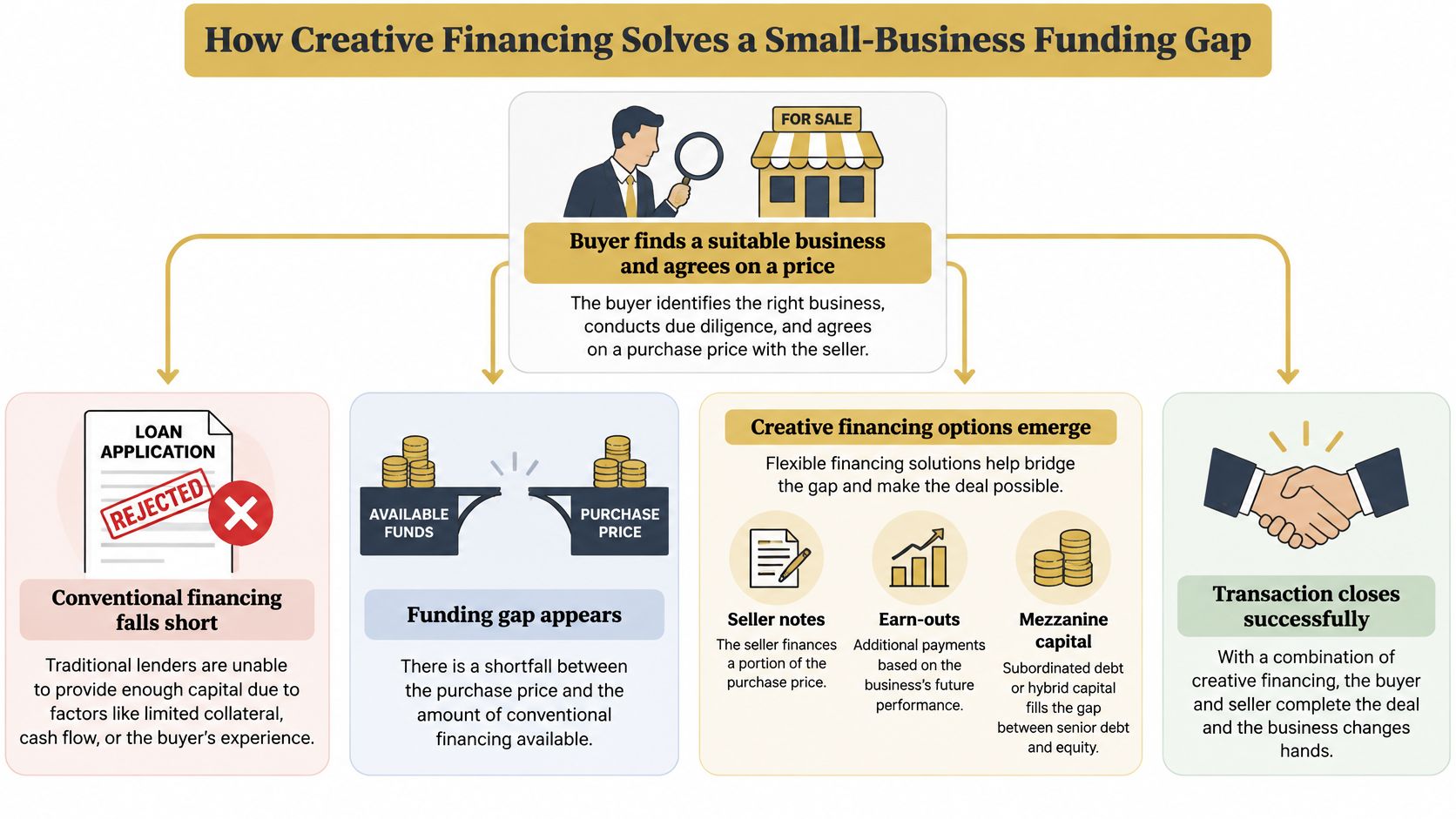
Financing constraints aren't unusual. Among small employer firms that applied for financing in 2021, 31% received everything requested, compared with 47% in 2017 and 51% in 2019, according to the Federal Reserve's discussion of small-business financing access. Those figures describe financing applicants, not acquisition buyers specifically, but they explain why relying on a conventional loan alone can leave a gap.
Practical rule: Design the purchase around sustainable cash generation, not around the largest payment a seller will accept on paper.
The buyer in this hypothetical situation hasn't found free money. The seller or partner has agreed to bear an exposure the conventional lender wouldn't take. Before accepting that flexibility, the buyer needs to understand what each participant receives in return.
Building the Creative Financing Capital Stack
A capital stack is the combination of debt and ownership interests used to finance a transaction. Build it backward from the proposed acquisition: identify what must be funded at closing, what can remain outstanding, and which payments depend on future events.
Keep the purchase price separate from transaction expenses and operating liquidity. A structure that pays the seller but leaves the business unable to meet payroll isn't adequately funded.
Follow the money into the acquisition
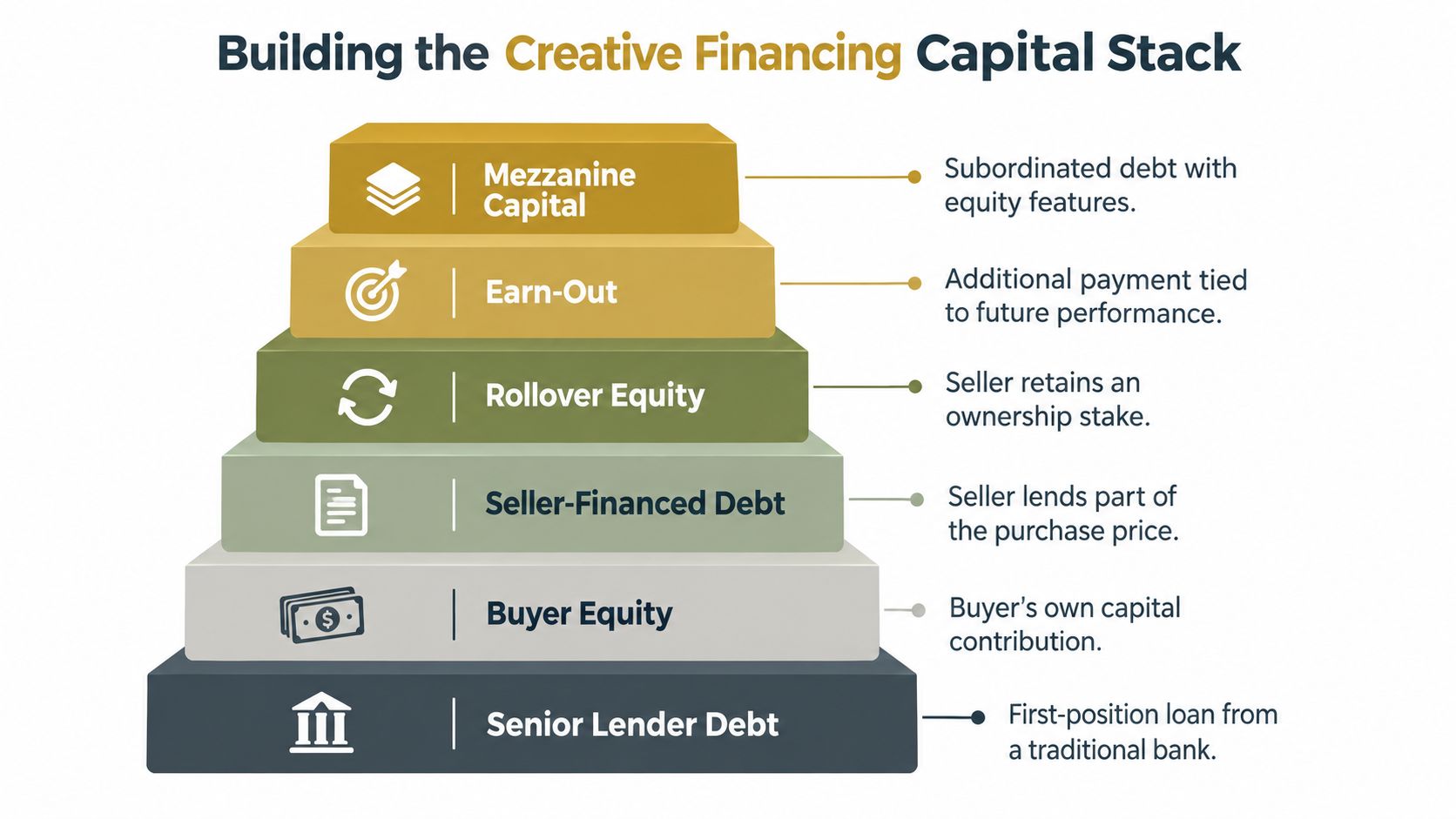
Senior lender debt and buyer equity commonly provide closing cash. A seller note leaves part of the purchase price unpaid, while rollover equity leaves the seller invested. An earnout puts conditional value outside the fixed closing payment.
Depending on the transaction documents, lender proceeds may pass through an acquisition entity or involve borrowing supported by the acquired business. The important questions are which entity owes the money, which assets support it, and where operating cash must travel to make payments.
The diagram identifies possible components, but its visual order shouldn't be read as a universal legal repayment ranking.
The underlying logic isn't new. Leveraged acquisitions separate a buyer's immediate cash resources from the total purchase price by using borrowing supported by business assets and future cash flow. The history of leveraged buyouts illustrates how this approach developed into a broader acquisition model.
Distinguish payment timing from payment priority
Think of the purchase-price waterfall as a schedule of destinations. Closing cash goes to the seller immediately; scheduled debt payments follow; contingent payments require their contractual triggers; ownership interests participate according to their economic rights.
Priority is a separate issue. A payment due soon doesn't necessarily have stronger security than an obligation due later.
- Seniority: Establishes contractual payment priority between creditors.
- Collateral: Identifies assets a creditor may look to for recovery.
- Subordination: Limits a junior creditor's rights relative to another lender.
- Ownership rights: Determine control, distributions, and participation in remaining value.
When considering leveraging assets for acquisition financing, identify existing claims before assuming assets can support additional borrowing.
A useful closing schedule therefore has more than a list of funding sources. For every contribution, record its recipient, borrower or issuer, payment terms, security, and approval requirements. That makes it easier to distinguish money available to complete the purchase from value the seller may receive only later.
Comparing the Main Creative Financing Mechanisms
Choose an instrument based on the problem you need to solve. A seller who wants a predictable payment stream has different objectives from one who wants continuing ownership or payment for an ambitious forecast.
The comparison below separates creditor claims, contingent purchase price, and ownership capital. They shouldn't be treated as interchangeable ways to fill an empty cell in a financing spreadsheet.
Creative financing mechanism comparison
| Mechanism | When Value Is Paid | Economic Role | Buyer Upside | Core Risk |
|---|---|---|---|---|
| Seller note | On the agreed repayment schedule | Seller becomes a creditor | Reduces immediate cash required | Fixed obligations can strain liquidity |
| Earnout | After defined performance conditions are met | Contingent purchase consideration | Avoids paying uncertain value upfront | Measurement and operating-control disputes |
| Rollover equity | Seller retains an interest with value realized through distributions or exit | Seller remains an owner | Reduces the cash buyout requirement | Shared control and competing exit preferences |
| Mezzanine capital | According to negotiated debt and equity-related terms | Capital between senior debt and common equity | Can fill a remaining funding gap | Adds contractual complexity and financial burden |
| Partner equity | Capital enters at closing or as agreed | Partner receives negotiated ownership rights | Adds funding without scheduled principal repayment | Dilution and governance disagreements |
| KISS or SAFE-like arrangement | Depends on negotiated conversion or other contractual triggers | Proposed future-equity or partner economics | May defer some ownership negotiations | Startup-style terms may not fit an acquisition |
| SBA-related standby seller note | Payment is restricted under applicable standby terms | Subordinated seller debt with a limited equity-injection role | May reduce qualifying buyer cash needed | Seller liquidity is deferred and eligibility is constrained |
Match the instrument to the seller's role
With an ordinary seller note, the seller exchanges immediate proceeds for a repayment claim. Buyers should compare interest, maturity, security, and default provisions together, rather than negotiating the payment amount in isolation. A closer review of seller-financing options can help distinguish manageable deferral from an obligation the business can't support.
An earnout addresses uncertainty about value. Its defining feature is conditional payment, not delayed payment. KPMG describes earnouts as post-completion price-adjustment mechanisms: revenue can be easier to audit but reward unprofitable growth, while EBITDA can invite disagreements over expenses and accounting adjustments.
Rollover equity and partner equity require a different conversation. Instead of focusing primarily on repayment dates, discuss voting, distributions, information access, and exit rights. For a practice acquisition, Everglow Prosperity's discussion of debt or equity for your practice provides a related resource for considering that choice.
Treat special-purpose structures cautiously
Mezzanine capital belongs in a negotiated layer between senior borrowing and common ownership. Don't assume the extra funding will be affordable merely because a provider is willing to supply it.
Similarly, treat KISS or SAFE-like arrangements as proposals requiring acquisition-specific legal and tax review. Don't assume startup-style conversion documents adequately address ownership transfer, operating control, or the acquisition entity's obligations.
For an SBA-backed purchase, qualifying standby seller debt is particularly constrained. Under the summarized framework, it must be subordinated and on full standby for the entire SBA loan term, with no principal or interest payments during that period; standby debt and other limited sources may cover no more than 50% of the required equity injection. Confirm the currently applicable treatment with the lender rather than assuming every seller note qualifies; the Federal Reserve's small-business credit report provides broader credit context.
Choosing a Structure for the Deal
Start by diagnosing the gap, not by choosing a fashionable instrument. A shortfall caused by limited buyer savings requires a different response from a disagreement about future growth.
The seller's willingness also matters. A structure can be affordable for the buyer but unacceptable to a seller who needs immediate liquidity.
Identify what the parties actually disagree about
Use the negotiation to distinguish among these situations:
- The fixed price is unaffordable: Revisit valuation before adding obligations to make the price appear achievable.
- The forecast is disputed: Consider whether uncertain value belongs in contingent consideration rather than fixed debt.
- The buyer lacks qualifying capital: Explore eligible contributions with the lender and potential partners.
- The seller wants continuing participation: Assess whether retained ownership fits the seller's desired involvement.
- The seller has liquidity or tax objectives: Ask advisers to evaluate the consequences rather than assuming deferral produces a favorable outcome.
A rollover can make sense when the seller wants exposure to future value and both parties accept shared ownership. It's less suitable when either party expects a clean separation.
Underwrite the payment burden before negotiating it
Normalize operating results before calculating debt capacity. Examine whether earnings reflect the ongoing cost of replacing the seller's work, maintaining assets, and funding ordinary operations.
Then compare sustainable earnings with all scheduled obligations. Include the senior loan and any permitted current-pay seller debt, not just the payment associated with the most recently proposed financing source.
Don't use optimistic growth to justify a payment the business can't support at its existing operating level.
For mezzanine proposals, ask what specific gap the additional layer solves and whether reducing the fixed purchase price would be more durable. For equity proposals, assess the ownership you're giving up alongside the cash you're receiving.
Use a decision gate before accepting terms
A proposed structure should pass a practical review:
- Cash-flow fit: Can the business pay obligations while retaining an operating cushion?
- Seller capacity: Can the seller tolerate delayed payment or investment losses?
- Lender permission: Are junior payments, ownership arrangements, and security interests permitted?
- Control alignment: Can the owners agree on spending, distributions, and major decisions?
- Downside flexibility: Can the business respond to weaker performance without immediately breaching terms?
If a structure fails one of these tests, change the price, timing, ownership mix, or funding source. More elaborate documentation won't repair an acquisition whose basic economics don't work.
Seeing Creative Financing in Practice
The following scenarios are hypothetical illustrations, not reported transactions. Each shows a different path from an agreed purchase to the seller's eventual receipt of value.
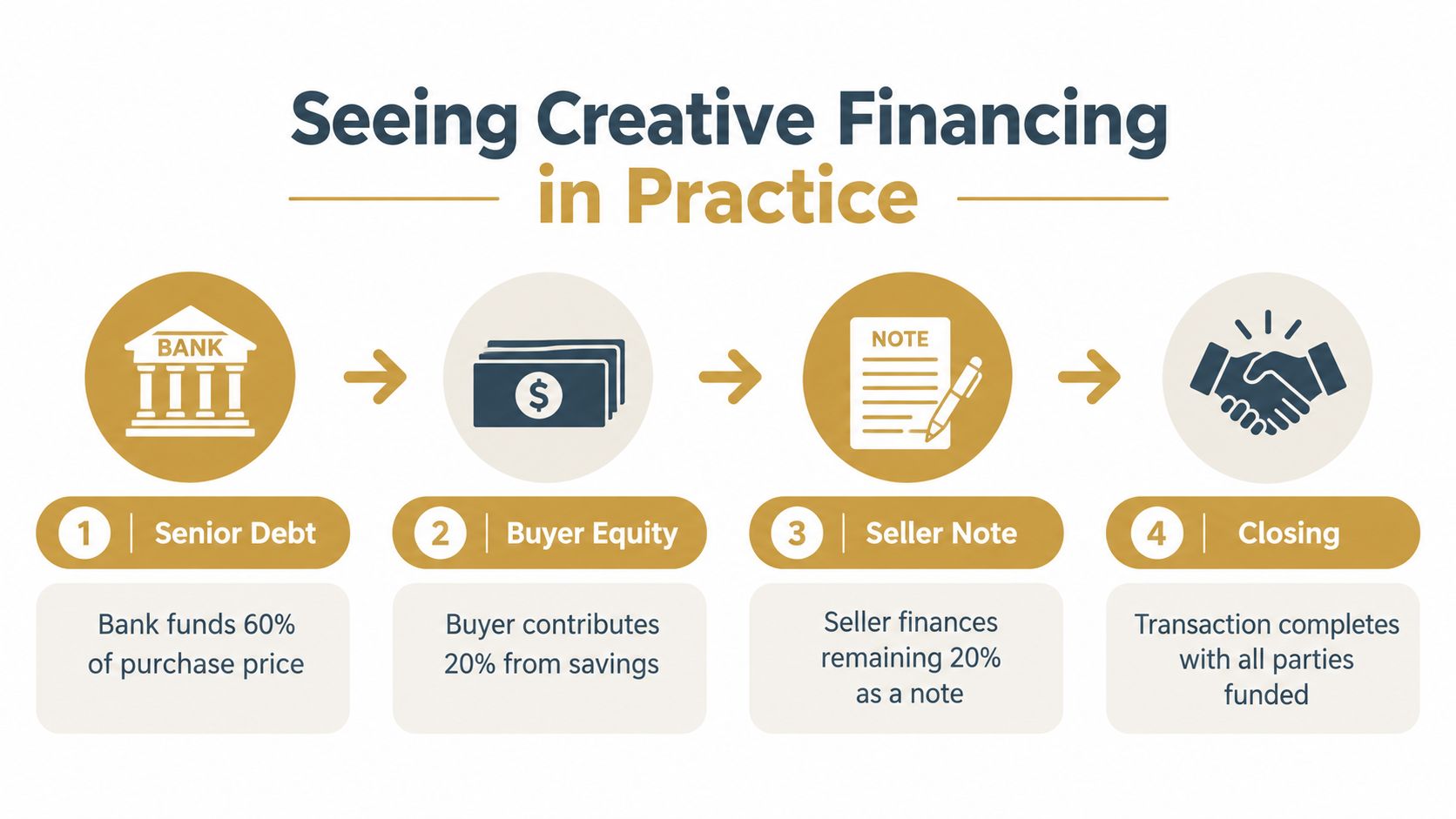
The process graphic illustrates the sequence of funding a seller-note acquisition, rather than a recommended allocation for every purchase.
A seller accepts scheduled payments
A buyer and seller agree on a service-business acquisition. The bank and buyer provide the closing funds, while the seller accepts a note for the deferred portion.
After closing, the buyer operates the company and makes the permitted payments with interest. The seller no longer manages the business but remains financially exposed through the outstanding note.
The key underwriting question is whether there's room for that payment. In the supplied SBA-focused illustration, normalized EBITDA of $500,000 and senior annual debt service of $320,000, assessed against a 1.25x coverage threshold, allow approximately $400,000 in total annual debt service, leaving about $80,000 for permitted additional debt service.
That illustration is a capacity check, not a promise of distributable cash. The buyer still needs to examine operating liquidity and the lender's treatment of additional payments. A standby obligation also can't be treated as a current-pay note.
A seller's growth forecast remains unproven
A seller expects a recently developed customer relationship to generate substantial business. The buyer is willing to pay for the established operation but won't treat the forecast as certain.
They negotiate fixed closing consideration plus an earnout tied to defined performance. If the conditions aren't achieved, the seller doesn't receive the associated contingent amount.
The drafting question is concrete: which sales count, when are they recognized, and what happens if customers move between business units? Without agreed answers, the parties haven't resolved the valuation disagreement. They've postponed it.
A seller keeps ownership instead of taking all cash
A founder wants to step away from daily management but remain invested. The buyer purchases part of the founder's interest, and the founder retains rollover equity under the ownership agreement.
The seller's remaining value depends on the investment outcome rather than a fixed repayment schedule. The buyer must negotiate how much influence that continuing owner has.
- Operating authority: Identify who approves budgets and major spending.
- Information rights: Specify what financial reporting the seller receives.
- Exit arrangements: Address how the parties may eventually sell their interests.
A capital partner joins the buyer
An operator finds a business but needs an investor to complete the purchase. The partner contributes capital while the operator takes responsibility for running the company.
Before closing, they should separate compensation for work from returns on invested capital. Contributions, ownership, any vesting conditions, future funding responsibilities, and exit rights need explicit agreement.
This arrangement solves a capital problem but creates a relationship that must function after closing. A willing investor isn't enough; the buyer needs a partner whose expectations remain workable when distributions are delayed.
Testing Who Loses Money First
Flexible financing isn't automatically cheaper or safer. A buyer may reduce closing cash while accepting personal exposure, restrictive terms, or obligations that become difficult to meet during a downturn.
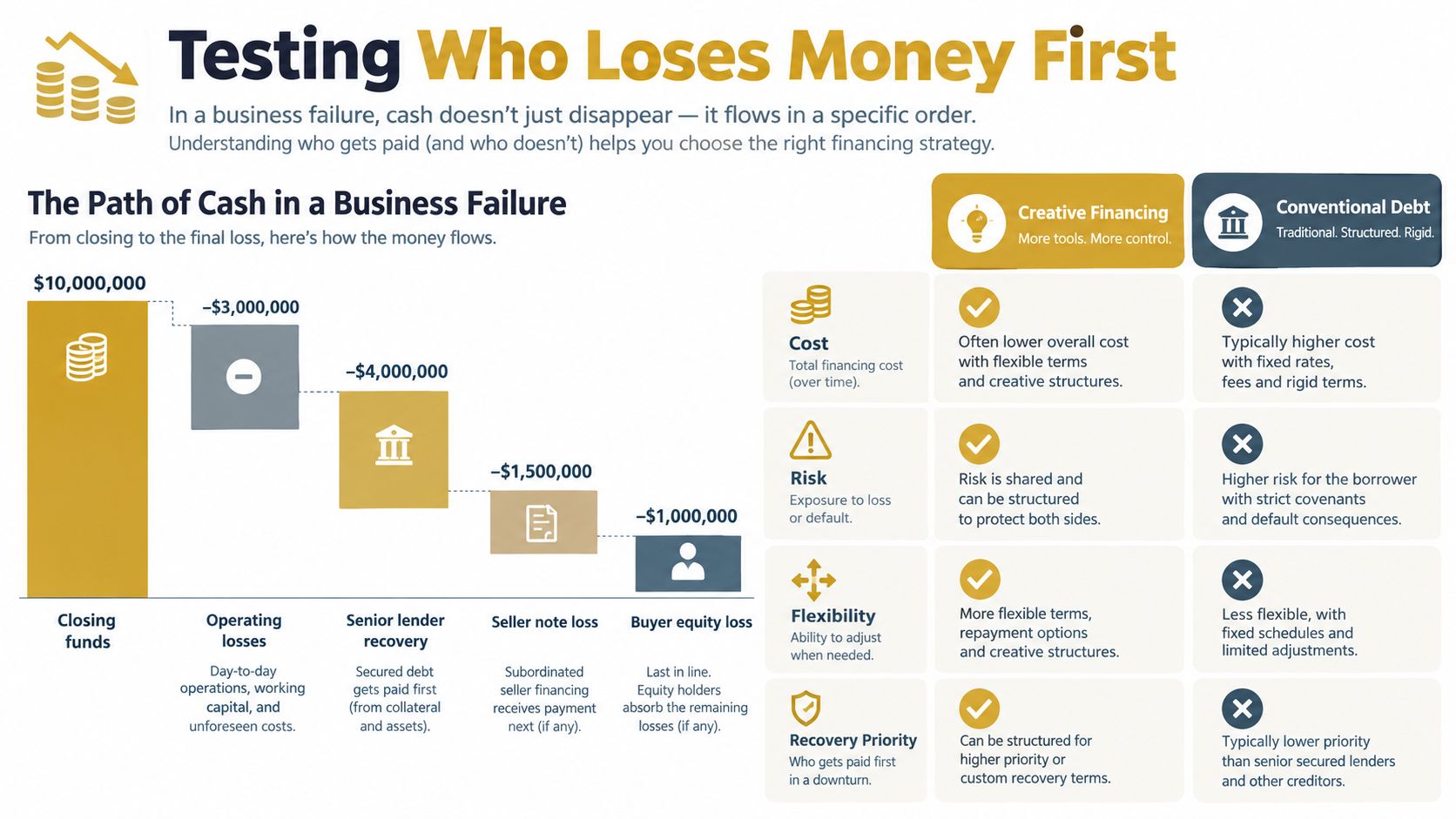
The failure-waterfall approach separates loss of investment value from priority of creditor recovery. Those are related, but they aren't the same sequence.
Use the graphic as a prompt to map the actual contractual rights, not as a universal ranking.
Trace a downturn through the documents
When earnings weaken, owners can lose economic value even while the business continues paying lenders. If the company later can't meet its obligations, creditor recoveries depend on collateral, priority, guarantees, and the applicable legal process.
Map each exposure separately:
- Buyer and rollover equity: Identify whose invested value is exposed and whether ownership classes have different rights.
- Senior debt: Review collateral claims, payment requirements, and enforcement provisions.
- Seller debt: Check whether subordination restricts payments or recovery actions.
- Earnout consideration: Determine whether missed performance eliminates payment or creates a measurement dispute.
- Partner distributions: Establish whether payments are discretionary or contractually required.
A personal guarantee deserves its own review. Don't assume an owner's potential loss stops at the equity contributed to the purchase.
Stress the obligations, not just the valuation
Model a 20–30% earnings decline, a downside range highlighted in the SBA acquisition-market analysis. Test whether the business can still meet scheduled payments, preserve reserves, and fund necessary operations.
For fixed debt, ask what happens when the payment remains unchanged but cash generation falls. For an earnout, examine whether the buyer can make necessary operating decisions without creating a dispute about deliberately suppressing performance. The practical details of structuring acquisition earnouts matter most in that difficult scenario.
Downside test: Identify who must contribute cash, who can stop receiving payments, and who can enforce rights before assuming the parties share risk equally.
For a supplementary perspective on acquisition structuring, use the video alongside your written downside analysis.
The decisive output is a written explanation of what happens under underperformance. If the buyer can't explain the consequences without relying on a refinance, rapid growth, or a cooperative creditor, the structure needs more conservative assumptions.
Building a Deal-Ready Financing Plan
Turn the proposed structure into a coordinated set of financial schedules and legal terms. The lender, seller, partners, and advisers should be evaluating the same transaction, not different interpretations of a verbal agreement.
Start with verified operating results and a defensible valuation. Then connect every component of consideration to its funding source or payment condition.
Prepare the financial package
- Normalize earnings: Document adjustments and the cost of operating without the departing seller.
- Reconcile sources and uses: Include purchase consideration, transaction expenses, and operating liquidity.
- Confirm eligibility: Obtain lender confirmation of permitted contributions, ownership arrangements, standby treatment, and junior payments.
- Model adverse performance: Show payment capacity and reserve needs under conservative assumptions.
Keep deferred obligations visible even when they don't require immediate payment. A distant maturity still needs a credible repayment plan.
Translate economics into enforceable terms
For seller debt, document interest, maturity, payment timing, security, default rights, and subordination. Make sure the seller's note and the senior lender's requirements don't promise incompatible rights.
For earnouts, specify accounting principles, permitted adjustments, reporting access, operating discretion, milestones, caps, and dispute resolution. Ask advisers to test ambiguous situations before either party has money at stake.
For ownership arrangements, address contributions, governance, vesting where relevant, transfer restrictions, distributions, and exit rights. Legal and tax review should reflect the actual acquisition structure rather than a borrowed template.
The final test is operational: can the buyer explain how the business will pay employees, serve customers, maintain assets, and satisfy its financing commitments if results miss expectations? A deal-ready plan supports the business after closing, not merely the transfer of ownership.
Dealmaker Wealth Society offers acquisition education, live coaching, and a private peer community covering creative deal structuring, capital raising, and post-acquisition growth. Visit to explore training and deal feedback that can help you assess funding sources, repayment terms, and downside exposure before committing to an acquisition.

From the Dealmaker Blog







A Creative Business Buying Fable