Buying a Business with SBA Loan: The Complete Guide
Buying a Business with SBA Loan: The Complete Guide
You've found a business that looks like a real alternative to your corporate job. The seller's asking price seems supportable, and an SBA loan appears to make the purchase possible. But the headline down payment isn't the whole cash requirement, and a lender's willingness to finance the deal won't tell you whether the business can handle debt, a bumpy transition, and the first unexpected expense after closing.
Buying a business with an SBA loan can make a sound acquisition accessible, but the guarantee doesn't turn a weak business into a good one. The work is to build a credible capital stack, verify the company's cash flow, and keep enough liquidity to operate after the seller hands over the keys.
Table of Contents
- Why SBA Financing Changes the Acquisition Math
- Comparing the 7(a) and 504 Programs for Acquisitions
- Eligibility and Prequalification Before You Shop for Deals
- How Lenders Underwrite an SBA Acquisition
- The Deal Timeline From LOI to Funding
- Why SBA Approval Is Not the Same as a Good Deal
- Negotiation Tactics and Your First 100 Days Post-Close
Why SBA Financing Changes the Acquisition Math
A corporate professional considering a $1.2 million business purchase may assume an SBA loan means the government is lending the money or absorbing the buyer's risk. Neither is true. The loan comes from a participating private lender, and the SBA guarantee protects the lender against part of its loss if the borrower defaults. The buyer remains responsible for repayment and must pass credit review, demonstrate repayment capacity, and make the transaction work financially.
For an acquisition, the 7(a) program is often relevant because SBA guidance permits proceeds for complete or partial changes of ownership. The program's maximum loan amount is $5 million, but that ceiling doesn't mean a lender will finance the entire purchase price or approve every transaction. A lender still assesses the target's performance, the buyer's ability to operate it, and whether cash flow can cover debt service. The federal guarantee changes the lender's risk calculation, not the need for a defensible deal.
Build the capital stack around the business
Think of the financing as a set of parts, not a single loan. The buyer contributes equity, the lender finances an eligible share of the transaction, and a seller note or outside capital may help fill a gap. Separate the purchase price from transaction costs and the cash the business needs to run after closing. A deal that uses every available dollar to get across the closing table can leave a perfectly viable company short of payroll or inventory money.
SBA-backed financing differs from a conventional bank loan because the guarantee can make a lender more willing to consider an acquisition that might not fit its standard credit box. It differs from startup financing because the buyer is assessing an operating company's records and obligations, not financing a business with no operating history. And unlike a pure equity purchase, debt creates fixed repayment obligations that the business must meet through its cash flow.
Before agreeing on terms, get legal help with the transaction documents and ownership transfer. A lawyer experienced in business sales can help coordinate purchase terms with lender requirements, as outlined in Lein Law Offices' business purchase and sale practice. For a broader view of financing structures, compare the business acquisition financing options available for your deal.
An SBA loan can't replace due diligence, justify an inflated valuation, guarantee lender approval, or supply all the cash a buyer needs after closing. Treat the guarantee as a financing tool, not a verdict on the business.
Comparing the 7(a) and 504 Programs for Acquisitions
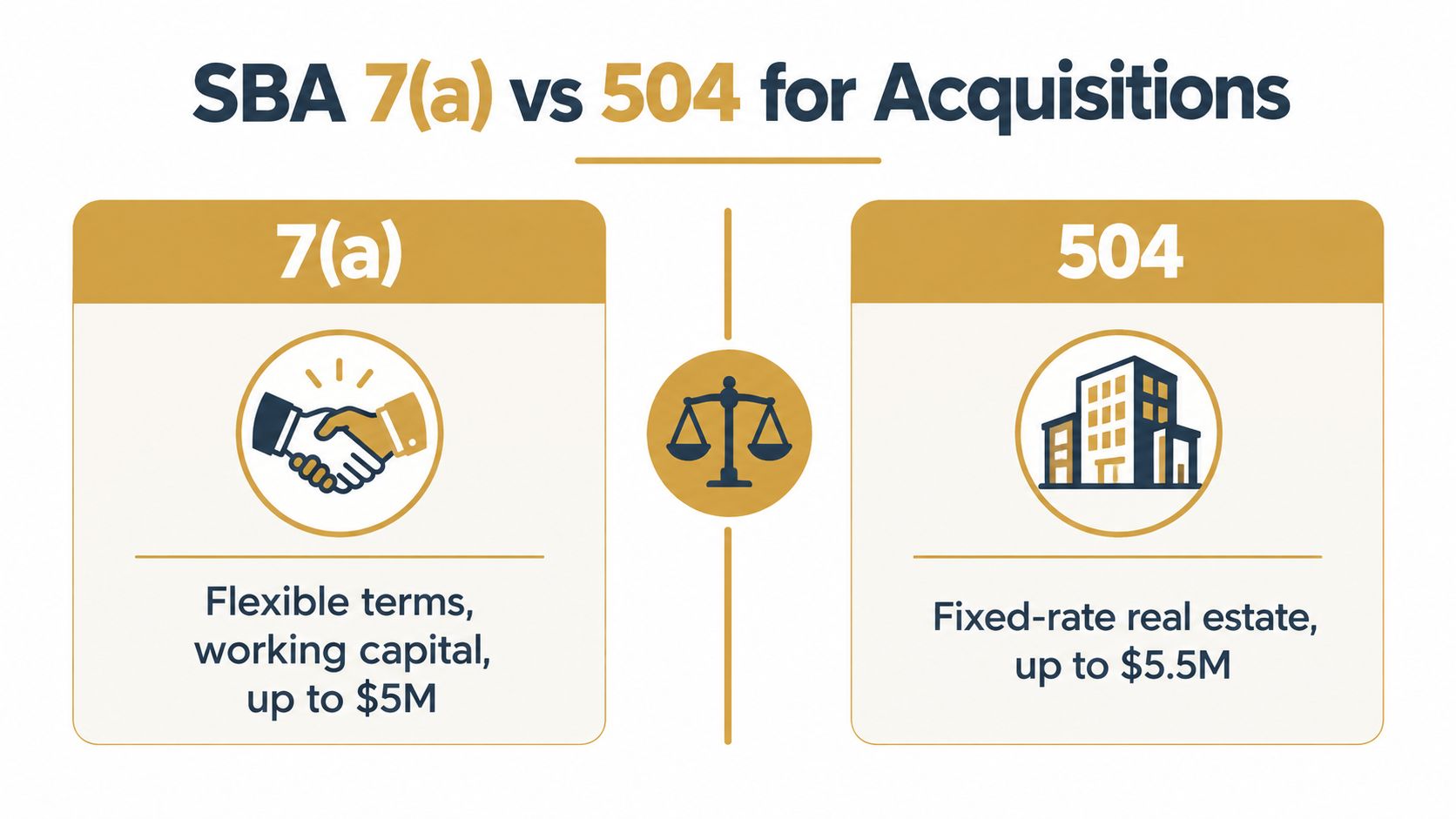
Choose the program after you understand what you're buying. 7(a) is generally the more flexible route for acquiring an operating company because it can support a change of ownership and can accommodate uses such as working capital. 504 is designed for fixed-asset projects, making it a more natural fit when owner-occupied real estate or other eligible long-lived assets anchor the transaction.
For a conventional business acquisition, 7(a) financing can generally run for up to 10 years. Qualifying owner-occupied real-estate financing may extend to 25 years, subject to applicable conditions. Those longer real-estate terms can reduce scheduled payments, but they don't make weak operating cash flow safe. The SBA's 7(a) program guidance sets out the program's permitted uses, loan ceiling, and guarantee framework.
Match the program to the assets and uses
| Feature | SBA 7(a) | SBA 504 |
|---|---|---|
| Typical acquisition fit | Flexible financing for a change of ownership, including eligible business-related uses | Fixed-asset project financing, especially when qualifying owner-occupied real estate is central |
| Program structure | A participating lender makes the loan, with an SBA guarantee supporting the lender | Typically structured around a private lender and a Certified Development Company |
| Working capital | May be included when eligible and supported by the lender's structure | Not generally the reason to choose the program; confirm eligible project uses |
| Loan ceiling | $5 million under SBA program guidance | The applicable limit depends on the project and current program rules; confirm directly with a lender |
| Repayment horizon | Generally up to 10 years for business acquisition, with qualifying real-estate portions potentially extending to 25 years | Often considered for long-lived fixed assets; ask a lender to confirm terms for the proposed project |
| Best starting question | Does the deal need flexible financing for the business itself and related eligible uses? | Does eligible real estate or fixed-asset investment drive the project? |
Don't select 504 because a deal includes a building, or 7(a) because it's familiar. Ask the lender how it will allocate purchase consideration, real estate, equipment, fees, and working capital, then compare the resulting payment schedule and equity requirement. The right answer depends on the actual assets and transaction structure, not a program label.
Eligibility and Prequalification Before You Shop for Deals
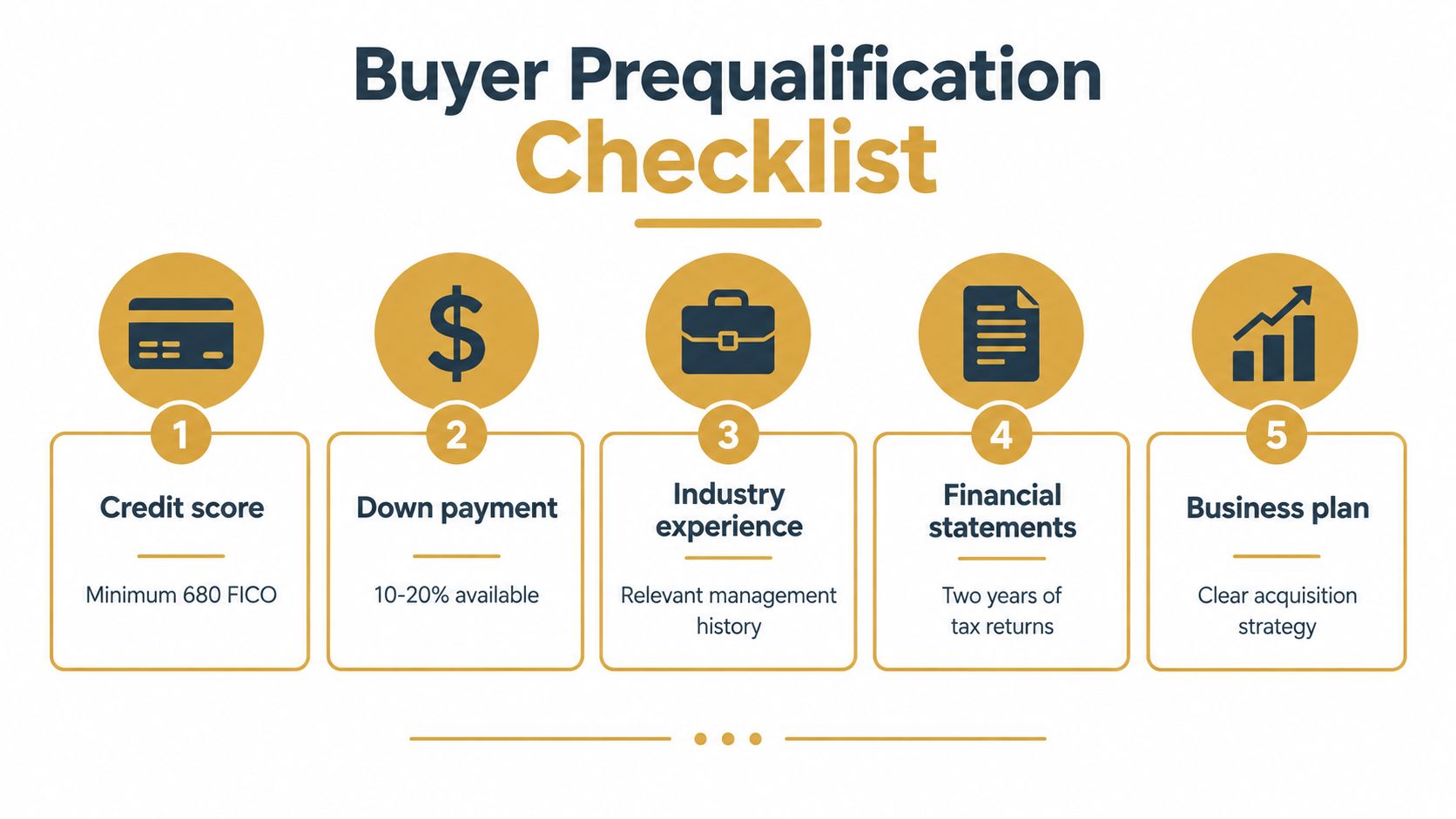
Prequalification is a way to learn what a lender may support before you spend time negotiating a business you can't finance. It's not a loan commitment. SBA eligibility generally requires the target or resulting company to operate for profit, be located in the United States, meet SBA size standards, and demonstrate a reasonable ability to repay. The lender then evaluates the buyer and the transaction under its own credit process.
Make the first lender call useful
Look for a lender that regularly handles SBA-backed business acquisitions. On the first call, describe your professional background, the type of company you're pursuing, how you expect to fund the purchase, and the role you'd play after closing. Ask what documentation it needs to give you a credible early read on likely structure, equity, and repayment capacity.
Bring organized personal financial information, a résumé or operating history, and a clear description of your acquisition plan. Once you have a target, the lender will also need the company's financial records and transaction details. Don't present seller-provided earnings as settled fact. Explain what you've verified, what remains untested, and how you're thinking about owner compensation and working capital.
Credit, relevant operating experience, and liquidity all affect the lender's view, but don't treat an informal prequalification conversation as a universal checklist or promise. A lender may have its own credit standards and industry preferences. Ask directly about potential concerns, including whether your experience fits the target, what equity contribution it expects, and which business records will be necessary to assess repayment.
Practical rule: Get lender feedback on the transaction's likely structure before you sign an offer that exposes you to a nonrefundable deposit.
The SBA's lender guidance describes the role of participating lenders in processing SBA loans. Your practical goal is to identify lender-specific hurdles early, then shop for businesses whose size, cash flow, and operating demands fit both the financing plan and your own capabilities.
How Lenders Underwrite an SBA Acquisition
Underwriting begins where the seller's story ends. The lender rebuilds cash flow from source documents, adjusts reported earnings, and tests whether the business can carry its debt after closing. Federal rules require a creditworthy applicant and a loan sufficiently sound to reasonably assure repayment, based on prudent commercial-credit analysis. In practice, the underwriter forms an independent view of sustainable cash flow and presses on every assumption that makes the price look affordable.

Rebuild earnings before you model debt
Pull the tax returns, financial statements, debt schedules, and bank activity first. Reconcile reported results across all of them, normalize the owner's compensation, and tie each proposed add-back to invoices or other records. A personal expense sitting in the company books isn't automatically a valid adjustment. If the business needs that spending to operate, or you'll have to pay someone to replace the owner's hours, the cost survives closing.
Then subtract what a headline earnings figure leaves out: scheduled debt service, inventory, taxes, capital expenditures, and working capital. A model resting on seller discretionary earnings measures the wrong thing. Separate what the company did under the seller from the cash you can reasonably expect to retain once you own it.
According to the MBBA's April 2026 program overview%20Program%20Overview%20-%20MBBA%20April%202026.pdf), the median SBA acquisition loan reached $610,000 in fiscal year 2025, compared with $245,000 for startup loans. Acquisitions carry layered costs that startup financing rarely touches, so the full capital structure deserves more attention than the loan amount alone.
Treat the equity requirement as a starting point
As noted in the 7(a) program guidance above, SBA rules generally require at least 10% buyer equity for a complete change of ownership. Qualifying seller debt on full standby can generally cover no more than half of that requirement, subject to program rules and lender review. I've watched a lender exclude a seller note from the injection count because the standby language was wrong, which forced the buyer to bring more cash late in the process. Payments on a poorly structured note can also compete with the company's cash needs after closing.
The injection is only the first line in the cash-to-close calculation. Add eligible transaction costs, lender and closing fees, working capital the transaction requires, and a reserve for the surprises that surface early in your ownership. Ask the lender to confirm in writing how it will treat the seller note, retained working capital, and the full sources-and-uses schedule.
Underwriters commit to the deal they can defend. Give them one.
Strong buyers build a parallel model before the lender finishes its own, then compare assumptions line by line. Run the downside case too: coverage at current earnings matters less than coverage after a customer loss or a slow quarter. For a practical explanation of why debt-service coverage matters in deal analysis, work from cash available after realistic operating costs, since that is the figure the lender's own model will test.
The Deal Timeline From LOI to Funding
An acquisition doesn't move from handshake to funded loan in a straight line. The buyer, seller, lender, landlord, and other third parties each control different pieces, so a delay in one area can hold up the rest. In fiscal year 2025, the SBA guaranteed $45 billion through its 7(a) and 504 programs for more than 85,000 small businesses, the highest combined annual figure in agency history, according to Bank of America's overview of SBA loans. That demonstrates the scale of SBA-backed lending, but it doesn't remove the document and approval work required for an individual acquisition.
Keep the process moving in the right order
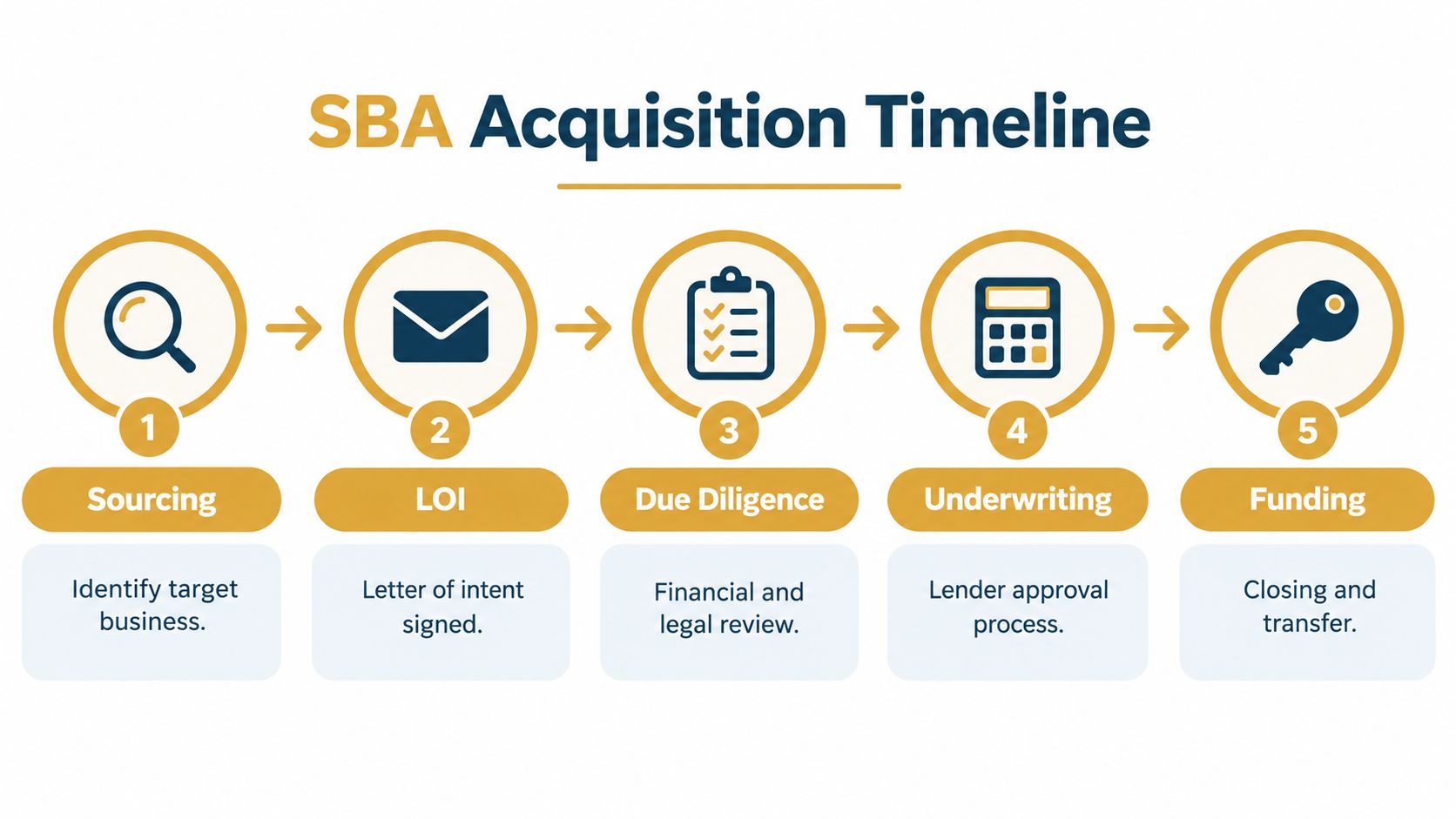
Sourcing and screening: Check the business's financial history, customer base, operating requirements, and likely financing fit before spending heavily on diligence. A lender can give early feedback, but it needs enough detail to be useful.
Offer and LOI: Put the purchase structure, financing contingency, diligence access, and deposit terms in writing. An LOI can be a useful negotiating framework, but it isn't a substitute for the purchase agreement. Understand what's binding before you sign; this overview of what an LOI does in a deal can help frame the discussion.
Due diligence and lender submission: Verify financials and legal records while the lender reviews the borrower, transaction, and repayment plan. Quality-of-earnings work, appraisals, lease assignment, license transfer, and seller-note documentation can add coordination work. The lender's SBA acquisition process also depends on complete records and the seller's cooperation.
Approval and closing: Resolve lender conditions, finalize purchase documents, confirm funds flow, and coordinate the closing date with all parties. Don't assume an initial indication means final credit approval or that a commitment means every closing condition has been cleared.
A short preparation list can prevent avoidable closing-week confusion:
- Confirm consents: Verify that the landlord and any necessary contract counterparties have addressed assignment or transfer requirements.
- Reconcile funds: Match the purchase agreement, lender sources and uses, seller-note documents, and closing statement.
- Plan the handover: Agree on what the seller will transfer, how the buyer will receive access and records, and how the seller will support the transition.
- Check payment readiness: Confirm wire instructions and timing directly with the appropriate parties using established verification procedures.
Why SBA Approval Is Not the Same as a Good Deal
A lender's approval tells you that the transaction meets the lender's credit criteria. It doesn't prove that the company will operate smoothly under new ownership or that the buyer's equity is safe. SBA acquisition lending reportedly grew from $3.8 billion in fiscal year 2018 to $7.7 billion in fiscal year 2025, according to Core Strategy Partners' acquisition analysis. That growth says nothing about whether any particular business can withstand a rough transition.
Underwrite the company you'll own, not the seller's story
Build a downside case that removes discretionary add-backs you can't substantiate and accounts for the cost of replacing the seller's work. Ask what happens if a major customer leaves, margins tighten, or revenue weakens. Don't use an arbitrary stress test as a substitute for evidence. Use the company's customer concentration, seasonality, contracts, and historical performance to identify the operating shocks that are plausible for this specific target.
Debt-service coverage can look comfortable while the business is fragile. A company may have enough historical earnings to satisfy a lender and still lack cash for inventory, payroll, deferred maintenance, or new management after closing. Add cash demands that won't appear in a simple comparison of earnings against scheduled loan payments, then test whether the business can still function if those demands arrive together.
A lender approves a repayment case. The buyer has to prepare for the operating case.
Set a minimum post-close liquidity reserve before you make the offer. Size it around the business's actual working-capital cycle, customer exposure, maintenance needs, and transition demands. Keep a written seller handover plan, too. It should identify the key customer and vendor relationships to transfer, the operational information the seller must document, and the access the buyer needs to run the business.
Technology and integration planning belong in diligence, not afterthoughts. Confirm that the buyer can access the systems needed to manage cash, orders, customer records, and reporting, and identify any vendor or software relationship that could be disrupted by a change of ownership. The question isn't only whether the loan can close. It's whether the company can keep serving customers and meeting its obligations after the buyer takes control.
Negotiation Tactics and Your First 100 Days Post-Close
The best negotiation protects the company's ability to perform after closing, not just the buyer's price. If the seller proposes financing part of the transaction, ask the lender to review the terms before you count that note toward equity or assume the company can make payments on it. SBA guidance requires at least 10% buyer equity for a complete change of ownership, and qualifying seller debt on full standby can cover no more than half of that injection, as described in the SBA's 7(a) program guidance. Get the lender's treatment of the note in writing.
Use the purchase agreement to make key obligations clear: what assets and liabilities transfer, how working capital is handled, what representations the seller makes, and what transition help the seller will provide. If an earn-out or holdback is proposed, have transaction counsel and the lender review its interaction with the purchase price and cash flow. Don't rely on informal promises where the closing documents can specify responsibility and timing.
Protect operating capacity after funding
During the first 100 days, preserve cash while you learn how the company runs. Meet customers and vendors, verify that essential access and records have transferred, and keep a regular cadence for reviewing cash, receivables, payables, inventory, and sales. Avoid sweeping changes until you understand which routines protect revenue and which create unnecessary cost.
Set expectations with the lender for financial reporting and respond promptly if performance deviates from the plan. A shortfall in sales, delayed customer payments, unexpected repair costs, or a key employee departure calls for investigation and a corrective plan, not silence. The financing only supports the acquisition if the buyer actively manages the business's ability to repay it.
Dealmaker Wealth Society offers acquisition training, due-diligence and lender-preparation tools, negotiation guidance, and peer feedback for buyers working through SBA-backed purchases. Explore its acquisition education and community to prepare your financing plan, pressure-test a deal, and build a practical post-close operating approach.

From the Dealmaker Blog








A Creative Business Buying Fable