Raising Capital Through Debt for SMB Buyouts
Raising Capital Through Debt for SMB Buyouts
You've found a profitable small business, negotiated a price that appears supportable, and received two lenders' term sheets. One offers a lower rate but demands faster amortization and a personal guarantee. The other closes more quickly, yet includes a cash sweep and broader default rights. At closing, both offers look workable. Several months later, a delayed customer payment and a margin squeeze turn the choice of debt into the most important operating decision you made.
Raising capital through debt works when the repayment schedule follows the acquired company's cash-conversion cycle. It fails when the buyer chooses a product because the rate looks attractive, the lender says yes quickly, or the headline proceeds reduce the equity check. The right question is not, "How cheaply can I borrow?" It's, "How much cash will this business reliably convert into debt service after I own it?"
Table of Contents
- Why Debt Choice Matters More Than Purchase Price
- The Five Debt Products That Actually Close SMB Buyouts
- How Lenders Actually Underwrite Your Acquisition
- The Documentation Package Lenders Expect
- Reading Term Sheets Beyond the Interest Rate
- When Private Credit and Seller Notes Look Like Cheaper Alternatives
- Closing Checklist and Blending Debt With Equity Partners
Why Debt Choice Matters More Than Purchase Price
Consider a profitable services company with $3 million in annual revenue. The seller presents strong discretionary earnings, recurring client relationships, and a clean-looking growth story. One lender offers a conventional term loan with a lower nominal rate. Another offers private credit with a quicker process, slightly more flexible underwriting, and a higher rate.
The first offer appears cheaper, but its amortization leaves less monthly cash after principal payments. The second preserves more flexibility during underwriting, but it includes tighter reporting, a floating rate, and remedies that give the lender greater control if performance weakens. Neither offer can be evaluated from the rate alone.
In month seven, a major client delays payment and two employees leave. Revenue doesn't disappear, but cash conversion slows. The first lender's scheduled principal payment consumes the reserve the buyer expected to use for hiring. The second lender's covenant test becomes difficult because the business has less operating cash than projected. The buyer now faces a choice between injecting personal funds, requesting a waiver, or negotiating under pressure.
Practical rule: Price the debt against the business you'll operate after closing, not the business the seller operated before closing.
Debt is a mainstream source of capital for small and medium-sized businesses, although usage varies sharply across firms. The Federal Reserve reported that 40% of surveyed firms had more than $100,000 in outstanding debt in 2021, compared with 31% in 2017, while 60% had less than $50,000 in debt. The distribution matters because a buyer's capacity depends on existing liabilities, recurring cash flow, collateral, and repayment ability, not just purchase price. Federal Reserve small-business credit data provides the relevant context.
The framework for comparing acquisition financing is straightforward:
- Cash-flow fit: Can the company convert earnings into scheduled payments after taxes, working capital, and owner compensation?
- Control cost: What happens if a covenant is missed, a payment is late, or a forecast is wrong?
- Personal exposure: Which guarantees, collateral claims, and indemnities survive a difficult year?
- Refinancing risk: Will the business need a new lender before the debt naturally matures?
- Execution certainty: Can the financing close within the transaction timeline without sacrificing diligence?
A buyer evaluating equity and debt financing for acquisitions should treat debt as part of the operating plan. Even practical transaction work, such as finding missing people in London, reinforces a broader deal lesson: unresolved information creates risk, and lenders price uncertainty aggressively.
The Five Debt Products That Actually Close SMB Buyouts
Acquisition buyers generally encounter five debt categories. They aren't interchangeable, and the best product depends on cash-flow reliability, collateral quality, management experience, and the amount of equity available.
| Product | Typical Use Case | Amortization | Personal Guarantee | Relative Cost |
|---|---|---|---|---|
| Senior bank term loan | Stable cash flow and conventional acquisition | Longer, scheduled repayment | Often required for owner-operated SMBs | Lower relative cost |
| SBA 7(a) or SBA 504 | Eligible acquisition or asset-heavy transaction | Structured long-term repayment | Commonly required | Moderate relative cost, plus program fees |
| Asset-based lending | Receivables, inventory, or equipment support borrowing | Tied to borrowing base and collateral | Depends on structure and lender | Moderate to high, with monitoring costs |
| Mezzanine debt | Gap between senior debt and buyer equity | Often lighter scheduled amortization | May include guarantees or equity rights | High relative cost |
| Seller-financed note | Seller shares repayment risk after closing | Negotiated between buyer and seller | Usually focused on buyer and business obligations | Negotiated, often valuable for alignment |
Senior bank term loans fit a business with dependable historical cash flow, clean reporting, and a buyer who can satisfy conventional underwriting. They're usually a poor fit for a company with volatile collections, heavy customer concentration, or a buyer without relevant operating experience.
SBA 7(a) financing can suit an eligible acquisition where the buyer needs a structured repayment profile and the business has supportable cash flow. SBA 504 financing is more relevant when fixed assets are central to the transaction. Government support doesn't remove the lender's scrutiny, and the buyer still needs a credible operating plan, documented cash flow, and acceptable guarantor strength.
Asset-based lending works when receivables, inventory, or equipment provide reliable collateral. A distributor with dependable invoices may fit this structure better than a consulting firm whose value rests mainly on relationships and human capital. The trade-off is frequent borrowing-base reporting and the risk that collateral values fall when the business needs liquidity most.
Mezzanine debt fills a capital gap when senior lenders won't fund the entire purchase. It can reduce the immediate equity requirement, but warrants, equity kickers, higher pricing, and restrictive reporting can make the apparent flexibility expensive. It rarely fits a thin-margin business with unpredictable cash conversion.
Seller notes often create the strongest alignment because the seller remains exposed to the company's post-close performance. They can also complicate negotiations, tax treatment, subordination requirements, and transition obligations. Buyers comparing structures should also distinguish acquisition loans from specialized products discussed in resources such as ecommerce business loans, because an online brand's inventory, platform dependence, and receivables profile may produce a different borrowing case.
The practical selection test is simple: choose the instrument whose payment timing matches how the company collects cash. A product that closes quickly but requires repayment before customers pay can be more dangerous than a slower facility with a better operating fit.
How Lenders Actually Underwrite Your Acquisition
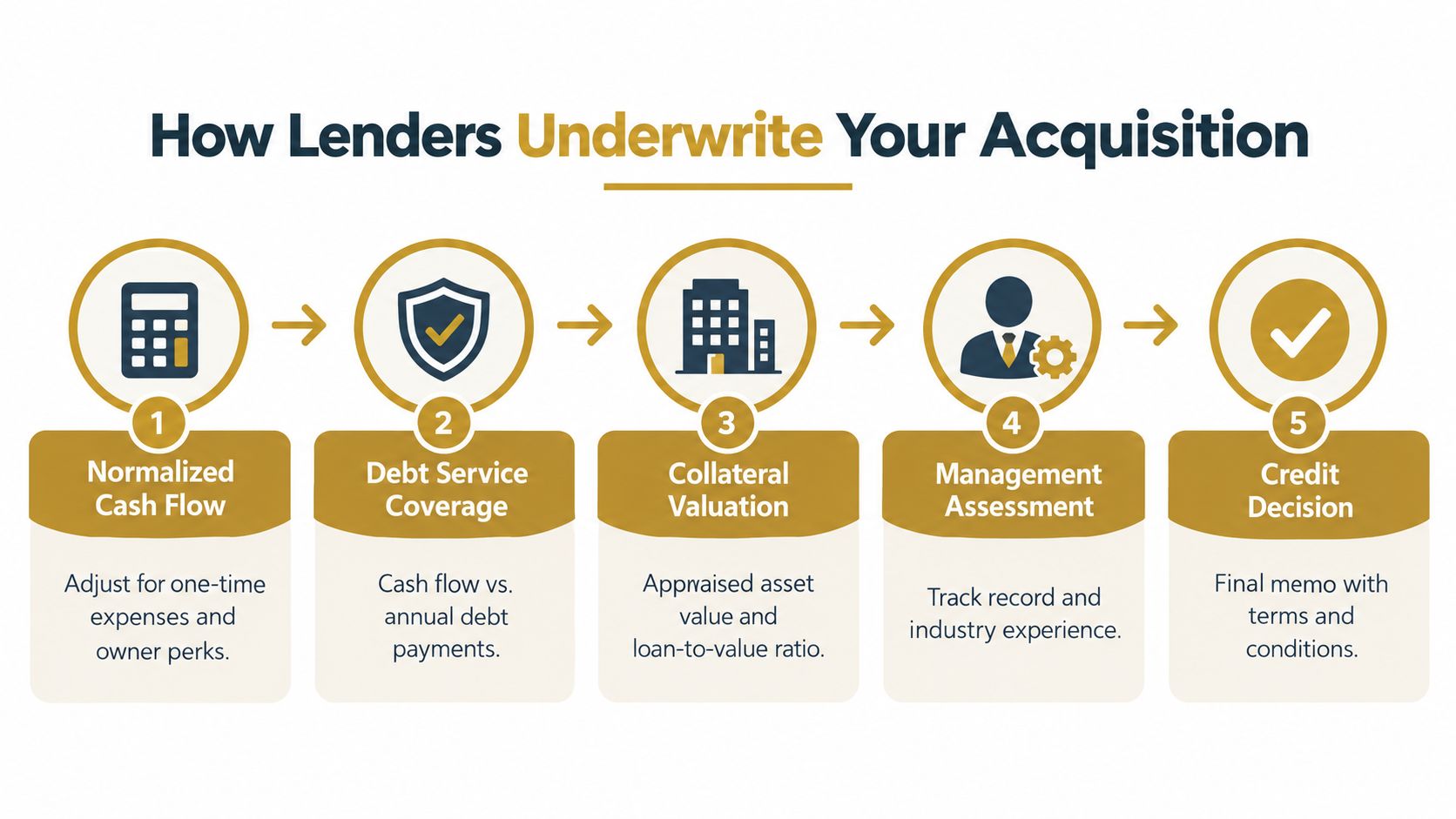
Most buyers prepare a pitch deck. Lenders prepare a credit memo. The difference matters because a persuasive growth narrative can't replace verified cash flow.
Start with normalized cash flow
Underwriters recast historical financial statements. They remove expenses that won't recur, challenge seller add-backs, compare reported earnings with tax returns and bank statements, and test whether the buyer can operate the company without relying on the seller's personal involvement.
Seller's discretionary earnings can be useful for initial screening, but lenders need sustainable post-close cash flow. A buyer who adds back every owner benefit, one-time repair, and optimistic adjustment may produce an attractive model that collapses under scrutiny.
The core measure is debt-service coverage ratio, or DSCR:
DSCR = operating cash flow ÷ scheduled principal and interest
For U.S. SBA 7(a) credit analysis, standard guidance identifies 1.0:1 as a minimum for certain analyses, while newer SBA small-loan procedures specify at least 1.10:1 on a historical or projected basis. The Congressional Research Service summarizes the relevant SBA underwriting framework in its overview of SBA 7(a) lending. A buyer should target an internal cushion of 1.25x or more, because a model that barely clears a lender floor leaves little room for margin compression, customer loss, working-capital swings, or integration costs.
Test the borrower, not just the target
Lenders also assess management history, industry experience, guarantor liquidity, collateral coverage, liens, lease obligations, and the buyer's post-close plan. A strong company can still produce a weak credit if the buyer has no credible transition plan or lacks funds for working capital.
A useful pre-submission model includes:
- Base case: Management's expected revenue, margins, collections, and operating expenses.
- Downside case: Lower revenue, slower receivables, weaker margins, and delayed integration benefits.
- Covenant case: The exact definitions and testing periods used in the proposed loan documents.
A professional business valuation service can help separate market value from lender-supportable cash flow, but the valuation doesn't replace underwriting. The lender cares about the amount of cash available for repayment after the transaction changes ownership.
The Documentation Package Lenders Expect
A lender-ready file reduces questions before they become delays. It also forces the buyer to discover inconsistencies before the lender does.
The package should normally include:
- Monthly financial statements: Provide 24 to 36 months of income statements, balance sheets, and cash-flow information where available. Monthly detail reveals seasonality and collection patterns that annual statements hide.
- Quality-of-earnings adjustments: Document every add-back, explain why it won't recur, and support it with invoices, payroll records, tax filings, or bank activity.
- Tax returns and bank statements: Let the lender reconcile seller-reported earnings with filed results and actual cash movement.
- Debt and lien schedules: List every loan, lease, guarantee, security interest, maturity, payment, and existing collateral claim.
- Sources-and-uses statement: Show exactly how purchase price, fees, working capital, debt refinancing, and buyer equity fit together.
- Management resumes: Explain who will run the company, what experience they bring, and how the transition will work.
- Collateral details: Include equipment lists, inventory reports, receivables aging, property information, insurance, and ownership records.
- Guarantor financial information: Provide personal financial statements, liquidity evidence, contingent liabilities, and supporting account statements.
- DSCR sensitivity tables: Show how coverage changes after revenue, margin, collection, and expense shocks.
- Transaction documents: Include the purchase agreement, lease assignment, customer or vendor consents, licenses, and material contracts.
A missing lease assignment can hold up a closing just as effectively as a weak projection. The lender needs confidence that the company can continue operating from the premises and retain the assets that produce cash flow.
The most damaging packaging error is inconsistency. Sending one lender a purchase price with one set of add-backs and another lender a different sources-and-uses schedule creates a credibility problem. Build a controlled data room, assign one owner to the model, and circulate a single version of the transaction.
A clean file doesn't make a weak deal financeable. It prevents a financeable deal from looking weak.
Reading Term Sheets Beyond the Interest Rate
The headline rate is the easiest term to compare and often the least informative. Two offers with the same rate can produce different cash outcomes because one amortizes faster, charges larger fees, or gives the lender more control after a covenant breach.

Calculate the full economic cost
Read each term sheet across the full life of the loan:
- Amortization: A longer schedule may preserve cash, even if the rate is higher. A short schedule can create a payment burden that the annual income statement doesn't reveal.
- Fees: Include origination charges, guarantee fees, underwriting fees, legal expenses, unused-line fees, and lender monitoring costs.
- Interim interest: Determine whether interest accrues before closing, during a delayed funding period, or on undrawn commitments.
- Prepayment rights: A penalty can make refinancing or selling the company expensive when conditions improve.
- Floating-rate exposure: Model the payment under higher rates, not just the rate quoted on signing day.
- Personal guarantees: Identify whether the guarantee is unlimited, capped, released after milestones, or supported by specific collateral.
- Cash sweeps: Understand whether excess cash must repay debt instead of funding hiring, inventory, technology, or integration.
- Reporting: Note monthly borrowing-base certificates, financial statements, field exams, compliance certificates, and audit rights.
A maintenance covenant is tested regularly, whether or not the borrower takes a new action. An incurrence covenant generally restricts a specific action, such as taking on more debt or making a distribution. A debt-coverage covenant tested monthly behaves very differently from a springing covenant tested only after a triggering event.
The exact wording controls the practical risk. “EBITDA” may exclude certain costs in one agreement and include them in another. “Excess cash flow” may be calculated before or after permitted capital expenditures. The buyer should ask counsel to reconcile every defined term with the operating model.
The following video provides a useful visual introduction to how term sheets and financing decisions are assessed:
Before signing, put every offer into one comparison model. Show initial proceeds, cash interest, scheduled principal, fees, minimum liquidity, covenant headroom, prepayment cost, guarantee exposure, and the consequence of a downside case. The winning offer is the one that leaves the company able to operate through an ordinary bad quarter, not merely the one with the smallest rate.
When Private Credit and Seller Notes Look Like Cheaper Alternatives
Private credit and seller financing solve different problems. Treating them as interchangeable substitutes for bank debt is how buyers mistake speed for affordability.
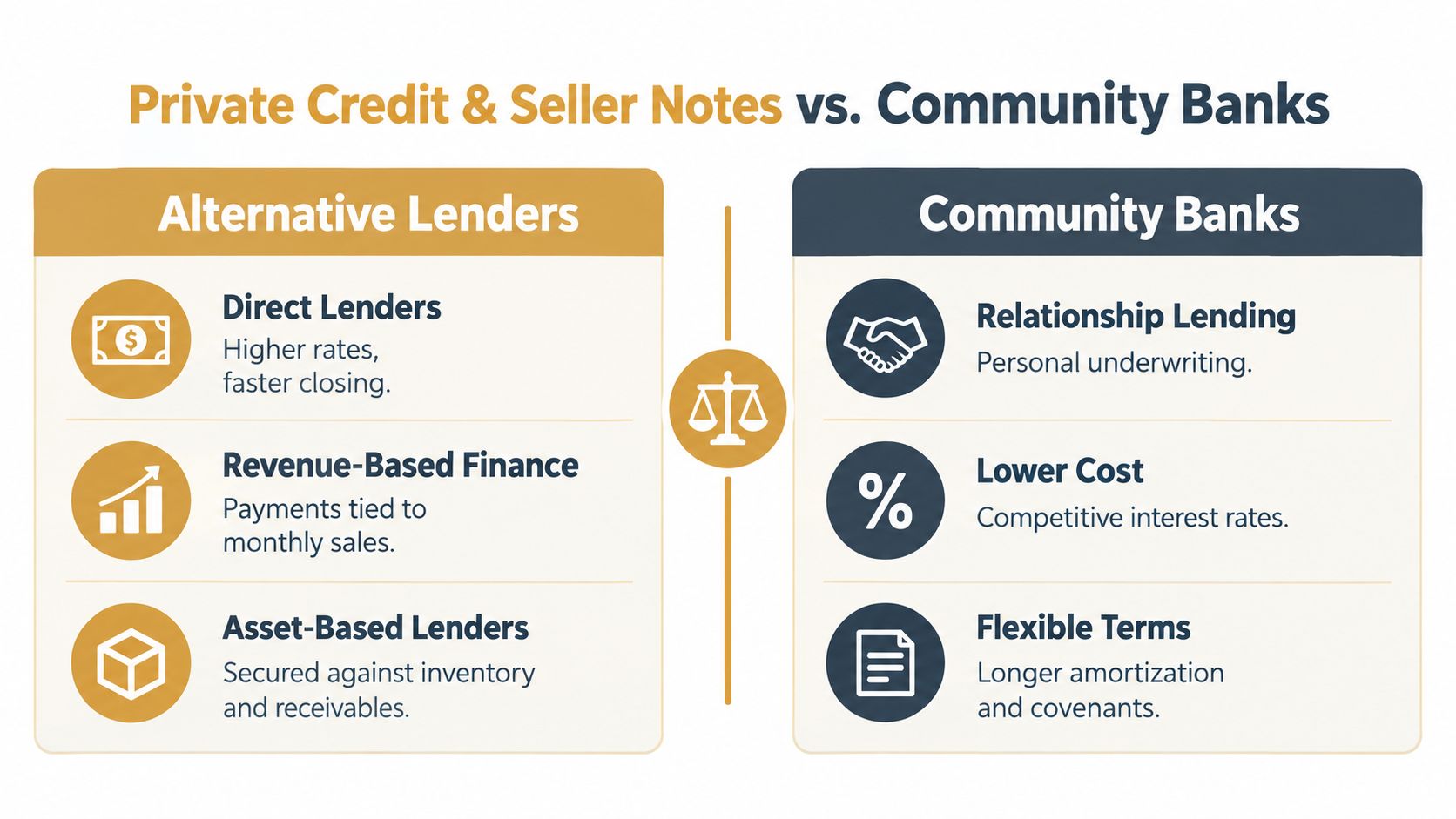
Private credit can close faster and may underwrite situations a community bank rejects. That flexibility often comes with floating-rate exposure, tighter reporting, cash sweeps, warrants, broader collateral claims, or more aggressive default remedies. The lender may give the buyer certainty of execution, but the buyer pays for that certainty through economics and control.
Seller financing can align the seller with post-close performance and reduce the amount of senior debt. It can also take longer to negotiate because the seller is balancing tax objectives, security, transition obligations, subordination, and confidence in the buyer. A seller note that fits the company's cash cycle may be more valuable than a faster loan, even if the seller demands a higher stated return.
Rank the structure by downside control
Compare alternatives using five questions:
- Total economic cost: What will the borrower pay after interest, fees, warrants, monitoring, and refinancing?
- Payment alignment: Do required payments follow customer collections and the company's cash-conversion cycle?
- Covenant burden: How much management attention and cash must be reserved for compliance?
- Refinancing risk: Does the structure require a new transaction before the business has matured under new ownership?
- Downside control: What happens after a missed covenant, delayed payment, or valuation decline?
Private credit is expanding materially. The cited OCBC commentary estimates global private-credit assets under management at USD 2.3 trillion in 2025, with a projection of USD 4.5 trillion by 2030. The same source cites an MSME financing gap of USD 5.7 trillion across emerging and developing markets, based on IFC and World Bank work. These figures describe access conditions, not a reason to accept any available loan. OCBC's private-credit commentary is useful precisely because it highlights the trade-off between access and structure.
Unsecured substitutes deserve particular caution. The same commentary notes that average business-credit-card APRs exceeded 25% in 2025, which can push borrowers toward installment products without solving the underlying repayment problem. A high-cost facility may preserve a closing date while raising the break-even revenue the acquired company needs every month.
For buyers negotiating seller notes, the seller financing options guide is a useful reference point. The central discipline remains unchanged: creative debt helps only when repayment timing matches cash generation.
Closing Checklist and Blending Debt With Equity Partners
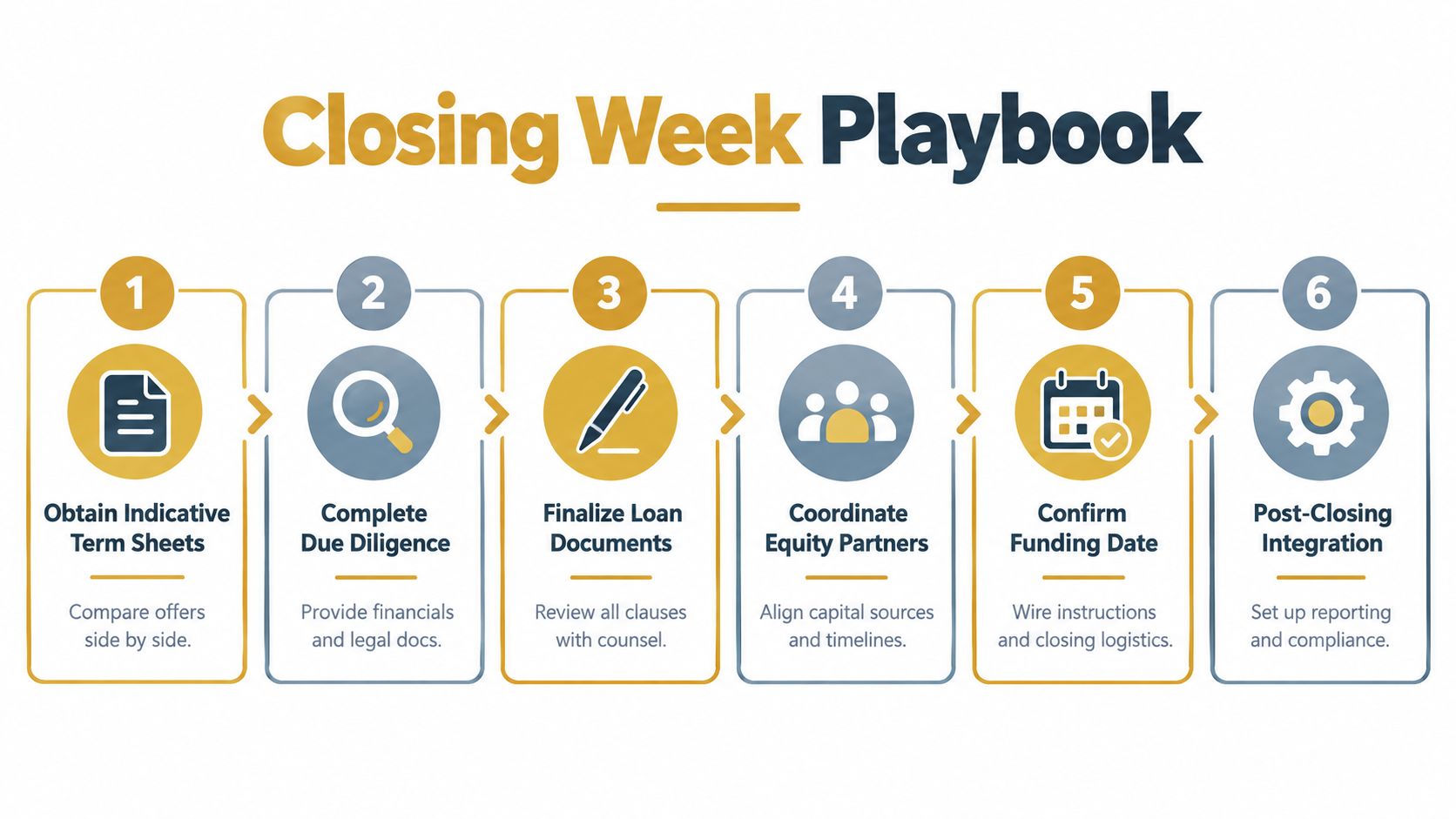
Debt should be substantially understood before the buyer signs an unconditional purchase agreement. Obtain indicative term sheets early, preserve an equity or seller-financing backstop, and include financing and diligence contingencies in the letter of intent.
Closing-week controls
Use the final week to confirm, not discover, the following:
- Title and liens: Verify ownership, releases, UCC filings, equipment claims, and lender priority.
- Legal authority: Collect officer certificates, board or member approvals, powers of attorney, and required consents.
- Insurance: Bind the policies required by the loan documents and name the appropriate parties.
- Lease and contracts: Confirm assignments, landlord consent, licenses, customer approvals, and key vendor continuity.
- Funding mechanics: Validate wire instructions independently and reconcile sources and uses against the closing statement.
- Liquidity plan: Reserve cash for payroll, taxes, inventory, integration, and unexpected operating needs after closing.
- Reporting calendar: Assign responsibility for financial statements, covenant certificates, borrowing-base reports, and lender communications.
Equity partners can improve a transaction when debt alone would leave too little operating cushion. A searcher, co-investor, or sponsor-backed partner may contribute capital, experience, or relationships while sharing ownership and risk. The trade-off is dilution, governance, investor reporting, and a different decision-making dynamic.
| Stack Pattern | Best For | Key Risk to Manage |
|---|---|---|
| Debt only | Stable cash flow with ample coverage | Payment pressure and personal guarantees |
| Debt plus seller note | Transactions where seller alignment matters | Subordination, transition, and repayment negotiation |
| Debt plus equity partner | Larger or riskier acquisitions | Dilution, governance, and investor expectations |
| Senior debt plus mezzanine | Capital gaps after senior underwriting | High total cost and layered control rights |
A buyer comparing business acquisition funding strategies should build the stack around post-close cash conversion, not maximum borrowing. Dealmaker Wealth Society offers acquisition training, templates, mentorship, and peer support covering capital raising, debt structures, and deal execution.
Use debt only when the business can repay it through realistic operating cash flow. If the model needs perfect collections, immediate growth, or aggressive add-backs to work, reduce the debt load, add patient capital, renegotiate the seller note, or walk away.
Dealmaker Wealth Society helps acquisition entrepreneurs evaluate debt structures, prepare lender-ready deal packages, and combine senior financing, seller notes, and equity partners with practical transaction guidance. Visit Dealmaker Wealth Society to explore its training, templates, mentorship, and peer support for buying and scaling small businesses.

From the Dealmaker Blog





A Creative Business Buying Fable