Mergers and Acquisitions Transactions: A Practical Guide
Mergers and Acquisitions Transactions: A Practical Guide
You've found a business for sale, the owner sounds ready to retire, and the advertised profit looks enough to replace your salary. Then you read that the M&A market is growing and wonder whether you need to move quickly before someone else buys it.
That's when you need to slow down. In mergers and acquisitions transactions, the headline price matters less than what you're buying, which obligations come with it, and whether the business can keep earning after the seller leaves.
Table of Contents
- Why Headline M&A Growth Does Not Make Small Deals Cheaper
- Asset Deals, Stock Deals and Mergers Compared
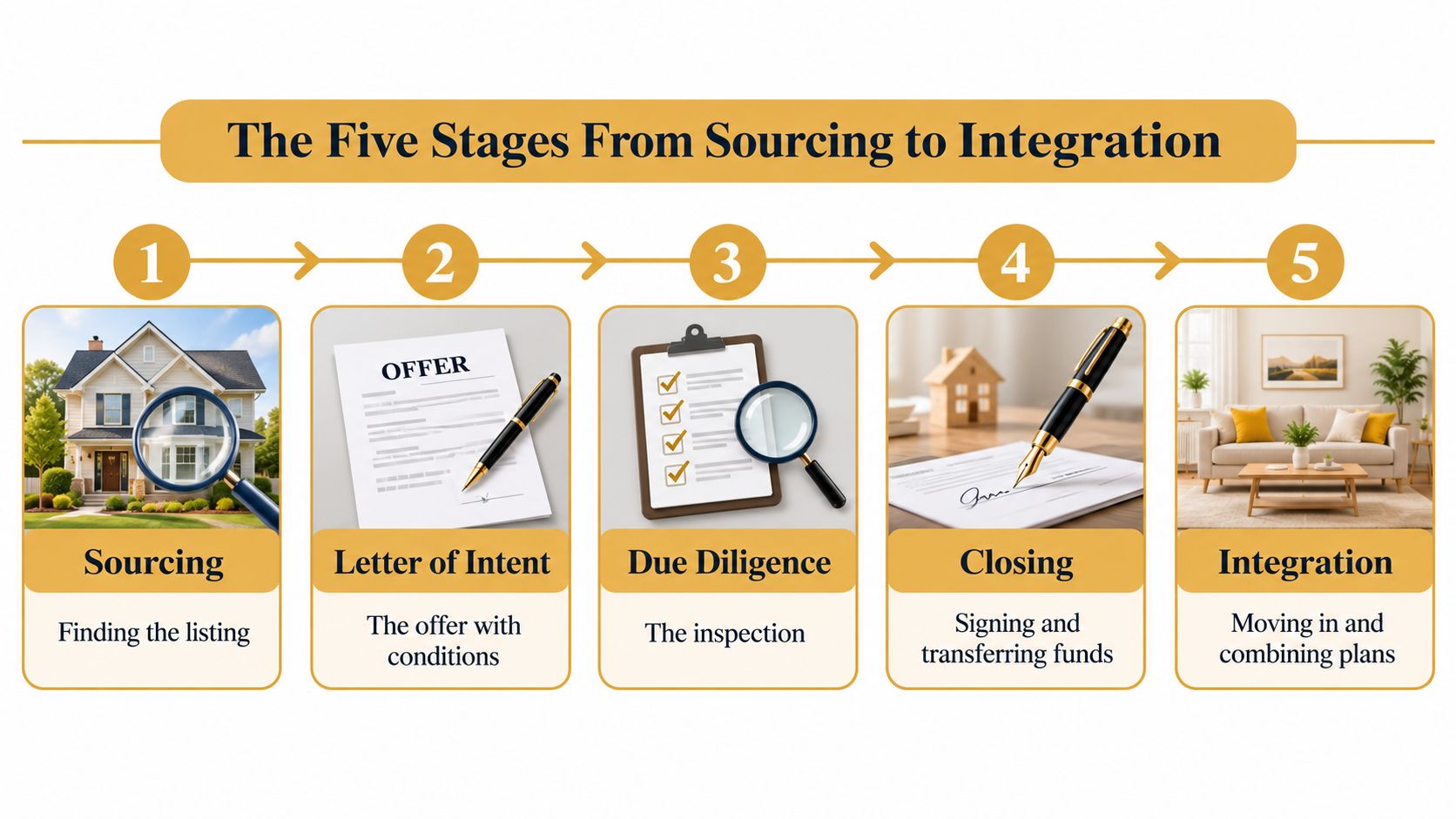
- The Five Stages From Sourcing to Integration
- Due Diligence Checks That Change the Price
- Capturing Value After the Deal Closes
- Choose Your Deal Structure Before You Make an Offer
Why Headline M&A Growth Does Not Make Small Deals Cheaper
In 2024, global transactions valued above $25 million totaled approximately $3.4 trillion, up 12% from $3.1 trillion, with 7,784 companies changing hands and an average transaction value of $443 million, according to McKinsey's M&A market review.
An M&A transaction transfers control of a business, or part of its assets, from one owner to another under a signed agreement. That definition covers far more than the corporate combinations that make the news.
Market totals aren't a reliable guide to your buying conditions. PwC's global deals outlook projects approximately $4 trillion in global M&A value in 2026, up about 13%, while transaction volume is projected to fall 13% to roughly 42,000 deals. Higher spending doesn't necessarily mean more accessible businesses or cheaper financing.
What actually sets a small-business offer
A competitive market can attract more buyers to companies with dependable profits and capable managers. It doesn't make a lender overlook weak cash flow or make an owner-dependent business easier to operate.
Start with the business's ability to fund its own obligations.
Valuation drivers and what lowers the offer
| Driver | What buyers check | What lowers the offer |
|---|---|---|
| Cash flow quality | Three years of profit, add-backs and one-off items | Unexplained add-backs or lumpy earnings |
| Owner dependence | Who holds key customers, pricing and supplier relationships | Sales that leave when the owner leaves |
| Working capital | Normal receivables, inventory and payables needed to operate | Buyer must inject cash on day one |
| Debt service coverage | Cash flow divided by annual loan payments | Insufficient cash remaining after loan payments |
| Seller financing | Whether the seller will carry part of the price and on what terms | Seller refuses any note, forcing more buyer equity |
Treat the financial history in the table as a document request, not proof of quality. Reconcile reported profit with bank activity, tax filings, payroll and the expenses you'll incur after taking over.
Debt service coverage compares cash available for debt service with annual loan payments. A business that earns barely enough to make those payments leaves no room for a late-paying customer, equipment failure or replacement manager. Confirm the lender's required calculation and test a downside case rather than relying on the seller's profit figure.
A seller note means the seller accepts payment for part of the purchase price over time. It can bridge a funding gap and leave the seller exposed to repayment risk, but willingness to offer one isn't proof that the business is sound. Interest, security, payment priority and lender restrictions still matter.
Identical earnings can justify different offers
Say two hypothetical businesses report identical earnings. In one, the owner wins the work, sets prices and manages every important customer; in the other, established managers handle those responsibilities.
The first business warrants a lower earnings multiple, a stronger transition arrangement or an earn-out, which makes part of the price conditional on agreed future results. The second gives you more evidence that earnings can survive the transfer.
A valuation is only as good as the earnings behind it.
Before reviewing a financing term sheet, list the business characteristics most likely to move your price. That keeps the offer grounded in operating risk rather than the amount someone is willing to lend.
Asset Deals, Stock Deals and Mergers Compared
| Structure | What transfers | Liabilities | Consents | Tax basis |
|---|---|---|---|---|
| Asset purchase | Named assets and agreed assumed obligations | Can leave unwanted liabilities with the seller, subject to legal exceptions | Material contracts often need assignment or consent | Purchased assets may receive a new tax basis |
| Stock purchase | Shares in the company, which continues owning its assets and contracts | Known and unknown liabilities remain inside the acquired company | Change-of-control clauses and ownership approvals matter | Buying shares doesn't necessarily reset underlying asset basis |
| Statutory merger | Entities combine through a legal process; a surviving entity holds assets and obligations | Obligations generally continue with the surviving entity | Contract wording and applicable merger rules govern | Determined by transaction design and applicable tax law |
The central distinction is buying the contents versus buying the container. In an asset purchase, you identify the equipment, inventory, intellectual property and other assets you want. In a stock purchase, you buy ownership of the company that already holds them.
A statutory merger is another legal route to combining businesses. It isn't a friendlier name for a share purchase, and it doesn't erase inconvenient obligations.
Apply the structure to the target
Consider a hypothetical regional HVAC service business with maintenance customers, service vehicles, technicians and a pending lawsuit. A buyer might prefer an asset purchase that includes the operating assets while expressly leaving the lawsuit with the seller.
That preference needs legal testing. Some liabilities can follow assets despite the purchase agreement, and excluding an obligation doesn't prevent someone from bringing a claim.
Contract transfer also needs its own workstream. Our closing rule is that any material contract without an assignment clause needs a customer consent letter before the deal closes. Counsel should also review assignment restrictions, termination rights and consent conditions in contracts that do contain assignment provisions.
Now consider a company whose valuable permits or long-term agreements are difficult to transfer. A stock purchase may preserve continuity because the contracting entity remains in place. However, a change-of-control provision can still require approval, so keeping the company intact isn't a substitute for reading the documents.
Our comparison of asset purchases versus stock purchases provides a useful framework for separating ownership mechanics from operational continuity.
Structure rule: A liability exclusion is useful only if the law, the documents and the seller's ability to meet its obligations support it.
Check the tax consequences separately
Tax basis is the amount used to calculate relevant tax deductions and gains. A structure that benefits the buyer can impose a different tax cost on the seller, which can change the economics of the negotiation.
Tax treatment varies by jurisdiction and transaction design. Have a tax adviser confirm the consequences rather than treating an asset purchase as automatically favorable or a merger as automatically tax-neutral.
The Five Stages From Sourcing to Integration
Buying a business resembles buying a house: you find a candidate, make a conditional offer, inspect it, complete the transfer and take responsibility for what happens next. The important difference is that the business must keep serving customers throughout the process.
Use the timeline to understand the sequence, then manage each stage by its required deliverable.
Move forward on evidence, not enthusiasm
Sourcing means finding a suitable business. Use broker listings, referrals and direct owner outreach, then screen for profit history, operating fit and the responsibilities you'd personally inherit. Before moving forward, hold a target screening memo explaining why the business fits and which assumptions remain unverified.
The letter of intent establishes the proposed bargain. Set out the price range, proposed structure, payment approach, exclusivity, confidentiality and conditions, with counsel distinguishing binding provisions from nonbinding commercial terms. Your output is a signed letter of intent, not a verbal agreement that everyone remembers differently.
Due diligence tests the purchase case. Inspect financial records, customer relationships, contracts, employees, technology and legal exposure while advisers reconcile claims against supporting documents. Hold a diligence memo that records findings, unresolved questions and the effect of each material issue on price, terms or the decision to proceed.
Closing completes the agreed transfer. Finalize the purchase agreement, disclosure schedules, financing, required consents and funds-flow instructions, and verify payment details through an independently confirmed channel. Before funds move, hold a completed closing checklist that identifies every document, approval, payment and responsible party.
Integration turns ownership into operational control. Keep payroll, customer service, purchasing and collections working while managers execute the transition plan and communicate approved changes. Your output is an operating handover plan with named owners, deadlines, access credentials and escalation routes.
Keep the workstreams connected
These stages overlap. Lawyers may draft purchase documents while accountants verify earnings, and the operating team should prepare the handover before the transaction closes.
The buyer needs a single issue tracker that connects those workstreams. If diligence reveals an equipment lease, for example, record who checks transferability, who models the payment obligation and who ensures the final agreement addresses it.
Avoid treating a signed letter of intent as a commitment to buy regardless of what follows. Its purpose is to establish a basis for investigation and negotiation, not to make uncomfortable findings disappear.
Due diligence is the stage buyers are most tempted to rush. The seller may want certainty, the financing may be progressing, and everyone may already be discussing announcements. None of that replaces evidence that the business is worth buying.
Due Diligence Checks That Change the Price
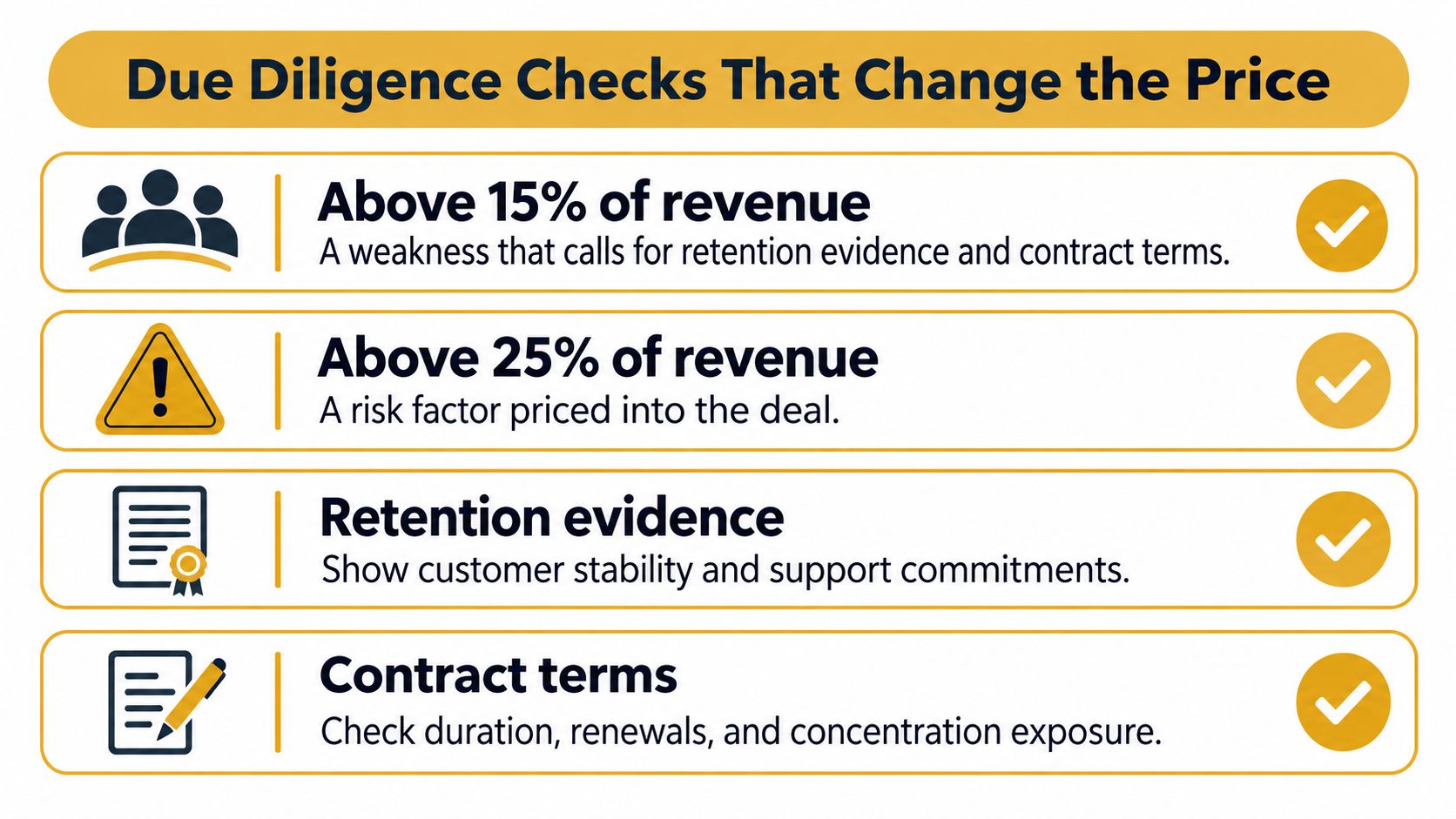
Customer concentration deserves an early review because losing a major account can undermine both earnings and acquisition financing. We use the following customer concentration thresholds to guide the response, not as universal legal or lending standards.
| Customer share of revenue | Classification | Effect on the deal |
|---|---|---|
| 15% or below | No concentration weakness from this test | Standard review |
| Above 15% | Weakness | Ask for retention evidence and contract terms |
| Above 25% | Risk factor | Risk priced into the offer |
| Above 40% | Changes the deal structure | Expect earn-out, escrow or restructured terms |
The applicable response escalates as exposure increases. Passing this test doesn't establish that the customer base is secure: several accounts may belong to the same corporate group or depend on the same underlying project.
Use the visual checklist to keep retention evidence alongside the revenue calculation.
Verify the relationship behind the invoice
Our customer verification process combines customer interviews, concentration analysis, contract review and retention risk assessment. Coordinate interviews with the seller under agreed confidentiality rules rather than contacting customers without permission.
Ask why customers buy, who controls the relationship and what would prompt them to leave. Then compare those answers with renewal dates, cancellation rights, purchase history and unresolved complaints.
A long relationship isn't the same as a committed order book. A satisfied customer may still have no obligation to purchase again.
Build a technology blueprint before closing
In one acquisition example, McKinsey found that nine core-platform decisions accounted for approximately 70% of expected technology synergies. That's a reason to prioritize systems that control revenue and operations rather than trying to combine every application immediately.
Inventory the enterprise resource planning system, customer relationship management platform, billing software and workforce tools. Record data ownership, administrator access, license transfer rights, duplicate workflows and the consequences of an outage or failed migration.
Use a shared checklist across the following areas:
- Financial: Reconcile earnings, cash collections, add-backs and working-capital requirements.
- Customer: Verify account stability and the evidence supporting expected retention.
- Contract: Identify renewal, termination, exclusivity and performance obligations.
- People: Review compensation, responsibilities, retention needs and undocumented knowledge.
- Technology: Test access, data quality, security and migration dependencies.
- Legal: Investigate disputes, ownership rights, compliance gaps and contingent obligations.
Our guide to assessing operational due diligence factors helps connect these findings to how the business runs.
A red flag needs a decision, not just a note in a folder. Reduce the price, require remediation, use a carefully defined earn-out or escrow, or walk away when the exposure can't be bounded.
Capturing Value After the Deal Closes
Synergies are improvements you must deliver, not extra earnings you receive at closing. Removing duplicate software costs, improving purchasing terms or selling additional services all require someone to make decisions and execute them.
Make the integration program visible to the people responsible for delivery.

Turn the forecast into an operating program
Establish the pre-close baseline. Record existing costs, revenue, staffing and service levels so the team can distinguish an acquisition benefit from an unrelated change in trading.
Assign an accountable owner. Give each initiative a named person with authority, resources and a deadline. Shared responsibility without a decision-maker makes it easy to postpone difficult work.
Define monthly operating measures. Select measures such as gross margin, repeat-customer rate and cost per job, then specify how each is calculated and who checks it.
Reconcile benefits through the accounts. Verify that claimed savings or additional revenue reach the profit and loss statement, and record implementation costs alongside them.
Separate forecasts from verified improvements. Keep expected benefits distinct from demonstrated cash-flow changes so you don't spend money that the business hasn't generated.
McKinsey's review of 160 mergers found that synergies not realized within approximately the first full budget year after consolidation may be overtaken by later business changes. Set the closing date partly around your ability to execute, not merely the availability of signatures.
Make the seller's handover measurable
Suppose the seller stays temporarily under a paid consulting agreement. Define the customer introductions, supplier handovers, training materials and decision rights required, rather than paying for availability alone.
Our post-acquisition integration strategies offer a framework for coordinating people, processes and systems without disrupting the service customers already receive.
Use the accompanying video as a prompt for discussing how your team will manage the transition.
A synergy you haven't measured is only a hope.
Keep contractual disagreements separate from routine operating decisions. If a Singapore-based transition leads to a dispute over contractual obligations, The Lawyer Guide provides a resource to find a lawyer for contract disputes in Singapore.
A practical launch checklist should include:
- At handover: Deliver approved staff and customer communications, confirm payment authority and test critical access.
- During stabilization: Establish reliable reporting and resolve service interruptions before launching discretionary changes.
- At the formal review: Compare actual results with the baseline, investigate missed commitments and revise the remaining integration plan.
Choose Your Deal Structure Before You Make an Offer
Choose the asset purchase, stock purchase or merger structure that fits the target's liabilities, contracts, permits and essential people before you submit an offer. A price without a defined purchase perimeter leaves too much room for the parties to believe they've agreed to different transactions.
Your proposed structure can change during negotiations, but it should begin as a reasoned choice. Don't select it merely because a broker's template already contains that wording.
Put the unresolved decisions in writing
Answer these questions before drafting:
- Which liabilities must remain with the seller? Identify the obligations you won't accept and have counsel assess whether the proposed exclusions can work.
- Which contracts require consent or assignment? Name the counterparties, required approvals and consequences if approval isn't obtained.
- Which key people must remain? Specify the roles, handover obligations and retention arrangements needed to operate after completion.
Convert the answers into a letter of intent that names the proposed structure, price range, exclusivity period and diligence conditions. Explain what is included in the price, how payment will work and which findings could change the proposed terms.
Send that draft to transaction counsel and a tax adviser before it goes to the seller. Ask them to identify assumptions that could make the offer impractical, unexpectedly expensive or inconsistent with the target's operating requirements.
The objective isn't to eliminate every uncertainty before discussions begin. It's to distinguish negotiable commercial points from conditions you need to protect the business and your capital.
Once those questions are answered, Dealmaker Wealth Society offers training across all aspects of M&A if you'd like to continue learning before pursuing a transaction.
Dealmaker Wealth Society combines acquisition education with specialty coaching in deal origination, capital raising, financial due diligence, M&A contracts and post-acquisition integration. Visit Dealmaker Wealth Society to explore support for evaluating a target, preparing an offer and planning the responsibilities that begin after closing.

From the Dealmaker Blog












A Creative Business Buying Fable