How to Get Into Mergers and Acquisitions in 2026
How to Get Into Mergers and Acquisitions in 2026

The usual advice says to get an investment-banking analyst seat, build a few years of experience, then move into private equity or corporate development. That route works, but it isn't the only way to work on acquisitions, and it can be a poor fit if your real goal is to buy and operate a small business.
The better answer to how to get into mergers and acquisitions starts with three practical questions: What capital can you access? What operating or finance experience can you prove? And how close are you to business owners who may sell? Your answers point to different entry routes, and each route has its own evidence test.
Table of Contents
- Choose the Entry Route That Fits Your Background
- Skills Each Route Tests and How to Prove Them
- Credentials Worth Earning and When to Skip Them
- Build Deal Exposure Through Experience and People
- Stress-Test Financing and Choose the Deal Structure
- How to Run Your First Acquisition Step by Step
- Pick Your First Move This Month
Choose the Entry Route That Fits Your Background
The right route depends on your capital, operating experience, and access to sellers, not on a single university-to-banking ladder. Banking is a structured start for candidates who can meet its recruiting requirements. Buying a business directly can suit an operator with sector knowledge and financing access. Partnership can create another opening when you bring operating ability but not enough capital to buy alone.
| Route | Best fit background | Typical entry role | Proof checked | Time to first deal |
|---|---|---|---|---|
| Investment banking | Finance, economics, or quantitative degree | Analyst on a deal team | Modeling test and deal internship | 1–2 years, including recruiting cycle |
| Corporate development | FP&A, controllership, or strategy inside an acquirer | Associate or manager | Analysis of past projects and board materials | After 3–5 years of industry experience |
| PE or search fund | Banking or operating background with strong finance | Associate, or searcher raising capital | Sourced deals and an investor-ready thesis | 2–4 years |
| Independent small-business buyer | Operator, accountant, or sales manager with some capital or loan access | Owner-buyer of a single company | Proof of funds, lender-ready financials, and sector knowledge | 6–18 months |
| Operator-partner or joint venture | Industry operator with a strong network | Co-investor or operating partner | Track record of running a business | 6–12 months |
These are planning ranges, not guarantees. A recruiting cycle, a lender's decision, the availability of a suitable business, or the time needed to build a partnership can all shift the timeline. For scale, BizBuySell figures reported by the Associated Press recorded 9,093 U.S. small businesses sold in 2023, with $6.5 billion in transaction value. That's evidence of a route outside large corporate deals, not a promise that any individual buyer will find a suitable company quickly. Read the Associated Press report on BizBuySell's small-business sale figures.
Choose based on what you can demonstrate
Banking analyst hiring follows campus or lateral recruiting cycles, so candidates often need to prepare well before they want to start. Corporate development usually makes more sense after experience in finance or operations at an acquiring company. Independent buyers face a different test: they must show that they can find a target, finance it, and run it after closing.
If banking is your chosen path, practice both the technical interview and the story that connects your experience to deal work. This investment-banking interview guidance can help you prepare for common screening and modeling questions. If you're exploring an investor or search-fund route, compare how different private equity investment strategies use capital and source opportunities.
Before committing, answer three questions: How much capital can you put at risk? What operating experience can you show? Do you already know owners who may sell? If your strongest answer is operating experience, don't assume a banking seat is the only credible first move.
Skills Each Route Tests and How to Prove Them
Every M&A route calls for financial judgment, clear communication, and reliable follow-through, but employers and sellers test those skills differently. Banking interviews often emphasize modeling speed. Corporate development teams look for sound judgment within a company's strategy and approval process. Independent sellers and lenders want to know whether you can source responsibly, finance a purchase, and keep the business working afterward.
A certificate can show that you completed coursework. A finished project shows how you think. Build artifacts you can walk through, explain your assumptions, and defend when someone challenges them.
| Skill | Proof accepted | Practice project |
|---|---|---|
| Financial modeling | Three-statement model with a five-year forecast | Rebuild a public company's model from its annual filing |
| Valuation | Comparable-company and precedent-transaction analysis | Value a listed peer using EBITDA multiples from its reports |
| Due diligence | Red-flag list from a data room | Review a sample data room covering contracts, payroll, and debt |
| Negotiation | Written letter of intent with terms and walk-away points | Role-play an offer with a mentor and document the counteroffers |
| Integration planning | 100-day plan with named owners | Write a 100-day plan for a business you've worked in |
| Sourcing and outreach | Target list with contact log and response rate | Build a list of 50 owner-operated businesses and log every outreach |
Make your work easy to inspect
Keep each project in a clean folder with the source documents, your assumptions, the finished analysis, and a short note on what you'd investigate next. In a model, label inputs separately from formulas and show how a change in revenue or margins affects cash flow. In a diligence review, tie each concern to a document request or a question for the seller.
People changing careers can also translate relevant experience into deal evidence. A sales leader may show customer-retention and negotiation skills; an operations manager may show process improvement and integration judgment. This guide to transferable skills for a career change can help you frame those capabilities for an employer or seller.
For a finance-oriented route, start with modeling and valuation. For a direct-buying route, start with sourcing and diligence. Pick two, complete the work, then use it in a real conversation. The financial modeling training resource can support the modeling practice, but it shouldn't replace a project you can explain yourself.
Credentials Worth Earning and When to Skip Them
A credential opens a door only when the route you want values or requires it. Choose training to close a specific gap, not to make a résumé look busy. Before paying for a program, identify the role or transaction task it's meant to prepare you for and the work product you'll be able to show afterward.
| Credential or training | What it signals | Typical effort | Best fit |
|---|---|---|---|
| CFA charter | Valuation and finance rigor | Three exam levels with a large study commitment | Corporate development, PE, valuation roles |
| CPA | Accounting, audit, and tax fluency | Exam sections plus experience rules that vary by state | Independent buyers and due diligence work |
| Series 7 license | Licensed securities representative | Requires sponsorship by a broker-dealer | Sell-side banking roles, rarely needed to buy a business |
| Certified Business Intermediary (IBBA) | Small-business brokerage competence | Training course plus documented experience | Brokers and advisers in small-business deals |
| ASA or ABV valuation credential | Business valuation specialist | Multi-year exams and experience | Valuation specialists and fairness work |
| Practical acquisition training | Deal mechanics for first-time buyers | 10-Day Business Buying Launch curriculum | Independent small-business buyers |
Match the signal to the work
The CFA charter can demonstrate broad finance and valuation knowledge, but it's a substantial commitment. Earn it when the roles you're targeting value that signal; skip it if your immediate gap is finding sellers or learning how to assess a small company's records. A CPA is especially useful if you'll be reading tax returns, reconciling earnings, or taking responsibility for financial diligence.
A Series 7 license is tied to securities work and broker-dealer sponsorship. It's not a general-purpose business-buying credential, so don't pursue it just because it sounds relevant to M&A. The Certified Business Intermediary designation suits people who want to broker smaller companies, while an ASA or ABV credential is a more specialized choice for valuation work.
For a first-time buyer who needs practical deal mechanics, the 10-Day Business Buying Launch is one training option. Take it when you need structure around sourcing, offers, or diligence, then apply the material to an actual target search. Skip any credential that doesn't connect to a role, a deal task, or a capability you can demonstrate. Stacking courses without deal activity doesn't prove readiness.
Build Deal Exposure Through Experience and People
Reading about M&A can teach terminology, but it won't show whether you can manage a live process, ask a seller a useful question, or catch an assumption that doesn't match the records. Get close to transaction work and keep a record of what you contribute. Even an entry-level support task can create evidence if you complete it carefully and can explain your decisions.
Choose actions that leave proof
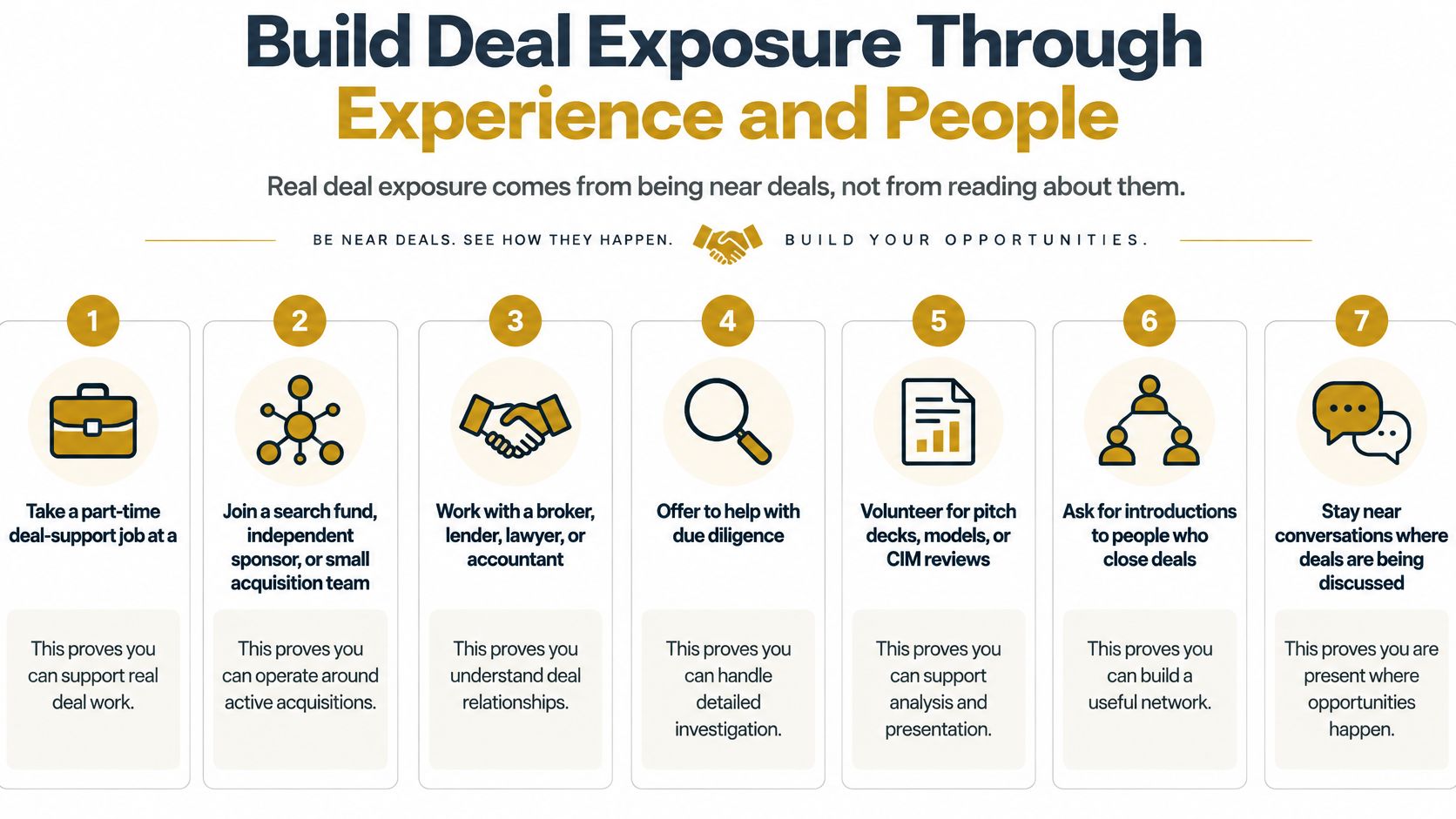
- Take a part-time deal-support job at a boutique or business broker. Start with administrative work if that's what's available. Maintaining a buyer list, organizing documents, or preparing meeting materials proves you can handle detail and follow a process.
- Write a one-page memo on a public merger proxy. Compare the offer premium with the buyer's stated synergy rationale, then list the assumptions you'd want to verify. This shows you can read transaction documents and separate a claim from evidence.
- Build a target list of 50 owner-operated businesses and log every outreach and response. Record the company, your reason for targeting it, the contact method, the reply, and the next action. The log proves you can source systematically rather than relying on vague interest.
- Shadow a broker through listings and letters of intent. Ask what sellers typically disclose early, what buyers need to verify, and why a proposed term matters. This builds familiarity with the sequence of a small-business sale.
- Meet SBA lenders, transaction attorneys, and accountants. Ask what makes a buyer credible and what problems commonly delay a deal. These professionals can also help you understand the records and financing questions owners must address.
- Join industry associations and owner groups where exits get discussed. Listen before pitching yourself. Your goal is to learn the sector's ownership patterns and become someone owners can speak to about a possible transition.
- Find a peer or mentor who has closed a deal and walk them through your offer. Bring the target, financing outline, diligence questions, and your walk-away point. Their questions will expose gaps in your thinking before a seller or lender does.
The accompanying graphic emphasizes being near live transactions and people who can involve you in the work.
Keep notes that show judgment
Ten well-documented conversations with owners can teach you more than a hundred cold emails with no follow-up. After each conversation, write down what the owner said about the business, what might need verification, and the next question you'd ask. Those notes become interview examples, help you improve your outreach, and give advisers a clearer picture of your thinking.
Stress-Test Financing and Choose the Deal Structure
Start with the downside, not the advertised price. Rebuild the business's cash flow under a case where earnings are 20% lower, then ask whether the company can still cover its debt. A lender may have a minimum debt-service coverage requirement, but don't assume one universal threshold applies. Ask the lender what it will require and test the business against that standard before you make an offer.
Accounting EBITDA isn't the same as dependable cash flow. Deduct a market-based replacement salary if the owner does work you'll need someone else to do, allow for maintenance spending, and account for working capital the business needs to operate and grow. Test the effect of losing a major customer, too. If a downside case leaves too little cash for debt service and normal operations, a clever payment structure won't repair the underlying economics.
GF Data recorded 170 private-equity-backed middle-market transactions in the first half of 2026, with average pricing at 7.1x trailing adjusted EBITDA. In the same period, the premium for above-average financial performers fell to 5% from 7% in the first quarter. Those figures describe a particular slice of the market, not a valuation rule for every small business. Use the GF Data middle-market transaction discussion as context, then judge the company on its own cash generation and risks.
| Structure | Reduces risk when | Hides an unaffordable price when |
|---|---|---|
| Seller note | The seller stays involved and the note is subordinated to bank debt | The note is large and repayment depends on cash the business doesn't yet generate |
| Earn-out | Payment is tied to a metric the seller can influence | The target depends on growth the seller can't deliver or is set unrealistically high |
| Minority equity partner | The partner brings capital and operating help without control risk | The partner's return requires a sale or refinancing the business can't support |
| Deferred consideration | Payment is spread over a timeline the cash flow can carry | Deferrals stack up so the total payout exceeds what the business can afford |
Structure should allocate risk, not disguise price. A seller note can bridge a financing gap, but it still needs a credible repayment source. An earn-out can connect payment to a result, but the parties must define the metric, measurement period, and access to the records. Set your maximum price and walk-away conditions before negotiations make a poor deal feel personal.
How to Run Your First Acquisition Step by Step
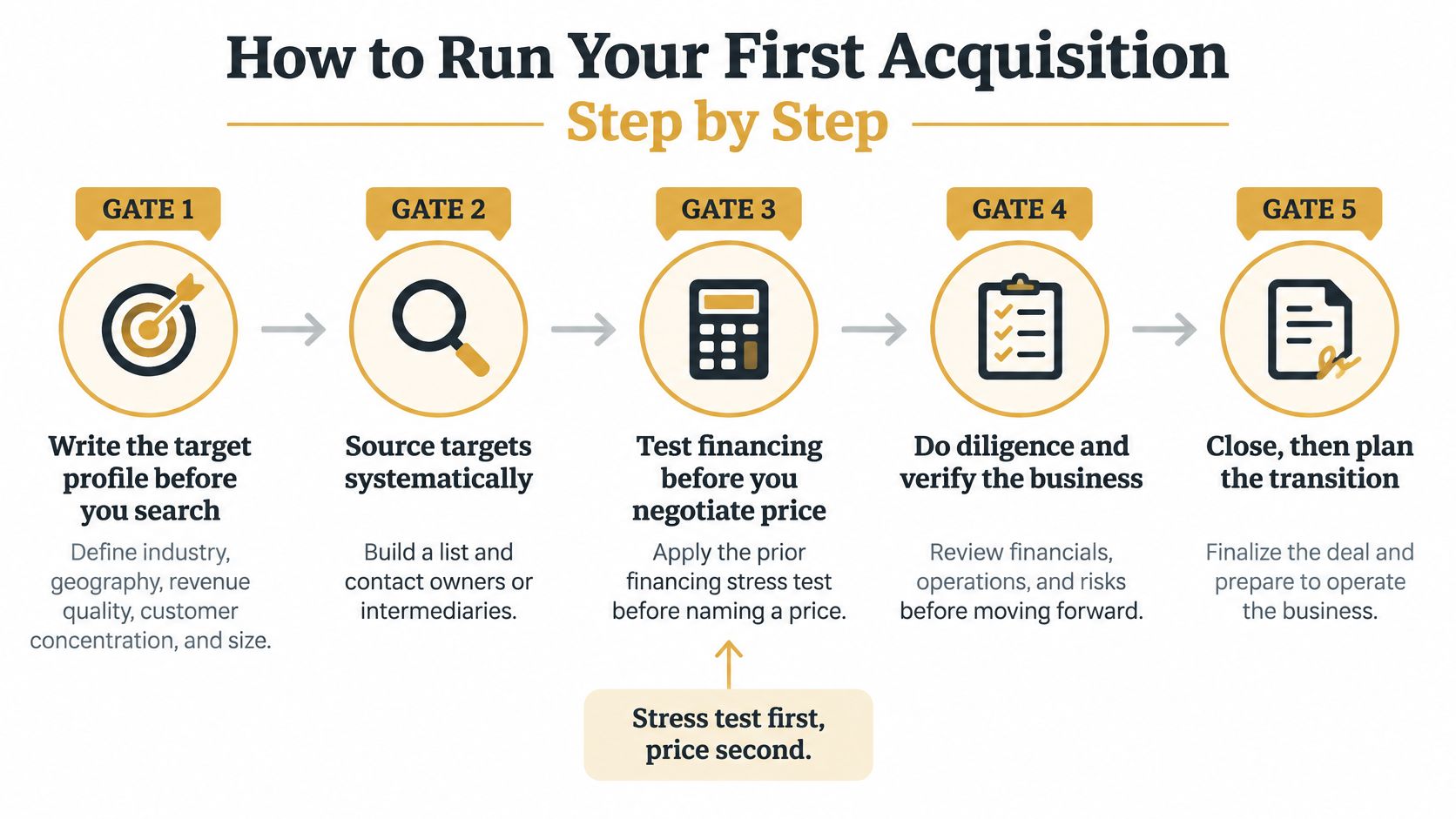
A first acquisition is won or lost before the offer. Set the target criteria, establish a sourcing routine, and test whether the business can support your price and financing under weaker conditions.
Five gates from target profile to offer
Write the target profile before you search. Set limits for industry, geography, revenue quality, customer concentration, owner dependence, and debt. Use them to reject poor fits, even when a listing looks attractive.
Build a sourcing funnel. Work through brokers, direct outreach, advisers, and referral partners. Record where each opportunity came from, the response, and the next follow-up. A contact list only helps if it produces opportunities you can compare.
Screen the business before naming a price. Review normalized EBITDA, recurring revenue, working-capital needs, and debt capacity. Model lower earnings, include the cost of replacing the owner, and test debt service against downside cash flow. Reject targets that fail your criteria.
Use diligence to challenge the thesis. Examine commercial, financial, tax, legal, operational, technology, and customer-retention risks. Test assumptions about growth, margins, pricing, market share, and synergies. Diligence should identify what could break the deal and what evidence would change your view.
Make an offer only when the evidence supports it. Keep an evidence register for forecast assumptions, including each source, owner, sensitivity range, and walk-away threshold. Model base, downside, and severe-downside cases. Verify tax filings, bank statements, customer contracts, payroll, debt, and working capital before accepting adjusted earnings.
Treat projected synergies cautiously. Don't pay upfront for savings or revenue improvements that have not been demonstrated. When evaluating a strategic transaction offer, check the commercial terms alongside the legal questions. This guide to navigating the mergers and acquisitions process offers another view of the transaction sequence.
Pick Your First Move This Month
Turn your chosen route into a month of work you can show someone. The point isn't to force a deal or rush a career decision. It's to replace general interest with evidence that an employer, seller, lender, or potential partner can assess.
Week one: Write down your route, the capital you can commit, and the two skills it tests first. Block four hours for one project: rebuild a three-statement model from a public filing if you're pursuing finance, or begin an owner-outreach log if you're pursuing a purchase.
Week two: Complete one exposure action that leaves useful notes. Write a merger-proxy memo, shadow a broker, or meet an SBA lender, transaction attorney, or accountant. Record what you learned and the next question you need answered.
Week three: Draft your target profile and your walk-away rules. Decide how much cash the business must generate after replacing the owner, what debt-service result you need under a downside case, and the maximum price you'll accept.
Week four: Set a decision date for recruiting, joining a sponsor, or preparing a first offer. Before that date, book your next conversations with people who can help you assess the route and move the work forward.
If structured acquisition training would help, the 10-Day Business Buying Launch is an option already compared with other credentials. Treat it as support for your work, not a substitute for testing your route or building deal evidence. Your first deal should follow from deliberate preparation, not speed.
Dealmaker Wealth Society offers training, mentorship, and peer support for people learning to source, evaluate, finance, and acquire small businesses. If you're building an acquisition path outside traditional banking, visit Dealmaker Wealth Society to explore its programs and deal support.

From the Dealmaker Blog











A Creative Business Buying Fable