How to Do a Leveraged Buyout of a Small Business
How to Do a Leveraged Buyout of a Small Business

The most popular advice about buyouts gets the starting point wrong: find a business, borrow as much as possible, and let its profits repay the loan. That approach confuses access to credit with the ability to survive ownership transition.
If you're learning how to do a buyout of a small business, start with the cash you can verify, not the financing you hope to obtain. The right purchase price leaves room for owner pay, taxes, equipment upkeep, and mistakes. Seller financing should put part of the seller's proceeds at risk where uncertainty remains, not give you permission to bid higher.
Table of Contents
- Start With Debt Capacity Not the Maximum Loan
- Value the Business and Test Debt Service
- Build the Sources and Uses Before You Bid
- Run the Buyout From Screen to Offer
- Use Seller Financing as Shared Risk
- Negotiate Legal and Tax Protections
- Stabilize Cash and Operations After Closing
- Decide to Close Reprice or Walk
Start With Debt Capacity Not the Maximum Loan
A small-business buyout combines buyer equity and acquisition debt, with operating cash flow funding repayment. Unlike a spreadsheet, the business must keep paying employees and suppliers while you replace the seller's relationships, judgment, and daily work.
Safe borrowing capacity is what recurring cash flow can support after normal business needs. It isn't the largest check a lender might approve.
Treat SBA financing as a boundary
The Small Business Administration's lender guidance permits financing for complete or partial changes of ownership through its 7(a) program, with loans up to $5 million and maturities typically up to 10 years, extending to 25 years when real estate or qualifying long-life assets are financed. Those are program boundaries, not evidence that a particular acquisition deserves that much debt.
A lender still evaluates your credit history, the target's industry, collateral, repayment capacity, and financial statement quality. An eligible transaction can still be unaffordable.
Say you're evaluating a service company whose owner handles sales and scheduling. Its reported earnings may look healthy, but you'll need to pay someone to perform those jobs, replace aging equipment, and fund payroll before customers settle invoices. Borrowing against earnings without those deductions leaves you financing work that somebody must still do.
Model the cash the business actually needs
Build a spreadsheet that separates purchase consideration from lender fees, transaction expenses, working capital, and post-closing reserves. Then map scheduled principal and interest against the cash remaining after operating obligations.
Use these distinctions as your starting point:

Cash timing matters as much as annual profit. For an eCommerce acquisition, LA Law Group, APLC's discussion of funding before Amazon payouts is a useful resource for understanding the gap between making a sale and receiving spendable cash. Don't mistake a settlement delay for acquisition debt capacity.
A practical acquisition cash-flow requirements analysis should distinguish recurring operating needs from temporary transition costs. Otherwise, you can appear fully funded at closing and immediately run short.
Practical rule: If conservative cash generation can't cover debt payments with breathing room, reduce the price or the debt. Don't repair the model by forecasting faster growth.
Test customer loss, margin pressure, and slower integration before negotiating the financing package. Growth should improve an already workable acquisition, not rescue an overindebted one.
Value the Business and Test Debt Service
The seller's asking price is a negotiating position. Your valuation needs an earnings base that survives the seller's departure.
Start with normalized EBITDA, meaning earnings before interest, taxes, depreciation, and amortization. Reconcile every proposed adjustment to supporting records, then account for replacement management at market compensation. If the earnings figure already includes appropriate management pay, don't deduct it again.
Convert earnings into affordable payments
Use this formula rather than treating EBITDA as spendable cash:
Cash available for debt service = normalized earnings − replacement owner compensation not already expensed − cash taxes − maintenance capital spending − additional working capital and reserve funding.
Divide that result by your chosen debt-service coverage target to establish an affordable payment ceiling. The target should reflect the business's volatility and the lender's requirements, not whatever makes the asking price work.
Build the calculation in Excel with separate inputs for customer revenue, gross margin, payroll, collections, and equipment replacement. A single percentage haircut to EBITDA hides too much. Losing a large customer can remove revenue immediately while leaving rent, supervisors, and software costs unchanged.
Keep valuation and financing separate
An independent valuation helps test whether the proposed price is supportable. It doesn't guarantee that your particular financing structure will work.
- Supportable value: What the verified business can justify without speculative improvements.
- Affordable debt: What your payment schedule permits after essential cash needs.
- Buyer return: What remains for your equity after compensation, reinvestment, and financing costs.
If value exceeds your affordable purchase price, the business may suit another buyer better. That isn't a modeling failure. Paying yourself nothing or postponing necessary repairs only conceals the gap.
Your output should be an affordable annual debt-payment ceiling, supported by a downside case. Use that ceiling to constrain both bank debt and fixed seller payments.
Build the Sources and Uses Before You Bid
Small-business LBO sources and uses
| Source | Typical share | Term or condition | What it may fund |
|---|---|---|---|
| Buyer equity | Lender-required cash contribution | Cash injected at closing | Required equity contribution toward eligible project costs |
| Senior SBA acquisition debt | Main funded borrowing component | Subject to program limits and lender underwriting | Eligible purchase consideration, working capital, equipment, and loan fees |
| Seller note | Negotiated deferred purchase consideration | Subordination and acceptable payment restrictions | Part of the price, not a separate operating cash reserve |
| Earn-out | Contingent, outside fixed debt | Payable only when defined post-close metrics are achieved | Allocation of performance and transition risk, not closing cash |
| Fees, reserve, and working capital | Uses included in total project cost | Minimum cash established before an offer | Lender fees, transaction costs, and post-close liquidity |
The last row is deliberately a use, not a funding source. Keeping it visible prevents a common mistake: balancing the purchase price while leaving the operating company underfunded.
Build from project cost
For an SBA acquisition, the SBA's 7(a) loan guidance provides the relevant financing framework; a commonly reported acquisition structure is approximately 10% buyer equity, 10%–15% seller financing on a five-year amortization schedule, and 75%–80% senior debt. Treat that mix as an underwriting discussion starter, not an entitlement or a ready-made capital stack.
Select compatible amounts that balance. You can't take the highest share from every range, and a seller-note payment schedule that works independently may fail when added to bank payments.
Populate the uses side from documents:
- Purchase consideration: Separate the amount payable at closing from deferred or contingent consideration.
- Transaction costs: Obtain estimates from counsel, the accountant, valuation providers, and the lender.
- Operating funding: Calculate cash needed for payroll, supplier terms, inventory, and collections.
- Equipment and reserves: Identify required replacements and cash that must remain untouched at closing.
Next, populate sources with money that can arrive. Buyer equity means available cash, not an anticipated refinance. Senior debt means an amount supported by lender feedback, not the amount requested on an application.
Make every funding source usable
A seller note belongs in the closing model only when its terms are acceptable to the senior lender. Keep an earn-out separate: a future contingent payment doesn't fund today's closing costs.
Reconcile sources to uses and assign responsibility for every unresolved item. If the lender won't finance a fee or reserve, somebody still has to fund it. Don't reduce working capital without saying so just to make the spreadsheet balance.
The underwriting file should also distinguish legitimate nonrecurring expenses from wishful adjustments. An owner's personal expense may be removable if documented; undocumented labor or unresolved tax exposure isn't an earnings improvement. An expense that returns under new ownership belongs in the forecast.
Finally, run the entire capital stack through lower revenue, narrower gross margin, slower collections, and transition costs occurring together. Review cash balances by payment period, not just at year-end. An otherwise profitable company can miss payroll before its annual earnings become cash.
Finish with a concise schedule showing each source, each use, evidence supporting the amount, and any outstanding lender condition. That's a useful lender conversation document. A purchase-price figure alone isn't.
Run the Buyout From Screen to Offer
Move from evidence to financing, then to an offer. Reversing that order creates pressure to defend a price before you understand the business.
Assemble the acquisition file
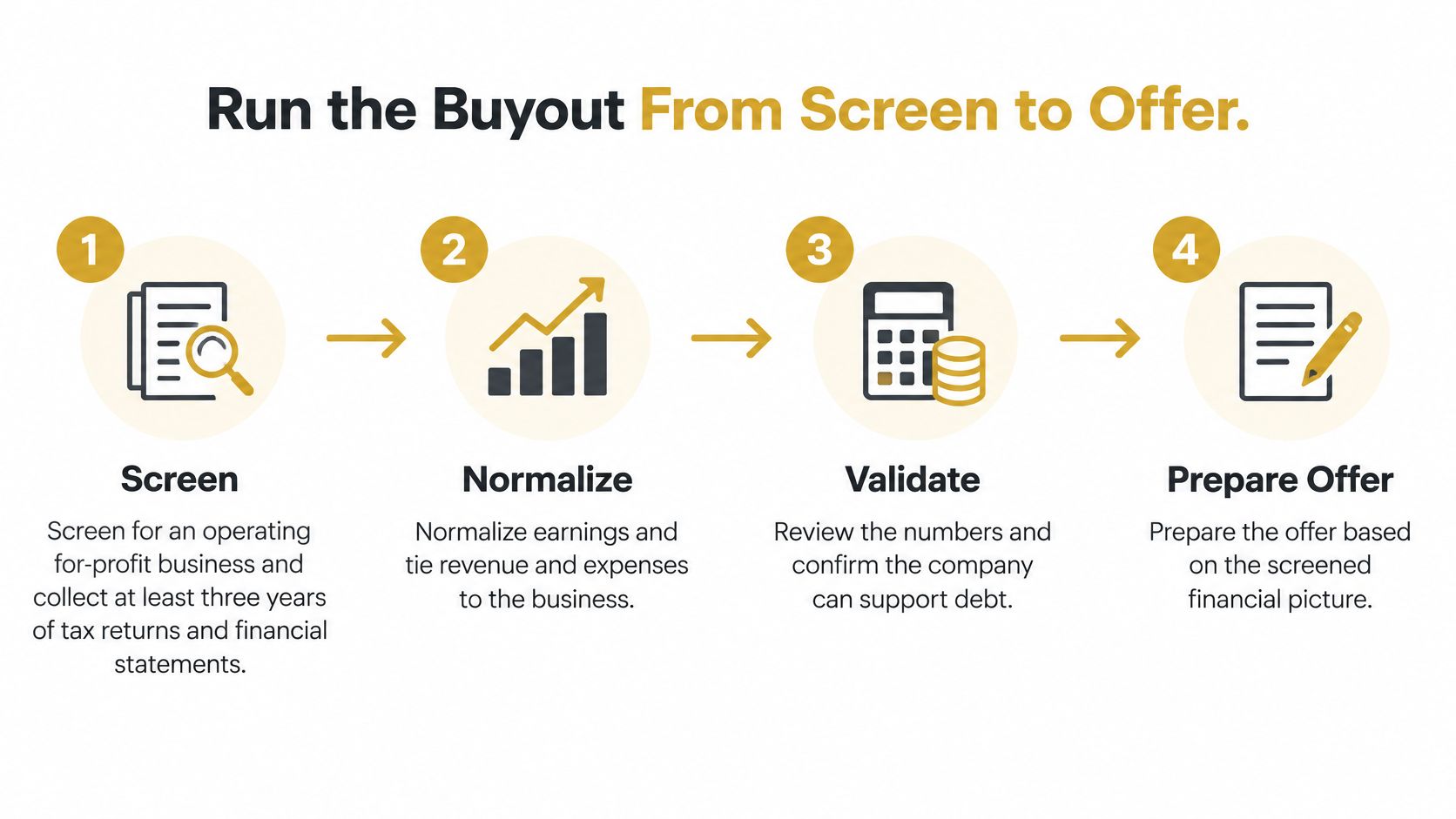
Screen the target. Confirm that you're evaluating an operating, for-profit business and understand how it earns money. Identify licensing requirements, key employees, and work the seller performs personally. Request historical tax returns, financial statements, current management accounts, and relevant operating reports.
Reconcile the earnings. Match reported revenue to bank activity, allowing for settlement timing and transfers. Trace add-backs to invoices, payroll records, or general-ledger entries. Keep an adjustments register showing the seller's claim, your treatment, and the evidence.
Inspect concentration and collections. Obtain customer-level sales, aged receivables, supplier terms, and inventory reports. Ask whether customer contracts survive a sale and whether buyers purchase because of the company or the owner. Examine overdue balances rather than assuming every receivable will become cash.
Prepare the downside package. Include the sources-and-uses schedule, normalized earnings, working-capital assumptions, and repayment model. Describe the operational response to lost business, not just the financial effect. A credible response identifies spending you can stop without damaging delivery.
The visual sequence is simple, even though the evidence behind it takes work:
Obtain financing feedback before committing
Ask lenders for indicative terms. The Federal Reserve's report on employer firms indicates that only 52% of financing applicants received the full amount they sought in 2025. That isn't an acquisition-loan approval rate, but it's a sound reason not to assume your requested debt will arrive intact.
Send lenders a consistent package so their responses are comparable. Ask about eligible uses, collateral, guarantees, required equity, seller-note treatment, repayment assumptions, and conditions that could change the proposed amount. Indicative terms aren't a binding commitment, so record what remains subject to underwriting.
Write a conditional letter of intent. Address financing and due-diligence contingencies, access to records, purchase structure, working-capital treatment, and the seller's transition obligations. Have counsel distinguish binding provisions from nonbinding commercial terms. Avoid promising financing certainty you don't possess.
Pause when the financing won't engage. Ask whether the obstacle is missing documentation, your borrower profile, industry risk, valuation, or repayment capacity. Each requires a different response. Another lender may resolve a policy mismatch, but it won't make weak cash flow stronger.
Don't use a signed offer to force yourself to become comfortable with a deal you haven't underwritten.
If you receive reduced proceeds, rebuild the funding schedule before renegotiating. Increasing buyer equity might preserve the transaction, but only if it doesn't consume the personal and business liquidity you need afterward.
Your pre-offer deliverable is a credible file with indicative financing terms, or a clear decision not to bid. Signing blind doesn't create negotiating strength.
Use Seller Financing as Shared Risk
Seller financing is ordinary acquisition work, not a loophole: Calder Capital's Q2 2025 market update reported that 60% of winning letters of intent in one deal database included seller financing. Its presence doesn't prove a deal is safe. The payment obligations matter more than the label.
The negotiation should identify which uncertainty the seller is being paid to retain:

Separate a promise to pay from contingent consideration
A fixed seller note is debt. Unless the agreement provides otherwise, disappointing results don't erase the obligation.
An earn-out makes part of the consideration conditional on defined outcomes. It can bridge disagreement about customer retention or transferable earnings without pretending the disputed value is already proven.
A seller may accept deferred proceeds to support the transaction, but genuine risk-sharing requires more than delayed payment. Discuss interest, security, permitted payments, remedies, and how senior-lender restrictions affect enforcement. The seller deserves compensation for waiting and accepting credit risk; the buyer needs obligations the business can realistically meet.
A practical review of seller financing options for acquisitions can help you compare those mechanics before negotiating the note.
Draft for the difficult outcome
Payment-in-kind interest preserves current cash by adding interest to the balance. It doesn't eliminate cost. A standstill similarly postpones pressure, so model the balance and payment burden when restrictions end, including any balloon payment.
Use precise drafting:
- Earn-out measurement: Specify named accounts, recognized revenue or collected cash, exclusions, returns, and accounting policies.
- Buyer obligations: Define reporting access and any operating commitments without preventing sensible management decisions.
- Dispute resolution: Establish who calculates the payment, how objections work, and who resolves accounting disagreements.
- Payment restrictions: Reconcile the seller documents with senior-loan subordination and standby requirements.
Use this companion video while reviewing the financing choices:
Say a seller insists that key customers will stay after the handover. Contingent consideration tied to collections from those accounts addresses that disagreement more directly than a larger unconditional note.
Model bank payments, permitted seller payments, and plausible earn-out obligations together. An earn-out triggered by revenue can become payable even when margins or collections disappoint.
Seller paper should allocate uncertainty. If it merely lets you pay more for unchanged cash flow, you've deferred the overpayment rather than solved it.
Negotiate Legal and Tax Protections
Negotiate protections while diligence remains open, because every term you accept here changes what the debt can safely carry. Under the SBA's summarized program guidance, a complete ownership change above $500,000 requires a 10% equity injection, lender policy may apply at or below that threshold, and owners holding 20% or more generally must provide an unlimited personal guarantee. That guarantee is why the downside case matters: a missed payment follows you home.
Document what you're buying
Ask counsel for tax, payroll, litigation, contract, intellectual-property, and customer-data representations; escrow or holdback for unresolved liabilities; transition services; and restrictions on pre-closing working-capital withdrawals. The withdrawal restriction deserves attention. Without it, a seller can pull cash out between signing and closing, and you end up funding payroll from the reserve your downside case depends on.
For UK operations, HR Management 365's explanation of implied terms in UK employment contracts is useful context for reviewing obligations beyond written employment agreements. Don't apply UK employment assumptions to a US acquisition.
Discuss asset versus stock treatment with counsel and an accountant, covering basis, depreciation recapture, transfer taxes, inherited liabilities, and contract consents. This review of acquisition tax implications can help organize those questions; it isn't transaction-specific advice. A stock purchase inherits liabilities that an asset deal can leave behind, so price the difference rather than assume it.
Keep the business plan, projections, valuation, and financing documents consistent. Conflicting assumptions invite delays and leave obligations unclear.
Stabilize Cash and Operations After Closing
Once the loan funds, your job changes from proving affordability to protecting it. Resist the urge to demonstrate ownership through immediate expansion or sweeping operational changes.
Secure control and continuity
Put a closing-to-stabilization calendar in your project tracker. Assign each task a named owner, completion evidence, and escalation trigger.
- Immediately after closing: Change bank authorities, verify insurance, confirm payroll access, and document spending permissions. Test accounting and banking access before the seller disappears.
- During the customer handover: Use scheduled seller time for introductions to important accounts, suppliers, and employees. Confirm who owns each relationship and record promises made during the sale.
- As operations settle: List every task that still requires the former owner's judgment. Assign an employee, write a procedure, and verify that someone else can complete it.
- Before approving growth: Reforecast using actual collections, margins, payroll, and upkeep. Compare payment-period cash balances with the acquisition model.
Seller transition hours should have specific deliverables. Introductions, quoting guidance, supplier negotiations, and documented operating routines are more useful than open-ended availability.
Protect the reserve before funding expansion
Review receivables, payables, payroll, tax obligations, and debt payments in a rolling cash forecast. Track actual collection dates against expected dates, and investigate deviations while you still have choices.
If a concentrated customer leaves, distinguish expenses you can cut immediately from costs needed to retain everyone else. Stop discretionary spending before seeking lender relief, but contact the lender early if you expect a covenant breach. Surprise makes an already difficult conversation harder.
Don't approve a hiring wave, added capacity, or another acquisition merely because the current bank balance looks healthy. Establish that actual results cover debt after owner pay, taxes, maintenance, and reserve needs across normal operating fluctuations.
Then approve growth projects individually. Identify the cash at risk, the person accountable, and the conditions for stopping. Fund expansion from genuine surplus, not money earmarked for the next payroll or debt installment.
Decide to Close Reprice or Walk
The decision gets made in the deal file, not in your confidence about the opportunity. Before signing, match every test to a document you can hold: reconciled tax returns and bank statements for verified earnings; an earnings-based valuation that does not need growth to work; proof of the equity injection and operating reserve; the purchase agreement protections, seller note, and written handover plan; a downside model and debt schedule that still pay after owner compensation, tax, and upkeep; and the final guarantee language in the loan papers.
When each document is present and consistent, ask the lender for a commitment letter and have counsel finish the closing checklist against the funding schedule. Indicative terms are a green light to keep working, not approval to fund.
If one test fails, use the remedy tied to the cause. Reprice when value depends on add-backs that will not reconcile or projections the seller cannot support. Restructure when the note or payment schedule leaves too little cash in a flat year. Treat seller paper as paid risk-sharing: it can absorb part of the downside, but it is not a reason to bid above verified cash flow. Walk when records stay unreliable, liabilities stay unresolved, or guarantee exposure is still unexplained.
A higher forecast is never a remedy.
This week, send no letter of intent until a lender has issued indicative terms and the downside case still pays debt on schedule.
Dealmaker Wealth Society offers acquisition training, live coaching, and community feedback on active deals, including financing structures and due diligence. Visit Dealmaker Wealth Society if you want help pressure-testing a specific acquisition's cash flow, seller terms, and execution plan before committing.

From the Dealmaker Blog










A Creative Business Buying Fable