Business Acquisition Course: How to Choose Well
Business Acquisition Course: How to Choose Well

In 2024, 70% of small-business owners had no formal succession plan, while nearly one-third expected to exit within five years, according to figures cited by Entrepreneur. For a prospective buyer, that reframes the opportunity. Buying a business isn't just about finding an attractive price. It's about helping an owner make a workable exit while ensuring the company can operate without them.
A good business acquisition course prepares you for that responsibility. Valuation and financing matter, but so do seller trust, employee continuity, and cash after closing. The programs worth paying for connect those decisions rather than treating a signed purchase agreement as the finish line.
Table of Contents
- Why a Business Acquisition Course Exists
- Modules a High-Quality Course Must Cover
- How to Score Mentorship and Deal Support
- Course Formats for Five Buyer Personas
- The Seller Transition Most Syllabi Skip
- Cash and the First Hundred Days
- Pick a Program and Start a Live Deal
Why a Business Acquisition Course Exists
In 2024, 9,546 U.S. small businesses were sold, representing $7.59 billion in total enterprise value, according to BizBuySell's Insight Report as reported by Small Business Trends. These were transactions recorded in that marketplace report, not a count of every private business transfer. Still, they demonstrate that acquisition is an established ownership path, not merely a Wall Street activity.
Say you find a commercial maintenance company whose owner wants to retire. It has customers, technicians, equipment, and a promising profit statement. Before you make a credible offer, you need to establish whether customers will stay, whether the owner performs unpaid management work, and whether the business can support acquisition debt.
A business acquisition course is a sequenced program that teaches you to find an operating company, test its numbers, fund the purchase, agree terms, and manage the handover. Its value lies in connecting those tasks on a realistic deal.
Learning should produce decisions
A webinar can introduce seller financing. A podcast can explain an acquisition story. A letter-of-intent template can help you organize proposed terms. None of those, by itself, checks whether your assumptions about a particular business are sound.
The buyer's work combines financial analysis with practical investigation.

For the maintenance company, a useful course would make you reconcile reported profits, identify who maintains customer relationships, and explain how payroll gets funded while invoices remain unpaid. It would also teach you when to pause rather than push ahead.
Financing availability belongs inside that decision. A purchase that works with one repayment schedule may fail with another. Changes in borrowing costs, lender appetite, regulation, or sector conditions can change what you can responsibly offer.
Practical rule: Judge acquisition education by the decisions you can defend, not the number of lessons you can watch.
Fit matters before tuition
Different buyers need different practice. A first-time buyer needs help moving from interest to a qualified target. An established operator may need to combine teams and systems. A capital partner needs clarity about governance and investor rights.
Before paying, evaluate the curriculum, the people who will review your work, and the delivery format. Use the module map below as a purchasing scorecard, with a concrete output attached to every skill.
Modules a High-Quality Course Must Cover
Curriculum a business acquisition course should be able to teach
| Module | Skill the buyer leaves with | Proof it is really taught |
|---|---|---|
| Deal sourcing | Weekly off-market outreach and broker follow-up | A pipeline target and sample owner scripts |
| Screening | Filter for recession-tested, profitable firms around $1 million-plus revenue | Written criteria plus a customer-verification checklist |
| Valuation | Normalized EBITDA, working-capital peg, and downside cases | A worked quality-of-earnings style reconciliation |
| Financing | Capitalization table, standby seller notes, and debt-service coverage | A full source-of-funds example such as the SBA case below |
| Negotiation and structure | LOI terms, earnouts, and seller paper that still clears a lender | Role-play with feedback on a real term sheet |
| Seller transition | Trust, legacy, and a gradual handover | Interview scripts and a transition-service outline |
| First 100 days | Cash reserve, people, customers, and systems | A 13-week cash plan and an integration sequence |
The core deal stages should form a connected process, not a collection of unrelated presentations.
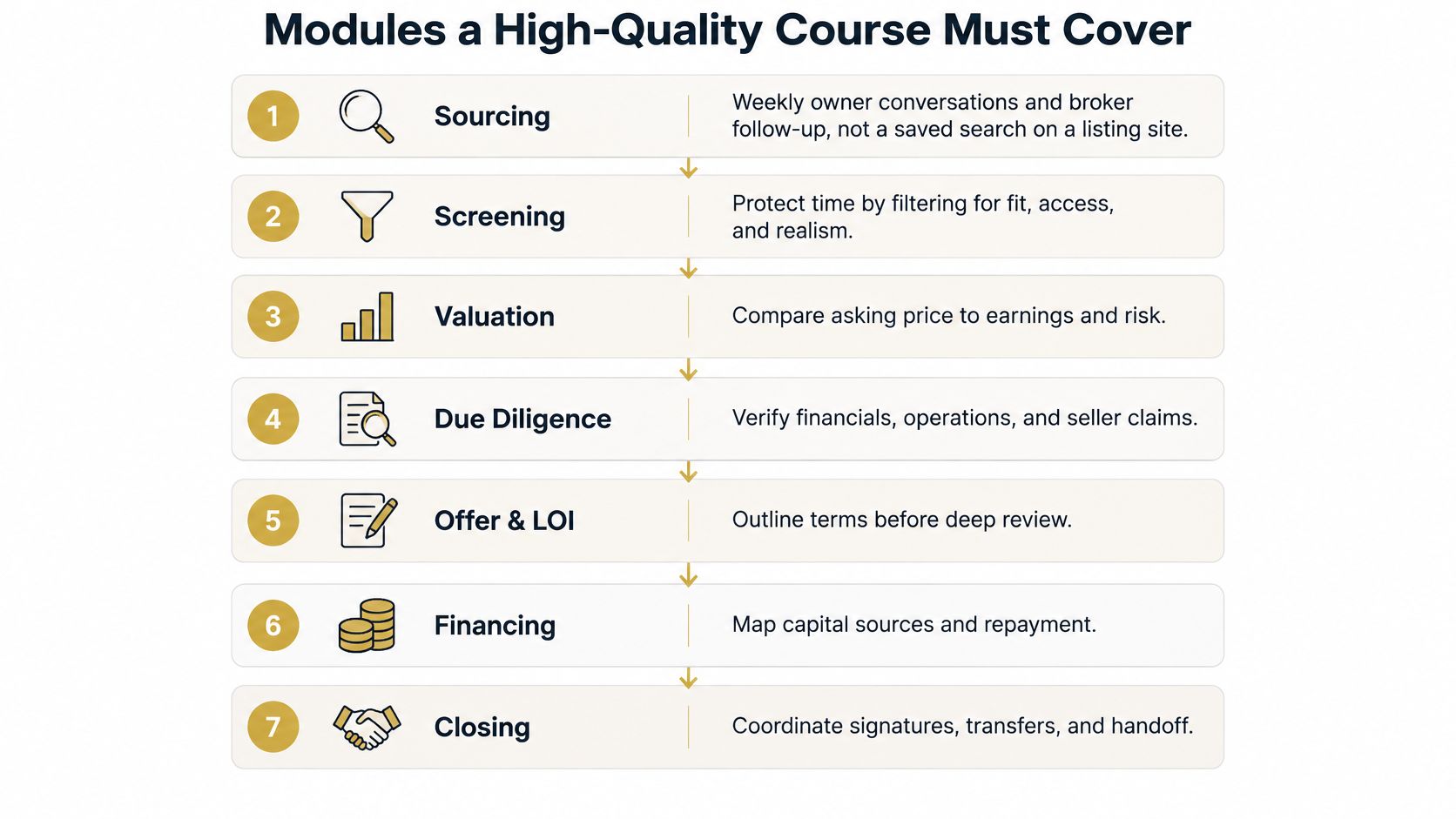
From finding a target to testing its earnings
Sourcing means maintaining owner conversations, tracking responses, and following up with brokers. A saved listing search is a useful input, but it isn't a sourcing routine.
Screening protects your attention. At Dealmaker Wealth Society, we recommend acquiring only businesses that have weathered economic recessions, generate $1 million in gross revenue, and have a proven track record of steady profits. That's our acquisition filter, not a universal lender requirement.
Our customer verification process at Dealmaker Academy has four parts: customer interviews, concentration analysis, contract review, and retention-risk assessment. Conduct customer contact with the seller's permission and agreed confidentiality safeguards.
Valuation then asks what those earnings are worth after correcting for unusual expenses, owner compensation, and costs the buyer will inherit. A working-capital peg specifies the operating working capital expected at transfer, so the buyer doesn't acquire an apparently profitable company stripped of the resources needed to trade.
Contract review also needs a practical workflow. LeaveWizard's AI tools for contract checks provide context for using technology to organize an initial review, but acquisition counsel should interpret assignment restrictions, change-of-control clauses, and legal exposure. Don't upload confidential documents without authorization and appropriate safeguards.
Financing must survive a worked example
For a U.S. SBA 7(a) acquisition, PBS Brokers' financing FAQs describe a minimum 10% equity injection, making the injection $250,000 on a $2.5 million project, with an eligible seller note covering at most $125,000 and remaining on full standby for the loan's life.
Full standby means the seller receives neither principal nor interest during that period. The remaining injection must come from qualifying buyer or unrestricted capital. A seller note requiring current payments instead adds debt service and can weaken repayment coverage.
That's why financing instruction needs a capitalization table showing ownership, a source-of-funds worksheet showing where money comes from, and a repayment model. Confirm current eligibility and documentation with the lender before relying on a proposed structure.
Use the accompanying video as a discussion prompt, then test the ideas against an actual funding worksheet.
An LOI, or letter of intent, outlines proposed terms before deeper review. Negotiation instruction should connect those terms to diligence findings, lender constraints, closing conditions, and the handover. Mark down any syllabus whose final lesson is sending the LOI.
Request a week-by-week syllabus with named deliverables. A topic list describes what instructors discuss. A deliverable shows what you'll learn to do.
How to Score Mentorship and Deal Support
A certificate proves that someone completed a program. It doesn't establish that they can recognize an unsupported earnings adjustment, negotiate a workable seller obligation, or protect themselves from an unaffordable structure.
The stronger signal is who reviews your work while a deal is still changeable. A knowledgeable reviewer should challenge your assumptions before you commit money, not merely explain afterward why your model was optimistic.
Weak versus strong business acquisition course support
| Signal | Weak program | Strong program |
|---|---|---|
| Who coaches | One generalist on a group call | Specialty coaches for capital, diligence, legal, origination, and integration |
| Feedback | Comments on a hypothetical case | Real-time review of the student's live offer and structure |
| Capital help | A slide on loans | Source-of-funds coaching and investor positioning |
| Tools | A logo template pack | Checklists for roll-ups, bolt-ons, and leveraged buyouts |
| Proof | Testimonials and headcount | Deal write-ups with funding and post-close notes |
| Peers | An open chat | Partner matching and a mastermind that reviews deals |
Match the question to the specialist
A sourcing coach can help improve an owner conversation. A financial diligence specialist can challenge an add-back. An integration coach can identify whether your proposed handover leaves critical work without an owner.
At Dealmaker Wealth Society, our specialty coaches cover capital raising, operations, financial due diligence, M&A legals and contracts, post-acquisition growth, post-acquisition transition and integration, and deal origination. Students receive real-time feedback and coaching on their own deals.
That range matters because acquisition problems cross disciplines. An earnout, which makes part of the purchase payment conditional on future results, needs financial modeling, precise drafting, and a practical way to measure performance. A general discussion about negotiation won't resolve all of those questions.
Coaching also doesn't replace professional representation. Establish who is providing education, who is formally engaged as your lawyer or accountant, and who carries responsibility for final advice. Our discussion of the measurable power of mentors offers another way to think about accountable guidance rather than passive access.
Demand evidence you can inspect
A useful deal summary explains what was acquired, how the purchase was funded, and what changed after closing. It should distinguish the student's work from the coach's involvement and acknowledge problems, not present a frictionless success story.
When comparing support, examine:
- Access: Who reads a live offer, how feedback is delivered, and whether a response can arrive before your decision deadline.
- Relevant experience: Whether the reviewer understands your transaction type, industry, and financing route.
- Working tools: Whether templates include usable assumptions, instructions, and completed examples.
- Commercial terms: The total price, refund provisions, support duration, and any separate professional fees, all in writing.
Access to a coach matters only if you can bring the coach a decision that still needs to be made.
Peer support should also have a purpose. Partner matching, structured deal reviews, and clear confidentiality expectations are more useful than a busy chat feed. Keep looking if a provider can't explain who handles capital, legal questions, and integration, or can't demonstrate how live-deal feedback works.
Course Formats for Five Buyer Personas
Which business acquisition course format fits each buyer
| Buyer | Format that fits | Why | Mismatch to avoid |
|---|---|---|---|
| First-time buyer | Short launch curriculum plus coaching | Builds a pipeline before advanced tactics | A year of theory with no owner calls |
| Operator doing a bolt-on | Cohort with integration labs | They already run a company and need combination skills | Beginner modules on what EBITDA means |
| Corporate career switcher | Live role-play and a peer network | The gap is reps and relationships | Pure self-study with no feedback |
| Capital or equity partner | Partnership and governance series | They may not want operating control | A course aimed only at full buyouts |
| eCommerce brand owner | Roll-up playbooks and concentration tests | Growth comes from combining brands | A syllabus stuck on local main-street listings |
Choose a format around the work you need to perform, not the amount of content included.
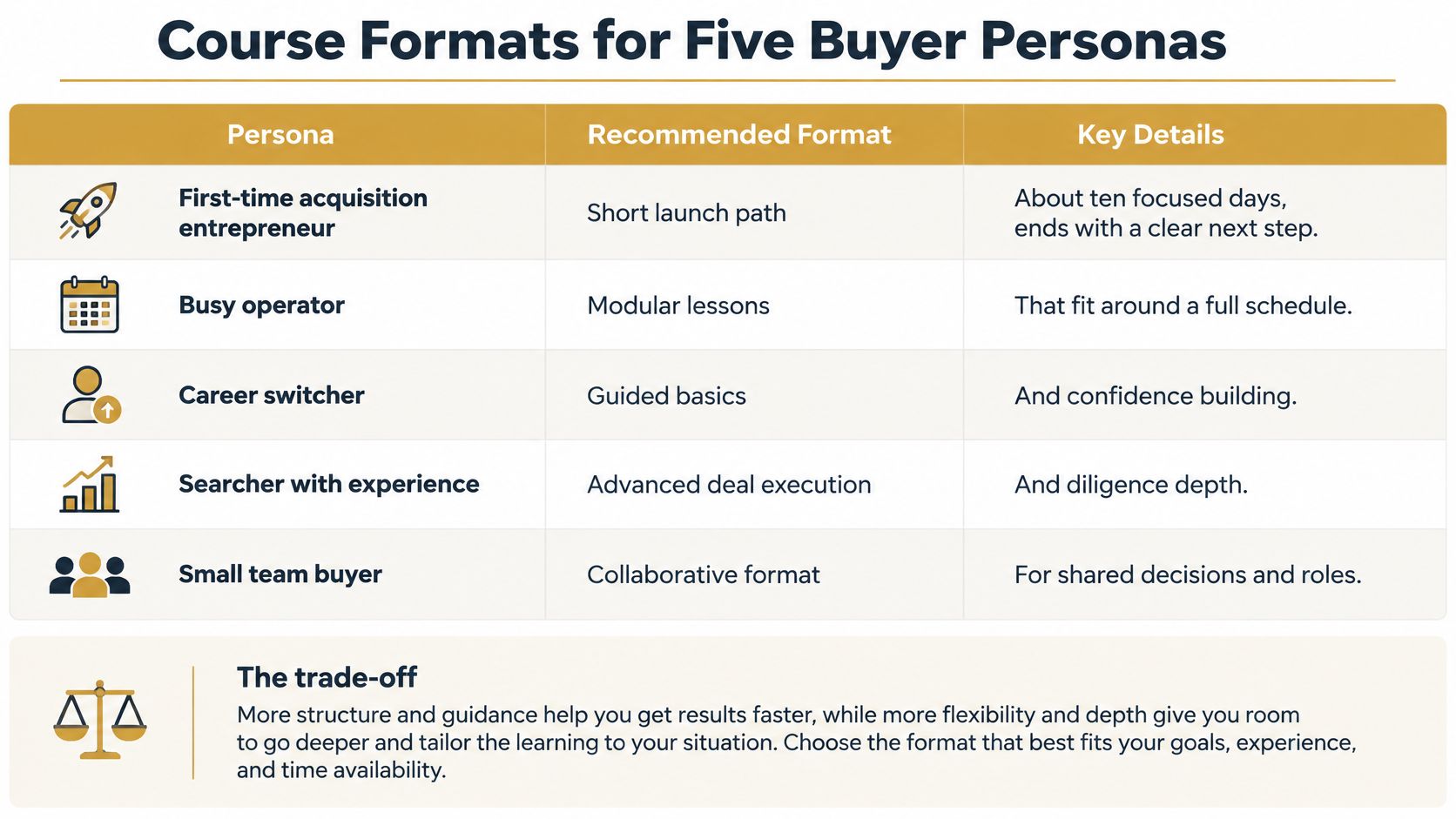
Where each buyer can get stuck
First-time buyers need a bounded launch path that ends with a target list, an outreach script, and a screening decision. Advanced financial engineering can become a distraction before you've established whether an owner wants to sell. Choose guided practice that makes you speak to owners rather than continually prepare to speak to them.
An operator pursuing a bolt-on, meaning a purchase added to an existing company, has a different gap. Integration labs should address overlapping staff, customer ownership, combined profit-and-loss statements, and the cost of moving systems. A promised saving isn't useful until someone can explain how to achieve it without disrupting service.
Corporate professionals may understand budgets and strategy but lack repetitions in direct negotiation. Live role-play helps them practice asking uncomfortable questions, responding to objections, and refusing unsuitable terms. A peer network can provide perspective outside their former employer's processes.
Capital partners need to understand what happens when they own a stake but don't control daily decisions. Their learning should cover voting rights, distributions, reporting, deadlock, and exit provisions. Consulting for equity also requires clarity about how services earn ownership and what happens if either party stops performing.
For an eCommerce owner, a roll-up means combining acquired businesses or brands. Instruction should examine marketplace dependence, advertising economics, shared suppliers, inventory exposure, and customer overlap. Combining brands doesn't automatically diversify risk if they all depend on the same platform.
Choose a schedule you can use
Self-paced learning suits a buyer who can translate lessons into action and needs a reference while progressing a deal. Without feedback or an application task, however, a video library can become a substitute for making decisions.
A cohort creates deadlines and shared momentum, but only if its live sessions fit your calendar. Request the attendance expectations, assignment workload, and review schedule before enrolling.
- Working alongside a job: Favor manageable sessions, explicit milestones, and a defined completion point.
- Running an existing business: Confirm that integration workshops fit around operational responsibilities.
- Buying with partners: Select exercises that assign roles and require joint decisions rather than parallel individual study.
The longest course isn't necessarily the best fit. A shorter program that changes your behavior can be more useful than an extensive library you never apply.
The Seller Transition Most Syllabi Skip
Legacy and credibility can compete with price. In its 2025 small-business survey, U.S. Bank reported that 37% of surveyed owners planned to sell within 12 months, while 54% had a formal succession plan. A buyer shouldn't interpret an intended sale as proof that an owner is ready for an uncomplicated departure.
The seller may be handing over their identity, employees' livelihoods, and relationships built over a career. A course that treats every hesitation as a price objection misses the actual negotiation.
Build a buyer-side succession playbook
Start identifying potential sellers through advisers, trade associations, and respectful direct outreach before a formal listing. In early conversations, ask how the company developed, what customers value, and what the owner wants preserved.
Then turn intentions into workable terms:
- Employee continuity: Explain your staffing assumptions with clarity. Offer written commitments only when you can honor them.
- Relationship transfer: Identify introductions the seller must make and how you'll confirm that customers and suppliers accept the new arrangement.
- Gradual handover: Define responsibilities, availability, compensation, and an end point for transition services.
Say Buyer A leads with a higher price and an abrupt exit. Buyer B presents a credible operating plan, a supported handover, and a clear message for employees. Buyer B gives the seller reasons to continue the conversation beyond the headline bid. That doesn't guarantee acceptance, but it creates a different basis for comparison.
Seller question: What would you need to see from the next owner to feel comfortable stepping away?
A course should supply a seller-interview script, a succession-readiness checklist, and a documented case showing how non-price terms affected negotiations. Our guide to business transition strategies develops the practical handover questions behind that assessment.
Don't confuse dependence with cooperation. If the company can't function without the seller indefinitely, you haven't designed a transition. You've postponed an operating problem.
Cash and the First Hundred Days
GF Data put average U.S. middle-market purchase prices at approximately 7.2 times trailing-twelve-month adjusted EBITDA in 2025, according to Taureau Group's quarterly newsletter. That is middle-market context, not a pricing rule for every small business.
The lesson is that purchase price and operating flexibility belong in the same model. Adjusted EBITDA attempts to describe normalized operating earnings, but it isn't cash available to the buyer after loan payments, equipment spending, taxes, and working-capital needs.
A company can satisfy a lender's closing requirements yet struggle when customers pay late or a key employee leaves. In the 2025 Contrarian Thinking SMB Report, 34.7% of respondents identified cash-flow constraints as a concern, and 30.7% identified access to capital.
Require an operating survival plan
A useful business acquisition course should make you prepare:
- A liquidity reserve: Size it against delayed collections, weaker sales, margin pressure, and unavoidable spending, rather than choosing a comfortable-looking balance.
- A 13-week cash forecast: Schedule actual receipts and payments, including payroll, debt service, taxes, and inventory purchases.
- An exposure map: Record loan covenants, reporting obligations, personal guarantees, and the consequences of breaching them.
- A key-person review: Identify who controls customer relationships, technical knowledge, system access, and payment approvals.
- An implementation sequence: Stabilize employees and customers before attempting avoidable system changes.
Our guide to analyzing acquisition cash-flow requirements helps connect funding decisions to these operating needs.
During the first hundred days, give each action a named owner and a visible completion test. Confirm payroll access, meet essential employees, transfer customer relationships, and protect service continuity before pursuing discretionary improvements.
Once operations are stable, The OKR Hub growth execution guide offers a useful framework for connecting growth objectives to accountable execution. Growth targets should follow cash and capacity constraints, not ignore them.
A financeable purchase isn't automatically a resilient business. The buyer needs enough room to absorb disruption while learning how the company works.
Pick a Program and Start a Live Deal
Choose with a short decision sequence rather than another round of promotional webinars:
- Score the curriculum. Match each module to a completed exercise and reject programs that stop at a preliminary offer.
- Verify the support. Confirm who will review your target and which questions require separately engaged professional advisers.
- Match the format. Select a delivery schedule you can attend and assignments you can complete alongside your existing commitments.
- Test the teaching. Examine a sample capitalization lesson and a deal-review example before committing.
For newcomers, our 10-Day Business Buying Launch is one example of a short starting path, including instruction in creative deal structuring. Dealmaker Wealth Society is a business acquisition coaching and training company formerly known as Ninja Acquisitions. Apply the same evaluation standards to us as to any provider.
Credentials aren't a substitute for fit
Our founder, Carl Allen, has worked on transactions worth over $48 billion, including over 330 acquisitions and sales, and our coaches collectively teach and mentor over 20,000 students. Those company credentials provide background, not a guarantee of your outcome. Evaluate the relevance of the instruction and the work you'll receive feedback on.
Don't make enrollment your only milestone. Book an off-market owner conversation this week, prepare questions about the business and the owner's goals, and use the answers to identify what you need to learn next. Attach your education to a genuine decision rather than consuming it as content.
Dealmaker Wealth Society offers structured acquisition training, live coaching, and peer support for buyers learning to acquire, build, and scale businesses. Visit Dealmaker Wealth Society to explore a starting path, then compare its curriculum and deal support against the practical standards above.

From the Dealmaker Blog












A Creative Business Buying Fable