Acquire or Be Acquired: A Strategic Decision Framework
Acquire or Be Acquired: A Strategic Decision Framework
Your business is profitable, but you're still the person customers call when something goes wrong. A competitor might be available to buy, a potential acquirer has approached you, and reinvesting in your existing operation remains an option. You don't need another opinion about whether acquisitions are exciting. You need to decide which ownership position you want, and what you're prepared to risk to get there.
Table of Contents
- The Real Question Behind Acquire or Be Acquired
- Why the Ownership Transfer Wave Changes the Math
- Acquiring Versus Building From Scratch
- Financial Mechanics That Drive Each Path
- Alignment and Deal Structure Beyond Price
- Integration Execution in the First 12 to 18 Months
- Decision Triggers for Owners and Buyers
- A 30 60 90 Day Plan to Put This Into Motion
The Real Question Behind Acquire or Be Acquired
Acquire or be acquired is a capital-allocation decision and a personal commitment. Buying means taking responsibility for another organization's performance. Selling means exchanging some combination of control, future upside, and operating responsibility for liquidity and a different role.
Neither path automatically solves founder dependence. Buying can multiply your workload if your current company still needs you everywhere. Selling can leave you tied to the business if deferred payments depend on performance you no longer control.
| Path | Makes sense when | What you gain | What you accept |
|---|---|---|---|
| Acquire | Your operation can support expansion without constant founder intervention | Additional capabilities, customers, and earning potential | Financing obligations and integration responsibility |
| Be acquired | Your personal objectives no longer match the company's next investment cycle | Liquidity and a planned ownership transition | Reduced control and negotiated ongoing obligations |
| Build organically | Your existing business has attractive, executable growth opportunities | Control over pace and operating design | The cost and uncertainty of developing capabilities internally |
| Pass for now | Neither the economics nor your readiness supports a transaction | Flexibility and preserved capital | A delayed ownership decision |
Start with the owner, not the offer
Write down what you want your working life to look like after the transaction. Specify your desired operating role, acceptable financial exposure, liquidity needs, and tolerance for partners.
Then judge each path through distinct lenses: market context, formation risk, financial mechanics, alignment, execution, and decision triggers. Don't let an attractive headline valuation substitute for those tests.
- From the buyer's chair: Ask whether you can operate the target and finance its transition without depending on immediate improvements.
- From the seller's chair: Ask whether the buyer can deliver the consideration and stewardship they're promising.
- From either chair: Separate a desirable outcome from an executable transaction.
My recommendation is to preserve the option to walk away until you've connected your personal objectives to a credible operating and financing plan. A deal should serve your ownership strategy, not become your strategy just because someone offered it.
Why the Ownership Transfer Wave Changes the Math
An owner approaching retirement and an entrepreneur seeking an established company can solve each other's problem. But the existence of willing sellers doesn't mean every business is transferable or every buyer is ready.
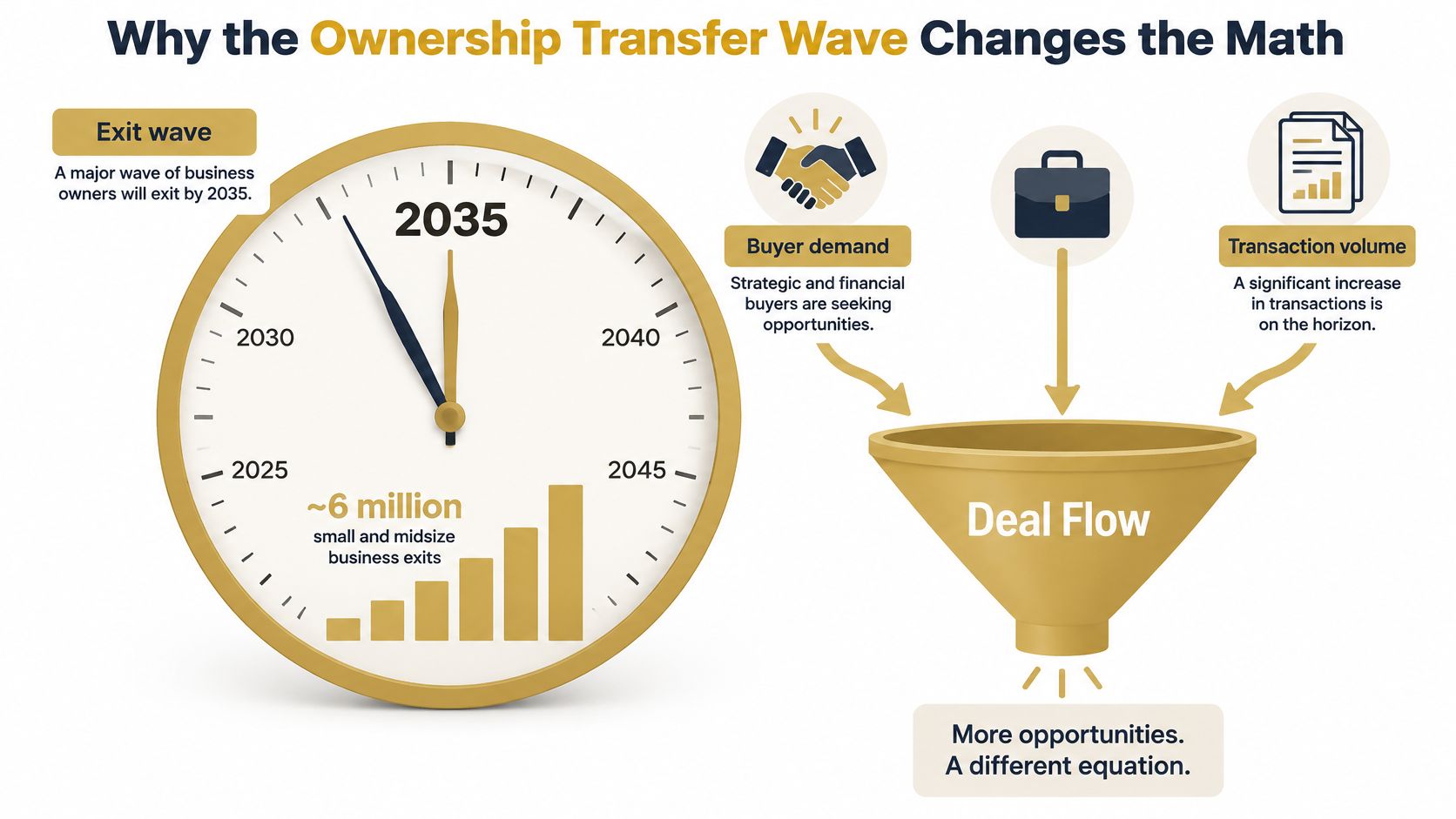
McKinsey's ownership-transfer analysis projects approximately six million U.S. small and midsize business ownership exits by 2035, compared with about 4.5 million during the preceding decade, and identifies more than one million businesses as viable candidates for sale or employee ownership, representing approximately $5 trillion in enterprise value. These are projections and estimates, not a count of businesses currently listed for sale.
The projected scale is easier to understand visually.
More exits don't guarantee better deals
For buyers, the opportunity is to become a credible successor rather than merely another bidder. That requires committed capital, an operating plan, and a clear explanation of what will happen to the company after closing.
For sellers, I'd treat the projected supply of ownership transitions as a reason to prepare, not as proof that valuations must fall. The projection alone doesn't establish a shrinking buyer pool or predict your company's sale multiple.
- Strategic sellers can choose when to approach buyers, address weaknesses, and negotiate from an operating position they understand.
- Pressured sellers may have to negotiate around health, availability, or succession constraints before resolving those weaknesses.
- Prepared buyers can distinguish a transferable operation from a business whose apparent profitability depends on an unavailable founder.
Being acquired should therefore be a proactive succession strategy, not shorthand for losing independence under pressure. You're choosing who should own the next chapter and how much exposure you want to retain.
The practical advantage belongs to owners who can explain their businesses clearly and buyers who can execute what they propose. Neither side should confuse a large potential market with certainty about an individual transaction.
Acquiring Versus Building From Scratch
Buying an established business lets you evaluate an operating history instead of relying entirely on a forecast. You can inspect customer relationships, employee responsibilities, supplier arrangements, and financial records before committing.
The historical baseline matters: SBA analysis of employer establishments founded from 1994 through 2021 found survival rates of 67.9% after two years, 49.2% after five years, 33.8% after ten years, and 25.6% after fifteen years. These figures describe establishments, not necessarily independent legal companies, and survival doesn't establish profitability.
Use the comparison below as context, not as proof that acquiring guarantees survival.
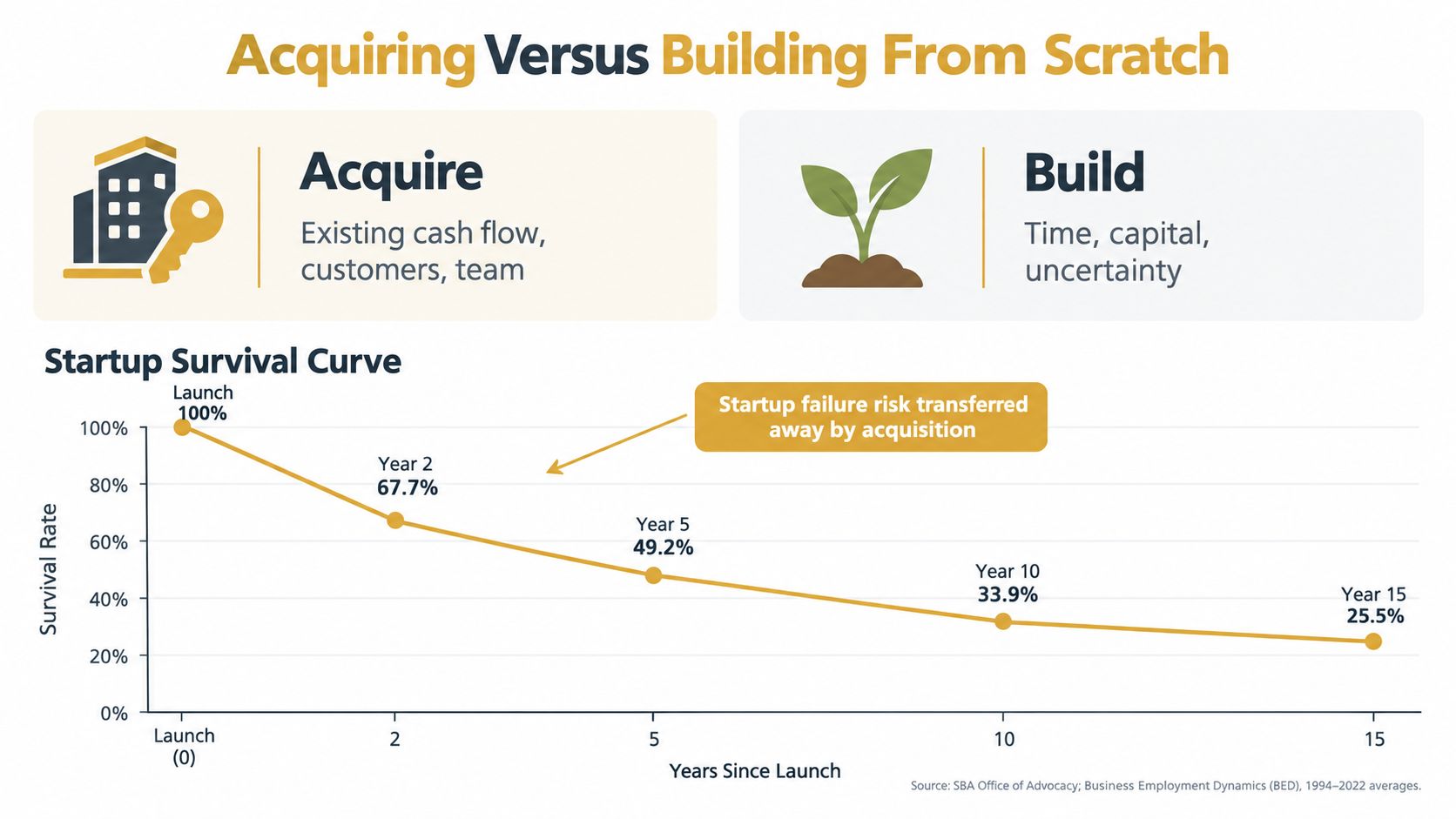
You exchange formation risk for transaction risk
An acquisition doesn't erase the risks illustrated by the survival curve. It gives you an existing organization to evaluate, while introducing purchase-price, financing, diligence, and transition risks.
Test the operating evidence directly:
- Revenue quality: Reconcile reported sales to collections, contracts, refunds, and customer purchasing behavior.
- Customer concentration: Identify relationships whose loss would undermine debt service or staffing.
- Employee retention: Determine who holds essential knowledge and whether they intend to stay.
- Supplier dependence: Check whether critical terms and relationships will remain available after ownership changes.
Build from scratch when your advantage requires an operating model that an existing target would obstruct. Buy when the target already possesses capabilities you can verify and would otherwise have to develop.
For sellers, the corresponding task is to make the organization transferable. Document how work gets done, delegate commercial relationships, and establish management responsibility beyond the founder.
Risk rule: Buy evidence of an operating advantage, not relief from the discomfort of starting something new.
Use the accompanying video as an additional discussion resource.
Financial Mechanics That Drive Each Path
Value the business before designing the financing. Start with normalized EBITDA, scrutinize owner adjustments, and account for the cost of replacing the seller's actual responsibilities. Then distinguish enterprise value from the cash the seller will receive after debt, transaction adjustments, and agreed working-capital treatment.
Sellers should support their valuation expectations with relevant completed transactions, growth quality, and defensible earnings. Buyers should keep unproven synergies outside the base purchase-price justification.
Acquirer and Seller Side Financial Levers
| Lever | Acquirer Side | Seller Side | Structural Risk |
|---|---|---|---|
| Normalized EBITDA | Verify sustainable earnings | Substantiate adjustments | Paying for earnings that won't continue |
| Working capital | Preserve operating liquidity | Agree what stays at closing | Closing adjustments and cash shortages |
| Senior debt | Match repayments to cash generation | Evaluate funding certainty | Covenants and refinancing exposure |
| Seller note | Defer part of the purchase price | Retain a contractual payment claim | Default, subordination, and repayment disputes |
| Earn-out | Make consideration performance-dependent | Retain contingent upside | Measurement and operating-control disputes |
| Rollover equity | Reduce cash consideration | Participate in future equity value | Illiquidity and governance conflict |
Underwrite the funding you can obtain
The financing gap is substantial: cash financing increased from 33% in 2024 to 40% in 2025, while 78% of buyers expected SBA-backed financing and 90% expected seller financing, compared with only 29% of owners planning to provide it, according to the financing data summarized in Deloitte's M&A trends survey.
Don't build an offer around seller financing before asking whether the seller will accept it. Likewise, don't assume SBA-backed or senior bank debt will arrive on your preferred timetable.
A proposed stack might combine buyer equity, senior acquisition debt, and a subordinated seller note, while leaving cash available for operations. Outside investors can replace some borrowing, but introduce dilution and decision rights. An earn-out addresses contingent consideration, not a guaranteed operating-cash shortfall.
Use a comparison of equity and debt acquisition financing to assess control and repayment trade-offs. Have legal and tax advisers evaluate the actual transaction terms rather than assuming deferred consideration produces a particular tax result.
My preference is the least fragile executable stack, not the highest available advantage. Reject structures that require immediate improvements to keep payments current.
Alignment and Deal Structure Beyond Price
Ask the seller what they're protecting before asking what they'll accept. Their answer may concern employee stability, family income, reputation, or a clean departure. Those priorities require different terms.
Entrepreneur's discussion of small-business succession reports that 43% of owners prioritize legacy and continuity over sale price and 70% lack a formal succession plan; it also cites European SME deal data in which 38% used earn-outs, 29% included subordinated seller loans, and only 9% used a simple lump-sum payment. The European figures provide structural context, not a forecast for a particular U.S. transaction.
The alignment question is straightforward: what must each party receive, preserve, or control?
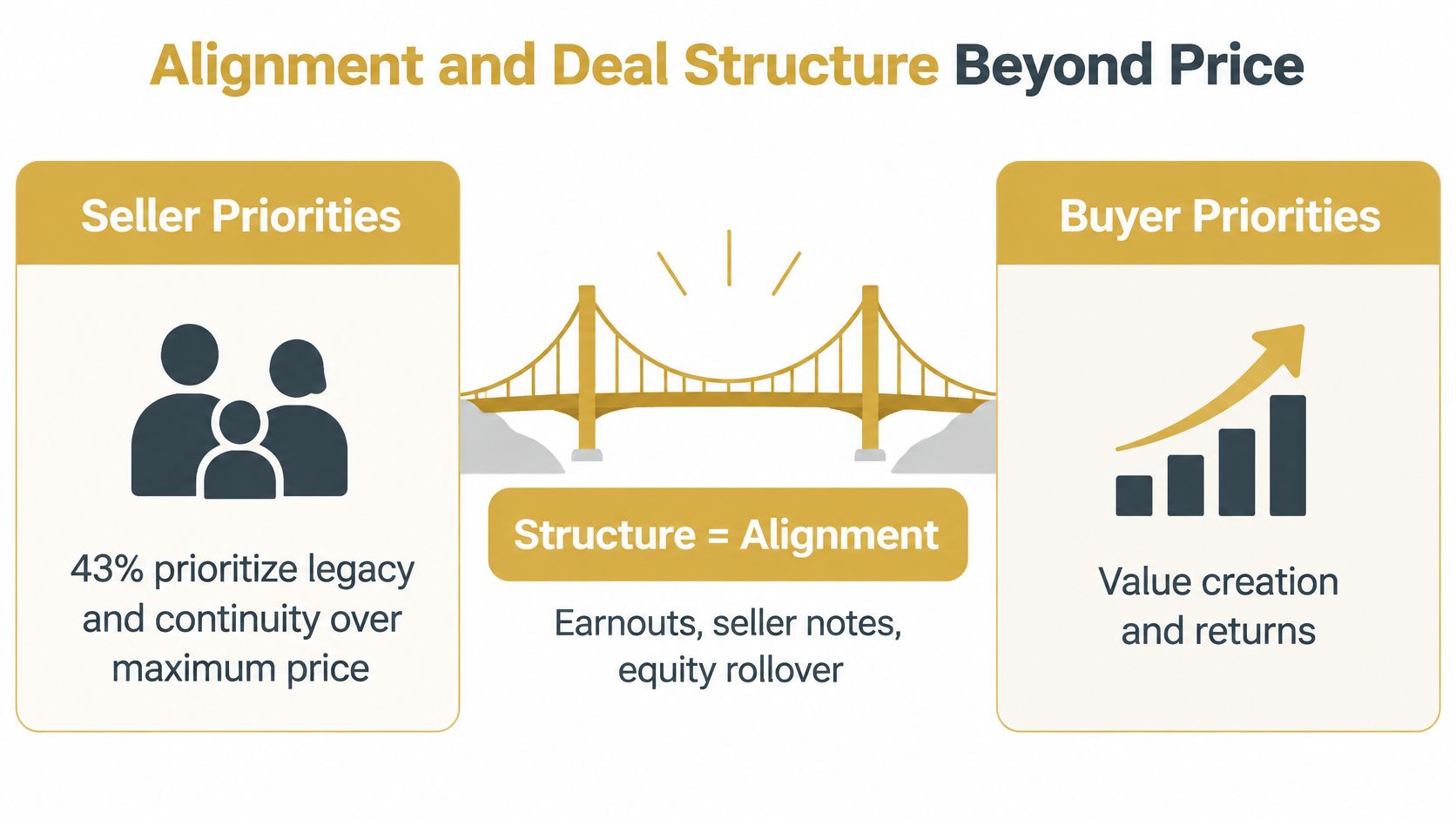
Translate priorities into enforceable terms
A seller note can address deferred payment, but it isn't an earn-out. Unless the agreement says otherwise, the buyer still owes the contractual amount even when performance disappoints. Don't describe fixed repayment as shared operating risk.
A consulting agreement should identify deliverables, availability, compensation, and an end point. Introductions to customers and documented operating knowledge are useful obligations. An undefined promise to remain available invites disagreement.
Use other structures selectively:
- Minority rollover: Define distributions, information rights, dilution, future funding obligations, and the route to eventual liquidity.
- Earn-out: Specify the calculation, accounting treatment, buyer operating discretion, reporting access, and dispute process.
- Legacy protections: Identify the commitments that matter and negotiate their duration and exceptions.
Legacy-sensitive terms create alignment when obligations are measurable and authority is clear. They create excessive risk when the buyer guarantees outcomes without controlling the decisions needed to achieve them.
Choose the counterparty as carefully as the terms
An owner should assess buyer fit before negotiating detailed protections. For a logistics owner, Bizbe, Inc.’s resource on buyer types for last-mile delivery is a useful starting point for framing that discussion.
Then ask each prospective buyer the same practical questions: Who will run the company? What changes are contemplated? What decisions require approval?
A founder who wants continuity may accept a different payment profile, but don't assume sentiment makes financing available. Equally, a buyer shouldn't promise permanent operating restrictions merely to win the deal. Good alignment accommodates the seller's priorities without disabling the successor.
Integration Execution in the First 12 to 18 Months
Closing transfers ownership. It doesn't complete the investment thesis.
In McKinsey's analysis of 29 large Global 2000 transactions, outperforming deals captured a run-rate equivalent to 50% of stated synergy targets in the first year; 79% remained above their market index after three years, while only 17% of initially underperforming deals recovered, and companies with highly effective finance capabilities were twice as likely to meet value-creation objectives. These are large-deal findings, not small-business performance guarantees.
Use the timeline as an operating sequence rather than a deadline for indiscriminate change.

Turn the thesis into assigned work
Before signing, prepare a 12-month operating plan that separates customer protection, cost initiatives, and revenue initiatives. Each workstream needs an accountable operator and finance support.
- Stabilize operations: Confirm payroll, supplier payments, customer contacts, access permissions, and escalation responsibilities.
- Retain essential people: Clarify reporting lines and decision authority before announcing organizational changes.
- Sequence improvements: Assign each initiative a baseline, implementation cost, dependencies, and completion evidence.
- Validate results: Track normalized EBITDA, gross margin, retention, working-capital conversion, and realized synergies against underwriting assumptions.
Protect revenue while changing the business
Don't combine systems or remove customer-facing staff because doing so appeared in the investment presentation. Test dependencies first. A cost saving that interrupts billing, delivery, or account ownership needs a different implementation plan.
Use integration planning best practices to document the handoffs and escalation process. Give finance authority to challenge claimed savings and distinguish recurring improvements from timing effects.
The seller's transition role should fit this operating plan. Keep their knowledge accessible without leaving employees uncertain about who makes decisions.
Decision Triggers for Owners and Buyers
Choose your path based on the constraint you face. Capital won't fix an absent operating leader, and a motivated seller won't make weak earnings dependable.
Profile to Path and Structure Mapping
| Profile | Recommended Path | Primary Structure | Key Risk to Manage |
|---|---|---|---|
| Retirement-minded owner with a transferable operation | Prepare to be acquired | Cash-led sale with a defined handover | Payment certainty and transition obligations |
| Operator with a strong platform and available capital | Acquire complementary businesses | Funded acquisition with selective deferred consideration | Management capacity |
| Founder-dependent owner | Institutionalize before marketing | Management transition before sale | Inability to transfer relationships |
| First-time buyer with limited capital | Seek a compatible succession transaction | Equity and debt, with negotiated seller participation | Insufficient operating liquidity |
| Serial acquirer | Target platforms with bolt-on capacity | Platform equity and disciplined acquisition funding | Integration overload |
| Strategic corporate buyer | Buy demonstrable complementary capabilities | Consideration tied to supportable value | Overestimating executable synergies |
Make the recommendation conditional on evidence
Retirement-minded owners should prepare now, rather than waiting until leaving becomes urgent. Founder-dependent owners have a different assignment: transfer authority and relationships before inviting bids. Reviewing exit strategies for entrepreneurs can help distinguish a sale objective from an achievable succession route.
Established operators should acquire only when their existing team can support the added responsibilities. Serial acquirers should decline otherwise attractive targets when their integration capacity is already committed.
For first-time buyers, seller participation can help bridge an executable transaction, but it shouldn't conceal inadequate capitalization. Strategic buyers should demand evidence that their organization can deliver the proposed combination benefits, not merely identify them.
Acquire when you can fund and operate the next chapter. Be acquired when another owner can deliver that chapter on terms that meet your objectives. Pass when neither proposition survives scrutiny.
Passing is a decision, not a failure to negotiate. Keep a written record of the conditions that would change your answer, so the next conversation starts with evidence rather than renewed enthusiasm.
A 30 60 90 Day Plan to Put This Into Motion
Days 1 to 30
Create a one-page ownership thesis. State whether you're evaluating a purchase, preparing a sale, or comparing both, then define your desired role, financial boundaries, and nonnegotiable outcomes.
Buyers should document target criteria and available capital. Sellers should assemble financial records, management responsibilities, and outstanding contractual obligations. Use the earlier survival, ownership-transfer, and financing evidence as context, not as a substitute for company-level analysis.
For acquisition fundamentals, the 10-Day Business Buying Launch is one training option alongside direct work with an accountant, lawyer, and prospective lender.
Days 31 to 60
Test alignment before negotiating detailed documentation. Ask the counterparty to rank liquidity, continuing income, control, involvement, and continuity.
- Model alternative structures: Compare cash-led consideration, deferred fixed payments, and performance-dependent consideration.
- Pressure-test funding: Obtain lender feedback, clarify investor conditions, and confirm whether seller participation is available.
- Document failure points: Identify what happens if financing stalls, performance weakens, or the transition relationship breaks down.
Become an Equity Partner and The Creative Dealmaker are relevant training paths for exploring capital participation and structuring. Use professional advice to evaluate the agreements you intend to sign.
Days 61 to 90
Build the operating plan, identify unfilled leadership and finance responsibilities, and assign responsibility for resolving them. Operators pursuing a roll-up can consider 9-Figures in 24 Months as an additional execution-focused training resource, not a promised outcome.
Commit to a specific next action: begin targeted sourcing, start sale preparation, submit an evidence-backed offer, or stop pursuing the transaction.
Final test: Don't commit because you can describe the upside. Commit when you can explain who funds the transaction, who runs the business, and what happens when performance disappoints.
Dealmaker Wealth Society offers acquisition education, coaching, and peer support covering sourcing, deal structure, capital raising, and post-close growth. Visit Dealmaker Wealth Society to explore training that fits your next move, whether that's evaluating a first acquisition or building the capability to execute a broader acquisition strategy.

From the Dealmaker Blog









A Creative Business Buying Fable