Acquiring a Business: How to Buy a Company, Step by Step
Acquiring a Business: How to Buy a Company, Step by Step

In 2022, about 510,000 small and midsize businesses left the market, yet 92% closed, only 5% were sold, and 3% transferred to new owners, often family members. McKinsey's analysis of the ownership transfer also estimates that roughly 6 million firms with fewer than 500 employees will exit ownership by 2035, with more than 1 million viable for sale or employee ownership. Browsing listings won't close that gap. A buyer who works a fixed sequence will.
Table of Contents
- Acquisition Roadmap From Search to Day 90
- How to Find and Screen Acquisition Targets
- How to Value a Business Without Overpaying
- Financing Options and How to Stack Them
- How to Negotiate the Offer and Letter of Intent
- Due Diligence Checklist and Closing Steps
- Plan the First 90 Days After Closing
Acquisition Roadmap From Search to Day 90
Most first deals stall because the buyer treats search, money, and verification as one blur. Split them. Each phase has one output that proves you're done, and one risk that kills the file if you skip it.

| Phase | Typical duration | Key output | Biggest risk |
|---|---|---|---|
| Source and screen | 1-6 months | Shortlist of 3-5 targets with owner interest | Spending weeks on listings that never reach a real seller |
| Value and finance | 3-6 weeks | Valuation range and lender term sheet | Financing that doesn't cover the full price plus working capital |
| Negotiate LOI | 1-3 weeks | Signed LOI with exclusivity period | Exclusivity too short for lender approval and diligence |
| Due diligence | 4-8 weeks | Normalized earnings and risk register | Trusting seller-reported earnings |
| Close | 2-4 weeks after diligence | Purchase agreement and funds transfer | Missing a lender, landlord, or license consent |
| First 90 days | 90 days after close | Baseline KPIs and retention plan | Cutting costs before revenue stabilizes |
Deals that use an SBA loan often run 60 to 120 days from signed letter of intent to close. An all-cash deal can close in four to six weeks, because there's no lender queue. Cash is faster, not safer. You still need the same checks.
Before you call any seller, have these five documents ready.
- Buy box: industry, location, earnings floor, and the owner role you'll accept.
- Valuation range: the price you'll pay on normalized earnings, and the price you walk from.
- Financing term sheet: who funds the price and the working capital, in writing.
- LOI draft: price, structure, exclusivity, and what isn't binding.
- Diligence tracker: the workstreams, owners, and the questions that change price.
How to Find and Screen Acquisition Targets
Three routes produce targets, and they don't cost the same in time.
Marketplaces such as BizBuySell put many files in front of you in a week. Competition is thick, and asking prices often stick. Brokers hold cleaner books, but they want proof of funds before they'll take a call. Off-market outreach to owners takes the most hours and leaves the most room on price, terms, and pace.

Retirement owners are the less crowded path
A 2025 U.S. Bank survey found that only 54% of owners had a formal succession plan, while 37% expected to sell within 12 months, and 36% of Gen Z and Millennial owners planned to buy from a retiring owner. That mismatch is your pipeline. Many of those owners aren't listing anything.
Lead with continuity for staff and customers, not with a number. Offer a confidentiality note before you ask for financials. A partial buyout, a consulting tail, or a staged handoff often beats a max-cash bid for someone who cares about the name on the door. Test readiness in the first meeting. Ask when they want to be done, who would run the shop if they left next month, and whether a family member expects the business. If those answers are vague, you're early. Keep the relationship and move to the next name.
Spotting that timing is a sourcing skill. CapyScout's guide to buying signals is a useful checklist for signs an owner is actually in market, not just tired on a Tuesday. Pair those signals with a screen for identifying viable acquisition opportunities so you don't fall in love with a story.
Five questions before you spend real time
- Does the owner work in the business daily? If yes, you're buying a job until you can replace that labor.
- What share of revenue comes from the top three customers? A heavy share means one phone call can break the loan.
- How many years of tax returns exist? You want at least three, matched to the bank, not a spreadsheet alone.
- Does profit hold after you remove the owner's salary? If it doesn't, the multiple is sitting on compensation, not on a business.
- Is this an industry you can run? Charm isn't a substitute for knowing how the work gets sold and delivered.
Write the answers into a one-page buy box: earnings floor, customer-concentration cap, geography, owner hours you'll tolerate, and industries you'll refuse. If a deal misses two lines, stop. That's how the screen stays repeatable when the tenth broker email looks exciting.
A short walk-through of how buyers source and filter targets helps before you build that page.
How to Value a Business Without Overpaying
Price the earnings the buyer will keep. The multiple comes second.
Seller's discretionary earnings (SDE) adds back the owner's salary and personal expenses. It fits an owner-operated company where one working owner runs the place, usually while earnings are still modest. EBITDA fits once a hired manager runs the business. You deduct a market-rate manager salary before you apply any multiple. Using SDE on a company you'll have to staff is how buyers overpay.
Say a plumbing services company shows $420,000 of SDE and the seller wants 2.5 times that, about $1.05 million. You can't do the owner's route work and the books. A general manager at $120,000 drops the earnings you keep to about $300,000. Test the price against $300,000, not against the seller's SDE. At $1.05 million you're paying 3.5 times the cash the business throws off after a real manager. That's a different deal than the teaser described.
| Metric | Best suited for | Typical multiple range | Key adjustment |
|---|---|---|---|
| SDE (seller's discretionary earnings) | Owner-operated business with one working owner | Only after add-backs are tied to tax returns | Add back owner salary and personal expenses |
| EBITDA | Managed business with a hired general manager | Only on earnings after a market manager salary | Deduct a market-rate manager salary |
| Revenue multiple | Brands or subscription models with strong margins | Only after gross margin is known | Ignore it until margin and churn are clear |
Use the multiple as a sanity check
Published ranges move with growth, customer concentration, and industry, so treat any multiple as a cross-check, not a price. Compare the annual cash the price implies with what you'd accept on a lower-risk investment of the same cash. If a large share of profit walks out with the seller's relationships, discount the price or push the gap into a contingent payment you can measure.
Practical rule: Set the walk-away price from the financing you can actually secure, including working capital, not from the seller's asking number.
If the lender won't fund the structure, a prettier multiple doesn't make the deal real. Recast the offer or leave it.
Financing Options and How to Stack Them
The stack has to cover the full price plus working capital, not just a loan sized to the asking price. A deal that funds the purchase and starves payroll in month two isn't funded.
| Source | Typical share of price | Upside | Main constraint |
|---|---|---|---|
| SBA 7(a) loan | Up to 90%, with 10% minimum equity on change of ownership | Long amortization and a lower personal rate | Personal guarantee and lender review of tax returns |
| Seller note on standby | Only a limited slice of the 10% equity | Signals seller confidence and lowers cash at close | Lender may require subordination, and it isn't a full cash replacement |
| Conventional bank loan | A smaller advance than SBA, with a larger cash down payment | Can close without SBA processing | Shorter terms and more buyer cash |
| Equity partner or rollover | Negotiated share, set in the partnership papers | No monthly debt service on that slice | Dilution and shared control |
| Earn-out | The price gap you won't pay in cash at close | Bridges a valuation fight | Disputes over how the earnings metric is defined |
| Cash or personal savings | Remainder of price and working capital | Fastest close | Concentrates personal financial risk |
BizBuySell figures reported via the Des Moines Register show 90% of buyers expect seller financing, while only 29% of owners plan to offer it, and upcoming SBA rules cited in that reporting require a 10% minimum equity injection for a complete change of ownership, with a standby seller note allowed to cover only a limited portion. You can't swap the whole equity check for a note.
A $1.05 million stack
On a $1.05 million purchase, a 90% SBA loan is about $945,000, which leaves about $105,000 of equity. A standby seller note might cover part of that $105,000. The rest is your cash. Working capital sits on top of that, so budget it before you write the offer. A useful side-by-side of comparing equity and debt financing for acquisitions keeps the pieces from getting mixed up in the offer letter.
Three breaks show up constantly. The seller refuses standby terms, so your cash need jumps. The senior lender demands the note be subordinated, which the seller may reject. Or an earn-out fights over the definition of revenue after close. Negotiate interest, deferral, payment priority, default remedies, and how the note sits against lender covenants before you rely on it. A seller note is a risk-share, not a favor, and only if control and handoff are written down.
Lenders usually ask for two or three years of business tax returns, a personal financial statement, debt service that clears the payment with a cushion, and a personal guarantee. If those documents aren't clean, fix them before you shop the loan.
How to Negotiate the Offer and Letter of Intent
The letter of intent is where the fight gets framed. Negotiate it before diligence, while changing a term is still cheap.
- Headline price and the earnings it sits on. Name SDE or EBITDA, the year, and which add-backs you accept.
- Cash at close versus seller note and earn-out, with dates and amounts. A higher headline is fine if the extra dollars are contingent.
- Exclusivity of 60 to 90 days. That's the window a lender and a real diligence pass usually need. I wouldn't sign a shorter exclusive unless the file is all cash and the books are already in a data room.
- A working capital target. That's the normal level of receivables, inventory, and cash that transfers. Without it, you can "buy" a business and fund its float on day one.
- Transition, often 30 to 90 days, and what the seller really does. Introductions to the top customers beat a vague "available to consult."
- Non-compete, commonly three to five years inside a defined area and a defined line of work. A nationwide ban on a local plumber is theater. A tight local one is protection.
- Closing conditions: lease assignment, license transfer, and retention of the people who hold the accounts.
- What's binding. Usually only confidentiality and exclusivity. Price and structure stay subject to diligence.
Anchor the price talk on normalized earnings from the seller's own tax returns. If the seller won't move the headline, shift the difference into an earn-out tied to a revenue figure both sides can pull from the same report. Lawyers who focus on aligning mergers with company goals are worth a read before you freeze those terms, because a price that fights the reason you're buying will fail in the purchase agreement.
Two mistakes wreck otherwise good files. Exclusivity shorter than lender approval, and no working capital peg. Both feel like small concessions in a friendly call. They aren't.
An LOI is cheap to revise now and expensive to reopen later.
Due Diligence Checklist and Closing Steps
Every material finding should end as a price change, a contract protection, a post-close action, or a risk you accept on purpose. If it ends as a note in a folder, you didn't finish diligence.
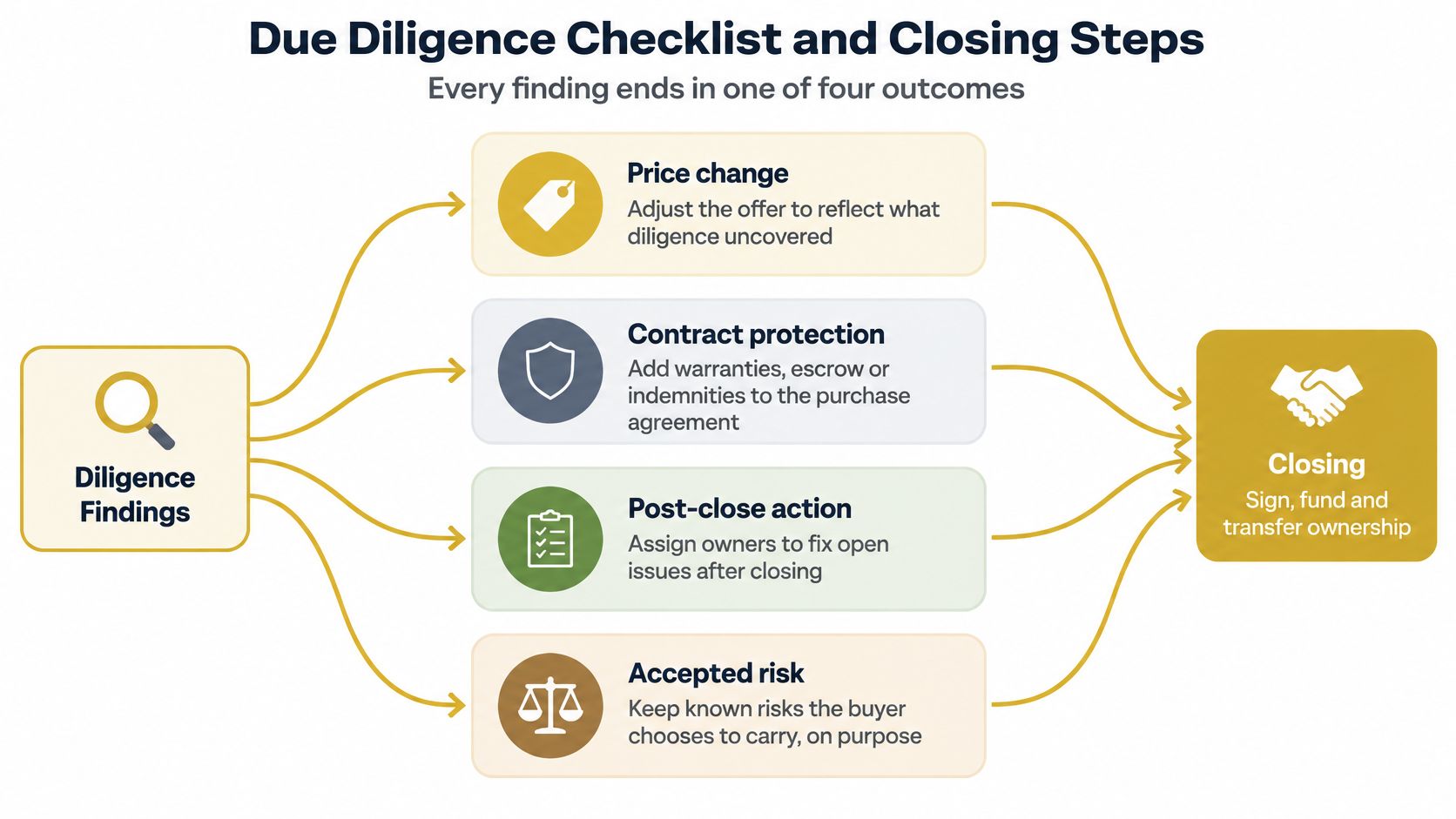
McKinsey's integration research reports that about 42% of due-diligence exercises failed to provide an adequate roadmap for capturing synergies and creating value, and that roughly one-quarter of transactions overestimated planned cost synergies by at least 25%, which can produce a 5 to 10% valuation error. A checklist without a decision on each item is that failure mode.
Stress-test debt service under a revenue drop, a margin squeeze, loss of the largest customer, and a fatter working-capital need. Reconcile reported earnings to normalized earnings with the same tests you used to price the deal: owner pay, related-party items, one-time costs, and seasonal cash. Don't underwrite only the seller's best year.
| Workstream | What to verify | Red flag that changes the deal |
|---|---|---|
| Financial | Three years of tax returns matched to bank deposits and the P&L | Add-backs the bank statements don't support |
| Customers | Top 10 customers' share of revenue, contract terms, and churn | One customer driving most revenue, or no written terms for top accounts |
| Legal and licenses | Permits, leases, IP ownership, and pending claims | A lease that can't be assigned, or brand and domain held personally |
| Tax and payroll | Sales tax filings, payroll tax, and worker classification | Unfiled sales tax, or contractors who should be employees |
| Operations | Equipment age, deferred maintenance, and supplier terms | Year-one capital spending the seller's earnings ignore |
| People | Key staff, pay, non-competes, and the owner's daily role | Only the owner holds customer relationships or system access |
| Technology and security | Account access, passwords, domains, and backups | Critical accounts registered in the seller's personal name |
| Working capital | Normal receivables, inventory, and cash versus a seasonal average | A headline price that quietly assumes the busy-season balance sheet |
Where a business name, trademark, or domain sits in an individual's name, get the transfer path in the purchase agreement. EndureGo's note on CGT implications of transferring business names is a clear reminder that the name on the sign isn't automatically an asset the company can hand you, and tax on that transfer can surprise a seller who thought it was "just paperwork."
Closing sequence
- Finalize the purchase agreement, including representations, warranties, and any indemnity escrow.
- Lock the lender's final approval and every closing condition.
- Transfer licenses, leases, and permits, with landlord and regulator consents in hand.
- Confirm the working-capital true-up and the funds flow with the seller's accountant.
- Sign, fund, and update banks, payroll, and tax registrations the same day.
If three or more material findings lack a price adjustment, a contract protection, or a named plan, reprice the deal or reject it.
Plan the First 90 Days After Closing
Day 1 is about continuity, not a new strategy. Have these ready before you sign: the first payroll run, bank signatories, one customer-service contact customers already know, supplier accounts with terms confirmed, system logins that aren't the seller's personal email, and the regulatory filings that lapse if nobody owns them.
For the first 100 days, review revenue, gross margin, cash conversion, and key-employee retention every week against the model you bought. Give each initiative a named owner. Keep a simple register that separates cost savings, pricing, cross-selling, and working capital so a "synergy" can't hide a revenue problem. A practical set of integration planning best practices is the right template for that register before the close, not after the first missed payroll scare.
McKinsey's discussion of merger integration found that 79% of deals that outperformed their market index 18 months after closing still outperformed three years later, while only 17% of underperforming deals recovered, and that merging companies can lose 2 to 5% of combined customers. Treat month 18 as a re-underwriting date, and treat the top customers and frontline staff as the first assets you protect. Cutting costs before revenue is stable, delaying the systems decision, and calling customer risk a "soft" issue are how that 2 to 5% becomes your problem.
This month, pick the first target that fits your buy box, and line up a lawyer and a lender against the closing list above. Dealmaker Wealth Society's 10-Day Business Buying Launch, along with its LOI, diligence, and integration playbooks, is one place to build those templates before you make the offer.
Dealmaker Wealth Society teaches first-time buyers how to source a company, structure the capital, and run the close without treating acquiring a business like a listing browse. The training, live coaching, and peer network cover letters of intent, diligence, and the first months after you own the company. Visit Dealmaker Wealth Society when you're ready to turn a buy box into a signed deal.

From the Dealmaker Blog











A Creative Business Buying Fable