Post Merger Integration Team: Roles, Structure and KPIs
Post Merger Integration Team: Roles, Structure and KPIs
You closed on Friday. The seller shook your hand, the wire cleared, and the group chat filled with congratulations. Monday morning the two lead techs still hold every commercial account in their phones, the old owner's spreadsheet is the only thing sending invoices, and payroll runs Thursday under a bank signatory who no longer owns the business.
That Monday is where small deals go wrong. Legal ownership moved. Operating control did not. A post merger integration team is the group that owns the gap between those two facts for the next one to two years, not a weekend task force that fades after the announcement email.
On a single site or a bolt-on, you don't need a corporate army. You need named owners, dates, and a short list of people and tools the business can't afford to lose.
Table of Contents
- What a Post-Merger Integration Team Is and Why It Matters
- Team Structure and Who Fills Each Role
- RACI and Reporting Rhythm That Keeps Decisions Moving
- Staffing, Timing and Pre-Close Setup for SMB Deals
- KPIs That Show Whether Integration Is Working
- Common Integration Problems and How to Fix Them
- Org Chart and Integration Plan Templates You Can Reuse
What a Post-Merger Integration Team Is and Why It Matters
A post-merger integration team is the central execution group that turns a signed transaction into operating and financial results. Without one, the buyer spends the first month chasing invoices, technicians, and a payroll file nobody updated after the wire.

Treat the team like air traffic control. The planes are already airborne: customers, suppliers, payroll, and the people who know how the work really gets done. The tower doesn't fly them. It sequences the landings so two aircraft don't claim the same runway.
McKinsey's analysis of merger outcomes found that the first 12 to 18 months after closing strongly shape whether a deal succeeds or fails. The same research showed a stubborn split. 79% of deals that beat peers 18 months after closing were still ahead three years later, while only 17% of deals that were behind at 18 months had recovered by year three. Early governance, milestone tracking, and escalation decide which side of that split you land on.
Diligence often stops short of a workplan. In 42% of cases, pre-merger diligence didn't give an adequate roadmap for capturing synergies and creating value, based on reporting of McKinsey's merger evidence. The integration team closes that gap by turning assumptions into owned, dated work across people, process, technology, customers, finance, and culture.
A task force is not a team
An informal task force meets when someone remembers to book the room. A working team has a different shape.
- Named leader: one integration manager, not "the leadership team."
- Cross-functional workstreams: finance, operations, people, commercial, and communications each have a lead.
- Synergy owners: every savings or revenue target has one person and a date.
- A 12 to 24 month mandate: McKinsey identifies a strong integration team kept for the life of the deal, potentially two years, as critical to post-close execution.
- P&L visibility: the team reads the profit-and-loss statement, not a slide that sits beside it.
McKinsey also reported that 60% of M&A practitioners wished they had committed more resources to culture and change management. Finance, systems, and cost cuts are necessary. They aren't the whole job.
Team Structure and Who Fills Each Role
Three layers beat a flat chart. The top decides, the middle coordinates, and the bottom does the work that shows up in payroll, invoices, and customer calls.
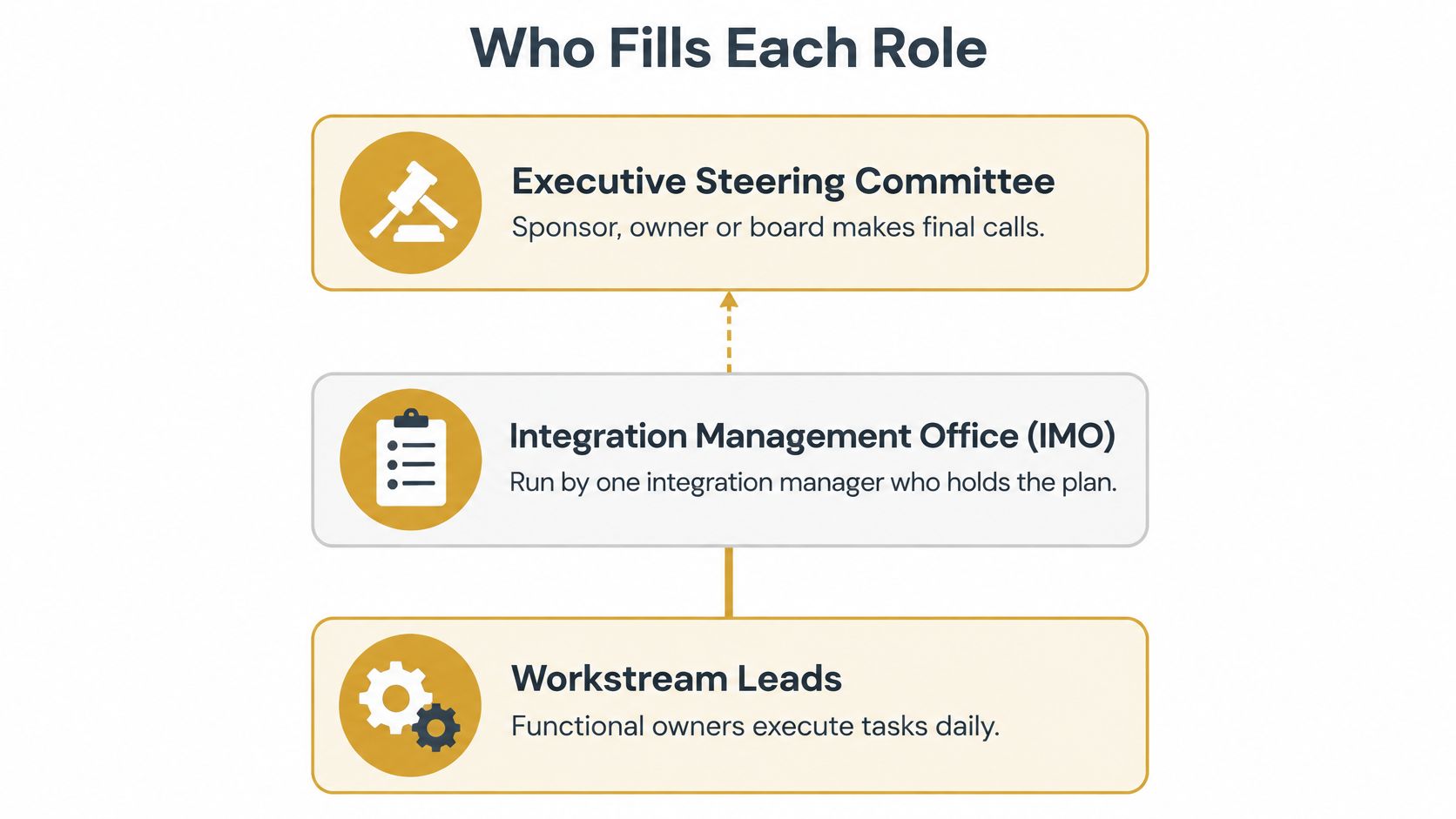
Executive steering committee. The sponsor, owner, or board makes final calls on money, headcount, and anything blocked. Part-time is normal. Going quiet is not.
Integration management office. One integration manager holds the master plan, the decision log, and the risk register. A dedicated integration office works as a cross-functional control tower, not a conventional project group. It keeps the integrated plan, maps dependencies, sets decision rights, tracks risks, checks Day 1 readiness, watches cost and revenue synergies, and escalates blocked calls. Large deals often staff that office with about three to eight full-time analysts or junior managers. A single-site deal shrinks the same job to one part-time coordinator.
Workstream leads. Finance, operations and technology, people, commercial, and legal and communications execute daily. Synergy owners sit under those leads. Each owns one dated target, not a theme.
| Role | Reports to | Core responsibility | Typical SMB staffing |
|---|---|---|---|
| Executive sponsor | Owner or board | Final decisions, escalations, and funding | Owner or buyer, part-time |
| Integration manager (IMO lead) | Executive sponsor | Master plan, decision log, escalation | One dedicated person, an operating partner or a hired manager |
| PMO coordinator | Integration manager | Status reports, milestone tracker, risk log | Part-time coordinator; several analysts only on large deals |
| Finance workstream lead | Integration manager | Closing balance sheet, reporting, working capital, synergy tracking | Controller or bookkeeper with an outside accountant |
| Operations and technology lead | Integration manager | System cutover, process changes, vendor contracts | Senior operations manager or an IT contractor |
| People (HR) lead | Integration manager | Retention, pay continuity, staff communications | Owner or an HR consultant |
| Commercial lead | Integration manager | Customer continuity, pricing, sales pipeline | Top account manager from the acquired business |
| Synergy owner | Relevant workstream lead | One dated savings or revenue initiative | A named person for each initiative |
Centralized or federated
A centralized IMO fits one site. One person holds the plan. Workstream leads are the controller, the ops manager, and the account manager you already employ.
A federated model fits a roll-up. Each acquired business keeps a local lead who reports into a shared office. The center owns standards and dates. The site owns customers and know-how. Putting a corporate chart on a bolt-on is how a small team inherits process it can't staff.
Practical rule: Every milestone has exactly one named owner, and every workstream lead can name the synergy they own. Two people who "share" a milestone means you don't have an owner.
How the sponsor and that manager stay aligned is laid out in leadership alignment after an acquisition.
A short walkthrough of how these layers sit together is worth ten minutes before you assign names.
RACI and Reporting Rhythm That Keeps Decisions Moving
Every decision gets one Accountable name, one Responsible name who does the work, and clear Consulted and Informed parties. Two A's in one row means nobody decides, because each person waits for the other.
| Decision | Executive sponsor | Integration manager | Finance lead | Ops and technology lead | People lead |
|---|---|---|---|---|---|
| Approve Day 1 readiness | A | R | C | C | C |
| Cut over payroll and billing | I | A | R | C | C |
| Change supplier contracts | A | R | C | I | I |
| Change customer pricing | A | C | R | C | I |
| Reduce headcount | A | C | I | I | R |
| Revise a synergy target | A | R | C | I | I |
| Announce organization changes to staff | I | A | I | I | R |
Read the rows as a habit, not a poster. The sponsor is Accountable for Day 1 readiness, pricing, headcount, supplier changes, and any rewrite of a synergy target. The integration manager is Accountable for the payroll and billing cutover and for what staff are told. Finance is Responsible for the cutover and for pricing math. The people lead is Responsible for headcount action and the staff announcement. Ops is Consulted where systems move, and Informed where the change is commercial or legal.
A rhythm that matches the risk
- Day 1 week: a daily 15-minute stand-up. Payroll, billing, and live customer issues only.
- Weekly: a 45-minute issue meeting run by the integration manager, with open items and their age in days.
- Biweekly: a steering review of one page covering milestones, synergies, and the top risks.
- Monthly: realized synergies against the plan, taken from the P&L, not from a tracker that never hits the books.
Any decision blocked for more than five working days moves to the executive sponsor. The note is one line: the blocker, the options, and the deadline.
Copy the matrix into a shared Google Sheet or Excel workbook and fill the names before closing. A blank grid on closing day is a wish list. What employees and customers hear, and when, belongs in a communication plan for the merger transition.
Staffing, Timing and Pre-Close Setup for SMB Deals
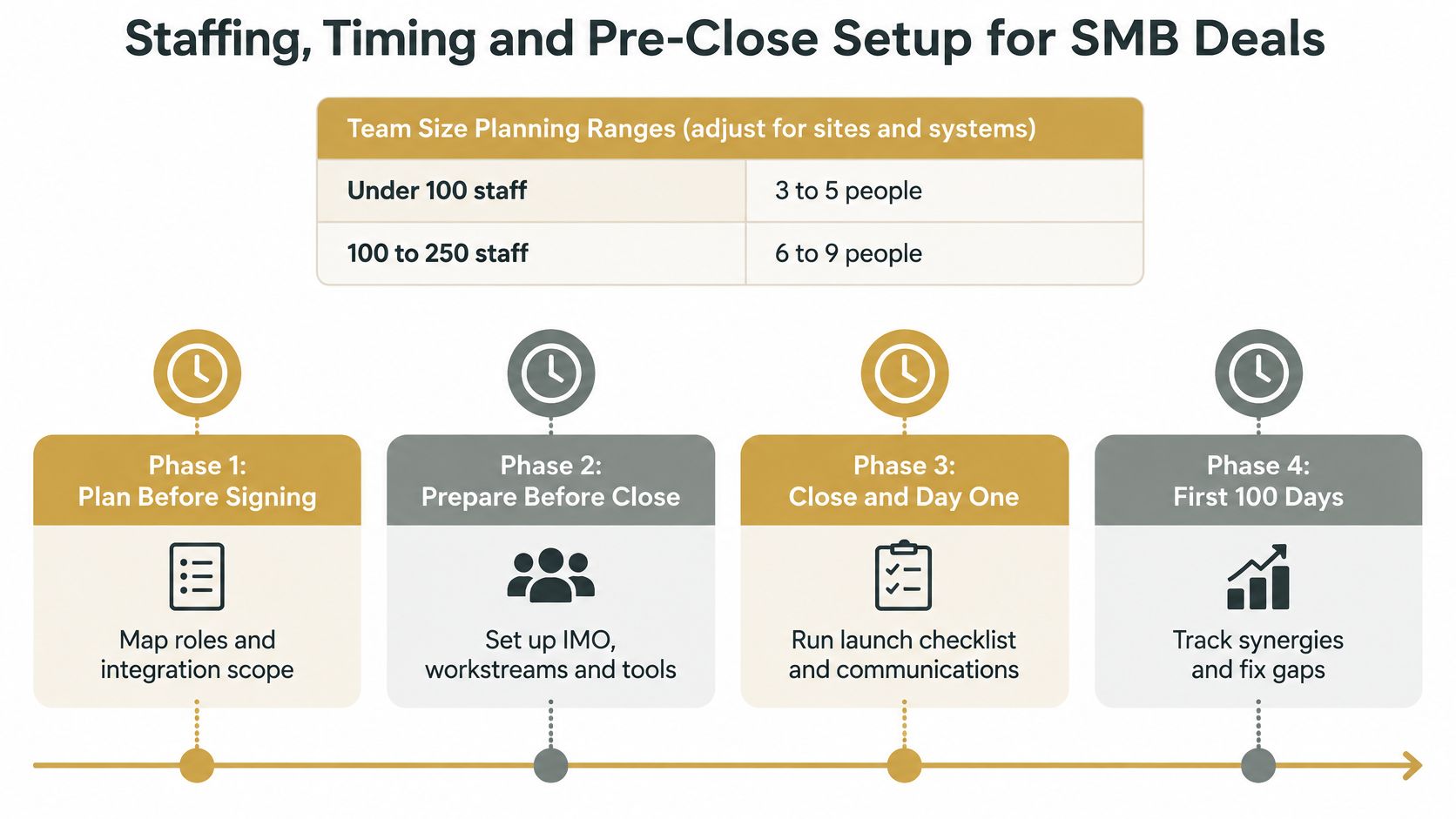
These ranges come from typical small-deal practice, not from a published benchmark. Add people when you have more sites or more systems you must keep alive.
| Deal profile | Team to staff | Start preparation | Typical duration |
|---|---|---|---|
| Single site, under $1M revenue | Owner part-time plus an outside accountant, with one named integration coordinator | 30 days before close | 6 to 9 months |
| Single site, $1M to $10M revenue | Dedicated integration manager plus 2 to 3 workstream leads | 60 days before close | 9 to 12 months |
| Bolt-on to an existing platform, $5M to $20M revenue | Integration manager plus 3 to 4 leads drawn from existing staff | 90 days before close | 12 to 18 months |
| Roll-up, three or more deals | Standing IMO of 2 to 4 people, reused across deals | Playbook ready before the first close | 18 to 24 months |
Four phases on one clock
Pre-close, usually 30 to 90 days. Build the Day 1 checklist. Confirm payroll, banking, and which customers get a call versus a letter. This is preparation, not ceremony.
The first week under new ownership. The goal is narrow. No missed payroll. No lost orders. A new logo can wait. A bounced paycheck can't.
The first 100 days. Quick wins, direct conversations with named critical employees, and a decision on which systems stay duplicated for now.
Months 4 through 24. Synergy delivery, system cutover, and culture that has to settle in real work, not in a values poster. The common miss is shutting the team down at day 100 while synergy dates still run into year two. The office can shrink. It shouldn't vanish.
The four phases, and a sensible headcount band, look like this on one page.
When the owner is also the operator
An owner running a business under $1 million, part-time, with an outside accountant, can coordinate the work without a hired manager. A $5 million bolt-on can't. That deal needs a named person whose only job is the integration, even if the workstream leads keep their day jobs.
Add a person when decisions older than five working days regularly number more than three. That's a capacity signal, not a character flaw.
Five dates before you hold the keys
- Name the integration manager and lock their hours, 60 days before close, or 30 days on deals under $1 million.
- Build the RACI and get the sponsor's sign-off, 45 days before close.
- Map single points of failure and agree retention actions for named staff, 30 days before close.
- Load the tracker with diligence baselines and hold the first weekly issue meeting, 14 days before close.
- Sign off Day 1 readiness, two to three days before close. Payroll, billing, and customer notices need a signature, not a verbal "we're fine."
Name that manager this week, even if close is still a month away. A title with no hours on the calendar is the same as no manager.
KPIs That Show Whether Integration Is Working
Each line below has its own trigger. A blended "health score" hides the account you just lost.
| KPI | What it measures | Benchmark or trigger | Review |
|---|---|---|---|
| Synergy capture rate | Realized savings or revenue against the target | At least 50% of target in year one | Monthly |
| Top-customer retention | Pre-close revenue from top accounts still ordering | No top account lost; any decline triggers outreach within 5 working days | Biweekly |
| Key-staff retention | Share of named critical employees still employed | 90% or more at month 12 | Biweekly |
| Organic revenue growth | Revenue growth against the pre-deal trend | Trend maintained, not falling | Monthly |
| Day 1 readiness | Share of critical checklist items complete before close | 100% of critical items | Once, before close |
| Cash conversion | Collections against the working-capital plan | Within 5 days of plan | Biweekly |
| Open decision age | Days a blocked decision has stayed open | Under 5 working days | Weekly |
| Milestone on-time rate | Milestones delivered on their due date | 80% or more | Weekly |
Eight Advisory's 2023 review of more than 700 M&A transactions across 92 European companies and private equity funds found expected synergies achieved or exceeded in only 40% of deals. A team that tracks nothing is choosing the larger group.
Why cost and growth sit side by side
McKinsey's merger research, cited earlier, found that successful deal leaders met at least 50% of their publicly stated synergy targets in the first year, and in many cases beat them. That's the monthly synergy line. It isn't permission to ignore customers.
Organic growth belongs next to those savings. In that same research, 72% of successful mergers maintained organic growth, compared with 33% of deals that ultimately failed. Cutting cost while revenue slips isn't integration. It's a smaller company than the one you bought.
Who sees which number
The integration manager reports synergy capture and the age of open decisions every week. Customer retention, retention of named staff, and cash conversion go to the steering committee every two weeks. Monthly is too slow for a paused account or a payroll miss.
One red line on top-customer retention outweighs a green total on synergies. Each KPI needs its own trigger, or the average will flatter you.
How these measures tie back to whether the acquisition itself is working is the subject of performance metrics for acquisition success.
Common Integration Problems and How to Fix Them
Value leaks through people before it leaks through systems. WTW's 2025 M&A Barometer found that 78% of respondents named below-executive employees with unique or specialized skills as their highest people-related due-diligence priority. Retention of non-executive talent was the leading integration-success measure, cited by 50%, against 29% for leadership retention. A calm executive team and a departed dispatcher is a failed integration with a tidy chart.
The same survey, covering HR leaders in North America, Europe, the Middle East, and Asia-Pacific, found culture alignment was the top overall challenge for 74% of non-US respondents and 54% of US respondents. A town hall doesn't retire that risk.
Find the single points of failure
Before any announcement, list every process or customer relationship held by one person. Ask who colleagues and customers actually call. That list of informal influencers rarely matches the org chart. Assign a knowledge-transfer owner to each concentration, and settle retention terms for those people before uncertainty recruits them away.
Temporary dual control helps. For a few months, two people should be able to run payroll or a key account. A heroic handover on a Friday doesn't.
Standardizing on day 30 feels like progress and often kills the local habit that produces the revenue. Protect customer continuity, operational know-how, and specialist decision rights. Standardize the back office. Leave the front line alone until you understand why it works.
Govern the tools, including AI
KPMG's 2025 survey of 135 US organizations found that 61% of executives feared AI-tool sprawl would raise operational complexity during integration. The live question isn't only which ERP wins. It's who owns permissioning, the inventory of models and agents, data lineage, human review, and the right to shut a tool off after close.
Keep an AI and automation register. Classify systems by how badly the day breaks if they fail. Freeze any deployment that has no named owner. Run duplicated systems in parallel for 30 to 60 days with a reconciliation, instead of a cutover on night one. Controlled coexistence is often safer than fast consolidation, and a five-person shop shouldn't inherit enterprise controls that wipe out the margin you underwrote.
Match the symptom to a fix
- Staff leave inside 90 days: agree retention terms before the announcement, not after the resignation.
- Synergies never hit the P&L: one owner per synergy, reviewed monthly in the actual numbers.
- Customers pause orders: a named contact for each top account inside 30 days.
- Reports don't match: a cutover date plus 30 to 60 days of reconciliation.
- Tools multiply: freeze anything without an owner.
- People go quiet after a forced standard: standardize back-office work only.
If you still run the existing business, hand one workstream to someone else before closing. You can't be the integration manager and the operator of both companies in the same week.
Org Chart and Integration Plan Templates You Can Reuse
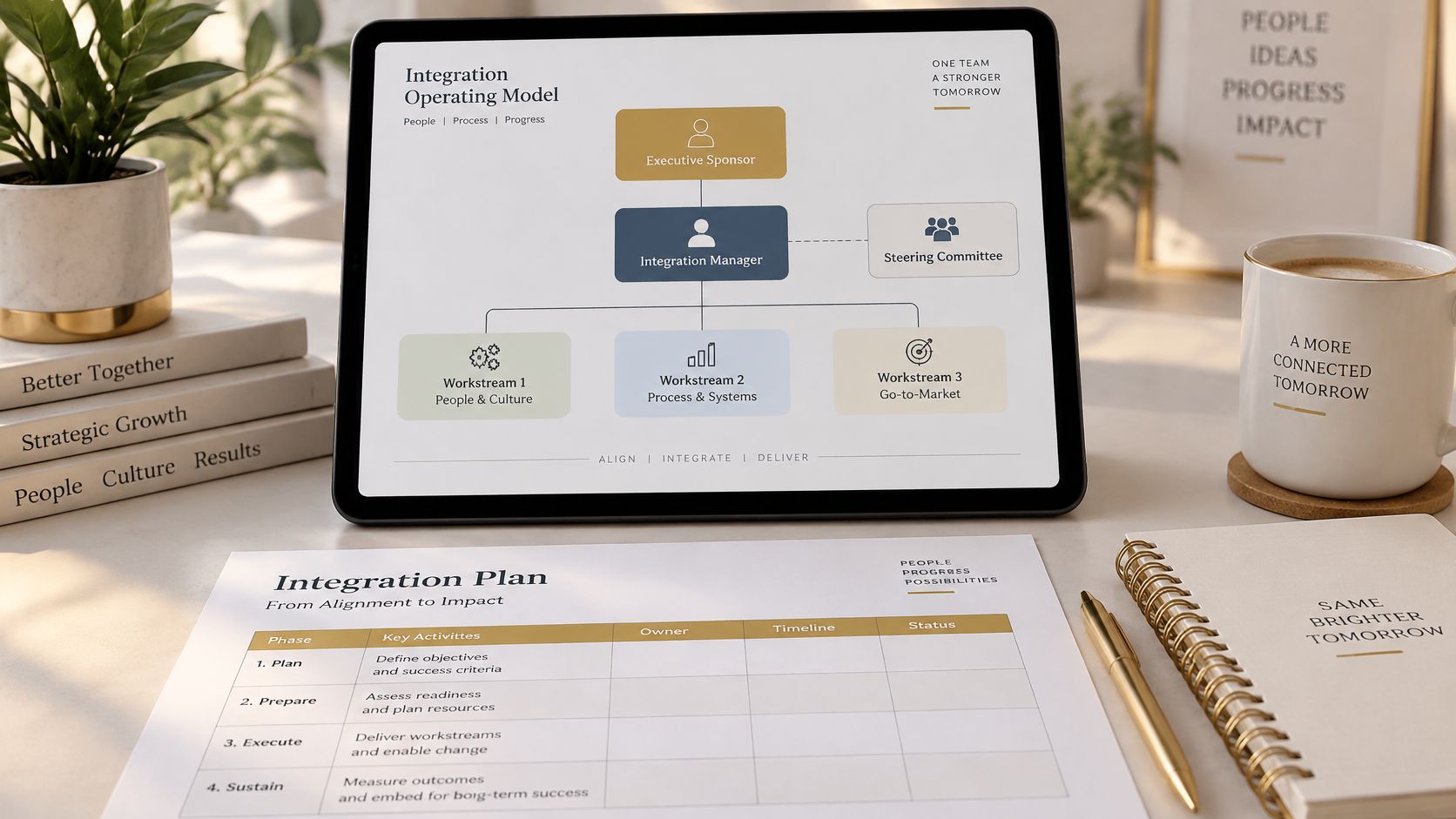
Paste this into a slide or a sheet. One name per box. "Finance team" isn't a name.
Executive sponsor (top row, steering committee)
Integration manager, with a dotted line back to that committee
Third row, five leads:
- Finance
- Operations and technology
- People
- Commercial
- Legal and communications
Synergy owners sit under the relevant lead, one initiative and one name in each box.
A tracker only works if it lives where the work happens, not in a slide nobody opens after week two.
Seven fields, one row per milestone
- Workstream. The function, such as Finance.
- Milestone and due date. A specific outcome and a calendar date. Example: payroll provider confirmed, 30 days before close.
- Owner. One person. Example: finance lead, Dana Ruiz. Never a department.
- Synergy value and baseline. The target and the diligence figure behind it. Example: $120,000 a year in purchasing savings, taken from the supplier-spend line in the diligence model. If diligence didn't support a number, don't write one in after close.
- Status. On track, at risk, or blocked.
- Blocker and escalation date. Example: bank signatory change, escalate on day 5.
- Risk score. Likelihood times impact, each scored 1 to 5. A 3 times a 4 is 12, and 12 gets time in the weekly meeting.
Open the sheet with three rows only. Payroll provider confirmed 30 days before close. Customer notification list signed off two weeks before close. First synergy review at day 90. Save the file and reuse it. The second integration should start from the first one's misses, not from a blank workbook.
Dealmaker Wealth Society teaches acquisition entrepreneurs how to staff and run integration after a small-business close, with playbooks, checklists, and live coaching on IMO setup, KPI tracking, and the people and systems work that follows the wire. If you're naming an integration manager for a first deal or a bolt-on, start with the templates and the peer community at Dealmaker Wealth Society.

From the Dealmaker Blog











A Creative Business Buying Fable