AI for M&A Due Diligence: Gains, Limits and Controls
AI for M&A Due Diligence: Gains, Limits and Controls
The most repeated advice is to drop the data room into a chatbot and let it write the issues list. That advice treats speed as the whole job. A faster first read is useful. A price you can defend is a different job.
In 2024, 45% of respondents said AI would improve due diligence, while 51% expected an impact on risk analysis, according to Dykema's 2024 M&A survey. An expectation is not a finding you can take to a seller. I would treat every model output as a lead. If it can't point to a page, a ledger line, and a named reviewer, it doesn't move the offer.
AI for M&A due diligence earns its place when it shortens the first pass and forces a cleaner evidence trail before valuation, contract protection, or a walk-away.
Table of Contents
- Where AI Fits in Each Due Diligence Workstream
- Set Up and Run a Safe AI-Assisted Document Review
- Validating AI Findings Before They Move the Price
- Spotting Financial Anomalies Before You Sign
- Contract Clauses AI Can Find and Lawyers Must Check
- Matching AI Tools to a Small Acquisition
- Confirm Your Diligence Process Before the Next Deal
Where AI Fits in Each Due Diligence Workstream
AI handles the high-volume first pass in most workstreams. People own the judgement calls that change what you pay.
| Workstream | AI task | Human check |
|---|---|---|
| Commercial and customers | Summarise customer lists, flag revenue concentration | Confirm revenue figures and run customer interviews |
| Financial | Normalise ledgers, flag working-capital and revenue anomalies | Accountant validates every flag against source records |
| Legal and contracts | Extract clauses and compare them with a checklist | Counsel interprets clauses and decides the risk |
| Operations and IT | Inventory systems, licences and data flows | Technical specialist tests security and integration |
| HR and employment | Scan employment agreements for key terms | Employment counsel reviews flagged terms |
| Synthesis | Draft an issues list across workstreams | Deal lead ranks issues and sets price impact |
A 2025 McKinsey survey of 200 M&A professionals found that 40% of respondents using generative AI said it shortened deal cycles by an average of 30% to 50%. On diligence itself, 51% reported enhanced accuracy in analysis. Those are reported benefits, not independently verified causal gains. Treat the table as a map, not a promise that your next file will close that much faster.
Start where the pile is thick: contracts, general ledgers, and customer lists. The human check matters most where a bad read changes value, including quality of earnings, tax exposure, customer concentration, and who owns the intellectual property. Our guide to operational due diligence for acquisitions shows the operating questions a specialist still has to test after a system inventory. On the numbers, pre-acquisition financial checks for investors from Lighthouse Consultants is a practical companion when you decide which flags deserve an accountant's hours.
Before the next target, pick one workstream, name the person who reviews its AI output, and write that down before anyone uploads a file.
Set Up and Run a Safe AI-Assisted Document Review
The time saving and the leak risk arrive together. A 2026 benchmark study of 400 senior corporate and private-equity M&A professionals reported that more than one-third of dealmakers saved between 21% and 30% of their time on diligence-related tasks. In the same period, 80% of firms said they had experienced an AI-related security incident or near miss, including access-control lapses and inaccurate outputs tied to hallucinations.
Data rooms hold financial statements, employee records, customer contracts, pricing, trade secrets, and privileged advice. Uploading first and checking settings later is the common slip. A summariser that keeps files, or trains on them, can put a target's pricing in front of people who were never in the deal.
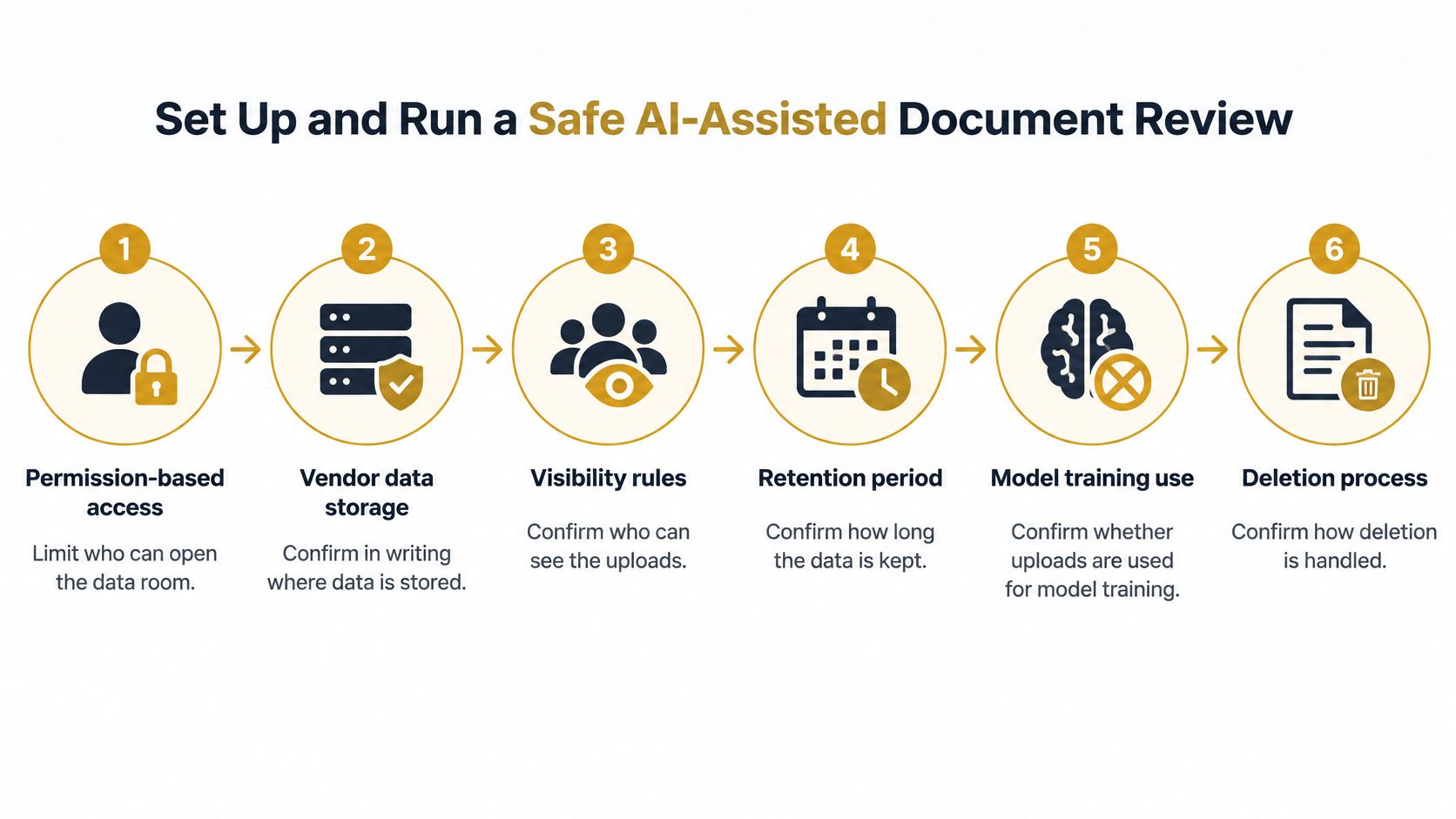
Lock the vendor terms before the first file
Get the answers in writing, not in a settings screen you might change later.
- Permission-based access: Limit who can open the room, and turn access off when a reviewer leaves the deal.
- Storage location: Confirm where the vendor keeps the files, including any backup region.
- Visibility: Confirm who inside the vendor, and which other customers, can see uploads.
- Retention: Confirm how long copies stay after you close the project.
- Training use: Confirm whether uploads are used to train or improve a model. If the answer is yes, don't upload.
- Deletion: Confirm how deletion is proved, not just promised.
Keep an audit log of who uploaded, who queried, and what was exported. Tools built for review, including AI document review software from LegesGPT, are worth comparing on source links and access controls, not on how fluent the summary sounds.
Run a review you can trace
- Index every document with name, date, folder, and owner. An unindexed upload can't be cited later.
- Extract clauses and topics across the full set, not a sample you already think is risky.
- Require a source on every output: file name, page or section, and the quoted span. No source means a lead, not evidence.
- Sample flagged and unflagged documents and write down what the tool missed. Reading only the flagged pile hides the misses.
- Escalate low-confidence or contradictory results to counsel or the accountant before they enter the issues list.
- Log the decision beside each red flag with the reviewer's name and the date.
Practical rule: An output without a quoted span stays out of the price discussion until a person ties it to the underlying file.
The finished file is an issues list where every item has a source, a confidence level, a reviewer, and a decision, plus workpapers that hold the extracted fields. That file is what you hand to the deal lead, not a chat transcript.
If you want a short walkthrough of how teams are putting these controls around live rooms, this briefing is a useful orientation before you pick a vendor.
Validating AI Findings Before They Move the Price
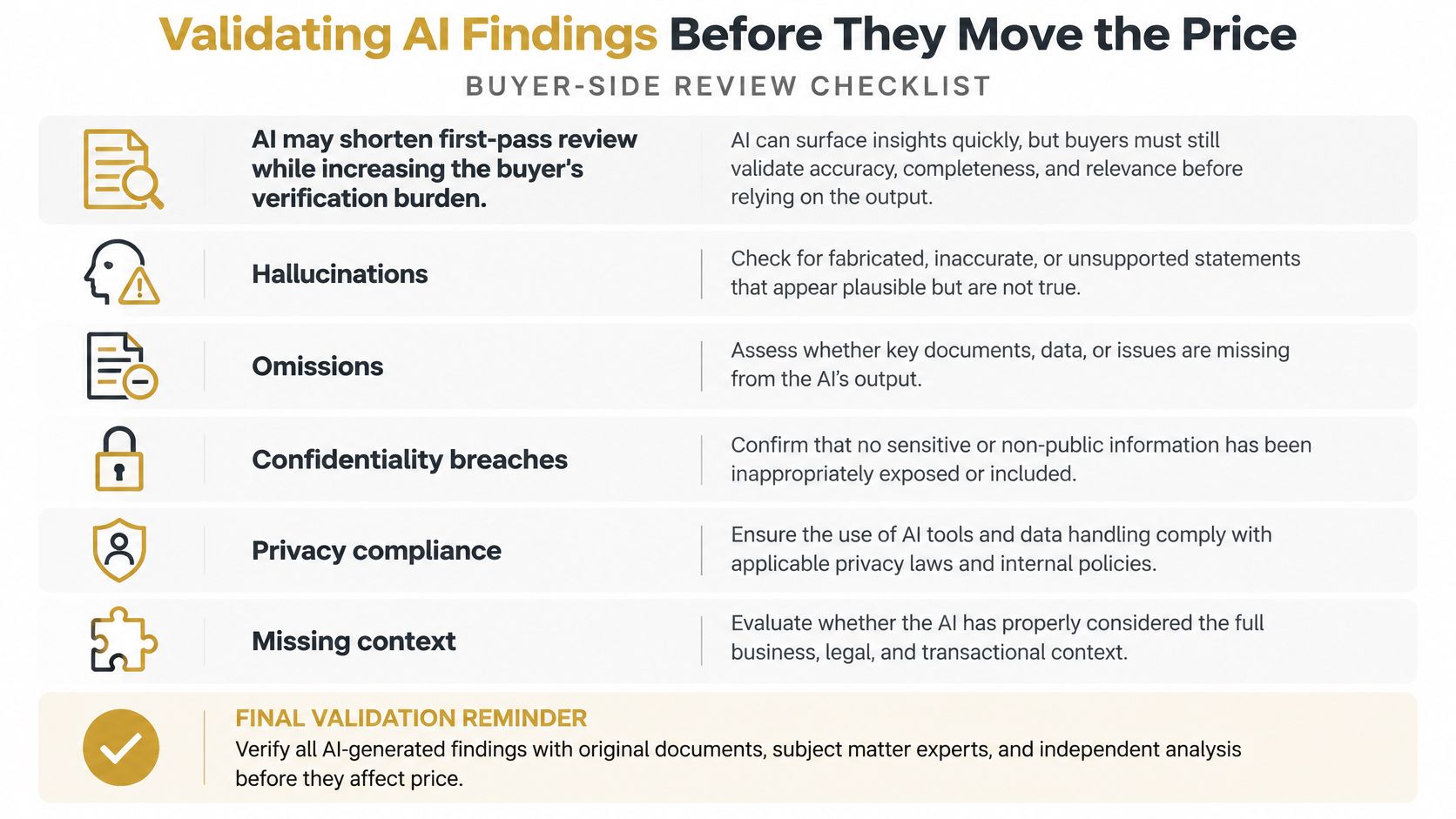
AI can shorten a first-pass review while increasing the buyer's verification burden. More flags mean more claims to test before they affect price or terms.
The American Bar Association's discussion of AI risks in transactions identifies hallucinations, omissions, confidentiality breaches, privacy compliance, and liability for misleading outputs as concerns. It also recommends reviewing the target's AI policies, vendor contracts, IP controls, cybersecurity, privacy practices, and employment-related uses of AI. For a small acquisition, keep a written record of what the tool found, what evidence supports it, and who reviewed it.
Accuracy and reliability are common concerns for dealmakers using AI. The practical test is whether a finding could affect valuation, representations and warranties, financing, or a decision to walk away. Before changing terms, have a qualified reviewer check the underlying evidence, record any uncertainty, and document who approved the conclusion.
Test revenue with customers, not with a summary
Customer verification puts reported revenue claims to a direct test. The process taught at Dealmaker Academy has four parts: a customer interview, a concentration analysis, a contract review, and a retention risk assessment. During confirmatory due diligence, the interview is a direct conversation with the target's top 5 to 10 customers, conducted under NDA. AI can help rank accounts for review, but a summary cannot establish what a customer says about the relationship or its future.
If a material finding remains uncertain, reflect that uncertainty in the deal terms. Depending on the issue, protection may take the form of an escrow, a specific indemnity, a price adjustment, or a decision to walk away. An unresolved model output is not a substitute for evidence or contractual protection.
Spotting Financial Anomalies Before You Sign
The miss that hurts small buyers is revenue that looks smooth in a management pack and lumpy in the ledger. Period-end spikes, working-capital moves that don't track sales, revenue without matching cash, and a valuation model that uses different numbers from the accounts are the signals worth forcing into the open.
AI is most useful here as a high-recall screen, not as the person who signs the quality-of-earnings memo. As described in published research on AI-enhanced due diligence, natural-language processing can read contracts and filings, while anomaly models compare transactions, ratios, and disclosures with expected patterns. That coverage beats manual sampling. It still isn't conclusive evidence.
A workflow a finance lead can audit
Normalise the general-ledger export, bank data, customer concentration, inventory, and monthly KPIs so the columns mean the same thing across months. Apply simple rules first (cash versus revenue, period-end journals, negative inventory) and then a statistical pass for outliers. Route each flag with the source transactions and a plain explanation of the signal. A finance professional accepts, rejects, or reclassifies it. Broader coverage raises the chance you see the exception before signing. Human review stops a false positive from becoming an unsupported purchase-price adjustment.
Our checklist for identifying red flags in business evaluations is the right companion when you turn those flags into questions for the seller.
Price concentration with fixed bands
In our concentration analysis, one customer over 15% of revenue is a weakness, over 25% is a risk factor priced into the offer, and over 40% changes the deal structure. Say a target earns 32% of revenue from one account. That sits in the middle band, so I would expect the risk in the price, not a casual note in the memo. The model can calculate the share. It shouldn't set the discount.
Each flag needs a documented explanation before it becomes a purchase-price adjustment. "The tool highlighted it" is not that explanation.
Contract Clauses AI Can Find and Lawyers Must Check
Contract extraction is weaker than a clean summary suggests. On the CUAD dataset, 510 contracts annotated by legal experts across 41 clause types, the best tested model reported an area under the precision-recall curve of 47.8%. Tuned to capture 90% of relevant clauses, only 17.8% of returned items were correct. On the MAUD benchmark of 152 merger agreements, the best reported model reached 57.8%, as set out by Botminds on legal due diligence limits. Use the model to inventory, extract, compare, and prioritise. Don't use it for the legal conclusion.
| Clause type | Why it matters | AI role | Human check |
|---|---|---|---|
| Change of control | Can trigger termination or consent on sale | Locate and quote the clause | Counsel confirms whether this deal triggers it |
| Indemnity | Sets post-close liability | Extract caps, baskets and survival periods | Counsel assesses the exposure |
| Termination | Can end revenue on short notice | Flag notice periods and triggers | Check against customer history |
| Exclusivity | Limits growth and pricing options | Flag restrictive covenants | Counsel assesses enforceability |
| IP ownership | Shows whether you own what you buy | Trace assignment and licence terms | IP counsel verifies chain of title |
| Data protection | Governs transfer of customer data | Flag transfer and consent wording | Privacy specialist reviews |
| Customer consent | Needed where contracts lack an assignment clause | Flag missing assignment clauses | Obtain consent letters before closing |
Any material contract without an assignment clause needs a customer consent letter before the deal closes. Flagging the gap is the model's job. Getting the letter is yours. For how those clauses sit inside the purchase agreement, see our note on evaluating business sale agreements.
Keep document name, page or section, quoted span, confidence, and the reviewer's disposition on every extracted obligation. Sample both flagged and unflagged contracts, and measure recall on the risk-critical types in the table before you rely on the extract. Low-confidence or contradictory hits go to counsel, not into the disclosure schedule as facts.
Matching AI Tools to a Small Acquisition
Choose by the job, not by the logo. A category that fits a 200-person diligence team can be the wrong buy for a first acquisition.
| Vendor category | Typical task | Main strength | Main limit |
|---|---|---|---|
| General-purpose AI assistants | Summaries and questions on uploaded files | Fast drafting and summaries | Not built for audit trails; check data retention |
| Data room AI features | Search and tagging inside the data room | Access controls already in place | Covers only files uploaded to the room |
| Contract analysis platforms | Clause extraction and comparison | Source-linked clause outputs | Weaker on difficult clause questions |
| Financial analytics and anomaly tools | Ledger and KPI screening | Covers large transaction volumes | Needs clean data; produces false positives |
| Specialist advisers with AI workflows | Full diligence with human sign-off | Accountability and expertise | Higher cost than tools |
What fits a small deal
Enterprise contract platforms can cost more than a small buyer's whole diligence budget, and list prices are rarely a fair guide until you have a quote for your file count. Data-room features are often the better first tool because access control is already there. General-purpose assistants such as ChatGPT with file analysis, or Claude, are fine for a private summary of a document you already trust, once retention and training are confirmed. They are a poor system of record.
Specialist advisers who use AI inside their own workflow cost more than software and give you a named sign-off. That trade is rational when the issue is tax, IP title, or a change-of-control fight, and wasteful when you only need a searchable index.
Limits that sit on every row
Hard clause questions still come back noisy. Models still invent a citation that isn't in the file. Anything never uploaded is invisible, including side letters on a founder's laptop. Junior reviewers who only read the summary get worse at spotting what the model skipped.
Run a pilot on a deal you already closed and score recall against issues you know were real. Confirm you can export the audit log. Assign one named person to own that tool's output on the live deal. If nobody owns the output, you don't have a process.
Confirm Your Diligence Process Before the Next Deal
Confirm the process before the next target's files hit a model. Four gates are enough.
- Write the coverage. List which workstreams AI will touch and name the human who owns each one.
- Set the evidence bar. Every material finding needs a source, a stated uncertainty, a human confirmation, and the name of who approved it.
- Agree vendor rules in writing on retention and model training before the first upload.
- Book the customer checks for the top 5 to 10 customers under NDA, not after you have already argued the price.
Members who want a second pair of eyes on a live file can book a coaching call to review that specific deal with Carl Allen and our M&A coaches. That is one support route. It isn't a promise about the outcome of the acquisition.
This week, pick one workstream for the next target, name its reviewer, and write that down before you start.
Dealmaker Wealth Society teaches acquisition entrepreneurs how to buy, finance, and grow small businesses, including the diligence habits that keep an AI lead from becoming a bad price. If you want structured training, live coaching, and a peer group around your next deal, visit Dealmaker Wealth Society and start with the workstream you will review this month.

From the Dealmaker Blog










A Creative Business Buying Fable