How to Build a Pro Forma Analysis for an Acquisition
How to Build a Pro Forma Analysis for an Acquisition

You're reviewing a business for sale, and the seller's spreadsheet makes the acquisition look straightforward. Combine the companies, remove some expenses, add expected savings, and the earnings look strong enough to support the asking price. But you still don't know whether you can pay the lender, replace the owner, and keep enough cash available while customers take their time paying.
That's where pro forma analysis becomes useful. Not as an earnings showcase, but as a way to separate documented transaction effects from promises, assign responsibility for assumptions, and decide how much financial risk you can afford.
Table of Contents
- What Pro Forma Analysis Shows and Why Deals Depend on It
- The Five Components of an Acquisition Pro Forma
- Separating Accounting Adjustments From Real Operating Gains
- How to Build the Pro Forma Step by Step
- Testing the Assumptions Before You Trust the Model
- Reading Scenario Cases for a Go or No-Go Decision
- Post-Close Cash Headroom and the Final Go or No-Go Check
What Pro Forma Analysis Shows and Why Deals Depend on It
Say you own a commercial cleaning company and are considering buying a competitor. The seller shows you combined revenue and suggests that eliminating duplicate office expenses will make the purchase attractive. You need a picture that includes the acquisition debt and accounting changes, not just the potential savings.
A pro forma analysis rebuilds historical financial statements as if a transaction had already happened, showing the financial shape of the combined business.
The distinction is between a reconstructed snapshot and a forecast. Recalculating historical earnings with acquisition financing applied is pro forma analysis. Estimating sales from customers you hope to win after closing is forecasting. Private deal spreadsheets often contain both, but they should label them separately.
The discipline behind the presentation
The SEC's Financial Reporting Manual explains the framework under Regulation S-X Article 11 for presenting the hypothetical effects of significant transactions; the SEC's historical adjustment criteria emphasized effects directly attributable to the transaction, supported by facts, and expected to continue. That discipline matters even when a small-business acquisition doesn't require a public-company filing.
The principal readers have different concerns:
- The buyer tests whether the price makes sense.
- The lender tests whether the business can support the proposed debt.
- The seller tests how persuasive the transaction's financial presentation looks.
A full presentation includes a pro forma balance sheet, showing assets, liabilities, and equity at a point in time, and pro forma income statements, showing revenue, expenses, and profit over a period. A small-business model may use a simpler layout, but it still needs both perspectives.
Ask of every adjustment: does this number represent a documented transaction effect, or a hopeful projection presented as history?
The Five Components of an Acquisition Pro Forma
Build the model in separate columns before calculating combined results. The SEC's guidance on acquired and disposed businesses describes transaction adjustments that reflect accounting and financing effects, rather than adding the companies' reported earnings.
The hierarchy below keeps those effects visible.
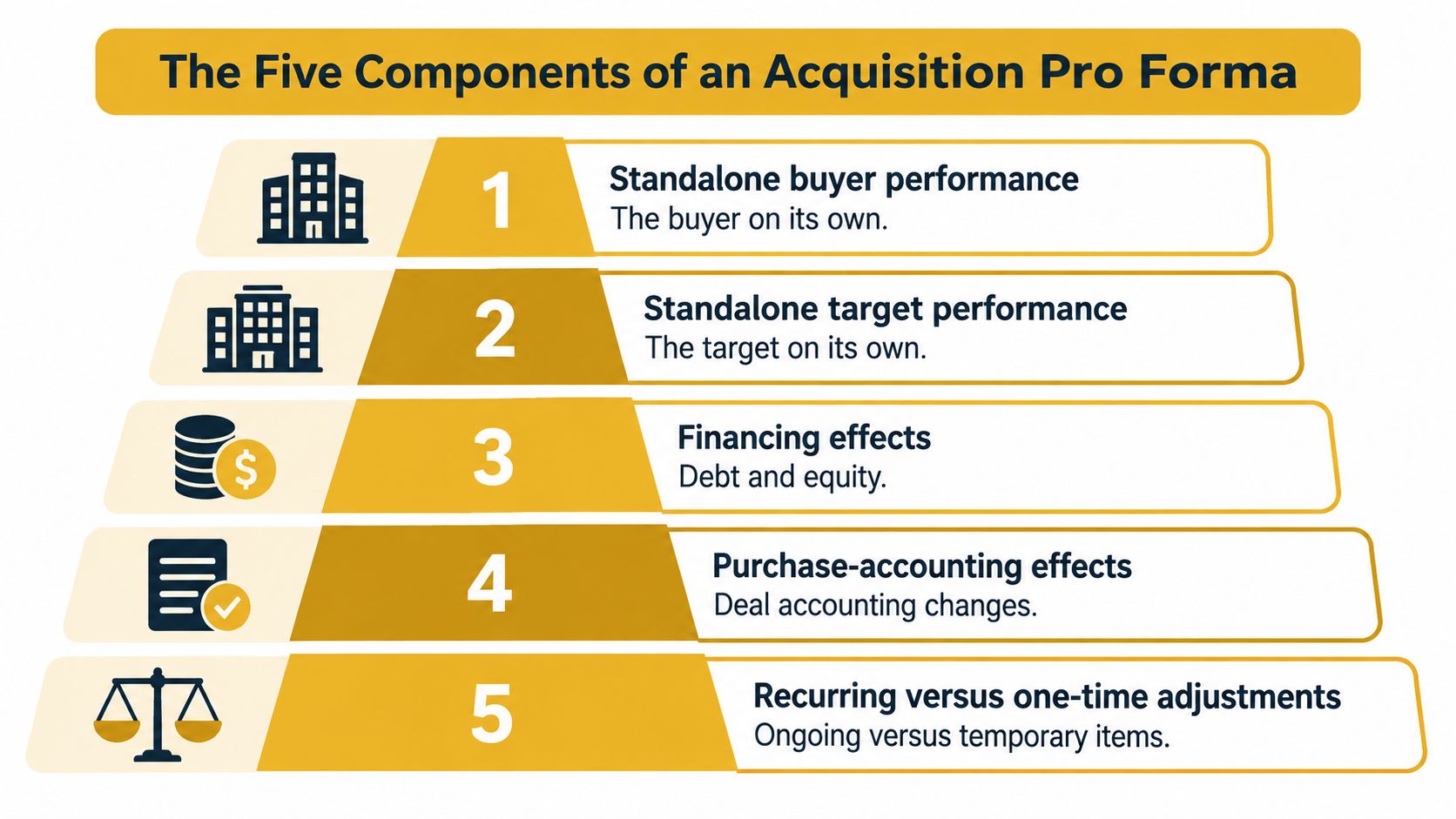
Keep the inputs separate
Standalone buyer performance means the buyer's results without the acquisition. Standalone target performance means the business being acquired on its own. Both need consistent reporting periods and accounting classifications.
For example, a target may report attractive earnings before its existing interest expense, but your acquisition financing could cost substantially more. EBITDA, earnings before interest, taxes, depreciation, and amortization, helps compare operating performance, but it doesn't show what remains after paying lenders.
Financing effects capture new borrowing, interest, and required principal repayments. Purchase-accounting effects capture changes arising from allocating the purchase price to acquired assets and liabilities. Increasing an equipment asset's recorded value, for example, can create additional depreciation expense without creating additional sales.
Recurring versus one-time adjustments distinguish ongoing costs from temporary deal spending. A recurring replacement manager's salary belongs in the ongoing cost base; a transaction adviser's fee belongs in a separate deal-cost line.
Acquisition pro forma components and their sources
| Component | What It Contains | Source Document |
|---|---|---|
| Standalone buyer performance | Buyer's historical revenue, EBITDA and cash position | Buyer's financial statements and bank records |
| Standalone target performance | Target's revenue, seller-adjusted EBITDA and working capital | Seller's P&L, tax returns and bank statements |
| Financing effects | Incremental interest and mandatory principal amortization | Lender term sheet and debt schedule |
| Purchase-accounting effects | Depreciation and amortization from fair-value step-ups | Purchase price allocation and valuation report |
| Recurring versus one-time adjustments | Run-rate costs kept apart from fees and integration spending | Deal budget and diligence findings |
Entity formation can also create transaction costs. If your structure requires a Spanish company, renn's guide to how to register your Spanish company provides context for identifying setup tasks and associated budget items.
These components feed an earnings bridge: standalone EBITDA plus supported operating adjustments produces pro forma EBITDA. From there, deduct depreciation and amortization to reach operating profit, then interest and taxes to reach net income, the accounting profit remaining after expenses. Don't treat acquisition debt, integration spending, or accounting changes as operating improvements.
Separating Accounting Adjustments From Real Operating Gains
Does this change happen because of the transaction's accounting, or must the new owner do something to achieve it? That question separates mechanical adjustments from execution risk.
Use the comparison below as a reminder to classify changes before accepting the combined earnings figure.
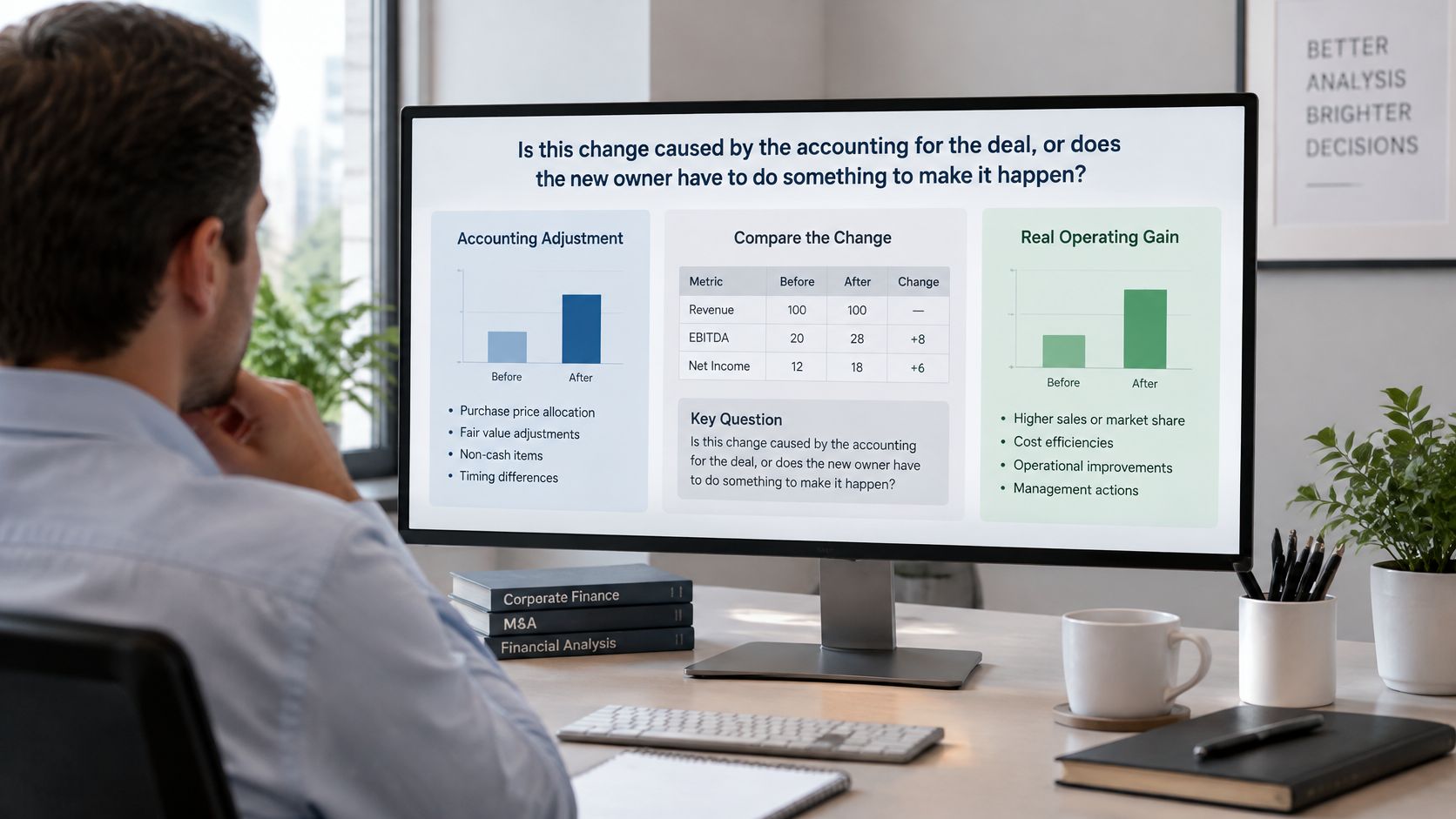
Sort changes by what makes them happen
Purchase-accounting depreciation and interest on acquisition debt follow from the transaction structure. Removing a seller's personal expenses is different: that's an earnings normalization, and you must prove the expense stops. Owner compensation isn't removable if someone still needs to perform the owner's work.
Synergies are benefits available from combining businesses, such as consolidating facilities or negotiating better supplier terms. They require operational evidence. For an importing business, understanding how landed costs affect margins can help you check whether freight, duties, and handling erase an apparent purchasing benefit.
Some supposed gains are deferred costs. Neglected equipment maintenance, employee retention payments, and system migration spending may consume the cash that the seller's adjusted earnings appear to promise.
Turn potential benefits into accountable initiatives
McKinsey's analysis of merger synergies reports that managers in roughly 60% of mergers deliver planned cost synergies almost entirely, while synergies are overestimated by at least 25% in approximately one-quarter of cases, potentially translating into a 5%–10% valuation error.
Build an initiative register rather than entering a single savings total:
- Driver and owner specify the operational change and who must deliver it.
- Implementation cost captures spending required before savings begin.
- Start date and ramp show when benefits begin and how they build.
- Achievement probability records the uncertainty behind the estimate.
Have the relevant operating manager validate each entry. A facility closure may require lease payments or customer-service changes that the finance model otherwise misses. Use an acquisition synergy evaluation to connect the benefit to an executable operating plan.
For an additional explanation, use the accompanying video.
Underwriting rule: No synergy belongs in headline EBITDA until its driver, implementation cost, and timing are documented.
How to Build the Pro Forma Step by Step
Use Excel or Google Sheets with separate tabs for historical statements, assumptions, debt, adjustments, combined statements, and scenarios. Keep source inputs separate from formulas, and give every adjustment an identifier that connects it to supporting documents.
The process illustration provides a high-level map.
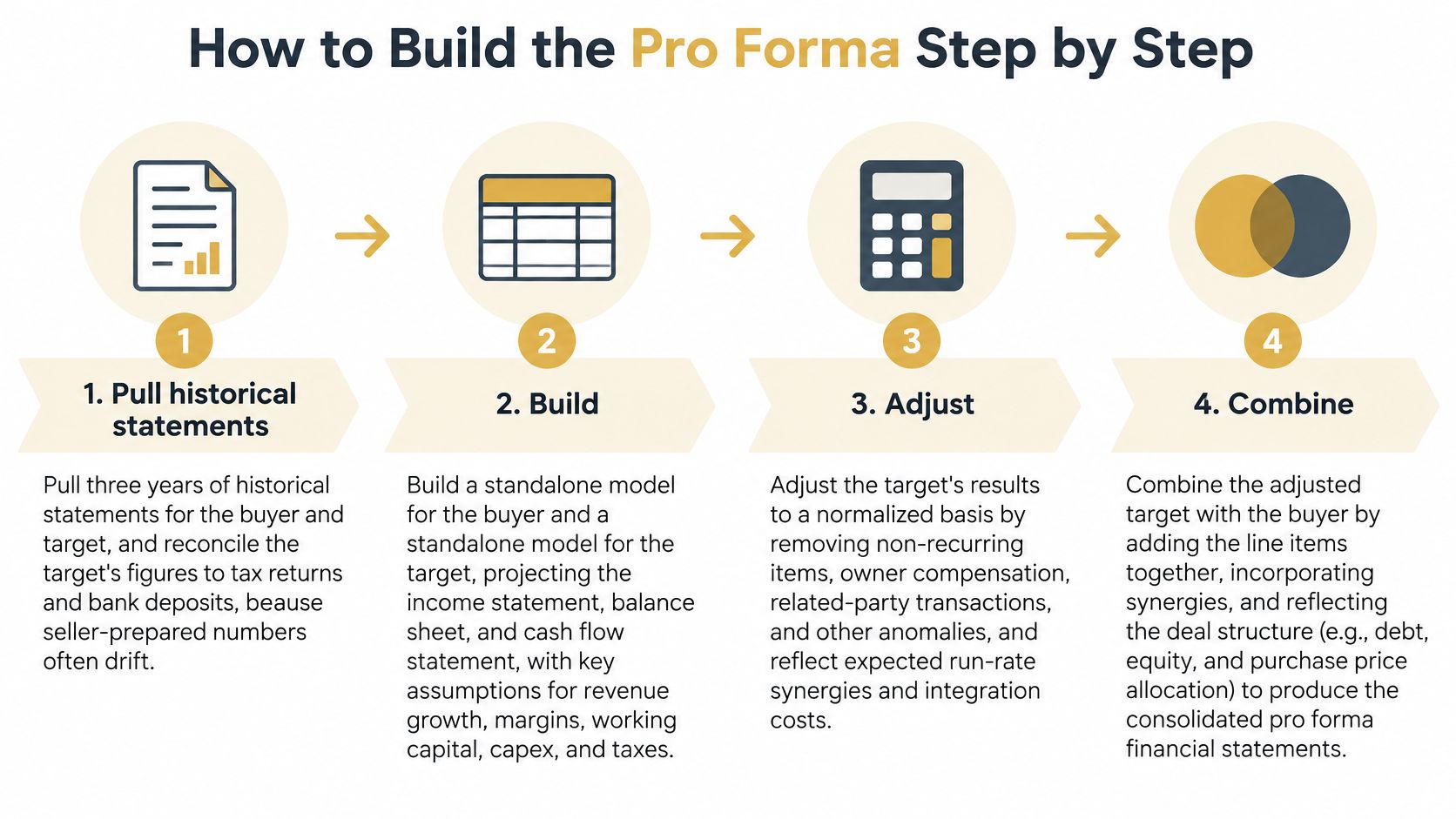
Establish the historical starting point
Collect and reconcile the records. Pull comparable historical income statements and balance sheets for buyer and target, then reconcile the target's revenue to tax returns, bank deposits, and customer records. For this hypothetical worked example, suppose the seller presents $800,000 of adjusted EBITDA, but your review shows that this figure still includes the owner's salary expense.
Build untouched standalone columns before making adjustments. In the hypothetical target, removing $120,000 of owner salary but hiring a replacement for $150,000 creates a negative $30,000 adjustment, leaving $770,000 before other changes. If the seller's starting EBITDA already excluded owner compensation, you'd deduct the full replacement cost instead, so check the starting definition carefully.
Enter the financing terms. Suppose the hypothetical acquisition requires $3.2 million of new debt at 9%, producing $288,000 of annual interest before principal reductions. Interest reduces pretax income and, subject to tax treatment, net income; mandatory principal repayments reduce cash and debt, not income-statement profit.
The interest calculation follows the example:
Annual interest = outstanding principal × annual interest rate
Use the lender's actual payment schedule in the model. A flat opening-balance calculation is only a starting approximation when principal changes during the year.
Connect the deal to earnings and cash
Add purchase-accounting adjustments supported by the proposed allocation and valuation work. For the hypothetical target, leave an identified equipment valuation adjustment unresolved until the accountant can support it, rather than entering an invented depreciation charge to finish the spreadsheet.
Phase supported synergies and separate implementation costs. If the target's purchasing savings require supplier negotiations, start them only after the expected agreement date and increase them as eligible purchases transition. Keep legal fees, relocation spending, and system conversion costs visible even when you exclude them from ongoing earnings.
Combine the income statements and balance sheets, then reconcile profit to cash. For the hypothetical target, begin with the normalized operating result, account for depreciation, interest, and taxes, then track customer collections, supplier payments, equipment spending, and debt repayments.
A customer invoice can increase accounting profit before the customer pays. Buying replacement equipment can consume cash without an equivalent immediate income-statement expense. Those differences explain why free cash flow, cash remaining after operating needs and capital expenditure, matters alongside earnings.
- Run linked scenarios rather than editing isolated output cells. Change purchase price, borrowing, interest rates, close timing, taxes, and synergy delivery through the assumptions tab. For the hypothetical target, test whether it can service acquisition debt without relying on purchasing savings.
Before calculating a ratio, identify the cash genuinely available for lender payments. Debt-service coverage compares that amount with required interest and principal payments:
Debt-service coverage = cash flow available for debt service ÷ required interest and principal
Use the definition and threshold in the lender's documents. Don't substitute EBITDA for the numerator unless that's explicitly how the lender defines its covenant, and don't assume every financing agreement uses the same calculation.
Testing the Assumptions Before You Trust the Model
A spreadsheet can calculate an unsupported assumption to the nearest cent. That precision doesn't make the assumption reliable.
Xero's explanation of pro forma financial statements highlights the importance of assumptions and the limitations of comparing presentations built using different methods. Your review should therefore test the input definitions before debating the output.
Build an assumption register
Give each material input a source, owner, confidence rating, and revision trigger. Include customer retention, pricing, gross margin, payroll, working capital, taxes, debt service, and synergy timing.
For example, an operations manager might own the payroll forecast, with employee records as evidence and a planned departure as the revision trigger. A customer-retention assumption based only on the seller's reassurance deserves less confidence than one supported by renewal history and customer conversations.
Key assumptions, evidence to request and red flags
| Assumption | Evidence to Request | Red Flag |
|---|---|---|
| Customer retention | Churn by customer cohort over comparable historical periods and signed contracts | Retention improves only in the year of sale |
| Owner add-backs | Invoices, payroll records and proof that owner costs stop at close | Add-back accepted with no supporting records |
| Gross margin | Job-level costing or cost of goods sold detail | Margin well above peers with no explanation |
| Working capital | Receivables and payables aging covering a full operating cycle | Collections stretched in the months before the sale |
| Synergy timing | Named initiative with an owner and a start date | Savings booked as if they arrive immediately |
An add-back is an expense removed from reported earnings because the seller argues it won't continue. Evidence must establish both that the expense occurred and that the buyer won't need an equivalent replacement.
Verify customers before accepting growth
Our customer verification process taught at Dealmaker Academy has four parts: a customer interview process, a concentration analysis, a contract review, and a retention risk assessment. Coordinate interviews through an agreed confidentiality process rather than contacting customers without permission.
Under our concentration method, one customer over 15% of revenue is a weakness, over 25% is a risk factor priced into the offer, and over 40% changes the deal structure. These are our underwriting guidelines, not universal regulatory thresholds.
Use a financial forecasting diligence checklist to connect customer evidence with the revenue forecast. Then set a negotiating boundary: the maximum price and borrowing that remain viable under a defined revenue shortfall, not merely the price that works if every assumption holds.
Reading Scenario Cases for a Go or No-Go Decision
The base case is the reference plan, not the answer. It should reflect supportable operating assumptions, documented financing terms, and benefits phased according to actual implementation work.
The downside and no-synergy cases answer different questions. A revenue decline tests operating resilience; removing synergies tests whether you're paying today for improvements you haven't delivered. Neither should be replaced by an optimistic weighted average that hides a cash shortage.
Set pass signals before reviewing results
The following is a hypothetical decision framework, not a statement of standard lender requirements. Its downside assumptions and review period are chosen stress tests; substitute conditions appropriate to the target's customer risks, seasonality, and financing.
Scenario cases and pass signals for an acquisition
| Case | Key Assumptions | Test Question | Pass Signal |
|---|---|---|---|
| Base case | Supported operating plan, documented financing, and phased synergies | Does debt service clear the coverage threshold? | Coverage exceeds the lender's contractual minimum |
| Downside case | Hypothetically, revenue 15% below plan and synergies delayed 12 months | Does cash stay above the minimum reserve? | Reserve intact through month 12 |
| No-synergy case | Zero synergy benefit and integration spending included | Can the business pay its debt without any gains? | Positive free cash flow after debt payments |
| Upside case | Synergies on schedule and supported pricing gains realized | Does the agreed price still leave a margin of safety? | Returns hold at the agreed purchase price |
A minimum cash reserve is the cash floor you decide the business must maintain to meet essential obligations and absorb disruption. Set it using payroll timing, supplier terms, seasonality, and available committed funding, rather than an arbitrary percentage of revenue.
Read the weakest period
Inspect the month with the lowest cash balance, not just the year-end total. A seasonal business may recover by year-end but still miss payroll during its inventory buildup.
Also test debt headroom, the remaining room under borrowing limits and financial covenants. Unused credit isn't useful protection if a covenant breach prevents you from drawing it when needed.
A deal that works only in the upside case is a bet on execution, not evidence that the current price is affordable.
If the downside case breaches the reserve, or the no-synergy case cannot pay the debt, change the transaction. Renegotiate price, reduce borrowing, add committed equity, or extend closing while resolving the uncertainty. Moving the closing date helps only if the additional time fixes a specific financing, diligence, or operating problem.
Post-Close Cash Headroom and the Final Go or No-Go Check
Build a post-close liquidity bridge that starts with unrestricted opening cash and tracks collections, operating payments, taxes, debt service, owner compensation, transaction fees, capital expenditure, and integration spending. Record when synergies become actual cash savings, not merely when management announces an initiative.
EY's guide to pro forma financial information distinguishes transaction-accounting presentations from prospective financial information. Keep that separation in your acquisition model: the opening accounting picture and the forward cash-survival schedule serve different purposes.
The liquidity view should make the lowest cash point easy to identify.
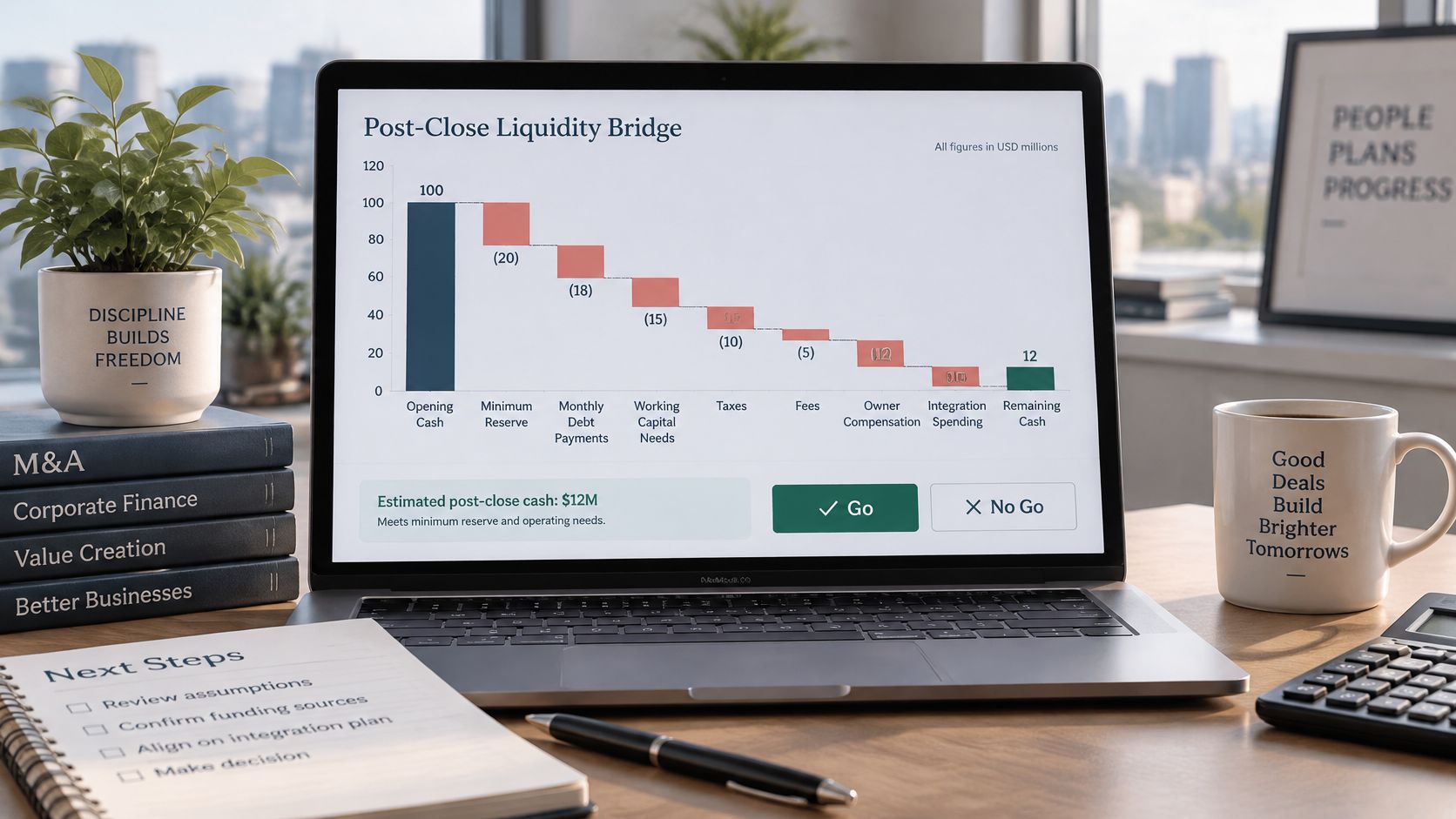
A hypothetical cash bridge
Suppose unrestricted opening cash is $400,000 and your chosen minimum reserve is $150,000. That leaves $250,000 of cash headroom, meaning cash available above the reserve.
In this hypothetical example, debt service of $32,000 monthly for three months consumes $96,000. Integration spending of $90,000, split equally across the second and third months, leaves $64,000 of headroom.
Remaining headroom = opening cash − minimum reserve − net cash outflows
That simplified example assumes other operating cash movements net to zero and includes no synergy receipts. It therefore illustrates a no-synergy bridge, but it isn't a complete cash forecast: slower collections, inventory purchases, or tax payments could eliminate the remaining cushion.
Use a detailed review of acquisition cash-flow requirements to populate those missing movements. Track cash and available committed borrowing separately so an undrawn facility doesn't get mistaken for money already in the bank.
Make the signing decision explicit
Before committing, complete these checks:
- Classify adjustments as transaction accounting, earnings normalization, or operating improvements.
- Document execution with a driver, cost, owner, and start date for each synergy.
- Assign accountability through evidence and revision triggers for material assumptions.
- Confirm affordability using the stressed price, debt load, minimum cash balance, and covenant headroom.
Sign only when the downside preserves your reserve, the base case meets the actual financing requirements, and the no-synergy case supports debt payments. Otherwise, change the terms or decline the deal.
Treat the seller's model as a starting point to challenge. The most useful pro forma isn't the one with the highest earnings. It's the one that tells you what must be true, who must deliver it, and how much cash remains if they don't.
Dealmaker Wealth Society offers acquisition training, deal-analysis tools, and coaching to help you challenge assumptions before committing capital. Our students receive real-time feedback on their own deals, and Dealmaker Academy members can run customer verification on real targets with the coaching team. Visit Dealmaker Wealth Society to explore support for evaluating your acquisition's financing, operating assumptions, and post-close cash needs.

From the Dealmaker Blog












A Creative Business Buying Fable