Buying a Business with a Partner: Equity, Roles and Deals
Buying a Business with a Partner: Equity, Roles and Deals

You've found a business you could see yourself running, but the cash requirement feels uncomfortable and you've never managed an acquisition. A friend offers to join you. You start discussing an equal split before deciding who'll leave their job, sign the guarantees, or handle payroll when customers pay late.
Buying a business with a partner means negotiating separate arrangements for ownership, control, compensation, and personal liability. Test those arrangements before you submit an offer, while you can still walk away without abandoning a deal you've become attached to.
Table of Contents
- Decide Whether a Partner Solves a Real Bottleneck
- Deal Structures Compared Side by Side
- How to Vet a Partner Before Any Offer
- Agreements to Sign Before the Letter of Intent
- Financing and Guarantee Stress Tests
- Confirm the Terms Before You Make an Offer
- Running the Partnership After Closing
Decide Whether a Partner Solves a Real Bottleneck
Name the constraint first. Do you need cash for the equity injection, an experienced operator, stronger lender credibility, or someone available to lead the company after closing? A useful partner removes a specific obstacle, not just the discomfort of buying alone.
The ownership structure itself is well established: the U.S. Census Bureau's partnership research defines partnerships as businesses where people operate together and share revenue and losses, and found they averaged approximately five owners during 2007–2015.
Acquisition-rate evidence provides context, but it doesn't identify the right partner for your deal.
| Evidence | What it tells a prospective buyer |
|---|---|
| Partnered search funds had a 58% acquisition rate, compared with 43% for solo funds, in Stanford Graduate School of Business data summarized by EBIT Community. | Partnered teams can complete acquisitions, but the comparison doesn't prove that adding any partner improves your prospects. |
| 73% of international search funds that concluded their searches acquired a company as of 2025, according to IESE Business School. | Acquisition outcomes belong to defined buyer populations, not every informal buying partnership. |
Within our own activity, over 60% of deals closed in 2024 were partnerships. That's evidence of how our buyers structure deals, not a reason to surrender equity unnecessarily.
Use a structured process for analyzing potential business partnerships before discussing percentages. Include what you lose: independent decisions, undivided returns, and the freedom to choose your own risk level.
Decision rule: Partner when a named person removes a named constraint. If the main benefit is reassurance or a larger shopping budget, buy solo or wait.
Write the sentence now: the acquisition requires a particular capability or resource, and this person can supply it.
Deal Structures Compared Side by Side
Partner deal structures compared
| Structure | Who Holds Control | Typical Capital Split | Best Fit | Main Risk |
|---|---|---|---|---|
| Equal co-buy | Shared, with a defined tie-breaker | Equal contributions if agreed | Operators bringing similar skills and cash | Deadlock without a decision rule |
| Operator-led with capital partner | Operator holds majority voting authority | Contributions negotiated separately from voting rights | Operator has skills, partner supplies cash | Passive partner expects early distributions |
| Operator with vesting equity | Lead owner controls reserved decisions while partner earns equity | Labor partner earns equity against agreed milestones | Partner brings operating labor, not cash | Vesting disputed when effort drops |
| Preferred return to capital partner | Operator or shared under the agreement | Capital partner receives an agreed priority return before residual profits split | Cash-heavy partner alongside an operator with thin savings | Early cash flow goes toward the preferred return |
| Seller note with partner equity | Final voting agreement sets control | Partner equity funds part of the equity injection | Lender-backed deal using seller financing | Guarantees and seller-note obligations overlap |
These are design options, not standard market terms. Capital contribution, voting power, and profit participation don't have to use the same proportions.
Buyers have reason to examine their purchasing capacity carefully. The BizBuySell fourth-quarter insight report states that the median small-business sale price rose 2% to $350,000 in 2025, while median cash flow rose 3% to $158,950. Neither figure tells you whether a particular target can support its acquisition debt or your household expenses.
Compare the same business under different agreements
Build a spreadsheet with identical purchase price, debt service, operator salary, reserves, and exit assumptions. Change only the partner arrangements. Otherwise, you'll mistake a more optimistic forecast for a better structure.
Under an equal co-buy, residual distributions follow the agreed equal split. But if every hire requires joint consent, an ordinary staffing decision can become a negotiation. Equal owners can still delegate routine hiring to the operator and reserve senior appointments for joint approval.
Under an operator-led structure, the operator approves budgeted spending within agreed limits. The capital partner receives reporting and consent rights over reserved matters, such as new borrowing or a sale. This protects the investor without requiring them to manage the company.
Salary pays for work; distributions compensate ownership. Deduct a realistic operator salary before comparing investor returns. A business that looks attractive only because the operator works unpaid isn't supporting both an investment and a job.
Match incentives to contributions
Vesting makes labor-based equity conditional on continued service or measurable delivery. Specify what happens to unearned equity if the partner leaves.
A preferred return can compensate a cash-heavy partner, but distinguish a priority allocation from a guaranteed payment. Model whether unpaid amounts accumulate and whether lender restrictions prevent distributions.
Seller financing adds another negotiation: repayment timing, security, and lender consent must fit the wider capital structure. Before choosing a row, identify the constraint it removes and the guarantee each person would sign.
How to Vet a Partner Before Any Offer
Start the first serious conversation with money, availability, and responsibilities, not friendship. You're testing whether this person can make difficult decisions with you, not whether you enjoy spending time together.
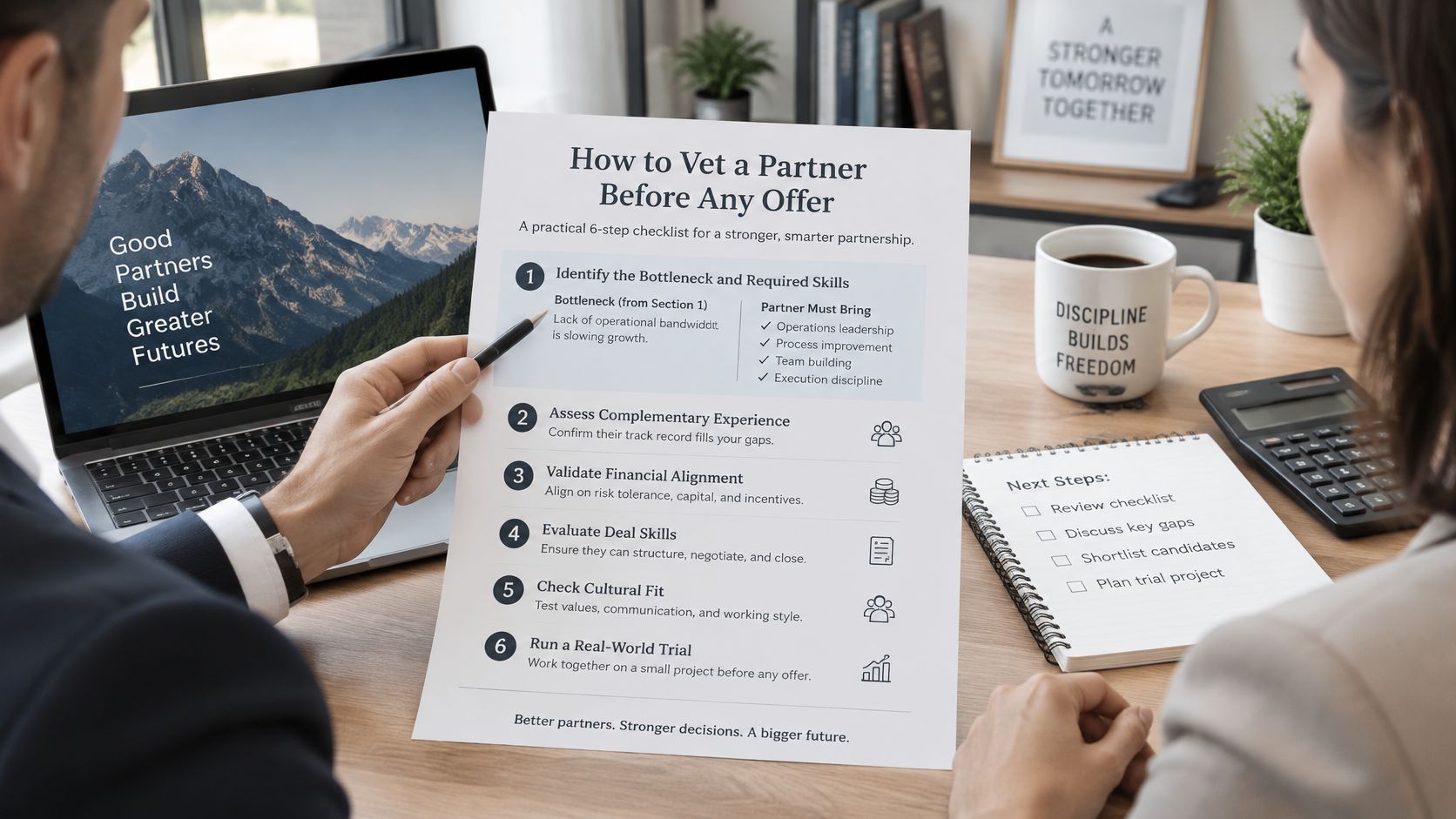
Run a practical vetting sequence
Translate the bottleneck into evidence. If you need operating experience, ask which functions the person has owned: scheduling, purchasing, collections, hiring, or customer retention. A senior title doesn't establish that they can run a smaller company without corporate support.
Put availability on a calendar. Record full-time, part-time, or evening availability in months, including the transition from existing employment. Identify outside restrictions and what happens if a resignation or relocation takes longer than expected.
Compare usable liquidity. Separate cash available for closing from emergency savings, retirement assets, and money contingent on another sale. Ask what each person could contribute after closing without creating a household financial crisis.
Test an uncomfortable decision. Suppose the company can't make its next debt payment without extra cash. Have each partner independently write whether they would contribute funds, suspend distributions, reduce spending, or seek a lender modification, then compare answers.
Check references under pressure. With permission, speak to former business partners, managers, or counterparties. Ask how the candidate handles missed commitments, unwelcome financial information, and disagreements about money.
Complete a shared diligence task. Review the seller's tax returns and reconcile reported revenue to the financial statements. Notice who documents unanswered questions, follows up, and changes their view when the evidence changes.
Verify background and legal history. Have counsel coordinate appropriate, consent-based checks of litigation, insolvency, ownership interests, and conflicts. Resolve material discrepancies before authorizing deposits or shared commitments.
Evaluate behavior, not just answers
Someone may know the correct response to a hypothetical problem and still avoid doing the work. Track whether they meet deadlines, share requested documents, and acknowledge gaps in their knowledge.
Use a shared issue log with an owner, required evidence, and completion date for each item. It's a simple test of how you'll work together when the transaction becomes demanding.
A partner who won't document roles, money, and exit terms before an offer isn't ready to share an acquisition.
Don't treat resistance as something the excitement of closing will fix. Pause the partnership, resolve the issue, and only then decide whether to pursue the target together.
Agreements to Sign Before the Letter of Intent
Before either buyer approaches the seller as a committed team, sign a partner-level arrangement governing confidentiality, acquisition costs, authority to negotiate, and withdrawal. Agree the commercial governance terms early, then have counsel complete the entity-specific operating or shareholders' agreement before closing.
Harvard Business School guidance reports that 65% of startups fail because of founder conflict and recommends a written founders' agreement covering rights, responsibilities, liabilities, and obligations, alongside a preselected independent mediator. An acquisition isn't a startup, but the practical warning applies: goodwill doesn't resolve an undefined obligation.
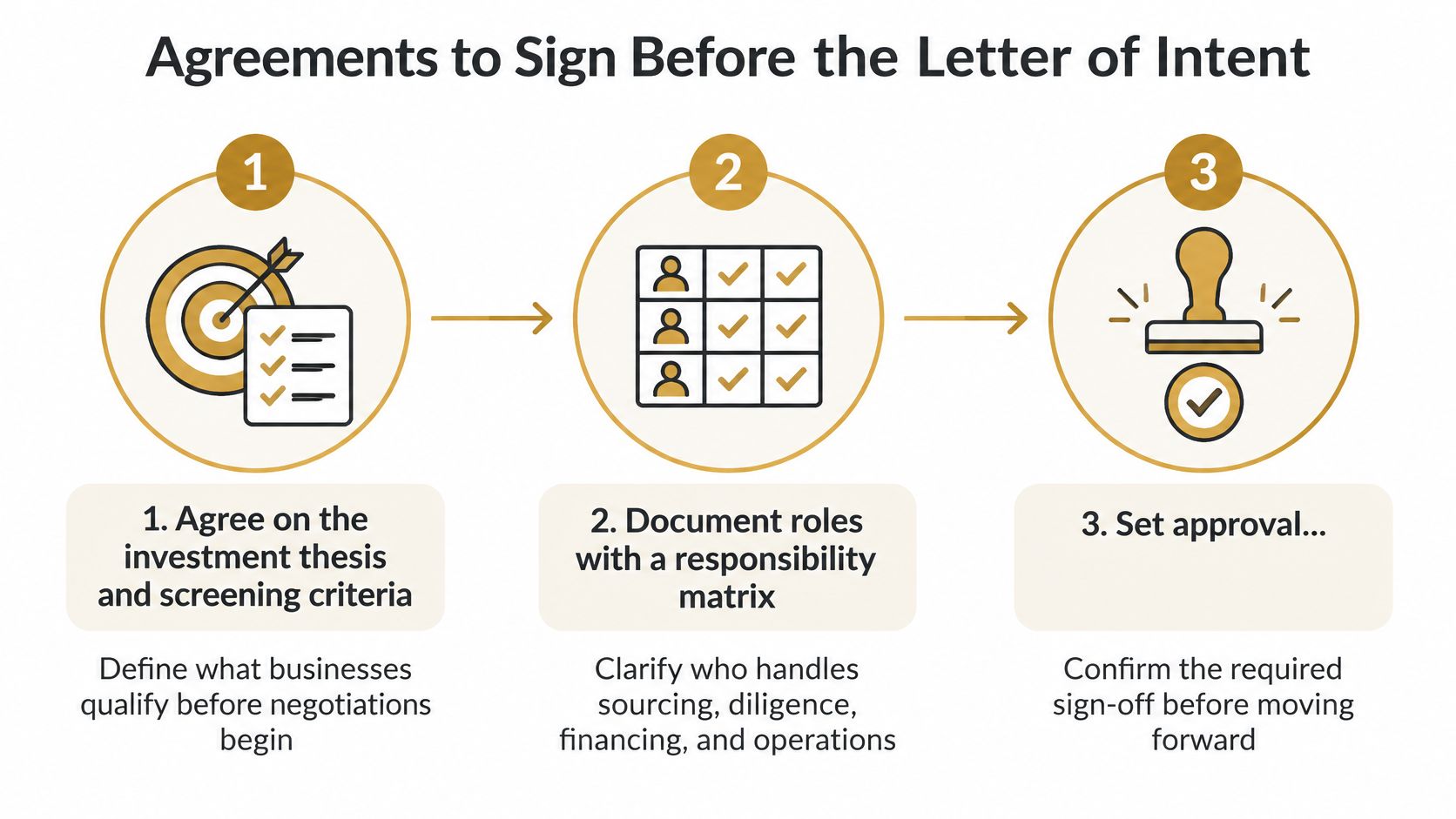
Turn decisions into drafting instructions
Agree the investment thesis. Define acceptable industries, geography, customer concentration, operating demands, and financing constraints. This prevents one partner from pursuing targets the other would never approve.
Assign responsibilities. Use a responsibility matrix for sourcing, financial diligence, financing, legal coordination, and post-close operations. Give every workstream an accountable owner and identify required reviewers.
Set approval thresholds. Separate delegated decisions from reserved matters covering price, debt, hiring, distributions, and further acquisitions. State the approval process and response deadline, not merely a requirement to consult.
Review material risks together. Both partners should understand normalized earnings, customer concentration, tax records, litigation, licenses, employment liabilities, and working-capital needs. Delegating the analysis doesn't remove the need to understand its conclusions.
Prepare independent downside assessments. Each partner should challenge debt-service capacity and required liquidity before reconciling assumptions. Independent preparation exposes differences that a jointly built optimistic forecast can conceal.
Instruct counsel to document the agreement. Resolve the commercial terms before the letter of intent, with definitive ownership documents completed before closing. Don't confuse a discussion summary with enforceable legal drafting.
Make each clause solve a problem
Ownership and vesting establish who earns what. Compensation and distributions distinguish pay for work from returns on capital. Capital-call provisions establish whether additional funding creates a loan, new equity, dilution, or another agreed consequence.
The deadlock clause needs an escalation path, mediator, and ultimate resolution mechanism. A buy-sell procedure also needs a valuation method and credible funding arrangements. A forced bidding mechanism can disadvantage the partner with less liquidity, even when its wording looks symmetrical.
For employment documents supporting the transition, PDFWix's guidance on secure signing practices for HR contracts is a useful process reference. Counsel should separately confirm execution requirements for acquisition and ownership documents.
Our specialty coaches cover capital raising, operations, financial due diligence, M&A legals and contracts, post-acquisition growth, transition and integration, and deal origination. Coaching can help buyers prepare decisions, but your M&A counsel must review the actual obligations before you sign.
Financing and Guarantee Stress Tests
Partner stress scenarios to model before signing
| Scenario | What to Model | Clause to Negotiate |
|---|---|---|
| One partner works full time, the other stays employed | Unpaid labor against salary and time commitment | Compensation paid before profit distributions |
| One partner supplies cash, the other supplies operating labor | Dilution when capital is called later | Capital-call rules and a valuation formula |
| Business misses debt-service coverage | Guarantor exposure and cash left after debt payments | Cure procedure and lender-approved guarantee release terms |
| One partner wants to reinvest, the other wants distributions | Cash available after reserves | Distribution policy with approval thresholds |
| A partner becomes disabled, divorced, bankrupt, or disengaged | Forced-sale risk and who funds the buyout | Buy-sell trigger and buyout price formula |
Financing deserves attention before the offer, not after price negotiations. In BizBuySell's insight report, 78% of surveyed buyers expected to use SBA financing, and 38% of brokers identified SBA funding as the most common financing obstacle; the report also describes 2025 changes generally requiring a 10% equity injection, with qualifying seller financing able to cover only half that injection and potential guarantee requirements for sellers retaining ownership.
Treat those as reported requirements for that period, not a substitute for current lender confirmation. Obtain prequalification for the proposed ownership and financing structure.
Build the complete funding model
Your sources-and-uses schedule should balance purchase price, transaction fees, working capital, and contingency reserves against partner equity, acquisition debt, and seller financing. Identify whether each partner contribution purchases equity or creates a shareholder loan.
For a practical framework, compare equity and debt financing for acquisitions before deciding how much cash each partner must provide. Include seller-note standby, amortization, security, and payment restrictions in the model.
Stress repayment against historical cash flow after realistic operator compensation, maintenance spending, taxes, and working-capital movements. Test customer losses and slower collections separately so you can identify which problem creates the funding shortfall.
Price personal exposure explicitly
Prepare a partner-level waterfall showing cash contributed, compensation, permitted distributions, additional funding, and exit proceeds. Beside it, list each guarantee, its scope, collateral exposure, and conditions for release.
An indemnity between partners doesn't release a guarantor from the lender's contract. If one partner promises to reimburse the other, test whether they would have the resources to do so when the business is struggling.
Liquidity warning: A lower purchase price won't protect you if closing leaves no money for payroll, inventory, or delayed funding.
Retain usable reserves rather than treating every available dollar as acquisition equity.
Confirm the Terms Before You Make an Offer
A committed offer should follow a reconciled partner model, not start the negotiation between buyers. Set aside a working session to compare the draft ownership terms, lender assumptions, and cash-flow model line by line.
For a construction target, for example, use MyOfficeOps to compare construction business valuation multiples while examining the company's earnings quality and operating risks. A valuation reference helps frame price discussions; it doesn't establish affordability or fair partner economics.
Complete the pre-offer checklist
- Ownership: Percentages, vesting conditions, and treatment of unearned equity appear in the draft.
- Guarantees: Each obligation has a named signer, modeled exposure, and documented release requirements.
- Funding: Every equity contribution has an identified source and availability date.
- Disputes: The escalation process, mediator, and buy-sell mechanism are selected.
- Availability: Each partner's time commitment is stated in months.
- Downside: The stressed case covers debt service without relying on hoped-for growth.
- Liquidity: Sources and uses include working capital and delayed-funding reserves.
- Consistency: The partner-level waterfall matches the ownership documents and financing terms.
Don't submit a committed offer until these items are confirmed in writing and lender prequalification is in hand. Have counsel explain which letter-of-intent provisions would bind you even if the acquisition doesn't close.
Stop for any of these red flags: a partner refusing to document money and responsibilities, a guarantee nobody has priced, or a downside case that works only when projections hold. Seller urgency isn't a reason to accept an unresolved obligation.
Running the Partnership After Closing
Closing starts the operating relationship. Put review dates in the agreement and calendar before the handover, with a standing agenda covering cash, responsibilities, decisions, and exceptions.
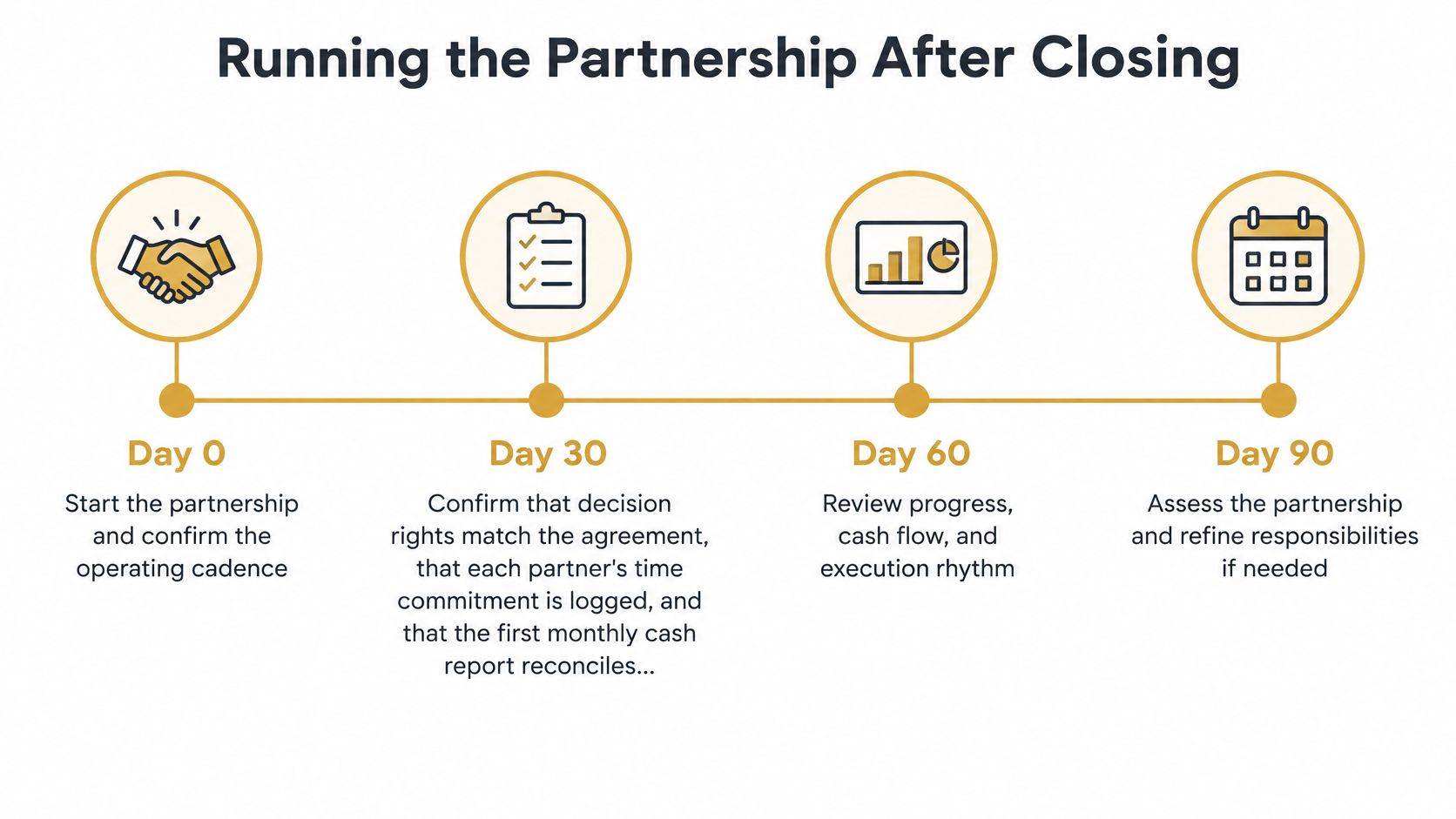
The governance issues discussed in the Milwaukee Business Journal's acquisition roundtable include obligations that don't necessarily track equity ownership. Keep those obligations visible after closing rather than filing the guarantee documents away.
Test the agreement against operating decisions
At the initial monthly review, confirm who made hiring, purchasing, and customer decisions. Compare each partner's logged availability with their commitment and reconcile the cash report with lender covenant calculations. Resolve reporting gaps before debating distributions.
At the following review, examine spending approvals and guarantee exposure. Say the operator proposes another manager whose compensation exceeds the approval threshold, and the capital partner objects. Because the proposed hire reaches the review before an offer is issued, the partners can examine workload, affordability, and alternatives without reversing a payroll commitment.
They might clarify that approval applies to total employment cost, not base salary alone. That's an operational improvement, not necessarily a deadlock. Record the clarification through the agreement's amendment procedure.
At the end of the initial transition period, compare actual performance with the downside model. Decide whether staffing, collections, reserves, or partner responsibilities need adjustment. Use a deliberate process for leadership alignment after acquisitions so employees receive consistent instructions.
Check incentives before pursuing growth
Review whether vesting milestones remain measurable, preferred returns are recorded correctly, and performance equity rewards the intended results. Do not replace contractual terms with informal concessions.
Our approach treats the job after acquisition as scaling from $1 million to $2 million and beyond through better marketing and sales. That's a growth objective, not an automatic outcome or a substitute for maintaining cash discipline.
Partners who hold these reviews can address a missed commitment while it's still manageable. Partners who skip them may discover the disagreement only when a lender, employee, or departing owner forces a decision.
Dealmaker Wealth Society offers acquisition training, mentorship, and peer support covering deal structuring, capital raising, and post-acquisition growth. Visit Dealmaker Wealth Society to explore support for evaluating a buying partner and preparing your ownership, funding, and operating arrangements before you make an offer.

From the Dealmaker Blog












A Creative Business Buying Fable