Business Acquisition Due Diligence: Your 2026 Playbook
Business Acquisition Due Diligence: Your 2026 Playbook
You've found a business that looks attractive on paper. Revenue is steady, the seller's EBITDA appears convincing, and the broker wants an answer before another buyer appears. Then the data room opens and you discover that the largest customer can leave, the owner approves every important decision, the accounting add-backs are generous, and nobody knows who controls the company's critical software accounts.
This is the challenge of business acquisition due diligence. You're not trying to read every document with equal intensity. You're trying to identify the facts that can change your valuation, your transaction structure, your ability to operate on Day 1, or your decision to walk away. A disciplined process balances speed with depth, using an early red-flag screen to decide where specialist time belongs.
Table of Contents
- Introduction to Business Acquisition Due Diligence
- Prioritizing Red Flags in Limited Timelines
- Financial Due Diligence Quality Checks
- Legal and Commercial Due Diligence Steps
- Assessing Operations HR and Technology
- Streamlined Templates and Tools
- Post Close Remediation and Integration
Introduction to Business Acquisition Due Diligence
M&A research has long carried an uncomfortable lesson for buyers. Broader industry literature commonly places transactions that fail to create expected value in the 70% to 90% range, while a widely cited Bain report found that almost 60% of executives attributed deal failure to due diligence that missed critical issues (Bain's global M&A due diligence report). Those figures don't mean every acquisition is doomed. They show why a signed purchase agreement can't substitute for verification.
In a small-business transaction, hidden risk often sits in ordinary places: customer dependence, weak cash conversion, undocumented processes, change-of-control clauses, tax exposure, employee obligations, software access, or intellectual property that belongs to a founder rather than the company. Seller-provided financial statements may describe historical performance, but they don't automatically prove that earnings will survive a change in ownership.
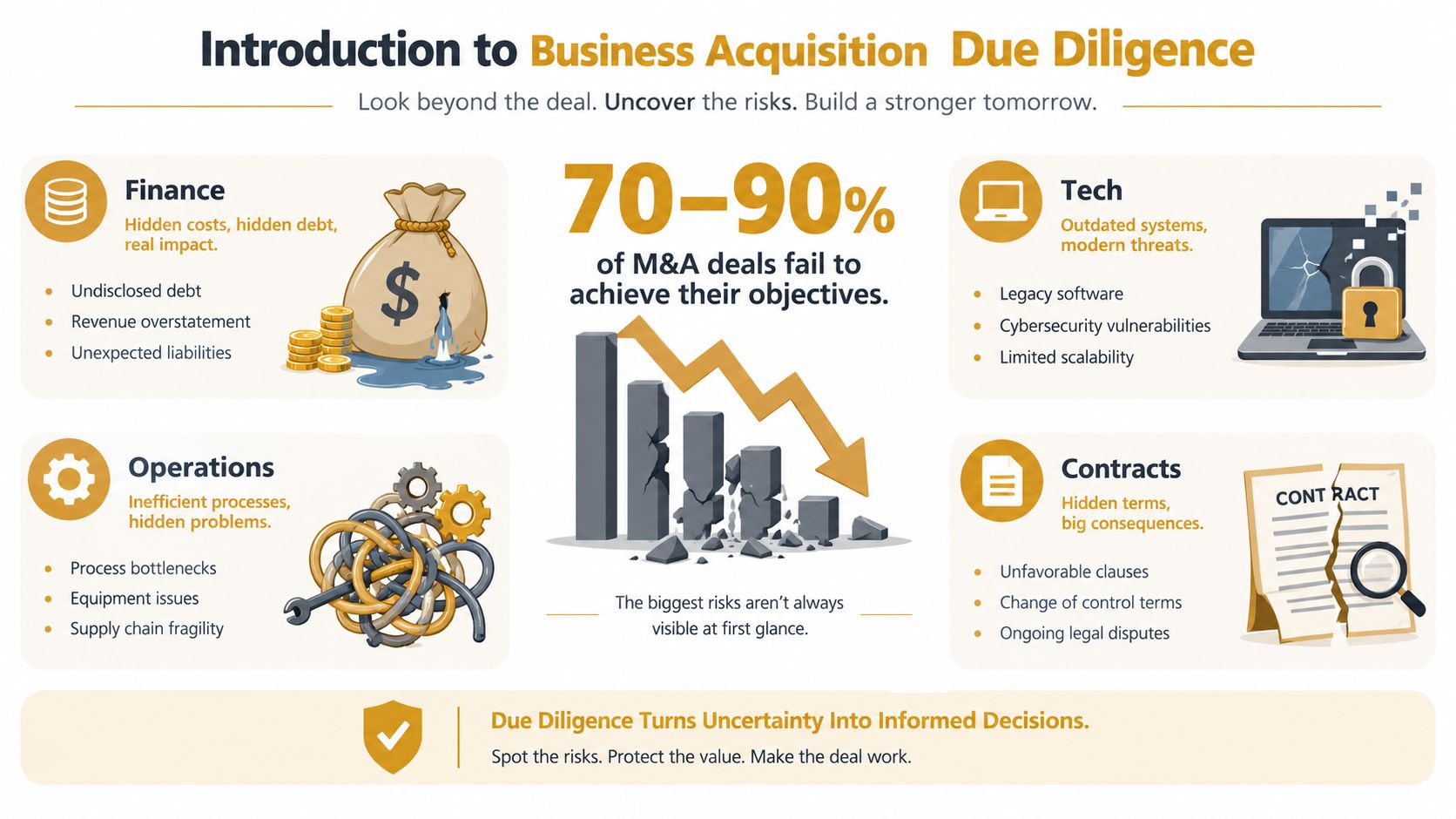
The practical answer isn't an academic review that treats every folder as equally important. It's a prioritized playbook. Start with the risks most capable of killing the deal or changing its economics, then deepen the review only where the evidence justifies it. That approach preserves time without turning diligence into a box-checking exercise.
Practical rule: Every material finding should end in a decision, a price adjustment, a contract protection, a remediation task, or a decision to stop.
Buyers evaluating mergers and acquisitions in Australia will recognize the same discipline across different markets and transaction structures. The legal documents vary, but the buyer's questions remain consistent: What am I buying, what can go wrong, and who bears the risk? For a structured checklist and broader acquisition framework, use this business acquisition due diligence resource.
Prioritizing Red Flags in Limited Timelines
A compressed timeline changes the order of work, not the standard of judgment. The first review should answer whether the target deserves deeper diligence, not whether you've completed every possible inquiry.
Begin by assembling a short list of deal-killer questions. For most SMB acquisitions, that list may include:
- Customer dependence: Can the business withstand the loss or renegotiation of a major account?
- Owner dependence: Does the seller personally control sales, pricing, delivery, banking, or key relationships?
- Earnings credibility: Do bank activity, tax filings, general ledger detail, and reported EBITDA tell the same story?
- Debt and liabilities: Are there liens, unpaid taxes, deferred obligations, or commitments that the headline price ignores?
- Transferability: Can the contracts, licenses, software, premises, and intellectual property move to the buyer?
Score each item according to impact, evidence quality, and reversibility. A high-impact risk supported by weak evidence deserves immediate attention. A low-impact issue with a clear fix can wait. Don't let a well-organized lease file distract the team from an unexplained revenue gap or a customer relationship that exists only through the owner.
A useful priority matrix has four outcomes:
| Finding | Evidence standard | Immediate response |
|---|---|---|
| High impact, unclear evidence | Missing records or inconsistent explanations | Escalate and pause valuation reliance |
| High impact, confirmed | Material concentration, liability, or dependency | Reprice, restructure, protect, or walk |
| Lower impact, manageable | Document gap with a credible remedy | Assign an owner and deadline |
| Low impact, immaterial | No meaningful effect on value or operations | Record and move on |
Set exit triggers before the review becomes emotionally expensive. Examples include an inability to verify core earnings, a critical contract that can't transfer, an ownership gap in essential IP, or a liability the seller won't disclose or allocate. The trigger isn't a substitute for professional advice. It's a way to stop sunk-cost thinking from taking over.
A practical benchmark reports that 38% of deals reaching diligence never close, while 62% of closed deals require price adjustments (Fundenza's acquisition due diligence analysis). That makes early screening valuable even when the deal survives. You're not wasting time by finding a problem early. You're buying a stronger negotiating position and avoiding weeks of work on a thesis that no longer holds.
A private investigator may be useful when identity, ownership, undisclosed relationships, or reputational concerns require independent verification. Use external investigation selectively, with a defined question and a lawful scope, rather than treating it as a substitute for financial, legal, or operational diligence.
Financial Due Diligence Quality Checks
Seller-reported EBITDA is a starting hypothesis, not a conclusion. Financial diligence should test whether reported earnings are recurring, whether cash arrives, and whether the business will require a normal level of working capital after closing.
Quality of earnings first
Start with the general ledger, bank statements, tax filings, accounts receivable, accounts payable, and revenue by customer or product. Reconcile the seller's narrative to transaction-level evidence. A claimed add-back deserves support, a clear explanation, and a reason it won't recur under new ownership.
Review revenue recognition with particular care. Ask whether the company records revenue when it earns it, when it invoices it, or when cash arrives. Compare reported sales with collections, credit notes, refunds, deferred revenue, and unusual period-end activity. A business can show attractive revenue while producing weak cash if customers pay slowly or management recognizes sales aggressively.
Working capital requires its own analysis. Examine monthly patterns rather than accepting a single closing snapshot. Receivables may be collected before closing, inventory may be depleted, or payables may be stretched to make the business appear to deliver a stronger balance sheet than it normally carries.
Use the numbers to change the deal
Axial's 2025 Dead Deal analysis attributes 46.6% of failed letters of intent to diligence findings, split between 25.3% from non-quality-of-earnings issues and 21.3% from quality-of-earnings discrepancies (Axial dead deal analysis summary). The practical lesson is simple: financial diligence can kill a deal, but it can also tell you exactly what must change for the deal to work.
Build a bridge from seller EBITDA to buyer-underwritten earnings. Label each adjustment as accepted, rejected, or requiring further evidence. Then connect the result to purchase price, working-capital assumptions, debt capacity, seller financing, earnout terms, or indemnity protection.
| Metric | What to verify |
|---|---|
| Revenue | Customer-level support, timing, returns, credits, and collection history |
| Gross margin | Product or service margin trends, pricing changes, and cost allocation |
| EBITDA adjustments | Evidence for each add-back and whether the cost will recur |
| Accounts receivable | Aging, collectability, concentration, and subsequent receipts |
| Working capital | Normal operating level, seasonality, and closing delivery assumptions |
| Accounts payable | Aged obligations, unpaid vendors, and unusual payment delays |
| Taxes | Consistency between filed returns, books, payroll, and sales activity |
| Debt and commitments | Loans, leases, guarantees, liens, and obligations outside the balance sheet |
| Cash flow | Conversion from earnings, capital requirements, and owner-funded activity |
Use this financial due diligence guide when assigning work across your CPA, finance lead, and operating team. The best review isn't the one with the longest spreadsheet. It's the one that produces a defensible view of recurring earnings and tells counsel which representations and protections need attention.
Legal and Commercial Due Diligence Steps
Legal diligence protects the buyer from acquiring rights that can't be transferred, assets the seller doesn't own, or liabilities that were never reflected in the price. Commercial diligence tests whether the revenue base is durable outside the seller's personal network.
Review ownership and transferability
Request formation documents, governing agreements, ownership records, board materials, licenses, permits, litigation records, insurance information, and lien searches. Then move from collection to interpretation. A contract folder doesn't tell you enough unless you identify termination rights, assignment restrictions, renewal dates, exclusivity, service obligations, pricing commitments, and change-of-control provisions.
Pay particular attention to:
- Customer agreements: Confirm term, renewal, termination, service levels, and assignment requirements.
- Supplier arrangements: Identify single-source exposure, minimum commitments, rebates, and ownership-change restrictions.
- Leases: Review assignment, personal guarantees, rent changes, repair obligations, and permitted use.
- Intellectual property: Verify written assignments from employees and contractors, domain ownership, software licenses, trademarks, and confidentiality controls.
- Corporate records: Reconcile the cap table, ownership documents, approvals, and authority to sell.
- Regulatory matters: Check permits, inspection history, correspondence, claims, and unresolved compliance issues.
- Insurance and litigation: Match coverage to the business's actual risks and investigate pending or threatened claims.
Commercial diligence should challenge the seller's growth assumptions. Interview customers where appropriate, inspect churn and renewal history, test pricing, and distinguish contracted backlog from an informal sales pipeline. A strong market position that depends entirely on the founder's relationships is a key-person problem, not a durable competitive advantage.

Translate findings into protection
Don't leave material findings in a report that nobody uses. Ask counsel whether each issue requires a pre-closing consent, a seller covenant, a specific indemnity, a holdback, a price change, an earnout condition, or a closing condition. The right response depends on whether the risk is measurable, controllable, and likely to survive closing.
A missing contractor IP assignment may require execution before close. A disputed tax position may need specific indemnity language. A customer relationship at risk may justify contingent consideration tied to retention. The purchase agreement should reflect the actual findings, not a generic checklist.
Assessing Operations HR and Technology
A profitable business can still be difficult to own. Operational diligence asks whether the company's processes, people, systems, and vendors can keep working when the founder steps away.
Map the operating dependency chain
Start with the customer journey, from lead generation through delivery, invoicing, support, and renewal. For each stage, identify the person, vendor, system, approval, and physical asset required to complete the work. Mark dependencies that have no documented backup.
A simple dependency map might include:
- Sales: Who owns the relationship, quote approval, pricing authority, and pipeline records?
- Delivery: Which employees, contractors, suppliers, and licenses are essential?
- Billing: Who controls invoicing, collections, payment access, and credit decisions?
- Support: Where are service histories, passwords, tickets, and escalation procedures stored?
- Renewal: Which contracts, reminders, account owners, and performance commitments protect recurring revenue?
Visit the site when physical operations matter. Look for maintenance records, inventory controls, safety practices, production bottlenecks, and informal workarounds. Interview managers separately from the owner. Employees often reveal that a supposedly documented process exists only in someone's memory.
Operating test: Ask, “Could a competent manager run this process next week using the records and access currently available?” If the answer is no, you've found an integration task or a valuation risk.
Audit the people risk
Request the employee roster, compensation records, employment agreements, contractor arrangements, benefit plans, workplace policies, claims history, and any change-of-control obligations. Confirm who is essential, who is replaceable, and who may leave because the transaction changes reporting lines or incentives.
Look for:
- Key-person exposure: The owner handles sales, estimating, approvals, or technical decisions personally.
- Retention risk: Critical employees lack clear roles, transition communication, or documented incentives.
- Classification problems: Contractors perform work like employees without consistent documentation.
- Unfunded obligations: Accrued leave, bonuses, benefits, severance, or other commitments aren't reflected in the model.
- Capability gaps: The company lacks managers who can absorb the founder's responsibilities.
Don't assume an employment agreement solves dependency. A signed agreement may help legally, but the buyer still needs a transition plan, knowledge transfer, and realistic retention strategy.
Treat technology as an ownership question
Technology diligence now deserves focused attention even in businesses that don't sell software. In a 2026 survey, 47% of M&A buyers said technology diligence was their top priority, and 51% found it the most burdensome part of the review (SRS Acquiom's 2026 M&A due diligence study). Buyers are testing whether systems can support ownership, integration, security, and continuity, not merely whether employees can log in today.
Request a system inventory and verify it against actual use. Identify accounting, payroll, CRM, inventory, communications, hosting, backup, cybersecurity, and payment systems. For each system, record the owner, administrator, renewal terms, data location, integrations, export capability, vendor dependence, and recovery process.
Check access directly. The seller should be able to demonstrate administrative control, recovery options, privileged accounts, evidence retention, and the ability to transfer or recreate access after closing. Seller assurances don't prove that backups work or that the company owns the data.
For software or IP-heavy companies, inspect contractor assignments, open-source usage, third-party licenses, code repositories, domain registrations, and security incident history. A single missing assignment can undermine ownership of a core asset. An unreported breach can create legal exposure and customer trust problems long after closing.
Test Day 1 continuity
Create a Day 1 access checklist before signing. It should cover banking permissions, payroll administration, email, domains, cloud platforms, CRM, accounting, payment processors, vendor portals, physical keys, alarm systems, and customer communication channels.
Then run a tabletop exercise. Ask what happens if the owner becomes unavailable at closing, a key employee resigns, the primary software vendor suspends an account, or a supplier refuses to continue. The exercise exposes gaps faster than another generic document request.
Streamlined Templates and Tools
Templates create speed only when they support decisions. A request list that nobody updates becomes administrative clutter, while a short, integrated workbook can keep the buyer, CPA, attorney, and operator working from the same risk register.
Use four connected tools:
- Red-flag screen: A one-page pre-LOI sheet for earnings credibility, customer exposure, owner dependency, liabilities, transferability, and technology access.
- Request tracker: A data-room index showing requested, received, reviewed, follow-up required, and closed.
- Findings register: Each issue gets an owner, severity, evidence reference, proposed response, and deadline.
- Integration dashboard: Converts accepted findings into Day 1, early remediation, and longer-term improvement tasks.
A useful contract review template captures party names, term, renewal, termination, assignment, change of control, exclusivity, pricing, liability, and consent requirements. A financial walkthrough should link every material adjustment to ledger evidence and a clear conclusion.
Tools such as a secure data room, shared spreadsheet, task manager, and video meeting platform are usually enough for an SMB team if someone owns the workflow. Dealmaker Wealth Society provides acquisition education, checklists, templates, and community support that buyers can use alongside their legal and financial advisors.
Avoid template paralysis. Adapt the checklist to the target's transaction structure, industry, systems, and known risks. If a question can't affect price, protection, continuity, or the decision to proceed, it probably shouldn't outrank an unanswered material issue.
Post Close Remediation and Integration
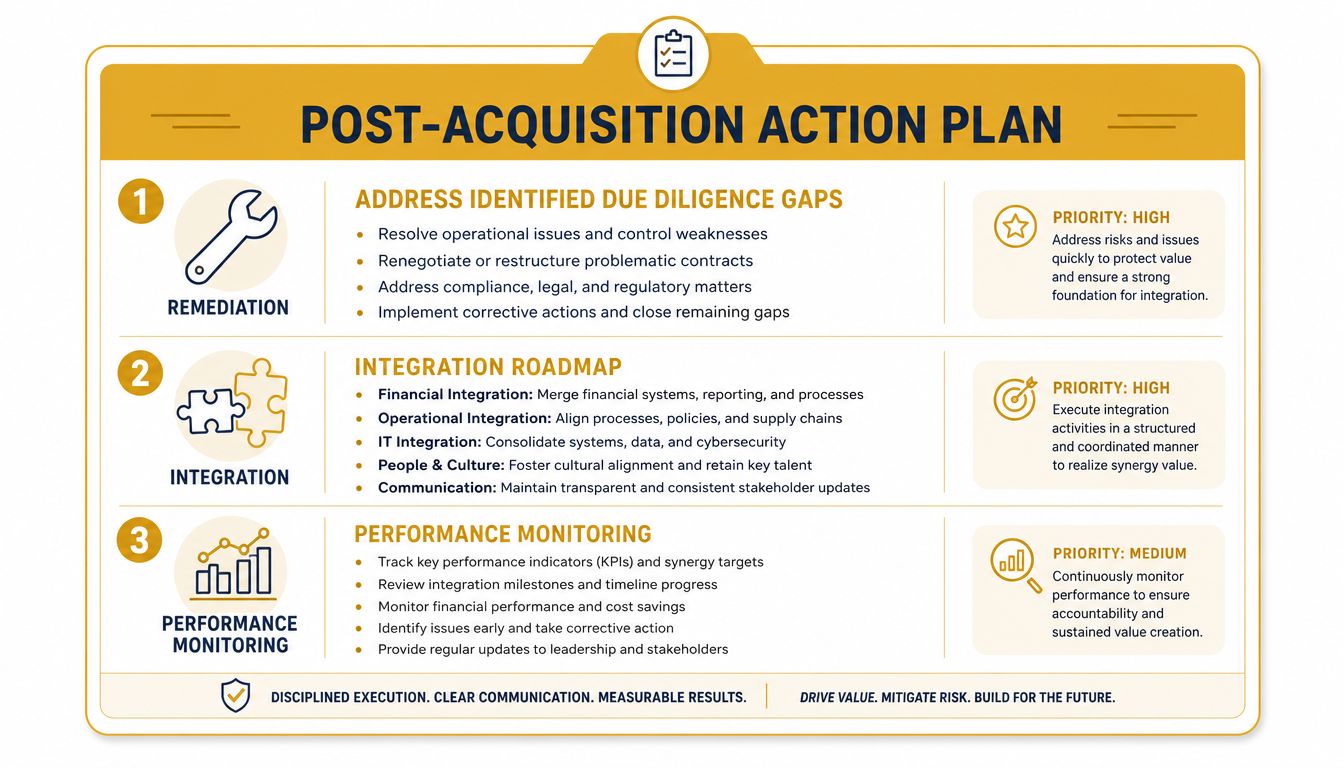
Closing transfers ownership, not operational readiness. Every unresolved diligence finding should already have a post-close owner, a deadline, and a definition of completion.
A practical remediation sequence is:
- Protect continuity: Secure banking, payroll, software administration, customer records, insurance, licenses, and vendor access.
- Fix immediate exposure: Address missing consents, urgent compliance matters, employee obligations, security gaps, and critical contract issues.
- Transfer knowledge: Complete owner handover, customer introductions, process documentation, and management responsibilities.
- Integrate deliberately: Combine systems, reporting, policies, purchasing, and communications without disrupting customer delivery.
- Monitor the thesis: Track the operating indicators that supported the valuation and investigate deviations early.
The connection between diligence and disputes deserves explicit attention. A 2026 survey reported that 46% of respondents identified diligence gaps as the most prevalent factor fueling M&A disputes, an increase of nine percentage points from 2024 (Global Legal Post's survey coverage). Buyers reduce that risk by documenting findings, preserving evidence, matching protections to the issue, and assigning responsibility before the transaction closes.
For a more detailed operating framework, review these integration planning best practices. If the workload is heavy, administrative support such as hiring remote legal assistants can help maintain the request tracker, organize evidence, and prepare follow-up lists, while qualified counsel retains responsibility for legal judgment.
The strongest integration plan is specific. Name the system to migrate, the contract to renegotiate, the employee to retain, the customer to contact, and the metric to review. If a diligence finding matters enough to influence the purchase, it matters enough to manage after closing.
Dealmaker Wealth Society offers acquisition training, due diligence checklists, deal-structuring guidance, mentorship, and peer support for buyers working through small-business acquisitions. Use the platform to turn your diligence findings into a practical offer, closing plan, and post-acquisition action list, then visit Dealmaker Wealth Society to explore the available resources.












A Creative Business Buying Fable