Small Business Purchase Agreement Guide
Small Business Purchase Agreement Guide
You've agreed on a price, shaken hands with the seller, and started imagining your first week as owner. Then the draft arrives. It's packed with defined terms, schedules, indemnities, closing conditions, and exceptions that seem harmless until you ask one practical question: what happens if the business you receive isn't the business you agreed to buy?
A small business purchase agreement answers that question. It converts the commercial bargain into enforceable obligations, allocates risks that diligence can't eliminate, and gives both parties a process for resolving surprises. The strongest agreements don't merely describe the transaction. They protect the cash flow, assets, relationships, and operating continuity that make the acquisition valuable.
Table of Contents
- The Role of the Purchase Agreement in Deal Execution
- Asset Purchase vs Stock Purchase Structures
- Purchase Price Mechanics and Payment Structures
- Representations Warranties and Indemnification
- Closing Conditions and Transition Covenants
- Common Negotiation Points and Red Flags
- Quick Reference Checklist for Acquisition Entrepreneurs
- Glossary of Key Legal and Commercial Terms
The Role of the Purchase Agreement in Deal Execution
A buyer may think the purchase agreement is finished once it states the price and closing date. In practice, those are only the visible parts of the deal. The agreement must also define what transfers, what stays with the seller, which liabilities the buyer accepts, what the seller promises about the business, and what happens when those promises prove inaccurate.
Consider a buyer acquiring a local service company. The headline deal price looks reasonable, but the seller's largest customer contract requires consent before assignment. Several employees have unused compensation obligations. A major piece of equipment is leased rather than owned, and the landlord has not yet approved the lease transfer. None of these issues necessarily kills the transaction. Each one changes the buyer's risk, negotiating position, or cash requirement.
The agreement should turn those uncertainties into specific conditions, schedules, deadlines, and remedies. “The seller will transfer the business” is weak drafting. A stronger provision identifies the equipment, customer contracts, intellectual property, permits, deposits, records, and other assets included in the sale, then lists excluded assets and liabilities with equal care.
Price discovery becomes enforceable
The market context matters because the agreed price usually reflects negotiation, not a theoretical valuation exercise. BizBuySell reported 9,586 closed U.S. small-business transactions worth $7.95 billion in 2025, with sellers receiving an average of 94% of asking price and total enterprise value rising 3% year over year. The same report recorded 2,599 closed deals in Q3 2025, an 8% increase from Q3 2024 and 11% above Q2 2025. Those figures show why the purchase agreement must capture the negotiated gap between asking price, final price, timing, working capital, and payment certainty. BizBuySell's 2025 transaction report provides useful market context, but it doesn't replace deal-specific diligence.
The contract also protects the seller. Clear definitions reduce post-closing disputes, establish when the seller gets paid, and identify the buyer's obligations for assumed contracts and employees. A carefully drafted agreement can preserve business value during the transition, a concern also discussed in this practical resource on how to preserve business value during your exit.
Practical rule: If a commercial point matters enough to negotiate, it matters enough to appear in the agreement or one of its schedules.
The document controls the handoff
The most useful purchase agreements connect legal rights to operating steps. They require payoff letters for secured debt, assignments for transferable contracts, delivery of passwords and records, confirmation of employee treatment, and a clear process for handling customer deposits and accounts receivable.
That connection is what makes the agreement a risk-management instrument rather than administrative paperwork. A buyer shouldn't rely on a seller's general promise to deliver a clean business. The buyer should require defined deliverables, conditions to closing, and post-closing remedies that apply if the delivery is incomplete.
The seller's assurances, the working capital calculation, the escrow arrangement, and the transition covenant should work together. If one element is vague, the buyer may have a legal claim but no practical way to recover the value lost during the transition.
Asset Purchase vs Stock Purchase Structures
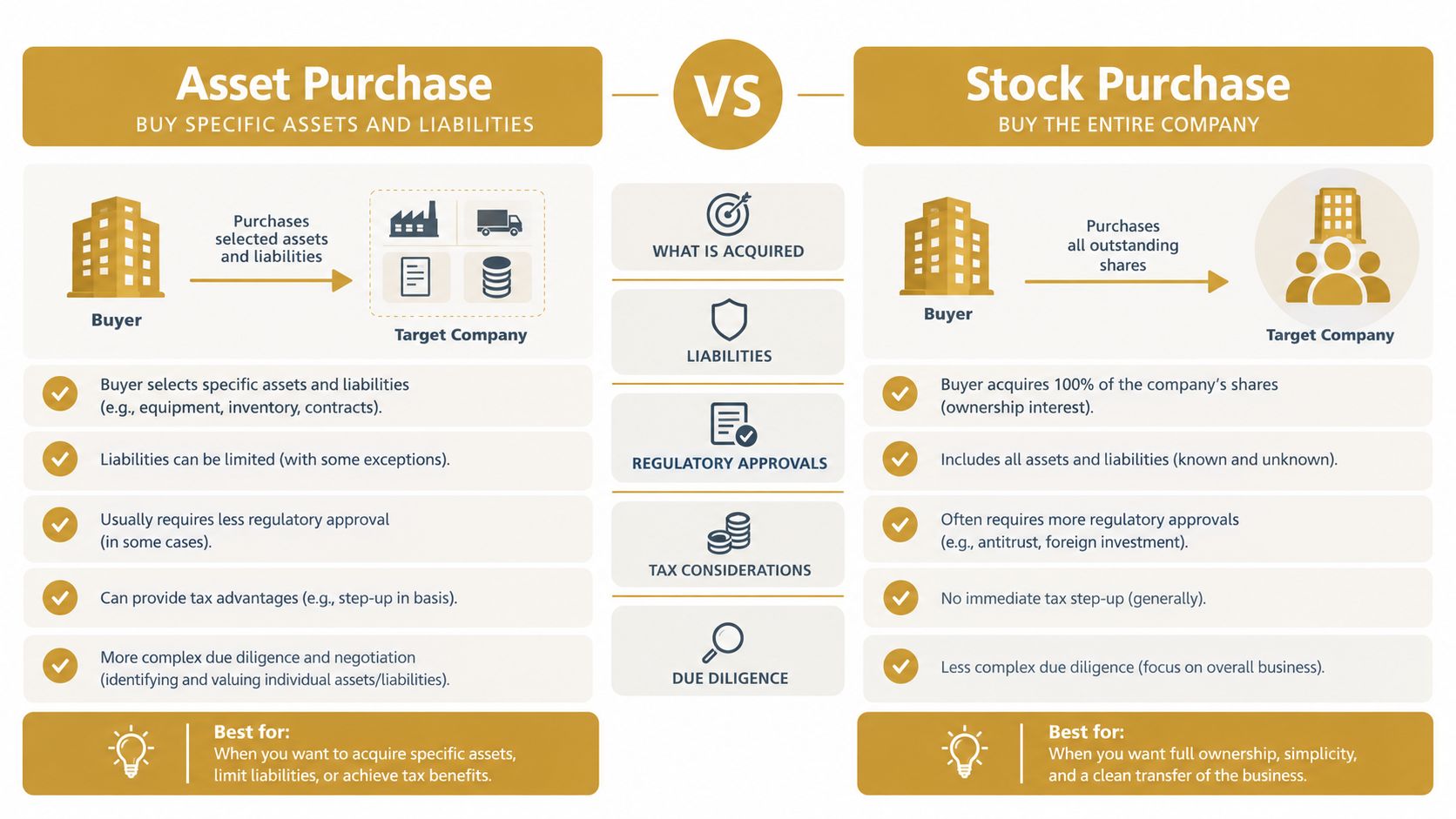
The first structural decision is whether the buyer acquires selected business assets or the ownership interests in the entity that operates the business. That choice affects liability exposure, taxes, contracts, employees, licenses, and the schedules attached to the small business purchase agreement.
An asset purchase transfers identified assets and selected liabilities. The buyer might acquire equipment, inventory, goodwill, trade names, customer records, intellectual property, and assignable contracts, while the seller retains the legal entity and liabilities the agreement excludes. A stock purchase, or an equivalent purchase of membership interests, transfers ownership of the entity itself. The company generally keeps its assets, contracts, permits, employees, and liabilities, including risks the buyer may not have identified.
A widely cited small-business M&A benchmark places approximately 70% of transactions in the asset-purchase category, as discussed in this business purchase agreement guide. That structure is common because buyers can define the perimeter of what they're buying instead of inheriting the company's entire historical balance sheet.
What the buyer gains and gives up
| Issue | Asset purchase | Stock purchase |
|---|---|---|
| Liability perimeter | Buyer assumes only liabilities expressly identified or legally imposed | Entity retains its existing liabilities |
| Asset description | Agreement must specify included and excluded assets | Assets remain inside the acquired entity |
| Contracts and permits | Assignments and third-party consents may be required | Existing contracts may remain with the entity, subject to change-of-control provisions |
| Tax treatment | Allocation among assets can affect buyer and seller outcomes | Tax consequences differ because the ownership interests change |
| Operational continuity | Some licenses, relationships, or contracts may need replacement or consent | The operating entity may continue with fewer transfer steps |
The apparent simplicity of an asset purchase can create more drafting work. The agreement needs detailed schedules for equipment, inventory, intellectual property, contracts, deposits, prepaid items, and excluded assets. It also needs a precise list of assumed liabilities and excluded liabilities. “All ordinary-course liabilities” is often too broad because it can sweep in obligations the buyer never priced.
A stock purchase may preserve continuity, but it also demands deeper diligence into tax history, litigation, employment practices, environmental matters, customer claims, and debt. The buyer is buying the entity's history as well as its operations.
Consents and allocation matter
Buyers often choose an asset deal to reduce historical risk, then discover that valuable contracts can't be assigned without consent. A key customer relationship, software license, lease, permit, or supplier arrangement may become unusable if the agreement ignores transfer restrictions.
Tax allocation deserves the same attention. The parties should agree on how the price is allocated among tangible assets, inventory, goodwill, and other acquired property, then coordinate the agreement with their tax advisers. A buyer should also confirm that the allocation reflects the assets transferred.
For a fuller comparison of the commercial consequences, review this analysis of asset purchase versus stock purchase structures. The right structure isn't the one with fewer pages. It's the one that matches the buyer's risk tolerance, financing, tax position, and need for continuity.
Purchase Price Mechanics and Payment Structures
The purchase price is rarely paid as one unconditional transfer. A buyer may use a deposit, cash at closing, a seller note, an earnout, retained funds, or an adjustment after the closing balance sheet is prepared. Each payment method changes the parties' incentives and the buyer's ability to recover value if the business underperforms or the seller's information was wrong.
Start by separating the headline price from the amount payable at closing. The agreement should state whether the price is cash-free and debt-free, how working capital is measured, how transaction expenses are treated, and whether accounts receivable, inventory, customer deposits, and prepaid expenses are included.
Working capital is operating capacity
A business can meet its valuation assumptions and still arrive at closing starved of cash or inventory. The agreement should establish a target working capital level based on the operating needs underwritten during diligence. It should also explain the accounting principles, sample calculation, dispute process, and deadline for finalizing the post-closing amount.
A purchase-price adjustment protects the buyer when delivered working capital falls below the agreed target. It can also protect the seller when the business delivers more working capital than required. The mechanism only works if the parties define the calculation before closing rather than arguing over accounting interpretation afterward.
The 2025 ABA Private M&A study reported that 90% of deals used post-closing purchase-price adjustments, which illustrates how central this tool has become in deal risk allocation. The same market discussion is summarized in this practical overview of asset purchase agreement mechanics.
Deferred consideration needs control
Seller financing can bridge a valuation gap and keep the seller economically invested in a smooth transition. It also creates an ongoing creditor relationship. The note should address interest, repayment, default, acceleration, subordination, security, and the interaction between payment obligations and indemnity claims.
Earnouts create a different problem. They can let the seller participate in future performance, but ambiguous metrics invite disputes. Define revenue, gross profit, adjusted earnings, customer retention, expenses, accounting policies, permitted business changes, and the buyer's authority to operate after closing. If the buyer can't control the variables that determine the earnout, the seller may argue that the buyer deliberately prevented payment.
A buyer should also decide whether a holdback or escrow is more useful than relying on a lawsuit after the money has left the transaction. For a practical discussion of deferred consideration, see this guide to earnouts in business transactions.
Negotiation insight: A lower price with weak adjustment language can cost more than a higher price tied to the working capital and liabilities actually delivered.
The agreement should state who prepares the closing statement, which records each party receives, how objections work, and whether an independent accountant resolves technical disputes. A short resolution process protects both sides from an open-ended post-closing argument.
Representations Warranties and Indemnification
Representations and warranties are the seller's factual statements about the business. They give the buyer a contractual basis for relying on information supplied during diligence. Indemnification then establishes the financial remedy when those statements are false, incomplete, or breached.
A useful representation package should match the risks uncovered in diligence. Common subjects include:
- Authority and enforceability: The seller has power to sign, and the agreement creates valid obligations.
- Title to assets: The seller owns the transferred assets, subject to disclosed liens or permitted encumbrances.
- Financial information: The financial statements and other operating data were prepared consistently and don't omit material obligations.
- Taxes: Returns were filed, taxes were paid or properly reserved, and no undisclosed tax dispute threatens the business.
- Contracts: Material agreements are valid, disclosed, and not in known default.
- Employees and benefits: Compensation, benefits, worker classifications, and employment claims are accurately described.
- Intellectual property: The business owns or has rights to use its names, content, software, inventions, and customer data.
- Litigation and compliance: Pending claims, investigations, permits, environmental matters, and regulatory violations are disclosed.
Match survival to the risk
Not every representation should remain actionable for the same length of time. General business representations commonly survive for 18 to 24 months, while fundamental representations concerning authority, title, and taxes commonly survive for 3 to 5 years or longer. This distinction is described in the overview of representations, warranties, and indemnification.
The survival period should reflect how quickly a breach can be discovered and how long a claim can remain legally relevant. A payroll error may surface quickly. A tax issue or ownership defect may emerge much later. The agreement should also specify how a claim is noticed, what information must be supplied, and whether the seller gets a reasonable opportunity to cure.
Build a workable remedy
Indemnification negotiations usually involve four connected tools:
- Cap: The maximum aggregate amount the seller must pay for covered claims. Fundamental matters, fraud, intentional misconduct, and specific known risks may receive separate treatment.
- Basket: The threshold a buyer must reach before recovering. A deductible basket reduces recovery by the threshold, while a tipping basket may allow recovery from the first dollar once the threshold is crossed.
- Escrow or holdback: Funds retained or placed with a third party to support payment of valid claims.
- Exclusions: Contract language limiting consequential, punitive, or indirect damages, along with negotiated exceptions.
A broad cap can make a warranty meaningless if the buyer's likely loss exceeds the available recovery. An unlimited obligation can also be commercially unrealistic and prevent a seller from accepting the deal. The right result usually links each cap and exception to the seriousness of the underlying risk.
The buyer should review disclosure schedules line by line. A representation qualified by “except as disclosed” is only as useful as the disclosure. If the seller lists a vague “possible customer disputes,” the buyer should request the facts, documents, financial exposure, and proposed treatment before signing.
Closing Conditions and Transition Covenants
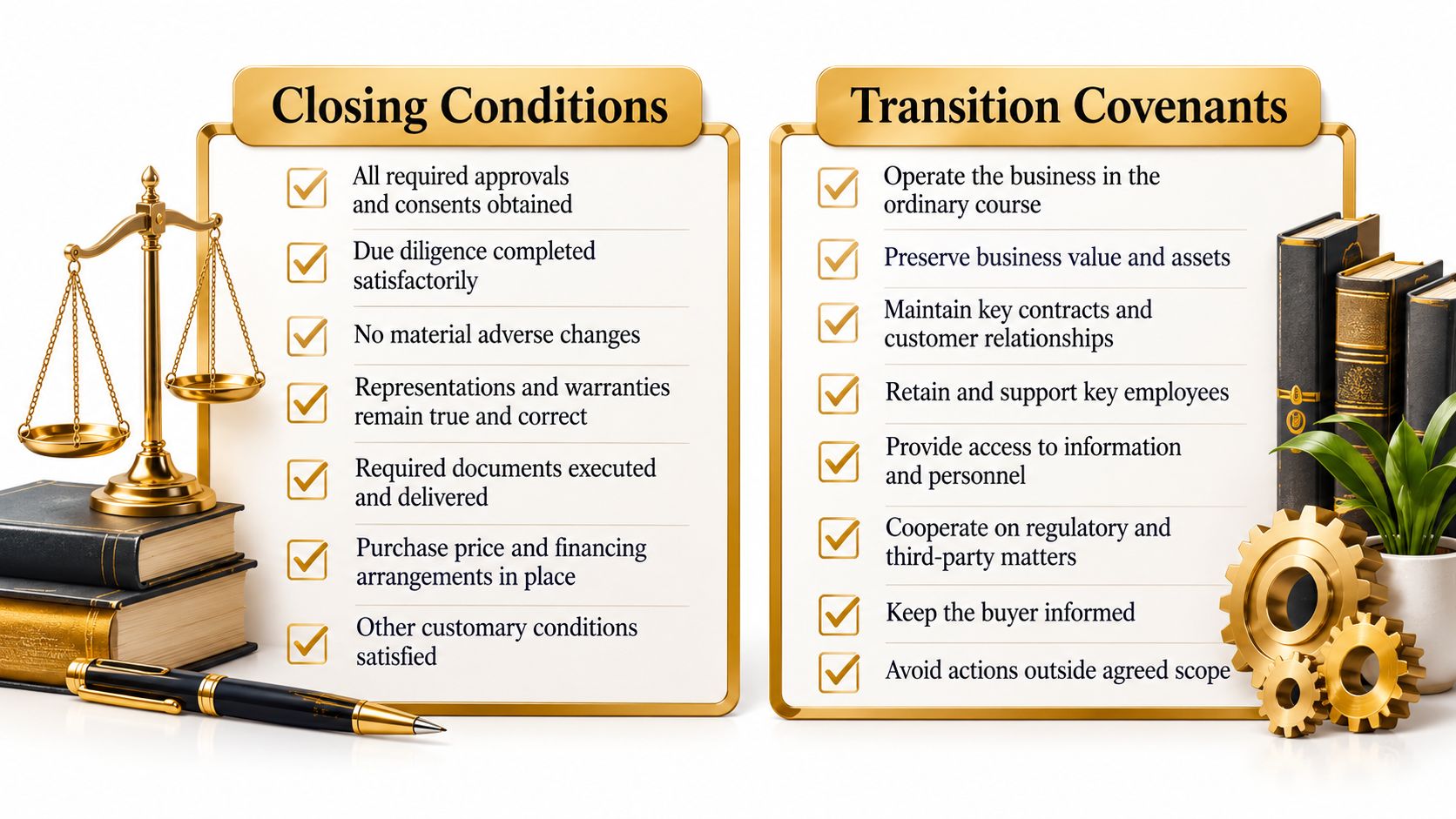
Signing and closing are different events. At signing, the parties commit to complete the transaction if the stated conditions are satisfied. At closing, ownership changes hands and the buyer releases funds. The period between those events creates a risk that the seller changes the business, loses a contract, or fails to obtain a required consent.
Closing conditions give the buyer a right to refuse closing when a defined requirement remains unsatisfied. They may include third-party assignments, lender approval, regulatory consent, payoff letters, lien releases, delivery of records, accuracy of representations, and absence of a prohibited material change.
A condition should be objective enough to administer. “Buyer is satisfied with the business” gives the buyer broad discretion but may create unnecessary conflict. “The landlord has delivered written consent to assignment of the identified lease” gives both parties a clear standard.
Keep the business consistent
Transition covenants govern what the seller can and must do before closing. A seller will typically agree to operate in the ordinary course, maintain insurance, preserve key relationships, keep licenses active, and avoid unusual spending, new debt, major compensation changes, or asset sales without buyer consent.
The buyer should be careful with consent rights. Requiring approval for every ordinary business decision can slow operations and make the seller less willing to pursue the deal. Focus restrictions on actions that could alter value, create liabilities, or frustrate the agreed post-closing plan.
The agreement should also cover transition assistance. Specify whether the seller will introduce the buyer to customers, vendors, employees, lenders, and landlords. Address the duration and scope of assistance, access to records, confidentiality, and whether separate compensation applies.
Connect conditions to remedies
A missed condition doesn't always justify terminating the transaction. The parties can sometimes use a holdback, escrow, delayed closing, special indemnity, or seller note adjustment to manage a remediable issue. For example, a missing lien release may justify withholding funds until the lien is cleared, while a defective customer assignment may require a specific indemnity and a seller obligation to obtain replacement rights.
The agreement should state who bears costs if a consent isn't obtained, whether the parties must seek an alternative arrangement, and when either side may walk away. It should also identify deliverables that must be handed over at closing, including keys, credentials, books, corporate records, domain access, permits, and evidence of debt payoff.
A closing condition prevents the buyer from accepting an unacceptable risk. An escrow or holdback gives the buyer leverage when the risk is acceptable only with a financial backstop.
Common Negotiation Points and Red Flags
The most dangerous language in a purchase agreement often looks reasonable in isolation. A seller may ask for a broad materiality qualifier, a narrow tax representation, a small escrow, and a short claim period. Each request can sound like an effort to keep a modest transaction practical. Together, they may leave the buyer paying for risks the seller controls.
Start with the materiality scrape. A representation may say there is no breach unless the matter is material. A scrape can determine whether materiality qualifiers are ignored when calculating damages, deciding whether a breach occurred, or both. Buyers usually want the qualifier removed for indemnity calculations because several individually modest issues can create a meaningful aggregate loss.
Challenge the exclusions
Review exclusions with the same attention given to the main promises. Common trouble spots include:
- Tax carve-outs: The seller excludes taxes connected to pre-closing periods but defines the period or tax base too narrowly.
- Environmental limitations: The seller provides no meaningful protection despite owned property, chemicals, waste handling, or historical industrial use.
- Employee liabilities: The agreement fails to assign responsibility for wages, bonuses, benefits, leave, classification issues, or claims earned before closing.
- Contract defaults: The seller discloses contracts but not informal side arrangements, verbal promises, or customer termination rights.
- Fraud standards: The agreement defines fraud so narrowly that intentional concealment becomes difficult to pursue.
- Knowledge qualifiers: The seller's statement is limited to what one person knows, even when the business has records that would reveal the problem.
A buyer shouldn't accept “as is” language without understanding what it overrides. It may limit claims based on independent investigation, but it shouldn't automatically erase specific representations, fraud protections, or agreed indemnities.
Protect the customer base
Non-compete and non-solicitation provisions deserve practical drafting. A non-compete that is too broad may be unenforceable or provoke resistance. One that is too narrow may let the seller reopen a competing operation and contact the same customers immediately after closing.
Tie the restriction to the business acquired, the customers and employees directly involved, and the geographic or market scope that protects goodwill. Confirm local law before relying on the provision, particularly where courts limit post-employment restrictions.
The seller may also resist escrow because it delays access to sale proceeds. The buyer should explain that escrow isn't a punishment. It creates a defined source of recovery for claims that may take time to investigate. If the seller refuses escrow, the buyer can consider a seller note, targeted holdback, special indemnity, or a price adjustment, but each substitute has different enforcement risks.
This guide to identifying red flags in business sales can support a broader review. The strongest negotiation isn't the one that wins every clause. It's the one that prevents a known operational risk from being disguised as boilerplate.
Quick Reference Checklist for Acquisition Entrepreneurs
Use the checklist below with transaction counsel, accountants, lenders, and operational advisers. The purpose isn't to replace legal review. It's to make sure the business deal you negotiated appears consistently across the agreement, schedules, exhibits, financing documents, and closing file.
Before drafting
- Confirm the buyer and seller. Identify the legal entities, owners, signing authority, and any acquisition vehicle.
- Write down the commercial deal. Record price, payment mix, deposit treatment, financing, earnout terms, working capital expectations, closing date, and transition obligations.
- Choose the structure. Decide whether the transaction is an asset purchase or stock purchase, then identify the tax and continuity consequences.
- Define the perimeter. Prepare preliminary lists of included assets, excluded assets, assumed liabilities, and excluded liabilities.
- Map third-party dependencies. Identify leases, licenses, customer contracts, supplier agreements, franchises, software, and permits requiring consent.
During diligence and drafting
- Match schedules to reality: Verify that asset lists, contracts, intellectual property, inventory, debt, litigation, employees, and permits are complete.
- Test the financial mechanics: Agree on working capital methodology, inventory treatment, accounts receivable, transaction expenses, purchase-price adjustments, and dispute procedures.
- Review representations: Compare each representation against diligence findings and require specific disclosure of exceptions.
- Allocate historical risk: Assign responsibility for taxes, employee claims, litigation, environmental matters, data issues, debt, and pre-closing operations.
- Set remedy boundaries: Negotiate survival periods, caps, baskets, escrow, holdbacks, fraud exceptions, and claim notice requirements.
- Plan the handoff: List records, passwords, keys, equipment, customer communications, employee notices, vendor introductions, and seller assistance.
Before releasing funds
Obtain signed assignments, lien releases, payoff letters, certificates, approvals, possession of assets, and required third-party consents. Confirm that the seller has complied with interim operating covenants and that the bring-down certificate doesn't reveal a new breach.
Closing discipline: Compare the final agreement against the term sheet and the latest diligence report. Most avoidable surprises come from negotiated points that never made it into the final schedules.
After closing, calendar every surviving obligation. Track escrow release dates, seller-note payments, earnout reporting, transition meetings, insurance renewals, tax filings, customer notifications, and indemnity claim deadlines. A signed contract protects the buyer only when the buyer follows its procedures.
Glossary of Key Legal and Commercial Terms
Asset purchase agreement: A contract under which the buyer acquires specified business assets and assumes specified liabilities. The schedules are central because they define the items that transfer. If a customer database, trade name, or piece of equipment matters to operations, it should be identified clearly rather than left to implication.
Stock purchase: A transaction in which the buyer acquires the seller's ownership interests in the company. The entity continues to own its assets and remain responsible for its liabilities, so the buyer's diligence must examine the company's full history.
Assumed liabilities: Obligations the buyer agrees to take on. The agreement should state them specifically, such as ordinary-course obligations arising after closing under assigned contracts. Broad language can unintentionally transfer old debts or claims.
Excluded liabilities: Obligations retained by the seller or the selling entity. Typical examples can include pre-closing taxes, seller debt, undisclosed litigation, and liabilities arising from the seller's operation before closing. The agreement should address how claims are handled if a creditor contacts the buyer.
Representation and warranty: A contractual statement about a fact or condition. A statement that the seller owns equipment free of undisclosed liens is a representation. If it's inaccurate, the buyer may pursue the remedies established in the indemnification provisions.
Indemnification: The process by which one party compensates the other for specified losses. Indemnification isn't a guarantee against every bad business outcome. It applies to defined breaches, liabilities, or special risks covered by the agreement.
Survival period: The time during which a representation remains actionable after closing. General business statements commonly have shorter negotiated survival than authority, title, or tax matters, because the latter risks can remain hidden longer.
Basket: A threshold that claims must exceed before indemnity becomes payable. A deductible basket reduces the amount recovered by the threshold. A tipping basket can permit recovery from the first dollar once the threshold is crossed.
Indemnity cap: The maximum amount recoverable for covered breaches. Buyers often seek higher or separate limits for fundamental matters, fraud, and specifically identified liabilities.
Escrow: Money held by a third party to satisfy eligible claims or other post-closing obligations. It gives the buyer a recovery source without requiring immediate litigation against the seller's other assets.
Holdback: A portion of the purchase price retained by the buyer for a defined purpose. Unlike general escrow, a holdback may be tied to a particular adjustment, unresolved consent, or post-closing deliverable.
Material adverse effect: A contract-defined change that significantly harms the business or the transaction. The definition usually includes negotiated exclusions and should be tested against the actual risks of the company, not copied mechanically from a larger deal.
Sandbagging: A provision addressing whether the buyer can claim a breach after closing when the buyer knew, or arguably knew, about the issue before closing. The parties should decide whether pre-closing knowledge limits recovery and how that rule interacts with disclosure schedules.
A small business purchase agreement works when its definitions, schedules, payment mechanics, representations, closing conditions, and remedies reinforce one another. Read each clause as part of that system. A precise promise with no remedy is weak, and a strong indemnity with no defined risk may become an expensive argument.
Dealmaker Wealth Society offers acquisition training, negotiation guidance, deal-structure education, templates, and peer support for entrepreneurs buying and scaling small businesses. Visit Dealmaker Wealth Society to explore resources that can help you evaluate terms, prepare for diligence, and negotiate your next purchase agreement with greater confidence.









A Creative Business Buying Fable