
Business Acquisition Process: A Complete Step-by-Step Guide
Business Acquisition Process: A Complete Step-by-Step Guide
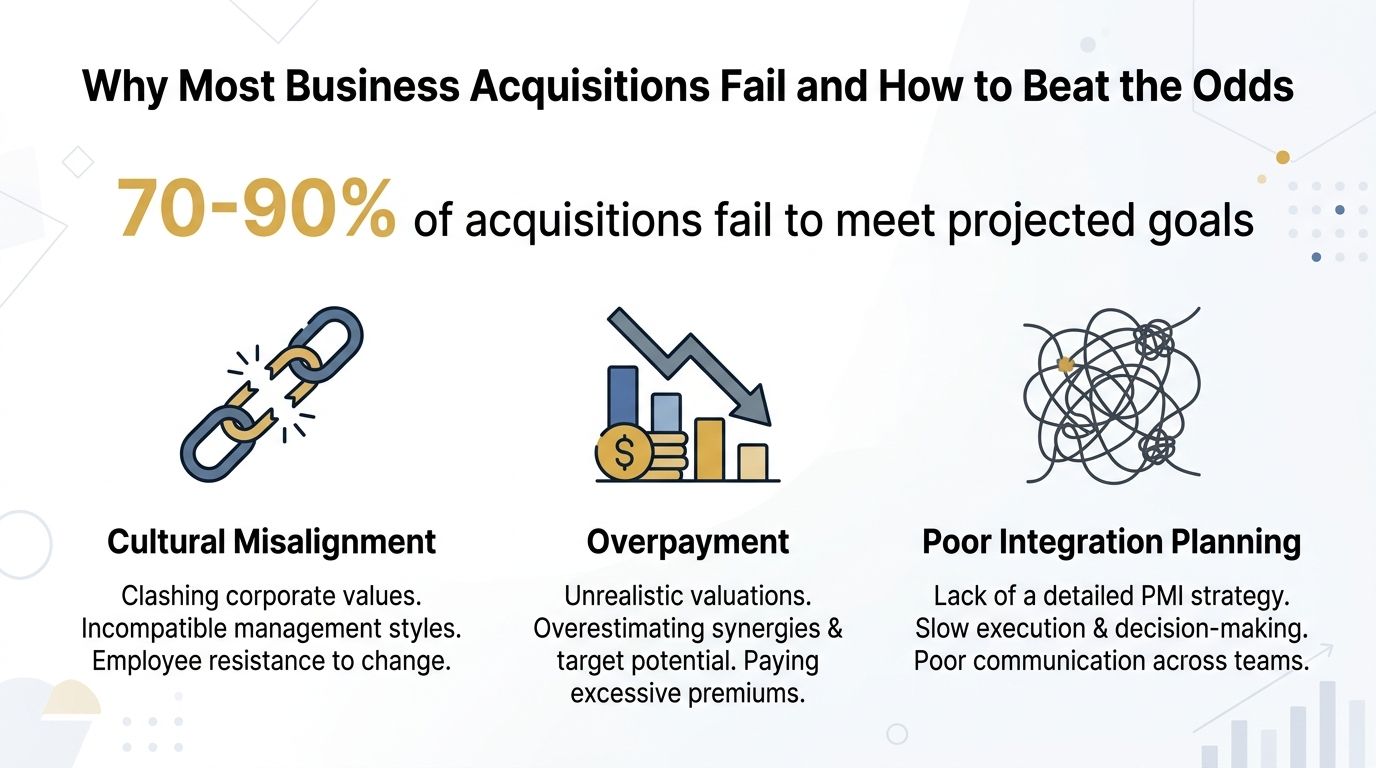
A widely cited benchmark in mergers and acquisitions says 70% to 90% of deals fail to create shareholder value. That warning, discussed in this acquisition-process analysis of diligence failures, changes how a serious buyer should approach the business acquisition process. Finding a seller is only the visible part. The harder work is validating earnings, funding the purchase without starving the company, and taking control without damaging the relationships and systems that made the business valuable.
Table of Contents
- Why Most Business Acquisitions Fail and How to Beat the Odds
- Sourcing and Evaluating Acquisition Targets
- Conducting Due Diligence That Protects Your Investment
- Financing Your Acquisition Without Overpaying or Overleveraging
- Negotiating Terms and Closing the Deal
- Post-Acquisition Integration and Value Creation
- Your Complete Acquisition Roadmap and Timeline
Why Most Business Acquisitions Fail and How to Beat the Odds
The buyer who loses money rarely loses it on signing day. The problem usually begins earlier, when an attractive seller narrative replaces a clear acquisition thesis, projected synergies stand in for tested improvements, or closing is treated as the finish line. Ownership can transfer through a purchase agreement, but the agreement cannot make a weak operation easier to run.
Acquisitions fail because several execution risks arrive together. Buyers may overpay, misread earnings quality, inherit legal or tax exposure, overestimate customer loyalty, or discover that the owner alone understands key processes. Financing can stall when lenders challenge adjusted earnings or working-capital needs. Diligence can miss a change-of-control clause or an undocumented liability. After closing, rushed staff changes or poor handoffs can erode the relationships and knowledge that supported the valuation.
Treat the deal as an operating project
First-time buyers often concentrate on the asking price and offer mechanics. Experienced acquirers manage connected workstreams:
- Sourcing: Find companies that fit a defined strategy instead of reacting to every listing.
- Validation: Test revenue, margins, cash conversion, contracts, people, and liabilities.
- Capital design: Match debt, equity, and seller participation to the target's actual cash flow.
- Integration: Protect customers, employees, suppliers, and operating knowledge after control changes.
Repeat buyers usually perform better because they build procedures for sourcing, diligence, financing, and integration. A first-time buyer who improvises each stage can let small omissions accumulate into expensive surprises.
Practical rule: Ask more than “Can I buy this business?” Ask whether you can finance it, operate it, and improve it under realistic conditions.
Set walk-away conditions before emotional attachment takes hold. Examples include unacceptable owner dependence, add-backs that cannot be verified, weak contract-transfer rights, or a capital structure with no room for working-capital pressure. Each phase of the business acquisition process should produce a decision, not merely another document. That discipline exposes execution gaps while the buyer can still renegotiate or walk away.
Sourcing and Evaluating Acquisition Targets
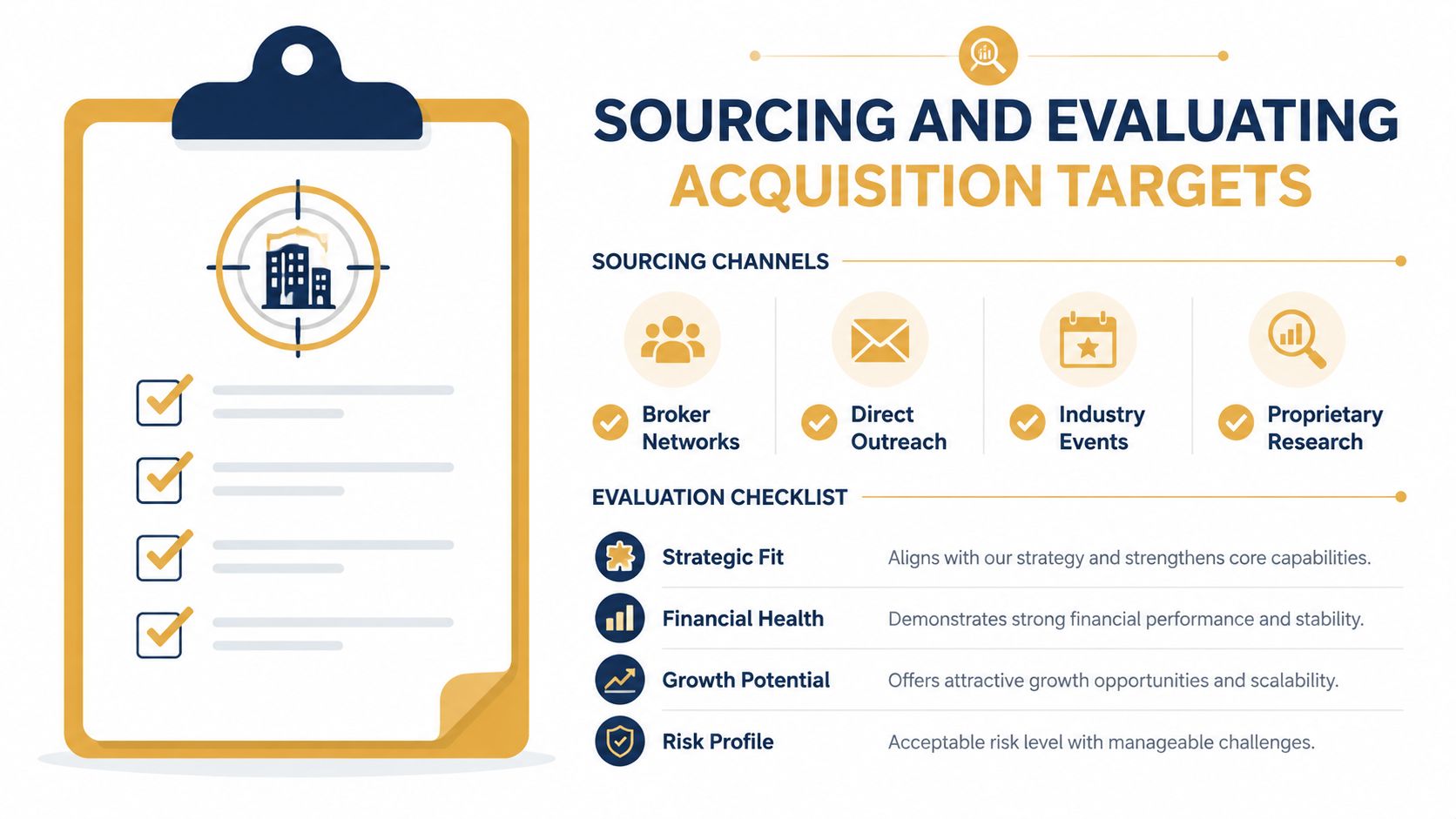
A target profile prevents an acquisition search from becoming a reaction to whatever appears in a broker's inbox. Define the industries you understand, the geography you can serve, the operating role you want after closing, and the capital you can commit without starving the business. Specify acceptable structures too, including an asset purchase, stock purchase, seller note, or blended arrangement. The structure affects taxes, liabilities, financing, and the seller's willingness to transact.
Build deal flow from several sources, then apply the same screen to each. Brokers offer organized opportunities and seller materials. Direct outreach can reach owners who have not started a formal sale process. Industry contacts, advisers, trade events, and proprietary research often provide operating context that a marketing package leaves out. That context can expose owner dependence, customer concentration, or weak systems before those issues consume diligence time.
Screen before you spend
A confidential information memorandum presents the seller's case. Use it to understand the narrative, then test that narrative against operating records before authorizing extensive diligence. The first serious conversation should answer questions that can change valuation, financing, or the decision to proceed:
- Earnings quality: Can the seller reconcile reported profit with tax filings, bank activity, and management accounts?
- Revenue durability: Do customers renew because of contractual value, or because of the owner's personal relationships?
- Customer exposure: Would losing one account materially affect the company's ability to service debt?
- Owner dependency: Who approves pricing, handles key sales, manages suppliers, and resolves operating exceptions?
- Working-capital behavior: Does growth consume cash through inventory and receivables, or does the model fund itself?
- Transferability: Can leases, licenses, customer contracts, software rights, and supplier agreements pass to a new owner?
- Strategic fit: Does the company complement your skills, resources, distribution, or existing operations?
Walk away from poor fits early. Attractive revenue cannot compensate for records that cannot support a financing case. Historical profit also means little if the seller is the only salesperson and has no credible transition plan.
The screening result should be a short investment memo. Record the thesis, risks, unanswered questions, preliminary valuation logic, financing assumptions, and explicit walk-away conditions. This record creates a decision point before attachment and deal fatigue take over. A promising target still fails the screen if its cash flow cannot support the proposed capital structure or if integration depends on knowledge that exists only in the owner's head.
Conducting Due Diligence That Protects Your Investment
Due diligence determines whether the business you are buying matches the business presented by the seller. Deal-analysis summaries estimate that about 31% to 34% of failed M&A transactions collapse because of diligence shortcomings, while roughly one-third of signed letters of intent don't reach closing, according to a review of why M&A deals fall apart.
A serious review commonly takes 60 to 90 days. The buyer must reconcile financial, legal, tax, operational, customer, and personnel information, then convert unresolved issues into price adjustments, protections, or walk-away decisions. Rushing the work moves risk into the post-close period, after the purchase price is paid and the buyer has less negotiating power.
Test the claims that affect value
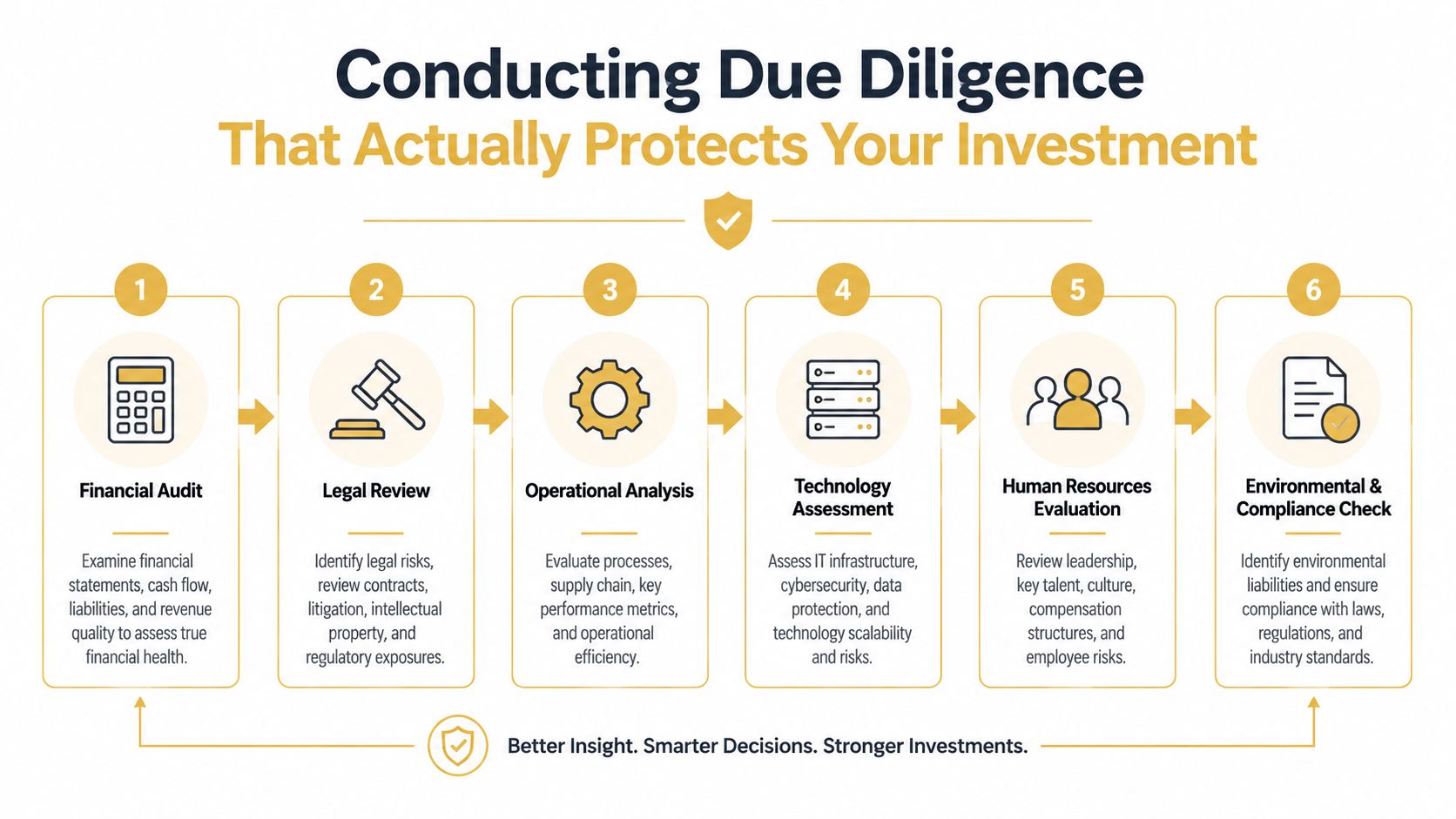
Start with the earnings figure used to support the offer. Rebuild revenue by customer and product, investigate unusual adjustments, compare management accounts with tax returns, and review receivables, payables, inventory, and normalized working capital. Profit that does not turn into cash should produce a different valuation from profit supported by consistent collections.
Legal and tax work should trace obligations that could remain with the buyer. Review ownership records, material contracts, leases, intellectual property, litigation, employment matters, permits, tax filings, and regulatory compliance. Confirm whether important agreements can be assigned, and search for commitments absent from the headline financial statements.
Operational review exposes execution risks that accounting schedules often miss. Examine customer complaints, renewal practices, pricing changes, informal commitments, supplier concentration, termination rights, and cost exposure. Map employee responsibilities, compensation, retention concerns, and undocumented knowledge. Review core systems, access controls, data ownership, cybersecurity practices, and software dependencies. Then document the processes, systems, people, and customer relationships required to operate on day one.
Use this operational due diligence factors checklist with qualified accounting and legal professionals. The checklist matters because post-close integration can fail even when the financial statements are accurate.
For each finding, ask what it will do to cash flow, customer retention, management capacity, and integration. A 2025/2026 dispute survey cited 46% of respondents identifying diligence gaps as the most prevalent factor driving M&A disputes, up nine percentage points from 2024, according to the academic source discussing that survey and post-closing uncertainty, this review of due diligence and legal structures.
Use the following video as a supplementary visual explanation, not as a substitute for professional review.
Financing Your Acquisition Without Overpaying or Overleveraging
Many first-time buyers assume the hard part is finding a target. In practice, capital structure often becomes the bottleneck. A lender may like the business but reject the proposed terms, or approve the purchase only with enough equity and covenants to leave too little cash for payroll, inventory, technology, and growth after closing.
U.S. SBA activity shows how important government-backed debt can be for smaller acquisitions. In FY2025, SBA 7(a) activity reached 78,078 loans and $37.3 billion, while combined SBA 7(a) and 504 lending reached a record $45.1 billion, according to reported acquisition-market financing data. SBA lending can increase borrowing capacity, but eligibility, collateral, repayment, and documentation requirements still determine whether the structure works.
Match the structure to the target
| Financing Type | Typical Terms | Best For | Key Risks |
|---|---|---|---|
| SBA-backed debt | Government-supported loan subject to program and lender requirements | Buyers acquiring eligible small businesses with dependable cash flow | Approval conditions, collateral expectations, personal obligations, and repayment pressure |
| Conventional debt | Bank loan structured around borrower strength and target performance | Buyers with strong financial resources and a lender-ready operating plan | Higher equity demands, tighter underwriting, and less tolerance for uncertainty |
| Seller financing | Seller receives part of the price over time | Bridging a valuation gap and preserving seller involvement | Seller may demand security, control rights, or restrictive covenants |
| Earn-out | Part of consideration depends on agreed future results | Businesses where future performance or customer retention remains uncertain | Disputes over measurement, buyer control, and post-close decisions |
| Vendor rollover or deferred consideration | Seller retains an economic interest or accepts delayed payment | Transactions requiring alignment or additional funding flexibility | Complicated incentives and unclear responsibility for performance |
| Blended capital | Combination of debt, buyer equity, and seller or alternative capital | Acquisitions where no single source can fund the price safely | Intercreditor issues, layered claims, and excessive repayment obligations |
Financing conditions vary by region, business size, and buyer profile. UK SMB data describes 40% of UK SMB deals in 2024 using alternative or mixed financing, up from 25% two years earlier, while a separate 2025 U.S. SMB summary says nearly 60% of transactions in Q1 2025 included non-traditional financing, including earn-outs, seller financing, vendor rollovers, or deferred consideration, as summarized in the UK SMB M&A report.
Build the capital stack around downside cash flow, not the seller's forecast. Test debt service after weaker sales, delayed collections, customer losses, and one-time integration costs. A structure that works only if every assumption holds leaves the buyer exposed before the business has stabilized.
Creative finance should allocate uncertainty fairly, preserve cash after closing, and give the seller a reason to support the transition. It should not justify an inflated price. Review equity and debt financing considerations for acquisitions before choosing the capital stack, then have lenders and advisers model repayment capacity under both expected and adverse conditions.
Negotiating Terms and Closing the Deal
A signed purchase agreement does not remove transaction risk. It decides who carries that risk when forecasts miss, records are incomplete, or a promised asset cannot transfer. The letter of intent should set the commercial framework. The definitive agreement must then specify what changes hands, what the seller guarantees, and what remedies apply when those guarantees prove inaccurate.
Start negotiations with a ranked risk register, not a general wish list. Place deal-breaking findings first. For each remaining issue, decide whether the right remedy is a price change, a representation, an indemnity, escrow, or a closing condition. That discipline keeps the discussion focused and gives the seller clear ways to resolve problems.

Write terms that still protect you after closing
Representations and warranties should cover the facts that support the valuation, including financial statements, taxes, contracts, employees, intellectual property, litigation, regulatory matters, assets, and undisclosed liabilities. Indemnification determines how the buyer recovers when those statements are wrong. Define baskets, caps, survival periods, escrow, and the process for third-party claims with enough precision that the remedy works in practice.
Working capital is a frequent source of post-closing disputes. Set the target level, measurement method, treatment of cash and debt, and true-up procedure before signing. Vague language can leave a buyer with weak collections, depleted inventory, or unusual payables while the seller argues that the closing condition was satisfied.
Several operational terms deserve line-by-line review:
- Transition services: Set the seller's availability, duties, access, response expectations, and compensation.
- Non-compete protections: Match the restriction to applicable law and the actual competitive risk.
- Employee arrangements: Identify retention commitments, key-person agreements, and responsibility for pre-closing obligations.
- Contract consents: Make required landlord, customer, supplier, and licensing approvals closing conditions where appropriate.
- Funds flow: Confirm wire instructions, lien releases, payoff letters, escrow deposits, and ownership documents.
Seller incentives can determine whether the handover works. An owner may accept a lower headline price in exchange for certainty, a clean transition, or a fair opportunity to earn contingent consideration. Buyers should avoid terms that create needless resentment, while keeping protection for risks that diligence has identified.
The closing coordinator owns the final control check. That person should track every condition, collect executed documents, confirm funds, verify releases, and prepare communications for employees, customers, and suppliers. A signature alone does not give the buyer operational control. Access to bank accounts, systems, contracts, records, and decision-makers must be confirmed before the transaction is treated as complete.
Post-Acquisition Integration and Value Creation
Closing transfers ownership. It does not transfer trust, process knowledge, customer loyalty, or employee confidence. Those assets move only when the buyer manages the transition deliberately, with the same discipline applied to financing and diligence.
The first days should favor stability over visible transformation. Tell employees what changes, what will stay the same, who makes decisions, and how customers will be supported. Preserve service levels while mapping workflows, confirming cash controls, and identifying operational risks that were easy to miss before closing.
Build the integration plan during diligence
Owner dependency is one of the most dangerous small-business risks because it often hides behind strong relationships and informal routines. During diligence, document who performs critical tasks, where information lives, which customers expect executive contact, and what decisions the owner makes without a written process. If this work waits until closing, the buyer may discover that the acquired company's value depends on knowledge no system records.
A practical integration plan assigns an owner and deadline to each workstream:
- People: Communicate reporting lines, protect key employees, and address compensation or role uncertainty.
- Customers: Contact important accounts with a continuity message before internal changes disrupt service.
- Systems: Inventory accounting, payroll, CRM, inventory, email, access, and security systems before migrating anything.
- Cash: Confirm bank controls, collection procedures, payment approvals, and the working-capital baseline.
- Operations: Preserve processes that work, then prioritize improvements using evidence rather than instinct.
- Seller transition: Define meetings, introductions, documentation, availability, and the point at which responsibility ends.
Integration should remove friction without interrupting the revenue engine. A buyer who imposes a new technology stack to demonstrate control can create avoidable disruption. The same judgment applies to culture. Listen to managers and frontline employees before replacing practices that look informal but support customers or daily operations.
Use the integration planning best practices guide to organize workstreams and responsibilities. A project-management platform such as Asana, Monday.com, or Microsoft Project can support the plan, provided the team records decisions, assigns accountability, and follows through.
Owner transition test: If the seller disappeared tomorrow, which customer, process, password, or decision would stop the business?
Track indicators that fit the target, including customer retention, service delivery, collections, employee stability, backlog, gross margin, and cash conversion. The dashboard should expose whether the company is stabilizing, drifting, or losing the capabilities that justified the purchase. Review the measures with workstream owners, then connect weak results to a specific corrective action rather than treating reporting as a closing exercise.
Your Complete Acquisition Roadmap and Timeline
A workable roadmap shows what must be true before each commitment. Map the deal from strategy and target screening through valuation, LOI, diligence, financing, definitive documents, closing, and integration. Some phases overlap, but urgency must not erase the evidence needed at each gate.
Use decision gates, not wishful milestones
Before an LOI: Confirm strategic fit, seller credibility, preliminary earnings, likely financing, owner-transition requirements, and a maximum price. If a critical screen fails, walk away before accepting exclusivity.
During diligence: Reconcile financial records, test working capital, review legal and tax exposure, map customer and supplier dependencies, and record integration work. Use verified risk to proceed, renegotiate, or exit.
Before signing: Confirm executable financing, specific purchase-agreement protections, satisfied closing conditions, and a documented funds flow. An optimistic lender conversation is not financing.
After closing: Stabilize customers and employees, secure systems and cash controls, complete the seller transition, and compare operating results with the acquisition thesis. Assign corrective action while evidence remains fresh.
A sample six-month roadmap might allocate the first month to screening, management meetings, and preliminary valuation. The second month can cover the LOI, lender package, and diligence planning. The third and fourth months should expose financial, legal, tax, customer, and operational risks while financing terms develop. The fifth month is for resolving findings, negotiating definitive documents, and confirming closing mechanics. The sixth month covers closing and the first integration priorities. That schedule is a planning model, not permission to rush unresolved issues.
The total timeline depends on target complexity, lender requirements, seller responsiveness, and the number of problems requiring resolution. The strongest roadmap makes uncertainty visible early enough to price it, protect against it, or reject the deal.
Dealmaker Wealth Society offers training, mentorship, playbooks, and peer support for deal sourcing, diligence, financing, negotiation, and post-acquisition growth. Visit Dealmaker Wealth Society for practical resources and support.












A Creative Business Buying Fable
