
Due Diligence Checklist Private Equity: Deal-Level Metrics
Due Diligence Checklist Private Equity: Deal-Level Metrics
The popular advice is to build a longer checklist. That's usually the wrong answer. A private equity team can review thousands of documents, commission multiple reports, and still miss the question that determines returns: what will we do after closing?
A useful due diligence checklist for private equity should connect every material finding to a decision. A customer concentration issue should change the commercial plan and the LBO model. A weak reporting system should become a Day One implementation task. A key-person dependency should affect governance, retention, and succession planning. If a finding doesn't influence price, structure, risk allocation, or the first 100 days, it may be diligence theater rather than investment work.
Modern PE diligence is broader than a historical accounting review. After the 2008–2009 financial crisis, firms expanded their review across commercial, operational, legal, and other risk areas, while commonly examining at least 3 to 5 years of financial statements to separate durable performance from short-term spikes. The evolution and structure of the private equity diligence process explains why exploratory and confirmatory diligence now run across parallel workstreams.
Table of Contents
- Why Most Due Diligence Checklists Miss the Point
- Financial Deep Dive Beyond the Surface Numbers
- Commercial and Operational Reality Check
- LBO Model Inputs and Sensitivity Analysis
- Legal and Governance Structure Decisions
- Staged Diligence Process That Drives Better Outcomes
- Converting Findings Into Your 100-Day Plan
Why Most Due Diligence Checklists Miss the Point
A checklist that only asks what could go wrong produces a risk inventory, not an investment plan. The operating question belongs in the diligence process from the start: which findings should change the purchase decision, the first 100 days, or the value-creation roadmap?
Pricing work illustrates the difference. Review transaction-level price realization, discount authority, customer segments, approval rules, and retention evidence. The objective is to determine whether pricing can improve without damaging demand, identify the systems and managers required, and set a post-close test rather than assume an immediate margin gain.
IT diligence needs the same operating lens. Security gaps matter, but so do system capacity, reporting quality, integration requirements, replacement priorities, and the people who can execute the change. A weak data foundation may not kill the deal, yet it can delay a commercial initiative and should therefore appear in the first 100-day plan.
Recent industry coverage describes a shift toward value-creation-focused diligence. The RealDeals diligence coverage highlights a persistent gap: checklists often specify what to inspect without showing how findings become operating KPIs, execution milestones, or bolt-on validation.
Build the checklist around decisions
Start with the investment thesis, not a generic data request. If returns depend on pricing, request transaction-level realization data, discount authority, churn by customer cohort, and the sales process behind quotes. If the thesis depends on scale, map capacity, labor constraints, bottlenecks, service levels, and required capital. Each request should support a decision or establish a baseline for post-close execution.
A practical finding register should include:
- Observation: What did the team verify?
- Implication: Why does it matter economically or operationally?
- Action: What will change after close?
- Owner: Who is accountable for execution?
- Timing: Does the task belong in the first 30, 60, or 100 days?
- Model effect: Which revenue, margin, cash flow, capex, or debt assumption changes?
Practical rule: Every red flag needs a response, and every value-creation idea needs evidence, an owner, and a sequence.
Keep unproven opportunities out of the base case. Management may say a pricing program can launch immediately, but the diligence team should test customer data, sales leadership, price lists, and change-management capability. Without those foundations, place the initiative in an upside case or post-close diagnostic. Do not pay for it upfront.
A broader business transaction diligence guide can help organize legal and commercial documents. The PE team still must tailor the checklist to the thesis and assign execution responsibility. A tidy data room does not protect returns. Decisions, owners, and dated actions do.
Financial Deep Dive Beyond the Surface Numbers
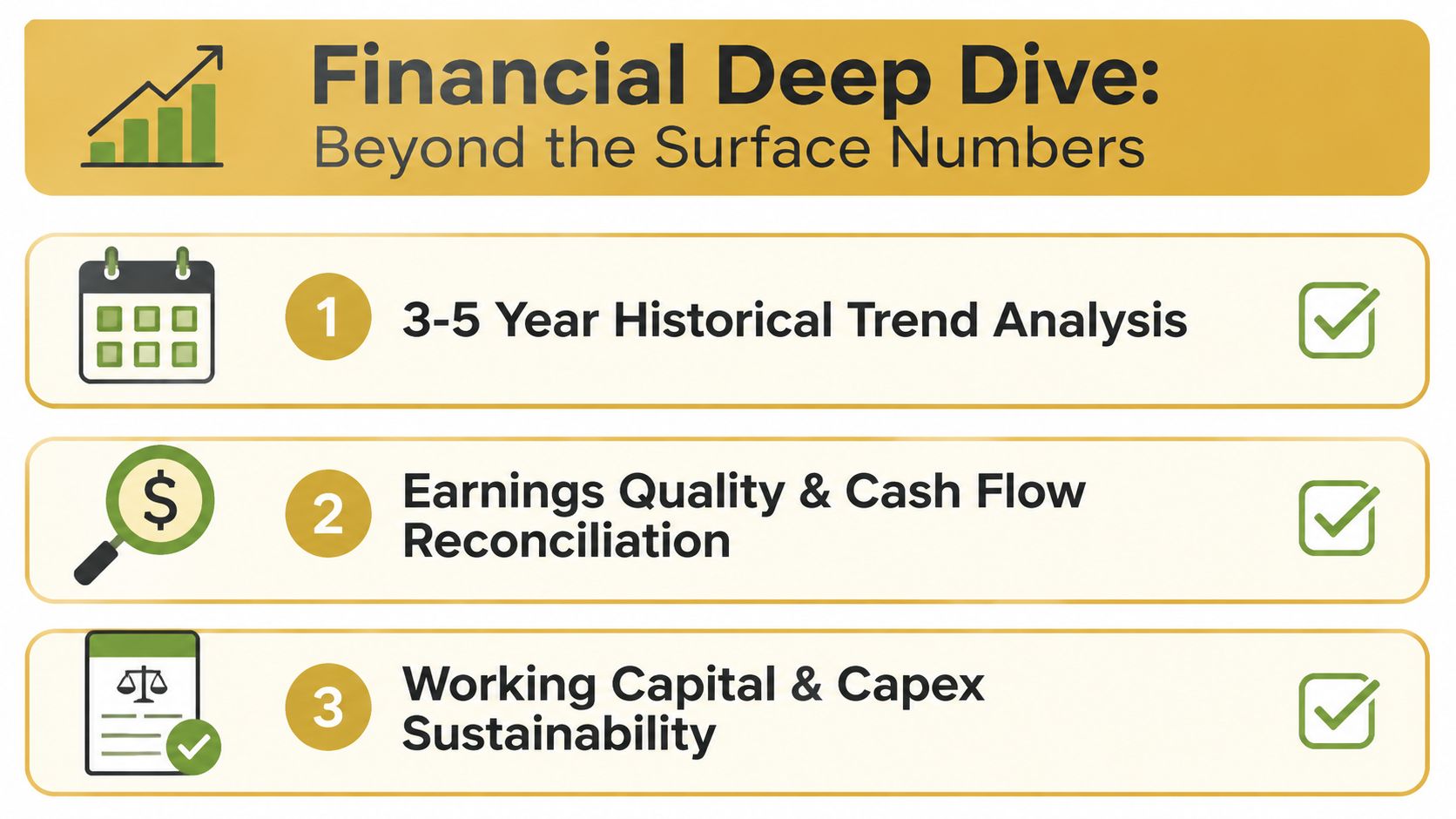
Reported EBITDA starts the inquiry. The conclusion depends on whether earnings reflect repeatable demand, sustainable gross margin, normal working capital, and the cash required to keep operations running. The useful output is a set of assumptions that can guide both the investment case and the first 100 days after close.
Establish the historical pattern
Review at least 3 to 5 years of balance sheets, income statements, and cash flow statements. Use a financial due diligence checklist for business acquisitions to organize source documents, but test each item against the deal thesis. Read the statements as a connected operating history, not isolated annual snapshots. Reconcile revenue growth to customer additions, volume, price, mix, contract terms, and evidence of delivery.
Flag revenue recorded late in a reporting period, unusually large year-end transactions, credits issued after close, and contracts whose recognition policy differs from normal practice. Rising revenue with deteriorating collections can indicate weak commercial terms rather than stronger demand. Stable EBITDA alongside rising working capital can require more debt capacity than headline earnings imply.
Quality of earnings should separate recurring performance from proposed adjustments. Test add-backs against invoices, payroll records, contracts, and the general ledger. One-time expenses may be legitimate. Repeated “one-time” costs, owner-related expenses without a clear normalization basis, and projected savings without an implementation plan deserve skepticism. Every adjustment should have a path into the model and a post-close owner.
Follow cash, working capital, and capital expenditure
Working capital analysis should show how the company funds growth. Review receivables aging, inventory turns, payment terms, customer deposits, accrued liabilities, and the relationship between bookings, billings, revenue, and cash collection. Strong earnings can still consume cash when customers pay slowly, inventory becomes obsolete, or suppliers shorten terms.
Capital expenditure requires the same discipline. Separate maintenance capex, which preserves current operations, from growth capex, which supports added capacity or new capabilities. If the forecast assumes margin expansion while omitting equipment, software, hiring, or facility investment, free cash flow is overstated and the 100-day plan starts with a funding gap.
Convert findings into model adjustments and operating actions. State normalized EBITDA, sustainable cash conversion, working capital needs, capex requirements, debt service capacity, and assumptions that remain unproven. Keep speculative savings outside the base case until management can assign an owner, sequence the work, and produce evidence.
Commercial and Operational Reality Check
Financial statements tell you what happened. Commercial and operational diligence tests whether the company can repeat it without exhausting its people, customers, suppliers, or systems.
Test the commercial engine
Start with customer-level data rather than a polished market narrative. Reconcile the customer list to revenue, gross margin, renewal dates, contract terms, payment behavior, complaints, service usage, and sales ownership. Concentration isn't automatically a deal killer. It becomes dangerous when a large account has weak contractual protection, low switching costs, pricing pressure, or a relationship tied to one executive.
Customer interviews should test behavior, not invite compliments. Ask why the customer chose the company, what problem it solves, where service fails, how alternatives compare, what would trigger a switch, and whether the customer expects to expand or reduce usage. Interview responses should be compared with churn records, support tickets, renewal history, and pricing data.
Market position matters only if it creates a defendable economic outcome. A differentiated product may support pricing, but the team should verify win rates, sales-cycle length, competitor concessions, implementation requirements, and customer willingness to pay. A large addressable market doesn't compensate for an undisciplined sales process or expensive delivery model.
Inspect the operating system
Operational diligence should trace how an order becomes cash. Map quoting, scheduling, procurement, production, fulfillment, billing, collections, and customer support. Identify manual handoffs, duplicate data entry, approval bottlenecks, rework, service failures, and capacity constraints.
Review the supplier base for single points of failure, renegotiation exposure, quality problems, and terms that could change after a transaction. Assess technology for reliability, integration, data ownership, cybersecurity controls, and hidden replacement needs. Don't treat a modern interface as evidence of a scalable architecture.
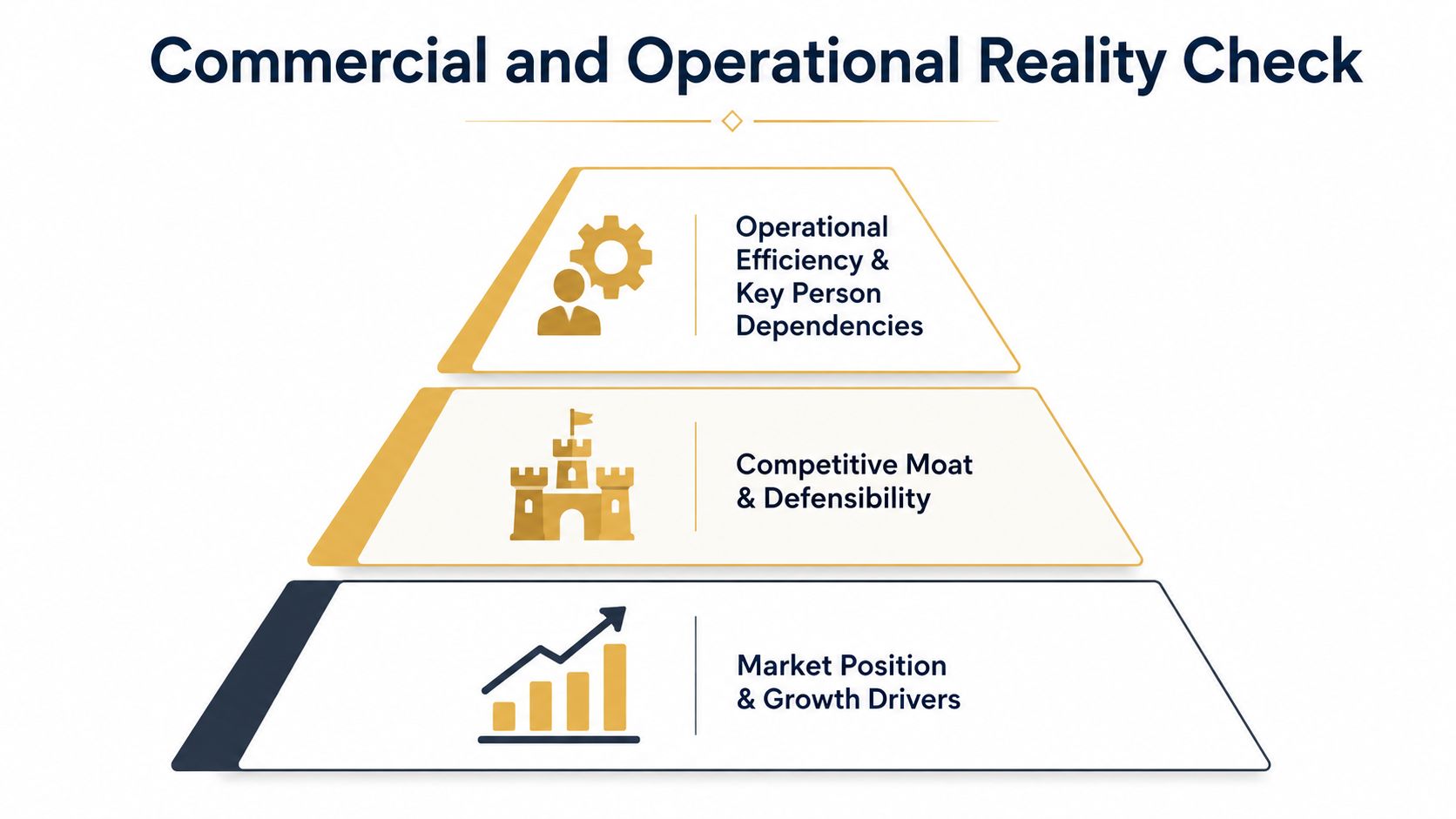
Management depth is an execution variable. Document who owns pricing, forecasting, hiring, customer relationships, compliance, and technology decisions. If one person controls several critical processes, the 100-day plan needs retention, delegation, documentation, and possibly recruitment before it assumes aggressive growth.
The best commercial and operational findings identify a credible lever. That might be pricing governance, route density, procurement savings, automation, service redesign, or a bolt-on opportunity. Validate the lever's prerequisites before underwriting it.
LBO Model Inputs and Sensitivity Analysis
Diligence earns its keep when it changes the LBO model. Qualitative findings should become explicit assumptions, not vague footnotes in the investment committee memo.
Customer concentration is a useful example. If one account represents a material share of revenue, model the effect of delayed renewal, partial volume loss, price pressure, and replacement timing. Don't assume a lost customer disappears with no operational consequence. The downside may include stranded labor, excess inventory, sales costs, and temporary margin compression.
Operational findings should shape the ramp, not just the terminal opportunity. If a pricing initiative requires clean data and a new approval process, delay the benefit until those dependencies are complete. If management has limited bandwidth, reduce the number of simultaneous initiatives or budget for outside support. If maintenance capex is understated, increase cash requirements before determining debt capacity.
Model the finding, then stress the assumption
A practical sensitivity framework includes:
- Base case: Uses only initiatives supported by evidence available before signing.
- Downside case: Tests the most credible adverse outcome, such as customer loss, slower margin improvement, weaker collections, or higher capex.
- Upside case: Includes opportunities that appear achievable but still require execution.
- Break-even case: Identifies the revenue, margin, or cash flow point at which the deal no longer supports the intended return.
| Diligence Finding | Model Input | Sensitivity Range |
|---|---|---|
| Customer concentration with renewal uncertainty | Revenue retention, timing of replacement revenue, collection assumptions | Stable renewal, partial loss, delayed replacement |
| Pricing inconsistency across accounts | Realized price, gross margin, implementation timing | No change, gradual improvement, accelerated improvement |
| Manual operating processes | Margin improvement timing, implementation costs, hiring needs | No benefit, delayed benefit, staged benefit |
| Volatile working capital | Cash conversion, revolver usage, debt paydown | Normal funding need, elevated need, stressed need |
| Key-person dependency | Retention cost, replacement timing, operating plan confidence | Retained leader, interim coverage, delayed execution |
A finding should trigger a model change only when the causal path is clear. For example, weak forecasting may not justify an arbitrary revenue haircut, but it should reduce confidence in the management case and increase the weight given to downside scenarios.
Use financial assessment frameworks for acquisition diligence alongside the model, not after it. The purchase price should reflect the risk-adjusted cash flows, required investment, financing constraints, and the work needed to achieve upside.
Legal and Governance Structure Decisions
Legal diligence becomes valuable when it changes transaction protection or post-close control. A contract review that ends in a report has limited use. The same finding can become a purchase price adjustment, a representation and warranty provision, an indemnity, a holdback, a consent condition, or a Day One governance task.
Change-of-control provisions deserve early attention. A key customer or supplier may have termination rights, consent requirements, pricing rights, or exclusivity provisions that conflict with the investment thesis. Don't wait until final documentation to discover that a commercial lever depends on a contract the buyer can't freely modify.
Match protection to the risk
Use the remedy that fits the exposure:
- Known quantified liability: Consider a purchase price adjustment or a specific indemnity.
- Uncertain but material exposure: Seek targeted indemnification, escrow, or holdback protection.
- Unresolved consent risk: Make the required consent a signing or closing condition.
- Operational compliance gap: Assign an owner, deadline, budget, and reporting metric in the 100-day plan.
- Management retention issue: Pair employment terms with a clear transition and incentive structure.
Litigation should be assessed for financial exposure, operational distraction, reputational effects, and potential limits on the company's ability to execute. The right question isn't only whether the target may lose. It's whether the dispute affects customers, licenses, financing, key employees, or exit readiness.
Employment agreements can reveal non-compete limitations, change-in-control payments, retention concerns, classification issues, and dependence on undocumented relationships. Intellectual property review should verify ownership, assignment language, open-source use, licenses, renewal obligations, and whether the assets central to the thesis will remain with the acquired entity.
Governance findings should produce a control map. Define board reporting, reserved matters, approval thresholds, cash controls, compliance escalation, management incentives, and the cadence for operating reviews. If the buyer intends to pursue bolt-ons, confirm that the legal structure supports acquisitions, integration, financing, and ownership of acquired IP.
The legal report should tell the deal team how to allocate risk, not merely describe where risk exists.
Tax diligence belongs in the same decision chain. Review historical filings, open disputes, transaction structure, tax attributes, and liabilities that could affect cash generation. The output should tell the investment committee what must be priced, protected, cured, or monitored.
Staged Diligence Process That Drives Better Outcomes
Running every diligence workstream at full depth from day one wastes time on targets that should have been rejected early. It also lets urgent red flags disappear under document volume. A staged process links diligence effort to the decisions the deal team must make and the actions management will take after closing.
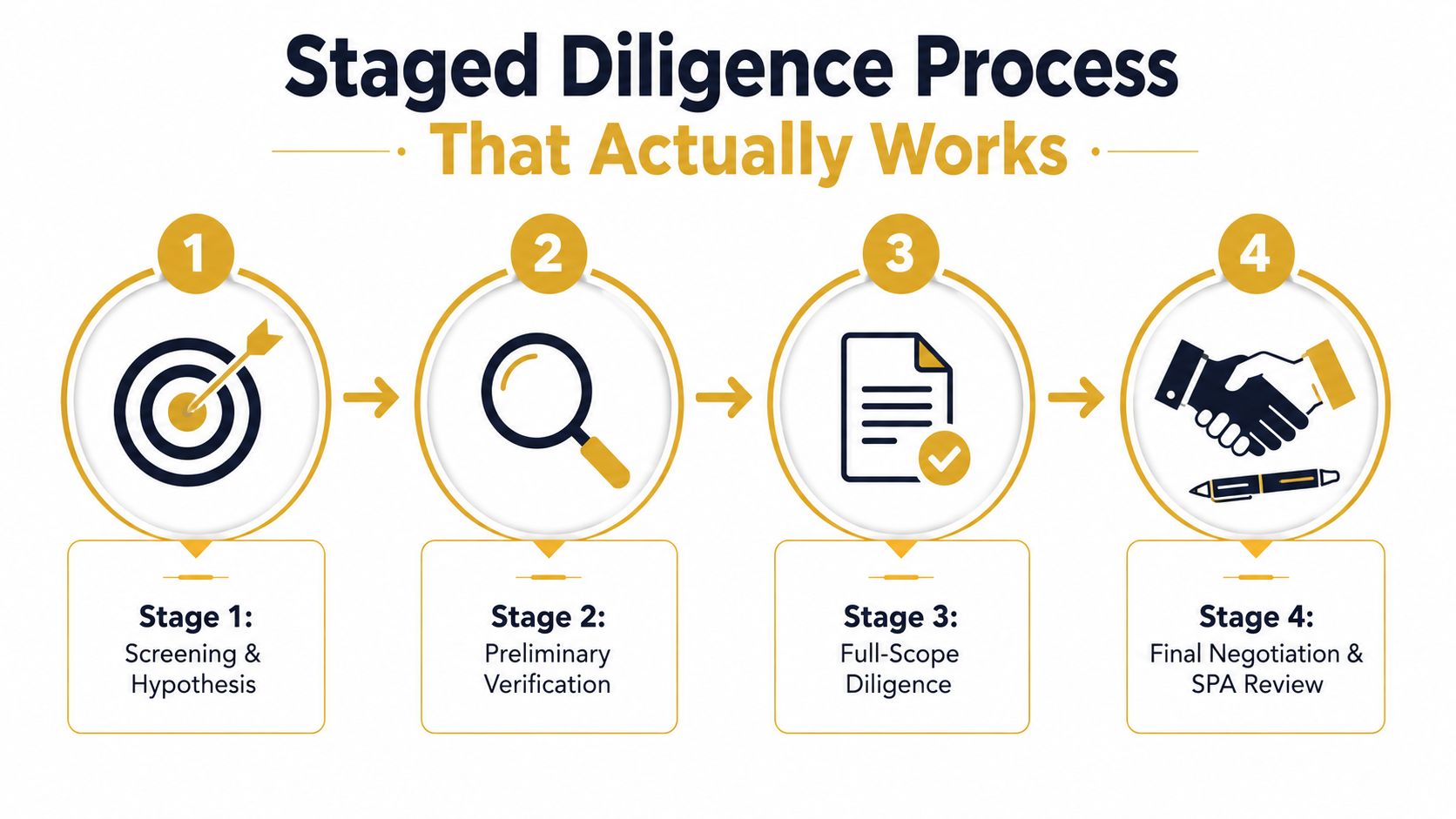
The first stage tests the investment thesis and obvious deal breakers. The second verifies the facts that support price and financing. The third examines surviving risks and value levers. The final stage converts findings into negotiated protections, owners, and an operating plan.
Allocate effort by decision value
Accenture's report notes that PE acquirers typically spend approximately 1% of total deal value on due diligence, equivalent to about $10 million on a $1 billion transaction. Accenture's private equity diligence report puts the scale of that investment in context. The point is not to spend more by default. Direct the budget toward assumptions that could change price, structure, financing, or the first 100 days.
A practical sequence looks like this:
- Screening and hypothesis: Test strategic fit, earnings quality, customer durability, obvious legal barriers, and the central value thesis.
- Preliminary verification: Reconcile headline information with source data. Log gaps that require specialist review or management explanation.
- Full-scope diligence: Run financial, commercial, operational, tax, legal, IT, HR, and other relevant reviews in parallel. Tie each material finding to a potential post-close action.
- Negotiation and SPA review: Convert findings into price changes, conditions, indemnities, covenants, transition requirements, or a walk-away decision.
Use specialists where internal judgment lacks depth, particularly for quality of earnings, cybersecurity, environmental exposure, regulatory issues, and technical operations. Keep one integrated issue log with the finding, evidence, financial or operational impact, proposed response, owner, and timing. That prevents separate advisor reports from pointing in different directions.
The process should accelerate as conviction rises. A thesis-breaking red flag is more valuable than a polished report delivered after emotional commitment has set in. Findings that survive should already have a path into the operating agenda, so diligence produces decisions rather than a stack of reports.
Converting Findings Into Your 100-Day Plan
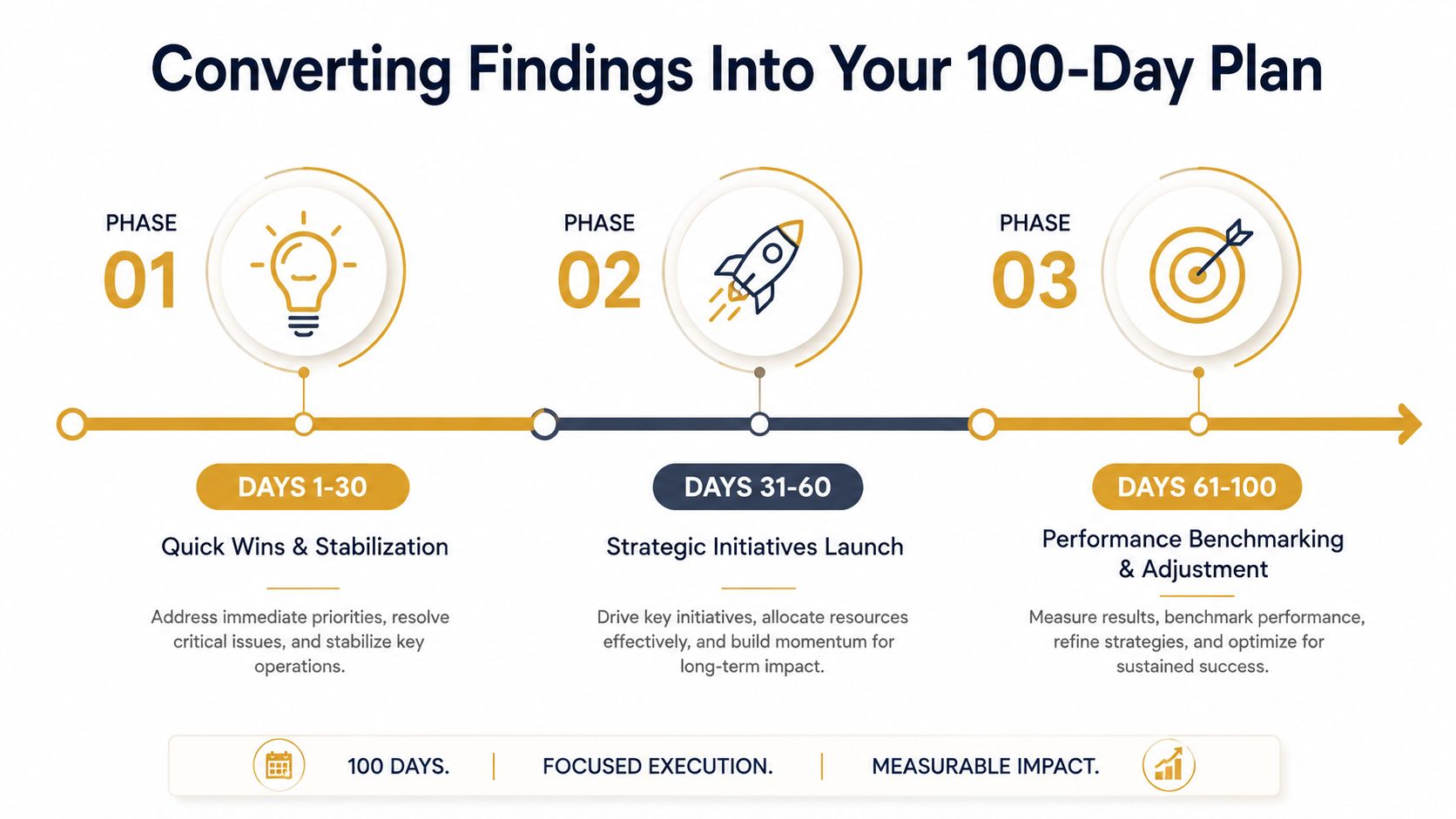
The 100-day plan should be drafted before signing, while the diligence evidence is still fresh. It doesn't need to predict every operational detail. It needs to identify the few actions that stabilize the business, establish control, and create proof that the investment thesis can move from paper to practice.
Use three operating phases
Days 1 to 30 should stabilize the platform. Protect key customer relationships, confirm cash controls, validate the forecast, secure critical employees, document urgent compliance tasks, and establish a weekly operating dashboard. Avoid launching a dozen initiatives before the team understands the baseline.
Days 31 to 60 should launch selected initiatives. Start the pricing pilot, procurement review, sales pipeline discipline, process redesign, technology remediation, or hiring plan that the diligence findings support. Each initiative needs an owner, a measurable KPI, a budget, and a dependency list.
Days 61 to 100 should test performance and adjust. Compare actual results with the diligence baseline. Separate execution failure from a flawed thesis. If the initiative works, define the next scale step. If it doesn't, stop funding it or revise the approach.
A useful workstream template contains:
- Finding: The verified issue or opportunity.
- Value mechanism: Revenue, margin, cash conversion, risk reduction, or strategic flexibility.
- First action: The earliest executable step.
- Owner: Named executive or functional lead.
- KPI: A metric that shows movement.
- Dependency: Data, hiring, systems, customer consent, or capital.
- Decision date: The point at which the team continues, changes, or stops.
Customer interviews may produce a pricing or service hypothesis. Operational mapping may reveal a bottleneck that should be fixed before growth investment. Management diligence may show that the existing team can execute with coaching, or that a critical hire must happen before the plan expands.
For a practical framework on coordinating workstreams after close, review these integration planning best practices. The strongest plans are short, owned, and reviewed against actual operating evidence. They don't confuse activity with value creation.
Dealmaker Wealth Society provides acquisition training, due diligence checklists, deal-structuring playbooks, mentorship, and peer support for buyers who want to turn diligence into disciplined post-close execution. Visit Dealmaker Wealth Society to explore resources for evaluating targets, financing acquisitions, and building a practical 100-day value creation plan.

From the Dealmaker Blog












A Creative Business Buying Fable
