
Due Diligence Checklist M&A: Essential Buyer Guide 2026
Due Diligence Checklist M&A: Essential Buyer Guide 2026
You're staring at a data room, a draft LOI, and a seller who keeps saying, “The numbers are pretty straightforward.” They rarely are. The primary task of a due diligence checklist M&A process is to find out what the seller's summary view left out, then turn those findings into a deal you can live with after close.
A good buyer doesn't ask, “Did I get the documents?” The buyer asks, “What could blow up this deal after I sign?” That question changes everything, because it forces diligence to cover earnings quality, contract transferability, tax exposure, people risk, software and AI issues, and the structure you're about to own. A modern checklist is a multi-workstream control system, not a legal formality, and leading guides describe it as covering financial, legal, tax, operational, technology, people, ESG, and integration-readiness topics with a commonly cited minimum of 20 checklist items across those categories Diligent's M&A due diligence checklist.
If you want a practical companion while you work through your own file set, the MyOfficeOps M&A due diligence guide is a useful reference point because it keeps the focus on buyer-side requests, document collection, and review discipline. The point isn't to collect more paper, it's to make sure every item in the data room answers a specific acquisition question. For a broader buyer's framework, the internal guide on essential due diligence checklists for buyers lines up well with that same mindset.
Table of Contents
- What a Buyer's Due Diligence Checklist Really Does
- Building the Workstreams That Run Your Deal
- Financial Diligence That Tests the Earnings Story
- Legal, Tax, HR, and IP Diligence in One Pass
- Diligencing AI, Software, and Data Risk in 2026
- Diligencing Creative Deal Structures and Partnerships
- Timing, Priorities, and Deal-Killing Red Flags
What a Buyer's Due Diligence Checklist Really Does
A buyer's checklist is a risk-control system that starts after the LOI and runs through signing or close. Its job is to test whether the target's reported performance is supported by contracts, accounting records, and the operating reality underneath them. In practice, it turns a purchase price into an evidence-based valuation.
The Core Buyer Question
Every request should answer one question, what would make this business worth less, harder to integrate, or structurally different from what I think I'm buying? That is why a checklist cannot stop at legal documents. It has to connect financial, tax, commercial, operational, technology, people, ESG, and integration-readiness workstreams, because the same issue often shows up in more than one place.
A customer concentration issue, for example, is not only commercial. It affects revenue durability, contract assignment, change-of-control rights, and key-account retention. First-time buyers lose money when they treat diligence like a form to complete instead of a structured test of the deal thesis.
Practical rule: if a diligence item does not change price, structure, or close conditions, it is probably noise.
The strongest buyers use diligence to decide three things. First, whether the business is really worth the headline price. Second, whether the deal terms need protection through reps, indemnities, escrows, or earn-outs. Third, whether the post-close plan is realistic once the target's actual dependencies are visible.
For a deal mentor's perspective on how buyers should think about the checklist as a control tool, the resource at MyOfficeOps M&A due diligence guide is a useful reference because it stays focused on buyer-side requests, document collection, and review discipline. That matters when you are the one wiring money and inheriting the liabilities.
A broader buyer framework is also laid out in essential due diligence checklists for buyers, which fits the same mindset of tying each request to a decision.
What this protects
The checklist protects price, structure, and post-close execution. If you miss an issue in any one of those buckets, you can still close and lose money later. Speed becomes dangerous when it replaces verification. The shortcut is usually not a missing document, it is a missing connection between documents.
Building the Workstreams That Run Your Deal
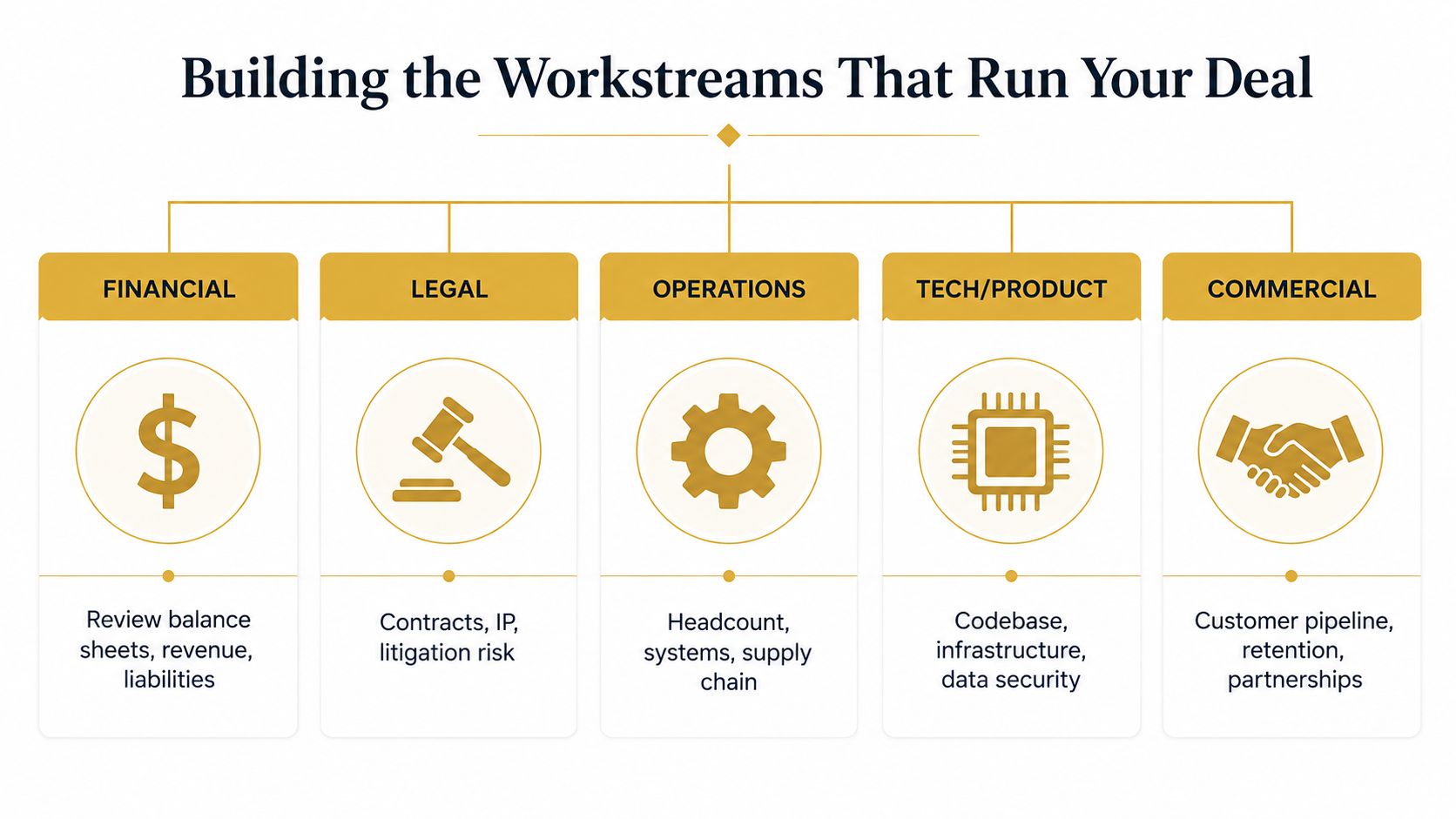
A useful checklist is organized like a project, not a file dump. The buyer should assign each workstream to one owner, define what “done” means, and keep every request tied to a decision. A lean SMB deal can run with a small team, but the same logic applies at every size. The workstream map just gets more disciplined as the transaction gets more complex.
Put owners on every stream
The core streams are financial, legal/compliance, tax, HR and people, operations, technology, and commercial. In smaller deals, one advisor may handle more than one stream, but the logic doesn't change. Someone owns the earnings story, someone owns contract transferability, someone owns workforce risk, and someone owns the integration implications.
A clean setup usually looks like this:
- Financial lead: tests earnings quality, working capital, debt, and cash flow support.
- Legal lead: reviews corporate authority, contracts, litigation, and IP ownership.
- Tax lead: checks filings, exposure, and change-of-control tax effects.
- HR lead: reviews key-person dependence, benefits, and retention risk.
- Tech lead: tests cybersecurity, data rights, and software dependencies.
- Commercial lead: validates customer concentration, pipeline, and retention.
- Integration owner: translates findings into the day-one plan.
A buyer who skips this structure ends up with duplicated requests, contradictory notes, and findings that don't connect to the model. That's the exact failure mode that turns diligence into a document review exercise instead of a deal decision engine.
Useful standard: every finding should end in one of four actions, re-trade, escrow, indemnity, or walk-away.
The broader M&A process also rewards a real team structure. If you're assembling one for your first deal, the internal piece on how to build an invincible deal team is worth reading because it treats diligence as a coordinated function rather than a solo operator's checklist.
How deep to go
For an SMB acquisition, depth should follow risk, not habit. A lower-middle-market target with concentrated customers and weak systems needs heavier commercial and tech work. A cleaner business with simple contracts may need less legal volume but more attention on earnings quality and people retention. The best teams don't try to review everything equally, they push hardest where a finding would change the price or the structure.
Financial Diligence That Tests the Earnings Story
Financial diligence is where the purchase price gets pressure-tested. The question is whether the earnings story survives buyer-side scrutiny, because a clean file set still does not prove the business earns what the seller says it earns. If the numbers do not hold up, the rest of the deal sits on weak ground.
Pull the right evidence
Start with the core records, historical financial statements, tax returns, the debt schedule, AR aging, cash flow statements, cap table, and monthly management accounts. Then tie those records back to what the seller said in the CIM or teaser. The point is not whether the files exist, it is whether the numbers reconcile across sources and whether the revenue pattern matches the contracts and collections that drove it.
A banker-style benchmark is to review the last 3 years of financials plus forward projections, then stress-test assumptions on revenue, margin, cash flow, and working capital Wall Street Prep's M&A diligence guidance. That matters because seller forecasts are often where first-time buyers get too optimistic. Projections only help when the assumptions behind them can stand up to review.
For a detailed breakdown of this process, our guide on evaluating a business's financial health lays out the checklist buyers can use to test the earnings story. It is the kind of pass that separates a tidy file from a finance package you can trust.
The cleanest financial file set still needs one test, do the reported numbers match the operating reality that produced them?
What changes price
Some findings do more than raise concern, they change the economics of the deal. Revenue concentration, weak recurring revenue quality, customer churn, and large swings in working capital can all justify a re-trade or a different deal mechanism. The same is true for undisclosed debt, debt-like obligations, and liabilities that do not sit neatly on the face of the balance sheet.
Data quality can move the model too. If the accounting records are inconsistent, the buyer may be building the price on numbers that do not line up with the underlying source data. Teams that work with structured finance data often use disciplined governance processes, such as the guide for finance data engineers, to keep source records, normalization logic, and reporting outputs aligned.
How to read the red flags
A gap between revenue growth and cash collection usually deserves a deeper look. So does a business with heavy customer concentration, especially if those accounts sit on short-term contracts or can walk on a change of control. If the target's reported performance depends on one-time items, management adjustments, or loose revenue recognition, the purchase price should reflect that fragility.
The practical outcome is straightforward. Strong financial diligence produces a normalized earnings base, a working capital view the buyer trusts, and a list of items that belong in reps, escrows, or earn-out language rather than in a generic “miscellaneous risks” folder. For a first-time buyer, that is the difference between paying for a business and paying for a story.
Legal, Tax, HR, and IP Diligence in One Pass
Most material surprises don't stay in one bucket. A contract issue can become a tax issue. An HR issue can reveal IP ownership problems. A legal clause can directly affect the purchase price if it changes closing certainty or the transferability of revenue. That's why these workstreams work best when you read them together.
Contracts and control
Customer and supplier agreements should be reviewed for assignment rights, exclusivity, termination rights, change-of-control clauses, and renewal mechanics. These terms decide whether the revenue survives the transaction or gets renegotiated after close. If the top customers can exit on notice, the headline revenue number means less than it looks like it means.
That's also where a disciplined contract-management process helps. The HireParalegals 10 best practices are useful because they reinforce something buyers often forget, the contract set is only as good as the way it's indexed, tracked, and kept current.
Tax, people, and IP in the same lens
Tax diligence should cover filed returns, open audits, deferred tax exposures, and any jurisdictional issues that could follow the buyer after closing. HR diligence should focus on key-person dependency, benefits, severance, and whether the people who hold customer relationships or technical know-how are staying. IP diligence should verify chain of title for code, trademarks, domain names, and licensed content.
Buyers need to stop accepting summary language like “all IP is owned by the company.” Verify assignment agreements, contractor obligations, and any licensed material that may limit how the asset can be used after close. If the target built important software with contractor help and never collected proper assignments, the problem isn't cosmetic. It's ownership.
What each issue triggers
A clean legal or tax answer can support close. A weak answer often triggers a representation and warranty, an indemnity, a purchase-price adjustment, or a walk-away. The same is true for HR findings when key personnel aren't retained or when benefits liabilities are larger than expected.
Site visits and management interviews matter here too. Documents show what exists. Interviews show whether the team understands how the business runs. If the explanations don't line up with the paper, the buyer should slow down before committing to a structure that assumes too much trust.
Diligencing AI, Software, and Data Risk in 2026
A software target can look clean on paper and still hide a serious risk in its product stack. That's especially true when AI tools, customer data, and open-source components are part of the business model but aren't disclosed clearly in the core legal or financial files. In SMB deals, generic checklists fail in such scenarios.

The hidden failure mode
A buyer acquires a SaaS target because the product's workflow automation looks sticky. During integration, the team learns the core feature depends on a third-party LLM, the vendor's terms limit commercial resale, and customer data was routed through tooling nobody documented properly. The revenue looked fine. The contract and data-rights story did not.
That kind of miss changes more than a legal memo. It can change valuation, delay integration, and create a product rewrite the buyer never priced. A modern checklist has to ask whether the target uses AI tools, customer data, or open-source code in ways that could break contracts, privacy rules, or IP ownership. Recent checklist commentary also points buyers toward items like SBOMs, disaster recovery testing, unreported breaches, and broader cybersecurity posture Govern365's M&A due diligence checklist commentary.
What to ask for
The best technology review is concrete. Ask for:
- SBOMs and dependency lists for the product stack.
- Data processing agreements with vendors and AI providers.
- Model provenance for any AI features or embedded tools.
- Vendor AI clauses that govern training, output use, and resale.
- Breach history and incident-response documentation.
- Disaster recovery testing results and cybersecurity policies.
- Open-source usage and any license obligations tied to distribution.
These aren't theoretical asks. They tell you whether the target's product can be integrated, resold, or expanded without stepping into contractual or regulatory trouble.
Why this needs its own workstream
Technology isn't just another IT box anymore. It can create a direct purchase-price issue if the core feature is built on rights the seller doesn't control. It can also create post-close friction if the buyer inherits shadow software, undocumented AI usage, or weak data-handling practices.
A strong SMB buyer should treat AI and data rights as a standalone diligence track. If the business depends on software, the checklist needs to prove the software can legally and operationally support the business you think you're buying.
Diligencing Creative Deal Structures and Partnerships
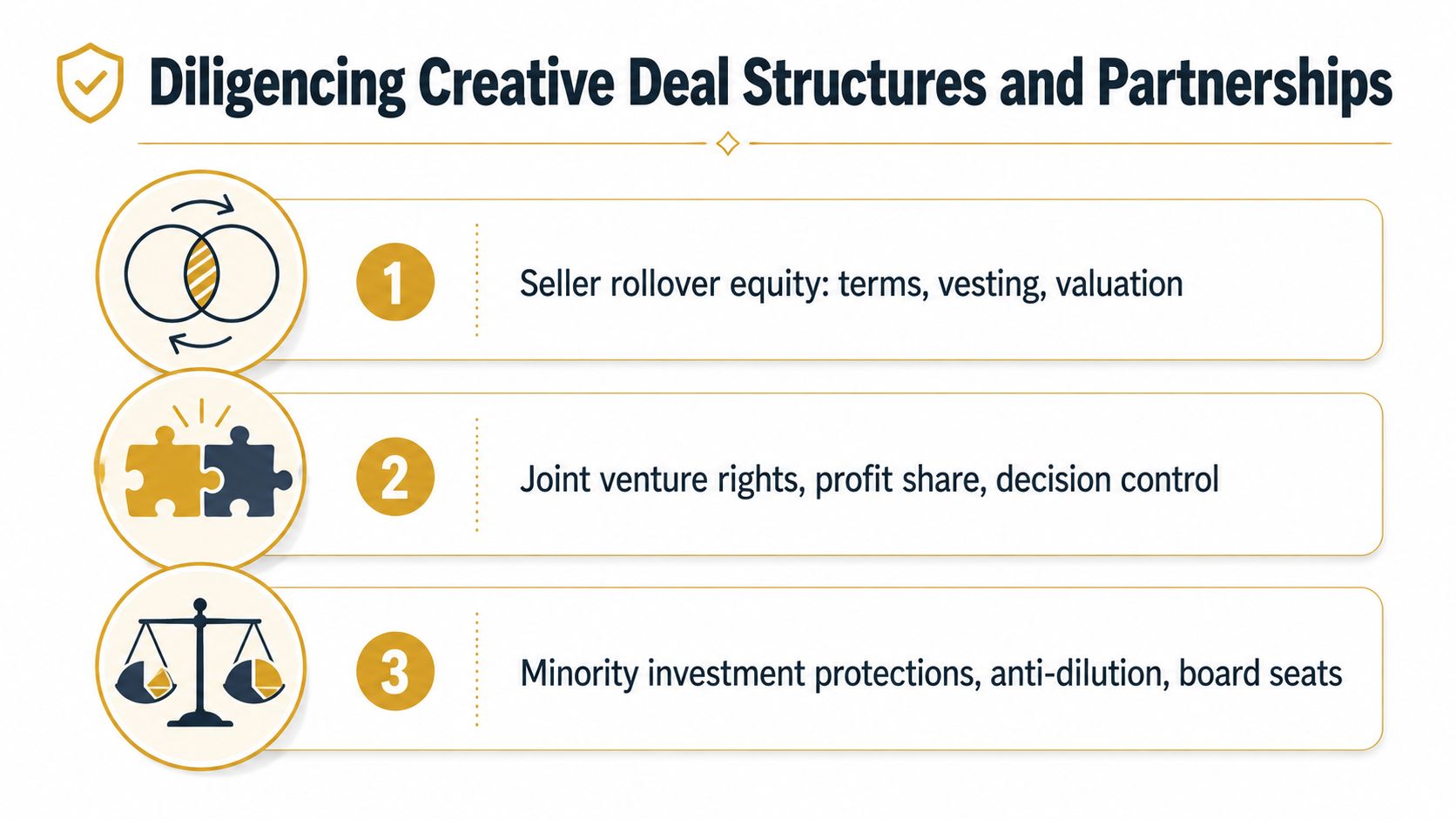
A lot of real SMB deals aren't clean 100% cash purchases. They involve seller rollover, partner capital, minority stakes, earn-outs, or debt-heavy capital stacks. Once that happens, diligence has to cover not just the company, but the control system around the company.
Diligence the structure, not just the asset
If the seller is rolling equity, the buyer needs to know what happens if that seller stays, leaves, competes, or misses post-close milestones. If there's a JV partner, minority investor, or layered financing, the questions are about governance rights, deadlock provisions, related-party transactions, capital-call obligations, and who bears working-capital true-up risk. A beautifully priced deal can still become unmanageable if control rights are vague.
This is also where people forget that the seller becomes part of the asset. In a rollover or earn-out, the seller's incentives matter. Verify the post-close role, the vesting or payout mechanics, and the enforceability of any non-compete or non-solicit provisions. If the seller is essential to the transition, you're buying the business and the behavior.
Partner risk is deal risk
Partnership-led acquisitions need a different lens because the buyer may not control every decision from day one. Minority protections, board seats, approval thresholds, and dispute rights all matter. So do related-party arrangements that can shift value after close.
The right question is not “Is this structure creative?” It's “Does this structure leave me able to operate the company when the honeymoon ends?” If the answer is unclear, the buyer hasn't finished diligence. The structure itself is part of the risk model.
Timing, Priorities, and Deal-Killing Red Flags
A serious diligence process usually runs on a 30 to 90 day clock from signed LOI to close. Buyer-side diligence can also create real transaction costs, which is why the first pass has to focus on the items most likely to move price or kill the deal. One industry guide notes that mid-market buyers can end up using several third-party diligence providers and spending a meaningful share of enterprise value on the buyer-side process, which is a reminder that complexity adds cost quickly CTA Acquisitions' due diligence checklist.
What to verify first
Run the highest-priority workstreams in parallel right away.
- Revenue quality: confirm the earnings story, customer concentration, and recurring revenue durability.
- Contract transferability: check change-of-control and termination rights before you get too deep.
- Key-person dependence: identify who keeps customers, code, or operations moving.
- AI and data exposure: verify software rights, vendor terms, and data-use permissions.
- Litigation and title issues: look for anything that prevents clean ownership or clean closing.
Some items can wait. Decorative ESG statements, broad competitor scans, and generic process documents matter less than whether the target can keep the revenue, the talent, and the rights it claims to have.
What to do when the file turns red
The most common deal-killing findings are undisclosed litigation, unregistered or unassigned IP, and missing revenue evidence. A target with those problems may still be buyable, but the buyer should respond with one of four moves, re-trade the price, add an escrow, tighten indemnities, or walk away. If the issue cannot be priced, it usually cannot be fixed by optimism.
Bottom line: the checklist is not optional administration. It is the control system that protects valuation and deal structure.
A disciplined buyer does not wait until the final week to discover risk. The team should keep the workstreams moving, lock the biggest issues first, and use the findings to shape the agreement rather than react to it after the draft is already too far along.
Dealmaker Wealth Society teaches buyers how to evaluate businesses, structure deals, and avoid paying for risks they have not verified yet. If you are preparing your own acquisition, visit Dealmaker Wealth Society to find training, templates, and deal support that fit the way SMB acquisitions get done.

From the Dealmaker Blog











A Creative Business Buying Fable
