
Leveraged Buyout Financing: A Practical Guide to Debt
Leveraged Buyout Financing: A Practical Guide to Debt
The most popular advice about leveraged buyout financing is also the least useful: maximize debt capacity and let the returns take care of themselves. That approach treats financing as a closing event instead of an operating decision. In an SMB acquisition, the wrong debt package can consume the cash needed for inventory, hiring, maintenance, customer retention, and the occasional mistake that every new owner makes.
The better question is more demanding. Which lender will fund this business, on what terms, and will the structure still work after the first difficult quarter? Private credit has changed the answer for many buyers, but flexibility isn't free. A faster lender may charge more, require stronger reporting, or expect tighter control over cash and collateral. The buyer's job is to match the capital structure to the business, not to win a borrowing contest.
Table of Contents
- Why Leveraged Buyout Financing Matters for SMB Acquisitions
- Understanding the LBO Capital Stack Structure
- How Debt-to-Equity Ratios Have Evolved Over Time
- Bank Lending Versus Private Credit for Buyouts
- Navigating Covenants and Default Triggers
- Connecting Financing Structure to Post-Close Execution
- A Realistic SMB Buyout Financing Scenario
Why Leveraged Buyout Financing Matters for SMB Acquisitions
Buyouts aren't reserved for large private equity firms acquiring household-name corporations. The same basic logic applies when an entrepreneur buys an established smaller company: the buyer contributes equity, raises acquisition debt, and uses the target's future cash flow to service that debt. The structure can let a buyer control a larger operating asset without funding the entire purchase price personally.
That doesn't make the transaction easy. It changes what the lender underwrites. A bank or private credit fund isn't primarily asking whether the buyer has a large personal balance sheet. It wants to know whether the acquired company can produce dependable cash after payroll, taxes, maintenance capital, working capital swings, and the owner's compensation.
Practical rule: The target's cash flow has to carry the debt before it carries your growth plan.
Why sellers may accept a leveraged deal
Sellers often care about more than the headline purchase price. They want a credible closing path, confidence that employees and customers will be treated responsibly, and a buyer who can complete diligence without repeatedly reopening the offer. A properly financed transaction can give the seller a clearer source of funds than an offer based entirely on uncertain future fundraising.
Seller financing can also help bridge a valuation or funding gap. It keeps the seller economically involved in the outcome and may align repayment with the company's ability to generate cash. That arrangement creates risk for the seller, so buyers should approach it with transparency rather than presenting seller debt as free capital.
Why SMB transactions behave differently
Large-cap LBOs may have multiple financing tranches, extensive sponsor support, and management teams that have executed acquisitions before. An SMB buyer often has a smaller team, less diversified revenue, fewer reporting systems, and a business where one customer, salesperson, or production line matters disproportionately.
Lenders therefore focus heavily on the quality of earnings and the durability of cash flow. They examine customer concentration, recurring versus project revenue, working capital requirements, owner add-backs, supplier dependence, tax compliance, equipment condition, and the credibility of the transition plan. A spreadsheet can show debt service. It can't repair weak customer retention or replace an owner whose relationships were never documented.
The most effective buyers use debt to acquire a business with predictable cash generation, not to rescue a business that needs an unproven turnaround. They also reserve enough liquidity for normal operational volatility. The acquisition price matters, but so do the cash left in the company, the amortization burden, the interest-rate exposure, and the covenant package.
Understanding the LBO Capital Stack Structure
An LBO capital stack is a priority system. The lender with the strongest claim generally accepts the lowest risk and receives repayment before capital positioned below it. Equity sits at the bottom, absorbs the first loss, and receives the residual upside if the company performs.
Senior debt creates the foundation
Senior debt is typically the anchor of an LBO and often provides about 30% to 50% of total sources, according to Macabacus' overview of LBO capital structure. Floating-rate term loans are commonly sized at roughly 2.0x to 3.0x LTM EBITDA, with 5- to 8-year maturities, amortization, and first-lien security over assets and stock pledges, as described in the same source.
The lender's priority explains the pricing and protections. First-lien security gives the senior lender the strongest claim if the borrower defaults. Floating-rate pricing transfers some interest-rate movement to the borrower, which makes cash-flow forecasting and interest-rate sensitivity essential. The lender still cares about collateral, but in a cash-flow LBO, collateral isn't a substitute for reliable earnings.
Subordinated and mezzanine capital fill gaps
Subordinated debt ranks behind senior debt. It can provide useful acquisition capital when the senior lender won't fund the full requirement, but it carries greater risk and therefore demands higher returns. Mezzanine capital can add flexibility through features such as payment-in-kind interest, warrants, or other negotiated economics, though each feature affects the sponsor's future ownership and cash burden.
The label matters less than the intercreditor agreement. That document governs who can exercise remedies, who controls enforcement, and how recoveries are distributed. A buyer who focuses only on the interest rate may miss restrictions that become decisive during a restructuring.
Equity absorbs risk and provides credibility
Equity is the loss-absorbing layer. It funds the portion of the purchase price and costs that debt won't cover, supports working capital, and demonstrates that the buyer has meaningful economic exposure. Equity also brings more than cash. A lender evaluates the sponsor's operating experience, reporting discipline, industry knowledge, and ability to handle a difficult lender conversation after closing.
For a practical overview of how different acquisition funding options fit together, review this guide to understanding acquisition financing options. The right stack isn't the one with the least equity. It's the one that leaves sufficient cash flow and decision-making room for the company to perform.
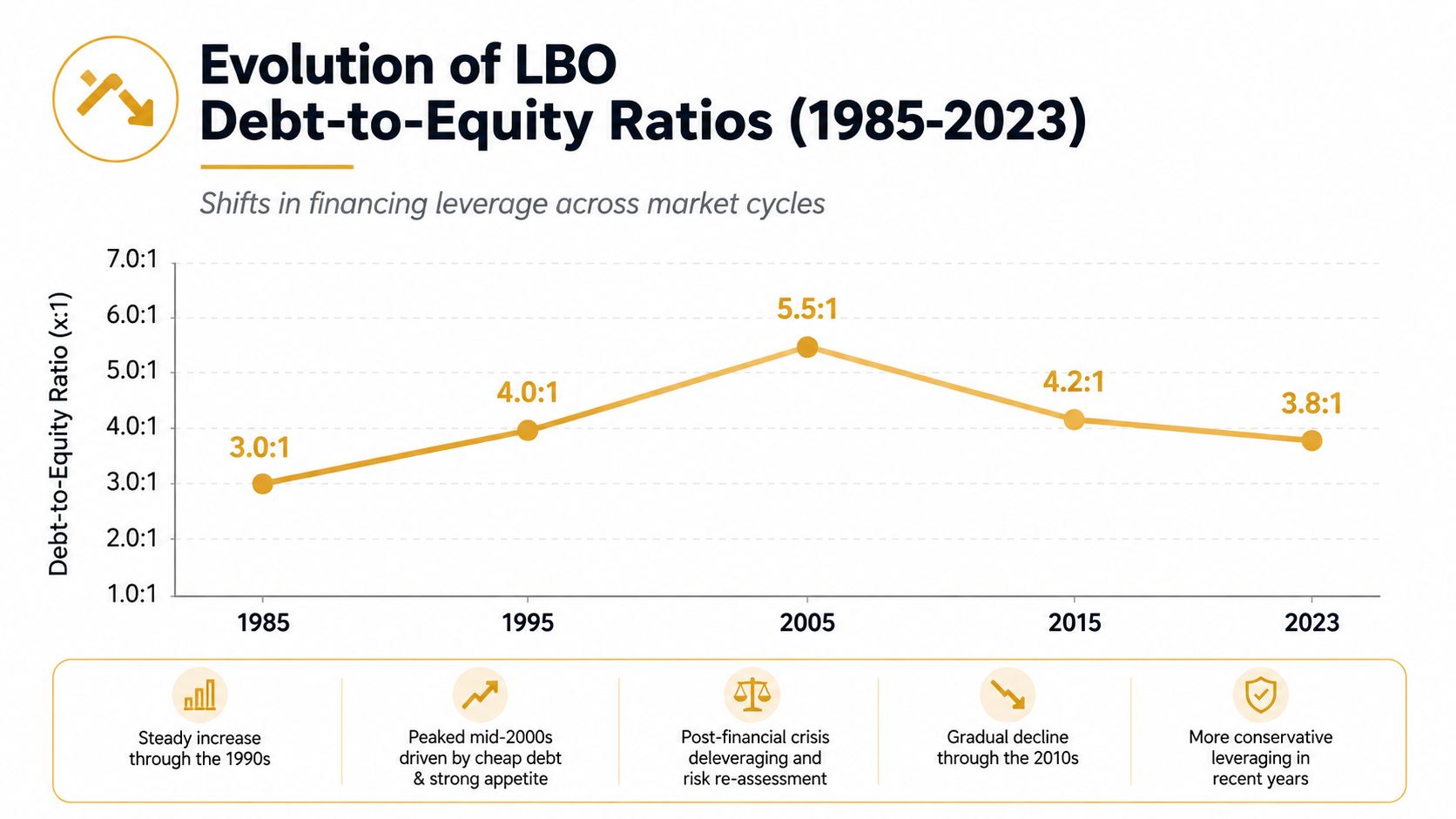
How Debt-to-Equity Ratios Have Evolved Over Time
Debt-heavy buyouts are a product of changing lender appetite, market liquidity, and competition for transactions. The early history shows how concentrated the market once was. During the 1985 to 1989 debt-heavy buyout wave, the United States, Canada, and the United Kingdom represented 89% of worldwide LBO transactions and 93% of worldwide transaction value, according to this historical analysis of LBO financing.
The same analysis shows that equity represented roughly 10% to 15% of capital in the first wave, while later buyout waves moved toward about 30% equity. That shift matters because equity gives a company more room to absorb earnings volatility. A thinner equity layer can produce stronger returns when the plan works, but it leaves less protection when revenue, margins, or refinancing conditions deteriorate.
The 2000s show how leverage accelerates
U.S. private equity LBOs became more debt-heavy between 2000 and 2005. Deals averaged 41% equity and 59% debt in 2000, then shifted to 34% equity and 66% debt by 2005, according to the U.S. Government Accountability Office's review of leveraged finance. From 2000 through 2007, private equity firms acquired nearly 3,000 companies worth more than $1 trillion, while U.S. syndicated loans for LBOs totaled nearly $2.7 trillion. About $1.1 trillion, or 42%, financed private-equity-sponsored transactions, according to the same report.
The lesson for an SMB buyer isn't that a particular historical ratio should be copied. It is that debt availability can make buyers and lenders overconfident at the same time. When competition rises, underwriting can drift from durable repayment capacity toward optimistic assumptions about growth, exit value, and refinancing.
Use history as a negotiation tool. A lender who proposes aggressive borrowing should explain the downside case, not just the base case. Your model should show what happens if margins compress, working capital expands, or the exit takes longer than planned.
Bank Lending Versus Private Credit for Buyouts
For first-time SMB buyers, the central financing decision increasingly isn't bank versus no bank. It's whether the transaction's size, complexity, and urgency fit a regulated bank's process or a private credit lender's underwriting model.
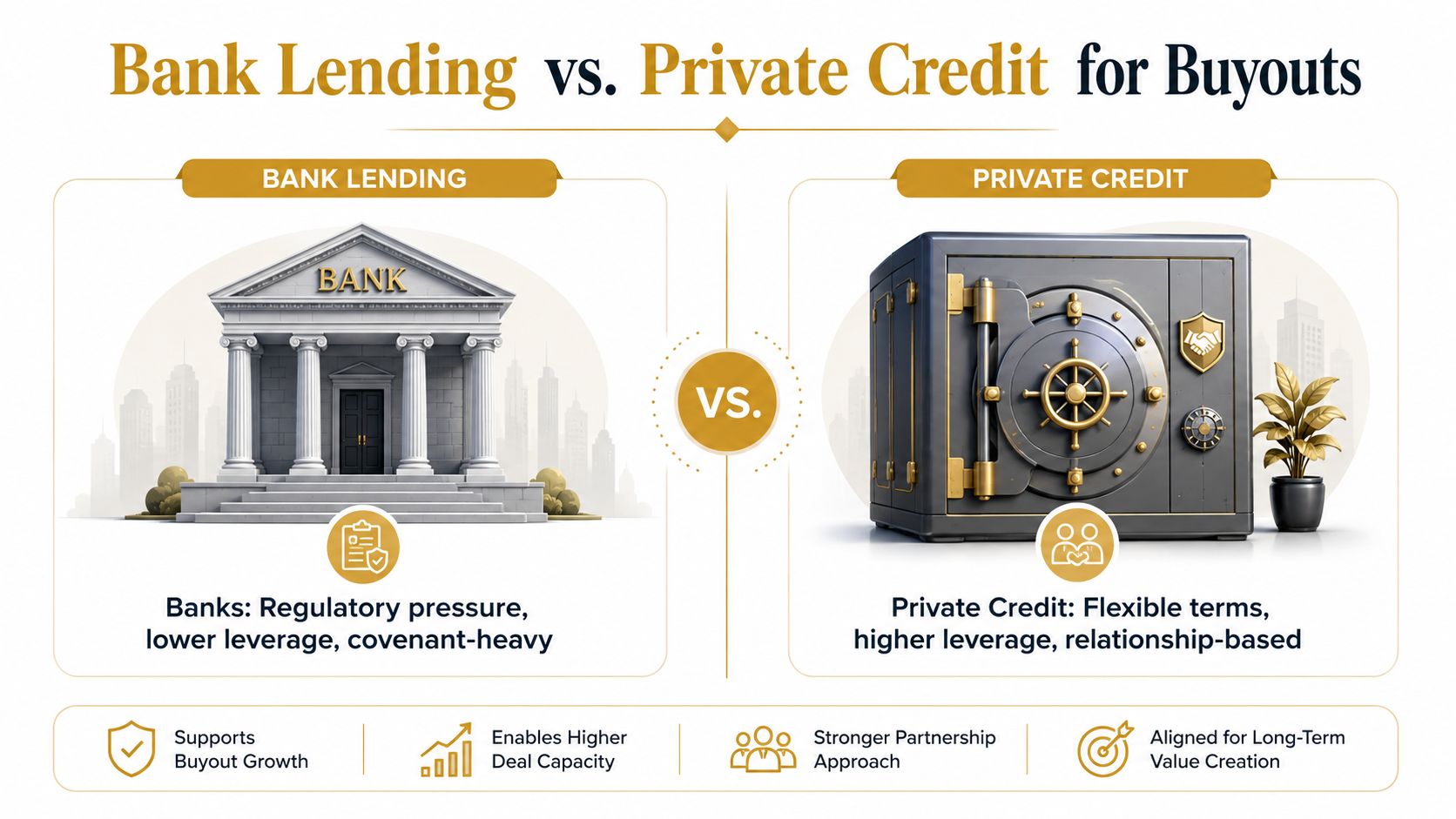
Banks generally offer lower-cost capital when a borrower fits their credit box. They may provide strong treasury services, operating accounts, and a relationship that remains useful after closing. The trade-off is a more standardized process, greater documentation demands, and less tolerance for uncertainty around earnings, collateral, or management succession.
Private credit lenders can underwrite more directly to cash flow and structure terms around the transaction. They often compete on execution speed, certainty of funds, and bespoke documentation. Those advantages come with a price. Borrowers may face higher interest expense, tighter reporting, call protection, minimum fees, or lender controls that affect future refinancing and asset sales.
What the 2025 market signals
The shift toward private credit is visible in recent market data. Independent 2025 data found that private debt financed 83% of 53 LBOs announced in early January 2025, as reported in Moody's leveraged finance and CLO outlook. Moody's also noted that competition between broadly syndicated loans and direct lenders was expected to continue as rates eased, with activity concentrated in North America and EMEA rather than APAC or LatAm.
McKinsey reported that LBO financings rose to $81 billion in 2025 from $73 billion in 2024, while deal count fell to 214 from 248, according to the same Moody's-linked market discussion. Fewer, larger transactions don't mean every smaller buyer gets easier access. A first-time SMB buyer still has to prove clean reporting, credible management, and a repayment plan that doesn't depend on heroic growth.
The buyer should compare lenders on more than headline pricing:
- Execution certainty: Ask who has authority to approve the deal and what conditions could still delay closing.
- Covenant design: Compare maintenance tests, cure rights, reporting frequency, and restrictions on acquisitions or distributions.
- Future flexibility: Review prepayment costs, incremental debt capacity, permitted acquisitions, and refinancing mechanics.
- Relationship fit: Determine whether the lender understands the sector and will communicate constructively when performance misses plan.
Buyers exploring the wider role of private credit for your portfolio should separate investment education from transaction-specific underwriting. For SMB acquisition work, an asset-based structure may also be relevant, particularly when receivables or inventory provide more dependable collateral than earnings. This discussion of asset-based lending helps frame that alternative.
Navigating Covenants and Default Triggers
Covenants are operating constraints written into the loan agreement. They determine what the borrower must maintain, what actions require consent, and how quickly a lender can respond when performance deteriorates. Buyers who negotiate only the interest rate often discover too late that the covenant package controls the core economics of the financing.
A maintenance covenant tests compliance on a recurring schedule, often using a metric like interest coverage or fixed-charge coverage. An incurrence covenant applies when the borrower takes a defined action, such as raising additional debt, making an acquisition, paying a distribution, or selling a material asset. The difference is practical. Maintenance tests can create pressure during ordinary underperformance, while incurrence tests focus on specific decisions.
A common LBO financing benchmark is a minimum first-year interest-coverage expectation of around 2.0x, while total debt often falls in the range of 3.0x to 6.0x LTM EBITDA, according to this LBO capital structure and financing guide. These are benchmarks, not promises. A lender will adjust them for customer concentration, cyclicality, collateral, management depth, and the quality of financial reporting.
Read the definitions before the ratio
The numerator and denominator can change the outcome. “EBITDA” may include negotiated add-backs, but the loan agreement defines which add-backs count, how long they remain available, and whether the lender can challenge them. A fixed-charge calculation may include rent, taxes, capital expenditures, or other obligations that an early model treated casually.
Ask specifically about:
- Testing frequency: Monthly, quarterly, or another schedule.
- Cure rights: Whether an equity contribution can repair a breach and how often.
- Threshold movement: Whether the covenant steps down as debt amortizes.
- Reporting deadlines: How quickly financial statements must be delivered.
- Remedy rights: What the lender can do after a technical default.
A covenant breach isn't always an immediate foreclosure event, but it can remove negotiating power from the borrower. Waiver fees, pricing increases, restricted cash, and additional reporting can follow. A covenant-lite structure may offer more breathing room, but lenders usually price that flexibility into the deal.
For a plain-language explanation of the subject, see this guide to what covenants mean in acquisition financing. Then have counsel review the actual definitions, baskets, cure provisions, and events of default before signing.
Connecting Financing Structure to Post-Close Execution
The financing package becomes part of the operating plan on the day the deal closes. A high debt service burden can force management to defer equipment replacement, slow hiring, reduce marketing, or reject a sensible acquisition because the company lacks liquidity. A lower-cost loan can still be the wrong choice if its amortization schedule drains cash during the business's seasonal trough.
The useful test is not whether the company can pay debt in the base case. It's whether the company can continue making sound decisions when the base case misses. That requires a model with explicit assumptions for volume, gross margin, payroll, inventory, receivables, capital expenditures, interest rates, and owner distributions.
The financing structure should protect the value-creation plan, not compete with it.
Stress the decisions you may actually make
A revenue decline of 15% is a scenario supplied for analysis, not a forecast. In that case, the buyer should examine whether the company still covers interest and mandatory amortization, whether suppliers tighten terms, and whether the business can maintain service levels without drawing every available dollar of liquidity.
A second stress case involves a new acquisition. Additional debt may expand the platform, but it can also breach an incurrence test, increase integration costs, and consume management attention. The buyer needs to know in advance whether the documents permit the transaction, require lender consent, or impose debt and cash-flow conditions.
Match debt features to operating reality
Floating-rate debt requires a rate sensitivity analysis. Amortizing debt accelerates principal repayment but reduces cash available for reinvestment. Bullet maturities preserve near-term cash but create refinancing exposure. Mezzanine or subordinated capital can reduce the equity check, yet its higher return requirements can make the combined burden harder to carry during a downturn.
Integration deserves equal attention. If the buyer plans to replace systems, add a sales leader, consolidate facilities, or change pricing, the model should show the timing and cash cost. Lenders don't need every initiative to succeed, but they do need to see which actions are essential, which can be delayed, and how management will respond if results lag.
The best post-close structure creates choices. It leaves room to fix a machine, retain a key employee, survive a slow customer payment, and pursue a compelling opportunity without asking the lender for permission every time.
A Realistic SMB Buyout Financing Scenario
Consider a hypothetical first-time buyer evaluating a manufacturing company with $12 million of revenue and $2.4 million of EBITDA. A proposed 4.5x structure implies total debt of $10.8 million, based on the supplied operating figures and the borrowing assumption. The buyer doesn't treat that amount as automatically available. The lender must decide how much of the debt can sit in senior financing, whether seller financing belongs behind it, and how much equity the buyer must contribute.

The private credit lender begins with quality-of-earnings work, customer concentration, backlog conversion, inventory aging, equipment condition, environmental exposure, tax filings, and the seller's transition obligations. It asks for historical financial statements, a monthly operating model, a sources-and-uses schedule, a debt repayment forecast, and downside cases. The buyer's strongest response isn't optimism. It's a clear explanation of which assumptions are contractual, which are management initiatives, and which remain uncertain.
The term-sheet negotiation focuses on more than spread. The buyer seeks adequate working-capital liquidity, practical reporting deadlines, a cure mechanism for temporary covenant pressure, permission for ordinary-course capital spending, and enough flexibility to hire management or pursue a small bolt-on. The lender seeks first-lien security, restrictions on distributions, testing, and clear remedies if cash flow weakens.
Seller financing can reduce the immediate equity requirement, but it must fit the senior lender's intercreditor terms. The buyer also needs personal equity or outside equity that leaves the company adequately funded after closing. A deal that closes with no cash cushion has already consumed its margin for error.
Dealmaker Wealth Society offers acquisition training, financing education, templates, mentorship, and peer support for buyers working through sourcing, diligence, negotiation, capital raising, and post-close execution. Visit Dealmaker Wealth Society to access practical acquisition resources and support while you structure an SMB buyout that can withstand lender scrutiny and operating reality.

From the Dealmaker Blog













A Creative Business Buying Fable
