How Long Does It Take to Buy a Business in 2026
How Long Does It Take to Buy a Business in 2026

A small-business purchase usually takes about 6 to 12 months from formal engagement to closing, while an SBA-financed deal typically takes 90 to 120 days from a signed letter of intent to closing. Neither window necessarily includes the time you spend searching for a suitable business.
That distinction changes how you should plan. BizBuySell's 2025 Year in Review reported a 170-day median to close a U.S. small-business sale, according to ClauseAudit's small-business sale statistics. That's a transaction benchmark, not a promise about how soon a first-time buyer can move from initial interest to ownership.
The useful question isn't just how long does it take to buy a business. It's which starting point the estimate uses, what must happen before funding, and who controls each unfinished task.
Table of Contents
- How Long Buying a Business Takes Overall
- Finding a Target Before the Clock Starts
- The Stages From Search to Closing and When the Clock Starts
- How Diligence and Financing Set the Pace
- Delays You Can Control and Delays You Cannot
- Plan Your Own Timeline Before You Make an Offer
How Long Buying a Business Takes Overall
Plan on months rather than weeks once a formal transaction begins, and keep your personal search period separate from the seller's transaction timetable.
The International Business Brokers Association and M&A Source's Q2 2026 Market Pulse survey, summarized by the Business Acquisition Institute, reported average engagement-to-close periods of 6–10 months for Main Street transactions and 11–12 months for lower-middle-market transactions. Transactions between $2 million and $5 million averaged 11.5 months in the same survey.
Typical elapsed time to close a small-business purchase
| Deal scenario | Typical elapsed time | Basis of the figure |
|---|---|---|
| Main Street small business, engagement to close | 6–10 months | IBBA and M&A Source Q2 2026 survey, formal engagement through closing |
| Lower-middle-market deal, engagement to close | 11–12 months | Same survey and engagement-to-close basis |
| Deal of $2 million to $5 million, engagement to close | 11.5 months average | Same survey, transaction-size category |
| All-cash deal, signed LOI to close | 45–60 days | Financing-based benchmark, begins after agreement on preliminary terms |
| SBA-financed deal, signed LOI to close | 90–120 days | Financing-based benchmark, includes post-LOI execution |
| U.S. small-business sale, median in 2025 | 170 days | BizBuySell 2025 Year in Review, sale-closing measure |
The financing-based estimates are explained under diligence and financing below. They answer a narrower question than the engagement-to-close figures: how much execution time remains after a buyer and seller sign a letter of intent, or LOI.
An average and a median also describe different things. An average incorporates the duration of every transaction in its group; a median identifies the middle observation. Neither tells you whether your seller has reconciled financial records, your landlord will approve a lease transfer, or your lender has received a complete application.
Planning rule: Before using a closing estimate, write down its starting event and ending event. A number without those boundaries isn't a usable deadline.
A seller may already have spent time preparing records and marketing the business before you see the listing. Conversely, you may spend considerable time evaluating opportunities before entering any seller's formal process.
The practical conclusion is to maintain separate search and transaction calendars. Don't add every published benchmark together, because some cover overlapping work. Don't substitute a post-LOI estimate for your entire acquisition journey, either.
Finding a Target Before the Clock Starts
The post-LOI clock starts only after you've found a business worth pursuing and negotiated preliminary terms. Your own acquisition journey starts much earlier, when you decide what you can buy and operate.
Grata's acquisition-process guide places strategy and target outreach before transaction-specific diligence, with outreach around weeks 2–6 in its illustrative process. That's a process model, not a guarantee that a suitable seller will appear within that window.
Screen for readiness, not just attractiveness
Start with acquisition criteria that make rejection straightforward:
- Business fit: Specify the industry, location, revenue range, and operating responsibilities you'll accept.
- Financial capacity: Define a maximum price and a financing structure you can realistically support.
- Ownership fit: Decide whether you'll replace the seller operationally or need management to remain.
- Seller readiness: Establish whether the owner wants to sell and can provide usable records.
Screen listings and contact owners against those criteria. An appealing business isn't automatically an available acquisition, and an interested owner isn't automatically ready for diligence.
Before committing to extensive advisory work, ask whether tax returns reconcile to financial statements, whether reported earnings support the asking price, and whether the transaction fits a plausible funding structure. Our guide to identifying viable acquisition opportunities provides a framework for that initial evaluation.
Measure what your search produces
Reviewing more businesses doesn't directly make legal work or underwriting faster. Its value is that you can reject poorly prepared opportunities and concentrate on sellers whose expectations, documentation, and operating risks fit your requirements.
Track targets reviewed, usable financial packages received, and reasons for rejection in a spreadsheet or deal tracker. If every candidate fails for the same reason, revise your criteria or sourcing channel rather than increasing outreach.
Set a search budget in months and review your progress monthly. Treat that budget as a decision point for reassessing your approach, not a deadline that forces you to buy an unsuitable business.
The Stages From Search to Closing and When the Clock Starts
Say you find an attractive service business. The seller shares preliminary financials, you discuss price, and you submit an indication of interest before negotiating an LOI. You've already done meaningful acquisition work, but a post-LOI closing estimate hasn't started yet.
Commercial Lending X's SBA acquisition timeline explains that commonly quoted 60–90-day LOI-to-close windows generally exclude search, offer preparation, lender prequalification, and the repair of incomplete seller records. Those exclusions explain why an advertised closing window can look much shorter than the buyer's lived experience.
The sequence is easier to understand when you separate the milestones from the overlapping work.
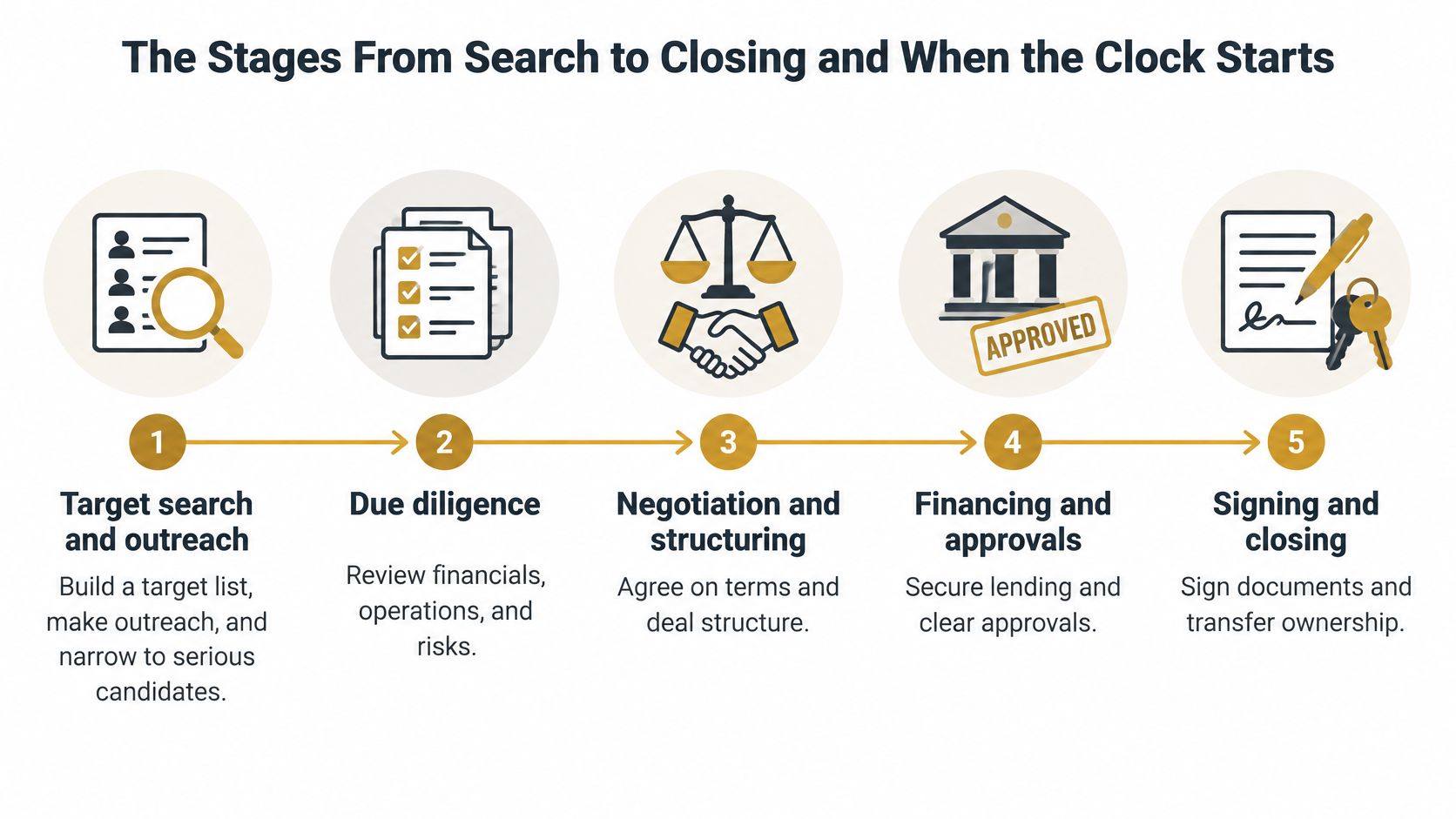
Benchmark timing for each acquisition phase
The week ranges below describe an illustrative broad M&A process, not a universal financed-small-business schedule. A lender's actual processing period must be fitted into the transaction calendar separately.
| Phase | Typical timing | Overlaps with |
|---|---|---|
| Target search and outreach | Weeks 2–6 for outreach; finding a suitable target can take several months overall | Pre-LOI screening and preliminary discussions |
| Due diligence | Weeks 6–12 in the illustrative process | Financing preparation and agreement drafting |
| Negotiation and structuring | Weeks 10–14 | Late diligence and resolution of findings |
| Financing and approvals | Weeks 12–16 | Diligence and closing-condition preparation |
| Signing and closing | Weeks 16–18 | Final approvals and ownership transfer |
What happens between the milestones
After the LOI, your accountant examines earnings and working capital while your lawyer reviews contracts, liabilities, and the proposed purchase agreement. You assess customer relationships, employee dependencies, and how the business operates without its current owner.
Meanwhile, the lender evaluates repayment capacity and requests supporting documents. Negotiation continues as findings become clear. A discrepancy in earnings might change price; a contract restriction might require consent; a working-capital question might change the cash required at closing.
Elapsed calendar time isn't the same as active buyer work. You might answer a lender request promptly and still wait for a third-party report. Equally, a quiet period on your calendar doesn't mean the accountant, attorney, and lender have stopped working.
Starting financing during diligence avoids making the lender wait for the entire review to finish before beginning its own work. The objective isn't to bypass diligence, but to prevent unnecessary sequencing.
A closing date becomes credible when the remaining conditions have owners, dependencies, and completion dates, not merely because buyer and seller agree they want to close.
Keep transition planning distinct from ownership transfer. Training, introductions, system access, and operating handover need explicit arrangements, even when some occur after closing. Before comparing any estimates, record whether they end at signing, funding, ownership transfer, or completion of the seller's transition obligations.
How Diligence and Financing Set the Pace
Once preliminary terms are agreed, the buyer's pace depends heavily on how quickly advisers can validate the business and the lender can approve funding.
The comparison below illustrates why removing financing changes the closing process.

The 1800BizBroker closing-process guide places signed-LOI-to-close timing at approximately 45–60 days for an all-cash transaction and 90–120 days for an SBA-backed acquisition. It describes diligence as commonly taking 30–45 days in a financed deal and SBA processing as approximately 45–90 days from a complete application to funding.
Those periods aren't additive. Financial, legal, operational, and commercial diligence can proceed alongside purchase-agreement drafting, lender underwriting, escrow preparation, and closing-condition work.
The critical path is the chain of unfinished tasks that determines the earliest possible closing. If the agreement is ready but the lender still needs tax-transcript verification, the transaction waits for financing. If funding is approved but the lease can't transfer, the lease becomes the constraint.
Prepare a lender-ready file
Before submitting an LOI, assemble or request:
- Business tax returns: Three years, with explanations for inconsistencies.
- Current financials: Year-to-date income statements and balance sheets.
- Debt schedules: Balances, payment obligations, and payoff information.
- Customer concentration: Revenue exposure to major accounts.
- Lease documents: Current terms, amendments, and assignment provisions.
- Seller financial information: Personal financial information where requested for the financing structure.
- Sources and uses: A clear schedule showing where funds originate and how they'll be spent.
Discuss document availability before promising a closing date. A request list isn't a complete application, and an application isn't a funding approval.
For additional closing-process context, Bizbe, Inc.’s resource on small business closing timelines is a useful companion when preparing questions for your advisers. Evaluate financing options for buying a company before committing to a structure your available capital can't support.
Use the following video as an additional discussion resource when reviewing acquisition execution.
Our specialty coaches cover capital raising, operations, financial due diligence, M&A legals and contracts, post-acquisition growth, transition and integration, and deal origination. Those are distinct workstreams, so your plan should identify who handles each rather than treating the purchase as one undifferentiated task.
Financing may make an otherwise unaffordable acquisition possible. The trade-off is additional conditions and coordination, not an automatic reason to avoid borrowing.
Delays You Can Control and Delays You Cannot
A missed target date doesn't tell you whether a transaction is failing. An unresolved issue with no responsible party or credible remedy tells you much more.
Iconic's business-sale timeline identifies documentation, underwriting, valuations, environmental reviews, and lease consent as important sources of delay. It also highlights the coordination required when a transaction involves multiple investors, guarantors, or funding sources.
Sources of acquisition delay and how to respond
| Source of delay | Common triggers | Response |
|---|---|---|
| Buyer | Late personal financial statements, unclear equity sources, slow replies | Prepare documents before submitting the LOI |
| Seller | Missing tax returns, inconsistent books, unclear owner transition details | Request records early and reconcile tax returns to financial statements |
| Lender | Underwriting, approval queues, closing conditions | Submit a complete lender-ready package and track open conditions weekly |
| Third party | Appraisals, environmental reports, landlord lease consent | Order reports early and confirm lease-assignment terms before signing |
Control and influence aren't the same. You can't approve your own loan, but you can remove unanswered questions from the lender's file. You can't force a landlord to consent, but you can discover an assignment problem before spending heavily on the transaction.
Match the response to the trigger
Incomplete tax records call for a pause in reliance on the seller's earnings claims. Ask the seller and accountant to identify what's missing, who will correct it, and what evidence will demonstrate that the issue is resolved.
A valuation below the purchase price creates a funding problem, not just a scheduling inconvenience. Review whether the parties can justify the price, renegotiate it, or adopt a financing structure acceptable to the lender. Don't assume extra waiting will close a valuation gap.
A landlord's refusal to assign a necessary lease can threaten the operating premise of the purchase. Have counsel assess whether a new lease or another acceptable arrangement is possible. If the location is essential and no workable arrangement exists, walking away may be more rational than extending the deadline.
Decision threshold: Wait for a fix only when there's a defined deliverable, an accountable person, and a clear deadline.
Larger or more complex transactions can require additional approvals and review. Partnership acquisitions also require agreement among the people supplying capital and guarantees, so settle decision rights before a closing issue demands an immediate answer.
Your delay log should therefore record the consequence of noncompletion, not merely the outstanding task. That turns a status report into a decision tool.
Plan Your Own Timeline Before You Make an Offer
Build your acquisition schedule around evidence you can obtain, not a desired resignation date or an advertised promise of speed. A useful plan tells you what must be true before you advance.
Set a search budget in months. Decide how much time and money you can commit before reassessing your criteria. Separate owner outreach from deeper evaluation so an unresponsive prospect doesn't consume your entire search.
Choose the appropriate transaction benchmark. Match your prospective business to its size, complexity, and likely financing route. Record the benchmark's starting event rather than treating every estimate as first-contact-to-funding time.
Prepare the financing file before making commitments. Establish what documents you already have and what must come from the seller. Ask your lender to identify gaps before you promise a funding date.
Give diligence a sequence and acceptance criteria. Start with earnings reconciliation and customer concentration, because either can undermine the purchase rationale. Define what constitutes an acceptable answer, not merely whether a document has arrived.
Run independent work concurrently. Let financing, legal drafting, and operational review proceed where they don't depend on unresolved findings. Ask advisers to flag dependencies explicitly so you don't pay for avoidable rework.
Assign every open condition to an owner. Maintain a shared tracker with the responsible party, required evidence, due date, and effect on closing. Distinguish a submitted item from an accepted or approved item.
Set an exit decision date. Decide when you'll stop extending an unresolved issue. An extension should purchase a credible route to completion, not postpone a difficult decision.
The visual below provides a compact planning reference. Treat its windows as benchmarks to test against your actual transaction, not deadlines to impose on missing information.
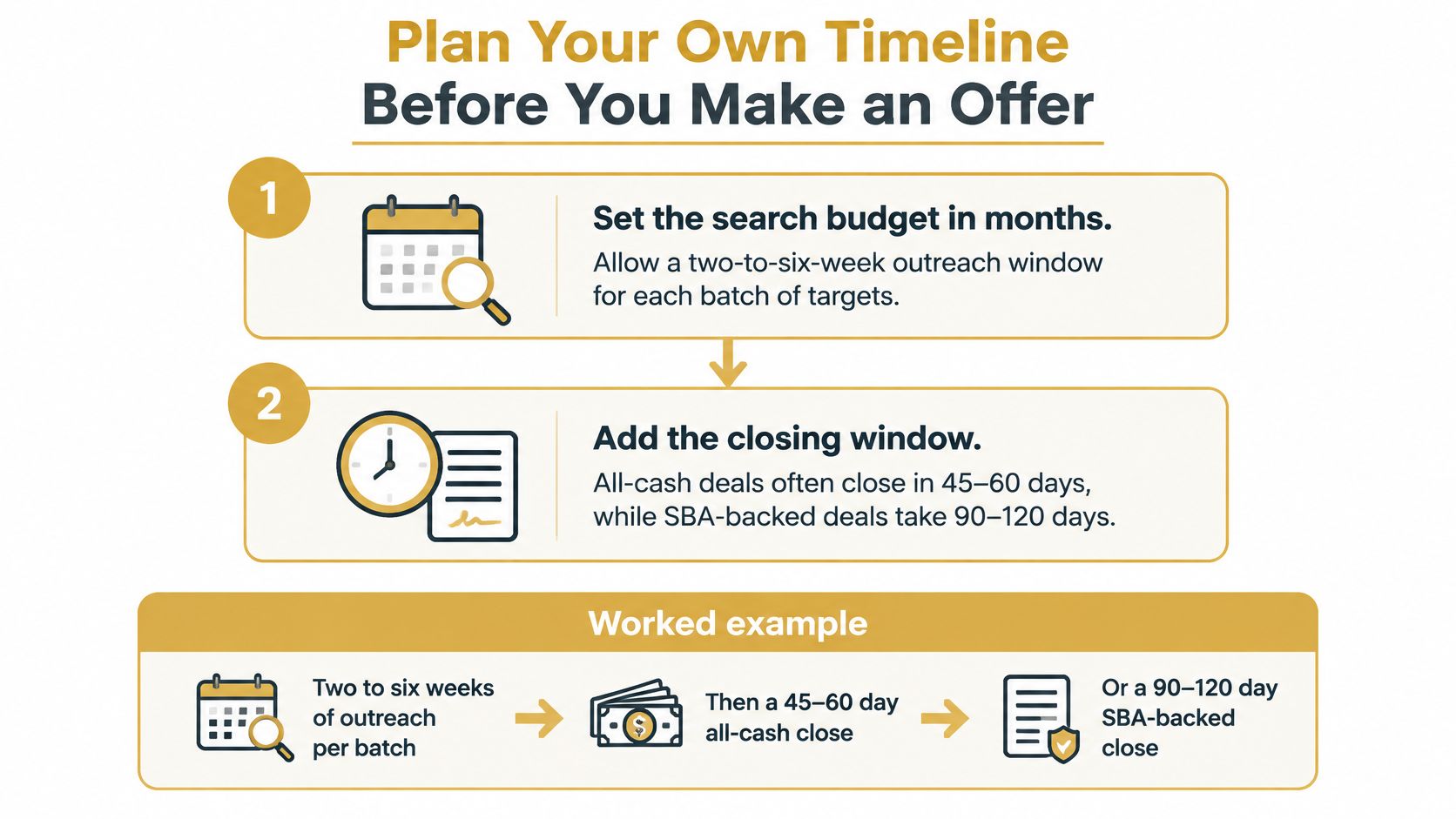
Turn assumptions into a workable calendar
Say your hypothetical search lasts six months and you then budget another four months for financed execution. Your personal planning horizon is approximately ten months, before any contingency for an unsuccessful deal. That's an illustrative budget, not a market prediction.
If diligence reveals an unacceptable business, ending the transaction can be the correct outcome even though the search restarts. Measure progress by the quality of your decisions as well as proximity to closing.
Before contacting an owner, put your start date, search budget, funding assumptions, and exit criteria on one page. That gives you a baseline you can revise deliberately rather than a deadline you keep missing.
Our 10-Day Business Buying Launch is the first step for newcomers to the business-buying journey, and all our top dealmakers started with it. Visit Dealmaker Wealth Society to explore the training, mentorship, and peer support available as you turn your acquisition criteria into a practical search and closing plan.

From the Dealmaker Blog













A Creative Business Buying Fable